Mapping Objects to External DBMSs
There are many decisions to be made when mapping objects to external(non-object) DBMS products. The mapping capabilities of the object storage products factor into these decisions. The tables in this section cover mapping direction, mapping generation, SQL support, and the details about table-to-class mappings and class-to-table mappings. The data here is critical to your decisions about accessing external (or legacy) data and bringing it into an object environment.
Mapping Direction: Database Table or Object Language Class or Type
Generation
This table describes the derivation of the database schema and application’s object model.
Application class or type definitions generated from the definition in the DBMS or the Data Definition Language
forward engineering: the DBMS database schema (tables) is generated from an existing object model.
reverse engineering: the programming language object model is generated from an existing DBMS schema
an existing object model is mapped to an existing DBMS schema − generation does not occur in either direction
an existing object model is mapped to an existing DBMS schema −
generation can occur in either direction
Mapping Generation
This table describes the creation and location of the database schema to application object model mapping.
mapping is defined using a text description mapping is defined using a form-based interface mapping is defined using a graphical / drag-and-drop interface mapping is automatically generated from DBMS schema or class definitions mapping is generated manually mapping exists as generated code incorporated (compiled or interpreted) as part of application. mapping exists as dynamic meta-data stored in files or the database
SQL Generation and Support
This table describes the SQL generation capabilities
automatically generates SQL for mapped tables dynamic SQL is used precompiled SQL is used generates stored procedures pre-existing stored procedures can be called pre-existing SQL queries (e.g., prepared SQL statements) can be called directly (without developer writing calls) generated SQL is hidden generated SQL is accessible (i.e., can be viewed if necessary)
Object Identifier Mapping
This table describes how object identifiers are mapped to the external DBMS instances.
--- object identifier generation and storage --- --- object identifier / instance mapping ---
object identifiers are
generated, but not stored object identifiers are generated once and the mapping of the object identifier to the external instance is stored in the external database
object identifiers are generated once and the mapping of the object identifier to the external instance is stored outside the external database
a one-to-one relationship exists between each object identifier and the external instance in the external database (fully coherent cache)
more than one object identifier may exist for the same external instance in the external database (this would appear as duplicates of an object)
a brief description of the construction of the object identifier (i.e. a generated number, a concatenation of table name and primary key, etc.)
Literal Attribute Mappings
This table describes how external data source literal data types are mapped to program language types.
database primitive data types map to
default programming language primitives
default mappings of database primitive data types can be overridden by user to map to other programming language primitive data types database primitive data types can be mapped to user defined object classes
database primitive data types can be transformed on read
database primitive data types can be transformed on write
database primitive data types can map to relationships
Multimedia Attribute Mappings
This table shows binary large objects (blobs) in the DBMS map to in the programming language
blobs map to image classes or types blobs map to audio classes or types blobs map to text classes or types blobs map to text classes or types using HTML format blobs map to text classes or types using XML format blobs map to text classes or types using SGML format blobs map to full-motion video classes or types (format indicated) blobs map to other classes or types
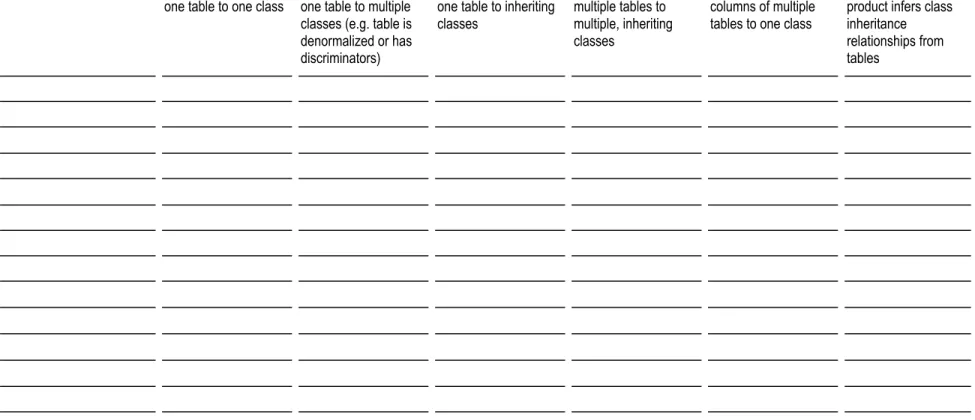
Table to Class Mappings
This table describes the kinds of table to class mappings
one table to one class one table to multiple classes (e.g. table is denormalized or has discriminators)
one table to inheriting classes
multiple tables to multiple, inheriting classes
columns of multiple tables to one class
product infers class inheritance relationships from tables
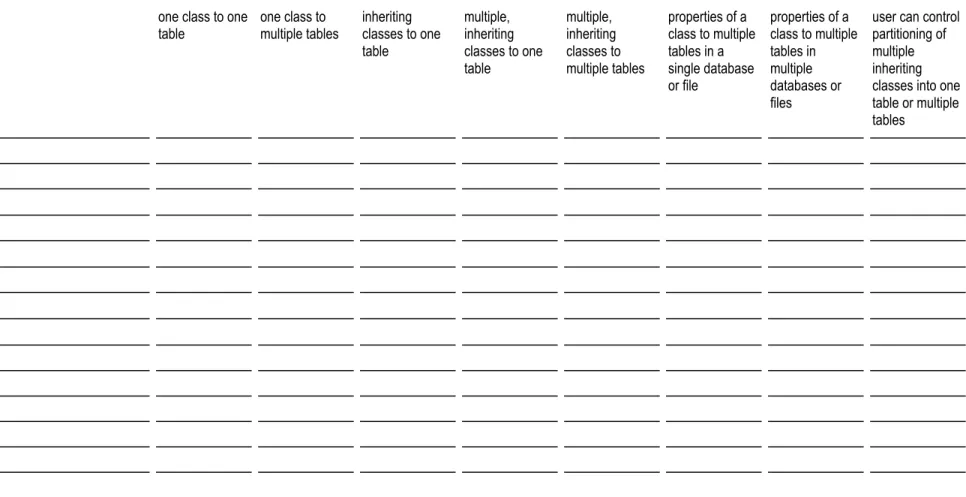
Class to Table Mappings
one class to one
table one class to multiple tables inheriting classes to one table multiple, inheriting classes to one table multiple, inheriting classes to multiple tables properties of a class to multiple tables in a single database or file properties of a class to multiple tables in multiple databases or files
user can control partitioning of multiple inheriting classes into one table or multiple tables
Collection to Table Mappings
This table describes the kinds of collection to table mappings
--- homogeneous collection --- heterogeneous collection to one denormalized table
heterogeneous collection to multiple tables
to one table to multiple tables automatically determined based on discriminator manually automatically determined based on discriminator manually multiple homogeneous collections to one denormalized table
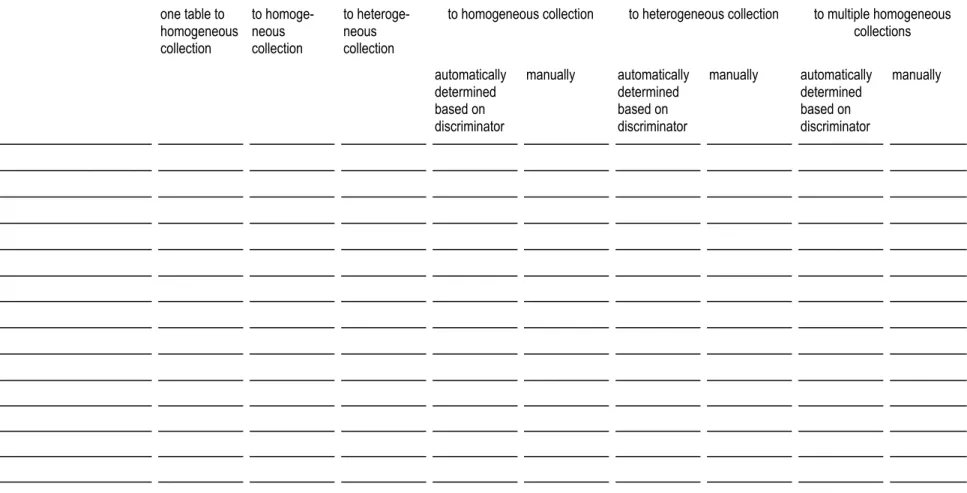
Table to Collection Mappings
This table describes the kinds of table to collection mappings
---multiple tables --- --- denormalized table --- one table to homogeneous collection to homoge-neous collection to heteroge-neous collection
to homogeneous collection to heterogeneous collection to multiple homogeneous collections automatically determined based on discriminator manually automatically determined based on discriminator manually automatically determined based on discriminator manually