President of the Editorial Board Ioan TALPOŞ
Editor-in-Chief Marilen PIRTEA Assistant Editor-in-Chief Carmen BĂBĂIŢĂ
Senior Editor Alexandru JIVAN Editors Costinel DOBRE Doina DĂNĂIAŢĂ
Vasile DOGARU Camelia MARGEA
Language Advisors Monica BOLDEA Anca MAGHEŢIU Bogdan VECHE Iulia PARA
Editorial Secretary Alina ALMĂŞAN Miruna NĂCHESCU
Webmaster Romeo MARGEA
The authors are liable for the content of the texts.
All rights reserved. No part of this publication may be reproduced, stored in a retrieval system or transmitted, in any form or by any means, electronic, mechanical, photocopying, recording or otherwise, without the prior permission of the publisher.
Editorial Board
Robert W. ACKRILL Nottingham Trent University, United Kingdom
Vasile COCRIŞ “Alexandru Ioan Cuza” University, Iaşi, Romania
Maurice CHENEVOY Université d’Auvergne Clermont-1, France
François FULCONIS Université d’Avignon et des Pays de Vaucluse, France
Orio GIARINI L’Istituto del Rischio, Trieste – Milano – Ginevra
Aurel IANCU National Institute of Economic Research, Bucharest, Romania
Vasile IŞAN “Alexandru Ioan Cuza” University, Iaşi, Romania
Nigel HEALEY University of Canterbury, Christchurch, New Zealand
Dinu MARIN Academy of Economic Studies, Bucharest, Romania
Dumitru MATIŞ “Babeş-Bolyai” University, Cluj-Napoca, Romania
Kozo MAYUMI University of Tokushima, Japan
Philippe ROLLET Université des Sciences et Technologies de Lille, France
Mihai ROMAN Academy of Economic Studies, Bucharest, Romania
Guy SOLLE Institut d’Administration Economique de Metz, France
Ion STANCU Academy of Economic Studies, Bucharest, Romania
Content
R A M V H A E l' M S a G A M S P A S S Jo K T N Report on the P Administration Marilen PIRT Vectors of Econ Horia CRISTE Approche de co Economique pe 'entreprise....
Marc GUIRAU Some Aspects and Work Hum Gh.Gh. IONES Adina Letiţia Motivation to L Support in Trai Performance..
Azman ISMAI Sofiah BONGO Sheela Chitra oint of QFD & Kambiz RADM The Western Ec Nicolae ŢĂRA Participation o n Delegation a TEA nomic Harmon EA onstruction d' ermettant d'é...
UDabout the Rel manization
...
SCU, NEGRUŞA Learn as a Med ining Program...
IL, OGOH, a CHANDRA S & DEA & SupplMAN conomic Rece AN of the Faculty at the Annual E ny
...
'une base de d évaluer les opp...
lationship betw...
diator of the R s, Transfer of...
SEGARAN ly Chain...
ession – Cause of Economics EDUNIVERSAL...
donnée en Int portunités d'a...
tween Product...
Relationship b Competency a...
...
es and Conseq and Business L Convention.
...
telligence affaire dans...
tivity...
between Super and Job...
...
quences...
s...
222
...
225
...
235
...
241
rvisor...
257
...
27
1
...
279 221Key words: Supervisor Support; Motivation to Learn; Transfer of Competency; Job Performance.
JEL classification: M53; M54; O15; I29; J28
This study was conducted in oder to measure the effect of the supervisor sup-port and motivation to learn on employee outcomes (i.e., transfer of competency and job performance) using 100 usable ques-tionnaires gathered from technical em-ployees who have worked in one city based local authority in Sarawak, Malaysia (MLAUTHORITY). Outcomes of stepwise regression analysis showed the relationship between motivation to learn and supervisor support had been an important predictor of transfer of competency and job perfor-mance. Further, this result confirms that motivation to learn does act as a full me-diating role in the training model of the stu-died organization. In addition, implications and limitations of the study, as well as di-rections for future research are discussed
1
*,**,*** Faculty of Cognitive Sciences and Human Development. Universiti Malaysia Sarawak
MOTIVATION TO LEARN
AS A MEDIATOR
OF THE RELATIONSHIP
BETWEEN
SUPERVISOR SUPPORT
IN TRAINING PROGRAMS,
TRANSFER
OF COMPETENCY
AND JOB PERFORMANCE
Azman ISMAIL *Sofiah BONGOGOH **
Sheela Chitra CHANDRA SEGARAN ***
INTRODUCTION
A supervisor is often viewed as an experienced leader, a problem solver and a role model at the first level of or-ganizational management (Elangovan & Karakowsky, 1999; Ellinger, Ellinger & Keller, 2005). They often work together with their employers to design, imple-ment and monitor the organizational policies and functions, including train-ing programs (Comstock, 1994; Robbins & DeCenzo, 2004). The training program is a strategic function of human capital management where it focuses on devel-oping employees’ competencies to over-come daily problems that may lead to support the development and growth of
an organization in the future
(DeSimone, Warner & Harris, 2002; Mac-Neil, 2004). In the traditional manage-ment perspective, the supervisors are given much responsibility by an em-ployer to identify daily, routine and short-term employee deficiencies, as well as to report such deficiencies to the top management. The top management will identify the training requirements to overcome such employee deficiencies (Noe, 2007; Rodrígues & Gregory, 2005). Many scholars think that this approach is appropriately practiced in organiza-tions that have no strategic missions and operated in a stable marketplace envi-ronment (Noe, Hollenbeck, Gerhart & Wright, 2004; Robbins & Coultar, 2005).
In the era of global competition, many organizations have shifted their
Azman ISMAIL, Sofiah BONGOGOH, Sheela Chitra CHANDRA SEGARAN paradigms from traditional job based
training to organizational business stra-tegies and cultures (Blanchard & Thacker, 2007; Ellinger et al., 2005). Un-der this approach, the supervisors are empowered by employers to effectively design and administer training pro-grams to develop useful competencies for future organizational development.
In the design of training programs, supervisors often work together with the management team and employees in establishing objectives, selecting suitable trainers, developing lesson plans, selecting program methods and techniques, preparing materials, sche-duling the program, as well as con-ducting training needs’ analysis (Gold-stein & Ford, 2002; Golemen, 2000; Nij-man, 2004). In the administration of training programs, supervisors are usually referred to the management team and experienced employees to en-sure that the implementation of train-ing activities achieve the objectives
(DeSimone et al., 2002; Elangovan &
Ka-rakowsky, 1999; Noe et al., 2004). For
example, the role of supervisors in ad-ministering training programs does not only provide financial and physical fa-cility supports, but they also have the capabilities to establish realistic learn-ing expectations, encourage positive reinforcements, create a positive impe-tus for the training program, make em-ployees feel comfortable to attend training, and increase employees’ com-petencies and performance (Blanchard & Thacker, 2007; Brinkerhoff & Monte-sino, 1995; Colquitt, LePine, & Noe 2000).
SUPERVISOR SUPPORT
IN TRAINING PROGRAMS
The supervisor’s support is a criti-cal organizational climate factor that may motivate or demotivate employees to enter and participate in training
pro-grams (Noe & Wilk, 1993; Quiñones, 1997). Support is often viewed as a su-pervisor who encourages trainees to at-tend training programs, helps em-ployees before, during and after the training programs in terms of time, budgetary support and resources; in-volves employees in decision-making; and guides trainees in applying compe-tencies that they learnt in the workplace (DeSimone et. al., 2002; Elan-govan & Karakowsky, 1999; Nijman, 2004). Many scholars advocate that the ability of a supervisor to properly pro-vide support in training programs may increase positive individual attitudes and behaviors, especially transfer of competency (Axtell, Maitlis & Yeartha, 1997; Cheng, 2000; Foxon, 1993) and job performance (Chiaburu & Takleab, 2005; Ford, Quinines, Sego & Sorra, 1992; Tsai & Tai, 2003). Transfer of competency is often defined as trainees who effec-tively applied the knowledge, skills and abilities that they gained from a train-ing program to the job environment (e.g., positive behavioral changes and performing job better) (Baldwin & Ford, 1988; Gradous, 1991). Job per-formance is viewed as a function of the capacity to perform, the opportunity to perform, and the willingness to per-form. The capacity to perform relates to the extent to which an employee pos-sesses task-relevant skills, abilities, knowledge, and experiences. The op-portunity to perform is viewed as a critical element in the performance process. The willingness to perform is referred to as the degree to which indi-vidual employees desire and will to put high effort in order to meet their job performance requirements (Eysenck, 1998; Ford et al., 1992). Thus, the com-bination of those elements may lead to a high employee performance
MOTIVATION TO LEARN AS A MEDIATOR OF THE RELATIONSHIP BETWEEN SUPERVISOR SUPPORT IN TRAINING PROGRAMS,
TRANSFER OF COMPETENCY AND JOB PERFORMANCE
berg & Pringle, 1982; Bohlander, Snell & Sherman, 2001).
Surprisingly, a thorough review of such relationships reveals that the ef-fect of the supervisor’s support on vidual attitudes and behaviors is indi-rectly influenced by the motivation to learn (Axtell et al., 1997; Facteau, Dob-bins, Russell, Ladd & Kudisch, 1995; Tsai & Tai, 2003). Motivation is often viewed as “variability in behavior not attributable to stable individual differ-ences (e.g. cognitive ability) or strong situational coercion” (Quiñones, 1997: 182-3), which means an individual who willing to expend efforts toward a par-ticular set of behavior. In a training man-agement context, motivation to learn is defined as an employee’s willingness to follow, getting involved and committed to learning activities in order to achieve particular objectives (Maurer & Tarulli, 1994; Noe & Wilk, 1993; Quiñones, 1997), to exert energy toward develop-ment activities (Guerrero & Sire, 2001; Mathieu, Tannenbaum & Salas, 1992), transfer what they learn in the program onto the job (Baldwin & Ford, 1988; Facteau et al., 1995). Many scholars be-lieve that the ability of a supervisor to provide adequate support in training programs will increase individuals’ mo-tivation to learn new knowledge, up to date skills and good moral values, this may lead to increased transfer of
compe-tency (Ismail, Bongogoh & Ayyup,
2007a) and job performance (Ismail, Chandra Segaran, Cheekiong & Guat-leng, 2007b). The nature of this rela-tionship is interesting, but little is known about the mediating role of mo-tivation to learn in training manage-ment literature (Foxon, 1993; Noe & Wilk, 1993; Tsai, 2006). Thus, it moti-vates the researchers to examine the mediating effect of motivation to learn in the relationship between supervisor
support in training programs and indi-vidual attitudes and behaviours that oc-cur in MLAUTHORITY. For confidential reasons, the name of this organization is kept anonymous.
LITERATURE REVIEW
Context of the Study
Many researchers argue that socio-cultural differentiations are among the important factors that affect the train-ing program management in
organiza-tions (Desimone et al., 2002; Goldstein
& Ford, 2002). For example, one dimen-sion of culture that can have implica-tions for attitudes to training programs is the concept of collectivism and indi-vidualism. Collectivism is perceived as the norm and standard that practice large power distance (e.g., more hierar-chical structure and centralized deci-sion making) and emphasizes more on group interests, co-operation, loyalty and harmony. Individualism is a term used to describe the value and standard that practice low power distance (e.g., less hierarchy and decentralized deci-sion making) and focus more on indi-vidual achievement (Hofstede, 1991; Redding & Wong, 1993).
The literature suggests that Malay-sians tend to reflect collectivism culture and this can be traced in the website of the Public Service Department (PSD). For example, the government of Malay-sia has established a National Institute of Public Administration (INTAN) as a human capital development centre to design and implement the various types of training programs for government departments in this country, as well as conduct certain international courses. Participants who attended the training programs are people from the top, mid-dle and low management levels who work in the federal government
Azman ISMAIL, Sofiah BONGOGOH, Sheela Chitra CHANDRA SEGARAN
cies, state government agencies and lo-cal authorities. The primary objective of a training program is to prepare public administration to support the changes of national development, vision, mis-sion and goals (Mat, 1988; Siew Nooi, 1988; INTAN, 2007). In order to im-prove customers’ needs at the funda-mental level, INTAN first established a Center for Urban and Environmental Management in September 2000. This center was restructured to become the Local Government and District Man-agement in January 2004. Its main func-tion is to improve the capacity and ca-pability of local authorities in providing services and managing resources, for-mulate positive changes in developing and managing local government and to meet customers’ needs (INTAN, 2007).
The nature of Malaysian public sec-tor has affected the administration of training programs in Malaysian local government. It consists of three types of local authorities: city hall, municipality council and district council. These au-thorities are responsible to the Ministry of Local Government and Housing. These authorities rely very much on traditional incomes from the taxes be-sides the federal government fund to sponsor rural and urban development projects (Jabatan Kerajaan Tempatan Malaysia, 2007). Due to the many com-mitments, these authorities do not have adequate budget for training programs. This situation encourages the manage-ment to send their staff (e.g., supervi-sor) to attend management and skills based training programs offered by professional training providers and/or INTAN. Upon returning from such training programs, they are required to conduct formal and/or informal train-ing (e.g., coachtrain-ing and mentortrain-ing) for their own staff. This approach is often practiced to create positive learning
culture that may lead to increased em-ployees’ competencies and performance.
Specifically, in the studied organiza-tion, all technical employees are en-titled to attend training programs spon-sored by the organization. In managing training programs, supervisors have provided technical supports (e.g., bud-getary, materials, facilities) and non-technical supports (e.g., encourage-ment, and practicing good interaction) before, during and/or after attending training programs. These practices have been used to increase employees’ motivation to learn new knowledge, skills and attitudes in training pro-grams. The ability of employees to un-derstand what they learn in such training programs may help employees to improve their competencies and job performance in the workplace. A tho-rough investigation of the interview re-sults showed that the motivation to learn has indirectly influenced the ef-fect of the supervisor’s support on job satisfaction and job performance in the organization. For example, the ability of supervisors to provide material and moral supports have increased em-ployees’ motivation to learn, which in turn, led to increased transfer of com-petency and job performance in the workplace. Although numerous studies have been done, the mediating of effect of motivation to learn in the training program model of the organization is
less emphasized (Ismail et al., 2007a;
Ismail et al., 2007b). Therefore, explora-tion of this issue is imperative.
The Relationship between
the Supervisor’s Role, Motivation
to Learn, Transfer of Competency
and Job Performance
The mediating role of the motiva-tion to learn in the training programs of MLAUTHORITY is consistent with the
MOTIVATION TO LEARN AS A MEDIATOR OF THE RELATIONSHIP BETWEEN SUPERVISOR SUPPORT IN TRAINING PROGRAMS,
TRANSFER OF COMPETENCY AND JOB PERFORMANCE
training research literature, mostly published in Western countries. For ex-ample, Axtell, Maitlis and Yearta (1997) examined the training transfer based on a sample of 45 trainees in UK organiza-tions and found that motivation to learn acquired knowledge and skills had in-creased longer trainees’ transfer of competency and performance in the workplace. Further, Tai (2006) con-ducted a study about training programs based on a sample of 126 employees in Northern Taiwan. This study found that the willingness of a supervisor to pro-vide well-design training frames to em-ployees had invoked their motivation to learn new knowledge, skills and posi-tive attitudes in training programs. As a result, it could to increase training ef-fectiveness, such as transfer of compe-tency and job performance.
These findings support the notions of motivation to learn theories, namely Bandura’s (1986, 1997) social learning theory and Adams’ (1963, 1965) equity theory. According to Bandura (1986, 1997), an individual often learns by ob-serving other persons (models) whom he/she believes are credible and knowledgeable will strongly invoke his/her motivation to learn acquired knowledge, skills and positive attitudes. As described in a need based motiva-tion theory, when an individual has high level of self-efficacy (i.e., belief to his/her capability to organize and per-form general and specific tasks in order to achieve particular aims), this may
lead to increased training effectiveness, such as transfer of competency and job
performance (Cheng, 2000; Judge &
Bono, 2001; Hysong & Quiñones, 1997;
Stajkovic & Luthans, 1998) Besides that, Adams (1963, 1965) explicitly states that unfair or fair treatment styles have a significant impact on an individual’s attitude and behavior. Application of this theory in training management shows employees who had received fair support (i.e., clarification, encourage-ment, budget and facilities) from their supervisors while applying and at-tending training programs will invoke motivation to learn, this may lead to in-creased training effectiveness, such as
transfer of competency (DeSimone et.
al., 2002; Goldstein & Ford, 2002; Yam-nill & McLean, 2001) and job perfor-mance (Chiaburu & Takleab, 2005;
De-Simone et al., 2003). The literature has
been used as a foundation for establish-ing a conceptual framework for this study as shown in Figure 1.
Based on the evidence, it seems reasonable to assume that the supervi-sor support will affect MLAUTHORITY employees’ motivation to learn and that may increase their competencies and performance as this motivation does affect Western and other Asian emplo-yees. Thus, motivation to learn theories further suggest that if MLAUTHORITY employees perceive that their supervi-sors provide good support in training programs, this will invoke employees’ motivation to learn. Thus, it may lead to
Figure 1. Motivation to Learn Mediates the Relationship between Supervisor Support in Training Programs, Transfer of Competency and Job Performance
Azman ISMAIL, Sofiah BONGOGOH, Sheela Chitra CHANDRA SEGARAN
an increased transfer of competency and job performance. Therefore, it is hypothesized that:
H1: The motivation to learn positively mediates the effect of supervisor support on transfer of competency.
H2: The motivation to learn positively mediates the effect of supervisor support on job performance.
METHODOLOGY
This study used a cross-sectional research design that allows the re-searchers to integrate training man-agement literature, the in-depth inter-view, the pilot study and the actual sur-vey as a main procedure to gather data. The use of such methods may gather accurate and less biased data (Cress-well, 1998; Sekaran, 2000). At the initial stage of this study, in-depth interviews were conducted involving six expe-rienced technical employees, namely an experienced technician, an assistant Human Resource Manager, a Head of the Training Unit, a supervisor and two senior officers of the Technical Depart-ment. The information gathered from the interviews was used to develop the content of a pilot survey questionnaire. Next, a pilot study was done by dis-cussing the survey questionnaires with the above participants. Their feedback was used to verify the content and for-mat of survey questionnaires for the ac-tual study.
The survey questionnaire was used as the main instrument. It consisted of 5 sections. Firstly, supervisor support was measured using 6 items and it was modified from training research litera-ture (Chiaburu & Takleab, 2005; Tsai & Tai, 2003). Secondly, motivation to learn was measured using 7 items and it was modified from training program literature (Noe & Wilk, 1993; Tsai & Tai, 2003; Rodríguez & Gregory, 2005; Foxon,
1993). Fourthly, transfer of competency was measured using 4 items that were also modified from transfer of training literature (Axtell et al., 1997; Rodríguez & Gregory, 2005; Tsai & Tai, 2003). Fi-nally, job performance was measured using 5 items that were modified from job performance literature (Hvang, Hvang, & Chen, 2004; Lawler & Hall, 1970). All items used in the question-naires were measured using a 7-item scale ranging from “strongly disagree” (1) to “strongly agree” (7). Demographic variables were used as a controlling va-riable because this study also focused on employees’ attitudes. The back trans-lation technique was used to translate the survey questionnaires in Malay and English; this may help to increase the validity and reliability of the instrument (Van Maanen, 1983; Wright, 1996).
The targeted population of this study was technical employees of the MLAUTHORITY. In a data collection, HR manager did not provide the list of reg-istered employees and did not allow the researchers to distribute survey ques-tionnaires to technical employees who work in the Technical Department of the studied organization. Considering the constraints of organizational rule, a convenience sampling technique was used to distribute 150 questionnaires to technical employees through contact persons (e.g., secretary of department heads, assistant HR managers, supervi-sors and/or HR managers). Of the num-ber, 100 usable questionnaires were turned to the researchers, yielding a re-sponse rate of 67 percent. The survey questionnaires were answered by par-ticipants based on their consents and voluntary basis. The number of survey participants exceeds the minimum sample of 30 respondents as required by probability sampling technique. Thus, the data collected can be analyzed
MOTIVATION TO LEARN AS A MEDIATOR OF THE RELATIONSHIP BETWEEN SUPERVISOR SUPPORT IN TRAINING PROGRAMS,
TRANSFER OF COMPETENCY AND JOB PERFORMANCE
using inferential statistics (Leedy & Ormrod, 2005; Sekaran, 2000).
RESULTS AND DISCUSSION
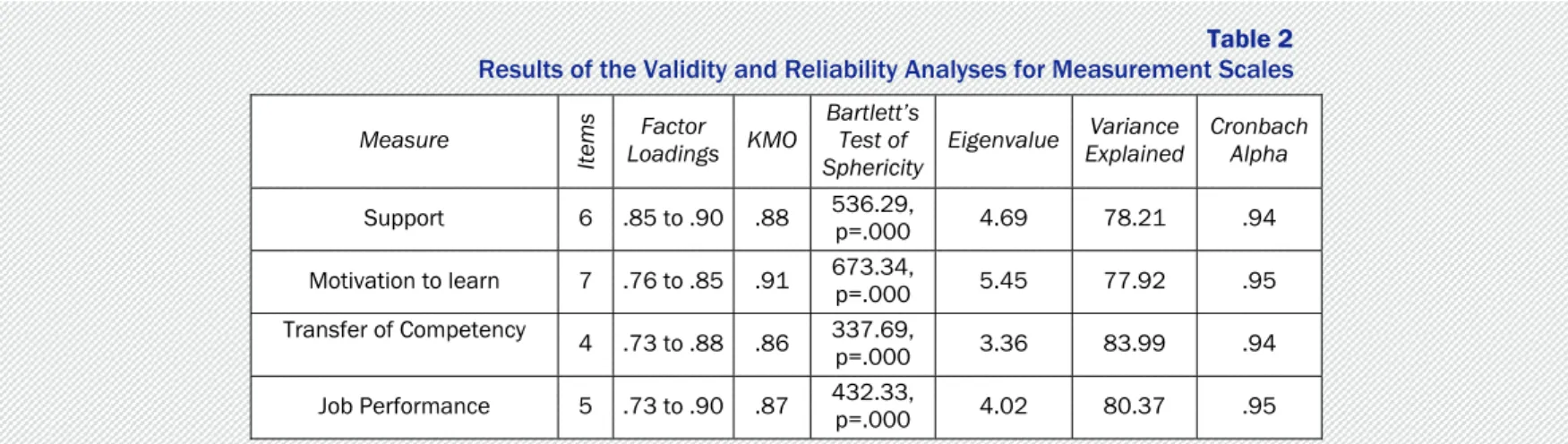
In terms of sample profile, Table 1 shows the majority respondent charac-teristics were male (92 percent), age between 30 to 39 years old (47 per-cent), technicians who held Malaysian Certificate of Education (45 percent), technicians who worked less than 5 years (33 percent) and group leader and supervisor positions (39 percent). Table 2 shows the results of validity and reliability analysis for measurement scales. The factor analysis with direct oblimin rotation was done for four variables with 22 items. Next, the Kaiser-Mayer-Olkin Test (KMO), which
is a measure of sampling adequacy, was conducted for each variable and the re-sults indicated that it was acceptable. Specifically, the results of these statis-tical analyses showed that (1) all re-search variables exceeded the mini-mum standard of Kaiser-Meyer-Olkin’s value of 0.6, were significant in Bar-tlett’s test of sphericity, (2) all research variables had eigenvalues larger than 1, (3) the items for each research variable exceeded factor loadings of 0.40 (Hair, Anderson, Tatham & Black, 1998), and (4) all research variables exceeded the acceptable standard of reliability analy-sis of 0.70 (Nunally & Bernstein, 1994). These statistical results confirmed the validity and reliability of measurement scales used for this study.
Table 1 Respondent Characteristics (N=100)
Gender (%) Age (%) Education (%) Length of Service (%) Position (%)
Male =92 Female= 8 20-29 = 27 30-39 = 47 40-49 = 22 >49 = 4 Degree = 9 Diploma/STPM=20 MCE/SPM = 45 LCE/SRP/PMR = 12 Others = 14 1-5 years = 33 6-10 years = 20 11-15 years = 20 16-20 years = 25 > 20 years = 2 Engineer/Planner = 7 Leader/Supervisor = 39 Technician = 21 Landscape/maintenance = 3 Architect = 7 Others = 23
Note: SRP/LCE/PMR: Sijil Rendah Pelajaran/Lower Certificate of Education/Penilaian Menengah Rendah SPM/MCE: Sijil Pelajaran Malaysia/ Malaysia Certificate of Education
STPM: Sijil Tinggi Pelajaran Malaysia
Table 2 Results of the Validity and Reliability Analyses for Measurement Scales Measure Items Factor Loadings KMO Bartlett’s Test of Sphericity Eigenvalue Variance Explained Cronbach Alpha Support 6 .85 to .90 .88 536.29, p=.000 4.69 78.21 .94 Motivation to learn 7 .76 to .85 .91 673.34, p=.000 5.45 77.92 .95 Transfer of Competency 4 .73 to .88 .86 337.69, p=.000 3.36 83.99 .94 Job Performance 5 .73 to .90 .87 432.33, p=.000 4.02 80.37 .95 263
Azman ISMAIL, Sofiah BONGOGOH, Sheela Chitra CHANDRA SEGARAN
Table 3 shows the results of Pear-son’s correlation analysis and descrip-tive statistics. The means for the va-riables are from 5.5 to 6.2, signifying that the levels of supervisor’s support, motivation to learn, transfer of compe-tency and job performance ranging from high (4) to highest level (7). The correlation coefficients for the relation-ship between the independent variable (i.e., supervisor support) and the me-diating variable (motivation to learn) and the dependent variable (transfer of competency and job performance) were less than 0.90, indicating that the data were not affected by serious colinearity
problem (Hair et al., 1998). The
mea-surement scales that had validity and reliability were used to test research hypothesis. Pearson correlation analy-sis was unable to determine the me-diating role of motivation to learn in the hypothesized model. Stepwise regres-sion analysis was undertaken to test the mediating hypothesis because it can as-sess the magnitude of each independent variable, and vary the mediating varia-ble in the relationship between many independent variables and one depen-dent variable (Baron & Kenny, 1986; Foster, Stine & Waterman, 1998). Ac-cording to Baron and Kenny (1986), the mediating variable can be considered when it meets three conditions: first, the predictor variables are significantly correlated with the hypothesized
diator. Second, the predictor and me-diator variables are all significantly cor-related with the dependent variable. Third, a previously significant effect of predictor variables is reduced to non-significance or reduced in terms of ef-fect size after the inclusion of mediator variables into the analysis (Wong, Hui & Law, 1995). In this regression analysis, standardized coefficients (standardized beta) were used for all analyses (Jac-card, Turrisi & Wan, 1990). The results of testing H1 and H2 were shown in Table 4.
Table 4 shows the outcomes of testing hypotheses in Step 3. Firstly, relationship between motivation to learn and supervisor support positively and significantly correlated with trans-fer of competency (ß=.66, p<0.001), therefore H1 was supported. Before the inclusion of motivation to learn into Step 2, supervisor support significantly correlated with transfer of competency (ß=.36, p<0.001). In terms of explana-tory power, the inclusion of motivation to learn in Step 3 had explained 18 per-cent o the variance in the dependent variable. As shown in step 3, (after the inclusion of motivation to learn into this step), the previous significant relation-ship between supervisor support did not change to non significant (step3: ß=-.17, p<0.05), but the strength of such relationships was decreased. In terms of explanatory power, the
inclu-Table 3 Pearson Correlation Analysis and Descriptive Statistics
Variable Mean Standard
Deviation
Pearson Correlation Analysis
1 2 3 4 5
1. Supervisor Support 5.6 .90 1
2. Motivation o Learn 6.1 .73 .25* .39** 1 .72** 3.Transfer of Competency 6.0 .76 .33** .40** .72** 1 .66** 4. Job Performance 6.2 .71 .11 .31** .64** .66** 1 Note: Significant at levels *0.05;** 0.01; ***0.001
MOTIVATION TO LEARN AS A MEDIATOR OF THE RELATIONSHIP BETWEEN SUPERVISOR SUPPORT IN TRAINING PROGRAMS,
TRANSFER OF COMPETENCY AND JOB PERFORMANCE
sion of motivation to learn in Step 3 had explained 56 percent of the variance in the dependent variable. These results demonstrate that motivation to learn does act as a mediating variable in the relationship between supervisor’s role and transfer of competency in the stu-died organization.
Secondly, the relationship between motivation to learn and supervisor support positively and significantly cor-related with job performance (ß=.65, p<0.001). Before the inclusion of moti-vation to learn into Step 2, supervisor support is not significantly correlated with job performance (ß=-.13, p>0.05). In terms of explanatory power, the in-clusion of supervisor support in Step 3 had explained 5 percent of the variance in the dependent variable. As shown in step 3, (after the inclusion of motivation to learn into this step), the previous non significant relationship between super-visor support and job performance did not change to significant (step 3: ß=-.05,
p>0.05). In terms of explanatory power, the inclusion of motivation to learn in Step 3 had explained 42 percent of the variance in the dependent variable. These results demonstrate that motition to learn does act as a mediating va-riable in the relationship between su-pervisor support and job performance in the studied organization.
The findings of this study confirm that supervisor’s support indirectly af-fects job performance via motivation to learn. In the studied organization, su-pervisors have provided adequate sup-ports (e.g., encourage employees to at-tend training programs and apply newly knowledge and skills that they gain from training programs) and used good communication practices (e.g., provide feedback, encourage discussion and openly deliver information on training) when dealing with training programs. The majority of the em-ployees perceive that such supervisors’ support had increased their motivation
Table 4 Result for Stepwise Regression Analysis
Variable Transfer of Competency Job Performance
Step 1 Step 2 Step 3 Step 1 Step 2 Step 3
Controlling Variable Gender .05 .04 -.01 .08 .07 .02 Age .11 .09 .03 .10 .10 .04 Education .05 -.03 .01 -.06 -.09 -.06 Service -.14 -.13 -.07 -.07 -.07 -.01 Training .12 .15 .04 .10 .11 .01 Learning .03 .05 -.00 -.06 -.05 -.11 Position -.19 -.15 -.11 -.03 -.01 .03 Independent Variable Support .36*** .17* .13 -.05 Mediating Variable Motivation to Learn .66*** .65*** R Square .06 .18 .56 .03 .05 .42 Adjusted R Square -.01 .11 .52 -.04 -.04 .36 R Square Change .06 .12 .38 .03 .02 .37 F .85 2.48* 12.80*** .41 .56 7.18*** F Change .85 13.12*** 78.39*** .41 1.58 57.41*** Note: Significant at levels *0.05;** 0.01; ***0.001
Azman ISMAIL, Sofiah BONGOGOH, Sheela Chitra CHANDRA SEGARAN
to learn. When employees’ motivation to learn have increased this may lead to higher job performance in the MLAUTHORITY sample.
IMPLICATIONS, LIMITATIONS
AND DIRECTIONS
FOR FUTURE RESEARCH
This study provides significant im-pacts on three major aspects: theoreti-cal contribution, robustness of research methodology, and contribution to the Human Resource Practitioners. In term of theoretical contribution, the findings of this study confirm that motivation to learn does act as a full mediating varia-ble in the relationship between super-visor support and employee outcomes (i.e., transfer of competency and job performance) in the organizational sample. This outcome is consistent with studies by Adams (1963, 1965), Ban-dura (1986, 1977), Tai (2006), Ismail, Bongogoh and Ayyup (2007a), and Is-mail, Chandra Segaran, Cheekiong and Guatleng (2007b). These findings have supported and broadened the training research literature mostly published in Western and other Asian countries. Thus, the notion of motivation to learn has been successfully applied within the training management models of the or-ganizational sample. With respect to the robustness of research methodology, the data gathered using training man-agement literature, the in-depth inter-views, pilot study and survey question-naires have exceeded an acceptable standard of validity and reliability anal-ysis, thus leading to the production of accurate findings.
Regarding practical contributions, the findings of this study can be used as a guideline by the management to up-grade the effectiveness of training pro-grams in their organizations. This ob-jective may be achieved if the
manage-ment consider these suggestions: firstly, the supervisor’s support can be shar-pened if they are properly trained with up to date knowledge and skills in the training needs analysis, interpersonal communication, managing employee, change and conflict management. Se-condly, supervisor’s support can be meaningful if they are involved in orga-nisational training committees. This will give them the opportunity to pro-vide practical experiences for estab-lishing the vision, mission, objectives and appropriate modules for training programs. Thirdly, supervisors may ef-fectively motivate employees to attend and apply competencies that they learn from informal and formal training pro-grams if top management hires em-ployees that have appropriate qualifica-tions and skills. Finally, supervisors can be motivated to increase their efforts in monitoring the development of em-ployees’ competencies if they are pro-vided with better monetary incentives. These factors may positively motivate supervisors to support organisational and departmental training strategies and goals.
The conclusion drawn from the re-sults of this study should consider the following limitations. Firstly, the data was only taken one time during the du-ration of this study. Therefore, it did not capture the developmental issues such as intra-individual change and restric-tions of making inference to partici-pants and/or causal connections be-tween variables of interest. Secondly, this study only examines the relation-ship between latent variables and the conclusion drawn from this study does not specify the relationship between specific indicators for the dependent variable, mediating variable and de-pendent variable. Thirdly, this study only focused on particular elements of a
MOTIVATION TO LEARN AS A MEDIATOR OF THE RELATIONSHIP BETWEEN SUPERVISOR SUPPORT IN TRAINING PROGRAMS,
TRANSFER OF COMPETENCY AND JOB PERFORMANCE
supervisor’s support and neglected other important factors (e.g., em-ployee’s readiness, leadership styles of the supervisor and supervisors training framing). Fourthly, other training out-comes (e.g., job performance, job com-mitment, and job turnover) that are significant for organizations and em-ployees are not discussed in this study. Fifthly, although a substantial amount of variance in dependent measures ex-plained by the significant predictors is identified, there are still a number of unexplainable factors that can be incor-porated to identify the causal relation-ship among variables and their relative explanatory power (Tabachnick & Fi-dell, 2001). Finally, the sample for this study was taken only from one depart-ment of the studied organization that allowed the researchers to gather data via survey questionnaires. These limita-tions may decrease the ability of gene-ralizing the results of this study to other organizational settings.
The conceptual and methodology limitations of this study need to be con-sidered when designing future re-search. Firstly, the organizational and personal characteristics as a potential variable that can influence the effec-tiveness of employees’ training needs to be further explored. If organizational (e.g., division and ownership) and per-sonal characteristics (e.g., gender, length of service, education level and position) are used in research, this may provide meaningful perspectives for understanding the individual differ-ences and similarities that affect train-ing outcomes. Secondly, the weaknesses of cross-sectional research design may be overcome if longitudinal studies are used to collect data and describe the patterns of change and the direction and magnitude of causal relationships
between variables of interest. Thirdly, the findings of this study may produce different results if this study is done in several organizational sectors (e.g., multinational and local companies). Fourthly, as an extension of the motiva-tion to learn, other theoretical con-structs of organizational climate (e.g., transfer of training, training policy and procedures, facilities, budget and em-ployee readiness) need to be consi-dered because they have been widely recognized as an important link be-tween supervisor support and training outcomes (Goldstein & Gilliam, 1990; Ismail et al., 2007a; Ismail et al., 2007b;
Noe et al., 2007). The importance of
these issues needs to be further ex-plained in future research.
CONCLUSION
This study confirms that motivation to learn does act as a full mediating role in the relationship between supervi-sor’s support and individual attitudes and behaviors. This result relied on and extended the training research litera-ture, mostly published in Western countries. Therefore, current research and practices within training manage-ment models need to consider the mo-tivation to learn as a crucial aspect of organisational training system where increasing individuals’ motivation to learn may strongly induce positive sub-sequent personal outcomes (e.g., com-petency, performance, satisfaction, commitment, trust, and positive moral values). Thus, these positive outcomes may motivate employees to sustain and support organisational strategy and goals.
Azman ISMAIL, Sofiah BONGOGOH, Sheela Chitra CHANDRA SEGARAN
REFERENCES
1. Adams, J.S. (1963). Towards an understanding of inequity, Journal of Abnormal and Social Psychology, 67, 422-436.
2. Adams, J.S. (1965). Inequity in social exchange, In L. Berkowitz, Advances in Experimental Social Psychology, 2, 267-299.
3. Adair, J. (1988). The effective supervisor. The Industrial Society: London.
4. Axtell, C.M., Maitlis, S., & Yearta, S.K. (1997). Predicting immediate and longer-term transfer of training. Personnel Review, 26 (3), 201-213.
5. Baldwin, T. T., & Ford, J. K. (1988). Transfer of training: A review and directions for future research. Personnel Psychology, 41, 63–105
6. Bandura, A. (1986). Social foundations of thought and action. New Jersey: Prentice-Hall, Englewood Cliffs.
7. Bandura, A. (1997). Self-efficacy: The exercise of control. New York: Freeman.
8. Baron, R.M., & Kenny, D.A. (1986). This moderator-mediator variable distinction in social psychological research: Conceptual, strategic, and statistical considerations, Journal of Personality and Social Psychology, 51 (6), 1173-1182.
9. Blanchard, N.P., & Thacker, J. (2007). Effective training: Systems, strategies, and practices. New Jersey: Prentice Hall.
10. Blumberg,M., & Pringle, C.D. (1982). The missing opportunity in organizational research: Some implications for a theory of work performance. Academy of Management Review, 7, 560–569.
11. Bohlander, G., Snell, S., & Sherman, A. (2001). Managing human resources. Australia: South-Western College Publishing.
12. Brinkerhoff, R.O. & Montesino, M.U. (1995). Partnerships for training transfer: Lessons from a corporate study. Human Resource Development Quarterly, 6 (3), 263-274.
13. Cheng, W.L. (2000). Test of the MBA knowledge and skills transfer. International Journal
of Human Resource Management, 11, 837-52.
14. Chiaburu, D.S., & Tekleab, A.G. (2005). Individual and contextual influences on multiple dimension of training effectiveness. Journal of European Industrial Training, 29 (8), 604-626.
15. Colquitt, J.A., LePine, J.A., & Noe, R.A. (2000). Toward an integrative theory of training motivation: a meta-analytic path analysis of 20 years of research. Journal of Applied Psychology, 85, 678-707.
16. Comstock, T.W. (1994). Fundamental of supervision: The first-line manager at work. New York: Delmar Publisher.
17. Cresswell, J.W. (1998). Qualitative inquiry and research design: Choosing among five traditions. London: SAGE publications.
18. DeSimone, R.L., Werner, J.M. & Harris, D.M. (2002). Human resource development,
Thomson Learning, Inc.
19. Elangovan, A.R. & Karakowsky, L. (1999). The role of trainee and environmental factors in transfer of training: An exploratory framework. Leadership and Organization Development Journal, 20, 268-275.
20. Ellinger, A.E., Ellinger, A.D. & Keller, S.B. (2005). Supervisory coaching in a logistics context. International Journal of Physical Distribution & Logistics Management, 35 (9), 620-636.
21. Eysenck, M. (1998). Psychology: An integrated approach. New York: Addison-Wesley Longman Ltd.
22. Facteau, J.D., Dobbins, G.H. Russell, J.E.A., Ladd, R.T., & Kudisch, J.D. (1995). The influence of general perceptions of the training environment on pretraining motivation and perceived training transfer. Journal of Management, 21(1), 1-25
23. Ford, J.K., Quinones, M.A., Sego, D.J., & Sorra, J.S. (1992). Factors affecting the opportunity to perform trained tasks on the job. Personnel Psychology, 45, 511-27. 24. Foster, D.P, Stine, B., & Waterman, R. (1998). Business analysis using regression: A
casebook, Springer-Verlag.
MOTIVATION TO LEARN AS A MEDIATOR OF THE RELATIONSHIP BETWEEN SUPERVISOR SUPPORT IN TRAINING PROGRAMS,
TRANSFER OF COMPETENCY AND JOB PERFORMANCE
25. Foxon, M. (1993). A process approach to the transfer of training. Part 1: The impact of motivation and supervisor support on transfer maintenance. Australian Journal of Educational Technology, 9 (2), 130-143.
26. Goldstein, I.L. & Ford, J.K. (2002). Training in organization: Needs assessment, development and evaluation. CA: Wadsworth Group, Thomson Learning, Inc
27. Goldstein, I.L., & Gilliam, P. (1990). Training system issues in the year 2000. American Psychologist, 45, 134-43.
28. Goleman, D. (2000). Leadership that gets results. Harvard Business Review, 78 (2), 78-90.
29. Gradous, D.B. (1991). The development and validation of a transfer-of-training system. Minneapolis, US: University of. Minnesota
30. Guerrero, S., & Sire, S. (2001). Motivation to train from the workers’ perspective: Example of French companies. International Journal of Human Resource Management, 12 (6), 988-1004.
31. Hair, J.F., Anderson, R.E., Tatham, R.L., & Black, W.C. (1998). Multivariate data analysis,
New Jersey: Prentice Hall International, Inc.
32. Harris, R., Simon, M., & Bone, J. (2000). More than meets the eye? Rethinking the role of workplace trainer. Australian National Training Authority, 1-65.
33. Hofstede, G. (1991). Cultures and organizations: Software of the mind. NY: McGraw-Hill. 34. Hornby, A.S. ( 2000), Oxford advance learner’s dictionary, NY: Oxford University Press. 35. Hvang, I.C., Hvang, P.W., & Chen, Y.J. (2004). A study of Taiwan’s travel agent salary: An
agency theory perspective. Tourism Management, 483-490.
36. Hysong, S.J., & Quiñones, M.A. (1997). The relationship between self-efficacy and performance: a meta-analysis. This paper presented at the 12th annual conference of the Society for Industrial and Organizational Psychology, St Louis, MO.
37. INTAN. (2007). Programme: PKTD, Retrieved June 7, 2007, from http://www.intanbk. intan.my/cda/m_abot/abt_centres_detail.php?centre=pktd.
38. Ismail, A., Bongogoh, S., & Ayupp, K. (2007). Motivation to learn as a mediator of the relationship between supervisor’s role and transfer of competency. This paper was published in the proceeding of International Leadership Conference, August 7-8, 2007, Universiti Tun Abdul Razak, Malaysia.
39. Ismail, Chandra Segaran, S.C., Cheekiong, T., & Guatleng, O. (2007). The Mediating Role of Motivation to Learn in the Relationship between Supervisor’s Role and Job Performance. This paper was published in the International Conference on Academy of Human Resource Development (Asia Chapter), Nov 3-6, 2007, University of Peking, China. 40. Jabatan Kerajaan Tempatan. (2007). Laman web rasmi-Jabatan kerajaan Tempatan,
Retrieved June 7, 2007, from http://www.kpkt.gov.my/jkt/malay/pro_fungsi_bah.asp 41. Judge, T.A., & Bono, J.W. (2001). Relationship of core self-evaluations traits ? self-esteem,
generalized self-efficacy, locus of control, and emotional stability ? with job satisfaction and job performance: a meta-analysis. Journal of Applied Psychology, 86, 80-92
42. Lawler, E.E., & Hall, D.T. (1970). Relationship of job characteristics to job involvement, satisfaction and intrinsic motivation. Journal of Applied Psychology, 54, 305-312.
43. Leedy, P.D. & Ormrod, J.E. (2005). Practical research: Planning and design. Pearson Education Ltd.
44. MacNeil, M.C. (2004). Exploring the supervisor role as a facilitator of knowledge sharing in teams. Journal of European Industrial Training, 28 (1), 93-102.
45. Mathieu, J.E., Tannenbaum, S.I., & Salas, E. (1992). Influences of individual and situational characteristics on measure of training effectiveness. Academy of Management Journal, 35, 828-47.
46. Mat, J. (1988). Pendapat pengarah INTAN, Buletin INTAN, 12 (2 & 3), 3-5.
47. Maurer, T.J., & Tarulli, B.A. (1994). Investigation of perceived environment, perceived outcome, and person variables in relationship to voluntary development activities by employees. Journal of Applied Psychology, 79, 3-14.
48. Nijman, D.J.J. (2004). Differential effects of supervisor support on transfer of training.
Enschede: University of Twente.
49. Noe, R.A. (2007). Employee training and development. Singapore: McGraw-Hill Education. 50. Noe, R.A., Hollenbeck, J.R., Gerhart, B., & Wright, P.M. (2004). Fundamentals of human
resource management. New York: McGraw Hill Irwin.
Azman ISMAIL, Sofiah BONGOGOH, Sheela Chitra CHANDRA SEGARAN
51. Noe, R. A. & Wilk, S. L. (1993). Investigation of the factors that influence employees's participation in development activities. Human Resource Development Quarterly, 4(4), 377-390.
52. Nunally, J.C. & Bernstein, I.H. (1994). Psychometric theory. New York: McGraw- Hill. 53. Quinones, M.A. (1997). Contextual influences: On training effectiveness. In Quinones,
M.A., and Ehrenstein, A. Training for a rapidly changing workplace. Applications of Psychological Research, 177-99. Washington, DC: American Psychological Association. 54. Redding, G., & Wong, Y.Y. (1993). The psychology of Chinese organizational behaviour. In
T.D. Weinshall, Societal Culture and Management, 243-270. Berlin: Walter de Gruyter. 55. Robbins, S.P., & Coultar, M. (2005). Management. London: Prentice Hall International
Editions.
56. Robbins, S.P. & DeCenzo, D.A. (2004). Supervision today, USA: Pearson Prentice Hall. 57. Rodrígues, C.M., & Gregory, S. (2005). Qualitative study of transfer of training of student
employees in a service industry. Journal of Hospitality ad Tourism Research, 29 (1), 42-66.
58. Sekaran, U, 2000, Research methods for business: A skill building approach, New York: John Wiley & Sons, Inc.
59. Siew Nooi, P. (1988). Kerajaan Tempatan di Malaysia pada masa kini: Pengalaman dalam proses penyusunan semula, INTAN Buletin, 12 (2 & 3), 11-33.
60. Stajkovic, A.D., & Luthans, F. (1993). Self-efficacy and work-related performance: A meta-analysis, Journal of Applied Psychology, 78 (2), 291-302.
61. Tabachnick, B.G., & Fidell, L.S. (2001). Using multivariate statistics. Sydney: Allyn & Bacon.
62. Tai, W.T. (2006). Effects of training framing, general self-efficacy and training motivation on trainees’ training effectiveness. Personnel Review, 35 (1), 51-65
63. Tsai, W.C., & Tai, W.T. (2003). Perceived importance as a mediator of the relationship between training assignment and training motivation. Personal Review, 31 (2), 151-163. 64. Van Maanen, J. (1983). Qualitative methodology. Beverly Hills, CA: Sage Publications. 65. Wong, C., Hui, C., & Law, K.S. (1995). Causal relationships between attitudinal
antecedents to turnover. Academy of Management Journal, 342-346.
66. Wright, L.L. (1996). Qualitative international management research. In B.J. Punnett and O. Shenkar, Handbook for International Management Research, 63-81. Oxford, UK: Blackwell Publishers Inc.
67. Yamnill, S., & McLean, G.N. (2001). Theories supporting transfer of training, Human Resource Development Quarterly, 12, 195-208.