Rowan Digital Works
Rowan Digital Works
Theses and Dissertations 4-7-2020Successful community college students: A case study of the path
Successful community college students: A case study of the path
to transfer
to transfer
Nancy Gartland Rowan UniversityFollow this and additional works at: https://rdw.rowan.edu/etd
Part of the Community College Leadership Commons, and the Higher Education Commons
Let us know how access to this document benefits you -
share your thoughts on our feedback form.
Recommended Citation Recommended Citation
Gartland, Nancy, "Successful community college students: A case study of the path to transfer" (2020). Theses and Dissertations. 2770.
https://rdw.rowan.edu/etd/2770
This Dissertation is brought to you for free and open access by Rowan Digital Works. It has been accepted for inclusion in Theses and Dissertations by an authorized administrator of Rowan Digital Works. For more
by Nancy Gartland
A Dissertation
Submitted to the
Department of Educational Services and Leadership College of Education
In partial fulfillment of the requirement For the degree of
Doctor of Education at
Rowan University March 12, 2020
I would like to dedicate this manuscript to my family. My husband Pat is an
awesome father to our children and grandfather to our grandkids. He has been at my side
for 40 years, taken care of me when I was sick, and kept me calm enough to finish this
project. I would not have completed this work without him. Pat, you are the funniest
person I have ever known. Thank you for being my best friend. I love you. My children,
Patrick, Stephanie, John, Erin, Michael, Alexis, and Sean, are my reason for being. I love
you all more than life itself. My grandchildren, Rosalind, John Michael, and Ophelia,
bring me more joy than I could have ever dreamed was possible. I am the luckiest
I would like to express my sincere appreciation to my dissertation chair, Dr.
Monica Reid Kerrigan for your patience and guidance throughout this process. I would
also like to thank the members of my committee: Dr. Ane Johnson who challenged and
inspired me, Dr. James Coaxum who so selflessly gave of his time and expertise, and Dr.
Rory Mc Elwee for her contributions at the beginning of this project. I am forever
grateful to each of you.
I would also like to express my sincere appreciation to the faculty at CC, who
welcomed me into their classrooms. You are all excellent educators. I am grateful for
your kindness and your generosity. Last, I want to thank the student participants for
sharing their experiences with me. Best of luck as you continue on the path to becoming
Nancy Gartland
SUCCESSFUL COMMUNITY COLLEGE STUDENTS: A CASE STUDY OF THE PATH TO TRANSFER
2019-2020
Monica Reid Kerrigan, Ed.D. Doctor of Education
Efforts to expand equity within post-secondary education, and to increase the
number of people who acquire a college degree or certificate nationally, depend on
community colleges. The rate of success for community college students, measured in
persistence and completion rates, is relatively low.
In the U. S. in the fall of 2017, sixty three percent of the 5.9 million community
college students attended part-time (NCES, 2019). Outside of class engagement is
difficult for these students who spend limited time on campus. A program design that
promotes a high level of engagement may contribute to student success. Thus, I set out to
study how the design of a community college program promoted success through
engagement. I proposed that the design of the Pre-Nursing (PRN) program at a suburban
community college supported engagement. Engagement provided opportunities for the
acquisition of social capital and social capital promoted success.
This qualitative holistic single-case study investigated the path to successful
transfer for a cohort of students who were enrolled in the PRN major. Findings indicate
that the small and interactive design of the laboratory classes, not the design of the
program as a whole, promoted engagement. Engagement provided opportunities for the
acquisition of social capital. Social capital promoted student success, as measured by
Abstract ...v
List of Figures ...xii
List of Tables ...xiii
Chapter 1: Introduction ...1
Background ...1
Problem Statement ...3
Purpose of the Study ...4
Overview of the Students and the Program ...5
Health Professions ...7
The PRN Major: A Guided Pathways Type of Program ...8
Engagement in the Pre-Nursing Program ...9
Social Capital in the Pre-Nursing Program ...10
Research Questions ...12
Sub-Question #1...12
Sub-Question #2...13
Sub-Question #3...13
Significance of the Study ...14
Scope of the Study ...16
Definition of Terms...16
Limitations ...17
Chapter 2: Literature Review ...19
Constructive Alignment ...21
Curriculum Design and Management ...22
Guided Pathways ...23
Engagement...25
Astin’s Student Involvement Theory ...25
Tinto’s Model of Student Departure ...26
Combining Involvement and Integration ...26
Characteristics of an Engaged Student ...27
Engagement at Community Colleges...28
Program Design and Engagement ...29
Measuring Engagement in the Laboratory ...29
In Summary ...30
Social Capital Theory ...30
Forms of Capital ...30
Social Capital ...31
Social Capital Theory and Educational Success ...34
This Study ...39 Chapter 3: Methodology ...41 Purpose Statement ...42 Research Questions ...43 Sub-Question #1...44 Sub-Question #2...44
Sub-Question #3...45
The Setting ...45
Research Design...46
Rationale for and Assumptions of a Qualitative Methodology ...48
Case Study ...48
Sampling Design ...51
Data Collection ...53
Research Questions and Data Collection Methods ...61
Pilot Study ...64
Data Analysis ...64
Analytic Strategy ...64
Analytic Technique – Logic Models...65
Transcript and Program Guide Analysis ...65
LIPI Data Tally ...66
Interview Data Analysis ...66
Spreadsheet ...67 Validity ...68 Construct Validity ...68 Internal Validity ...69 External Validity ...69 Reliability ...70
Validity Concerns ...70
Role of the Researcher ...70
Ethical Considerations ...71 Limitations ...73 Conclusion ...74 Chapter 4: Findings ...75 The Case...76 Participants ...77 Graduates ...80 Continuing Students ...81
Satisfactory Academic Progress ...81
Engagement...82
LIPI Findings ...85
Themes ...87
Students Feel Anxiety Regarding College Preparedness ...88
Time Constraints Shape CPTR Students’ Interactions ...89
HP Goals are Reflected in Personalized Plans and Individual Paths ...90
Advising Along the Path ...92
Laboratory Groups Promoted Peer Support and Faculty Interactions ...95
Labs Promoted Valuable Faculty Interactions ...97
Forms of Social Capital Supported Success ...99
Chapter 5: Conclusions and Recommendations ...105
Significance of the Study ...106
Research Questions, Propositions, and Alternate Explanations ...107
Sub-Question #1...107
Sub-Question #2...108
Sub-Question #3...108
Design and Engagement ...108
Program Design, as a Whole ...110
Design of a Program Component: Laboratory Classes ...110
Engagement and the Acquisition of Social Capital ...116
Social Capital and Success...122
Research Questions and Related Findings Summarized ...125
Implications Regarding Policy ...126
Student Success, Ratings, and Performance Based Funding ...127
Student Success and Federal Financial Aid Guidelines ...128
Future Research ...129
Guided Pathways ...129
Involvement ...131
Social Capital ...132
Engagement, Social Capital, and Success...132
Implications Regarding Leadership ...133
Implications Regarding the Design of the Classroom ...134 Recommendations ...134 Guided Pathways ...134 Classroom Design ...135 Final Thoughts ...135 References ...137
Appendix A: Informed Consent ...146
Appendix B: PRN Program Guide ...148
Appendix C: Laboratory Observation Protocol ...150
Figure Page
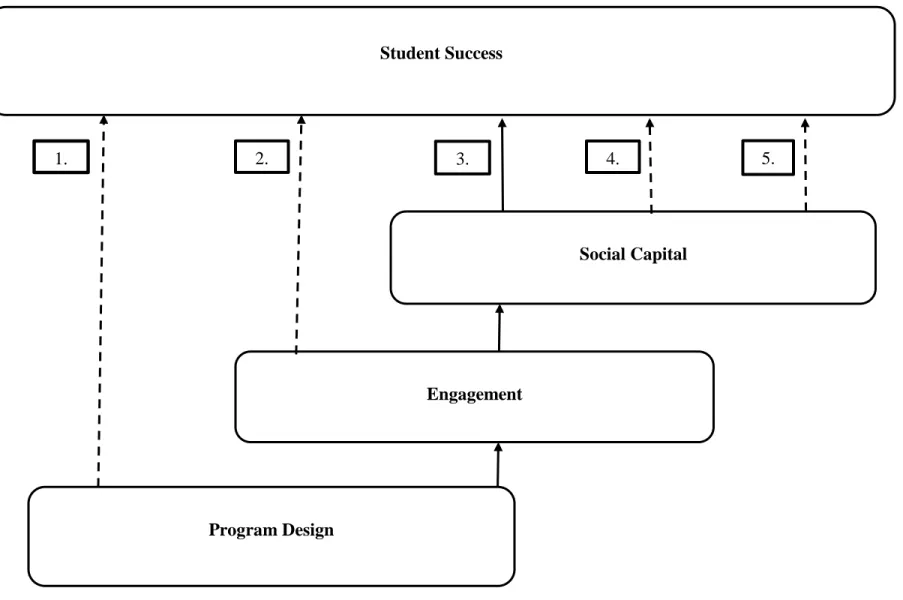
Figure 1. Conceptual Framework ...11
Table Page
Table 1. Participant Sample ...53
Table 2. Research Sub-Questions, Sampling, and Data Collection Methods ...62
Table 3. Propositions, Alternate Explanations, and Data Collection Methods ...63
Table 4. Participant Educational Demographics ...79
Chapter 1 Introduction Background
In 2016 there were more than thirteen million health professionals working in the
United States (U. S. Bureau of Labor Statistics, 2018). Twenty of the 30 fastest growing
occupations between the years 2014 and 2024 in the U.S. will be in the health care
professions. Registered nursing, one of the health professions projected to have the most
growth, will add nearly 440,000 new positions and will replace more than 600,000
positions vacated mainly due to retirement during that same 10-year period (Center for
Health Workforce Studies, 2016). According to the U. S. Bureau of Labor Statistics
(2018) there were more than 2.95 million Registered Nurses (RN’s) in the U. S., whose
median income was 70,000 USD in 2016. Educating future health professionals is an
enormous task. In the U. S. in the 2014-2015 academic year, 1,895,000 baccalaureate
degrees were conferred, of which more than 216,000 were in the health professions. This
number ranked second only behind business degrees. In that same year the greatest
number of doctoral degrees, 71,000, were conferred in the health profession (NCES,
2018).
The community college (two-year, associate degree, and certificate granting
programs) is the place where many students begin on the educational path to a career in
the health professions. In the fall of 2017, there were 5.9 million students (NCES, 2019)
enrolled in 1,108 community colleges in the U.S. (Juszkiewicz, 2017). While there are
some community colleges and some programs within other community colleges which
policies which grant admission to nearly all students who apply (Cohen & Brawer, 2003;
Goldrick-Rab, 2010; Levine, 2007). The open admission policies at many of these
colleges, and the relatively low cost, leads to a student population which varies in a
number of ways, especially in regard to prior academic experiences, skills, and
competing priorities. Cohen and Brawer (2003) stated that community college students
can best be described using two words: varied and numerous.
Generally, the rate of success at community colleges is relatively low (Bailey,
Jaggars, & Jenkins, 2015; Bailey, Leinbach, & Jenkins, 2006). However, Jenkins (2014)
noted that certain programs like nursing and automotive technology are more
purposefully designed, and have greater rates of student success. For example, Jeffreys
(2006) retrospectively evaluated 112 nursing students enrolled in an associate degree
program and found that there was a 75% first year rate of retention. The National League
for Nursing (2008) reported a slightly higher, 80.3% first year retention rate for nursing
students in associate degree granting institutions, as compared to a little greater than 60%
retention rate for all students in these same institutions in 2006-2007. In addition to
purposeful design, these nursing an automotive technology programs often have selective
admission which may contribute to student success. However, the pre-nursing (PRN)
program at the community college where this study was conducted had open admission.
There were approximately 1,473 PRN students enrolled at this community college (CC,
2019). Each one was hoping to become a Registered Nurse (RN). The PRN students took
the prerequisite courses at the community college, and then applied for admission into
selective nursing programs. The study participants were successful members of this PRN
from this college into a Bachelor’s of Science in Nursing (BSN) or an Associate’s of
Science in Nursing (ASN) program. Understanding their path to successful transfer
should be an educational priority.
Problem Statement
Efforts to expand equity and acquire college attainment depend on community
colleges (Jenkins & Rodriguez, 2013). However, research has shown that student
progress through community colleges is generally slow, rates of dropout are high, and
rates of success are relatively low (Bailey, Jaggars, & Jenkins, 2015; Bailey, Leinbach, &
Jenkins, 2006). Student success is often measured by graduation/completion rates and/or
transfer rates. In 2018 the Integrated Postsecondary Education Data System (IPEDS)
reported that only 24% of the first-time, full-time, degree and certificate seeking students
at public two-year colleges graduate within three years (the 150% graduation rate at a
two-year college). At public four-year institutions 59% of first-time, full-time, degree
seeking students graduate within 6 years (the 150% graduation rate at a four-year
institution).
As the price of a college education continues to rise, students, parents, and
politicians are increasingly expecting higher education institutions to improve, and to
verify their productivity and efficiency (Gansemer-Topf & Schuh, 2006). This has
contributed to a change in the national community college agenda from access to success
(Sutherland, 2011). In order for broad access public institutions like community colleges,
which are more dependent on public funding than more selective institutions, to continue
to serve their rather large and varied student population, they must at least maintain, or
community colleges must demonstrate success. Community colleges are seeking ways to
increase student success without lowering their academic standards.
Purpose of the Study
The program goal at the community college where this study was conducted was
to successfully prepare the Health Professional (HP) students for transfer. The 1,473
students enrolled in Pre-nursing (PRN), a major within the HP program, were working
toward acceptance into either a BSN or an ASN transfer program. These PRN students
often had competing priorities, varied backgrounds, and differing levels of academic
preparedness and ability. Yet many were successful in that they gained acceptance into
relatively competitive transfer programs.
The purpose of this qualitative holistic single-case study (Yin, 2014) was to
explain the path to successful transfer for a cohort of students who were enrolled in the
PRN major in a suburban community college. In this study achieving the minimum
requirements for acceptance for transfer from this college into a BSN or ASN program
was the definition of success. I examined the design of this particular program, which
was similar to Guided Pathways (Bailey, Jaggars, & Jenkins, 2015; Jenkins, 2014). I
investigated whether this design supported engagement as defined by Kuh, Cruce, Shoup,
Kinzie, and Gonyea (2008), who proposed that engagement: student involvement and
integration supported by institutional design or educational practices, supports
educational success. Then I considered whether engagement provided opportunities for
the acquisition of social capital. Social capital in an educational setting was first studied
engagement at this community college, promoted student success, as Harper (2008)
found when he studied engagement, social capital, and success at four-year institutions.
Overview of the Students and the Program
College students tend to be viewed from a four-year college or university
perspective. These “traditional” college students are generally considered to be the norm.
Silverman, Aliabadi, and Stiles (2009) defined traditional college students in the U.S. as
residential, full-time, and first-year enrollees directly out of high school. Generally,
traditional students also tend to be native English language speakers, the second or third
generation in their family to attend college, members of the middle-class, and have
aspirations of obtaining a college degree (Levin, 2007).
There are many, varied definitions of nontraditional college students. They can be
identified by the acronym CPTR, which stands for Commuter, Part-time, Transfer, or
Returning students (Silverman, Aliabadi, & Stiles, 2009). Schuetze and Slowey (2002)
defined nontraditional students as students who either have an educational biography
which includes a winding path through college, enter college later then their traditional
counterparts and study part-time, or have competing priorities like family commitments
and jobs. According to NCES (2015), at least 70% of college students in the U.S. are
nontraditional.
The vast majority of community college students, including those who are
enrolled in the pre-nursing courses at the community college where this study was
conducted, are by either definition, nontraditional. Researchers agree that nontraditional
students have unique characteristics and needs (Levin, 2007). They often have varied
community college students delayed their entry into college because of limited finances
and/or to raise their family. Approximately 62% of community college students attend
part time (Moschetti & Hudley, 2015), and nearly 75% of them are employed
(Goldrick-Rab, 2010). Their part-time status is often due to the fact that they work in order to
support themselves and/or their families. In addition to their varied academic experiences
prior to college, and their competing priorities, community college students also differ in
level of skill. Nearly 61% of community college students must enroll in at least one
remedial course (Goldrick-Rab, 2010). They are racially diverse. For example, 58% of
African American students, and 66% of all Hispanic students are enrolled in community
colleges (Goldrick-Rab, 2010).
The diversity of the student population (Goldrick-Rab, 2010) and some other
factors including the number and variety of programs offered at community colleges
(Bailey, Jaggars, & Jenkins, 2015; Jenkins & Cho, 2014) have created a number of
challenges. In order to support these unique students in their progress toward completion
and/or transfer, the college must understand the unique characteristics and somehow meet
the unique needs of nontraditional students, like those in the pre-nursing program in this
study.
Success for community college students has been very limited. Only 24% of
first-time, full-time community college students, who enrolled in 2014 with the intention of
graduating, attained a degree or certificate of any kind by 2017 (NCES, 2018). There are
many part-time students at community colleges. Therefore, a three-year completion rate
may not be reflective of these students. However, expanding the time to completion to six
an academic credential of any kind to 41% (Juszkiewicz, 2016). Graduation is not the goal for every community college student. If the student’s goal is to transfer, then transfer
rate is the appropriate measure of success. However, the six-year rate of transfer form a
two year college was only 12.8% (Juszkiewicz, 2016).
The community college students in this study have been successful in that they
have completed at least 30 credits in the PRN program, and have achieved a minimum
G.P.A. of 3.0. Thus, they are on the path to attaining the minimum requirements for
acceptance for transfer from this college into a BSN or ASN program. Of the 1,473
students enrolled in the PRN major in the fall of 2019, there were 390 who were
successful according to my definition (CC, 2019). Once they complete their transfer
program and pass their licensure exam, they will enter a field in which positions are
plentiful and the pay is reasonably good.
Health Professions
Health professional is a general term for a person who is trained to work in any field of mental or physical health. Registered Nurses (RN’s) are a subset of the health
professions. The RN’s assess patient health, develop and implement nursing care plans,
maintain medical records, and administer care to ill, injured, disabled, or recuperating
patients. Registered Nurses are either educated through a four-year Bachelor of Science
in Nursing (BSN) program, a three-year Associate of Science in Nursing (ASN) program,
or a three-year hospital sponsored training program.
There are approximately 12,000 students at the suburban community college
where this study was conducted, of whom 1,473 were matriculated in the pre-nursing
college and then transfer to either a BSN program at a four year institution, or continue
their education at a hospital sponsored training program. Those students who attend the
hospital sponsored programs will ultimately complete an Associate Degree from the
community college, and perform the clinical rotations required for licensure at the
hospital (ASN). After completing course work and clinical rotations, students from both
the BSN and ASN groups must pass the same state licensing exam to become a licensed
RN.
The PRN Major: A Guided Pathways Type of Program
There will be openings for more than 1,000,000 new nurses in the U.S. from
2014-2024 (Center for Health Workforce Studies, 2016), and there are a large number of
PRN students enrolled at the college. It is important that as many of these students as
possible are successful. The PRN major in the HP program was purposefully designed to
support success. First, each student’s immediate goal was the same: to transfer into a
BSN or ASN program. The program was designed to ensure that courses are taken in a
required sequence and electives are limited. Advising was required at a common advising
session, and then offered throughout the program by two dedicated advisors. The path to
completion and transfer seemed clear and easy to navigate, and the students were offered
guidance and support. Faculty, staff, and students were supposed to communicate often to
keep the students on the correct path to transfer. This design predates Guided Pathways.
However, it is very similar to the guided pathways model (Jenkins, 2014), a curricular
framework which includes specific academic and career goals, clearly designed curricular
Engagement in the Pre-Nursing Program
Laboratory courses within the PRN program were generally small, and the lab
sections were interactive. The same instructor taught both the lecture and laboratory part
of a course. The design encouraged involvement right in the classroom and laboratories,
and promoted opportunities for students to interact with each other, with advisors, and
with the faculty. Specifically, these PRN students had opportunities to become socially
integrated with other students, faculty, and key staff. Being involved and integrated leads
to increased learning and personal development (Astin, 1999; Tinto, 1975). Kuh, Cruce,
Shoup, Kinzie, and Goyea (2008) define engagement as involvement and integration
supported by the effective educational practices of an institution. Many studies (Astin,
1999; Hu & Kuht, 2002; Kezar & Kinzie, 2006; Ream & Rumberger, 2008; Tinto, 1975;
Tinto, 1997) have found that engagement promotes success.
Was it engagement that directly led to success? Harper (2008) interviewed 32
high achieving African American male students at six, large, public, four-year research
universities in the Midwestern U.S. The participants were chosen to take part in the study
because they had high GPA’s and a record of leadership and involvement. In other words,
they were academically successful and engaged. Harper found that because they were
engaged on campus, the students acquired social capital. He found that social capital
supported their success.
I agree with Harper (2008). Engagement provides opportunities for the acquisition
of social capital. However, for community college students the opportunities for
engagement are limited. For the PRN students in this study, the laboratory provided a
laboratory classroom, as opposed to the out-of-class engagement experienced by the
baccalaureate students in his study. However, for both groups of students, engagement
provided opportunities for the acquisition of social capital, which supported student
success.
Social Capital in the Pre-Nursing Program
I suggest that the path to successful transfer for the students in this study was
supported by the PRN program design and by the engagement made possible by the
design. However, the factor which was the most important for these particular students
was that the program design and their engagement provided opportunities for the
acquisition social capital. Social capital in the forms of obligations and expectations,
information sharing, and shared norms (Coleman, 1987; Coleman, 1988) directly
promoted success. I formulated a conceptual framework for the path to successful
transfer that included: program design, engagement, social capital, and success (see
11
Figure 1. Conceptual Framework
Social Capital
Engagement
Program Design
Student Success
Research Questions
I contemplated five possible paths to success for these HP students as shown in
the conceptual framework above. Path #1 proposed that the program design directly
promoted success. Path #2 proposed that engagement promoted success. Path #3
proposed that the program design promoted engagement, engagement provided
opportunities for the acquisition of social capital, and social capital supported success.
Path #4 proposed that engagement provided opportunities for the acquisition of social
capital, and social capital supported success. Path # 5 proposes that social capital
supported success. As previously stated, I suggest that the PRN program design promoted
engagement, engagement provided opportunities for the acquisition of social capital, and
social capital supported success. In other words, I suggest that the third path in the
conceptual framework was the path that leads to success. Studies regarding guided
pathways (Bailey, Jaggars, & Jenkins, 2015; Jenkins, 2014; Jenkins & Rodriguez, 2013),
engagement (Kuh, et.al., 2008), the relationship between engagement and social capital
(Harper, 2008), and the role of social capital in educational success (Coleman, 1987;
Coleman, 1988) provided the foundation upon which I formulated the following research
questions:
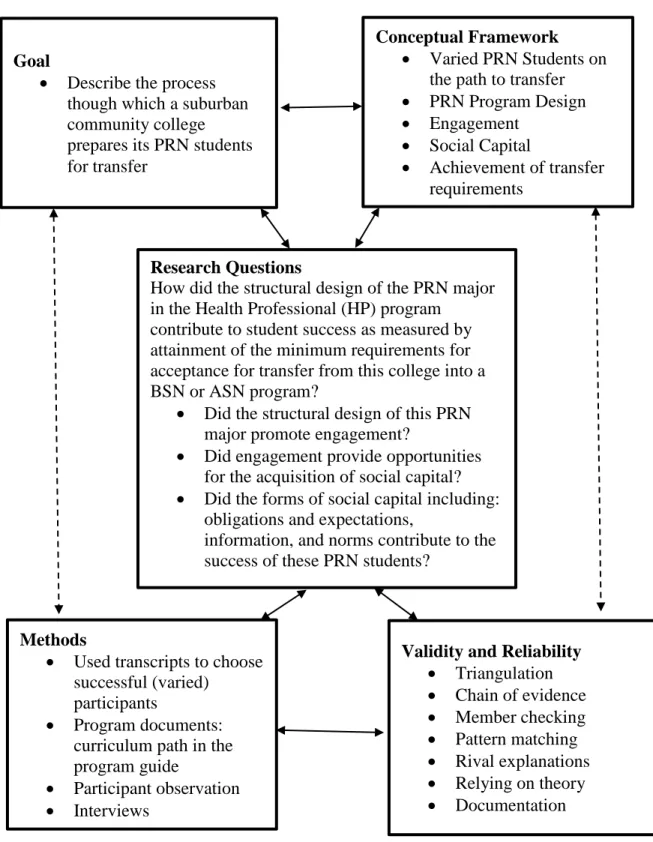
How did the structural design of the Pre-nursing (PRN) major in the Health Professional
(HP) program promote student success as measured by attaining the minimum
requirements for acceptance for transfer from this college into a BSN or ASN program?
Sub-question #1.
Proposition.
1A. The design component of the PRN major promoted engagement.
Alternate explanations.
1B. The students in the PRN major were not engaged. This is typical of
community college students, who have been described as Commuter, Part-time,
Transfer, and Returning (CPTR). They have less time to become involved in
educationally purposeful activities, and few opportunities to interact with other
students, faculty, or staff. Thus, engagement is limited.
1C. The students were engaged due to some other factor besides the design of the
program.
1D. The design of the program, as a whole, directly promoted success.
Sub-question # 2.
Did engagement provide opportunities for the acquisition of social capital?
Proposition.
2A. Engagement provided opportunities for the acquisition of social capital.
Alternate explanations.
2B. The students acquired social capital from other sources, and not from
engagement in the classroom, labs, and advising sessions.
2C. Engagement directly promoted success.
Sub-question #3.
Did the forms of social capital including: obligations and expectations,
measured by achieving the minimum requirements for acceptance for transfer
from this college into a BSN or ASN program?
Proposition.
3A. Social capital contributed to success.
Alternate explanation.
3B. Students were successful due to a characteristic or influence such as: a
common history, their own internal motivation, external support from family,
friends, and colleagues, or some other factor, but not due to design, engagement,
or social capital.
Significance of the Study
In the fall of 2017, there were 5.9 million students (NCES. 2019) enrolled in
1,108 community colleges in the U.S. (Juszkiewicz, 2017). Despite efforts to the contrary
research has shown that student progress through community colleges is generally slow,
rates of dropout are high, and rates of success are relatively low (Bailey, Jaggars, &
Jenkins, 2015; Bailey, Leinbach, & Jenkins, 2006). As the price of a college education
continues to rise, higher education institutions are expected to improve, and to verify
their productivity and efficiency (Gansemer-Topf & Schuh, 2006). Thus, increasing the
rate of persistence and student success continues to be an important issue for policy
makers, administrators, and educational researchers alike.
According to recent research regarding student persistence at commuter colleges,
there are three major factors which influence the decision to persist, and may influence
learning, development, and success. These factors are: entry characteristics, external
is difficult for community colleges to affect or control entry characteristics, due in part to
their mission of access (Cohen & Brawer, 2003; Goldrick-Rab, 2010; Levin, 2007). It is
also difficult for a community college to affect the external environment experienced by
students who live and work off campus. In order to be effective, the effort to promote
persistence and success in community colleges, should focus on the internal campus
environment, a factor over which the college administration, faculty, and staff have more
influence.
Possibly the desire to positively influence the internal campus environment is the
reason for the recent interest by both college administrators and researchers in Guided
Pathways (Bailey, Jaggars, & Jenkins, 2015; Jenkins, 2014), a curricular framework
which includes specific academic and career goals, clearly designed curricular paths, and
required advising at strategic points along the educational journey. It may also be the
reason for the sustained interest in engagement (Astin, 1999; Tinto, 1993) for more than
30 years. What is lacking is an understanding of the mechanism by which either guided
pathways or engagement promote persistence and success. In other words, how do they
really work? I proposed that guided pathways and engagement support student success
because they provided opportunities for the acquisition of social capital. Social capital
supported success.
The number of community college students is high, and the rates of success tend
to be low. It is essential that community colleges understand what works and why, in
regard to student persistence and success. This information will guide how best to spend
Scope of the Study
This qualitative holistic single-case study (Yin, 2014) was conducted at a
northeast suburban community college in the spring and summer of 2019. The sample
was comprised of successful PRN students, as measured by achieving the minimum
requirements for acceptance for transfer from this college into a BSN or ASN program.
The study included document collection, observation, and in-depth interviews to
elucidate the factors that contributed to each student’s success.
Definition of Terms
Guided pathways: is a curricular and student support framework designed to promote
student success (Bailey, Jaggars, & Jenkins, 2015; Jenkins, 2014; Jenkins & Rodriguez,
2013). It involves redesigning both academic programs and student support services,
creating a more clearly structured path to the end goal of successful completion in a
timely manner (Jenkins & Cho, 2014; Van Noy, Trimble, Jenkins, Barnett, & Wachen,
2016).
HP:the Health Professions program, within which the PRN major is housed, prepares
students for transfer and/or careers in mental and physical health.
Criterion-Based Sampling: choosing participants who meet a predetermined criterion. In
this study the criterion was success, as measured by achieving the minimum requirements
for acceptance for transfer from this college into a BSN or ASN program. Studying these
particular participants may help to uncover the characteristics or components of a process
that support the predetermined criterion (success) (Patton, 2015).
PRN:pre-nursing major/program. Students enrolled in this major are preparing for
Social capital:a valuable commodity gained from social interactionswhich has a
structural component, the social network, and functional components, actions of the
individuals or the group facilitated by the interactions within the network. Forms of social
capital are based in trustworthiness and trust of the members of the social network
(Kezar, 2014) and include: obligations and expectations, informational channels, and
social norms (Coleman, 1988).
Engagement:As defined by Kuh, et al. (2008), has the following components:
a. The level of agreement between the student’s beliefs, values, attitudes and
norms, and that of the social system of the college. It is reflected in the student’s level of involvement in that social system, including his/her
interactions with faculty, staff, and students
b. The effort that the college devotes to effective design and instructional
strategies which support both involvement and integration.
Success:attaining the minimum requirements for acceptance for transfer from this
college into a BSN or ASN program.
Limitations
This was a study of the path to successful transfer. It was a study of process. A
purposeful sample of successful, community college, PRN students were studied in order
to address gaps in the research, which tends to be from a deficit view in regard to
progress and completion in community colleges. Thus, this study focused on the process
and progress of successful students, and would not be applicable to students who have
not been as successful as these study participants. The study participants were
of higher education institutions. For example, nursing students at baccalaureate
institutions may gain social capital outside of the classroom, and the program design and
social capital acquired in the laboratory classroom may not be as essential to their
success.
This was a qualitative study. The expected acquisition of social capital due to the
engagement of the participants was investigated. However, a quantitative measurement of
Chapter 2 Literature Review
I was interested in studying a group of Health Professional (HP) community
college students because they have been “successful”. These students were enrolled in the
Pre-Nursing major (PRN), and had achieved the minimum requirements for acceptance
for transfer from this college into a Bachelor’s of Science in Nursing (BSN) and/or an Associate’s of Science in Nursing (ASN) program at a time when many of their
community college counterparts had not been able to thrive and succeed as they had done. Using Yin’s (2014) holistic single-case design, I investigated the PRN program
design, and the engagement and social capital acquired because of this design, which I
thought led to their success. The purpose of this chapter is to review the literature upon
which this case study was based. It is divided into three sections. The first section
introduces guided pathways (Bailey, Jaggars, & Jenkins, 2015; Jenkins, 2014; Jenkins &
Rodriguez, 2013; Van Noy, Trimble, Jenkins, Barnett, & Wachen, 2016), a curricular and
student support framework designed to promote student success. The PRN major in the
HP program in my study could be described as a modified guided pathways program.
Next, there is a description of involvement (Astin, 1999) integration (Tinto, 1993; Tinto,
1997) and engagement (Kuh, Cruce, Shoup, Kinzie, & Gonyea, 2008). The design of the
PRN program provided students the opportunity to interact with fellow students, faculty,
and advisors in the classroom and in advising sessions. Kezar and Kinzie (2006)argued that a college’s structural characteristics may influence engagement. I agree with them
and suggest that this PRN program design provided opportunities for and influences
students, who have been described as Commuter, Part-time, Transfer, or Returning
(CPTR) students (Silverman, Aliabadi, & Stiles, 2009). The CPTR students tend to leave
campus as soon as their classes are done. The limited time that they spend on campus as
compared to four-year students, reduces opportunities to engage with other members of
the college community in dorms, clubs, sports, and other extracurricular activities
(Silverman, Aliabadi, & Stiles, 2009). I think this limits their chances of success. Finally,
there is a section regarding social capital theory and student success (Coleman, 1988;
Dika & Singh, 2002). Social capital theory posits that social networks have value. The
relationships formed among the PRN students can provide assistance, support, and
information. These are valuable resources (Stanton-Salazar, 2001). Coleman (1987 &
1988) investigated the role of social capital in the development of human capital,
specifically in educational settings. His emphasis, like mine, was on the role of social
capital in regard to the academic achievements of both individual students and groups of
students.
In summary I propose that the PRN program design provided these community
college students opportunities for engagement with other students, faculty, and advisors
during specific classes and required advising sessions. The components/features of
engagement: involvement and integration, are two variables that have been found to be
important for student outcomes (Kuh, et. al., 2008)I propose that like the high-achieving African American male students in Harper’s (2008) study, the successful PRN students in
this study acquired social capital through engagement. Thus, engagement is critical for
acquisition of social capital. For both the students in Harper’s (2008) study and the PRN
students in this study, social capital promoted success.
Academic Success can be measured in many ways: test scores, grades,
persistence, completion, and development, to name a few. Dika and Singh (2002) linked
social capital and success, as measured by educational attainment. In this study success,
achieved through the acquisition of social capital, was measured by the attainment of the
minimum requirements for acceptance for transfer from this college into a BSN or ASN
program.
Program Design
Guided Pathways was described by Jenkins (2014). However, it is based on a
history which began with the study of student success in courses that were constructively
aligned (Biggs, 1996). Once success in aligned courses was confirmed, alignment was
expanded to include entire curricula (Larkin & Richardson, 2013). Jenkins (2014) noted
that certain programs like nursing and automotive technology, which were more
purposefully designed, had greater rates of student success. He took the idea of course
and curricular alignment one step further by proposing that an entire college can increase
student success by being more purposeful in program design and student support services
(Jenkins, Brown, Fink, Lahr, & Yanagiura, 2018; Jenkins & Rodriguez, 2013) via the
framework known as guided pathways.
Constructive alignment. In 1996 Biggs described the principles of constructive
alignment. Constructive alignment refers to a teaching environment where learning
outcomes, teaching methods, and assessments are aligned in an effort to improve
are clearly and specifically defined. After identifying the SLO’s the next step is to map a
path of teaching methods and activities to attain the goals, (Biggs & Tang, 2007). Then
assessments, which are aligned with both the goals and the map, are developed and
implemented. Many recognize the importance of alignment, but the literature relating to
its use tends to be limited to individual subjects or courses (Israel, Pitman, & Greyling,
2007) as opposed to the curriculum as a whole.
Curriculum design and management. Larkin and Richardson (2013) explored
applying constructive alignment across a curriculum, as opposed to applying it to
individual courses, when they studied an occupational therapy program. They included
baselines for comparison, used student outcome measures, and showed statistically
significant improvement in those outcomes. In his review of curriculum design and
management literature, Thompson (2010) identified six components of institutional
structures which support student improvement: organizational factors, design of the
curriculum, equity indicators, formal assessments, and facility and budgetary support for
instruction. In part his findings support that a formal curriculum which includes strict
pre-requisite requirements and course enrollment according to a pre-determined schedule
promote success. Students at community college often take courses part-time, and in an
order/sequence that is independent of curricular design and more dependent on their own
personal, familial, or work scheduling needs. However, the health professional students
are supposed to follow a pre-determined curricular path. It is very likely that the most
successful students carefully followed the curricular design very closely.
The results of a study by Fowler and Boylan (2010) suggest that an increase in
developmental course work is integrated with first year course work, intrusive academic
advising occurs and includes support in nonacademic areas, and academic support such
as tutoring is obtained. In this work it is again evident that a curriculum which includes
clearly stated goals and guidelines, as well as academic advising to keep students on the
correct curricular path is a large part of successful student retention and achievement.
Guided pathways. Most community colleges offer a large array of courses and
programs but provide little guidance (Jenkins & Cho, 2014), potentially contributing to
the relatively low rates of student success. Jenkins and Rodriguez (2013) proposed that in
order to improve program completion without either reducing quality or increasing costs,
colleges must change the way they organize and manage programs, not simply align
courses and/or curricula. A guided pathways approach in higher education applies the
combination of course constructive alignment (Biggs, 1996), curricular design and
management (Larkin & Richardson, 2013), and support services (Fowler & Boylan,
2010) to college programs. The guided pathways model involves redesigning both
academic programs and student support services, creating a more clearly structured path
to the end goal of successful completion in a timely manner (Bailey, Jaggars, & Jenkins,
2015; Van Noy, Trimble, Jenkins, Barnett, & Wachen, 2016). Support for guided
pathways is grounded in research which shows that structure and guidance, support
completion. Given the right guidance, students will generally enroll in the correct courses
in the correct sequence, helping them to stay on track (Fink, 2017).
According to Jenkins (2014) programs offered at community colleges that are
regulated either by licensure, like nursing, or by industry standards like automotive
these programs are more closely monitored. Students in these programs tend to be more
successful, and indicate that enrollment in a college program with a clearly defined and
monitored pathway increased their chance of success (Jenkins, 2014). However,
admission to community college programs, like nursing and automotive technology, is
often selective. Jenkins neither acknowledges the selective admission process, nor its
potential effect on completion and success. Also, although many students are pleased
with educational planning and program mapping, two components of guided pathways,
some students are not. Fink (2017) found that some students feel that: the planning stage
is overwhelming, the choices are limited, changing majors would be difficult, and the
process can be frustrating.
When a college program’s framework is designed as a guided path, students
define their educational and career goals as soon as possible. They choose a major which
is aligned with their goals. All classes within the curriculum are constructively aligned,
and curricula are carefully designed and managed throughout the program. Advising is
not offered, it is required. Progress monitoring with feedback at strategic points is
provided along the way. Although it predates the guided pathways model, the framework
for the HP program in my study is similar to guided pathways. The students in my study
decided to become a nurse, chose the PRN major, are supposed to be adhering to the
curriculum for this major closely, and are required to attend advising sessions.
Jenkins and Rodriguez (2013) propose that the guided pathways framework
promotes completion and success. I propose that the success attributed to this framework
is actually achieved because the HP program design provides opportunities for
student outcomes (Kuh, et., al., 2008).These variables will be discussed in the next
section.
Engagement
Astin’s student involvement theory. Astin’s student involvement theory was
first published in 1984. He defined involvement as the amount of “physical and
psychological energy that the student devotes to the academic experience” (Astin, 1999,
p. 518). His student involvement theory has five postulates: involvement requires both
physical and psychological energy, involvement occurs on a continuum, involvement has
both quantitative and qualitative factors, the amount of student learning and personal
development is directly proportional to the quality and quantity of student involvement,
and the effectiveness of educational policy and practice is directly related to the ability of
that policy or practice to increase student involvement (Astin, 1999, p. 519).
According to Astin (1999) students’ chances of dropping out are substantially
greater at a two-year college as compared to a four-year college. He posits that one
reason for the high dropout rate in community colleges is that involvement of both
students and faculty seems to be minimal. A large number of community college students
attend on a part-time basis, and most are commuters. Similarly, a large proportion of
faculty members are part-time college employees. As Chang (2005) noted the students
and the many part-time instructors come to the community college for their courses and
tend leave immediately after the class is done limiting opportunities and time for
involvement. The PRN students who were participants in my study were commuters, and
many attended college part-time. There were approximately 350 part-time faculty but
low levels of involvement. However, the design of the PRN program brought students
and faculty together in an interactive classroom environment, and provided opportunities
for discourse, potentially increasing involvement. Being involved leads to increased
learning and personal development (Astin, 1999).
Tinto’s model of student departure. Tinto’s (1975, 1997) model of student
departure begins with the premise that a student enters college with individual attributes,
family background and a pre-college schooling history which determine the student’s
commitment to the goal of completion, and his/her level of commitment to the institution.
Academic integration involves incorporating the academic norms of the college, and
meeting the academic standards set forth by the college. Social integration is a level of agreement between the student’s beliefs, values, attitudes and norms, and that of the
social system of the college. It is reflected in the student’s level of involvement in that
social system, including his/her interactions with faculty, staff, and students (Braxton,
Hirschy, & McClendon, 2004). According to Tinto (1975) it is the student’s integration
into the academic and social system of college that mostly determine his or her
continuing commitments to the goal of completion and to the institution. Ultimately,
academic integration and social integration positively influence a student’s decision to
continue in that college.
Combining involvement and integration. Educators have varying views of the
concept of engagement. For me engagement combines the concepts of involvement and
integration, and includes an institutional effort in support of involvement and integration.
I defined and used the term engagement in a manner that is most similar to Kuh, Cruce,
that the student devotes time and energy to educationally purposeful activities. That is,
the student must be involved. The second component of engagement is achieved when
the institution uses its organization and resources to guide the student toward acceptance
of the norms of the college and achievement of the desired outcomes; including
persistence, learning, and completion. That is, when the institution fosters student
integration.
In other words, the quality and quantity of a student’s educational activities, and
the quality and quantity of his or her interaction with members of the college community, are that student’s level of involvement (Astin, 1999). If and when a student incorporates
the academic norms of the college, meets the academic standards set forth by the college,
and attains agreement between his or her beliefs, values, attitudes and norms, and that of
the social system of the college, that student is integrated (Tinto, 1975). Thus, the
concepts of involvement and integration are related, but not exactly the same. A student’s
level of integration is generally reflected by his or her involvement (Braxton. Hirschy, &
McClendon, 2004). When an institution devotes effort to a design or educational
practices which promote involvement and integration, its students have opportunities for
engagement (Kuh, et.al., 2008).
Characteristics of an engaged student. Generally engaged students have studied
with peers, joined a subject matter or special interest club, joined a social club, call
faculty by first name, and/or have been invited to a faculty member’s home (Pascarella,
1985). They interact with peers and faculty, and have used institutional resources (Hu &
(Ream & Rumberger, 2008), have joined a learning community, have a positive
perception of faculty, and are involved with other students (Tinto, 1997).
Engagement at community colleges. The participants in most of the early
studies (Astin, 1999; Hu & Kuht, 2002; Pascarella, 1985; Ream & Rumberger, 2008;
Tinto, 1975; Tinto, 1997) regarding involvement and integration were traditional
four-year college students. Studies including community college students (Chang, 2005;
Greene, Marti, & McCleney, 2008; Tinto & Russo, 1994) confirmed the importance of
involvement and integration in persistence and success. Student persistence at commuter
colleges, like the community college where this study was conducted, is dependent on
three major factors. These factors influence the decision to persist, and may influence
learning, development, and success. One of these factors involves engagement. The three
factors are; entry characteristics, external influences, and the internal campus
environment (Braxton, Hirschy, & McClendon, 2004).
Examples of entry characteristics include parental level of education, motivation,
etc. Traditionally, part of the mission of community colleges is access. Community
colleges tend to accept nearly every student who applies (Cohen & Brawer, 2003;
Goldrick-Rab, 2010; Levin, 2007). It would difficult for a community college to increase
persistence and success by affecting or controlling entry characteristics of the students,
without limiting its level of access.
External influences are factors such as finances, work, and family (Tinto, 1993). It
is also difficult for a community college to affect the external environment experienced
The internal environment of a campus includes the learning communities of the
campus, and the institutional environment in regard to cost, integrity, and commitment to
student welfare (Braxton, Hirschy, & McClendon, 2004). Supporting an internal campus
environment rich in opportunities for engagement is an area where a college could make
purposeful changes. I think that the PRN program design in this study fostered
engagement for these students whose entry characteristics and external influences were
varied.
Program design and engagement. A program design that promotes a high level
of engagement may contribute to student persistence and to student success. The work of
many researchers supports this theory (Kezar & Kinzie, 2006; Kuh, et al., 2008; Porter,
2006; Tinto, 1997; Tinto & Russo, 1994). For example, Porter (2006) found that
institutional structure can influence student engagement. His results showed, in part, that
small, selective, baccalaureate schools with a low student to faculty ratio have higher
levels of integration. In a community college where time is such a precious resource, and
students and faculty tend to spend limited time on campus (Chang, 2005), it is important
to help students become involved and integrated by maximizing interactions and creating
community within individual courses (Chickering, 2000; Tinto, 1997). At the college in
my study, the PRN program design included small and interactive classrooms, low
student to faculty ratios, required advising, and laboratory groups of peers who shared a
common goal: to become a nurse. This was a purposeful design which potentially
contributed to engagement in the classroom and especially in the laboratory.
Measuring engagement in the laboratory. Engagement can be measured in
Engagement (CCSSE), developed by the Center for Community College Student
Engagement (2012) in Austin, Texas. This survey tool allows for large scale quantitative
data collection to help identify and improve practices that support engagement at two-year institutions. The Institutional Practices Inventory, the IPI, is a “classroom
observation tool that allows for comprehensive yet unobtrusive data gathering about instructional practices and student engagement” (Painter & Valentine, 1996, p. 26). It
allows for systematic yet unobtrusive observations in traditional classrooms. I studied
engagement in the laboratory setting using the Laboratory Instructional Practices
Inventory (Sadler, Puig, & Trutschel, 2011). The LIPI is a modification of the IPI. This
tool allowed for the collection of data regarding student engagement in the laboratory
setting. I used it because my study was small scale and qualitative, and the laboratory was
the place where these students engaged and acquired social capital.
In summary. Engaged students persist, learn, develop, and are successful (Astin,
1999; Hu & Kuht, 2002; Kuh, et al., 2008). For the community college students in this
study, opportunities for engagement occurred in the small interactive laboratories. I
proposed that engaged students had opportunities to acquire social capital. Social capital
supported persistence, learning, development, and success.
Social Capital Theory
Forms of capital. In economics, the termcapital refers to a type of wealth/good
that could be consumed immediately but if invested, will potentially yield a profit in the
future (Bartee & Brown, 2007). All systems require both economic capital, which
historically was termed physical capital, and human capital to be successful and
facilities, has a financial cost, is tangible and observable. Human capital includes the
knowledge and abilities of a person or group which could be of value to the person, the
group, or both. High levels of both physical and human capital tend to support productive
activity. Social capital can aid in the creation of human capital (Coleman, 1988).
Social capital. The crux of social capital theory is that social networks have
value. The relationships formed in social networks can provide assistance, support, and
information in a given social situation (Stanton-Salazar, 2001). These are valuable
resources for the persons involved. In regard to higher education social network analysis
(SNA) has examined issues of access and success. These studies have examined how
social networks connect students to important information and needed support and thus
foster the development of social and/or cultural capital (Kezar, 2014).
Many people attribute social capital theory to Bourdieu (1987), Putnam (1994),
and Coleman (1988). Bourdieu (1987) described the underlying forces of power in
society. He was especially interested in the role of social capital in power transfer and
social class maintenance across generations. Putnam (1994) studied the relationship
between social capital and public affairs. Specifically, he investigated civic engagement
and its effect on the economic development and prosperity of communities. Coleman was
a sociologist who studied social capital in educational settings. He investigated the social
networks, the relationship between adults and children, and the norms and values which
aided and guided children. He noted the importance of the connection between
community, families, and schools in the achievements of individual high school students
and certain groups of high school students (Coleman, 1987; Coleman, 1988). He
educational settings, and his emphasis was on the academic achievements of both
individuals and groups of students. Therefore, I will rely heavily on Coleman’s
interpretation of social capital.
Social capital has a structural component, the social network, and functional
components, actions of the individuals or the group facilitated by the interactions within
the network. Forms of social capital are based in trustworthiness and trust of the members
of the social network (Coburn & Russell, 2008) and include: obligations and
expectations, informational channels, and social norms (Coleman, 1988).
Obligations and expectations. Obligations and expectations can be explained in the following manner. Sometimes person “A” in the social network needs the assistance
of someone else, person “B”. The help is given, and no formal payment is requested. However, this seemingly altruistic deed is more like a credit slip. Person “B” trusts that if
he needs assistance on the future, it will be given to him in return (Coleman, 1988).This
sort of exchange occurred in the PRN classrooms all of the time. If one student was
absent, another would record the lecture for him or her. If one student did not understand
a concept, another was there to explain it. Students shared books, lab equipment, models,
and specimens frequently. This can be termed mutual aid, reciprocity, or obligations and
expectations. It is more likely to occur among the students who interact in the small,
relatively informal lab settings experienced by the PRN students than among the more
typical community college students who are enrolled in larger, more traditional classes,
and leave immediately after class is done (Chang, 2005).
Information sharing. Acquiring information can be difficult, time consuming,
information from the other members of the group much more easily and at a much lower
cost than those outside of the group (Coleman, 1988). Information like assignment due
dates, application deadlines, interview techniques, and financial opportunities for
example, are essential for academic achievement, and successful transfer. While working
in the lab, the students interacted more readily with faculty and fellow students. Faculty
often offered advisement about course work and/or strategies for academic success. The
students reminded each other of important dates, discussed interviews they had at the HP
schools to which many of the students apply, and made suggestions about financial
opportunities, child care, course section scheduling, and much more.
Norms supporting success. A norm is a commonly held value of proper behavior, which binds the members of a group. Norms guide, regulate, or control group members’
behaviors and are supported by sanctions: rewards for appropriate behaviors and/or
disapproval for inappropriate ones (Coleman, 1988). An educational system’s goals are
supported by norms of cooperation, information transfer, and of academic success. This
can be observed when the members of a lab group work together and encourage each
other, and when they congratulate each other for good work and/or improvement.
Sometimes the students even had a friendly competition between members for the highest
grade in a practical or lecture exam. The support for positive performance would only
occur if the students trusted each other enough to share this information, and if they
interacted enough to care. Within the lab groups norms often constrained inappropriate
behavior. Students who distracted the others or failed to contribute to the group would be
disinfecting a late member’s bench or refused to loan materials to help the “offender”
catch up.
Social capitaltheory and educational success. Coleman (1988) was the first to
apply theories of social capital to educational settings. He used quantitative data and
focused on high school students, who acquired social capital mostly from their family
members. More recent studies have integrated qualitative methods like interviews and
case studies, have focused on racial minorities and low SES students (Conchas, 2001;
Esau, 2015; Gonzales, 2013; Gonzalez, Stoner, & Jovel, 2003; Goyette & Conchas, 2002;
Hill, Bregman, & Andrade, 2014; Stanton-Salazar, 2011), and have included college
students as opposed to high school students (Esau, 2015; Gonzales, 2013; Jensen &
Jetten, 2015; Moschetti & Hudley, 2015).
Although current research supports Coleman’s claim that family social networks
are important for the success of some groups (Hill, Bregman, & Andrade, 2014), recent
work has expanded the social network to include the school environment in addition to
family. These studies indicate that the social capital acquired from fellow students and
institutional agents like faculty (Gonzales, Stoner, & Jovel, 2003; Hill, Bregman, &
Andrade, 2014; Stanton-Salazar, 2011) may play a larger role in the success of the
students as compared to social capital acquired from family members. Some studies
focus on school design (Conchas, 2001) and seem to indicate that institutional design and
culture can contribute to development (Kezar & Kinzie, 2006)) and success (Conchas,
2001; Gonzalez, Stoner, & Jovel, 2003). Success has been measured by achievement,
2002). I measured success by the attainment of the minimum requirements for acceptance
for transfer from this college into a BSN or ASN program.
Social capital and network members.
Family. Using High School and Beyond data, Coleman (1988) demonstrated that
greater amounts of social capital lead to lower dropout rates for high school students. Coleman’s work regarding social capital was focused on high school students and limited
the relevant social network from which the social capital was obtained to family structure
and parent-child interactions. For example, he studied the influence of two parent
households, smaller numbers of siblings, higher parental educational aspirations, and
intergenerational closure.
Hill, Bregman, and Andrade (2014) collected and analyzed survey data from
sophomores and seniors at two urban magnet schools. The student populations were
multiracial but predominantly African American, and both schools had a higher than
average college acceptance rate. The social network analysis revealed that those students
whose SNFC (social network for college) was dominated by peers were less likely to
choose a selective institution for college, and were less likely to pursue college right after
high school. Those whose social network was dominated by parents and school personnel
were more likely to attend college right after high school and more likely to choose a
selective college. These data suggest that for at least some groups of adolescents, family
remains an important component of their social network. This work also suggests that
information regarding college options and opportunities should be shared with family to
Institutional agents (faculty and staff). In 1995 Stanton-Salazar and Dornbusch
conducted semi-structured interviews with Mexican origin high school students and
found that students who had higher grades and higher status expectations generally had
social capital stemming from personal ties with those who controlled institutional
resources. These findings moved away from the exclusive role of social capital gained
from family to that obtained from ties and networks within an educational institution.
Stanton-Salazar (2011) then developed a conceptual framework for studying institutional
agents and the role they play in supporting working-class minority youth, and helping
them gain access to social capital.
Based on 150 life history interviews about the adult experiences of undocumented
immigrants, Gonzales (2013) compared the experiences of undocumented Mexican
college-goers versus early exiters. The students had similar family, community, and
school profiles. Prior school experience seemed to stand out when assessing the divergent
trajectories of the two groups. Those who succeeded in college had experienced positive
K-12 school environments and school based social capital, including positive
relationships with teachers and counselors, and positive peer group support and
information sharing. Esau (2015) studied the role of support programs, college
counselors, and faculty in the persistence and success of Latino/a community college
students. In part, Esau found that interactions with agents of the institution, which
increased social capital, supported a small but significant positive effect on student
success. Institutional agents, like the teachers and counselors in these two studies, are
high-status, non-kin individuals. They have relatively high positions in an institution, and