5/5/98
TEXAS POLLUTANT DISCHARGE ELIMINATION SYSTEM CHAPTER 6
ENFORCEMENT PROGRAM DESCRIPTION
INDEX
C General Discussion Page 1
C Water Quality Enforcement and Legal Action Page 10
C Regional Office Inspections Page 34
C Permit Compliance System Database Description Page 50
TEXAS POLLUTANT DISCHARGE ELIMINATION SYSTEM CHAPTER 6
ENFORCEMENT PROGRAM DESCRIPTION
GENERAL DISCUSSION
The Texas Natural Resource Conservation Commission (“Commission”) has the primary responsibility for taking the necessary enforcement action to correct environmental violations affecting human health and the State’s water quality. The Commission is responsible for compliance monitoring and enforcement of the National Pollutant Discharge Elimination System (NPDES) domestic and industrial wastewater program, sewage sludge program, pretreatment program, biomonitoring program (whole effluent toxicity testing), and Concentrated Animal Feeding Operations (CAFO) program.
EPA shall retain jurisdiction over all large and medium municipal separate storm sewer system (MS4) permits which it has issued. Retention of jurisdiction over the permits shall include the conduction of inspections and the receipt and review of any self-monitoring reports, compliance evaluation and enforcement actions. Prior to expiration of each of these MS4 permits, the TNRCC shall initiate processing of any renewal application it receives. Transfer of jurisdiction over each of these permits will occur at the time of issuance of a renewed TPDES MS4 permit, including the conduction of inspections, the receipt and review of any self-monitoring reports, and compliance evaluation and enforcement actions.
EPA shall also retain jurisdiction over all storm water general permits which it has issued. Retention of jurisdiction over the permit shall include the conduction of inspections, and the receipt and review of any self-monitoring reports, compliance evaluation and enforcement activities. Prior to expiration of each of these general permits, the TNRCC shall initiate processing of renewals of these general permits. Transfer of jurisdiction over
each of these general permits will occur at the time of issuance of a renewed TPDES general permit, including the conduction of inspections, and the receipt and review of any self-monitoring reports, and compliance evaluation and enforcement activities. TNRCC may exclude certain categories authorized to discharge under a general permit from coverage under a TPDES-issued general permit (making the general permit less broad in coverage). In such an instance, TNRCC would authorize the remaining discharges of storm water by individual permit.
After program assumption TNRCC will assume and administer the Region 6 CAFO general permit, and may amend this general permit to include some provisions more stringent than the Region 6 permit provisions. TNRCC will authorize CAFOs under a permit by rule or general permit that meets TPDES program requirements, as described in Section III.C.3 of the Memorandum of Agreement. Authorizations by rule and general permits issued under TPDES will be subject to EPA review, in accordance with Section IV.C. of the Memorandum of Agreement. Additionally, EPA will transmit copies to the TNRCC of any notices of intent it receives or other related information such as correspondence from EPA which requires an individual permit or excludes a person from coverage under the general permit.
Senate Bill (S.B.) 1660, effective September 1, 1995, added several sections to the administrative penalty section of the Texas Water Quality Control Act, the Texas Solid Waste Disposal Act and the Texas Clean Air Act. This new law affects the Commission's enforcement program significantly. Generally, the statute states that the Commission is not required to make findings of fact and conclusions of law in an enforcement action, other than those which give the agency jurisdiction. The law also allows Administrative Orders (AOs) entered by the Commission to contain some or all of the following provisions: the order is not an admission of a violation, the occurrence of the violation is in dispute, the order is not intended to become a part of a party’s compliance history; and all orders are explicitly made inadmissible in third party litigation.
S.B. 1660 enables the Commission to streamline its enforcement process thus allowing the Commission staff to concentrate on enforcement actions deserving the highest level of attention. Industrial and municipal entities will benefit from the streamlining and predictability the statute contemplates. Most important, the environment will benefit from the swift resolution of appropriate enforcement matters by expediting the implementation of technical recommendations and remedial actions.
The Texas Environmental, Health, and Safety Audit Privilege Act (“Audit Act”) was adopted by the 74th Legislature and became effective on May 23, 1995. The Audit Act was subsequently amended by House bill 3459, 75th Legislature, effective September 1, 1997. Texas is one of twenty-four states that have enacted legislation providing some form of voluntary environmental audit privilege and/or immunity. The Texas statute primarily affects litigation between non-TNRCC parties. However, Commission enforcement and regional inspection programs have also been affected, and a process is in place to implement the legislation. The Audit Act was proposed to encourage voluntary compliance with health and safety and environmental laws by granting a limited evidentiary privilege and penalty immunity, to entities that voluntarily seek to determine the environmental, health, and safety compliance status of their facilities. Certain violations discovered through a scheduled audit and promptly disclosed to the Commission are eligible for immunity from administrative penalty assessments, subject to the numerous conditions in the Audit Act. Commission enforcement authority regarding disclosed violations remains otherwise unaltered. Criminal violations, violations that have resulted in injury or substantial risk of injury, and violations that have resulted in an economic benefit resulting in a competitive advantage are not eligible for penalty immunity.
The adopted legislation provides an evidentiary privilege for certain information generated through a voluntary environmental audit and contained in an audit report with the following exceptions:
C Waiver - the privilege does not apply to the extent the privilege is expressly waived.
C Disclosure required by court or administrative hearings official - a court or administrative hearings official with competent jurisdiction may require disclosure of a portion of an audit report in a civil or administrative proceeding if the court determines that: the privilege is asserted for a fraudulent purpose; the portion of the audit report is not subject to the privilege under Section 8 of the Act; or the portion of the audit report shows evidence of noncompliance with an environmental or health and safety law and appropriate efforts to achieve compliance with the law were not promptly initiated and pursued with reasonable diligence after discovery of noncompliance.
C Nonprivileged materials - the privilege does not apply to: a document, communication, datum, or report or other information required by a regulatory agency to be collected, developed, maintained, or reported under a federal or state environmental or health and safety law; information obtained by observation, sampling, or monitoring by a regulatory agency; or information obtained from a source not involved in the preparation of the audit report. A regulatory agency may review information that is otherwise required to be available to it under federal law but this review does not waive the administrative or civil privilege.
In addition, the Audit Act provides immunity from administrative penalties for the violations disclosed as the result of a voluntary environmental audit. As conditions to immunity, the Audit Act requires the disclosing entity to promptly disclose the violations, to correct the violations within a reasonable time, and to cooperate with the Commission through all stages of the investigation of the violations. The immunity does not apply to all violations; for example, if the violation has resulted in a substantial economic benefit which gives the violator a clear advantage over its business competitors, the immunity does not apply. Other exceptions apply as follows:
C If the person making the disclosure intentionally or knowingly committed or was responsible for the disclosed violation;
C If the person making the disclosure recklessly committed or was responsible for the violation and the violation resulted in substantial injury to one or more persons at the site or off-site harm to persons, property, or the environment;
C If the offense was committed intentionally or knowingly by a member of the person’s management or an agent of the person and the person’s policies or lack of prevention systems contributed materially to the occurrence of the violation;
C If the offense was committed recklessly by a member of the person’s management or an agent of the person, the person’s policies or lack of prevention systems contributed materially to the occurrence of the violation, and the violation resulted in substantial injury to one or more persons at the site or off-site harm to person, property, or the environment; or
C If the entity has repeatedly or continuously committed significant violations and not attempted to achieve compliance, so as to constitute a pattern of disregard of environmental, health and safety regulations.
Furthermore, immunity does not apply if an investigation of the violation was initiated or the violation was independently detected before the entity disclosed the violation, thus preserving the Commission’s independent inspection and enforcement authority.
There are two types of notice contemplated by the law - the notice a facility gives to the Commission when its plans to perform an audit and the notice or disclosure made by the facility when it discovers a violation as a direct result of the audit. Both of these notices are public documents. An entity which undertakes an environmental audit is not required to provide the Commission with notice in order for audit information to become privileged; however, in order to take advantage of the immunity offered by the audit privilege, the entity must give notice of its intent to commence an environmental audit. A written disclosure must be submitted promptly upon discovery of the violation and must be sent via certified mail.
As stated previously, the Commission has encountered only a slight to moderate effect from implementation of the Audit Act. The Commission has established an Environmental Audit Task Force to process the notice s received pursuant to the Audit Act; to follow up on the correction of disclosed violations; and to coordinate all appropriate enforcement actions.
A written disclosure of violation is a pre-condition to immunity and initiates the enforcement process. Except for the possible penalty immunity for a violation identified under the audit, the enforcement process will not be altered. The immunity does not extend to injunctive relief or compliance or technical recommendations that may be contained in any enforcement action developed pursuant to violations identified at the facility.
Field operations have been impacted slightly by the presence of the evidentiary privilege for information contained in an audit report. The Commission will not routinely receive or review privileged audit reports. Inspectors have been cautioned not to request access to privileged audit information. If the review of privileged audit report information is necessary to determine compliance status, that information and information derived from its use will remain privileged and inadmissible in administrative or civil proceedings. The review will occur under the terms of a confidentiality agreement between the Commission and the auditing entity, where appropriate.
Finally, the environmental audit statute does not apply to EPA inspectors operating in Texas; however, the operation and administration of a federally delegated program (such as TPDES) is subject to and must conform with the conditions and requirements contained in the Audit Act.
Senate Bill 1876 (“SB 1876") which consolidates enforcement powers of the TNRCC, effective September 1, 1997, adds Section 7.052 to the Texas Water Code and authorizes a maximum administrative penalty for water
quality violations at $10,000 per day per violation and a maximum civil penalty of $25,000 per day per violation. Administrative penalties will be computed and assessed in accordance with the TNRCC Penalty Policy, effective October 1, 1997. A copy of the policy is included in the Enforcement Guidelines (Appendix 6-A, Part VI).
Senate Bill 1876 also adds Section 7.075 to the Texas Water Code to allow for written public comment on draft AOs. Notice of the opportunity to comment will be published in the Texas Register no later than the 30th day before the date on which the public comment period closes. Therefore, publication and the 30-day comment period will take place after the AO is settled and signed by the alleged violator but prior to the Commission’s agenda. Enforcement staff will promptly consider any written comments and may withdraw or withhold consent to the proposed AO or agreement if comments disclose facts or considerations that indicate that the consent is inappropriate, improper, inadequate, or inconsistent with the requirements of the Texas Water Code, Commission rules, or a Commission order or permit.
The Commission’s enforcement components are located in both the Central Office and the Regional Offices. The Field Operations Division (FOD) coordinates activity across the State through Regional Offices. Surveillance activities are conducted by inspectors located in those offices. They are responsible for conducting site visits for compliance inspections and complaint investigations. Most violations noted during inspections are resolved through informal enforcement efforts at the Regional Office level. However, if significantly noncompliant (SNC) violations or other serious and/or continuing violations are identified during an inspection, the Regional Office will initiate formal enforcement action.
The enforcement program is coordinated between Enforcement Team I (the Water Quality Team) and the Database and Administration Team of the Water & Multimedia Section in the Enforcement Division, the Pretreatment Team in the Water Quality Division, the Sludge and Transporter Review Team of the Water Quality
Division, the Toxicity Evaluation Team of the Water Quality Division, the Litigation Support Division, and the Regional Offices. Water Quality Team staff provide the administrative and technical actions necessary to identify alleged violations of the Texas Water Code, the Texas Health and Safety Code and Title 30 Texas Administrative Code (TAC).
The Water Quality Team also reviews compliance inspection reports submitted by the Regional Offices for facilities under Central Office enforcement action and monitors permittee progress in meeting compliance deadlines as required by AOs. An AO cannot be terminated until the alleged violator is compliant with the terms and requirements of the AO.
Regional Offices provide technical support for formal enforcement cases. Field staff conduct inspections to develop enforcement documentation, provide recommendations for corrective action requirements, participate in screening Regional Office referrals for the initiation of formal enforcement and review draft enforcement documents.
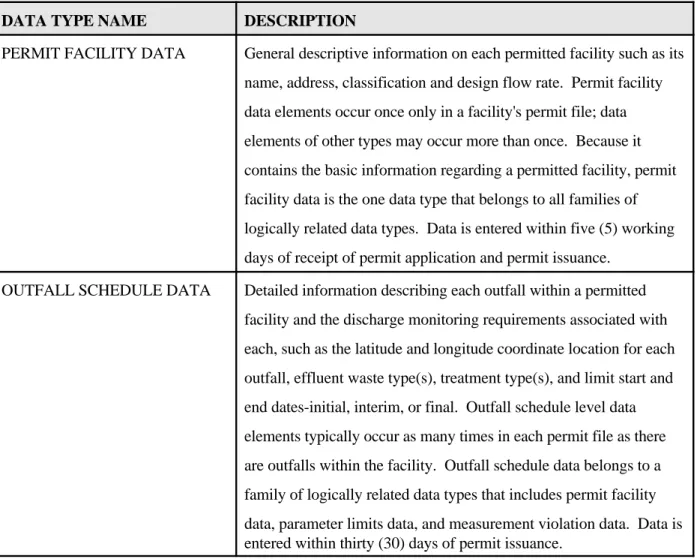
The Database and Administration Team of the Enforcement Division will update and maintain all Water Enforcement National Database (WENDB) data elements in the Permit Compliance System (PCS) and the Commission’s Texas Regulatory Activity and Compliance System (TRACS) database which contains information about all permitted effluent limitation requirements, biomonitoring for Whole Effluent Toxicity (WET) limits, pretreatment requirements, storm water requirements, and sewage sludge requirements for permits issued by the Commission. The Database and Administration Team is responsible for implementing Quality Assurance/Quality Control procedures for entering and monitoring reliable and consistent data in PCS.
forms with current permitted effluent limitations to all permittees. The team receives, reviews and tracks monthly self-reported data (DMRs) received from permitted facilities throughout the State. The Database and Administration Team receives and initially reviews the data utilizing the Violation Review Action Criteria (VRAC) located in the Enforcement Guidelines (Appendix 6-A, Part III). If the facility exceeds VRAC for administrative requirements (such as failure to self-report), the Database and Administration Team has the authority to take informal enforcement action which includes warning letters and verbal contact. The Database and Administration Team staff will take the appropriate action to address the noncompliance within thirty (30) days of becoming aware of the violation. If the alleged violator does not respond, if the response is not adequate, or if the noncompliance is non-administrative in nature, the facility is referred to the Water Quality Team Leader for assignment and enforcement review by Water Quality Team staff.
A listing of job descriptions associated with all Regional and Central Office Texas Pollutant Discharge Elimination System (TPDES) compliance evaluation and monitoring activities is included in Appendix 7-A.
WATER QUALITY ENFORCEMENT AND LEGAL ACTION
Types of Agreed Orders
An agreed order ("AO") is a legally enforceable document which is issued by the Commission. It is “agreed” because the entity under enforcement agrees to the terms of the order and to the penalty assessed. Most agreed orders include a penalty (reference the Enforcement Guidelines located in Appendix 6-A, Part VI) as well as technical requirements (“TRs”) which specify how and when the entity must achieve compliance.
There are two types of agreed orders (“AO”) prepared by Water Quality Enforcement, and/or Litigation Support Division (“LSD”). These documents, and the criteria for determining when each type will be used, are described below:
1660-styled Order
A 1660-styled Order is the informal term for a TNRCC agreed enforcement order which includes provisions authorized or required by Senate Bill (SB) 1660. Briefly, these include:
C A statement that the occurrence of any violation is in dispute and that the entry of the agreed order shall not constitute an admission by the respondent of any violation alleged in the agreed order;
C A statement that the agreed order is not intended to become a part of the respondent's compliance history; and
C A statement that the agreed administrative order, issued by the Commission, shall not be admissible against the respondent in a civil proceeding, unless the proceeding is brought by the attorney general’s office to: (1) enforce the terms of the order; or (2) pursue violations of the Water Code or Health and Safety Code.
Findings Order
A Findings Order differs from the 1660-styled Order in that it contains findings of fact and conclusions of law and becomes part of a respondent’s compliance history. A Findings Order will be used when any of the following four criteria is satisfied:
1) The violation is a gross deviation from a standard of conduct common in a given industry defined as:
a) indifference to legal duty;
b) a manifestly smaller amount of watchfulness than the circumstance(s) require of an entity acting with ordinary prudence; or
c) absence of management practices designed to ensure compliance;
2) Violations involving a significant emission or discharge of contaminants to the environment in the last five years. A significant water quality discharge is:
a. twice the permitted limits for conventional pollutants; or b. 50% above permitted limits for toxic pollutants;
3) Three repeated enforcement actions [notice of violation (NOV), corrective action directive (CAD), order, judgment] over the prior five year period for the same violation or a substantial history of the same violation entity-wide; or
4) Regardless of specific violations, an entity has demonstrated a pattern of disregard for environmental laws. This is a judgment to be made by the EC, investigator, legal staff and appropriate managers.
TNRCC will take timely and appropriate enforcement actions to implement TPDES. In cases where TNRCC cannot meet the criteria in EPAs oversight guidance, TNRCC agrees to notify EPA 45 days prior to the facility appearing on the Exceptions List. EPA will then initiate formal enforcement action in order to ensure that the violations are addressed in a timely and appropriate manner. EPA may also initiate enforcement action at the request of the TNRCC. During semi-annual audits of the TPDES program EPA will assess the frequency with which TNRCC meets timely and appropriate criteria (this includes assessment of adequate penalties). The results of these semi-annual audits will be used to evaluate the program against the criteria set forth in 40 CFR 123.63 (3) and 123.64 (4).
There are two processes used by the TNRCC in pursuing enforcement actions, the expedited order process and the Executive Director’s Preliminary Report and Petition (“EDPRP”) process. The EDPRP process is similar to the complaint process utilized by the EPA.
Expedited Order Process
Most often, the Water Quality Team will try to expedite the enforcement process by using the expedited order process. The purpose of the expedited order is to achieve a settlement with the violator by minimizing negotiations and avoiding the legal costs and time delays which can be incurred as the result of litigation. Both 1660-styled and Findings Orders can be used in the expedited process. If the alleged violator does not agree to the terms of the expedited order within 60 days of the date the order is mailed to the alleged violator, the case is referred to the LSD and the EDPRP process is begun. The Examples of the AO in either the 1660-styled or Findings format may be found in the Enforcement Guidelines (Appendix 6-A, Part VII).
EDPRP Process
This process may be used when the screening process indicates that timely settlement is unlikely (settlement will likely take longer than 60 days) and/or the action may be contested. A case is considered contested when the entity and the agency do not reach an agreement on the terms of an order. The document used to process cases which are contested (or the agency feels are likely to end up as contested cases) is called an Executive Director’s Preliminary Report and Petition, or EDPRP. The EDPRP is part of the agency’s administrative enforcement action as described in 30 Texas Administrative Code, Chapter 70. It is a petition filed by the Executive Director which seeks an enforcement order against a respondent. Both the 1660-styled and Findings Orders can be used in the EDPR process. The EDPRP includes a brief statement of the nature of the violation, the statute or statutes violated, the facts relied upon by the Executive Director in concluding that a violation has occurred, a recommendation that an administrative penalty be assessed, the amount of the recommended penalty, and an analysis of the factors required in the relevant statute to be considered by the Commission in determining the amount of the penalty. Also included are TRs which address outstanding noncompliances, including a specific date to complete the required action. The agency is required to develop an EDPRP prior to referring a matter to the State Office of Administrative Hearings (SOAH). (An EDPRP could lead to an agreed order but only if the entity under enforcement decides to settle with the agency and agree to an order prior to a contested case hearing.) Therefore if it is determined that no agreement can be reached, the staff attorney will request the Commission to remand the case at an agenda meeting immediately following the “no agreement” decision. The staff attorney will direct SOAH to set the matter for hearing within 60 days. The first meeting for the hearing is essentially a roll call to identify and determine party status of the individuals involved in the hearing. The actual hearing will normally be scheduled 60 to 120 days later, depending upon the complexity of the case.
Another Commission policy regarding proposed administrative penalties is the discretionary use of Supplemental Environmental Projects (SEPs) in AOs. A SEP is a project that prevents pollution, reduces the amount of pollution reaching the environment, enhances the quality of the environment, or contributes to public awareness of environmental matters. An alleged violator in an enforcement action may negotiate an agreement to perform a SEP in return for a deferral of a portion of the proposed administrative penalty. If the Director of the LSD approves the inclusion of a particular SEP in an AO, it will be presented to the Commission for consideration. Potential SEPs include such diverse projects as:
(1) Pollution prevention and/or reduction projects;
(2) Environmental restoration projects that go beyond repair to the enhancement of the environment in the vicinity of the violating facility;
(3) Technical assistance to other Commission regulated entities who are faced with economic and/or technological hardships;
(4) Environmental education and/or engineering assistance to members of the regulated community or the public;
(5) Projects to fund public works for a neighboring municipality or county that will benefit the environment in a way that is beyond ordinary compliance with the law; and
(6) Projects to clean up illegal municipal and industrial solid waste dumps.
The LSD is charged with the responsibility to review and approve SEPs. If an alleged violator is interested in negotiating a SEP, the Commission has developed a SEP Proposal guideline to assist an alleged violator in preparing a SEP for consideration. The Enforcement Guidelines (Appendix 6-A, Part VI) contains more detailed information regarding SEPs.
Default Order
If an alleged violator does not respond to the notice of an EDPRP, the Executive Director will seek an order issued by default. Any answer in response to an EDPRP must be filed with the chief clerk’s office no later than 20 days after the date on which the EDPRP is received as required under 30 Texas Administrative Code § 70.105.
Referral to the Office of the Attorney General
The agency may refer cases to the Office of the Attorney General (AG) who will, in turn, file a lawsuit against the entity on behalf of the State of Texas. The AG will file a petition in District Court of the appropriate county, depending upon the venue provisions set forth in the applicable statute.
It is possible for the AG to reach an agreement with the entity without having the case heard in court. This settlement must be approved by the District Court Judge. The agreement is formalized in a document called an Agreed Final Judgment. Other results that the AG may obtain are: a temporary injunction; a restraining order; or a final judgment (if there is no agreement). The criteria for TNRCC referral of a case to the AG are as follow: 1. Need for immediate action (temporary restraining order or injunction) to protect public health,
safety, or the environment;
2. Need for judgment to enforce compliance with existing administrative enforcement order; 3. Bankruptcy considerations, with the potential need for representation in bankruptcy court; 4. Egregiousness of violations and impacts, where availability of higher statutory civil penalties
should be considered;
5. Other strategic considerations, based upon the judgement of TNRCC management and AG advice; or
The statutory citation which specifies when a case shall be referred to the AG is as follows: (Upon delegation of NPDES permit authority)
Texas Water Code, § 7.105 (Subchapter A. General Provisions; Enforcement; Civil Suit):
“(b) The commission, through the executive director, shall refer a matter to the attorney general’s office for enforcement through civil suit if a person:
(1) is alleged to be making or to have made an unauthorized discharge of waste into or adjacent to the waters in the state at a new point of discharge without a permit in violation of state law; (2) has been the subject of two or more finally issued administrative penalty orders for violations of Chapter 26 occurring at the same wastewater management system or other point of discharge within the two years immediately preceding the date of the first alleged violation currently under investigation at that site;
(3) is alleged to be operating a new solid waste facility, as defined in Section 361.003, Health and Safety Code, without a permit in violation of state law;
(4) has been the subject of two or more finally issued administrative penalty orders for violations of Chapter 361, Health and Safety Code, occurring at the same facility within the two years immediately preceding the date of the first alleged violation currently under investigation at that site;
(5) is alleged to be constructing or operating a facility at a new plant site without a permit required by Chapter 382, Health and Safety Code, in violation of state law; or
(6) has been the subject of two or more finally issued administrative penalty orders for violations of Chapter 382, Health and Safety Code, for violations occurring at the same plant site within the two years immediately preceding the date of the first alleged violation currently under investigation at that site.”
“The attorney general’s office and the executive director may agree to resolve any violation, before or after referral, by an administrative order issued under Subchapter C by the commission with the approval of the attorney general.”
Additionally, the decision on whether or not to refer a case to the AG for noncompliance with the terms of a Commission Order should be evaluated on a case-by-case basis. Other administrative actions may be utilized, such as seeking the issuance of another Commission Order.
Criminal Prosecution
Finally, certain cases are developed for criminal prosecution by the Special Investigations Team in LSD. This team works through the Texas Environmental Enforcement Task Force which is comprised of several state and federal agencies. A parallel process may be appropriate to support both the civil and administrative relief necessary to protect human health, the environment, or other significant concern while continuing the criminal investigation or prosecution. Special Investigations will inform the Enforcement Division if it is necessary to develop a “no penalty” order due to a pending criminal case.
The Enforcement Process
When formal enforcement action is initiated, the desire of the enforcement program staff is to complete the action and to return the alleged violator (or respondent) to compliance in a timely and appropriate manner. To accomplish compliance in a timely and appropriate manner, all formal enforcement actions will be processed in accordance with the case prioritization policy included in the Enforcement Guidelines (Appendix 6-A, Part VI). The case prioritization policy specifies that AOs and EDPRPs be mailed to the alleged violator within thirty (30) to one hundred twenty (120) days of the decision to initiate action by the Enforcement Screening Committee
(“ESC”). This process includes mailing a proposed AO or EDPRP to the respondent in accordance with the case prioritization guidelines and to obtain the respondent’s consent to an AO within 60 days of mail out. AOs and EDPRPs will specify a penalty and timetable for compliance, and will require, if necessary, certain actions to achieve compliance with Commission rules or permits. It should be noted that all entities receiving a proposed AO with penalties have the opportunity to present evidence in an effort to prove that they are unable to pay all or part of the penalty. When a claim of financial inability to pay is made, Water Quality Team staff (or LSD staff, if assigned) will forward a list of financial disclosure documents to the alleged violator. Once properly completed and submitted by the respondent (within 30 days), the financial disclosure documents will be reviewed by the agency’s Financial Assurance Section to determine if the claim is valid. Another Commission policy regarding proposed administrative penalties is the discretionary use of Supplemental Environmental Projects (SEPs) in AOs. A SEP is a project that prevents pollution, reduces the amount of pollution reaching the environment, enhances the quality of the environment, or contributes to public awareness of environmental matters. The Enforcement Guidelines (Appendix 6-A, Part VI) contains more detailed information regarding SEPs.
To the extent that state judgements or settlements provide penalties in amounts which EPA believes to be substantially inadequate in comparison to the amounts which EPA would require under similar facts, EPA, may commence separate action for penalties. EPA’s definition of an adequate penalty is collection of at least the economic benefit of noncompliance.
The failure to comply with the requirements of an AO is independently enforceable without having to prove the original violation. If a respondent fails to meet the requirements of an AO, the Commission may enter into another formal enforcement action through the expedited or EDPRP process, or pursue an Agreed Final Judgment (AFJ) or Criminal Action. The Commission recognizes that the option of formal enforcement action for the
purpose of EPA's enforcement guidance must result in an AO issued by the Commission which may contain administrative and/or deferred penalties, or an AFJ, or Criminal Action.
For the purpose of Commission tracking of administrative procedures or tracking of actions through the Office of the Attorney General, the formal enforcement process is initiated through ESC. The ESC is a weekly multimedia committee meeting with managers from every media within the Enforcement Division present. In addition, the Regional inspector, assigned Water Quality Team staff and a representative from the LSD are present. Violations are screened within 15 days after the Water Quality Team receives the enforcement referral or within 15 days of discovering SNC. The action determined to be appropriate may be formal administrative enforcement action, judicial action, or a Commission emergency order. It is important to remember that coordination must be maintained between the Water Quality Team, LSD and Regional Office staff regardless of which strategy of enforcement is pursued, or when a case is escalated from one enforcement strategy to another in order to achieve compliance. The objective of the screening process is:
1. to review the documentation for the citations and verify that it is sufficient;
2. to determine the appropriate type of enforcement action to pursue such as a 1660-styled Order or Findings Order through the expedited process, referral to the LSD to develop enforcement through the EDPRP process, referral to the Office of the Attorney General, or to pursue a criminal action; and
3. to determine the case priority (see the Enforcement Guidelines (Appendix 6-A, Part VI) for the prioritization policy).
The Commission Enforcement Guidelines (Appendix 6-A) is the primary document that governs how enforcement procedures, both formal and informal, will be implemented. Enforcement program staff may utilize one or more of the following strategies available and discussed at length in the guidelines:
C Write a monitoring /warning letter outlining the identified deficiencies/violations and requesting compliance. If necessary, escalate after monitoring.
C Initiate formal enforcement action and write a Notice of Violation/Notice of Enforcement (NOV) letter outlining deficiencies/violations if a NOV has not already been written or verbally given. Develop and recommend issuance of an AO, using the expedited or EDPRP enforcement process, requiring certain corrective or remedial action, and/or assessing administrative penalties. If the EDPRP process is initiated, the case will be referred to the LSD, which will coordinate with the Water Quality Team to develop the EDPRP and subsequent AO. The Water Quality Team staff (enforcement coordinator) will prepare the penalty computation worksheet and technical requirements for the EDPRP and the expedited process.
C Submit criminal violations to the LSD’s, Special Investigations Team, for further investigation and action.
C Initiate a referral request to the Office of the Attorney General recommending civil judicial action in state court to obtain a court ordered temporary injunction, permanent injunction, or AFJ which will restrain the violator from continuing the action that caused the violations, enforce previous orders issued by the Commission, and may include additional penalties and/or injunctive relief.
C Initiate additional or further judicial or administrative action.
The formal enforcement process is described in detail in the Enforcement Guidelines (Appendix 6-A, Part II). The flow chart below describes the different steps in the formal enforcement process from the initiation of the action to the issuance of an AO. The Commissioners have the final approval authority for the issuance of an AO and vote whether to approve the AO during an agenda meeting. Assuming the AO is approved by the
Commissioners, the Commission’s Chairman signs the AO and the Chief Clerk’s office mails a certified copy to the respondent. The mail out date is considered the issuance date. Once issued, the AO requirements are monitored for compliance. The AO specifies penalty payment information, a time frame for compliance and may specify actions (technical requirements referred to as TRs) necessary for achieving compliance.
Water Quality Team receives referral Assignment to EC Screening Committee Expedited Order (W.Q. Team)
NOE/NOV (within 14 days of SC) - necessary only if entity has not been
previously notified of the violations
Facts meeting (optional)
Obtain Docket No.
Prepare Order, penaly calculation worksheet, cover letter, and executive summary
Enforcement Review
Mailout of Order: Priority 1 - in 30 days from SC Priority 2 - in 90 days from SC Priority 3 or 4 - in 120 days from SC
Agreement reached within 60 days of Order
Cover Letter date
Route to Legal Services Deputy for signature
Complete Agenda Item Request form
Send Agenda Notification letter with Executive
Summary
Agreement not reached within 60 days of Order
Cover Letter date
Agenda
Issuance
Send letter withdrawing settlement offer (within 70 days of Order Cover Letter date) and
refer case to LSD by memo
EDPRP mailed out (within 60 days of referral to LSD)
EDPRP (LSD)
NOE/NOV (except for Priority 1 cases) necessary only if entity has not been
previously notified of the violations
Penalty Calculation worksheet and TRs to LSD: Priority 1 - in 20 days from SC Priority 2 - in 60 days from SC Priority 3 or 4 - in 80 days from SC
Facts Meeting (optional)
EDPRP preparation by LSD
Mailout of EDPRP by LSD: Priority 1 - in 30 days from ESC Priority 2 - in 90 days from ESC Priority 3 or 4 - in 120 days from ESC
Settlement
Agreement reached Order drafted and signed
Agenda Issuance Refer to SOAH Hearing Process ENFORCEMENT PROCESS FLOWCHART
EC prepares penalty calculation worksheet and TRs
Enforcement review
Route to Legal Services Deputy for signature Complete Agenda Item Request form
Send Agenda Notification letter with Executive Summary
Agreement not reached Publish Notice in Texas Register Publish Notice in Texas Register Settlement Agenda Publish Notice in Texas Register Issuance EC = Enforcement Coordinator
EDPRP = Executive Director's Preliminary Report and Petition LSD = Litigation Support Division
NOV/NOE = Notice of Violation/Enforcement SOAH = State Office of Administrative Hearings SC = Screening Committee
Time frames for the expedited formal enforcement process include (longest time period):
Action Time Frame
ESC Day 0.
Mail out of the proposed AO Within 120 days of ESC, depending on the case priority assigned at ESC.
Settlement Within 60 days of the date the proposed AO is mailed to the respondent. A 45-day extension may be approved if the respondent proposes a Supplemental Environmental Project or requests a financial review due to a financial inability to pay the proposed administrative penalty. (180 days after ESC)
Settlement achieved - the signed Approximately 10 days from receipt of the AO to publication in Texas proposed AO is then published in Register. (190 days after ESC)
the Texas Register for public comment
Publish Notice in Texas Register 30-day comment. (220 days after ESC) Set AO for Agenda Approximately 21 days. (241 days after ESC)
AO approved at Agenda The issued AO is generally mailed to the respondent by the TNRCC’s Chief Clerk’s Office with 14 days of the agenda. (255 days after ESC)
Time frames for the EDPRP process include:
Action Time Frame
ESC Day 0.
Penalty Calculation Worksheet Within 80 days of ESC, depending on the case priority assigned at ESC. and TSS to LSD :
Mail Out of EDPR by LSD Within 120 days of ESC, depending on the case priority.
Settlement achieved - the signed Approximately 10 days from receipt of the AO to publication in Texas proposed AO is then published in Register. (190 days after ESC)
the Texas Register for public comment
Publish Notice in Texas Register 30-day comment period. (220 days after ESC) Set AO for Agenda Approximately 21 days. (241 days after ESC)
AO approved at Agenda The issued AO is generally mailed to the respondent by the TNRCC’s Chief Clerk’s Office with 14 days of the agenda. (255 days after ESC).
Time frames for the referral of cases to the Office of the Attorney General (“OAG”):
Action Time Frame
ESC Day 0.
Referral to the OAG Within 20 days of ESC.
OAG will file petition in district Within 60 days of the receipt of the referral. (80 days after ESC) court
The Commission has several programs that allow for the identification of noncompliances and the initiation of informal enforcement and formal enforcement actions. Many of these programs are tracked through PCS by the Database and Administration Team. Following is a description of each of these programs (each program is discussed in greater detail in the Enforcement Guidelines, Part II located in Appendix 6-A):
C Violation Review Action Criteria (VRAC) and SNC Violations - The Database and Administration Team will notify the Water Quality Team of facilities which exceed VRAC or are SNC. The Water Quality Team will prescreen the violations and recommend appropriate enforcement action, as necessary. The enforcement response should reflect the nature and severity of the violation, and, unless there is supportable justification, the response should be the initiation of a formal enforcement action for SNC violations or a return to compliance by the permittee within one quarter from the date that the SNC violation is first reported on the Quarterly Noncompliance Report (QNCR) generated by the Database and Administration Team. Formal Enforcement Action will be taken before the violation appears on the second QNCR, within sixty (60) days of receipt of the first QNCR. If the Water Quality Team does not act within this time period, the EPA Region VI Office may take formal Enforcement Action implementing the Federal Override justifications as outlined in the Memorandum of Agreement. In cases where TNRCC cannot meet the criteria in EPA’s oversight guidance, TNRCC agrees to notify EPA 45 days prior to the facility appearing on the Exceptions List. EPA will then t
initiate formal enforcement action in order to ensure that the violations are addressed in a timely and appropriate manner. During semi-annual audits of the TPDES program EPA will assess the frequency with which TNRCC meets timely and appropriate criteria (this includes assessment of adequate penalties). The results of these semi-annual audits will be used to evaluate the program against the criteria set forth in 40 CFR 123.63(3) and 123.63(4). In the rare circumstances where formal enforcement action is not taken, the Water Quality Team will have a written record that clearly justifies why an alternative course of action was considered more appropriate. An Exceptions List describing why formal enforcement action was not taken will be prepared and submitted to EPA by the fifteenth (15th) calendar day of the month the QNCR is due to headquarters.
C Violations Documented During Regional Office Inspections - Regional Offices will conduct scheduled compliance inspections for TPDES permittees to monitor compliance with applicable requirements for wastewater treatment plants, pretreatment standards, sewage sludge management facilities, concentrated animal feed operations and storm water discharges. Most noncompliances noted during inspections will be handled through implementation of an informal corrective action plan at the Regional level. Development of the plan will occur through Regional meetings with noncompliant entities and/or Regional NOV letters. If SNC violations or other serious and/or continuing violations are identified during an inspection, the Regional Office will initiate formal enforcement action.
C Unpermitted discharges, unauthorized bypasses and unauthorized sanitary sewer overflows - Any unpermitted discharge or unauthorized bypass which causes or has the potential to cause a water quality problem or health problem is defined as SNC by the EPA.
Other unpermitted discharges, unauthorized bypasses and unauthorized sanitary sewer overflows from wastewater collection systems may be referred by the Regional Offices to the Enforcement Division for the initiation of formal enforcement action, if warranted. The Sanitary sewer overflows will be handled as required by Texas Water Code Section 26.049(a). Accordingly, the Water Quality Team may not initiate any enforcement action related to sanitary sewer overflows or threatened overflows that: (1) is stricter than the national policy for sewer overflows; and (2) seeks compliance in a manner that exceeds the minimum requirements of the policy. Until the Sanitary Sewer Overflow National Policy is approved, sanitary sewer overflows which occur during periods of dry weather will be acted upon as violations of Texas Water Code Section 26.121 which states that no person may discharge sewage, municipal waste, recreational waste agricultural waste or industrial waste into or adjacent to any water in the state unless authorized by rule, permit or order issued by the commission.
C Failure to Renew an Individual Permit - The Applications Team located in the Water Quality Division will send a renewal notice to permittees one year prior to their permit expiration date. On a monthly basis, the Applications Team will identify permittees who have failed to submit a renewal application. The Applications Team staff will research the Record Services file and/or contact the appropriate Regional Office or facility representative to verify that the facility is still in operation. If the Applications Team can verify that the facility is operating without a permit and formal enforcement action is needed to achieve compliance, the case will be referred to the Water Quality Team management in the Enforcement Division by memo from the Applications Team management.
failure of a toxicity test conducted to fulfill the requirements of a WET limit is a permit violation. The Commission bases the criteria for considering formal enforcement action against a permittee on the number of test failures that occur in a twelve month period. The Toxicity Evaluation Team of the Water Quality Division will send the permittee a warning letter when a permittee fails two (2) tests (for a particular species) within 12 consecutive months and the Toxicity Evaluation Team will attempt to contact the permittee twice to discuss and resolve the violations.
The Water Quality Team will consider pursuing formal enforcement action if a permittee fails four (4) tests (for a particular species) in a period of twelve (12) consecutive months. At this point a permittee is also required to implement a Toxicity Reduction Evaluation (TRE).
C Sewage Sludge Reports - Domestic wastewater treatment plants are required to submit sludge management information included in their discharge monitoring reports (DMRs) on an annual basis. The DMRs will be processed in accordance with the procedures outlined in paragraph G of the Procedures for PCS Section of this chapter entitled “Self-Reporting Data/Discharge Monitoring Reports (DMRs)”. The semi-annual and annual sludge reports required by 40 CFR 123.45 will be included in the QNCR prepared by the Database and Administration Team. If a facility fails to submit the required report, the Database and Administration Team will refer the permittee to the Water Quality Team for appropriate enforcement action.
The Sludge and Transporter Review Team will review submitted annual reports and notify the entity of any noted violations. If the violations are not corrected in a timely or satisfactory manner, the Sludge and Transporter Review Team will refer the entity to the Water Quality
Team for appropriate enforcement action.
C Failure to Renew a Sludge Permit or Registration - On an annual basis, the Sludge and Transporter Review Team will send the Water Quality Team management and the Regional Offices a list of sludge beneficial use operators who have let their permit or registration expire. The Sludge and Transporter Review Team will research the Record Services file and/or contact the appropriate Regional Office or representative for the facility to verify that the sludge beneficial use site is still in operation. If the Sludge and Transporter Review Team can verify that the facility is operating without a required permit, formal enforcement action will automatically be initiated. If the facility is operating without a required registration, a letter will be sent directing the facility to submit an application for registration within 30 days. If the facility fails to submit an application for registration, formal enforcement action will be pursued.
C Pretreatment Enforcement Program - Based on pretreatment audits conducted by the Central Office Pretreatment Team, or reviews of annual pretreatment reports prepared by the POTW, the Pretreatment Team will notify the Water Quality Team within thirty (30) days of finding SNC or VRAC exceedances. The audit or annual report will also be forwarded to the Water Quality Team for appropriate action within 30 days of noting SNC or VRAC exceedances. Semi-annual reports from categorical and noncategorical Significant Industrial Users (SIUs) in areas outside the jurisdiction of the approved pretreatment programs will be sent to the Database and Administration Team. If these reports are not received in accordance with 40 CFR 403.12, the Database and Administration Team will refer the SIUs to the Water Quality Team within 60 days of the report due date.
If a Regional Office inspector identifies and documents violations through the pretreatment compliance inspection (PCI) or inspections of categorical SIUs which warrant formal enforcement action, the Regional Office will submit a request for the initiation of formal enforcement to the Water Quality Team.
In addition to direct enforcement authority over POTWs with approved pretreatment programs, the Commission may intervene and initiate formal enforcement action when a POTW, with an approved pretreatment program, fails to take appropriate action against a violating industrial user.
B. Enforcement Evaluation
Enforcement evaluation is the core of the entire compliance enforcement system. All basic enforcement action decisions and recommendations are initiated from this evaluation. Several sources and types of information, outlined below, are utilized and reviewed to determine entity compliance with program and permit requirements, rules and statutes.
C Regional inspection reports and requests for initiation of formal enforcement action provide information about violations discovered during facility inspections.
C Effluent quality violations are identified through a review of self-reported information contained in the Permit Compliance System (PCS).
C Noncompliance reports, unauthorized discharge reports, pretreatment reports (including Pretreatment Audits), biomonitoring and toxicity testing reports (including Toxicity Identification Evaluation/Toxicity Reduction Evaluation (TRI/TRE) studies), annual sludge reports, storm water monitoring and any other special reports required by the TPDES permit are evaluated for compliance.
C Pretreatment audits and reports will be given individual evaluation for compliance by the Central Office Pretreatment Team.
If a facility exceeds VRAC for administrative requirements (such as failure to self-report), the Database and Administration Team has the authority to take informal enforcement action which includes warning letters and verbal contact. The Database and Administration Team staff will take the appropriate action to address the noncompliance within thirty (30) days of becoming aware of the violation. If the alleged violator does not respond, if the response is not adequate, or if the noncompliance is non-administrative in nature, the facility is referred to the Water Quality Team Leader for assignment and enforcement review by the Water Quality Team staff. The Database and Administration Team will refer all SNC violations to the Water Quality Team. Additionally, the Pretreatment Team, the Sludge and Transporter Review Team, the Toxicity Evaluation Team and the Regional Offices may refer a facility to the Water Quality Team for evaluation or request the initiation of formal enforcement.
During this review, pertinent submissions and other associated documentation are evaluated and appropriate action is recommended to the ESC for consideration for initiation of formal enforcement action. The Enforcement Response Guide, located in Appendix 6-A, Part III, of the Enforcement Guidelines, will be utilized in determining the appropriate response or action. Also, during this review, the Water Quality Team will contact the appropriate Commission staff, as well as any other affected entities, such as state, county, city, and/or federal agencies, as necessary.
The Water Quality staff have the primary responsibility for gathering and drafting the information necessary for the formal administrative enforcement action. If the selected strategy
is to recommend issuance of an AO through the expedited process, the Water Quality Team’s responsibility includes drafting the proposed AO and participating in negotiations with the alleged violator and reaching a settlement within 60 days of mailing out the AO. If the respondent does not settle within 60 days, the case is referred to the LSD and further enforcement is pursued through the EDPRP process.
For each formal enforcement action, Water Quality Team, Regional, and Litigation Support staff must be committed to exceptionally well planned and on-going coordination. It is the responsibility of the LSD staff attorney, the Water Quality Team, and the Regional staff to:
C Pursue the appropriate level of informal/formal enforcement action selected by the ESC. If formal action is the chosen mechanism then determine with the Screening Committee’s assistance whether the expedited or EDPRP process should be utilized;
C Develop the proper presentation for the case;
C Ensure that a satisfactory resolution to the case is achieved through monitoring the on-going corrective/remedial action implemented by the alleged violator pursuant to the AO; and
C Complete and ultimately close the enforcement action.
Regular meetings and/or telephone conferences between the litigation, enforcement and field staff should be conducted to ensure this coordination is on-going.
C. Compliance Review
The purpose for reviewing a permittee's compliance status is to insure that all pertinent information is submitted in a timely manner and to verify that permit and/or AO requirements are met within the specified time frames. The Water Quality Team staff is responsible for
confirming that proper action is being taken on all compliance matters for the particular facility under review. The basic precept to be followed is to ensure that complete and appropriate action is taken such that compliance with all permit requirements can be confirmed. Facilities under enforcement will be reviewed according to the Compliance Review Checklist detailed in Part V of the Enforcement Guidelines.
D. Investigations
If it is determined that further investigation is needed during the course of the ESC meeting prior to initiating formal enforcement action, or, is needed as an adjunct to such actions, certain authorities, such as Regional staff, may be utilized to collect such information (subject to workload restrictions at the Regional level).
E. Case Information Tracking
Enforcement actions are entered into PCS upon completion of the action as described in the Compliance Procedures Manual, Section II.E. of this Chapter.
REGIONAL OFFICE INSPECTIONS
The Commission will use risk-based inspection targeting strategies as outlined in Sections A-D of this subchapter to select TPDES entities for scheduled compliance inspections. Factors that will be taken into account include: watershed impairment, severe and/or chronic effluent noncompliance, prior compliance history and time since the last scheduled compliance inspection. The Commission will also consider EPA inspection guidance, the watershed strategy and the annual Office of Enforcement and Compliance Assurance MOA guidance when targeting TPDES entities for inspections.
A. Compliance Inspections for the Domestic and Industrial Wastewater Program
The Commission will conduct inspections for domestic and industrial wastewater treatment plants (WWTP) in order to monitor compliance with permit requirements. The inspections will include compliance evaluation inspections (CEI), compliance sampling inspections (CSI), compliance biomonitoring inspections (CBIs), pretreatment compliance inspections (PCIs) and follow-up inspections as needed. Performance audit inspections (PAIs) and sludge compliance inspections will be incorporated into the CEI, CSI or CBI.
1. CEIs, CSIs and CBIs
During a CEI or CSI, operation and maintenance procedures will be evaluated, monitoring data will be reviewed, and effluent samples may be collected for comparison with permit limits. The distinction between a CEI and CSI will be based on the type of sampling conducted by the Regional inspector. A CEI will be either a non-sampling inspection or a sampling inspection in which sample types other than those required for permittee self-monitoring are collected (e.g., effluent grab sample for a publicly-owned treatment works (POTW) major). A CSI will be a
sampling inspection in which sample types consistent with permittee self-monitoring requirements are collected (e.g., effluent composite sample for a POTW major). For a selected number of facilities, a sample will be taken for biomonitoring analysis as part of a CSI. When biomonitoring sampling is conducted as part of a CSI, the inspection will be coded as a compliance biomonitoring inspection (CBI).
A performance audit inspection (PAI) will be conducted as part of the CEI, CSI or CBI for a WWTP if compliance factors indicate that such a review is necessary. When a PAI is done, the inspector will review the permittee’s self-monitoring procedures. This review will include an evaluation of the permittee’s procedures for sample collection, flow measurement, laboratory analyses, quality assurance practices and record keeping. In addition to inspections of on-site laboratories by Regional inspectors, some commercial laboratories that provide analytical services for wastewater permittees will be evaluated by the Quality Assurance Specialist from the TNRCC Laboratory in Houston.
Sludge compliance inspections will also be conducted as part of the CEI, CSI or CBI for a WWTP. During a scheduled compliance inspection for a WWTP, the Regional inspector will evaluate compliance with sewage sludge use and disposal practices regulated under the permit for the WWTP.
The Commission will use the following risk-based inspection targeting strategy to select domestic and industrial wastewater facilities for inspection. The Commission’s strategy includes risk factors, targeted watersheds and a neutral inspection component. The neutral inspection component considers the amount of time that has elapsed since a CEI, CSI, or CBI
was last conducted at a facility. The projected number of wastewater facilities to be inspected each year under this strategy will be determined prior to the beginning of the fiscal year.
(a) Mandatory Inspections: Certain facilities will be pre-selected for a required compliance inspection prior to the beginning of the fiscal year. These inspections will be referred to as mandatory inspections. Mandatory inspections will be determined using 2 methods.
(1) Watershed Model
(A) Priority Segments (Watershed Impairment/Effluent Noncompliance): A mandatory compliance inspection will be required for severely or chronically noncompliant domestic and industrial wastewater facilities which discharge to water bodies that are primarily impacted by point source discharges (priority segments). An exception will be allowed if sufficient justification is provided by the Regional Office for not requiring a mandatory inspection for a particular facility. A facility may be deleted from the mandatory inspection list if the facility was inspected in the previous fiscal year and corrective action has been completed or is underway, or if the facility is no longer in service or will be taken out of service in the near future. Priority segments will be selected from the 303(d) list which is based on information in the 305(b) report. For the purposes of inspection targeting, severe and chronic effluent noncompliance will be defined as:
or more for a conventional pollutant parameter for 4 of the most recent 12 months of self-reported data or exceeding the permit limit by 20% or more for a parameter for a heavy metal or toxin for 4 of the most recent 12 months of self-reported data.
(ii) Chronic Noncompliance: Any violation of a permit limit for a conventional pollutant parameter or a parameter for a heavy metal or toxin for 6 of the most recent 12 months of self-reported data, regardless of the level of deviation from the permit limit.
(B) Other Designated Watersheds: Mandatory inspections may also be required for domestic and industrial wastewater facilities in other designated watersheds within the state based on Commission management decisions.
(2) Majors: 40 CFR §123.26(e)(5) requires that State NPDES compliance evaluation programs shall have procedures and ability for inspecting the facilities of all major dischargers where applicable at least annually. TNRCC has the procedures and ability for inspecting the facilities of all major dischargers and all Class I sludge management facilities where applicable at least annually. TNRCC will inspect 100% of the majors and Class I sludge facilities on an annual basis, or a universe of majors and minors agreed upon annually. EPA and TNRCC are committed to a process for targeting inspections according to the priorities established by TNRCC to protect the waters of Texas. TNRCC will develop an annual plan which establishes these
priorities, lists the major and minor dischargers to be inspected under the plan and demonstrates that the plan is substantially equivalent to the annual inspection of all major dischargers and Class I sludge management facilities where applicable. EPA is committed to review TNRCC’s annual inspection priority plan and upon the determination that it is substantially equivalent to the inspection of the facilities of all major dischargers and all Class I sludge management facilities, approve it. The inspection priority plan will be negotiated annually in the timeframes and under the procedures specified for the TNRCC/EPA multimedia, multi-year enforcement MOU, and when approved by EPA, the inspection priority plan will become part of the enforcement MOU. In the first year under this Memorandum of Agreement, should EPA and TNRCC not reach agreement on TNRCC’s proposed annual inspection priority plan within 90 days of its submittal, TNRCC agrees to perform inspections in accordance with the currently existing inspection plan approved under the 106 grant for the remainder of TNRCC’s fiscal year. In subsequent years, should EPA fail to act on TNRCC’s proposed annual inspection priority plan within 90 days of its submittal, TNRCC agrees to perform inspections in accordance with the last approved inspection priority plan until the end of that fiscal year. In any year, if EPA disapproves the proposed annual inspection plan, it shall notify TNRCC of specific reasons the plan does not, in EPA’s opinion, describe the substantial equivalent of the inspection of all major dischargers and Class I sludge management facilities. If no agreement is reached on EPA’s objection(s) by December 31st, the disagreement will be referred to the Regional Administrator and the Executive
Director of the TNRCC. In all years, if there is no agreement on an annual inspection priority plan by the beginning of the following fiscal year, TNRCC agrees to inspect all major dischargers and all Class I sludge management facilities where applicable. The procedures that the Commission will use for conducting inspections are described in Section E of this subchapter. In terms of resources, approximately nineteen (19) FTEs would be needed to inspect all of the five hundred and sixty (560) operational majors currently identified in Texas. Chapter 7 of the Program Description shows that the Commission will have thirty (39) FTEs available for domestic and industrial wastewater inspections: twenty seven (27) existing FTEs plus twelve (12) new FTEs. These FTEs will provide sufficient ability for inspecting all majors at least annually as required by 40 CFR §123.26(e)(5). The number of majors to be inspected will be negotiated annually as described in the MOA. Major facilities selected for inspection will include those identified under the watershed model as described in Section A.1.(a)(1) above plus an additional number of majors selected using the Regional Office’s knowledge of a facility’s compliance history and time since the last CEI, CSI, or CBI (neutral inspection component of the targeting strategy).
(b) Discretionary Inspections: In addition to mandatory inspections, Regional Offices will be required to do a certain number of discretionary wastewater inspections each fiscal year. Specific facilities to be inspected as discretionary inspections will not be pre-determined prior to the beginning of the fiscal year. Regional Offices will select these facilities as the year progresses using the following information.
of severely or chronically noncompliant domestic and industrial minors which discharge to water bodies other than priority segments. Severe and chronic effluent noncompliance will be determined from self-reporting data using the method specified in Section A.1.(a)(1) of this subchapter.
(2) Regional Knowledge of Compliance History: Regional Offices will consider their knowledge of a wastewater facility’s compliance history based on prior inspections, complaints, and formal enforcement actions.
(3) Time Since Last Scheduled Inspection: Regional Offices will have database information indicating the date of the last CEI, CSI or CBI for each wastewater facility in their region. Facilities which have not been inspected within the last 2 fiscal years and are not scheduled for mandatory inspections in the upcoming fiscal year will be evaluated as candidates for discretionary inspections.
2. Pretreatment Inspections
In addition to pretreatment audits which will be conducted by the Central Office Pretreatment Team, Regional Offices will conduct pretreatment compliance inspections (PCIs) each fiscal year for a subset of approved pretreatment programs. The number of PCIs to be conducted will be negotiated annually as described in the MOA. Approved pretreatment programs will be selected for PCIs based on prior pretreatment audit findings, time since the last PCI and/or audit, and any known compliance problems at a WWTP that may be pretreatment related.
Inspections of industrial users (IUs) for POTWs with approved pretreatment programs will be conducted routinely by the Pretreatment Team during a pretreatment audit and on an as-needed basis by the Regional Offices as part of a PCI. IU inspection(s) during a PCI will be based on
whether the PCI findings indicate a problem or concern which would warrant a visit to the IU, such as problematic discharges from an IU into the WWTP or inadequate pretreatment monitoring or enforcement by the permittee.
Regional Offices will also inspect as necessary categorical IUs of POTWs without approved pretreatment programs. These categorical IUs will be selected for inspection based on type of IU, size of IU, and any known compliance problems at a WWTP that may be pretreatment related.
B. Compliance Inspections for the Sewage Sludge Management Program
40 CFR §123.26(e)(5) requires that State NPDES compliance evaluation programs shall have procedures and ability for inspecting the facilities of all Class I sludge management facilities (as defined in 40 CFR 501.2) where applicable at least annually. The procedures that the Commission will use for conducting inspections are described in Section E of this subchapter. In terms of resources, approximately three (3) FTEs would be needed to inspect all of the estimated one hundred (100) Class I sludge management facilities in Texas. Chapter 7 of the Program Description shows that the Commission will have four (4) FTEs available for sewage sludge inspections: three (3) existing FTEs plus one (1) new FTE. These FTEs will provide sufficient ability for inspecting all Class I sludge management facilities at least annually as required by 40 CFR §123.26(e)(5). The number of Class I sludge management facilities to be inspected will be negotiated annually as described in the MOA.
During a scheduled compliance inspection for a WWTP, the Regional inspector will evaluate compliance with sewage sludge use and disposal practices regulated under the permit for the
WWTP. Under this inspection procedure, the Commission will inspect Class I sludge management facilities that are associated with a WWTP which is targeted for a mandatory inspection based on the criteria described in Section A.1.(a) of this subchapter. This criteria takes into account severe or chronic effluent noncompliance in priority watersheds, location of a facility in other designated watersheds, and required inspections of majors. It also includes a neutral inspection component which considers the amount of time that has elapsed since a CEI, CSI, or CBI was last conducted at a facility. Since the majority of Class I sludge management facilities are majors, the inspection coverage for Class I sludge management facilities will be comparable to the inspection coverage for majors.
C. Compliance Inspections for the Storm Water Program
The Commission will inspect a subset of entities with TPDES general permits and TPDES MS4 permits for storm water. A risk-based inspection targeting strategy will be developed to select storm water permittees for inspection. The projected number of storm water inspections to be conducted each year will be determined prior to the beginning of the fiscal year.
D. Compliance Inspections for the Concentrated Animal Feeding Operations (CAFO) Program
The Commission will inspect TPDES authorized CAFOs. CAFOs will be selected for inspection based on (1) compliance history as indicated by past inspection findings, complaints and formal enforcement actions, (2) time since the last scheduled compliance inspection, and (3) specific agency initiatives, as applicable. The projected number of inspections to be conducted for CAFOs each year will be determined prior to the beginning of the fiscal year.