Lightweight Document Matching for Help Desk
Applications
Sholom Weiss, Brian White, Chid Apte, Fred Damerau
In
Workshop on Text Mining Foundations, Techniques, and
Applications
Sixteenth International Joint Conference on Artificial
Intelligence (IJCAI99
)
Lightweight Document Matching for
Help Desk Applications
Sholom M. Weiss, Brian F. White,
Chidanand V. Apte, and Fredrick J. Damerau
T.J. Watson Research Center, IBM Research Division,
Yorktown Heights, NY 10598
August 17, 1999
Abstract
We describe a fast document matcher that matches new documents to those stored in a database. The matcher lists in order those stored documents that are most similar to the new document. The new doc-uments are typically detailed problem descriptions or free form textual queries of unlimited length, and the stored documents are potential an-swers such as frequently asked questions or service tips. The method uses minimal data structures and lightweight scoring algorithms to compute eciently even in restricted environments, such as mobile or small desktop computers. Evaluations on benchmark document collec-tions demonstrate that predictive performance for multiple document matches is competitive with more computationally expensive proce-dures.
Keywords
Text mining, Information Retrieval, Text Categorization, Case-Based Reasoning
1 Introduction
In an age of distributed and pervasive computing, many future programs will run on smaller capacity machines requiring "lightweight" algorithms and data representations. We describe a Java-based document matcher that can accept as input a textual structure of unlimited length. A fast matching algorithm is employed to produce a ranked list of relevant documents. Our approach employs minimal processing and storage and is therefore suitable for installation directly in restricted environments, such as Java compatible mobile or small desktop computers. This does not eliminate the possibility of running on a large server, but the approach taken here is eective even when resources are relatively scarce.
The problem of retrieving relevant documents from a corpus has been extensively addressed by the information retrieval community. Most ver-sions of solutions to this problem are essentially text search-based systems that accept as input a query or limited length textual phrase, and produce as output a list of potentially relevant documents[Salton & McGill, 1997]. Many text search based systems require substantial storage and comput-ing resources. They can employ complicated document representations and document matching algorithms.
Search engines are one well-known embodiment of these systems. Typi-cally, most words in all stored documents are indexed, and a small number of words in a query are matched to the stored words. In distinction to the pure search engine, a document matcher takes a much larger new document as input, so the query can consist of hundreds of words. A search algo-rithm that looks to identically match many input words will likely nd no documents for an exact match.
One obvious approach to document matching is to use words as features and then use information retrieval techniques, such as nearest neighbors, to score the stored documents by similarity[Stanll & Waltz, 1986]. With thousands of documents and dictionaries of tens of thousands of words such an approach can be complex.
An alternative approach is case-based reasoning[Chang et al., 1996]. Each document is described in terms of decision rules and scoring criteria. Typically, the description is provided by humans. However, only a small set of key characteristics are needed for each document. A new document is then processed to produce a special format that can be matched to the stored representations.
response was an early goal of articial intelligence systems. Tied to help desks, the classic problem emerges in modern form. One example is a user who types a complete problem description and expects a program to pro-vide help, often in the form of nding the relevant documents in a stored database.
In this paper, we describe a method that is completely automated, can match lengthy input documents, gives output like a search engine, yet has the simplicity of case-based reasoning. We oer some empirical results that show that despite its lightweight algorithms, it is eective in fullling its goals for predictive performance.
The major characteristics of the document matcher are the following: Given a set of documents, their titles, and possibly keywords, an automatic o-line pre-process constructs (a) local dictionaries of relevant words for each document, and (b) a global dictionary of unique keywords. The on-line process uses this information to score the relevance of stored documents to an input query document. The scoring algorithm uses the count of matched words as a base score, and then assigns bonuses to words that have high pre-dictive value. It optionally assigns an extra bonus for words that matched from salient sub-structures in a document, such as a title, and domain spe-cic document tags (for example, spespe-cic product or release identication associated with a document).
2 Methods and Procedures
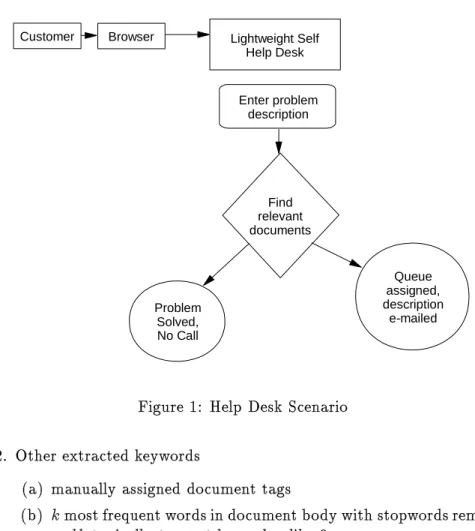
The objective of a document matcher is to match a new document to old documents and to rank the retrieved documents by assigning a score or relevance. The methodology is capable of taking a problem description, which may be just a few words or a long document, and nding relevant documents that may provide a solution. An example of an application of this technology is a self-help system for customers or a help desk tool for customer service representatives. Figure 1 illustrates one scenario for customer use of a lightweight help desk that employs a document matcher.
The lightweight document matching methods use only some of the avail-able elements of the document for searching, specically, the title of the document, the keywords assigned to the document, if any, and additional special tags as available, such as product names. Specically, documents in a repository are indexed using words only from the following sub-structures:
Customer Browser Lightweight Self Help Desk Enter problem description Find relevant documents Problem Solved, No Call Queue assigned, description e-mailed
Figure 1: Help Desk Scenario 2. Other extracted keywords
(a) manually assigned document tags
(b)
k
most frequent words in document body with stopwords removed andk
typically to a set low value like 8,A word is a set of contiguous alphanumeric characters, separated by delim-iters such as whitespace or punctuation.
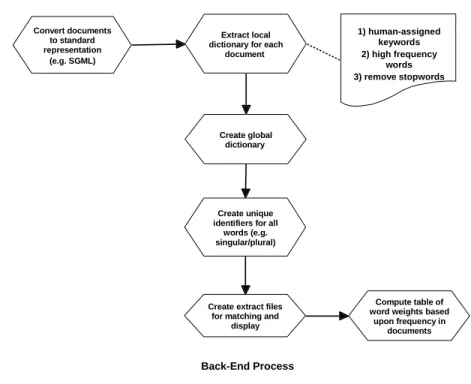
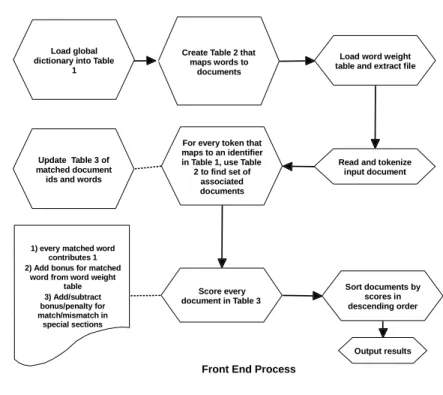
Figures 2 and 3 illustrate the overall process. An o-line back-end pro-gram processes the documents, using an XML-style markup language to delineate the parts of the documents relevant to text retrieval and presen-tation to the end user. An example of the markup for a single document is given below.
<DOC> <TITLE>
Twinax Tools: DUMP Task </TITLE>
Convert documents to standard representation
(e.g. SGML)
Extract local dictionary for each
document
Create global dictionary
Create unique identifiers for all
words (e.g. singular/plural)
Create extract files for matching and
display
Compute table of word weights based
upon frequency in documents Back-End Process 1) human-assigned keywords 2) high frequency words 3) remove stopwords
Figure 2: Algorithm Overview - Back-end Process
<KEYWORDS>
twinax tools dmpjob appc </KEYWORDS>
<COMPONENTS>
5716XA100 5763XA100 </COMPONENTS>
<TEXT>
Twinax Tools: DUMP Task
This document will contain the required steps to run a Dump Task for the twinax T1 component.
From the STRSST menu, select 1 to Start a service tool, then 4 for Display/Alter/Dump.
Select 2 if you want to Dump to printer Select 4 Tasks/Processes
Select 1 for Task
Select 5 to Display list of tasks
Load global dictionary into Table
1
Create Table 2 that maps words to
documents
Load word weight table and extract file
Read and tokenize input document For every token that
maps to an identifier in Table 1, use Table 2 to find set of
associated documents
Score every document in Table 3
Front End Process
Sort documents by scores in descending order Output results Update Table 3 of matched document ids and words
1) every matched word contributes 1 2) Add bonus for matched
word from word weight table 3) Add/subtract bonus/penalty for match/mismatch in special sections um
Figure 3: Algorithm Overview - Front-end Process
with T1- or choose another task defined by the developer. 10324314
</TEXT> </DOC>
Two data structures are derived from the resulting le:
a set of local dictionaries that contains the words that are relevant to specic documents. Typically, 8 to 10 keywords are assigned for each document. The words are not unique to documents; the same word may appear in many documents.
a pooled, global dictionary containing a list of all words that are rele-vant to any document. This is a unique collection of words.
The XML document contains information relevant to document retrieval that is not contained in these two data structures, such as document titles, and possibly application-specic attributes such as component identiers.
A nal XML-style extract document incorporates the contents of the local dictionaries with these additional attributes, as illustrated below. The words in the local dictionaries are represented by the internal identiers used by the object embodying the global dictionary.
<DOC> <TITLE>
Twinax Tools: DUMP Task </TITLE> <KEYWORDS> 573 226 2987 2944 969 2887 915 320 2601 </KEYWORDS> <COMPONENTS> 5716XA100 5763XA100 </COMPONENTS> </DOC>
These two data structures, a global dictionary and an extract le repre-senting a set of local dictionaries and additional attributes, are sucient for the fast document matcher to score new documents. Unless revised, the dic-tionaries are created once. They then can be read by an application program that repeatedly matches documents, and the program can be distributed to multiple users.
Given this document representation, a special scoring function is em-ployed to compare a request, entered as key words or as a natural-language document, to the stored document representations. The output is a ranked list of documents which are relevant to the problem entered. Words in the new document are matched to words in the global dictionary. Words must match exactly (plurals are mapped to singular) so that a hash table can be employed for almost immediate lookup in the table. The words in the global dictionary point to the local dictionaries of the stored documents.
The base score of each stored document is the number of its local key-words found in the new document. A bonus, usually 1, is then added to the base score, for every matched word that also appears in a title or special tags, e.g. product or release identier. Furthermore, a bonus equal to the predictive value of a matched word is also given. The predictive value of a word is 1
=n
, wherenum
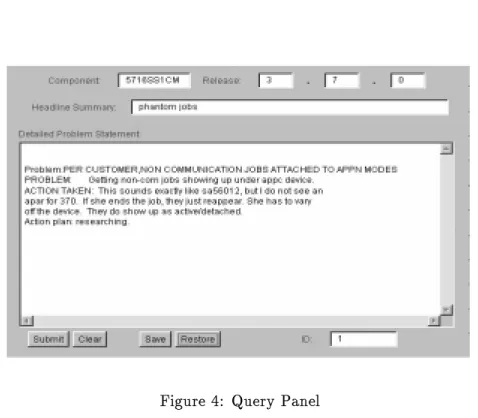
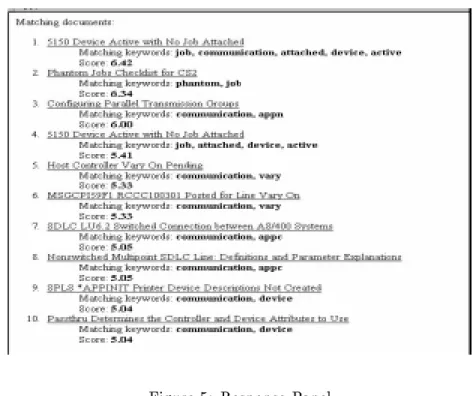
is the number of stored documents that contain that word.An example of a graphical user interface is shown in Figure 4. The html display produced in response to the query is shown in Figure 5. Not
Figure 4: Query Panel
all of these elds are required for all applications. If the text areas are separated into a single one-line summary versus a detailed description, then a slight bonus can be optionally assigned to words that appear in the one-line summary, giving extra weight to a "title" eect.
3 A Comparison to Classical Information Retrieval
Methods
Although they may score many words and documents, document matchers can be considered a variation of the classical information retrieval techniques used in search engines. The central theme of the lightweight document matcher is to reduce dimensions of large problems, resulting in ecient pro-cessing even in restricted environments. Let's look at the key characteristics of our approach and contrast them with classical information retrieval:
Figure 5: Response Panel
2. Exact word match with synonyms and no stemming except for plurals 3. Reduced indexing with no document frequencies
Equations 1 and 2 summarize the classical \cosine" approach to scoring [Salton & Buckley, 1997]. The data are weighted by \tf", the term frequency, i.e. the frequency of each word in a document, and \idf", the inverse doc-ument frequency, i.e. the number of times,
n
k, the k-th word appears in a document within a collection of N documents. This computation is more complicated than simple additive scoring and requires storage of frequency information. Scoring is a variation of nding the nearest-neighbors, as mea-sured by Equation 1, where Q is a new document that is matched to stored documents D. Our additive count is analogous to the cosine formula: our bonus is a form of idf. The denominator of the Equation 1 normalizes the computation, while our measures are relatively normalized with a count of 1 for each positive word match and a maximum of 1 for the bonus. The main dierence is the term frequency, where we just check for presence or absence of key or high frequency words. Term frequency helps with \recall" ofdocu-ments that otherwise might be lesser importance. The simple positive score has the great advantage of transparency of scoring, leaving the user with a clear explanation, in terms of identied key words, for the retrieval of a matched document.
similarity
(Q;D
) = P t k =1w
q kw
dk q P t k =1(w
q k) 2 P t k =1(w
dk) 2 (1)w
dk=tf
dkidf
k =tf
dklog
(N=n
k) (2)Our second attribute is greater reliance on exact matching of individual words without stemming, i.e. substring and common root matching. This is only justied when the feature space is reduced from full indexing.
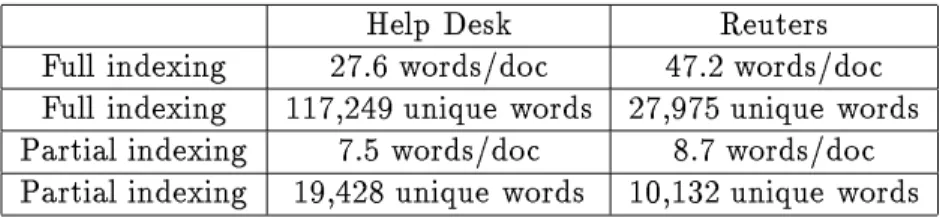
Help Desk Reuters
Full indexing 27.6 words/doc 47.2 words/doc
Full indexing 117,249 unique words 27,975 unique words
Partial indexing 7.5 words/doc 8.7 words/doc
Partial indexing 19,428 unique words 10,132 unique words Table 1: Indexing and Document Feature Lists
By far the greatest and most important technique for reducing complex-ity and application dimensions is item 3, reduced indexing. The number of documents that are referenced, the computations needed for matching many words, and the storage requirements, all grow dramatically with full indexing. Table 1 compares partial with full indexing for two applications. The dramatic eects on storage for a reduced indexing have been demon-strated in the GLIMPSE system[Manber & Wu, 1993]. There, disk storage is greatly reduced with some additional computation for nding substrings matches in text. In common with our lightweight document matcher is the greatly reduced inverted index. In our case, we use a reduced inverted index as the basis of all matching without any additional computation.
In the next section, we consider the eects of these dimension reduction techniques on predictive performance.
4 Results
Our goals are to build a document matcher that is (a) lightweight and (b) predictive. First, let's look at the goal of lightweight. Table 2 describes
var-ious measures of program performance for one of our help-desk applications. With a previous generation laptop, capacity of nearly 20,000 documents was achieved, and new documents were readily matched in real-time.
Computer 166MHz Thinkpad 560
Memory 48Mb
Java code 60Kb
Documents stored 17,415
Dictionary words 19,428
Response time per new document less than 1 second Table 2: Capacity and Performance for Help Desk Application Excellent capacity and runtime performance does not imply good predic-tive performance. We consider two forms of evaluation of predicpredic-tive capa-bility. First, the customer for the help-desk application did their own small, yet fully independent evaluation. They created 10 scenarios with brief prob-lem statements. The human experts' pre-selected the stored document that they considered to contain the correct solution. They concluded that for 7 of the 10 problems, the lightweight document matcher found the correct answer in one of its top ten document matches.
A more carefully controlled evaluation of predictive capability compares performance for text categorization. These tasks allow for training on la-beled documents, and new documents are assigned to one of a set of pre-dened topics. The literature on this task is extensive; many dierent meth-ods have been developed and their predictive performances measured[Apte, Damerau, & Weiss, 1994], [Weiss et al., 1999].
The lightweight document matcher's scoring procedures were formally evaluated on the well-known Reuters-21578 benchmark for text categoriza-tion [Lewis, 1995]. We used the Mod-Apte variacategoriza-tion of the benchmark with 9603 training documents and 3299 test documents. These are labeled doc-uments; each document is assigned one of 93 topics. Documents are scored by simply counting the number of dictionary words that appear in both a training and test document plus the bonus for the predictive value of those matched words.
The standard evaluation criterion for the Reuters benchmark is the breakeven point, the point at which precision equals recall on independent test documents. Given a binary classication problem of topic vs. not-topic, recall is the ratio of correct-topic-cases/total-topic-cases. Precision is
62 65 84 86 94 94 97 96 1 2 5 10 Top-k Matches 0 20 40 60 80 100 Accuracy 543 words 2133 words
Figure 6: Breakeven Accuracy For Top-k Matches
correct-topic-cases/total-predicted-topic-cases. If the three individual com-ponents of these measures are summed over all topics, we can compute an overall measure of performance. To obtain the breakeven point, the deci-sion threshold of a classier is artically adjusted. For our purposes, we need only a rough estimate of performance, and we average precision and recall. The best reported result is nearly 88% [Weiss et al., 1999], and the reported result for nearest-neighbor methods with cosine distance obtain about 82% with 30 nearest neighbors for each category and a 10,000 word dictionary[Joachims, 1997].
Figure 6 summarizes the results for dierent dictionary sizes and num-bers of matches accepted as correct. The 2133 word dictionary is identical to that used to achieve the benchmark 88% result of [Weiss et al., 1999]. The 543 word dictionary is formed using the same procedures as the 2133 word dictionary. Both use the most frequent words found for each topic: the larger dictionary uses the 150 most frequent words, the smaller, the 50 most frequent words. Stopwords, i.e. known weakly predictive words like pronouns, are removed prior to completing the nal dictionary. All
docu-ments were indexed with all words. When any of the top-k docudocu-ments is the correct class, the answer is marked correct. Figure 6 displays the increase in accuracy as the number of allowed top matches increases.
To solve the Reuters catgorization problem, clearly only one answer can be given. In Figure 6, the top-k matching documents were found, and a test document's label was marked correct if it appeared in any of the top-k matches. To provide a unique answer, the strongest approach is to accept the label that has the highest frequency among the top-k matched docu-ments, not just the label of the top ranked document. This is k-nearest neighbor scoring for our additive score as a distance measure, which com-putes distance only for words occurring in both the test document and its matched documents. To avoid top-10 ties for dichotomous classication, we found the top-11 documents for each test document. Using the same 2133 dictionary, the breakeven predictive performance was 79%. The result for the cosine distance measure, which also computes over positive word matches, was 82%. This result matches the previously published result, but uses a far smaller dictionary and unstemmed words.
5 Discussion
We have described lightweight document matching algorithms and represen-tations that have been implemented and tested in a Java program. Indexing is restricted to a relatively small number of keywords per document. The presence or absence of a word in a document is determined by exact word match, which is readily implemented by ecient hash table lookup with no stemming, no lexical analysis, and no frequency counts. A simple additive scoring method is employed that counts positive word matches.
The idea of processing text for classication or processing queries by re-trieving relevant documents has been a fundamental task of many research communities for decades. We have shown that by combining relatively light-weight approaches, we produced a solution that computes eciently even in restricted environments, such as mobile or small desktop computers. This approach can mimic a search engine, yet has the capability to match a new document of many thousands of words. In our recent applications, the typ-ical size of documents in the repositories was in the 20,000 range. For one help-desk application, the entire system easily resides on a laptop, requiring only about 50MB of disk space to store and search documents.
good. Matched to systems that train on labeled data, the lightweight al-gorithm gives reasonable predictive performance for classication problems that require a unique answer[Yang, 1998]. Performance for a simple ad-ditive score of positive word-matches is only slightly weaker than nearest neighbor methods that compute the more complex cosine distance over fully indexed documents. However, in our expected application environment for document matching, multiple answers are satisfactory, and the user may intervene and discriminate among the top document choices, ltering the strong from weak responses. Experimental results support the idea that for any reasonable scoring method some good answers are likely to appear in a top-10 set of potential document matches.
The fast document matcher seems to be an ideal solution component for building help-desk and retrieval systems for mobile computing or the expected proliferation of distributed computers and network appliances.
References
[Apte, Damerau, & Weiss, 1994] Apte, C.; Damerau, F.; and Weiss, S. 1994. Automated Learning of Decision Rules for Text Categorization. ACM Transactions on Information Systems12(3):233{251.
[Chang et al., 1996] Chang, K.; Raman, P.; Carlisle, W.; and Cross, J. 1996. A self-improving helpdesk service using case-based reasoning techniques. Computers in Industry113{125.
[Joachims, 1997] Joachims, T. 1997. Text Categorization with Support Vec-tor Machines: Learning with Many Relevant Features. Technical report, University of Dortmund.
[Lewis, 1995] Lewis, D. 1995. README File for the Reuters Text Distrib-ution. Technical report, ATT. See http://www.research.att.com/lewis. [Manber & Wu, 1993] Manber, U., and Wu, S. 1993. Glimpse: A tool to
search through entire le systems. Technical Report TR 93-34, University of Arizona. See http://glimpse.cs.arizona.edu/webglimpse/index.html. [Salton & Buckley, 1997] Salton, G., and Buckley, C. 1997. Term-weighting
approaches in automatic text retrieval. In Sparck-Jones, K. and. Willet, P., ed., Readings in Information Retrieval. Morgan Kaufmann. 323{328. [Salton & McGill, 1997] Salton, G., and McGill, M. 1997. The smart and sire experimental retrieval systems. In Sparck-Jones, K. and. Willet, P., ed., Readings in Information Retrieval. Morgan Kaufmann. 381{399. [Schapire & Singer, 1999] Schapire, R., and Singer, Y. 1999. Boostexter: A
boosting-based system for text categorization. Machine Learning in press. [Stanll & Waltz, 1986] Stanll, C., and Waltz, D. 1986. Toward
memory-based reasoning. ACM Communications 1213{1228.
[Weiss et al., 1999] Weiss, S.; Apte, C.; Damerau, F.; and et al. 1999. Max-imizing text-mining performance. IEEE Intelligent Systems in press. [Yang, 1998] Yang, Y. 1998. An evaluation of statistical approaches to text