Dissertation
zur Erlangung des akademischen Grades Doktor-Ingenieur
Vorgelegt
der Fakultät für Elektrotechnik und Informationstechnik der Technischen Universität Chemnitz
von M.Sc.,Ronald Romero Reyes
Dissertation
zur Erlangung des akademischen Grades Doktor-Ingenieur
Vorgelegt
der Fakultät für Elektrotechnik und Informationstechnik der Technischen Universität Chemnitz
von M.Sc.,Ronald Romero Reyes
Notwendigkeit einer Umstellung auf dynamische, optische Netze, welche die kurzfristige Bereitstellung von Bandbreite auf Nachfrage (Bandwidth on Demand - BoD) ermöglichen. Diese Netze müssen Verbindungen mit unterschiedlichen Bitratenanforderungen, mit zufälligen Ankunfts- und Haltezeiten und stringenten Einrichtungszeiten realisieren können. Grid Computing und Cloud-basierte Dienste führen in manchen Fällen zu Verbindungsanforderungen mit Haltezeiten im Bereich von Sekunden, wobei die Einrichtungszeiten im Extremfall in der Größenordnung von Millisekunden liegen können.
Bei optischen Netzen für BoD muss der Verbindungsaufbau und -abbau, sowie das Netzmanagement ohne manuelle Eingriffe vonstattengehen. Die dafür notwendigen Technologien sind Flex-Grid-Wellenlängenmultiplexing, rekonfigurierbare optische Add / Drop-Multiplexer (ROADMs) und bandbreitenvariable, abstimmbare Transponder. Weiterhin sind Online-Ressourcenzuweisungsmechanismen erforderlich, um für jede eintreffende Verbindungsanforderung abhängig vom aktuellen Netzzustand entscheiden zu können, ob diese akzeptiert werden kann und welche Netzressourcen hierfür reserviert werden. Dies bedeutet, dass die Ressourcenzuteilung als Online-Optimierungsproblem behandelt werden muss. Die Entscheidungen sollen so getroffen werden, dass auf lange Sicht ein vorgegebenes Optimierungsziel erreicht wird. Die Ressourcenzuweisung bei dynamischen optischen Netzen lässt sich in die Teilfunktionen Routing- und Spektrumszuteilung (RSA), Verbindungsannahmekontrolle (CAC) und Dienstgütesteuerung (GoS Control) untergliedern.
In dieser Dissertation wird das Problem der Online-Ressourcenzuteilung in dynamischen optischen Netzen behandelt. Es wird die Theorie der Markov-Entscheidungsprozesse (MDP) angewendet, um die Ressourcenzuweisung als Online-Optimierungsproblem zu formulieren. Die MDP-basierte Formulierung hat zwei Vorteile. Zum einen lassen sich verschiedene Optimierungszielfunktionen realisieren (z.B. die Minimierung der Blockierungswahrscheinlichkeiten oder die Maximierung der wirtschaftlichen Erlöse). Zum anderen lässt sich die Dienstgüte von Gruppen von Verbindungen mit spezifischen Verkehrsparametern gezielt beeinflussen (und damit eine gewisse GoS-Steuerung realisieren). Um das Optimierungsproblem zu lösen, wird in der Dissertation ein schnelles, adaptives und zustandsabhängiges Verfahren vorgestellt, dass im realen Netzbetrieb rekursiv ausgeführt wird und die Teilfunktionen RSA und CAC umfasst. Damit ist das Netz in der Lage, für jede eintreffende Verbindungsanforderung eine optimale Ressourcenzuweisung zu bestimmen. Weiterhin wird in der Dissertation die Implementierung des Verfahrens unter Verwendung eines 3-Way-Handshake-Protokolls für den Verbindungsaufbau betrachtet und ein analytisches Modell vorgestellt, um die Verbindungsaufbauzeit abzuschätzen. Die Arbeit wird abgerundet durch eine Bewertung der Investitionskosten (CAPEX) von dynamischen optischen Netzen. Es werden die wichtigsten Kostenfaktoren und die Beziehung zwischen den Kosten und der Performanz des Netzes analysiert. Die Leistungsfähigkeit aller in der Arbeit vorgeschlagenen Verfahren sowie die Genauigkeit des analytischen Modells zur Bestimmung der Verbindungsaufbauzeit wird durch umfangreiche Simulationen nachgewiesen.
Schlagwörter
Dynamische Optische Netze, Flex-grid Wavelength Division Multiplexing (WDM), Online Routing and Spectrum Allocation (RSA), Connection Admission Control (CAC), Ressourcenzuweisung, Dynamische Programmierung, Markov Entscheidungsprozesse, Capital Expenditures (CAPEX)
Bibliographic Description
Ronald Romero Reyes
Online Resource Allocation in Dynamic Optical Networks Dissertation
162 Pages, 61 Figures, 31 Tables, 118 References
Abstract
Conventional optical transport networks have leveraged the provisioning of high-speed connectivity in the form of long-term installed, constant bit-rate connections. The setup times of such connections are in the order of weeks, given that in most cases manual installation is required. Once installed, connections remain active for months or years. The advent of grid computing and cloud-based services brings new connectivity requirements which cannot be met by the present-day optical transport network. This has raised awareness on the need for a changeover to dynamic optical networks that enable the provisioning of bandwidth on demand (BoD) in the optical domain. These networks will have to serve connections with different bit-rate requirements, with random interarrival times and durations, and with stringent setup latencies. Ongoing research has shown that grid computing and cloud-based services may in some cases request connections with holding times ranging from seconds to hours, and with setup latencies that must be in the order of milliseconds.
To provide BoD, dynamic optical networks must perform connection setup, maintenance and teardown without manual labour. For that, software-configurable networks are needed that are deployed with enough capacity to automatically establish connections. Recently, network architectures have been proposed for that purpose that embrace flex-grid wavelength division multiplexing, reconfigurable optical add/drop multiplexers, and bandwidth variable and tunable transponders as the main technology drivers. To exploit the benefits of these technologies, online resource allocation methods are necessary to ensure that during network operation the installed capacity is efficiently assigned to connections. As connections may arrive and depart randomly, the traffic matrix is unknown, and hence, each connection request submitted to the network has to be processed independently. This implies that resource allocation must be tackled as an online optimization problem which for each connection request, depending on the network state, decides whether the request is admitted or rejected. If admitted, a further decision is made on which resources are assigned to the connection. The decisions are so calculated that, in the long-run, a desired performance objective is optimized. To achieve its goal, resource allocation implements control functions for routing and spectrum allocation (RSA), connection admission control (CAC), and grade of service (GoS) control. In this dissertation we tackle the problem of online resource allocation in dynamic optical networks. For that, the theory of Markov decision processes (MDP) is applied to formulate resource allocation as an online optimization problem. An MDP-based formulation has two relevant advantages. First, the problem can be solved to optimize an arbitrarily defined performance objective (e.g. minimization of blocking probability or maximization of economic revenue). Secondly, it can provide GoS control for groups of connections with different statistical properties. To solve the optimization problem, a fast, adaptive and state-dependent online algorithm is proposed to calculate a resource allocation policy. The calculation is performed recursively during network operation, and uses algorithms for RSA and CAC. The resulting policy is a course of action that instructs the network how to process each connection request. Furthermore, an implementation of the method is proposed that uses a 3-way handshake protocol for connection setup, and an analytical performance evaluation model is derived to estimate the connection setup latency. Our study is complemented by an evaluation of the capital expenditures of dynamic optical networks. The main cost drivers are identified.
The performance of the methods proposed in this thesis, including the accuracy of the analytical evaluation of the connection setup latency, were evaluated by simulations. The contributions from the thesis provide a novel approach that meets the requirements envisioned for resource allocation in dynamic optical networks.
Keywords
Dynamic Optical Networks, Flex-grid Wavelength Division Multiplexing (WDM), Online Routing and Spectrum Assignment (RSA), Connection Admission Control (CAC), Resource Allocation, Dynamic Programming, Markov Decision Processes (MDP), Capital Expenditures (CAPEX)
Acknowledgements
This dissertation was completed at the Chair for Communication Networks at the Technische Universität Chemnitz, Germany. Part of this work was supported by the German Federal Ministry of Education (BMBF), project VINO. I thank my doctoral supervisor Prof. Dr.-Ing. Thomas Bauschert not only for giving me the opportunity to participate in this project, but for his valuable guidance, support and constant dedication. His ideas and suggestions were key to the development of the models proposed in this thesis. I would also like to express my gratitude to my students Vishwanath Pai and Omair Ali for their support and dedication in the outstanding implementation work they performed. Also I thank my colleagues at the Chair for Communication Networks. They provided me with a pleasant working environment and were always open to exchange their knowledge and to provide constructive ideas. Last but not least I thank and dedicate this work to my parents Manuel and Elizabeth, and my brothers Alexander and Rosemberg. They are the most important persons in my life, without their love and emotional support I would have never been able to accomplish this work.
Contents
Chapter 1 Introduction and Motivation ... 1
1.1. Problem Statement ... 2
1.2. Research Contributions ... 3
1.3. Publications ... 4
1.4. Thesis Outline ... 4
Chapter 2 Dynamic Optical Networking ... 6
2.1. Dynamic Optical Network Architecture ... 6
2.2. Technology Drivers ... 8
2.3. Network Planning Challenges ... 10
2.4. Modelling Dynamic Optical Networks as Large-Scale Stochastic Systems ... 14
2.5. Chapter Summary ... 15
Chapter 3 Reward-based Resource Allocation in Dynamic Optical Networks ... 17
3.1. Stochastic Network Model... 17
3.2. Policy-based Online Resource Allocation ... 21
3.3. Network Reward Maximization Problem ... 24
3.4. Network Reward Maximization as a Markov Decision Process ... 33
3.5. Chapter Summary ... 39
Chapter 4 Approximate Approach to Online Resource Allocation... 41
4.1. Approximate Reward Maximization Problem ... 41
4.2. Macrostate-Dependent Network Reward Model ... 47
4.3. Online Estimation of Link Arrival Rates ... 55
4.4. Approximate Policy Iteration Algorithm ... 57
4.5. Chapter Summary ... 64
Chapter 5 Performance Evaluation Results ... 66
5.1. General Remarks ... 66
5.2. Performance Comparison of the Exact and the Approximate Reward Models ... 68
5.3. Performance Analysis of the Approximate PIA ... 77
7.2. Calculation of Infrastructure Costs in Dynamic Optical Networks ... 110
7.3. Evaluation of Network Infrastructure Costs ... 115
7.4. Chapter Summary ... 121 Chapter 8 Conclusion ... 123 List of Acronyms... 127 List of Figures ... 129 List of Tables ... 131 Bibliography ... 132 Annex ... 141
Current optical transport networks are circuit-switched systems that carry customer demands on optical connections. For that, fixed-grid Wavelength Division Multiplexing (WDM) is implemented in the optical layer. A connection is a lightpath that consists of an optical channel established on a route between two network nodes. Nowadays, setup times for optical connections are in the order of weeks as in most cases manual labour is required for the provisioning of resources. Once established, connections remain active for months or years. Most operators today deploy fixed-grid WDM networks that multiplex up to 80 channels per fibre at a 50 GHz spacing. Each channel may carry a single connection with typical fixed bit-rates of 10, 40 and 100 Gbps. This inflexible and static design of the optical layer was conceived for the provisioning of constant bit-rate connections without stringent setup requirements. A typical use case of this type of connectivity is the transport of Internet protocol (IP) traffic. Operators overprovision capacity in the optical layer (by leasing/deploying high-speed, constant-bit rate connections) to cope with the burstiness of IP traffic. According to [Rob05, SS11], in 2005 it was observed that the lightpaths used to serve IP traffic had around 25 percent average utilization in the US Internet. This trend continues today, which evinces that optical capacity is not being used efficiently, as it is underutilized at the expense of high network deployment costs.
The constant IP traffic growth together with the emergence of grid computing and cloud-based services are imposing new connectivity requirements on the optical layer. This is raising awareness on the need for a changeover to dynamic optical networks. As argued in [Sal06, Sal07, Sim14], besides capacity benefits, dynamic optical networking enables the provisioning of bandwidth on demand (BoD) in the optical layer. Hence, instead of supplying long-term installed, constant bit-rate connectivity, dynamic optical networks are expected to serve connections with different bit-rate requirements, and with random interarrival and holding times. Besides, connections may need to be set up and torn down rapidly. (According to [Sal06, Sal07], to cope with the connectivity needs of grid computing and cloud-based services, the optical network will have to serve connections with interarrival and holding times ranging from seconds to hours.) The scientific community is currently working on the definition of a network architecture that meets these connectivity requirements. In order provide fast BoD connectivity, this architecture must be software-controlled so that connections are automatically configured without manual intervention. Ongoing efforts in this direction have embraced flex-grid WDM [ITU12], reconfigurable optical add/drop multiplexers (ROADMs) [PFRC11, PP12], and bandwidth variable & tunable transponders [SS12, TAS+14] as the key
technology drivers. In particular, the Core Optical Networks program (CORONET) [Sal06] - one of the most visible initiatives that promoted the definition of a dynamic optical network architecture - has adopted these drivers to develop two contributions: a directionless/colorless ROADM architecture [WFJA10, SCG+12] that interworks with a shared pool of transponders [SW10, CCC+12, SCG+12], and a 3-way
handshake (3WHS) protocol that enables setup times in the range of milliseconds to seconds [CCC+12,
SCG+12, SN09, SGK+14]. The idea behind CORONET’s proposal is that the network must be installed
with enough capacity to cope with an expected demand growth without manual labour. For that, the nodes are designed with ROADMs equipped with pools of shared transponders. Hence, instead of installing a dedicated pair of transponders for each point to point connection (like conventional networks do), the dimensioning, i.e. the estimation of the number of transponders, and the installation of pools is performed before the network gets operational. Then during operation, the customer signals are assigned - on demand - to transponders in the pool, thereby avoiding manual configurations. This implies that a connection request may get blocked if transponders are unavailable in the shared pools of the source/destination ROADMs. To minimize this effect, in [SW10, SCG+12] a pool dimensioning method was proposed that
obtains low transponder-related blocking probabilities (e.g. less than 10-4). By having sufficient installed
capacity in the nodes, the 3WHS protocol was then proposed as the most efficient strategy to perform fast connection setup. For a connection request, the 3WHS protocol - unlike the generalized multiprotocol
label switching (GMPLS) [Ber03, Man04] mechanisms for connection setup - simultaneously probes resources on different paths, and therefore, it provides the network with real time information for more efficient resource allocation. Another advantage, as seen in [SCG+12], is that the protocol performs well
at minimizing backward blocking (i.e. the blocking arising from concurrent connection requests trying to seize the same resources on a given path). These capabilities render the 3WHS protocol more efficient than GMPLS. A thorough discussion of the advantages of the 3WHS protocol over GMPLS can be found in [CCC+12, SCG+12].
The aforementioned innovations represent a first step towards the implementation of dynamic optical networks. However, further work is still needed for the definition of a control plane architecture, along with appropriate signalling mechanisms, that enable automatic multilayer/inter-domain interoperability. This is a prerequisite to automatically deliver BoD to higher technology layers such as IP. In this respect, ongoing research suggests that software defined networking (SDN) [ONF13, ONF14] can be the control plane solution for that purpose. For instance, in [Das12] an SDN-based framework was proposed for the convergence of packet and optical circuit-switched networks. This work forms the basis to start with the definition of SDN-based control mechanisms for dynamic optical networks. Such mechanisms include (to name a few): signalling procedures whereby higher technology layers (like IP) request BoD from the optical layer, signalling procedures for connection setup (for instance, those procedures should define how to realize protocols like the 3WHS in an SDN framework), and the definition of a flow control mechanism that supports the spectrum granularity of flex-grid WDM. (Note that a typical fixed-grid system supports spectrum grids with 50 GHz channels, whereas flex-grid defines a finer granularity with 6.25 GHz channel slots [ITU12].) Besides these open research challenges, another problem to tackle is the development of strategies for optimum resource allocation. In dynamic optical networks, connections may arrive and depart randomly. Therefore, the network has to implement online control functions to efficiently assign the installed capacity on demand. This means that every connection request submitted to the network has to be processed independently. This problem is the main focus of this thesis and will be described in more detail in the following section.
1.1.
Problem Statement
Offline network planning and online resource allocation play a relevant role in the design of efficient network infrastructures. In dynamic optical networks, offline planning relies on demand forecasting to perform the dimensioning of links, ROADMs and transponders (i.e. it guarantees that sufficient infrastructure is deployed to provide BoD without manual intervention). On the other hand, online resource allocation ensures that the installed capacity is efficiently assigned to the connections served in the network. This is achieved by implementing network control functions for routing and spectrum allocation (RSA), connection admission control (CAC) and grade of service (GoS) control. These functions aim at providing quality of service (QoS) guarantees while the resources are optimally exploited.
Assuming an operational network with ROADMs equipped with pools of transponders, blocking of a connection request may occur either if transponders are unavailable in the shared pools of the source and destination ROADMs, or if a suitable lightpath cannot be found in the network. Low transponder-related blocking probabilities, as mentioned in the previous section, are achieved by a proper dimensioning of the transponder pools. On the other hand, the control of the blocking probability (i.e. the GoS) due to the unavailability of lightpaths is a task of online resource allocation. For a committed GoS, upon arrival of a connection request, resource allocation uses an online RSA algorithm to calculate candidate lightpaths. Then, based on admission decision rules, CAC determines the lightpath appropriate for the connection. Besides performing GoS control, resource allocation needs to fulfil at least three additional requirements to efficiently supply BoD. First, RSA and CAC algorithms must be fast, adaptive and state-dependent. Fast as resource allocation is performed on the time scale of connection interarrival times. Adaptive to varying traffic conditions, i.e. the criteria used to calculate lightpaths and to define the admission decision rules must dynamically change according to the statistical properties of the traffic. Also, admission control must take decisions that depend on the state, i.e. actual resource occupancy, of the network. Secondly, resource allocation algorithms must be designed to interwork with connection setup protocols. In reality, connection setup involves resource allocation. Thus, the design and implementation of network control functions for RSA and CAC needs to be aware of the signalling mechanisms whereby connections are established in the network. And thirdly, instead of solely minimizing blocking probabilities, the algorithms should allow optimization of other desired performance objectives, e.g. economic revenue maximization or cost minimization.
The design of online resource allocation algorithms that satisfy these requisites is an open problem. Today research on this field has focused on the design of online RSA algorithms. Existing approaches, e.g. [WWL10, CTV11b, PJJW11a, WWH+11, WZK+11, CVR+12, WZZ+12, ADB+13, CTV13], solely
aim at minimizing the overall blocking probability, and do not allow GoS control of individual connection classes. (We adopt the term class to refer to a group of connections which have similar properties such as
by the network to assign resources to connections depending on the network state.) The advantage of this approach is that the reward parameters can be set either to optimize any desired objective (e.g. blocking minimization, maximization of carried traffic or economic revenue) or to equalize or prioritize the GoS offered to different connection classes. MDP theory also provides the mathematical method to calculate the optimum policy. To apply this theory to the design of control algorithms for a specific type of network, it is mandatory to define first a stochastic model for the network. This includes a proper definition of the network state and the constraints of the optimization problem. With the model defined, the time evolution of the network state is represented as a stochastic process. Then MDP theory is used to control this process according to the desired optimization objective. This methodology was successfully applied to the design of adaptive and state-dependent routing in telephone and multiservice networks [DPKW88, DM89, DM92, DM94, Kri91, HKT00, Hwa93, Dzi97, Nor02]. However, those algorithms are not applicable to optical systems. The reason is that they describe stochastic networks with states and constraints that do not model the actual properties of the optical layer. In this thesis we therefore extend the applicability of MDP theory to the design of resource allocation methods for dynamic optical networks. The main contributions made to achieve this goal are:
1. Formulation of an exact reward-based resource allocation algorithm: a method is proposed whereby dynamic flex-grid optical networks are modelled as large-scale stochastic loss systems. The network state is defined as the configuration of the optical spectrum over all network links. This configuration is determined by the connections carried in the network, and hence, the state is given by the spectrum configurations of lightpaths that fulfil the contiguity and continuity constraints. (In flex-grid systems, a lightpath consists of contiguous spectrum slots centered at the same frequency on each link used by the lightpath.) Given this definition of state, the time evolution of the network is modelled as a continuous-time stochastic process. By applying MDP theory to control this process, resource allocation is formulated as a reward-based optimization problem. The solution is calculated by an online iteration algorithm that determines the optimum resource allocation policy. This policy is a set of state-dependent decisions on RSA and CAC that tell the network how to process each connection request. The approach guarantees that if the policy is used to allocate resources, the network reward rate is maximized. Since the policy calculation is performed online, its decisions are adaptive to changing traffic conditions. Besides, the approach optimizes any desired objective (and if needed performs GoS control) by properly setting the reward parameters. The proposed algorithm extends the applicability of MDP theory to the control of stochastic systems subject to contiguity and continuity constraints.
2. Formulation of an approximate reward-based resource allocation algorithm: a drawback of state-dependent control is that the computational complexity grows with the size of the network state-space. That is also the case of the exact reward-based algorithm, which is unsolvable for large-size networks. To circumvent this problem, a link decomposition approach is used whereby the rate of reward from the network is approximated as the sum of the link reward rates. By this strategy, the optimization problem is decomposed into separate problems (one for each link) by assuming statistical independence of the link state distributions. This approach reduces the computational effort required to calculate the resource allocation policy. In order to improve the adaptability to varying traffic conditions, the approach implements a method to estimate from online measurements the offered traffic. This allows the network to adapt the state-dependent policy decisions for each connection request.
3. Definition of an implementation scenario for the approximate reward-based algorithm with the 3WHS protocol: online resource allocation is part of the connection setup procedure. In that
respect, the 3WHS protocol for connection setup is adapted to perform resource allocation with the approximate reward-based algorithm. In the proposed scenario, the node that receives the connection request triggers the connection setup process, whereas the destination node calculates the policy decisions on CAC and RSA, and starts the resource allocation procedure. A centralized control plane is responsible for coordinating the whole process. The signalling mechanism of the 3WHS protocol guarantees setup latencies in the range of milliseconds to seconds. The proposed approach can be realized as an extension to GMPLS or as an SDN-based implementation. 4. Analytical approach to evaluating connection setup latency in dynamic optical networks:
an analytical method to estimate the connection setup latency of the 3WHS protocol is proposed. For that, the protocol is modelled as a task graph which represents the signalling latency during the connection establishment phase. By using reduction techniques, the graph is simplified so as to obtain a performance model that estimates the mean connection setup time. The analytical model provides precise estimates of the connection setup latencies. The advantage of the task graph approach is that it is applicable to any connection setup protocol operating with arbitrary resource allocation algorithms. Thus, the provided analysis can easily be extended to estimate latencies in different implementation scenarios for online resource allocation.
5. Evaluation of infrastructure costs for dynamic optical networking: a comprehensive cost model to evaluate the capital expenditures (CAPEX) for dynamic optical networks is provided. Based on a given traffic demand, the cost model uses a bottom-up approach to dimensioning the directionless/colorless ROADMs and the shared pools of transponders in the network. Then the infrastructure costs are evaluated. The approach provides a framework to identify the main cost drivers. The model can further be applied to calculate the network operational expenses (OPEX) and the total cost of ownership (TCO). The work extends the scope of existing cost evaluation studies for flex-grid WDM networks, e.g. [LYL+12].
The performance of all methods proposed in this thesis, including the accuracy of the analytical evaluation of the connection setup latency, were evaluated by simulations.
1.3.
Publications
The contributions to this thesis from the author are published in two journal papers [RB17a, RB17b] and nine conference papers [RB15, REB15, RB16a, RB16b, RB16c, RB16d, RB17c, RAB18, RB18a]. Another publication from the author related to the topic is [GREB17]. A synopsis of the thesis that summarizes relevant findings is published in [RB18b].
1.4.
Thesis Outline
The thesis is organized as follows. In Chapter 2 the architecture for dynamic optical networks is explained. Emphasis is given on the main technology drivers, the network planning challenges and the importance of modelling the network as a large-scale stochastic system. This chapter provides the main definitions and assumptions used in the remaining chapters of the thesis. Chapter 3 is focused on the formulation of the exact reward-based algorithm for resource allocation. For that, a stochastic loss model is defined for dynamic optical networks. Then the concept of policy is introduced, and MDP theory is applied to derive the reward-based optimization problem. An online policy iteration procedure is formulated to calculate the optimum resource allocation policy. In Chapter 4 a link independence assumption is applied to the derivation of an approximate reward-based algorithm. A simplified iteration procedure is proposed to calculate the resource allocation policy. The procedure uses an online estimation method that adapts the policy decisions to the stochastic properties of the traffic. Chapter 5 presents performance evaluation results obtained by simulations. First a performance comparison is made between the exact and the approximate reward-based algorithms. The purpose is to assess the accuracy of the approximate method. Besides, for different network topologies, a thorough performance analysis is made on the approximate algorithm. Chapter 6 describes a control plane implementation for the approximate approach with the 3WHS protocol. Furthermore, an analytical performance evaluation model is proposed to estimate the protocol latency. Simulations are used to assess the accuracy of the model. In Chapter 7 a bottom-up cost calculation framework is proposed to calculate the CAPEX in dynamic optical networks. In particular, the cost contributions from ROADMs and transponders to the network CAPEX is studied. Finally, Chapter 8 concludes the thesis and outlines future research challenges.
Chapter 2
Dynamic Optical Networking
This chapter describes an architecture envisioned for the design and implementation of dynamic optical networks. The architecture defines the network model used in the next chapters of this thesis. Section 2.1 outlines the transport services and technology layers that are currently driving the emergence of dynamic optical networking. In particular, a multilayer/multiservice transport network architecture is defined for the provisioning of bandwidth on demand over the photonic layer. In Section 2.2 we introduce the key technology enablers to dynamic optical networking, namely, the flexible spectrum grid (denoted as flex-grid), the bandwidth variable and tunable transponders, and the flexible optical switches. Section 2.3 discusses network design challenges that involve network control functions for online resource allocation. In Section 2.4 we argue on the importance of designing those control functions by modelling the network as a large-scale stochastic system. By this approach, it is possible to implement control mechanisms that guarantee optimum utilization of the network resources.
2.1.
Dynamic Optical Network Architecture
Communication service providers (CSP) supply information, transport and passive infrastructure services. Information services provide mechanisms to generate, store, process and retrieve information [CW03]. Transport offers transparent transmission of information without modifying its content. On the other hand, passive infrastructure services provide the physical support for the provisioning of transport. To offer those services, CSPs deploy multiservice networks that integrate different technology layers [REB15, RB17b]. In particular, the photonic (or optical) layer plays a relevant role as it leverages the provisioning of high-speed connectivity over access, metro and core networks. In the following we focus on the core or transport network and outline an architecture that has been envisioned for a dynamic optical layer.
2.1.1
Transport Services and Technology Layers
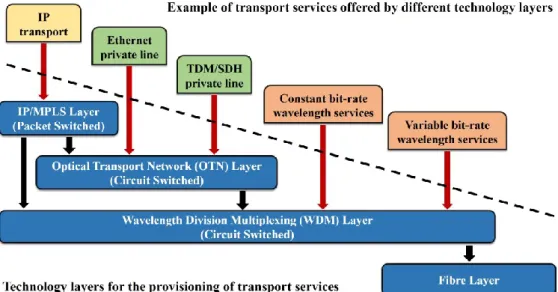
Core networks may provide a variety of transport services by integrating packet and circuit switched networking technologies. Figure 2.1 gives an overview of such integration which derives in a multilayer and multiservice core network. At the bottom is the fibre layer which provides the physical support for the provisioning of transport. Upon this fibre-based layout, we have the WDM layer which provides high-speed (constant bit-rate and variable bit-rate) wavelength services. On top of this layer, the optical transport network (OTN) technology can be provisioned to supply sub-wavelength services such as Ethernet and time division multiplexing (TDM) private lines. (Synchronous digital hierarchy (SDH) and synchronous optical network (SONET) services can be provisioned over OTN as well.) At the top we find the Internet protocol/multiprotocol label switching (IP/MPLS) layer which provides the transport commonly offered by internet service providers. Unlike IP/MPLS and Ethernet, which are implemented by packet-switched technologies, WDM, OTN, TDM and SDH/SONET services are realized by circuit-switched networking systems.
The service classification in Fig. 2.1 points out the importance of WDM as the key technology enabler for the provisioning of high-speed transport at all upper layers. Optical transport networks are the circuit-switched systems that implement the WDM layer. These networks carry client signals, e.g. wavelength services, IP/MPLS and OTN traffic streams, on optical connections provisioned as lightpaths, i.e. optical channels established on a route between two nodes. Today the WDM layer is static in the sense that the setup times for optical connections are in the order of weeks, and once established, connections remain
Figure 2.1: Transport services and technology layers that define the core network.
active for months or years. With the emergence of cloud-based services and grid computing, it is expected an evolution towards a dynamic WDM layer capable of providing high-speed bandwidth on demand [BSBS08, JTK+09, MCD+11, AWY13, Sim14, CDF+15]. This implies a changeover to highly-dynamic
networks where connections can be rapidly set up and torn down. In this future scenario, optical connections are expected to have random arrival times and different bandwidth requirements.
2.1.2
Network Architecture for the Dynamic Optical WDM Layer
In order to cope with the stringent connectivity requirements from applications such as those based on cloud services and grid computing, the WDM layer must be implemented as a dynamic optical network. We adopt the term “dynamic” to refer to an optical transport network which has the following attributes:
The network is able to provide BoD connectivity to the customers, i.e. optical connections can be established when and where needed. This has two relevant implications. First, the network must be installed with the infrastructure required to establish connections without involving manual intervention [CCC+12, SCG+12, Sim14]. Secondly, connections (if needed) can be
rapidly set up and torn down. In [Sal06, Sal07] it is shown that connections might require setup times in the order of milliseconds to seconds (e.g. for inter-data centre networks).
The network performs resource allocation for connection requests which may arrive randomly and which may have different bandwidth requirements. Furthermore, these requests may need to be served either upon arrival or at some specific time - as defined by the customer - after the arrival (this is the case of scheduled traffic, where a request is submitted in advance for the reservation of resources [Sim14]). The connection holding times can be either random (i.e. the connections can arbitrarily be terminated by the customers) or deterministic. This implies that the network has to implement resource allocation algorithms to efficiently serve the traffic demand.
To address these requirements, in Fig. 2.2 we present an architecture for dynamic optical networks which is based on the concepts developed in [Sal06, Sal07, SN09, SW10, WFJA10, MCD+11, SS11, CCC+12,
SCG+12, CDF+15]. The architecture is realized by three key technology drivers, namely, flex-grid WDM
[TAS+14], bandwidth variable and tunable transponders and flexible ROADMs.
Besides enabling an efficient utilization of the optical spectrum, flex-grid WDM makes possible the provisioning of connections with different bandwidth requirements. To implement this technology in a dynamic environment, the optical network is installed with nodes that integrate three components: a fibre crossconnect (FXC), a directionless and colorless flexible ROADM, and a shared pool of transponders [SW10, WFJA10, CCC+12, SCG+12]. As seen in Fig. 2.2 the fibre crossconnect interconnects (on demand)
the client interfaces to transponders in the pool. The transponders must be bandwidth variable and tunable, so that they can dynamically be configured to provision the bandwidth requested by the connections. The pool of transponders connects to a ROADM which is responsible for adding/dropping and switching (in the optical domain) connections.
Figure 2.2: Dynamic optical network architecture.
The customers of the dynamic optical network are higher technology layers such as OTN and IP/MPLS or clients that request high-speed (either constant or variable bit-rate) wavelength services. If the customers are far away from the nearest point of presence (POP) of the network provider, their customer premises equipment (CPE) may reach the POP via a dedicated channel over an access/metro network. Otherwise, if the CPE is collocated at the POP, a short-range interconnection, e.g. grey or coloured [RKD+13], can be
used to reach the FXC of the optical node (see Fig. 2.2).
2.2.
Technology Drivers
Conventional optical transport networks use fixed-grid WDM [ITU12] as the technology that multiplexes different connections onto a single optical fibre. With this technology, the optical spectrum is split into channels spaced at a fixed distance (expressed in GHz). For instance, most operators today deploy fixed-grid systems that multiplex up to 80 channels per fibre at a 50 GHz spacing. This WDM variant is known as dense WDM (DWDM). Each channel may carry connections with typical (fixed) bit-rates of 10, 40 and 100 Gbps. The major drawback of this technology is the inefficient usage of the spectrum resources. The emergence of advance multiplexing techniques, such as orthogonal frequency division multiplexing (OFDM) [ZDMM13] and Nyquist-WDM [BCC+11], have enabled the evolution of WDM towards
flex-grid WDM [ITU12]. This technology is the main driving force behind the dynamic network architecture depicted in Fig. 2.2.
2.2.1
Flex-grid Wavelength Division Multiplexing
The International Telecommunication Union – Telecommunication standardization sector (ITU-T) has defined in the recommendation G.694.1 [ITU12] the frequency plan for flex-grid WDM. Compared to fixed-grid, the flexible standard defines a spectrum grid that consists of frequency slots with a 6.25 GHz bandwidth. This finer granularity allows the provisioning of optical channels with different bandwidth requirements, which is accomplished by allocating the number of contiguous slots that guarantee the bit-rates required by the connections. This number depends on the spectral efficiency of the modulation scheme used by the transponders. Figure 2.3 presents a comparison of the traditional fixed-grid DWDM system with flex-grid. As seen, the major advantage of a flexible grid is the capability of tailoring the optical bandwidth to the customer requirements, thereby saving spectrum resources. Fixed and flex-grid are defined in the C-band transmission window which spans the wavelength range 1530 nm-1565 nm.
2.2.2
Flexible Node Architecture
Let us take a closer look at the flexible node architecture depicted in Fig. 2.2. The transponders installed in the shared pool are bandwidth variable. This is accomplished by multiplexing sub-carrier frequencies (using techniques such as OFDM or Nyquist-WDM) into a single channel that provides the bit-rate of the client signal [JTK+08, KRM+10, GJLY12]. (The sub-carrier frequencies are defined in the flexible
spectrum grid.) Besides providing bit-rate adaptability, the transponders are frequency-tunable, thereby the sub-carrier frequencies that conform a client lightpath can be centred at any standard frequency within the spectrum grid. Another attribute of the transponders is the transparent reach, which is the maximum achievable transmission distance before requiring signal regeneration. This distance is shortened as the signal bit-rate increases (and is dependent on the modulation scheme applied to the channel sub-carriers). For instance, typical values published in [RKD+13] show that flexible transponders can provide bit rates
from 10 Gbps (with reach 2000 km) to 400 Gbps (with reach 150 km).
An important design issue is the dimensioning of the number of transponders to install in the pool of each network node. Notice that blocking of an optical connection request may occur either if transponders are unavailable in the shared pools of the source and destination ROADMs, or if a suitable lightpath cannot be found in the network (due to the unavailability of free spectrum slots). In [SW10, CCC+12, SCG+12] a
dimensioning method has been proposed that obtains low transponder-related blocking probabilities (e.g. less than 10-4). In the method, a traffic forecast needs to be defined for the optical network. Then it is
assumed that each node has an infinite number of transponders. Based on this assumption, simulations are run to determine the histograms of the transponder occupancies at each node. From the histograms, the number of transponders that guarantee a desired blocking is obtained for each pool. Although the method uses simulations, it has the advantage that is applicable to any arbitrarily defined traffic forecast, and thus, it is not limited by the traffic assumptions (e.g. Poisson arrivals) typically made by traditional queuing models used for capacity dimensioning.
Flexible ROADMs [PFRC11] switch connections with different bandwidth requirements in the optical domain. Besides, they are the elements that add and drop connections in the network. In Fig. 2.4 we present three typical ROADM configurations, namely, basic, colorless, colorless & directionless, which are built by combining arrayed waveguide gratings (AWGs) - used to implement optical multiplexers (MUX) and demultiplexers (DEMUX) - passive splitters, wavelength selective switches (WSS) and optical amplifiers (pre-amplifiers and booster amplifiers for incoming and outgoing WDM signals, respectively) [GBS+10].
As seen in Fig. 2.4, all ROADM configurations (which are depicted for a two-degree node) have in common that and add/drop section is installed per node degree. The add/drop sections are connected to the transponders installed in the node. Before explaining the differences among the configurations, let us recall that an optical splitter is a passive device that replicates an incoming WDM signal on all its outgoing ports. On the other hand, the WSS takes an incoming WDM signal and individually switches each of its constituent channels to a selected output port [GBS+10].
In the basic ROADM configuration (see Fig. 2.4), each transponder attached to an add/drop section (via the passive MUX/DEMUX) can only access a single ROADM link. Besides this limitation, this node configuration does not automatically react (i.e. without manual intervention) if a transponder re-tunes its carrier frequency. (This is understood by the fact that the MUX/DEMUX ports are coloured, i.e. they operate at a fixed frequency.) This limitation is overcome by the colorless ROADM configuration which replaces the MUX/DEMUX devices by WSSs. These switches have colorless ports, and therefore, they allow the transponders to automatically re-tune their carrier frequencies without restrictions. However, as with the basic ROADM, this solution (as seen in Fig 2.4) only allows the transponders to add/drop traffic from a fixed ROADM link. This restriction is avoided by implementing the add sections with WSSs that
Figure 2.4: Typical ROADM configurations (a two-degree node is depicted as an example). can connect to all the WSSs that feed the booster amplifiers. On the other hand, the drop sections are implemented by WSSs that can connect to all the ROADM splitters. This solution is the colorless & directionless ROADM seen in Fig. 2.4. It allows any transponder to access any link connected to the node. This configuration enhances the network resilience (as traffic can automatically be re-routed in case of failures). In Chapter 7 a thorough analysis of these three configurations will be presented.
The colorless & directionless configuration together with the shared pools of transponders render the dynamic optical network in Fig. 2.2 implementable. However, this approach poses challenges for the design and operation of this type of networks. These issues will be discussed in the following section with special focus on the resource allocation problem and on selected control plane design challenges.
2.3.
Network Planning Challenges
To supply their services at low costs in the telecommunications market, CSPs perform techno-economic analyses to decide on a suitable network deployment plan. These analyses consist of the formulation, modelling and evaluation of business cases for selected candidate network solutions. A business case is a study that projects into the future the financial consequences (i.e. costs, revenues, profits, risk, etc.) of a decision. It tells (by means of financial metrics) what is expected to happen if a candidate network solution is adopted [REB15]. It is the task of the decision makers to select and install the network solution that fits best to their business interests. After the initial deployment, the evolution of the network life-cycle is determined by techno-economic evaluations of future network upgrades/migrations. The goal is to achieve optimal technical performance while yielding financial feasibility.
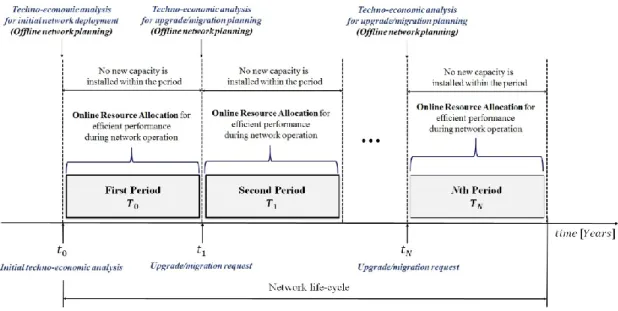
Techno-economic analyses involve network planning and economic evaluation methods. To illustrate this within the context of the network life-cycle, assume that at time 𝑡𝑖 a CSP wants to install a network to cope with an expected service demand over an interval 𝑇𝑖. To select a suitable network deployment plan, different candidate network solutions are defined. The financial feasibility of each solution is evaluated
Figure 2.5: Techno-economic analysis for network deployment planning [RB17b].
with the four-step model depicted in Fig. 2.5 [VCOL08, RB17b]. The grey and white boxes represent methods to perform technical and economic analysis, respectively. The green boxes are methods common to both analyses.
At time 𝑡𝑖 the four steps in Fig. 2.5 are executed for each candidate network solution. The first step, namely, input information processing, is responsible for surveying and defining data regarding market information, competitors, the network architecture and technologies to use, equipment pricing, the services to be offered and their QoS requirements. With this information, service demands and equipment costs are forecast over 𝑇𝑖. In the second step, the input information is used to design the network on the condition that the TCO is minimized while no capacity upgrades are needed in 𝑇𝑖. For that, offline network planning optimization algorithms are used for topology design, demand routing, infrastructure dimensioning and resilience planning. With the resulting design, the TCO is calculated as the sum the CAPEX and OPEX. Besides, the costs are allocated to the services offered by the CSP [You85, CVM+06, REB15, RB17b] and
the expected revenues are calculated. Hence, the second step defines a network deployment plan and its cash flow stream that states the timing and value of costs (cash outflows) and revenues (cash inflows) over
𝑇𝑖. In the third step, financial metrics such as the payback period (PB), the return on investment (ROI), the net present value (NPV) and the internal rate of return (IRR) are evaluated [VCOL08]. They provide information about the time it takes for revenues to cover costs, expected investment gains, risks, etc. The reliability of that information is assessed in the last step, namely, refinement. The purpose is to evaluate the impact of the model assumptions and the uncertainties of the input information on the financial metrics. Real options valuation [TVW+13] can be used as a method to identify and quantify the risks associated to
uncertainties and unexpected events.
Once the candidate network solutions are assessed, the most suitable alternative is chosen and installed at 𝑡𝑖 . In order to guarantee optimal operation within the planning period 𝑇𝑖, configuration, management and performance evaluation functions are performed on the installed network (see in Fig. 2.5 the blocks that connect the fourth to the first step). These functions include online resource allocation algorithms whereby capacity is assigned to the service demands admitted over 𝑇𝑖. Furthermore, these functions should recommend the time 𝑡𝑖′ at which a network upgrade/migration is necessary. At this time, the four-steps of the techno-economic analysis are repeated so as to select a suitable solution for the upgrade/migration request. This process is sequentially executed over the network life-cycle (see Fig. 2.6, where the evolution of a typical network throughout different planning periods 𝑇𝑖 is shown - the periods need not have the same length).
As seen in Fig. 2.6, offline network planning and online resource allocation play a relevant role in the design of efficient network infrastructures. Based on demand forecasting, offline planning guarantees that enough capacity is installed to cope with the expected demand growth. On the other hand, online resource allocation ensures that the installed capacity is efficiently used by the demands actually served in the network. In particular, for dynamic optical networks, offline planning includes the dimensioning of the colorless & directionless ROADMs and the sizing of shared pools of transponders (i.e. it guarantees that
Figure 2.6: The network life-cycle as driven by techno-economic evaluations.
sufficient infrastructure is deployed to provide BoD without manual intervention). Online resource allocation, on the other hand, is responsible for the implementation of network control functions for CAC and RSA. These functions guarantee that lightpaths are allocated to connections in such a way that a desired performance is achieved.
2.3.1
Online Resource Allocation
Conventional fixed-grid WDM networks serve connections with setup times in the order of weeks (as in most cases manual labour is required) and once established, connections remain active for months or years. Given the static characteristics of this traffic, offline planning for capacity provisioning is performed by routing and wavelength assignment (RWA) algorithms. With the advent of flex-grid WDM, more efficient capacity dimensioning is attained by offline RSA schemes - see for example [CTV11a, KW11, KRV+13].
Both RWA and RSA offline algorithms have in common that the traffic matrix is known. Besides, these algorithms can be formulated as integer linear programming (ILP) or mixed ILP (MILP) problems. RWA and RSA differ in that RSA algorithms must calculate lightpaths that fulfil the contiguity and continuity constraints, i.e. the lightpath spectrum slots must be adjacent and centered at the same frequency on each link in the selected path. (In RWA algorithms there is no contiguity constraint as a single wavelength may suffice for a connection request.)
In dynamic optical networks, offline RSA algorithms are only useful (based on demand forecasting) to estimate the capacity to deploy for any given planning period. However, for network operation (i.e. to perform online resource allocation) those algorithms are inapplicable as they tend to be slow. To provide GoS guarantees to their customers, the network needs to rely on resource allocation methods that integrate algorithms for online RSA and CAC. To carry a new connection, online RSA - based on an optimization objective - is responsible for calculating a set of candidate lightpaths. Then CAC applies decision rules to determine the lightpath on which the connection has to be carried. Although parts of the same problem, RSA and CAC can be solved separately to reduce modelling and implementation complexity [Dzi97]. In this context, for flex-grid WDM, a variety of online RSA schemes are proposed in the literature [WWL10, CTV11b, PJJW11a, WWH+11, WZK+11, CVR+12, WZZ+12, ADB+13, CTV13]. They mainly aim at
minimizing the overall blocking probability. A drawback of these algorithms is that they do not allow individual control of the blocking probability (i.e. GoS) of different connection classes (i.e. connections that have different bandwidth requirements). However, these approaches represent a first step towards the design of efficient resource allocation algorithms in dynamic optical networks. In general, any online resource allocation algorithm should fulfil the following requirements:
1. Since online resource allocation is performed on the time scale of connection interarrival times, the algorithms must be fast. Existing online RSA schemes tackle this issue by adopting heuristic methods to calculate lightpaths. For instance, some approaches [WWH+11, WZK+11, WZZ+12]
4. The algorithms must be state-dependent and adaptive to changing traffic load conditions. This means that the CAC decisions have to take into account the actual resource occupancy (i.e. the network state), and need to adapt to traffic fluctuations so as to meet the SLAs at its best. These requirements pose new challenges to the design of online resource allocation algorithms. Their performance is subject to the deployment of sufficient capacity at the beginning of each planning period within the network life-cycle (i.e. offline network planning should guarantee that the ROADMs, transponder pools and the fibre links are properly sized to cope with the traffic growth).
Spectrum defragmentation is another challenge to online network planning. The random arrival and departure of optical connections renders the spectral resources prone to reach a so-called fragmentation state [ASMW11]. A fragmentation state means that, on each link, the spectrum contains idle and non-contiguous spectrum slots which cannot be allocated to future connection requests. The increment in the connection blocking probability is a result of a fragmented spectrum. A strategy to solve this problem is to re-optimize the configuration of the lightpaths established in the network, i.e. their spectrum allocation and/or routing. By that, a spectrum defragmentation in the network is performed, whereby large blocks of empty and adjacent spectrum slots are made available for future connection requests. Online spectrum defragmentation involves three phases [GREB17]. First, on each link, the network tracks the spectrum fragmentation state so as to trigger the defragmentation process when deemed necessary. In the second phase, an optimization algorithm recalculates the spectrum allocation (or both the routing and spectrum allocation) for all carried lightpaths. In the last step, a strategy is adopted to migrate the lightpaths to the configuration calculated by the optimization algorithm. Such a strategy has to minimize the number of lightpath disruptions during the migration process. There is an increasing research interest in spectrum defragmentation strategies for flex-grid WDM networks. For example, [SP10, PJJW11b, THS+11] focus
on spectrum defragmentation without migration of lightpaths. In [CVR+12] an online RSA scheme is
introduced which re-allocates spectrum to established lightpaths when a connection request is blocked. A drawback of this scheme is that it may cause frequent reconfiguration processes (e.g. in high-traffic load scenarios). ILP-based defragmentation algorithms with integrated lightpath migration are introduced in [THT+14, TTHK15, TTHK16], where the defragmentation and the lightpath migration strategies are
calculated simultaneously. These algorithms can be used to improve the resource allocation process in dynamic optical networks. For example, RSA schemes can be designed together with CAC decision rules to minimize the spectrum fragmentation. It is also important to investigate the extent to which a migration of lightpaths is recommended in a dynamic scenario, as migrations may lead to service disruptions that may impact the SLAs offered to the customers.
2.3.2
Control Plane Challenges
To unfold the potential of dynamic optical networks, a control plane architecture is needed that enables automatic multilayer/inter-domain interoperability. Moreover, given the circuit-switched nature of the optical network, novel signalling mechanisms are required for fast connection set up.
Multilayer interoperability requires the definition of logical interfaces between higher technology layers (e.g. IP/MPLS, OTN) and the flex-grid WDM dynamic layer. These interfaces should specify the signalling procedures whereby BoD is automatically provisioned to the customers. Although efforts have been made to extend the GMPLS protocol suite to support flex-grid WDM (see for example [JTK+09,
GCZ+13]), ongoing research shows that an SDN-based control plane would reduce complexity, thereby
embraced SDN to propose an integration of packet (IP/MPLS) and optical circuit-switched networking technologies. As a result, SDN concepts have been extended to the optical domain [Col13, ONF13, SHS+14]. This has stimulated further research on the integration of GMPLS protocol functionalities with
SDN/OpenFlow capabilities [ANE+11, CKE+12]. The experimental results reported in [CNF+12, LCT+12,
YZZ+12, ZZY+13, ZZZ+13] indicate that by centralizing the network control with an SDN architecture,
not only multilayer convergence, but inter-domain interoperability is attained. However, additional effort is still required for the definition of an SDN-based dynamic optical network. In particular, this effort entails the standardization of the signalling procedures for the provisioning of capacity for multirate connections. (Note that currently, as defined by the fixed-grid WDM standard [ITU12], the GMPLS protocol handles connections at the granularity of wavelengths. The extension to flex-grid WDM implies a finer spectrum granularity, which imposes stringent scalability requirements not yet handled by GMPLS [TAS+14].)
Furthermore, as argued in [Sal06, Sal07] dynamic optical networks might need to serve connections with setup time requirements in the order of milliseconds to seconds. This evinces the need for faster connection establishment protocols that interwork with resource allocation algorithms.
In [CCC+12, SCG+12, SN09, SGK+14] a 3-way handshake (3WHS) protocol was proposed to provide
fast connection setup in dynamic optical networks. (A modified version of this protocol for multicarrier domain networks has been published in [WGK+15].) Originally, the 3WHS protocol was designed as an
alternative (or extension) to GMPLS in order to cope with the stringent setup latencies of BoD services. Unlike GMPLS, upon arrival of a connection request, the 3WHS protocol is able to simultaneously probe resources on different paths, and therefore, it provides the network nodes with the information they need to perform more efficient resource allocation. Another advantage, as shown by the simulation results in [SCG+12], is that the protocol performs well at minimizing backward blocking (i.e. the blocking arising
from concurrent connection requests trying to seize the same resources on a given path). These capabilities make the 3WHS protocol faster than GMPLS. An open issue is the definition of the implementation details of the protocol in an SDN-based environment. In this respect, a major challenge is the minimization of the delays of the signalling messages exchanged between the nodes and the SDN controller. As discussed in [Sim14], a purely centralized control plane implementation may result in large setup latencies. Therefore, a question to answer is whether a hybrid (i.e. centralized and distributed) or a purely centralized control plane is more suitable for fast connection setup.
2.4.
Modelling Dynamic Optical Networks as
Large-Scale Stochastic Systems
Extrinsic and intrinsic factors determine the performance (e.g. the blocking probability, the connection setup latency) of dynamic optical networks. Among the extrinsic factors we have the statistical properties of the bandwidth requirements, the interarrival times and the durations of connections. These properties, in principle, are independent of - and unknown to - the network. On the other hand, intrinsic factors include online resource allocation algorithms whereby lightpaths are provisioned on demand. The network performance is the large-scale effect that emerges from the interaction between the extrinsic and intrinsic factors. Understanding the causal relationship responsible for the emergence of the large-scale effects is essential for the design of efficient network control. By having this knowledge, it is possible to handle (and learn from) the randomness of connections so that the network control attains a desired performance. Given the random nature of the traffic, dynamic optical networks behave as large-scale stochastic systems whose state (i.e. the network resource occupation) changes by following the decisions of the resource allocation algorithm.
Having a suitable stochastic network model is key to the implementation of optimum control. A variety of models were successfully proposed in the past for packet and circuit switched networks (see for example [KY14]). In particular, circuit switched networks are modelled as stochastic loss systems. Relevant models for this type of networks such as [Kau81, Kel88, DM89, Hun89, Kel91, Hwa93, DM94, Ros95, HKT00, KY14] have succeeded in the design of adaptive/state-dependent routing and CAC. Unfortunately, these models are inapplicable to dynamic optical networks. The reason is that they describe stochastic systems with states which are not subject to continuity and contiguity constraints. A first step towards the definition of a stochastic model for dynamic optical networks is the work in [YZZ+14]. Therein a model is proposed
for a flex-grid WDM link. The optical link is described as a continuous-time Markov chain with states that fulfil the spectrum contiguity constraint. From the Markovian model, the link performance metrics (e.g. the blocking probability, the spectrum fragmentation) can be derived analytically. The simulation results in [YZZ+14] show that, for different spectrum allocation schemes (e.g. first-fit, random-fit), the analytical
model provides accurate estimates of the link performance.
In order to design applicable network control algorithms, the stochastic link model in [YZZ+14] must
and flexible ROADMs. With these technologies, the network design is performed by techno-economic analyses that involve offline network planning methods and economic evaluations. Based on demand forecasting, offline planning ensures that - before operation - the network nodes and links are installed with enough capacity to cope with the demand growth. For that, the optical nodes are designed with directionless & colorless ROADMs which are interconnected (via fibre crossconnects) with pools of transponders. By this node design, client interfaces are assigned (on demand) to transponders in the pool, thereby avoiding manual labour during the process of connection setup. During network operation, online resource allocation ensures that the installed capacity is efficiently used by the demands served in the network. For that, the network has to implement control functions for RSA and CAC. These functions guarantee that lightpaths are allocated to connections in such a way that a desired performance is achieved.
The statistical characteristics of the traffic and the control logic of the resource allocation algorithms determine the performance of dynamic optical networks (e.g. the blocking probability). This performance is a large-scale effect that can be controlled by modelling the network as a stochastic loss system. In the next chapters we will elaborate on this idea with special focus on adaptive and state-dependent resource allocation strategies. For that, the concepts and models introduced in the remaining chapters make the following assumptions. First, that the network conforms to the architecture described in this chapter. Secondly, that the dimensioning of ROADMs, transponders pools and flex-grid links has been performed by offline network planning methods. Thus, the assumption is made that sufficient capacity is available to cope with an expected demand growth. Our focus will then be on how to efficiently allocate resources to connections during network operation.
Online resource allocation in dynamic optical networks involves network control functions for CAC and RSA. These functions aim at guaranteeing that lightpaths are allocated to connections in such a way that a desirable network performance is achieved. In this chapter we define the performance as the rate at which the network earns reward from carried connections. Within that context, resource allocation is modelled as a Markov decision process that provides a policy with decisions on admission, routing and spectrum allocation. Section 3.1 defines a stochastic model for dynamic optical networks. In Section 3.2 the network model is used to introduce the concept of policy as a mechanism for resource allocation. Section 3.3 formulates the policy dependent reward-based optimization problem. Section 3.4 discusses a policy iteration algorithm that calculates an optimum policy for network reward maximization. To facilitate the readability of the concepts and mathematical models introduced in this chapter, in Table 3.1 we summarize the most relevant variables and parameters which are defined and used throughout all chapter sections. The content in this chapter includes results published by the author in [RB16a, RB16b].
3.1.
Stochastic Network Model
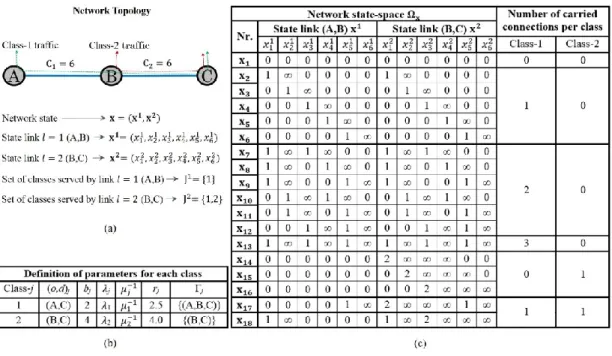
Consider a dynamic flex-grid optical network with 𝑁 nodes and 𝐿 links. Each link 𝑙 has a capacity of 𝐶𝑙 ordered spectrum slots and the nodes employ directionless/colorless ROADMs. Two types of nodes are distinguished: add/drop nodes and transit nodes. They differ only in that add/drop nodes have transponder pools to establish connections on demand. The connections served by the network are categorized into 𝐽
distinct classes, with a class-j being a group of connections fully characterized by six parameters, namely
(𝑜, 𝑑)𝑗, 𝜆𝑗, µ𝑗−1, 𝑏𝑗, Γ𝑗, and 𝑟𝑗. Specifically, class-j connections request connectivity between a pair of add/drop nodes (𝑜, 𝑑)𝑗, arrive at the network at a mean rate 𝜆𝑗, and have a mean holding time µ𝑗−1. A carried class-j connection seizes a bandwidth of 𝑏𝑗 spectrum slots. This bandwidth is provisioned by a lightpath on a route 𝜌 selected from a set of feasible paths Γ𝑗. (In general, Γ𝑗 may contain either all feasible paths between the nodes (𝑜, 𝑑)𝑗, or a sub-set of 𝑘-shortest paths.) The lightpath fulfils the contiguity and continuity constraints, i.e. in addition to being adjacent, the 𝑏𝑗 spectrum slots are centered at the same frequency on each link in the selected path 𝜌. A class-j connection brings to the network 𝑟𝑗 reward units (ru). The meaning and value of the reward parameter 𝑟𝑗 is defined by the network operator and thus, 𝑟𝑗 does not necessarily represent an economic revenue. Class-j connections offer to the pair of add/drop nodes
(𝑜, 𝑑)𝑗 a traffic load of 𝐴𝑗= 𝜆𝑗/µ𝑗 Erlangs. The rates 𝜆𝑗 and µ𝑗 have units of connections per unit of time (con/uot). Note that µ𝑗 is the rate at which a single carried class-j connection is terminated.
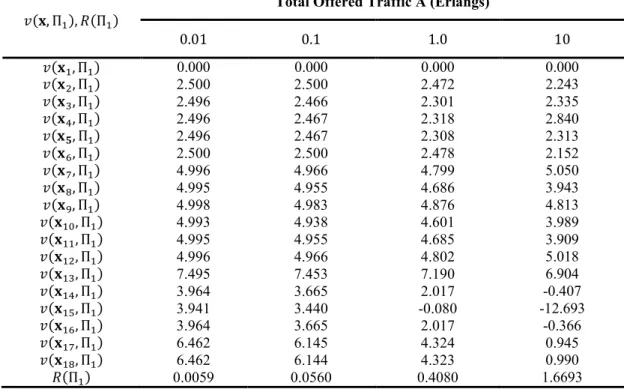
Example 3.1 Consider the network depicted in Fig. 3.1, which consists of seven links, four add/drop nodes (A, D, E, F) and two transit nodes (B,C). The add/drop nodes define six node-pairs, each one serving two connection classes, one requesting two and the other four spectrum slots. Thus, the network serves 12 classes, which are defined by the parameters shown in Fig. 3.1. For example, class-10 is the group of connections carried as lightpaths with a bandwidth of 𝑏10= 4 adjacent slots provisioned between the nodes (𝑜, 𝑑)10= (D, E). They arrive at a mean rate of 𝜆10= 6 (con/uot) and have a mean holding time
µ10−1= 1, thereby offering a traffic load of 𝐴10= 6 Erlangs. The lightpaths are provisioned on routes selected from the set of paths Γ10= {(D, C, E), (D, F, B, A, E)}. From a carried class-10 connection the network earns a reward of 𝑟10= 8 (ru).
![Figure 4.1: Flex-grid optical network with four nodes, five links and 12 classes [RB16d]](https://thumb-us.123doks.com/thumbv2/123dok_us/10176946.2920034/56.892.191.703.117.491/figure-flex-grid-optical-network-nodes-links-classes.webp)