PARALLELISM
A dissertation submitted towards the degree Doctor of Engineering (Dr.-Ing.)
of the Faculty of Mathematics and Computer Science of Saarland University
by
Kevin Streit
Saarbrücken, 2017Chair of the Committee Prof. Dr. Jan Reineke Reporters
First reviewer Prof. Dr. Andreas Zeller
Second reviewer Prof. Dr. Sebastian Hack
Third reviewer Prof. Christian Lengauer, Ph.D. Academic Assistant Dr. María Gómez Lacruz
showed the patience and understanding to support me in writing
this thesis.
Zusammenfassung
Chair of Software Engineering and Compiler Design Lab Department of Computer Science — Saarland Informatics Campus
by Kevin Streit
Mehrkernsysteme sind heutzutage allgegenwärtig und finden täglich weitere Verbreitung. Und während, limitiert durch die Grenzen des physikalisch Machbaren, die Rechenkraft der einzelnen Kerne bereits seit Jahren stagniert oder gar sinkt, existiert bis heute keine zufriedenstellende Lösung zur effektiven Ausnutzung der gebotenen Rechenkraft, die mit der steigenden Anzahl an Kernen einhergeht.
Existierende Ansätze der automatischen Parallelisierung sind häufig hoch spezialisiert auf die Ausnutzung bestimmter Programm-Muster, und somit auf die Parallelisierung weniger Programmteile. Hinzu kommt, dass häufig verwendete invasive Laufzeitsysteme die Kombination mehrerer Parallelisierungs-Ansätze verhindern, was der Praxistauglichkeit und Reichweite automatischer Ansätze im Wege steht.
In der Ihnen vorliegenden Arbeit zeigen wir, dass die Spezialisierung auf eng definierte Programmuster nicht notwendig ist, um Parallelität in Programmen verschiedener Domänen effizient auszunutzen. Wir entwickeln einen generalisierenden Ansatz der Parallelisierung, der, getrieben von einem mathematischen Optimierungsproblem, in der Lage ist, fundierte Parallelisierungsentscheidungen unter Berücksichtigung relevanter Kosten zu treffen. In Kombination mit einem spezialisierenden und adaptiven Laufzeitsystem ist der entwickelte Ansatz in der Lage, mit den Ergebnissen spezialisierter Ansätze mitzuhalten, oder diese gar zu übertreffen.
Abstract
Chair of Software Engineering and Compiler Design Lab Department of Computer Science — Saarland Informatics Campus
by Kevin Streit
Multi core systems are ubiquitous nowadays and their number is ever increasing. And while, limited by physical constraints, the computational power of the individual cores has been stagnating or even declining for years, a solution to effectively utilize the computational power that comes with the additional cores is yet to be found.
Existing approaches to automatic parallelization are often highly specialized to exploit the parallelism of specific program patterns, and thus to parallelize a small subset of programs only. In addition, frequently used invasive runtime systems prohibit the combination of different approaches, which impedes the practicality of automatic parallelization.
In the following thesis, we show that specializing to narrowly defined program patterns is not necessary to efficiently parallelize applications coming from different domains. We develop a generalizing approach to parallelization, which, driven by an underlying mathematical optimization problem, is able to make qualified parallelization decisions taking into account the involved runtime overhead. In combination with a specializing, adaptive runtime system the approach is able to match and even exceed the performance results achieved by specialized approaches.
First and foremost, I want to particularly thank my advisers Andreas and Sebastian for their time, patience and advice. They never stopped to believe in me and a risky research idea and provided support and inspiration throughout the years.
While I had the pleasure to meet many interesting and highly valued people that have influenced and contributed to the work that has been condensed in this very PhD thesis by endless and fruitful discussions, I have to particularly mention two of my colleagues with whom I closely collaborated and whom I consider my friends:
The implementation and ideas of the whole Sambamba framework, which is an integral part of the work presented in this thesis, has been done together with Clemens Hammacher, whose main topic of research lies in the field of speculative parallelization. He has been colleague, teammate and a good friend during the whole course of my thesis work. Consequently, not only the implementation, but also many ideas and solutions presented on the following pages are in the end the result of our collaboration.
In no way fewer influence on the presented results had Johannes Doerfert, a former Bachelor and Master student of ours who now conducts his PhD studies in the field of Program Optimizations based on the Polyhedral Model in the Compiler Design Lab at Saarland University. He also contributed in the form of code, time and discussions to many parts of the presented work.
Part of the work presented in this thesis was performed in the context of the Software-Cluster project EMERGENT (http://www.software-cluster.org). It was funded by the German Federal Ministry of Education and Research (BMBF) under grant no. “01IC10S01”. Later work has been supported, also by the German Federal Ministry of Education and Research (BMBF), through funding for the Center for IT-Security, Privacy and Accountability (CISPA) under grant no. “16KIS0344”.
Zusammenfassung iii
Abstract iv
Acknowledgements v
1 Introduction and Motivation 1
1.1 Contributions of this Thesis . . . 8
1.2 Publications . . . 10
2 Background Terminology and Concepts 11 3 State of Parallelization Research 23 3.1 Reduction . . . 23
3.2 Manual Parallelization . . . 26
3.3 Static Parallelization . . . 27
3.4 Runtime-centric Parallelization . . . 31
3.5 Conclusion and Open Issues . . . 33
4 Sambamba — A Static/Dynamic Parallelization Framework 35 4.1 Simple Task-based Parallelization — ParAτ . . . 37
4.1.1 Dependence Analysis . . . 38
4.1.2 Basic-block-wise Parallelization . . . 48
4.1.3 Parallel Control-flow Graph (ParCFG) . . . 49
4.1.4 Parallel Section Propagation . . . 52
4.1.5 Load-based Adaptive Dispatch . . . 55
4.1.6 Lessons learned fromParAτ . . . 56
4.2 Speculation Support . . . 56
4.2.1 Software Transactional Memory . . . 57
4.2.2 K-TLS . . . 58
4.3 The Dynamic Nature of Sambamba . . . 60
5 Generalized Task Parallelism — ParAγ 63 5.1 Program Representation . . . 65
5.1.1 Program Dependence Graph (PDG) . . . 65
5.1.2 Sequentialization of the Program Dependence Graph . . . 67
5.2 Parallelization Enabling Techniques . . . 71
5.2.1 Generalized Reduction . . . 72
6 ILP-based PDG-Scheduling 89
6.1 ILP Formulation . . . 90
6.1.1 Prerequisites . . . 90
6.1.2 Constraints . . . 91
6.2 Alternative ILP Formulations . . . 96
6.2.1 Whole Function Scheduling . . . 97
6.2.2 Scheduling with Code Duplication . . . 99
6.3 Scheduling Time . . . 102
7 Runtime-Adaptive Parallel Execution 105 7.1 Runtime Profiling . . . 106
7.1.1 Call-site Execution Times . . . 107
7.1.2 Branch Profiles . . . 109
7.1.3 On Profiling Overhead . . . 111
7.2 Candidate Composition . . . 112
7.2.1 Execution Cost Evaluation . . . 113
7.3 Dynamic Blocking . . . 116
7.4 Adaptive Dispatch . . . 118
7.4.1 Load-based Dispatch (load) . . . 119
7.4.2 Task Nesting Depth Dispatch (tnd) . . . 120
7.4.3 Tasks In Flight Dispatch (tif) . . . 126
7.4.4 Combined Dispatch . . . 128
8 Implementation 131 8.1 The Sambamba Framework . . . 131
8.1.1 Technical System Overview . . . 132
8.1.2 Sambamba Modules: Compile-time vs. Runtime . . . 136
8.1.3 Multiple LLVM Modules . . . 138
8.2 ParAγ—Relevant Implementation Details . . . 140
8.2.1 Block Splitting . . . 140
8.2.2 Schedule Cache . . . 142
8.2.3 ILP Cloud . . . 142
8.3 A Note on Inter-core Communication . . . 144
9 Evaluation 147 9.1 Setup . . . 150
9.2 Benchmark Suites . . . 150
9.3 Results of the Detailed Evaluation . . . 151
9.4 Results on PolyBench and theCilk suite . . . 156
10 Extension and Use Case: Semi-Automatic Parallelization 159 10.1 C/C++ Language Extension . . . 161
11 Conclusion and Future Work 167
List of Figures 171
List of Tables 173
Appendix 175
A Irregular Sample Application Written in C 175
B OpenMP-parallelized pairalign Function 179
Introduction and Motivation
The free lunch is over. This frequently cited phrase has been coined by Herb Sutter in his famous article [1] proposing a necessary reinterpretation of the consequences ofMoore’s Law [2]. Gordon E. Moore predicted in 1965 roughly a biennial doubling of the number transistors in dense integrated circuits. Surprisingly, this prediction, which was meant to cover the next ten years, held true for several decades and still does. The consequences changed, however.
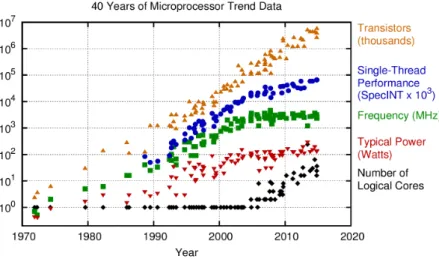
Consider Figure 1.1, which plots the development of transistor counts in Intel processors from 1970 to 2010 (note the log-scale of the y-axis). For many years, processor manu-facturers have been able to translate the increased number of transistors directly into higher clock speeds and increased instruction-level parallelism (ILP); this however changed dramatically around 2004 when those numbers started to stagnate due to increasing difficulties with dissipating the additionally produced heat that comes with an increasing power consumption.
Unfortunately, the increasing clock-speed and exploitable instruction-level parallelism have been the driving forces of increasing single-thread performance from which most programs have been able to effortlessly profit—the free lunch. As can be seen in Figure 1.2, the additional transistors, whose number still grows as predicted by Moore, are put into an exponentially growing number of compute cores.
Figure 1.1: Development of the number of transistors 1970-2010. Source: Sutter [1].
Now to exploit the power of modern multi-core architectures, the software being executed on it has to run in parallel. While there are multiple incarnations of parallel execution, like running multiple applications at the same time or running multiple instances of a program or heavy computation in parallel, developers inevitably have to face the problem of also
internally parallelizing a specific application. This also applies to legacy applications, i.e., applications which are typically not under active development, and, consequently, the original developer not necessarily available any more. Unfortunately, parallelizing software and maintaining the parallel code is expensive, error-prone and generally considered hard by most programmers of which many say about themselves that they are either unable or unwilling to explicitly deal with parallelization [4, 5]. These difficulties particularly apply to legacy software, which is oftentimes hard enough to understand and maintain in a sequential form, let alone in a platform-specific, parallelized form.
Consider thekernel_bicg function shown in Figure 1.3. It is anOpenMP [6, 7] parallelized version of the code shown in Figure 1.4a, as produced by a state-of-the art polyhedral
Figure 1.2: Development of transistor count, single-core performance, and number of
cores 1970-2015. Source: Rupp [3].
optimization tool. Performance-wise this version is desirable; but due to its complexity it is not the code developers should need to maintain. Instead it should be the easily reproducible result of the press of a button in the course of compiling for a new platform or changing the underlying algorithm as shown in Figure 1.4a.
Due to the increased complexity of producing and maintaining parallel code, automatic parallelization of sequential code has been a central goal of academic computing research and the past decades have produced several concepts and parallelization approaches. Each one is tailored to exploit parallelism found in specific program patterns: Given a suitable reduction analysis, anyDOALL-style loop parallelizer [8] can enable parallel execution of each of the three loops in Figure 1.4a. Loops which carry dependences do not qualify for
DOALL-style parallelization. They can be dealt with by employingDOACROSS-style loop parallelization [9] or Software Pipelining1, for instance. The manually tail-call optimized
version ofquicksort in Figure 1.4c, is an example for such a dependency-carrying loop. Recursive tasks, as shown in Figure 1.4b, can be parallelized by classical fork-join style
task parallelism.
The examples mentioned above are a first hint on the diverse appearance of parallelism on a very high level of abstraction. In fact, the patterns searched for and exploited by parallelization approaches discussed in modern parallelization research are way more
1
1 static void kernel_bicg(...) {
2 if ((ny >= 1)) {
3 ub1 = floord((nx + -1), 256);
4 #pragma omp parallel for private(c2, c3, c4, c5, c6) firstprivate(ub1)
5 for (c1 = 0; c1 <= ub1; c1++)
6 for (c2 = 0; c2 <= floord((ny + -1), 256); c2++)
7 for (c3 = (8 * c1); c3 <= min(floord((nx + -1), 32), ((8 * c1) + 7)); c3++)
8 for (c4 = (8 * c2); c4 <= min(floord((ny + -1), 32), ((8 * c2) + 7)); c4++)
9 for (c5 = (32 * c4); c5 <= min(((32 * c4) + 31), (ny + -1)); c5++)
10 #pragma ivdep
11 #pragma vector always
12 #pragma simd 13 for (c6 = (32 * c3); c6 <= min(((32 * c3) + 31), (nx + -1)); c6++) 14 q[c6]=q[c6]+A[c6][c5]*p[c5]; 15 } 16 if ((nx >= 1)) { 17 ub1 = floord((ny + -1), 256);
18 #pragma omp parallel for private(c2, c3, c4, c5, c6) firstprivate(ub1)
19 for (c1 = 0; c1 <= ub1; c1++) 20 for (c2 = 0; c2 <= floord((nx + -1), 256); c2++) 21 for (c3 = (8 * c1); c3 <= min(floord((ny + -1), 32), ((8 * c1) + 7)); c3++) 22 for (c4 = (8 * c2); c4 <= min(floord((nx + -1), 32), ((8 * c2) + 7)); c4++) 23 for (c5 = (32 * c4); c5 <= min(((32 * c4) + 31), (nx + -1)); c5++) 24 #pragma ivdep
25 #pragma vector always
26 #pragma simd
27 for (c6 = (32 * c3); c6 <= min(((32 * c3) + 31), (ny + -1)); c6++)
28 s[c6]=s[c6]+r[c5]*A[c5][c6];
29 }
30 }
Figure 1.3: An example of complex, but efficient parallelization: parallelBiCG.
specific. The following quotation has been taken from a recent publication [10] on so-called speculative cross-invocation parallelization of nested loops:
“
A hot loop is a candidate for SpecCross if it satisfies three conditions:1. the outermost loop itself cannot be successfully parallelized by any automatic parallelization technique implemented in the existing parallelizing compiler infrastructure (including DOALL, LOCALWRITE, and DSWP);
2. each inner loop can be independently parallelized by a non-speculative and non-partition based parallelization technique such as DOALL and LOCALWRITE; and 3. the sequential code between two inner loops can be
priva-tized and duplicated among all worker threads.
”
Searching for and exploiting such specific patterns raises the question of applicability to a broader range of applications. This is not to say that every parallelization approach should be able to deal with every form of exploitable parallelism or even every application domain. However, a big challenge of parallelization nowadays are general purpose applications. In contrast to typically well understood and statically analyzable scientific applications, such general purpose applications show irregular and input-dependent memory accesses and dependence patterns and are effectively assembled from a whole set of dynamically linked and at compile-time unavailable libraries. But most importantly, they are typically implemented by a diverse set of differently skilled and trained programmers making use of completely diverse computational patterns in different parts of an application. In contrast to a typical scientific application, one cannot easily identify the one deep loop nest that implements the computational kernel and dominates execution time.All the parallelization approaches mentioned before work well for the specific form of parallelism they have been developed for; however, they are mostly also restricted to
1 void kernel_bicg(double A[NX][NY], double s[NY], double q[NX],
2 double p[NY], double r[NX]) {
3
4 for (int i = 0; i < NY; i++)
5 s[i] = 0;
6
7 for (int i = 0; i < NX; i++) {
8 q[i] = 0;
9
10 for (int j = 0; j < NY; j++) {
11 s[j] = s[j] + r[i] * A[i][j];
12 q[i] = q[i] + A[i][j] * p[j];
13 }
14 }
15 }
(a) BiCG
1 void fft_twiddle(int i, int i1, COMPLEX *in, COMPLEX *out, COMPLEX *W,
2 int nW, int nWdn, int r, int m) {
3 4 if (i == i1 - 1) { 5 fft_twiddle_gen1(in + i, out + i, W, r, m, nW, nWdn * i, nWdn * m); 6 } else { 7 int i2 = (i + i1) / 2; 8 fft_twiddle(i,i2,in,out,W,nW,nWdn,r,m); 9 fft_twiddle(i2,i1,in,out,W,nW,nWdn,r,m); 10 } 11 } (b)fft
1 void seqquick(ELM * low, ELM * high) {
2 ELM *p;
3 while (high - low >= 1) {
4 p = seqpart(low, high); 5 seqquick(low, p); 6 low = p + 1; 7 } 8 } (c)Quicksort
Figure 1.4: Different parallelizable functions: BiCG (A) kernel implementation (taken from the PolyBench 3.2 suite); andfft (B) andQuicksort (C) implementations (adapted
from thecilksort andfft programs of theCilk example application suite).
be effective only on these patterns they seek to exploit. We are not aware of a single approach that efficiently parallelizes all of the three code examples in Figure 1.4, let alone handling code which embodies complex combinations of loops and recursion across several functions. Indeed, an integration of these parallelization approaches poses tremendous practical challenges, as the underlying models and assumptions are vastly different. This in particular holds true if the parallelization approach relies on a complex runtime system which is typically designed under the assumption of sole control over the computational
resources of a system. Different parallelized applications running in parallel, or even differently parallelized parts of a single application violate this assumption.
But even if we could build a compiler that provides all important parallelization approaches and covers any specific form of parallelism, we still would lack a joint cost model that is powerful enough to drive the choice between different kinds of parallelism: if a compiler has to decide for one approach to parallelize a given piece of code, how should it decide? In particular, being aware of the fact that it should decide for only one system used for the whole application, as the runtime systems of different approaches are typically not compatible or at least interfere in unpredictable ways, undermining the fragile cost models driven by heuristics and platform-specific benchmarks. Furthermore, as the benefits of parallelization outside of the scientific domain are still hardly predictable, most approaches rely on the option to fall back to sequential execution if the runtime system deems parallel execution unbeneficial. But if the one system chosen by the compiler at compile-time falls back to sequential execution at runtime, the chance for different parallelization approaches to prove successful is gone.
An integrated approach, however, would be worthwhile to combine the strengths of the present approaches for parallelization. The need for integration becomes even more obvious whenspeculation,privatization, andreduction are taken into account—three techniques that have been identified frequently as being among the most important techniques for enabling parallelism. Scientists even go as far as claiming that without such techniques efficient parallelization of general purpose applications is impossible (e.g., [11] or [12]). Enabling parallelism naturally increases the range of possibilities for a parallelizer to choose from. However, it is not automatically implied that such parallelism can be exploited in a profitable way. Each of those techniques introduces potentially significant overhead. This overhead needs to be compensated by an at least equally high reduction of execution time. As a detailed example, reconsiderBiCG in Figure 1.4a. Even without considering complex iteration space transformations as necessary to produce the result shown in Figure 1.3, we are left with multiple forms of parallel execution to choose from: different opportunities exist to realize a reduction, for instance, and an automatic parallelizer is left with the decision of which loop to parallelize. When parallelizing the outer loop of the loop-nest,
the reduction-induced dependence via the arraysneeds to be broken and handled specially in the parallel code. This can be done by privatizing the whole array s, techniques likeLOCALWRITE[13], or, for instance, by using atomic operations (or unordered atomic sections) instead. An alternative would be to parallelize the innermost loop only. In that case, only one array cell needs to be privatized in order to fix the broken reduction dependence via the arrayq. Making a qualified decision on the way to parallelize the code and fix the broken reduction dependences, or even to speculate on statically unanalyzable dependences requires to take multiple factors into account, some of which are not known at compile-time: user input, execution platform, available number of cores. All this calls for a deep integration of parallelization approaches on a sound theoretical base, implemented on a stable and powerful platform for compile-time and runtime analysis.
1.1
Contributions of this Thesis
The contribution of this thesis is a unified and generalizing approach of parallelization including the prototypical implementation ofSambamba, a hybrid compile-time/runtime parallelization framework based on the LLVM-compiler infrastructure. At the core of the thesis, we introduce the concept and implementation ofgeneralized task parallelism—a single unified framework for automated parallelization. The main contributions of the thesis are as follows:
Static/dynamic Compiler Framework for Program Parallelization We provide the prototypical implementation of ourSambamba framework based on theLLVM com-piler infrastructure. Sambamba, which is made available as open-source, can be used as the technical foundation of further research in hybrid static/dynamic parallelization approaches.
Uniform Program Representation We present a uniform program representation based on the program dependence graph (PDG) (Section 5.1). Relevant properties like profiling information, reduction, privatizability and speculation opportunities are broken down to the dependence level and correspondingly represented in the PDG.
Parallelization as Optimization Problem Based on this representation, wereduce the problem of parallelization to linear optimization to find local parallelization candidates
(Chapter 6). The formulation is independent of any special form of parallelism, and integrates central aspects of existing approaches without reimplementing them. Optimization is driven by a cost model derived from static profile estimates and runtime profiling information. Implementations of this approach do not rely on special code features. Loop structures, for instance, are completely transparent: existing loops can be fully (i.e., DOALL-style) or partially (in case of carried dependences) parallelized, while still allowing for loop-independent task parallelism.
Specializing Parallel Code Generation We show how to effectively generate special-ized parallel code (or, simply speaking: optimized parallel code) from the found generalized parallelism. Together with an adaptive runtime system that can continu-ously reassess parallelization decisions, our parallelizer ParAγ is able to match the performance of specialized parallelization approaches (Chapter 7).
Evaluation We evaluate the individual parts of our system (Chapter 9) on a set of programs from various benchmarks suites, showing that generalized task parallelism
1. subsumes and integrates different and independent forms of parallelism; 2. discovers parallelization opportunities similar to those found by experts; and 3. produces efficient parallel code for a broad range of applications.
Semi-automatic Parallelization Finally, we provide the implementation of a semi-automatic parallelization toolchain based on Sambamba and integrated into the
Eclipse IDE, which is able to not only parallelize parts of the application under development automatically, but also to verify, improve and finally implement par-allelization hints and decisions given by the developer in the form of very simple,
1.2
Publications
This thesis builds on the following publications, listed in descending chronological order.
Thread-Level Speculation with Kernel Support [14]. Clemens Hammacher, Kevin Streit, Andreas Zeller, and Sebastian Hack. In Proceedings of the 25th International Conference on Compiler Construction (CC), March 2016.
Generalized Task Parallelism [15]. Kevin Streit, Johannes Doerfert, Clemens Ham-macher, Andreas Zeller, and Sebastian Hack. In ACM Transactions on Architecture and Code Optimization (TACO), Volume 12, Number 1, April 2015.
Polly’s Polyhedral Scheduling in the Presence of Reductions [16]. Johannes Do-erfert, Kevin Streit, Sebastian Hack, and Zino Benaissa. 5th International Workshop on Polyhedral Compilation Techniques (IMPACT), January 2015.
Sambamba: Runtime Adaptive Parallel Execution [17]. Kevin Streit, Clemens Ham-macher, Andreas Zeller, and Sebastian Hack. In Proceedings of the 3rd International Workshop on Adaptive Self-Tuning Computing Systems (ADAPT), January 2013. SPolly: Speculative Optimizations in the Polyhedral Model [18]. Johannes
Do-erfert, Clemens Hammacher, Kevin Streit, and Sebastian Hack. 3rd International Workshop on Polyhedral Compilation Techniques (IMPACT), January 2013.
Sambamba: A Runtime System for Online Adaptive Parallelization [19]. Kevin Streit, Clemens Hammacher, Andreas Zeller, and Sebastian Hack. In Proceedings of the 21st International Conference on Compiler Construction (CC), March 2012. Profiling Java Programs for Parallelism [20]. Clemens Hammacher, Kevin Streit,
Sebastian Hack, and Andreas Zeller. In Proceedings of the ICSE Workshop on Multicore Software Engineering (IWMSE), May 2009.
Background Terminology and
Concepts
The purpose of this chapter is to introduce important background terminology and concepts used but not defined within this thesis. Also terminology is added which will be used throughout this thesis, potentially before it is fully defined. A reader with a background in compiler construction or parallelization may safely skip this section and use it as a glossary to return and read about unknown or unclear terminology only. We will keep definitions on an intuitive level and refer the interested reader to the respective literature where appropriate.
φ-nodes, orφ-instructions are virtual instructions selecting among a given set of values based on their dynamic control flow predecessor. They are an essential part of
SSA-based compiler IRs allowing to make def-use relations explicit and fulfill the single assignment requirement. φ-nodes are virtual in the sense that they usually do not have a direct correspondence in the finally produced machine code. [see Cytron et al. [21] for details on SSA andφ-nodes].
Atomic section is a section of code which is executed atomically, i.e., its effects, like memory effects, are either completely visible to outside observers or not at all. No intermediate state or subset of effects will be visible at any given point in time.
Atomic sections play a major role in speculation systems,reduction realization, or generally in concurrent execution as a mechanism of synchronization.
Automatic parallelization refers to the process of parallelization without involving the developer. It is typically performed statically by an automatically parallelizing compiler, ordynamically by a parallelizing runtime system. Sections 3.3 and 3.4 give an overview of research on automatic parallelization relevant in the context of this thesis.
Basic block is a linear sequence of instructions. The instructions contained in one basic block are all executed (if the block is entered) or not at all (if the block is not entered). Basic blocks typically form the vertices of a control flow graph. [see Allen [22] for more details].
Call instruction (LLVM) is anLLVM instruction calling a function. Call instructions (and invoke instructions) are interesting parallelization targets as they typically represent an isolated and encapsulated piece of work (the callee). [see http://
llvm.org/docs/doxygen/html/classllvm_1_1CallInst.html#details for more details].
Callee refers to the function called through acall orinvoke instruction. Caller refers to the function containing a givencall orinvoke instruction.
Common subexpression elimination (CSE) is a compiler optimization seeking to minimize repeated computation of the same expression on any givencontrol flow path. The computation of the subject expression is placed at a program point dominating
multiple appearances, which in turn are replaced by a usage of the new definition. Concurrency is the concept of executing multiple processes (or arbitrary pieces of code)
at the same time. Note that this does not necessarily imply that at any given point in time, multiple processes are executing simultaneously. Concurrency might as well be implemented by time slicing, i.e., switching between execution of multiple started but not yet finished processes. Parallelism is another form of concurrency.
Conflict in the context of this thesis refers to the interference of two or more instructions or pieces of code which executeconcurrently. Conflicts can for instance be caused by
concurrent and unprotected accesses to the same memory region involving at least one write access. Equations 4.1 to 4.6 on page 45 formally define a memory conflict
in our setting.
Control dependence refers to the execution of an instruction (orbasic block) B being dependent on a branching decision made by another instruction A. We say A
contributes to the decision to execute B or not, or B is control-dependent on A. [see Kennedy and Allen [8] for more details].
Control flow graph (CFG) is a graph representation of a program. Basic blocks typ-ically form the vertices of the CFG with edges representing transfer of execution. Paths through the CFG represent a static overapproximation of possible execution paths. Typically, a program is decomposed into functions with each function having its own CFG. [see Allen [22] for more details].
Control flow path is a path through the control flow graph representing a potentially possible path of execution. A control flow path is a static construct. It is not guaranteed that a program input exists whichdynamically triggers execution of this path. [see Allen [22] for more details].
Critical path in the context of parallel execution refers to the longest path of sequentially executing processes or tasks. The length of the critical path determines the overall execution time of a parallel program. The goal of parallelization typically is to minimize the critical path execution time.
Cross invocation parallelism refers to the parallelization of subsequent dynamic in-vocations of a loop. This is in contrast to classical approaches which parallelize a single invocation of a loop, followed by explicit synchronization before proceeding with the next invocation.
Data dependence is a dependence between two computational units (e.g., instructions,
basic blocks, PDG subgraphs, . . . ), in which one unit depends on the data produced by another unit. In this thesis, we say B depends on A, denoted by B → A1.
1
In the literature you will also find the arrow going in the other direction, i.e.,A→Bto state thatB
depends onA. This denotation resembles the direction of the control flow or the data, while we decided to use a notation expressing the dependence itself.
Subsection 4.1.1 formally defines our notion of dependence, while Kennedy and Allen [8] provide further background on the classical notion of dependence.
Data structure analysis (DSA) refers to a scalable, context-sensitive and flow-insensitive points-to-analysis designed and implemented for theLLVM compiler infrastructure.
DSAis used in this thesis as the foundation of thedata dependence analysis. Subsec-tion 4.1.1 provides a detailed descripSubsec-tion of DSAand its most important properties while the full description can be found in Lattner et al. [23].
Decoupled software pipelining (DSWP) is an approach to loop parallelization by decomposing the loop into multiple pipeline stages executing in parallel. The idea in short is to split the loop body into stages which can be ordered in such a way that dependences only go backward in the list of stages, loop-carried dependences are only allowed within a stage. Each stage then forms a separate loop executing in parallel to all other stages while dependences are fulfilled be explicit synchronization and communication of produced values from the producing to the consuming stage. We shortly describe multiple approaches from the DSWP family on page 29. def-use relation or data-flow is a relation between instructions, denoted s→˚ tin this
thesis, with the meaning ofs defining a value that is used byt. The def-use relation is used in this thesis to define reduction properties on page 77.
DOACROSS loop is, like DOALL, one of the classical loop parallelization techniques. It refers to a parallelized loop having loop-carried dependences. Correctness is guaranteed by introducing explicit synchronization to delay execution of the source of adata dependence until the target is ready. [see Cytron [9] for more details]. DOALL loop is the classical parallel loop having no loop-carried dependences. All
iterations of the loop can be executed in parallel to each other or in an arbitrary order. [see Kennedy and Allen [8] for more details].
Dominance is a relation over nodes of the control flow graph. A node A is said to
dominate (or pre-dominate) node B if A is contained in every control flow path
starting from the dedicated entry node of the CFG and ending in B. [see Allen [22] for more details].
Dynamic in the context of this thesis is used as a synonym for “at runtime”, i.e., while an application is running. This is in contrast tostatic meaning without requiring the program to be executed, typically at compile-time. Dynamic program analysis collects and interprets information during the (possibly artificial) execution of the target program. Static analysis in contrast deduces information solely from a representation of the program itself.
General purpose applications are large applications fulfilling multiple purposes by providing dynamically triggered functionality. They are typically complex, make use of a diverse set ofirregular data structures and showstatically hard or impossible to predict control-flow and memory access patterns (irregular application). Due to these properties general purpose applications, in contrast to mathematical or scientific applications, pose a grand challenge toautomatic parallelization.
Granularity (parallelization) refers to the size of the dynamic computational units a parallelizable program (part) is decomposed into. In the context of this thesis we refer to such a computational unit as task. If parallel tasks are too small (fine-grained), then the overhead of packing and spawning such a task outweighs the actual work done in the task, and the dynamic task scheduler getsoversubscribed. If the tasks are too coarsely defined, i.e., too large, then parallelism suffers and the task scheduler has not enough freedom to balance parallel execution. Efficient and profitable automatic parallelization needs to find the right trade-off between parallelism and overhead. Integrated development environment (IDE) refers to an application integrating
multiple tools important to software development. Such tools typically include a source code editor, compiler, debugger, source code management, and several analyses to point the developer to possible errors and flaws. Chapter 10 describes the integra-tion of our parallelizaintegra-tion tools into the Eclipse IDE (http://www.eclipse.org).
Invoke instruction (LLVM) is anLLVM instruction invoking a function which might throw an exception. In contrast to call instructions, an invoke has two control flow successors: one representing regular control flow, and one representing the exceptional control flow. Invoke instructions (andcall instructions) are interesting
of work (the callee). [see http://llvm.org/docs/doxygen/html/classllvm_1_
1InvokeInst.html#details for more details].
Intermediate representation (IR) refers to a program representation used internally by the compiler. A program is typically translated into multiple IRs during compi-lation from source code to machine code. The program dependence graph and the parallel control flow graph (see Subsection 4.1.3) are the main IRs used in this thesis; details on the main IR used by the LLVM compiler infrastructure can be found at
http://llvm.org/docs/LangRef.html.
Irregular applications are applications usingirregular data structuresand/or employing irregular, i.e., conditional and possibly input-dependent, control flow andmemory access patterns. Due to theirstatically unpredictable behavior and properties, irregu-lar applications pose a grand challenge to automatic parallelization. [see Yelick [24] for more details].
Irregular data structures are typically pointer-based data structures composed from
dynamicallyallocated, i.e., non-contiguous, memory connected via pointers. Irregular data structures include graphs, hashmaps, and unbalanced trees for instance. The behavior (memory accesses or execution time) of algorithms working with or traversing irregular data structures is oftentimes input-dependent and hard or impossible to statically predict, which poses challenges to effective automatic parallelization. [see Yelick [24] for more details].
Irregular memory access patterns are statically unpredictable memory access pat-terns typically induced by traversingirregular data structures. This is in contrast to regular memory access patterns which arise, for instance, from traversing an array. [see Yelick [24] for more details].
Irregular dependence pattern means astatically unpredictable dependence pattern, typically ofloop-carried dependences, whose existence and dependence distance are not statically determined. Irregular dependence patterns pose a challenge to automatic parallelization, for instance when efficiently placing synchronization primitives.
ILP (Instruction-level parallelism) in this thesis refers to hardware-exploited instruction-level parallelism as used by modern CPUs through out-of-order execution and pipelin-ing. Such a CPU is able to execute multiple instructions which are close-by on a sequential instruction stream in parallel to each other. Instruction-level parallelism is typically exploited by the hardware or the compiler without any interaction by the developer.
ILP (Integer linear programming), or integer programming, is a special form oflinear optimization in which some or all variables are restricted to be integer-valued. In contrast to real-valued linear optimization, which is known to be solvable in polynomial time, integer programming is provably NP-hard.
Inter-procedural Analysis/Optimization is an analysis/optimization technique prop-agating analysis results through call or invoke instructions, i.e., from callers to
callees or vice versa. Inter-procedural analyses are typically more powerful than
intra-procedural analyses but also more expensive.
Intra-procedural Analysis/Optimization in contrast tointer-procedural analysis is limited to working on a single function. Call or invoke instructions are typically treated conservatively, in the worst case assuming anything can happen when calling another function.
Linear optimization, or linear programming, is a mathematical optimization method. The goal of linear optimization is to minimize or maximize a linear objective function subject to linear inequalities by choosing values for a set of real-valued variables. LLVM is a modern, SSA-based compiler infrastructure used as a backend by many
modern programming languages and as the basis of many program analyses and transformations. LLVM is also used as the technical basis of this thesis work. [see
http://www.llvm.org for more details].
LOCALWRITE is a loop parallelization technique based on the owner-computes rule. In case of a loop writing to aregular data structure, possibly inducing loop-carried dependences, LOCALWRITE attempts to partition the iteration space in such a way that parallel threads executing disjoint parts of the iteration space also write to
disjoint parts of the target array. If this is statically impossible, for instance due to the target data structure being indirectly addressed, the iteration space is not completely partitioned, but (partially) replicated among threads. Before writing to the target data structure, each thread checks the target index is part of its assigned range, possibly throwing away computed values if this is not the case. [details can be found in Han and Tseng [13]].
Loop nest refers to multiple nested loops, i.e., loops contained in another.
Loop-carried dependence, or cross-iteration dependence, refers to adata dependence
that spans multiple iterations of the loop. I.e., the source and the target of the dependence are not contained in the samedynamic loop iteration.
Memory effect refers to the possibly externally observable effect caused by writing to (write effect) or reading from (read effect) memory.
Non-memory effect refers to any non-memory-induced externally observable effect caused by executing a program statement. Non-memory effects in the context of this thesis includetermination effects, which terminate the execution of the function under observation, non-memory read effects (like for instance reading the system clock), and non-memory write effects (like printing to the screen).
Online adaptive optimization refers to a dynamic program optimization being per-formed at runtime, taking into account information collected during the ongoing execution. Online adaptive optimization typically includes just-in-time compilation
capabilities to compile and use the online optimized program parts.
OpenMP (Open Multi-Processing) is a wide-spread scalable and platform-independent API for shared memory multiprocessing in C, C++, and FORTRAN. It consists of a set of compiler directives and libraries used by the programmer to explicitly describe and exploit the parallelism of an application. [see Dagum and Menon [6] and [7] for more details].
Oversubscription in the context of this thesis refers to the inability of the computational facilities involved in the execution of parallel tasks (dynamic scheduler and compute-cores for instance) to process the tasks at least as fast as they are produced. In case
of oversubscription there is no use in further spawning (i.e., producing) parallel tasks further increasing the pressure on an already overloaded system.
Parallelism is a special form of concurrency in which at any given point in time mul-tiple concurrently running tasks might be simultaneously executing on different computational facilities, like for instance multiple cores of a CPU.
Parallelization is the process of transforming a sequential application to a parallel application, typically with the goal to speed-up execution.
ParAγ refers to the generalized task parallelization scheme designed and developed in
this thesis. Chapters 5 to 8 describe different aspects ofParAγ in thorough detail.
ParAτ refers to the simple intra-block parallelization scheme developed on top of Sambamba. Section 4.1 describesParAτ in detail.
Polyhedral optimization is a program optimization typically focusing on loop nests. Intuitively, a loop nest is represented as a multi-dimensional polytope representing its iteration space, as well as a separate polytope describing dependences between individual iterations. Linear optimization is used to determine a scheduling function mapping the original to a transformed iteration space while respecting all dependences. Typical optimization goals of linear optimization include minimal execution time, improved data locality, and minimal communication volume. [details on polyhedral optimization can be found in the seminal work of Feautrier [25, 26] and Lengauer [27]]. Post-order numbering refers to assigning each node of a directed graph a unique integer
number (post-order number or post-order ID) while traversing the graph in a depth-first-search. The ID of each node is computed, once all successors of the node have been traversed, as thelast assigned ID+ 1. In the context of this thesis traversal starts at the unique entry node (CFG) orroot node (PDG); IDs start at 0.
Post-order traversal refers to traversing the nodes of a directed graph (in the context of this thesis a control flow graph or program dependence graph) in order of their
post-order numbers.
Privatization in the context of this thesis refers to assigning disjoint copies of a variable or data structure to different and possibly concurrently executing pieces of code to
avoid interference. Privatization is an important parallelization-enabling technique used to resolve data dependences under certain conditions. Subsection 5.2.2 provides the definition of privatization used in this thesis.
Profiling refers to adynamic analysis collecting information on the running application. In this thesis, profiling is used to collect call-site execution times (see Subsection 7.1.1 for details) and branch profiles (see Subsection 7.1.2 for details). The latter are used to estimate the frequency in which certain branches in the control flow graph are taken and how many iterations are executed on average per invocation of a given loop (loop trip count).
Program dependence graph (PDG) is the union of two sub-graphs sharing the same nodes: the data dependencesubgraph and the control dependence subgraph. Like in theCFG,basic blocks or instructions form the nodes of the graph. Unlike the CFG, the PDG represents real dependences and is free from artificial control flow making it particularly suitable to reason about parallelism. Subsection 5.1.1 describes the form of PDG used in this thesis in detail, while Ferrante et al. [28] provide the classical definition and background.
Reduction, likeprivatization, forms an importantparallelizationenabling technique. The term reduction refers to a computational pattern that reduces the dimensionality of an input using a commutative and associative operation, for instance summing up all elements of an array of integers. Once such a pattern is recognized, a parallelizing compiler can make use of the associativity and commutativity properties to transform the induced dependences and introduce parallelism. Section 3.1 provides an overview of research work on reduction while Subsection 5.2.1 formally defines the notion of a reduction as used in this thesis.
Recursion in the context of programming languages and compilers describes a function being defined in terms of itself. In a program this manifests in a functionF directly (by itself containing a call to F again) or indirectly (by calling another function which in turn transitively calls F) calling itself. Recursion is used to break down a problem into smaller sub-problems (for instance sorting arrays being defined based on sorting sub-arrays) and can be used to emulate loops. Consequently, recursive
algorithms/functions are a target of parallelization which is just as interesting as loops.
Runtime systems are used to observe and control the execution of an application. Typical tasks of a runtime system include resource management, garbage collection, scheduling, interpretation, and just-in-time compilation. The main tasks of ParAγ’s
adaptive runtime system are described in detail in Chapter 7.
Sambamba is a compiler framework for static/dynamic optimization based on theLLVM
compiler infrastructure and one of the contributions of this thesis. Chapter 4 and Section 8.1 describe Sambamba in detail.
Sampling is a technique used to reduce the overhead of profiling. Instead of incurring the overhead of profiling in every instance of the profiled behavior (e.g., call-site execution times), only everyn-thinstance is profiled or only once everyn milliseconds. Sampling can be used to trade accuracy for reduced overhead.
Sequential execution refers to the non-concurrent in order execution of a list of tasks. Speculation is a parallelization enabling technique which allows to speculatively ignore
certain conservatively assumed dependences, provided measures are taken to guaran-tee correct execution in case of a misspeculation. Speculation is used as a possibility to enable parallelization in this thesis (see Section 4.2 and Subsection 5.2.3). The implementation of the speculation mechanism is taken from Hammacher [29] where it is described in thorough detail.
Static single assignment (SSA) form is a property of a compilerIR with the purpose to make the def-use relation explicit and to simplify many analyses and transfor-mations performed during compilation. Properties dictated by the definition of SSA include a single static definition of each value and each usage of a value being
dominated by its definition. [see Cytron et al. [21] for details on SSA andφ-nodes]. Static in the context of this thesis refers to any information about an application won without executing it, i.e., by only inspecting a representation of the program itself. This is in contrast to dynamic information gathered during the execution of an application.
Tail-call optimization refers to an optimization performed to save overhead in case of the last statement of a function F preceding thereturn is a call to another function
G whose result will simply be returned by F. The overhead of performing the bookkeeping involved in an additional regular call can be saved by reusing the stack frame of the current execution of F and replacing the call by a simple jump (or unconditional branch). This optimization plays a special role in case the tail-call is a recursive call (a tail-recursion), when this optimization effectively transforms recursion into a loop.
Task parallelism generally describes the distribution of different tasks working on possi-bly disjoint sets of data to different compute resources for parallel execution. This is in contrast to data parallelism in which the same task is executed in parallel on disjoint input data. Task parallelism in principle does not pose any restrictions on the form of the tasks and in particular does not depend on the concept of a loop. Termination effect refers to the effect of terminating the currently executed function
State of Parallelization
Research
This chapter gives a short overview of the very broad field of parallelization and, because of its importance to parallelization, reduction research. Due to the size of the field, this study of related work cannot claim to be complete. Instead it introduces several approaches to parallelization and reduction which have influenced modern automatic parallelization and, in many cases, are still cited today. It hints at problems and restrictions which have until today hindered broad adoption of automatic parallelization and shows open issues which motivate the work conducted as part of this thesis.
3.1
Reduction
In [30] Midkiff has summarized fundamental compiler techniques used in the context of automatic parallelization. One very important parallelization enabling technique is the exploitation of reductions which Midkiff defines according to the frequently used informal and syntactical formulation: “[...] a compiler essentially looks for statements of the form ’s = s⊕expr’. [...] the value of expr must be the same regardless of the loop order it is evaluated in. [...] the left-hand side s must not be used in other statements.” This definition, which in one form or another appears frequently in the literature, has two
important restrictions: It is tied to reductions being part of a loop; and it is solely based on a tight syntactical pattern. Syntactically different but semantically equivalent forms are not covered by this definition. Furthermore, a syntactical approach needs to run very early in the compiler toolchain. We will argue in this thesis that parallelization, and with it also reduction recognition and realization, need to be fully integrated into the compiler toolchain.
Dynamic approaches likePrivateer by Johnson et al. [31] or the frequently citedLRPD-test
by Rauchwerger and Padua [32] avoid reliance on statically analyzable reductions of a particular syntactic form. These approaches optimistically detect candidates of reduction operations and parallelize their containing loops. To guarantee correctness, the optimistical assumptions need to be dynamically validated: Rauchwerger and Padua propose to use shadow memory to keep track of dynamic accesses performed during the execution of the optimistically DOALL-parallelized loop. The reduction is validated a posteriori and execu-tion of the loop completely repeated sequentially (i.e., non-speculatively) upon violaexecu-tion of the assumptions. Theextended reduction statements of Rauchwerger and Padua [32] share properties with our data-flow based approach to reduction (see Subsection 5.2.1) but have no notion of the overhead introduced by a realized reduction, in particular of varying reduction locations.
In their follow-up work onR-LRPD (recursive LRPD) Dang et al. [33] refine the scheme and allow to re-execute the iterations succeeding the misspeculation again speculatively upon recovery instead of having to sequentially reexecute the whole loop. This changed approach is in favor of loops showing low but non-zero misspeculation rates which could not be profitably parallelized using the original approach. The overhead induced by the speculative reduction is discussed but not explicitly modeled by the authors. Making a qualified choice between different reduction and parallelization opportunities as for instance done by our approach in theBiCG example (Figure 1.4a) is not addressed. Apart from the a posteriori validation of speculative assumptions on reductions Rauchw-erger and Padua [32], as well as Dang et al. [33], describe an alternative validation method based on the inspector/executor principle: In [34] Rauchwerger and Padua describe an inspector loop which is generated by the compiler preceding the speculatively executed
loop to dynamically validate speculative assumptions on the memory access patterns. Depending on the outcome of the validation the candidate loop is executed sequentially, parallelized, or according to a schedule generated by the inspector (see [35] for this ex-tended approach). The drawback of the inspector approach is obvious: a separate loop with the same iteration range is generated performing the same memory accesses as the original loop to determine the legality of the assumptions made. This not only requires all memory accesses to be loop-invariant (i.e., not altered by executing them twice), but is also costly. The authors propose to decide on a case-by-case basis if a separate inspector loop should be generated or if the checks should be performed after speculative execution of the loop. A semi-automatic selection scheme in the context of speculative reductions has been proposed a decade later by Yu and Rauchwerger [36]. The selection in this scheme is based on hardware dependent experiments performed on training data collected in synthetically generated benchmarks which are specific to a given problem domain.
A restriction which is shared by all approaches in the LRPD domain described above is their specialization to loop-based reductions performed on arrays. The validation of assumptions is based on shadow arrays being addressed by the indices of the array accesses performed during loop execution.
Recent approaches to reduction like the one of Ginsbach and O’Boyle [37] use constraint solving to improve the reduction detection capabilities abstracting completely from the syntactic form of a reduction and instead basing the recognition on semantic properties. Still the approach relies on unnecessarily narrow code features like considering only for -loops with a loop-invariant iteration range, for instance. Furthermore, it does not take into account the profitability of a possible exploitation of the identified reduction. The approach of reduction recognition described in this thesis (see Subsection 5.2.1) is not as restrictive as the usual definitions. Nevertheless, it is by definition a static approach and consequently not able to detect all possible reductions.
In this comparison of reduction approaches we left out the excessive body of work on reduction (or recurrence) detection and realization in the context of scientific codes, as most approaches require the target code to work on regular data structures with access functions to be expressible as linear or affine functions. Our approach explicitly targets general
purpose codes with irregular and statically unpredictable, possibly also loop-invariant memory access patterns. For a summary on approaches to reduction detection, modeling and optimization in the scientific domain, please refer to Doerfert et al. [16].
3.2
Manual Parallelization
Using manual parallelization domain experts and proficient programmers can achieve the highest performance benefits in most cases. This in particular holds true for general purpose or irregular applications (in contrast to scientific or numerical applications), whose irregular control flow and unpredictable memory access patterns severely hinder automatic parallelization and necessitate domain knowledge to successfully exploit the inherent parallelism of an application. Libraries like pThreads [38], Java Threads [39], Intel TBB [40], language extensions like OpenMP [6, 7] or Cilk [41] and Cilk+ [42] and language built-in functionality like actors in Erlang [43, 44], Go [45] and Scala [46, 47] are used for manual parallelization at different levels of abstraction. Domain experts can make use of highly specialized domain specific languages like the Halide DSL for image processing of Ragan-Kelley et al. [48], that ships with a parallelizing compiler which is able to exploit high level features of the DSL to implicitly and explicitly encode parallel execution schedules. Unfortunately, defining such schedules generally requires a deep understanding of the performance implications of the algorithm at hand, or the capabilities of the execution platform. It requires a level of understanding which is beyond the capabilities of most regular developers: manual parallelization is hard and error-prone and most developers still say about themselves that they are unable or unwilling to deal with manual parallelization [4, 5].
One possibility of reducing the complexity of parallelization is to at least automate the identification of code regions amenable for profitable parallelization while still leaving the realization of the found parallelism to the developer. This approach was chosen by Mak and Mycroft [49] (c.f., [50, 51]) in their Embla tool, whose idea it is to observe the dynamic dependences between instances of method calls and loop iterations. By then employing a typical critical path analysis the authors are able to pinpoint and propose candidate regions for parallel execution. As the proposal is based on dependences that manifested
during chosen profiling runs, it may be unsound. Validation, and actual parallelization, consequently has to be done manually or a potentially costly speculation system has to be used to guarantee correctness. The principle idea of Embla and Embla2 is similar to our very own previous work [20]. The ParaMeter tool of Kulkarni et al. [52] similarly identifies the data parallelism of irregular applications.
The goal of parallelization as described in this thesis is to be generally applicable. It will in most cases not achieve the performance gains achieved through manual parallelization done by a domain expert, but it enables a broader range of developers to parallelize their applications. Even if automatic parallelization is not possible, our approach to semi-automatic parallelization as described in Chapter 10 provides a helping hand and a safety net to non-expert programmers who will in turn provide domain-specific knowledge, which is hard or impossible to automatically deduce, to our parallelizing compiler.
3.3
Static Parallelization
Burke et al. [53] describe the exploitation of nested fork-join parallelism while taking into account the possibility to resolve (or eliminate) data dependences by using privatization. Parallelism is greedily introduced in the form of DOALL-loops andCOBEGIN. . . COEND
blocks of parallel processes. The approach does not trade parallelism for overhead, parallelizes everything it can, and uses all opportunities of privatization to increase parallelism without taking profitability or available computational resources into account. The model of parallelism in that work, which is described as being “general and simple”, shares important properties with the model described in this thesis, but is less expressive. We furthermore do not greedily introduce parallelism but instead take the introduced overhead into account when statically and dynamically striving for profitable parallel execution.
In a similar fashion, Sarkar [54] presents a heuristics-based approach to statically parallelize task trees computed from the program dependence graph of FORTRAN functions. The approach takes into account the overhead introduced by parallelization as well as profiling information collected during dedicated executions of the target application to statically
estimate the profitability of the parallelized code. The enforced tree structure, motivated by the requirement to generate a parallel FORTRAN program with structured parallelism, limits the flexibility of the approach. The linear-programming-based scheduling of hierar-chical task graphs for embedded systems by Cordes et al. [55] shares this limitation and further imposes restrictions on the shape of the generated parallel code regions.
Rugina and Rinard [56] propose a simple method to automatically parallelize divide-and-conquer algorithms as a use-case to their sophisticated region-based inter-procedural memory analysis: parallelism is introduced to a C program in the form of aCilk spawn
instruction preceding every relevant call-site, and a Cilk sync succeeding it. The parallel region formed this way is then expanded by moving the sync along the control-flow path until the dependence analysis forbids further propagation because of a potential conflict of the next statement with the spawned function. While the dependence analysis proposed in the work by Rugina and Rinard is quite strong, in particular for regular data structures, the simple parallelization approach is very limited as it is unable to abstract from the implemented control-flow.
Zhong et al. [57] describe an approach of automatic speculative DOALL parallelization of loops relying on hardware transactional memory, hardware-based low-cost thread spawning and low-latency inter-core communication. Mehrara et al. [58] implement a software transactional memory system to get rid of these hardware requirements. The described STM is specialized and limited to automatic DOALL parallelization of loops, however. Kim et al. [59] apply speculative DOALL parallelization to distribute the computation performed by a loop to a cluster of machines.
Madriles et al. [60] propose Anaphase, a fine-grained speculative parallelization technique finding regions for parallel execution and scheduling the code using a multi-level graph partitioning approach. The approach speculatively parallelizes a given sequential applica-tion at the level of single instrucapplica-tions driven by several heuristics estimating the affinity of computation nodes. Anaphase relies on hardware support for efficient recovery from misspeculation.
Suesskraut et al. [61] introduce Prospect, a compiler framework using an approach which they callpredictor/executor, which resembles themaster/slave parallelization concept of
Zilles and Sohi [62] by providing a fast but potentially incorrect variant and a slow but correct variant of the code. Parallelism is introduced by executing the fast variants on the critical path, and multiple slow variants in parallel to verify the results of the fast variants. The approach introduces very high overhead: even in the best case, i.e., in case no roll-backs occur, the slow variants have been occupying more computational resources than the actual (fast) computation.
To optimize loop nests, in particular for mathematical and scientific applications mostly based on the usage of regular data structures and control flow, so-called polyhedral loop nest optimization has been proposed by Feautrier [25] in his seminal work on scheduling in the polyhedral model for one-dimensional [25] and multi-dimensional [26] time. The focus of that work has been on efficient scheduling, while parallelization has been described as one possible use-case. Later work by Lengauer [27] and Feautrier [63] specifically dealt with parallelization based on polyhedral scheduling. Pluto by Bondhugula et al. [64] is aC source-to-source compiler which uses polyhedral scheduling to produce a parallelizedOpenMP[6, 7] program. Pluto is able to achieve extreme performance by far outperforming state-of-the-art productive compilers, if, and only if, the polyhedral model is applicable at all, which still is a drawback of polyhedral optimization. The cost of using this very clean and elegant mathematical model is a limited applicability with respect to irregular applications. A loop, or more precisely a static control part (SCoP), represented in the model typically needs to fulfill certain criteria: loop bounds as well as the predicates of conditionals used in the loop body have to be representable by affine functions in the surrounding loop indices as well as (provably) loop invariant parameters. Dependences between individual statements are only allowed via accesses to indexed variables (arrays), whose access functions are affine, also in the above mentioned parameters. Furthermore, called functions need to be statically known and provably pure1. These are severe restrictions whose mitigation has been the goal of excessive research work [65–70], conducted also by ourselves [16, 18] and Doerfert et al. [71]. Parallelization in the polyhedral domain is related but not addressed by the work described in this thesis. Its mathematically clean representation and optimization-based scheduling however have had a strong influence on our work.
1A pure function does not have any observable side-effect, and it computes the same result when called
Decoupled Software Pipelining (DSWP)aims at parallelizing sequential loops by forming patterns of pipelined execution [72]. Loops are decomposed into pipeline stages, possibly executing in parallel to each other. Each stage communicates produced values to the threads executing later stages as needed. DSWP has been extended in multiple ways over the years: Ottoni et al. describe how to automatically perform thread extraction [73]; the work of Raman et al. allows to distribute a single pipeline stage to multiple threads [74], introducing further parallelism. The work of Vachharajani et al. describes how to speculatively parallelize [75], and August et al. enables cross-invocation parallelism among iterations of different loop instances [76] for loops of a specific shape. Huang et al. [77] generalize the idea of Raman et al. [74] and enable the parallelization of individual DSWP stages by manually applying a secondary loop parallelization scheme. The work clearly shows that different parallelization schemes can be profitably combined. However, the question on how to automatically select and prioritize different approaches is considered to be a challenging open research question by the authors. While modern implementations of DSWP, like Parcae [78] for instance, avoid it, the earlier approaches rely on specialized hardware for inter-thread communication and recovery from misspeculation. The approach described in this thesis instead runs on commodity systems.
Vandierendonck et al. [79] (also [80]) describe Paralax, a semi-automatic approach of parallelization in a DSWP like fashion. Like the approach presented in this thesis the approach relies on DSA [23] for its dependence analysis, and suffers from the same imprecision as we do. To address this concern, Vandierendonck et al. [79] motivate a set of user annotations, which gave partial inspiration to our approach of semi-automatic parallelization presented in Chapter 10.
In Helix [81], adjacent loop iterations are automatically distributed in a round-robin fashion to different threads executing on adjacent cores of the same processor. The latency of inter-core communication necessary to transfer values to fulfill loop-carried dependences is hidden by exploiting the SMT capabilities of modern multi-core processors: potentially needed values are continuously pre-fetched to guarantee their availability in the local L1-cache without latency once they are used by the target core. While the performance results are impressive, the authors show in their own follow-up work [82] that the approach does not scale to more than four cores and propose hardware support in the form of
![Figure 1.1: Development of the number of transistors 1970-2010. Source: Sutter [1].](https://thumb-us.123doks.com/thumbv2/123dok_us/10213345.2925026/14.893.212.639.174.604/figure-development-number-transistors-source-sutter.webp)
![Figure 4.3: Local DS-Graph DSG α [perf ormT ask] of the performTask method.](https://thumb-us.123doks.com/thumbv2/123dok_us/10213345.2925026/54.893.137.716.142.517/figure-local-graph-dsg-perf-ormt-performtask-method.webp)
![Figure 4.5: The effect bits of performTask from Figure 4.2. DS-Node IDs correspond to those in DSG ⊥ [perf ormT ask] as depicted in Figure 4.4.](https://thumb-us.123doks.com/thumbv2/123dok_us/10213345.2925026/57.893.248.697.148.545/figure-effect-performtask-figure-node-correspond-depicted-figure.webp)