T
HE
E
CONOMIC
E
FFECTS OF
D
IRECT
D
EMOCRACY
–
A
F
IRST
G
LOBAL
A
SSESSMENT
L
ORENZ
B
LUME
J
ENS
M
ÜLLER
S
TEFAN
V
OIGT
CES
IFO
W
ORKING
P
APER
N
O
.
2149
C
ATEGORY2:
P
UBLICC
HOICEN
OVEMBER2007
An electronic version of the paper may be downloaded
• from the SSRN website: www.SSRN.com
• from the RePEc website: www.RePEc.org
T
HE
E
CONOMIC
E
FFECTS OF
D
IRECT
D
EMOCRACY
–
A
F
IRST
G
LOBAL
A
SSESSMENT
Abstract
This is the first study that assesses the economic effects of direct democratic institutions on a cross country basis. Its results are based on up to six new measures produced to reflect the legislative basis for using direct democratic institutions as well as their factual use. In addition, a more general overall indicator is used. On the basis of these two different data sets only some of the results of the former intra-country studies are confirmed. An analysis based on the more general democracy index for 87 countries shows that a higher degree of direct democracy leads to lower budget deficits and higher government effectiveness. The effects on government expenditure, corruption and productivity have the expected signs but do not reach conventional levels of significance. A more fine grained analysis for a cross section of 88 countries based on the second data set shows that institutional detail matters a great deal. In particular, the mere possibility of drawing on direct-democratic institutions is often not sufficient to induce significant effects whereas the frequency of their factual use has a number of substantive effects on economic variables.
JEL Code: H1, H3, H5, H8.
Keywords: direct democracy, economic effects of constitutions, positive constitutional economics. Lorenz Blume Economics Department University of Kassel Nora-Platiel-Str. 4 Germany - 34127 Kassel [email protected] Jens Müller
Department of Economics and Business Adminstration
Philipps University Marburg Barfüßertor 2
Germany - 35032 Marburg [email protected]
Stefan Voigt
Department of Economics and Business Adminstration Philipps University Marburg
Barfüßertor 2 Germany - 35032 Marburg [email protected]
The authors would like to thank Janina Satzer and Michael Seebauer for critical comments on a first draft of this paper. Gebhard Kirchgässner made helpful comments at the Annual Meeting of the European Public Choice Society in Turku, April 2006 and Edwin Woerdeman made very detailed comments at the annual meeting of the European Association of Law and Economics (2007) in Copenhagen. The paper was also presented at the annual meeting of the European Economic Association (2007). Two anonymous referees helped to improve the paper.
The Economic Effects of Direct Democracy – A First Global Assessment
1 Introduction
A number of empirical studies have shown that direct democratic institutions have significant and robust effects on economic outcomes. Matsusaka (2005, 185ff.) sums up the available evidence writing “Direct Democracy Works”. Some other recent studies (e.g. Bodmer 2004) have been more reluctant to assign substantial effects to direct democratic institutions in general but have hypothesized that it is very specific institutions, such as the fiscal referendum, that make the difference. Yet, to date all empirical studies have been constrained to analyzing the effects of direct democratic institutions within countries, most of these studies dealing either with the U.S. or Switzerland.
Here, we are interested in assessing the economic effects of direct democratic institutions on a cross-country basis. This is a timely question as direct democratic institutions have been created the world over and are more frequently used than ever before: between 1991 and 2004, 517 popular votes on the national level have been documented (Institute & Referendum Institute Europe 2005b, 106). Although the majority of them were held in Europe (317), the spread of direct democracy seems to be a global phenomenon: 85 took place in the Americas, 54 in Africa, 32 in Asia and 30 in Oceania (ibid.).2 The question could hence be rephrased as “does direct democracy work in general” or – probably more to the point – “under what conditions does direct democracy work”?
In their book-length study on the economic effects of constitutions, Persson and Tabellini (2003) have analyzed the effects of constitutional institutions on a number of variables, including (1) fiscal policy, in particular the size of the government, the composition of government spending, and the size of the budget deficit; (2) rent extraction by the government, in particular the perceived corruption of government and the effectiveness with which government provides public goods and services; and (3) composite measures of growth-promoting policies such as the protection of private property rights that should then be reflected in labor as well as total factor productivity. Persson and Tabellini did not analyze the effects of direct democratic institutions. But it seems to make sense to use their endogenous variables in order to ensure the comparability of our results
2 According to the Search Engine for direct democracy (http://www.sudd.ch), 432 referendums and
initiatives were observed between 1985 and 1994 the world over. This number increased to 492 in the decade from 1995 to 2004.
with theirs. We hence decided to use exactly the same endogenous variables here as long as there were no compelling reasons for some modification.
In a first analysis we use a composite indicator to proxy for “direct democracy” which is provided by Fiorino and Ricciuti (2007) in their paper on determinants of direct democracy and contains information on 87 countries. The use of this index has advantages, it relies, e.g., not only on the legal foundations but also on countries’ experiences with direct democracy, as well as disadvantages, the coding is, e.g., rather intransparent. Therefore, we go one step further in a second analysis by constructing a number of de jure as well as de facto variables that take institutional detail explicitly into account.
By and large, the results of the first analysis with the index variable are in line with the conventional wisdom gained on the basis of intra-country studies. The insights gained with regard to Switzerland and the U.S. would make us predict that the presence of direct democratic institutions is correlated with lower government expenditure, budget deficits and corruption as well as higher government effectiveness and a better economic development. In line with these expectations, we find that budget deficits are significantly lower and government efficiency is higher when direct democratic institutions are strong. With regard to government expenditure, corruption and factor productivity, our estimations show the expected signs but the regression coefficients do not reach a conventional level of significance.
The results of the second analysis with the extended data set partially confirm and extend these results. We do find a significant influence of direct democratic institutions on fiscal policy variables, yet we do not find a significant correlation between direct democratic institutions and corruption or productivity. Institutional detail matters a great deal: the effects hinge on specific institutions. It makes a difference whether we talk of initiatives, optional or mandatory referendums. The factual use of direct democratic institutions has more significant effects than their potential use.
The rest of the paper is organized as follows: section 2 surveys the empirical literature, the following section deals with possible transmission channels through which direct democratic institutions could have an impact on economic outcomes, section four describes the data and the estimation approach used here. Section 5 contains the actual estimates and offers some possible interpretations. Section 6 concludes and suggests a number of questions for further research. The paper
focuses, hence, on positive analysis and does not deal with any normative issues such as the optimal degree of representation.3
2 Survey of the Literature
The authors of the Institute & Referendum Institute Europe (2005b, 228) define direct democracy as the right of citizens to directly decide on substantive political issues by means of popular votes, i.e. independently of the wishes of the government or parliament. They emphasize two implications of that definition: (1) direct democracy is to do with decisions on substantive issues – and not on people; rights of recall and direct election of mayors and presidents are, hence, not part of direct democratic institutions. (2) The independence from the wishes of the governing implies that plebiscites which are often used by the governing to have their policies reconfirmed are not considered as forming part of direct democratic institutions either.
With regard to the kind of institutions that qualify, referendums are usually distinguished from initiatives. The constitution can prescribe the use of referendums for passing certain types of legislation. Usually, optional referendums are distinguished from obligatory referendums. Here, agenda setting powers remain with parliament, but the citizens need to give their consent. Initiatives, in turn, allow the citizens to become agenda setters: the citizens propose a piece of legislation that will then be decided upon given that they manage to secure a certain quorum of votes in favor of the initiative. Initiatives can aim at different levels of legislation (constitutional vs. ordinary legislation), and their possible scope can vary immensely (some constitutions prohibiting, e.g., initiatives on budget-relevant issues).
In a paper on the effects of direct democratic institutions in Switzerland, Frey (1994) argues that there is a “classe politique” that would tend to cartelize against the interest of citizens. Given that direct democratic institutions exist, citizens have the competence to constrain the power of this cartel. He observes that in 39% of the referendums that took place in Switzerland between 1848 and 1990, the majority of the population was different from the majority in Parliament (ibid., 73) which is interpreted as a proof of the hypothesis of a better reflection of voters’ preferences via referendums. If one assumes that politicians have an incentive not to be corrected by referendums, then they would try to anticipate the
3 For an early discussion of these issues drawing on an economic approach, see Buchanan and
result of the referendum and vote accordingly. Under this assumption, the number of 39% is a truly stunning figure.
Matsusaka (1995, 2004) has estimated the effects of the right to an initiative on fiscal policy among all U.S. states except Alaska. He finds that states that have that institution have lower expenditures and lower revenues than states that do not. With regard to Switzerland, Feld and Kirchgässner (2001) have dealt with the effects of a mandatory fiscal referendum on the same variables. They find that both expenditure and revenues in cantons with the mandatory referendum are lower by about 7 and 11 percent compared to cantons without mandatory referendums. Matsusaka (2004, ch. 4) also deals with the question whether initiatives have any effect on the distribution of government spending between the state and the local level and finds that initiative states spend 13 percent less per capita at the state level than non-initiative states but spend 4 percent more on the local level. Proponents of direct democracy would interpret this finding as evidence in favor of the hypothesis that under direct democracy, government spending is more in line with the preferences of the citizens. Recently, Bodmer (2004) has poured some water into the wine of those arguing that direct democratic institutions would substantially reduce government growth by showing that during the 1990ies, direct democracy had no effect on spending and deficits among the Swiss cantons.
The next question we are interested in is whether direct democratic institutions have any effects on rent extraction, i.e. the perceived level of government corruption as well as the efficiency with which public goods are provided. With regard to U.S. states, Alt and Lassen (2003) find that initiative states have significantly lower levels of perceived corruption than non-initiative states. Pommerehne (1983, 1990) dealt with the effects of direct democracy on the efficiency with which government services are provided. More specifically, he found that waste collection in Swiss towns with both a private contractor and direct democratic elements is provided at lowest cost. Some of the cost-effectiveness is lost when waste collection is provided by the town itself and additional efficiency losses materialize if waste collection is provided in towns without direct democratic elements. Blomberg et al. (2004) ask whether there is any significant difference in the effective provision of public capital between initiative and non-initiative states among the 48 continental U.S. states during the period from 1969 until 1986. They find that non-initiative states are some 20 percent less effective in providing public capital than initiative states.
Finally, do direct democratic institutions have any discernible effects on productivity and thus on per capita income? Feld and Savioz (1997) find that per capita GDP in cantons with extended democracy rights is some 5 percent higher than in cantons without such rights.
Frey and his various co-authors argue that one should not only look at the outcomes that direct democratic institutions produce, but also at the political process they induce (e.g. in Frey and Stutzer 2006). Kirchgässner and Frey (1990) speculate that the readiness of voters to incur information costs would, ceteris paribus, be higher in democracies with direct-democratic institutions because they participate more directly in the decisions (ibid., 63). The authors obviously believe their conjecture to be an advantage of direct-democratic institutions. Supporters of representative democracy would supposedly claim that this was a disadvantage because voters had to incur high information costs. Direct democracy would thus be a decision procedure in which resources were wasted whereas representative democracy would make use of the welfare enhancing principle of the division of labor. Frey and Kirchgässner (ibid. 65) themselves emphasize that time is scarce and the number of questions that could usefully be decided by referendums was naturally limited in number.
Smith and Tolbert (2004) are interested in the effects that the initiative might have on voting levels, civic engagement and confidence in government. They compare initiative with non-initiative U.S. states and find that the frequent use of initiatives has positive effects on all three aspects. Benz and Stutzer (2004) have also provided evidence in favor of the conjecture that citizens in states with direct-democratic institutions are better informed than citizens in purely representative states. Some European states used referendums to pass the Maastricht treaty whereas others did not. Relying on Eurobarometer data, Benz and Stutzer find that citizens in countries with a referendum were indeed better informed both objectively (i.e. concerning their knowledge about the EU) as well as subjectively (i.e. concerning their feeling about how well they were informed). The paper is also interesting because it is one of the very few papers that deals with the effects of direct-democratic institutions in a cross-country setting.
3 Some Theory
In their paper on the effects of direct democratic institutions on total factor productivity in Switzerland, Feld and Savioz (1997, 515) argue that due to the lack of theoretically convincing transmission channels, it would make sense to opt for the large picture, namely to inquire whether the presence of direct-democratic
institutions leads to higher total factor productivity.4 In other papers (e.g. Matsusaka 2005) three possible transmission channels are rehearsed again and again: principal-agent problems, asymmetric information and issue bundling. All three will be shortly dealt with in turn.
In a principal-agent framework, the citizens are the principals who are only very imperfectly able to control their agents – namely the government. Direct democratic institutions can now have two effects, namely a direct effect which enables the principals to override the decisions of unfaithful agents and an indirect effect where the threat of drawing on direct-democratic institutions might already be sufficient to induce agents to behave according to the preferences of the median voter. Potentially, the reduction of the principal agent problem due to the existence of direct democratic institutions could affect all of the endogenous variables already mentioned in the introduction: if citizens prefer an expenditure level that is higher/lower than the government, they should get it via direct-democratic institutions. It is often assumed that governments prefer higher expenditure levels than citizens, in this case, we would expect lower expenditure levels the more important direct democratic institutions are in a country.
But if it could also be the other way round, namely that citizens prefer higher expenditure levels than government, we cannot say anything about the sign of the coefficient anymore.5 This argument can also be applied to government revenue, the budget surplus/deficit, but also the composition of the government budget. But if direct democratic institutions can lead to both higher as well as to lower government expenditure, we should specify the conditions under which either outcome is plausible. It appears reasonable to assume that left-of-center governments have a higher propensity to spend than the median voter and that right-of-center governments have a lower propensity than the median voter. This condition needs, hence, to be controlled for.
The possible effects of the three direct democratic institutions here under consideration can be shown by drawing on a simple spatial model found in both Feld and Kirchgässner (2001) as well as in Feld and Matsusaka (2003). The model
4 They write: “…, there seems to be no simple theoretical reason how direct democracy should affect
economic performance. It seems to be more interesting to analyze the contribution of political decision making mechanisms in terms of efficiency. This hints towards the composition of revenue and expenditure, the efficiency of the revenue system in terms of tax evasion as well as the efficiency of the provision of public services.”
5 Matsusaka (2000) finds that during the first half of the 20th century, voters in the U.S. initiative
is based on the assumption that government wants to spend more than the median voter which can be motivated by the fiscal commons argument à la Buchanan and Tullock (1962). The nice thing about this model is that it enables us to compare the effects of various institutions. Call 0 the status quo expenditure level, the ideal point of the median voter is indicated by M and that of the (median member of) parliament by P. Under purely representative democracy (institutional setting 1), parliament will implement its most preferred spending level. This spending reduces the utility level of the median voter: the spending level 2M makes him indifferent between the status quo and 2M, spending level in excess of 2M thus lead to a lower utility level. Given that parliament needs to get the budget approved by the population (mandatory referendum; institutional setting 2) the voters would reject any proposal that would make them worse off than under the status quo. Parliament anticipates this and proposes a budget that will not be rejected which means that it will be very close to the level 2M. How do results change if the referendum is not mandatory but optional, i.e. voters have to collect signatures in favor of a referendum which is, of course, costly? If parliament knows the costs (which is assumed here), this third institutional setting enables parliament to spend more than under mandatory referendum. The difference in spending between these two institutional settings is exactly the amount of costs the voters have to incur for collecting the signatures necessary for having an optional referendum. This is expenditure level 2M+C in the graph.
The last institutional setting to be introduced is the initiative. The crucial point here is that agenda setting changes from parliament to the population at large. If it ever comes to an initiative, spending level M would be realized. Kicking off an initiative is, however, not costless either and an initiative will only take place if there is a net gain to the voters after having taken the costs (K) into account. The higher the percentage of the voters who need to consent to an initiative the higher K. Parliament can avoid an initiative by proposing a spending level M+K.
If we assume that the costs of collecting the signatures for an initiative K are smaller than the increase in the expenditure level preferred by the median voter (i.e. smaller than the axial sections 0M and M2M), we can rank order spending levels as “representative democracy” > “optional referendum” > “mandatory referendum”> “initiative”.
⏐_________⏐_________⏐__________⏐__________⏐____________________⏐ 0 M 2M 2M+C P exp.level status mand opt repr
quo ref. ref. democracy
Of course, the ideal points need not to be ordered in the way assumed here. It might, e.g., be the case that the ideal spending level of a conservative parliament is lower than that of the median voter. This would still imply that direct democratic institutions lead to outcomes that are closer to the preference of the median voter than purely representative institutions.6 But the possibility that the population at large wants higher spending levels than the median member of parliament should be taken into account explicitly.
The problem of asymmetric information is often mentioned as an argument against direct democracy. The argument basically reads that in order to make welfare enhancing policy choices, those choosing need a certain level of information. Elected representatives would simply have more or better information at their disposal and would thus make better policy choices then the citizens at large.
Effective legislation needs to be in tune with real problems real people are confronted with. It is often argued that the common law has an advantage over civil law in this regard because the law is constantly developed by judges whose agenda is set by plaintiffs and their lawyers. The argument thus is that common law is closely adapted to real problems because it constantly produces signals from below demanding its adaptation to a changed environment. It could now be argued that especially the initiative has similar effects: citizens who believe that legislation could be improved kick off an initiative. By way of analogy, it could be argued that they, too, provide information on potential ways to improve legislation from below.
6 Relying on a three actor model (a representative, an interest group and a voter), Matsusaka and
McCarty (2001) show that when uncertainty over voter preference is introduced, there are parameter constellations under which the (median) voter is worse off under a mixture of direct-representative institutions than under pure direct-representative democracy. The intuition is that the threat of the interest group to kick off a referendum might move the representative’s choice away from the voter’s ideal point – which is not known with certainty ex ante.
Another way to deal with the issue of asymmetric information is to question whether representatives are a priori always better informed than citizens. The consequences of policy choices are never completely certain and frequently, unexpected side effects unravel. The existence of direct democratic institutions can help to induce more intensive discussions during which new arguments are developed. As a consequence, it is predicted that both citizens and their representatives are better informed when direct democratic institutions are used in addition to representative democracy. Furthermore, under direct democratic institutions, representatives will often discuss single issues with their voters; they have more incentives to be informed than under purely representative democracy. There is empirical evidence that citizens living under direct democratic institutions are indeed better informed than those not living under them. We are, however, unaware of any evidence with regard to the general level of information that representatives have at their disposal in the two forms of democracy here under consideration.
A more standard reply to deal with the issue of asymmetric information is to propose to constrain the use of direct democratic institutions to situations in which there are not “true” or “false” choices, i.e. to situations in which fundamental values are at stake (see, e.g., Matsusaka 2005, 193f.). Here, it is preferences that count and not superior information.
We now turn to issue (un-)bundling. Given that different actors have different intensities in their preferences concerning various issues, the bundling of issues – also called log-rolling - can ideally make many actors better off and additional welfare benefits can be reaped. Empirically, it remains, however, heavily disputed if log-rolling is not systematically misused in order to realize spending levels far beyond the optimal level of the median voter (Mueller 2003, 104-27 sums up both the theoretical as well as the empirical evidence). If this is the case, then the unbundling of issues can potentially be welfare enhancing. This argument need not be confined to fiscal policy: if direct democratic institutions prevent politicians from an inefficient bundling of issues, this could also increase government effectiveness and labor as well as total factor productivity.
Until now, the theoretical arguments have closely followed the prevailing literature in which two aspects, namely (i) tax evasion and (ii) government corruption have played a minor role at best. With regard to tax evasion, the argument that direct democratic institutions improve the process of collective decision-making (as opposed to its results) that has been stressed by Frey and his co-authors becomes relevant: if citizens believe that they have a say in collective
decision-making, this increases the legitimacy of the political system. If citizens view the political system as “their” system, the readiness to accept its decisions will be higher. This could translate into a lower propensity to cheat on taxes. High levels of government corruption are often seen as the result of low transparency of the collective decision-making process as well as low accountability of politicians for the results of their actions. Higher levels of transparency would, hence, be correlated with lower corruption levels. The transparency of the political process is argued to be higher under direct democratic institutions, at least with regard to the issues that could potentially be subject to a referendum or an initiative: decision-making will be subject to public debate and it will be more difficult to hide corrupt practices from the voters.7 We are also interested in how institutions affect income. Given that public goods are provided more efficiently and that corruption levels are lower, this should also be reflected in labor productivity. But ex ante, we cannot exclude the possibility that direct democracy impacts on economic variables in ways still different from those explicitly mentioned here. If this is a possibility, then direct democratic institutions could have an effect on both labor as well as on total factor productivity even though they have no relevant effect on the other endogenous variables.
In the introduction, the question was raised whether certain conditions can be named that need to be given if direct democracy is to have any effects. In countries with feeble institutions of representative democracy, direct democratic institutions could be expected to matter more than in countries with strong institutions of representative democracy given that direct democratic institutions can factually be used. Additionally, it has been conjectured (Kaufmann et al. 2005, 179) that direct democracy will only work if the country has functioning media and the state operates under the rule of law. The media seem to be important for direct democracy as much of the discussion concerning the issues that the population will decide by way of popular vote will take place there. If the media are government-run or government-controlled, serious discussion seems unlikely. We will try to control for these factors in the empirical section.
7 It could be argued that the institutional possibility to kick out specific politicians by way of direct
democratic institutions after they have proven to be corrupt could be an even more relevant check on corruption. An empirical test of this hypothesis is left to future work though.
4 Data Description and Estimation Approach
Feld and Matsusaka (2003, 2706) notice that “many studies combine several institutional features into an ad hoc index of direct democracy” and point out that this does not allow to answer questions concerning the institutional details that possibly affect economic outcomes. This is why we propose to look at single aspects of direct democratic institutions in the second part of our empirical analysis. Yet, in order to ascertain whether direct democratic institutions have any clear-cut effects at all, it appears completely straightforward to begin with an index.
The Direct Democracy Index (DDI)
In the first part of our empirical analysis, we therefore rely on the “Direct Democracy Index (DDI)” as provided by Fiorino and Ricciuti (2007) in their paper on determinants of direct democracy. The index draws on three sources: Kaufman (2004) for 43 European countries, Hwang (2005) for 33 Asian countries and Madroñal (2005) for 17 Latin American countries. Kaufmann (2004) proposes a country-rating into seven categories.8 Each country is classified as: 1) radical democrat; 2) progressive; 3) cautious; 4) hesitant; 5) fearful; 6) beginner and, finally, 7) authoritarian. Hwang (2005) and Madroñal (2005), instead, use a four-category ranking, and Fiorino and Ricciuti have re-ranked these countries into the 7 previous categories with 7 being the countries rated as radical democrats, and 1 the countries with the lowest level of direct democracy. The index is documented in appendix 2.
This index has definite advantages and disadvantages: an advantage of the index is that it relies not only on the legal foundations of direct democracy in a given country but also on the de facto performance. This means that this indicator should not be subject to the fallacy of putting too much trust in the formal legal rules of a country. A second advantage is that the general relevance of direct democratic institutions in a country is measured, i.e. both the national as well as sub-national levels are explicitly taken into account. A definitive disadvantage is that the criteria used for weighing the different criteria remain completely opaque and that it does not tell anything on the relevance of institutional details (e.g. differences between referendums and initiatives).
8 The index is based on four different categories: very fundamental, fundamental, important, and
A desideratum for the second part of our research hence almost suggests itself: generate a database with transparent coding criteria for institutional details of direct democracy. Former studies on the economic effects of (constitutional) institutions have shown time and again that it is primarily their factual use that induces effects – and not their legal foundation. This is why the variables of our own coding for 88 countries are grouped into de jure variables on the one hand, and de facto variables on the other.9 The effect induced by the de jure institutions can also be called “indirect effect” and the one induced by de facto institutions “direct effect” as discussed in the theoretical section referring to the principal agent problem. In both groups, three variables form the core of our study. We begin by presenting the three de jure variables.
The de jure variables
REF_MAND is a variable that is coded 1 if the country knows mandatory referendums on the national level and 0 otherwise. Coding relies on both national constitutions and ordinary legislation.
REF_OPT is a variable that is coded 1 if the laws of the country provide for the possibility of optional referendums and 0 otherwise. Optional referendums are initiated by collecting signatures from among the population. If a non-mandatory referendum is initiated by government, it is not counted as a referendum here, but as a plebiscite.
INIT is a variable that is coded 1 if the country’s laws allow for the possibility of initiatives and 0 otherwise.
Information on these variables was collected by drawing on primary as well as secondary sources. As primary sources we analyzed both the constitutions of the covered countries as well as their laws. As secondary sources, we relied on country reports issued by the “Initiative and Referendum Institute” (IRI) and “Democracy International”. More specifically, data on Europe were taken from IRI’s “Guide to Direct Democracy 2004”, on Asia as well as Oceania from “IRI Asia”, on Latin America from Democracy International’s “Direct Democracy in Latin America” and on North America from national sources. Since no collection of country reports on Africa was available, no African country is covered in this study.
9 Additional potentially relevant distinctions include whether the direct democratic institutions can be
used on the national level or (only) on sub-national levels and whether certain policy areas are entirely exempt from directly democratic votes.
The de facto variables
If our theoretical priors were correct, then the mere possibility of using direct democratic instruments could already have important effects on the behavior of politicians. It can, however, not be excluded that our theoretical priors are not entirely correct. It could, e.g., be the case that politicians do not correctly anticipate the preferences expressed in factually held referendums or initiatives. In that case, direct democratic institutions could have a strong effect only if factually used. The de facto variables are supposed to reflect the factual use of our three institutions over the period 1996 to 2005. It seems reasonable not to assume a linear relationship between the number of factually used referendums or initiatives and the realized degree of direct democracy. This is why we grouped all countries into four groups according to this scheme:
0 = no factually observed direct democracy (i.e. no factual use between 1996 and 2005);
1 = low level of factually observed direct democracy (i.e. one or two votes); 2 = medium level of factually observed direct democracy (i.e. three to five votes); 3 = high level of direct democracy (i.e. more than five votes).
Based on this coding, the following variables were constructed:
REF_MAND_NUMB_GROUP is the group that a country belongs to based on the number of mandatory referendums that took place between 1996 and 2005.
REF_OPT_NUMB_GROUP is the group that a country belongs to based on the number of optional referendums that took place between 1996 and 2005.
INIT_NUMB_GROUP is the group that a country belongs to based on the number of initiatives that took place between 1996 and 2005.
In addition to the sources already mentioned with regard to the de jure indicators, two databanks were used to construct the de facto indicators: the Research Engine for Direct Democracy that can be found on the pages of the Swiss Federal Institute for Technology in Zurich and the databank provided by the Research Center on Direct Democracy at the University of Geneva.
There are a host of other variables that would also be interesting to use (Kaufmann 2004, 179 ff. provides an overview). The majorities needed to get a referendum passed differ. Different countries use different quorums that need to be met before the result of referendums are binding. The time spans within which a certain number of signatures need to be collected differ and so on. All these
variables would be very interesting. Only some of them will be used here as it is cumbersome to collect the relevant data. We refrain from describing most of the other independent variables as well as the dependent variables in any detail here. Their exact definitions as well as their sources are documented in appendix 3 and 4.
Descriptive Statistics
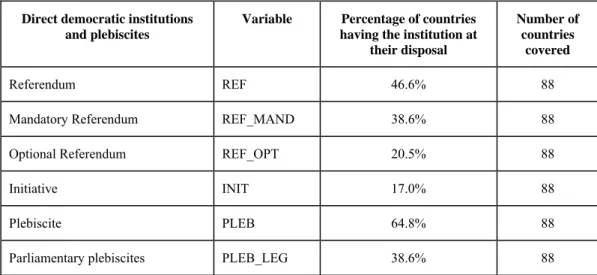
In order to get a first feeling for the prevalence of direct democratic institutions around the world, the first table shows how many countries out of the entire sample explicitly mention direct democratic institutions in their legal frameworks.
Table 1: An overview over de jure institutions
Direct democratic institutions and plebiscites
Variable Percentage of countries having the institution at
their disposal
Number of countries
covered
Referendum REF 46.6% 88
Mandatory Referendum REF_MAND 38.6% 88 Optional Referendum REF_OPT 20.5% 88
Initiative INIT 17.0% 88
Plebiscite PLEB 64.8% 88
Parliamentary plebiscites PLEB_LEG 38.6% 88
The table shows that plebiscites are quite common: almost two thirds of all states taken into account here have them. Among those institutions in line with our delineation of direct democracy, mandatory referendums are encountered most frequently whereas initiatives are encountered least frequently. The bivariate correlations among the three core direct democratic institutions show that initiatives and optional referendums are very highly correlated (0.82), whereas the correlation between mandatory referendums and optional referendums (0.23) as well as between mandatory referendums and initiatives (0.32) are a lot lower, although they are still significant on the 5%-level.
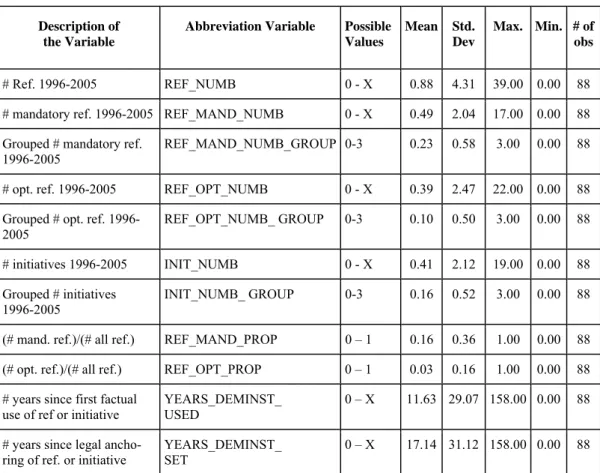
Table 2 offers some descriptive statistics on the factual use of direct democratic institutions. All maxima in the table are due to Switzerland (the individual country codings of all variables can be found in appendix 3). Looking at the last two lines of the table, it becomes evident that direct democracy is a rather young trend: on average, the legal foundations were only passed some 17 years ago, in many countries, direct democratic institutions have, hence, not reached legal age yet.
With regard to the last two lines, it is further noteworthy that there usually is some implementation lag: on average, the first actual experience with direct democracy occurs more than five years after creating the legal foundations.
Table 2: An overview over de facto institutions
Description of the Variable
Abbreviation Variable Possible Values Mean Std. Dev Max. Min. # of obs # Ref. 1996-2005 REF_NUMB 0 - X 0.88 4.31 39.00 0.00 88 # mandatory ref. 1996-2005 REF_MAND_NUMB 0 - X 0.49 2.04 17.00 0.00 88 Grouped # mandatory ref.
1996-2005 REF_MAND_NUMB_GROUP 0-3 0.23 0.58 3.00 0.00 88 # opt. ref. 1996-2005 REF_OPT_NUMB 0 - X 0.39 2.47 22.00 0.00 88 Grouped # opt. ref.
1996-2005 REF_OPT_NUMB_ GROUP 0-3 0.10 0.50 3.00 0.00 88 # initiatives 1996-2005 INIT_NUMB 0 - X 0.41 2.12 19.00 0.00 88 Grouped # initiatives 1996-2005 INIT_NUMB_ GROUP 0-3 0.16 0.52 3.00 0.00 88 (# mand. ref.)/(# all ref.) REF_MAND_PROP 0 – 1 0.16 0.36 1.00 0.00 88 (# opt. ref.)/(# all ref.) REF_OPT_PROP 0 – 1 0.03 0.16 1.00 0.00 88 # years since first factual
use of ref or initiative
YEARS_DEMINST_ USED
0 – X 11.63 29.07 158.00 0.00 88 # years since legal
ancho-ring of ref. or initiative YEARS_DEMINST_ SET 0 – X 17.14 31.12 158.00 0.00 88
Bivariate Correlations
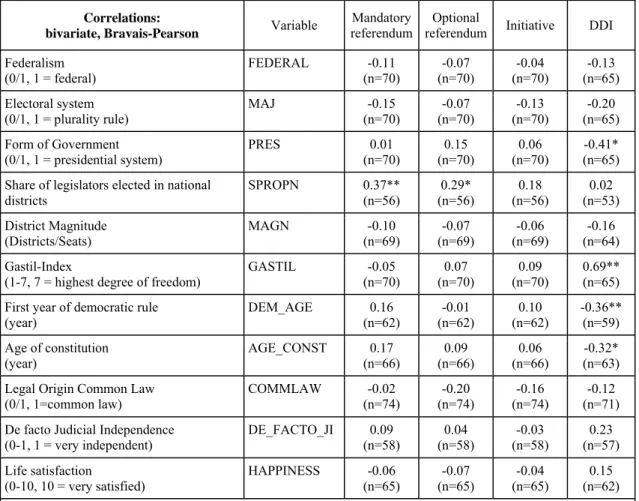
Before presenting the multivariate estimation approach, we report bivariate correlations in order to get an idea what the determinants of direct democracy could be and whether direct democratic institutions are empirically used as complements or rather as substitutes to other political institutions. Federalism is, e.g., one approach to make politics more transparent and politicians more directly accountable to their constituents. A high correlation would thus point at a complementary function of direct democratic institutions and a low correlation at a substitutive one. Table 3 reveals that most of the correlations between the de jure variables and other country characteristics are quite weak. This is also the case with regard to the correlation between common law and direct democratic
institutions. In the theoretical section, it was conjectured that both the common law and direct democratic institutions could be a means of signaling demands to modify legislation. The negative coefficient could indicate that the two tend to be used as substitutes rather than complements but the correlation never reaches conventional significance levels.
One exception is the correlation with the share of legislators elected in national districts. The conjecture motivating the inclusion of this variable is that transparency of what the legislators do and subsequently their accountability to the constituents are supposed to be higher if only a small share is elected in national districts (and also if district magnitude is small). The correlation observed here suggests that the direct democratic institutions are employed as a potential correction mechanism of the low accountability induced by the high share of legislators elected on the national level.
Table 3: Correlations between direct democracy and other country characteristics
Correlations:
bivariate, Bravais-Pearson Variable
Mandatory
referendum referendum Optional Initiative DDI Federalism
(0/1, 1 = federal) FEDERAL -0.11 (n=70) (n=70) -0.07 (n=70) -0.04 (n=65) -0.13 Electoral system
(0/1, 1 = plurality rule) MAJ -0.15 (n=70) (n=70) -0.07 (n=70) -0.13 (n=65) -0.20 Form of Government (0/1, 1 = presidential system) PRES 0.01 (n=70) 0.15 (n=70) 0.06 (n=70) -0.41* (n=65) Share of legislators elected in national
districts SPROPN 0.37** (n=56) 0.29* (n=56) 0.18 (n=56) 0.02 (n=53) District Magnitude (Districts/Seats) MAGN -0.10 (n=69) (n=69) -0.07 (n=69) -0.06 (n=64) -0.16 Gastil-Index
(1-7, 7 = highest degree of freedom)
GASTIL -0.05 (n=70) 0.07 (n=70) 0.09 (n=70) 0.69** (n=65) First year of democratic rule
(year) DEM_AGE 0.16 (n=62) -0.01 (n=62) 0.10 (n=62) -0.36** (n=59) Age of constitution (year) AGE_CONST 0.17 (n=66) (n=66) 0.09 (n=66) 0.06 (n=63) -0.32* Legal Origin Common Law
(0/1, 1=common law) COMMLAW -0.02 (n=74) (n=74) -0.20 (n=74) -0.16 (n=71) -0.12 De facto Judicial Independence
(0-1, 1 = very independent) DE_FACTO_JI 0.09 (n=58) (n=58) 0.04 (n=58) -0.03 (n=57) 0.23 Life satisfaction
(0-10, 10 = very satisfied) HAPPINESS -0.06 (n=65) (n=65) -0.07 (n=65) -0.04 (n=62) 0.15 **, * show that correlation is significantly different from zero on the 1 or 5 percent level, respectively.
The correlations with the Direct Democracy Index (last column of table 3) are somewhat different. This might be due to two differences with the de jure indicators: DDI also takes the factual use of direct democratic institutions into
account and does this, moreover, not only on the national but also on the local level. It seems that states with strong direct-democratic institutions are more likely to come along with parliamentary than with presidential systems. As the combination between majority rule and presidential system was found to have huge effects (e.g. on the fiscal policy of a state, in Persson and Tabellini), it is particularly interesting to ask whether strong direct democratic institutions can work as a corrective device in states that have a combination of parliamentary systems with proportional rule.
The variable “first year of democratic rule” indicates the first year in which a country has been rated as democratic and has remained so without interruption until today. It could be conjectured that higher levels of direct democracy enable countries to better implement democracy in general. If this was the case we would see a negative coefficient which is indeed the case. Alternatively, we have tested the correlation between the age of the current constitution and the indicator of direct democracy. The negative coefficient means that the older the constitution, the higher the degree of direct democracy. This is somewhat of a surprise given that the notions of more direct citizen participation seem to have developed rather recently.
More generally, direct democratic institutions could be expected to go hand in hand with more democratic regimes and higher levels of freedom.10 This is indeed the case and the correlation is the highest in the entire table. We further tested whether there is a correlation between the factual independence of a country’s judiciary and its direct democratic institutions, the two are uncorrelated. Finally, one could expect people in countries with a high degree of direct democracy to be happier than those who only enjoy low degrees of direct democracy. This does not seem to be the case.
A closer look at potential determinants of the factual use of direct democratic institutions (table 4) shows that the longer the period that has passed since the institutions were first introduced (or they were used for the first time), the more intensively they are used today (i.e. between 1996 and 2005). Excluding Switzerland leads only to a moderate reduction in the correlations. This seems to confirm the conjecture that citizens first need to learn how to use these institutions.
10 The Gastil-Index used here is a combination of the two indicators that distinguish between political
freedom and civil liberties. It thus covers a broad concept of freedom. We recoded it from 1 (least democratic) to 7 (most democratic).
Table 4: Correlations of factual use of direct democracy and institutional characteristics Direct Democratic Institutions
Correlations:
bivariate, Bravais-Pearson
# of mand. ref. # of opt. ref. # of initiatives Number of years since institution was created 0.58**
(n=88) 0.56** (n=88) 0.57** (n=88) Number of years since first use 0.61** (n=88) 0.60** (n=88) 0.62** (n=88)
# of excluded policy areas -0.15
(n=36) (n=36) -0.15 (n=36) -0.14 # of policy areas with mandatory referendums (n=39) 0.40* 0.43** (n=39) (n=39) 0.29 Signatures Needed (as percentage of eligible voters) - (n=17) -0.35 (n=15) -0.55* Quorum 1 (Minimum level of electoral participation) - (n=11) -0.18 (n=11) -0.21 Quorum 2 (Minimum „yes“ votes for being binding;
as percentage of electorate) - (n=11) -0.28 (n=11) -0.31
**, * show that correlation is significantly different from zero on the 1 or 5 percent level, respectively.
In many states, some policy areas are explicitly excluded from being subjected to referendums (e.g. basic constitutional rights, international treaties). Supposedly, the most frequently encountered constraint is that referendums are not allowed to have any budgetary consequences. A simple conjecture would be that the higher the number of excluded policy areas, the lower the number of factually held referendums and initiatives. Table 4 shows that all correlations have the expected sign but do not reach conventional significance levels. A significant correlation does, however, exist between the number of policy areas in which referendums are obligatory (e.g. constitutional changes) and the intensity of using direct democratic institutions. The correlation becomes somewhat weaker if Switzerland is excluded but remains significant on the 5 percent level. Another conjecture is also straightforward: the higher the percentage of signatures that need to be collected before an initiative (or an optional referendum) takes place, the less likely are they to factually take place. Both observed correlations do not contradict this conjecture, but note that the number of observations is fairly low.11 The next hurdle that needs to be mastered before optional referendums and initiatives can unfold any consequences is the quorum that is the minimum level of electoral participation that needs to be met for the referendum (the initiative) to be binding. Higher quorums can have discouraging effects on even trying to use direct
11 It is remarkable that the number of signatures that are required before direct democratic institutions
can be used are frequently not part of the constitution but of ordinary legislation. This means that the signature requirement is a tool that can be used by government actors to influence the intensity with which direct democratic institutions are factually used.
democratic institutions in the first place.12 All correlations have indeed a negative sign indicating that the conjecture cannot be rejected. Note again the small number of observations.
The Estimation Approach
The estimation approach used is straightforward and follows directly from the theoretical part. We are interested in estimating the dependent variable Y that can stand for (i) fiscal policy, (ii) government effectiveness or (iii) economic productivity of a country. The vector M is made up of the variables used by Persson and Tabellini (2003) to explain Y. The variable DD is either the Direct Democracy Index or one of our measures of direct democratic institutions from the extended data set. The Z vector is composed of a number of additional control variables and εi is an error term.
Yi = αi + βMi + γDDi + δZi + εi
Compared to intra-country studies, cross-country studies pose a number of problems that one should at least be aware of. In intra-country studies, the ceteris paribus condition is often a lot better satisfied than in cross-country studies: many factors that differ across countries can be safely assumed not to display large degrees of variation within countries. This means that the number of control variables used in cross-country studies should be higher than in intra-country studies. Beyond the Persson and Tabellini variables in the M-vector, we therefore also tested for additional variables in the Z-vector. We use a proxy for the size of coalition governments in terms of independent actors, the “index of political cohesion” variable, based on the conjecture that larger coalition governments would tend to pass larger budgets (Roubini and Sachs 1989). The source used here is the Database of Political Institutions (Beck et al. 2000). It has been argued that direct democracy would only be relevant in certain more general environments in which governments generally adhere to the rule of law, the press can freely criticize government etc. This is why we also included variables proxying for Press Freedom (Freedom House), the Rule of Law (Heritage Foundation) as well as a Political Conflict Index (Banks 2004). The Political Conflict Index is composed of eight single variables, namely the number of assassinations, the number of general strikes, the occurrence of guerilla warfare, the occurrence of
12 The same consideration should be true with regard to the majorities needed to make the outcome
of a referendum or an initiative binding. Yet, empirically, we do not find any variation in the needed majorities: it is always simple majorities that are needed. There is, hence, no empirical evidence with which the conjecture could be tested.
government crises, purges, riots, revolutions, and anti-government demonstrations. We also include legal origins as a control variable.
Further, two measures were used to control for the fiscal or ideological preferences of the electorate: the first one measures the degree of fiscal conservatism of the voters. The second one reflects ideological preferences of legislative and executive majorities. The first measure is taken from the World Values Survey. There are two variables, one aiming at the self-evaluation of the surveyed person, the other aiming at his or her normative ideal for the entire society.13 The second measure is taken from Whytock (2006) who coded political party affiliations of the executive and legislative branches according to the following scheme: -1 if both the executive branch and legislative branch are right-leaning ideologically, (with the negative sign implying lower expected government spending) and 1 if both the executive and the legislative branch are left-leaning (and 0 otherwise).
All the estimates presented in the next section are, however, robust to the inclusion of all of these variables of the Z-vector, if not mentioned otherwise. In addition, all estimates are robust to the exclusion of outliers whose residuals are larger than two standard deviations.14
Models in which institutional variables serve as explanatory variables are always subject to serious endogeneity issues. We believe that these issues are particularly relevant with regard to government effectiveness and the economy’s productivity. The so-called Lipset hypothesis (1960) assumes that the level of economic development of a country has a direct effect on its likelihood to be democratic. Hence, all regressions are estimated by OLS in the first place and a Hausman-Test is conducted to check for endogenity. Identification of adequate instruments for the Hausman-Test is difficult as the theory treating direct democratic institutions as endogenous is in its very infancy. This is why we have opted for a very pragmatic approach: We draw on a paper by Fiorino and Ricciuti (2007) who identify a number of variables that have a significantly positive effect on the level of direct democracy in a cross section of 87 countries, namely the latitude as instrument for per capita income, the level of education (we will use primary and
13 Here is the wording of the two questions: In political matters, people talk of "the left" and "the
right." How would you place your views on this scale, generally speaking? (Left Right 1-10); And now, could you please tell me which type of society your country should aim to be in the future. For each pair of statements, would you prefer being closer to the first or to the second alternative? A society with extensive social welfare, but high taxes. A society where taxes are low and individuals take responsibility for themselves. (somewhat closer to, on a scale 1-5).
secondary school enrollment), the stability of political rights (we will use age of democracy) and the share of Catholics among the population. The degree of ethno-linguistic fractionalization has a negative impact according to their findings.15 These five instruments explain 60 percent of the cross country variation of the DDI. None of the estimates presented in the next section is subject to serious endogeneity bias according to the Hausman-Test and we refrain from running TSLS in addition to OLS.
Additionally, a number of interaction effects between the proxies for direct democracy and press freedom, the rule of law, the level of education and de facto judicial independence were analyzed. The effects proved, however, insignificant and we do not report them here. This is entirely different with regard to the interaction between the proxies for direct democracy and the observed level of democracy. We were interested in the question whether direct democratic institutions have stronger effects in weaker democracies and constructed a dummy coded 1 for countries with a Gastil-Index of 4 and less.16 17 out of the 62 countries recognized in most regressions belong to the group of “weak democracies”. The results of the interaction effects are reported below.
5 Estimation Results and their Interpretation
Fiscal Policy Variables
We now move on to describe the estimation results with regard to fiscal policy variables. These include (i) total government expenditure, (ii) central government expenditure, (iii) central government revenue, (iv) budget surplus, and (v) composition of government spending. Empirical studies from Switzerland and the U.S. have usually found that the stronger the institutions of direct democracy, the lower the government expenditure, but also government revenue and the budget deficit. The picture that we get from the cross-country analysis points into the same direction but is not nearly as clear-cut as that from the former studies: The effect of the DDI for explaining differences in total government expenditure has the expected sign but does not reach conventional levels of significance.17 A
15 Tavares and Wacziarg (2001) find similar results with regard to the general level of democracy in a
country.
16 Remember that we recoded the Gastil such that lower values indicate lower levels of democracy. 17 It appears plausible to assume that the fiscal referendum is crucial for direct democratic institutions
to have expenditure decreasing effects. The fiscal referendum forces governments to ask the citizens for approval of their budget proposals. As the proxy for direct democracy used here does not include a variable specifically geared at the existence of fiscal referendums, empirical testing of this potentially relevant transmission mechanism needs to be explored in future studies.
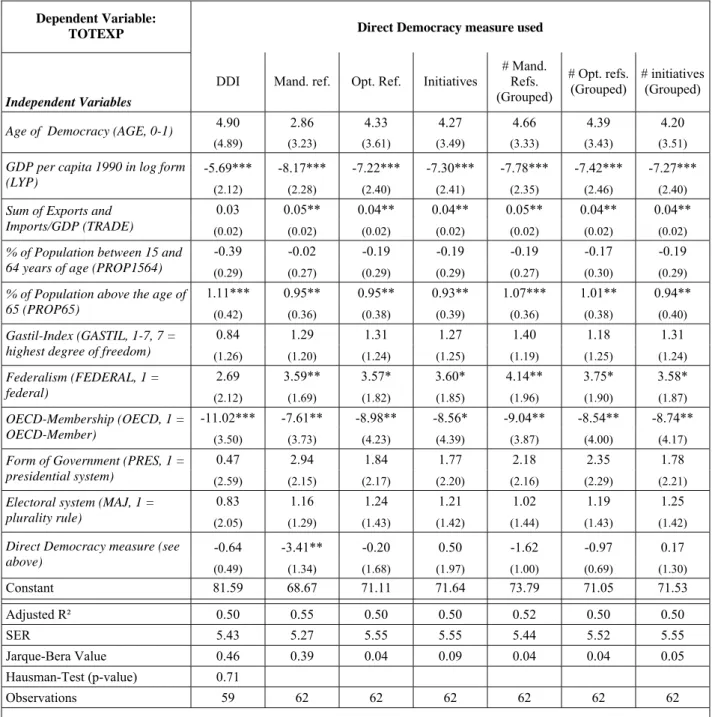
similar result is obtained when central government expenditure or revenue is used as the dependent variable. We, hence, refrain from documenting the results. Among the six variables on institutional details estimated here (three de jure and three de facto institutions), only the existence of mandatory referendums is significantly correlated with total government expenditure: states that have mandatory referendums have expenditures that are some 3.4% of GDP lower than states that do not.
We were interested to know whether the effects of direct democratic institutions only materialize in countries that have already achieved a high level of democracy – or whether they materialize independently of the general level of democracy. In order to test this, we constructed a dummy variable “weak democracy” that takes on the value of 1 if the Gastil-coding was smaller than four. This dummy was interacted with the direct democracy variables. The size of the coefficient for mandatory referendums more than doubles (to 7.2) and the direct effect of both mandatory referendums and initiatives becomes significant now. A one-group improvement in mandatory referendums would lead to lower total government expenditure of some 8% of GDP! The size of the coefficient for initiatives is still a very noteworthy 5.2%. What is stunning: it has a positive sign, i.e. the higher the number of factually held initiatives, the higher total government expenditure! It seems plausible to assume that well-organized lobby groups are able to take the direct democratic institutions hostage for their own agenda.18
18 As an aside, it seems noteworthy that the original “Persson-Tabellini variables” (i.e. form of
government and electoral system) are frequently not robust to the inclusion of direct democratic variables. In another paper (Blume et al. 2007) that replicates and extends on their findings, it is shown that form of government is sensitive to marginal changes whereas the effects of electoral systems appear more robust.
Table 5: Direct Democracy and Total Government Expenditure
Dependent Variable:
TOTEXP Direct Democracy measure used
Independent Variables
DDI Mand. ref. Opt. Ref. Initiatives
# Mand. Refs. (Grouped)
# Opt. refs.
(Grouped) # initiatives (Grouped) 4.90 2.86 4.33 4.27 4.66 4.39 4.20
Age of Democracy (AGE, 0-1)
(4.89) (3.23) (3.61) (3.49) (3.33) (3.43) (3.51)
-5.69*** -8.17*** -7.22*** -7.30*** -7.78*** -7.42*** -7.27***
GDP per capita 1990 in log form
(LYP) (2.12) (2.28) (2.40) (2.41) (2.35) (2.46) (2.40)
0.03 0.05** 0.04** 0.04** 0.05** 0.04** 0.04**
Sum of Exports and
Imports/GDP (TRADE) (0.02) (0.02) (0.02) (0.02) (0.02) (0.02) (0.02)
-0.39 -0.02 -0.19 -0.19 -0.19 -0.17 -0.19
% of Population between 15 and
64 years of age (PROP1564) (0.29) (0.27) (0.29) (0.29) (0.27) (0.30) (0.29)
1.11*** 0.95** 0.95** 0.93** 1.07*** 1.01** 0.94**
% of Population above the age of
65 (PROP65) (0.42) (0.36) (0.38) (0.39) (0.36) (0.38) (0.40)
0.84 1.29 1.31 1.27 1.40 1.18 1.31
Gastil-Index (GASTIL, 1-7, 7 =
highest degree of freedom) (1.26) (1.20) (1.24) (1.25) (1.19) (1.25) (1.24)
2.69 3.59** 3.57* 3.60* 4.14** 3.75* 3.58* Federalism (FEDERAL, 1 = federal) (2.12) (1.69) (1.82) (1.85) (1.96) (1.90) (1.87) -11.02*** -7.61** -8.98** -8.56* -9.04** -8.54** -8.74** OECD-Membership (OECD, 1 = OECD-Member) (3.50) (3.73) (4.23) (4.39) (3.87) (4.00) (4.17) 0.47 2.94 1.84 1.77 2.18 2.35 1.78
Form of Government (PRES, 1 =
presidential system) (2.59) (2.15) (2.17) (2.20) (2.16) (2.29) (2.21)
0.83 1.16 1.24 1.21 1.02 1.19 1.25
Electoral system (MAJ, 1 =
plurality rule) (2.05) (1.29) (1.43) (1.42) (1.44) (1.43) (1.42)
-0.64 -3.41** -0.20 0.50 -1.62 -0.97 0.17
Direct Democracy measure (see
above) (0.49) (1.34) (1.68) (1.97) (1.00) (0.69) (1.30) Constant 81.59 68.67 71.11 71.64 73.79 71.05 71.53 Adjusted R² 0.50 0.55 0.50 0.50 0.52 0.50 0.50 SER 5.43 5.27 5.55 5.55 5.44 5.52 5.55 Jarque-Bera Value 0.46 0.39 0.04 0.09 0.04 0.04 0.05 Hausman-Test (p-value) 0.71 Observations 59 62 62 62 62 62 62
*, ** und *** show that the estimated parameter is significantly different from zero on the 10, 5, or 1 percent level, respectively. The numbers in parentheses are the White heteroscedasticity-consistent standard errors. SER is the standard error of the regression, and J.–B. the value of the Jarque-Bera-test on normality of the residuals. The Hausman-Test draws on the instruments latitude, school enrollment, age of democracy, share of catholic population and ethno-linguistic fractionalization. Exclusion of the six countries that introduced direct democratic institutions after 1996 leads to very similar results. On average, the adj. R-square is some three to four points higher (results available upon request).
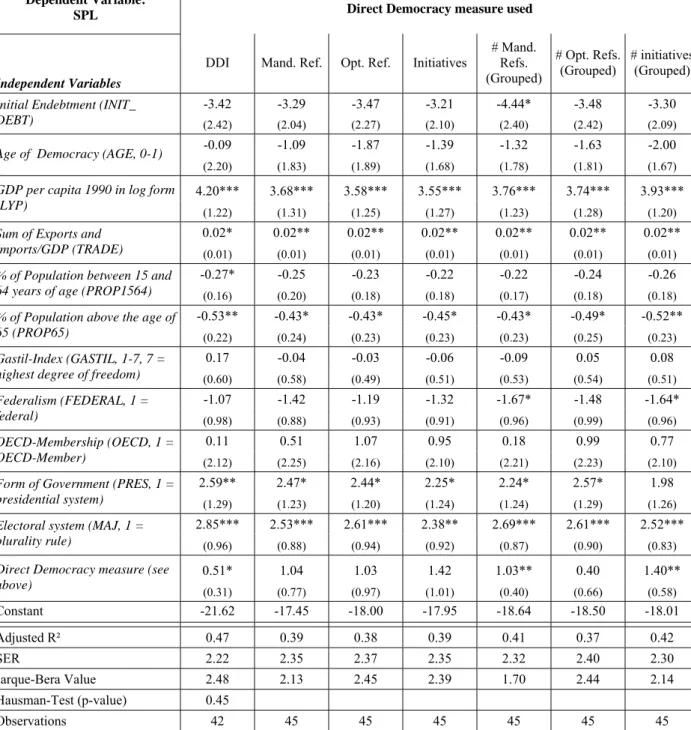
The effects of direct democratic institutions on the budget surplus (which frequently takes on a negative sign and could, hence, also be called budget deficit) are slightly different which is why they are presented in table 6.
Table 6: Direct Democracy and Budget Surplus
Dependent Variable:
SPL Direct Democracy measure used
Independent Variables
DDI Mand. Ref. Opt. Ref. Initiatives
# Mand. Refs. (Grouped)
# Opt. Refs.
(Grouped) # initiatives (Grouped) -3.42 -3.29 -3.47 -3.21 -4.44* -3.48 -3.30
Initial Endebtment (INIT_
DEBT) (2.42) (2.04) (2.27) (2.10) (2.40) (2.42) (2.09)
-0.09 -1.09 -1.87 -1.39 -1.32 -1.63 -2.00
Age of Democracy (AGE, 0-1)
(2.20) (1.83) (1.89) (1.68) (1.78) (1.81) (1.67)
4.20*** 3.68*** 3.58*** 3.55*** 3.76*** 3.74*** 3.93***
GDP per capita 1990 in log form
(LYP) (1.22) (1.31) (1.25) (1.27) (1.23) (1.28) (1.20)
0.02* 0.02** 0.02** 0.02** 0.02** 0.02** 0.02**
Sum of Exports and
Imports/GDP (TRADE) (0.01) (0.01) (0.01) (0.01) (0.01) (0.01) (0.01)
-0.27* -0.25 -0.23 -0.22 -0.22 -0.24 -0.26
% of Population between 15 and
64 years of age (PROP1564) (0.16) (0.20) (0.18) (0.18) (0.17) (0.18) (0.18)
-0.53** -0.43* -0.43* -0.45* -0.43* -0.49* -0.52**
% of Population above the age of
65 (PROP65) (0.22) (0.24) (0.23) (0.23) (0.23) (0.25) (0.23)
0.17 -0.04 -0.03 -0.06 -0.09 0.05 0.08
Gastil-Index (GASTIL, 1-7, 7 =
highest degree of freedom) (0.60) (0.58) (0.49) (0.51) (0.53) (0.54) (0.51)
-1.07 -1.42 -1.19 -1.32 -1.67* -1.48 -1.64* Federalism (FEDERAL, 1 = federal) (0.98) (0.88) (0.93) (0.91) (0.96) (0.99) (0.96) 0.11 0.51 1.07 0.95 0.18 0.99 0.77 OECD-Membership (OECD, 1 = OECD-Member) (2.12) (2.25) (2.16) (2.10) (2.21) (2.23) (2.10) 2.59** 2.47* 2.44* 2.25* 2.24* 2.57* 1.98
Form of Government (PRES, 1 =
presidential system) (1.29) (1.23) (1.20) (1.24) (1.24) (1.29) (1.26)
2.85*** 2.53*** 2.61*** 2.38** 2.69*** 2.61*** 2.52***
Electoral system (MAJ, 1 =
plurality rule) (0.96) (0.88) (0.94) (0.92) (0.87) (0.90) (0.83)
0.51* 1.04 1.03 1.42 1.03** 0.40 1.40**
Direct Democracy measure (see
above) (0.31) (0.77) (0.97) (1.01) (0.40) (0.66) (0.58) Constant -21.62 -17.45 -18.00 -17.95 -18.64 -18.50 -18.01 Adjusted R² 0.47 0.39 0.38 0.39 0.41 0.37 0.42 SER 2.22 2.35 2.37 2.35 2.32 2.40 2.30 Jarque-Bera Value 2.48 2.13 2.45 2.39 1.70 2.44 2.14 Hausman-Test (p-value) 0.45 Observations 42 45 45 45 45 45 45
*, ** und *** show that the estimated parameter is significantly different from zero on the 10, 5, or 1 percent level, respectively. The numbers in parentheses are the White heteroscedasticity-consistent standard errors. SER is the standard error of the regression, and J.–B. the value of the Jarque-Bera-test on normality of the residuals. The Hausman-Test draws on the instruments latitude, school enrollment, age of democracy, share of catholic population and ethno-linguistic fractionalization.
The table shows that mandatory referendums seem to increase the budget surplus (by 1.35% of GDP). Yet, this effect is not robust to the inclusion of the control variables. However, as soon as those countries that introduced direct democratic institutions only after 1996 are excluded, the coefficient becomes 2.20. The standard error being .66, this implies de jure mandatory referenda are significant on the 5% level (with N=40). Returning to the complete sample, inclusion of the
control variables changes the picture once again: now, the right to initiative has a significant positive effect on the budget surplus (namely 2.1%). Moving on to the variables that could have a direct effect, we see that both (the number of factually held) mandatory referendums and initiatives reduce the budget deficit. Both of these results are robust to the inclusion of the Z-vector. The regression with the DDI also indicates that stronger direct democratic institutions are correlated with lower central government budget deficit deficits. The economic significance seems to be substantial too: Every two-step improvement of direct democracy (remember that there are seven groups) goes along with a reduction of the central government budget deficit of more than one percentage point.
To conclude our analysis of the effects of direct democratic institutions on fiscal policy variables, we ask whether they have an effect on the composition of government spending measured by the variable social services and welfare spending. The variable is defined as the central government expenditures consolidated on social services and welfare as a percentage of GDP. Since our estimates show that they do not (at least for the entire sample), we refrain from presenting yet another table.19
Government Effectiveness
We now turn to the estimates that deal with the effect of direct democratic institutions on government effectiveness. The measure for government effectiveness is taken from the Governance Indicators of the World Bank (Kaufmann et al. 2003) and has been recoded here such that 10 indicates the highest level of government effectiveness. Additionally, we also analyze the effects of direct democratic institutions on tax morale and a measure called graft which is also taken from the World Bank’s Governance Indicators. Since the “graft” measure is a proxy for corruption, we checked the robustness of the results by regressing Transparency International’s “Corruption Perception Index” on the direct democracy variables.
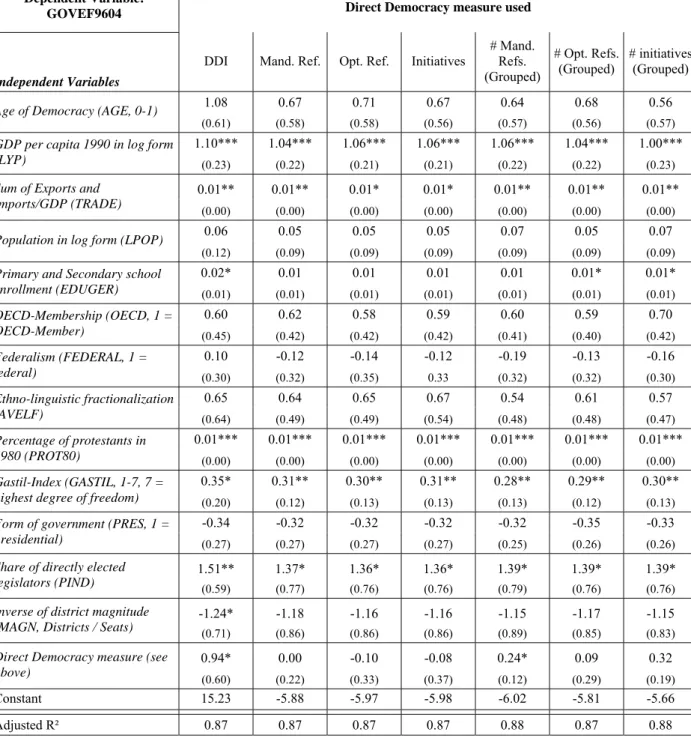
We do not find an indirect effect of direct democratic institutions on government effectiveness. But there is a direct effect: the factually held number of mandatory
19 When the “weak democracy” dummy is interacted with the possibility of optional referendums, it
shows that countries that have that institution spend 3.3% less on social services and welfare than countries without it. This result is due to the indirect effect as no optional referendums took place in weak democracies between 1996 and 2005.