NoSQL DATABASES
A Thesis Submitted to the College of Graduate Studies and Research In Partial Fulfillment of the Requirements
For the Degree Masters of Science In the Department of Computer Science
University of Saskatchewan Saskatoon
By
NICOLETA C. BRAD
PERMISSION TO USE
In presenting this thesis in partial fulfilment of the requirements for a Postgraduate degree from the University of Saskatchewan, I agree that the Libraries of this University may make it freely available for inspection. I further agree that permission for copying of this thesis in any manner, in whole or in part, for scholarly purposes may be granted by the professor or professors who supervised my thesis work or, in their absence, by the Head of the Department or the Dean of the College in which my thesis work was done. It is understood that any copying or publication or use of this thesis or parts thereof for financial gain shall not be allowed without my written permission. It is also understood that due recognition shall be given to me and to the University of Saskatchewan in any scholarly use which may be made of any material in my thesis.
Requests for permission to copy or to make other use of material in this thesis in whole or part should be addressed to:
Head of the Department of Computer Science 176 Thorvaldson Building
110 Science Place
University of Saskatchewan
Saskatoon, Saskatchewan (S7N 5C9) Canada
ABSTRACT
With the popularity and expansion of Cloud Computing, NoSQL databases (DBs) are becoming the preferred choice of storing data in the Cloud. Because they are highly de-normalized, these DBs tend to store significant amounts of redundant data. Data de-duplication (DD) has an important role in reducing storage consumption to make it affordable to manage in today’s explosive data growth. Numerous DD methodologies like chunking and, delta encoding are available today to optimize the use of storage. These technologies approach DD at file and/or sub-file level but this approach has never been optimal for NoSQL DBs.
This research proposes data De-Duplication in NoSQL Databases (DDNSDB) which makes use of a DD approach at a higher level of abstraction, namely at the DB level. It makes use of the structural information about the data (metadata) exploiting its granularity to identify and remove duplicates. The main goals of this research are: to maximally reduce the amount of duplicates in one type of NoSQL DBs, namely the key-value store, to maximally increase the process performance such that the backup window is marginally affected, and to design with horizontal scaling in mind such that it would run on a Cloud Platform competitively. Additionally, this research presents an analysis of the various types of NoSQL DBs (such as key-value, tabular/columnar, and document DBs) to understand their data model required for the design and implementation of DDNSDB.
Primary experiments have demonstrated that DDNSDB can further reduce the NoSQL DB storage space compared with current archiving methods (from 17% to near 69% as more structural information is available). Also, by following an optimized adapted MapReduce architecture, DDNSDB proves to have competitive performance advantage in a horizontal scaling cloud environment compared with a vertical scaling environment (from 28.8 milliseconds to 34.9 milliseconds as the number of parallel Virtual Machines grows).
ACKNOWLEDGMENTS
I would like to thank my supervisor, Dr. Ralph Deters for his continuous guidance, support and patience throughout the entire period of my studies. Also, I would like to thank my family (my husband Daniel and my daughter Arina) for their continuous support. And last, I would especially like to thank my mother for all her help in the last two years so that I can be successful.
TABLE OF CONTENTS
page
PERMISSION TO USE ... i
ABSTRACT ... ii
ACKNOWLEDGMENTS ... iii
LIST OF TABLES ... vii
LIST OF FIGURES ... viii
LIST OF ABBREVIATIONS ... x ... 1 CHAPTER 1 INTRODUCTION ... 1 ... 5 CHAPTER 2 PROBLEM DEFINITION ... 5
2.1 Applying Data De-duplication to NoSQL Database Backup ... 5
2.2 Research Goal ... 7 ... 9 CHAPTER 3 LITERATURE REVIEW ... 9 3.1 Cloud Computing ... 9 3.2 Databases ... 10 3.2.1 Relational DBs ... 10 3.2.2 NoSQL DBs ... 12 3.2.2.1 MapReduce ... 13 3.2.2.2 Key-Value DBs... 15 3.2.2.3 Column-Based DBs ... 17 3.2.2.4 Document-Based DBs ... 19
3.3 Data De-Duplication ... 22 3.4 Database Backup ... 26 3.5 Conclusion ... 28 ... 31 CHAPTER 4 DE-DUPLICATION APROACH ... 31
4.1 NoSQL DBs Data Model ... 31
4.1.1 Key-value DBs ... 32
4.1.2 Column-Based DBs ... 32
4.1.3 Document DBs ... 34
4.2 NoSQL DBs Metadata ... 35
4.3 De-duplication Ratio ... 37
4.4 Data DD with MapReduce ... 38
... 42 CHAPTER 5 IMPLEMENTATION ... 42 ... 48 CHAPTER 6 EVALUATION... 48 6.1 Experiment Goals ... 49 6.2 Experimental Setup ... 54 6.3 Dataset ... 56 ... 60 CHAPTER 7 RESULTS ... 60 7.1 De-Duplication Ratio ... 60
7.1.2 DD Ratio and the Amount of Data ... 64
7.1.3 Distribution of Duplicate Data ... 66
7.1.4 DD Ratio Comparison... 68
7.2 Scaling the DDNSDB... 73
7.2.1 DDNSDB Performance and Structural Information ... 76
7.2.2 DDNSDB Performance and Amount of Data ... 78
7.2.3 DDNSDB Performance and Distribution of Redundant Data ... 79
7.2.4 DDNSDB Performance and Number of Parallel Map/Reduce Processes ... 81
7.2.5 DDNSDB Performance and Number of Physical/Virtual Machines ... 83
7.2.6 Summary ... 87
... 91
CHAPTER 8 CONCLUSION AND FUTURE WORK ... 91
8.1 Conclusion ... 91
8.2 Future Work ... 93
LIST OF TABLES
Table page
Table 3.1:List of research solutions by area ...30
Table 6.1:Experiments variable and values. ...52
Table 6.2:EC2 VMs hardware configuration ...55
Table 6.3:Tuple complexity ...56
Table 6.4:DB Files structure ...57
Table 7.1:Backup Files and DD Ratio ...65
Table 7.2:DD Ratio based on distribution of redundant data ...66
Table 7.3:DDNSDB performance based on the distribution of duplicate data ...79
Table 7.4:Comparison of average DD Ratio between T1 and T2 ...81
Table 7.5:DDNSDB average run-time for T3.1, T3.3 & T3.4 ...84
LIST OF FIGURES
Figure page
Figure 1.1: SSTable internal structure. ...2
Figure 3.1: Generic MapReduce execution phases ...14
Figure 3.2: Representation of key-value store with arbitrary data (no schema) ...16
Figure 3.3: Google’s BigTable structure, used to store Web pages ...17
Figure 3.4: Structural representation of a Document DS for MongoDB. ...21
Figure 3.5: DD for two files split in chunks. ...22
Figure 4.1: Twitter model in a column oriented structure ...33
Figure 4.2: Overview of the execution phases ...39
Figure 4.3: Hierarchical reduction ...40
Figure 5.1 (a): Metadata base records split without hashing ...43
Figure 5.1 (b): Metadata base records split with hashing ...44
Figure 5.2: De-duplication steps. ...45
Figure 6.1: Experiments topologies. ...49
Figure 7.1: Average DD Ratio for the three different DB structure ...61
Figure 7.2: DD Ratio based on structural information ...61
Figure 7.3: Average DD Ratio for the three different data chunks. ...63
Figure 7.4: DD Ratio based on Chunk size. ...63
Figure 7.5: Average DD Ratio based on DB file sizes ...65
Figure 7.7 (a): DB Backup File sizes comparison for AM structure ...69
Figure 7.8 (a): DD Ratio for DDNSDB, Zip, and GZip for AM structure ...69
Figure 7.7 (b): DB Backup File sizes comparison for SM structure ...70
Figure 7.8 (b): DD Ratio for DDNSDB, Zip, and GZip for SM structure ...70
Figure 7.7 (c): DB Backup File sizes comparison for NM structure ...71
Figure 7.8 (c): DD Ratio for DDNSDB, Zip, and GZip for NM structure ...71
Figure 7.9: DDNSDB Timing for T1 with 6 map/reduce processes ...74
Figure 7.10: DDNSDB Timing for T1 with 48 map/reduce processes ...75
Figure 7.11: DDNSDB performance based on structural information ...77
Figure 7.12: DDNSDB Performance based on the amount of data ...78
Figure 7.13: DDNSDB performance based on the distribution of duplicate data ...80
Figure 7.14: Comparison of AVG DD Ratio between T1 and T2 ...82
Figure 7.15: DDNSDB performance comparison between T3.1, T3.3, and T3.4 ...84
LIST OF ABBREVIATIONS
ACID Atomicity, Consistency, Isolation, Durability
AM All Metadata
API Application Programming Interface
AWG Average
BASE Basically Available, Soft state, Eventually consistent CAP Consistency, Availability, and Partition tolerance
CC Cloud Computing
CP Cloud Platforms
CS Cloud Services
DBs Databases
DBMS Database Management Systems
DC Distributed Computing
DD De-Duplication
DDR De-Duplication Ratio
DDNSDB Data De-duplication in NoSQL Databases
DS Data Store
EC2 Amazon Elastic Cloud Computing
EVM Erlang Virtual Machine
IaaS Infrastructure as a Service JSON Java Script Object Notation
LAN Local Area Network
NAS Network-Attached Storage
NM No Metadata
NoSQL Not Only SQL
PaaS Platform as a Service
RDBMS Relational Databases Management Systems REST Representational State Transfer
SaaS Software as a Service
SM Some Metadata
SSTable Sorted String Table
SQL Standard Query Language
T1-3 Topology1,2, and 3
VLT Virtual Tape Library
WAN Wide Area Network
CHAPTER 1 INTRODUCTION
Cloud computing is transforming computing into a utility like service, changing the scale of computing operations. The cloud platforms composed of storage, computational power, and web access are becoming the choice for deploying highly available and scalable systems, changing the data landscape. At the same time the rapid growth of data pushed by Web 2.0 companies, social networking and user contributed content brings new challenges to the DB management systems, compelling them to consider data storage options beyond the traditional SQL-based relational DBs. Properties like elasticity and high availability are becoming increasingly important for these systems.
To be able to store and analyze the rich information, through custom engineering development at large web sites and services like Amazon, Google, Yahoo!, Facebook, etc., new types of DBs have emerged called NoSQL (Not Only SQL). More specifically, they are designed with horizontal scaling, availability, cost, and performance in mind. NoSQL DBs introduce new storage architectures that scale horizontally and parallel algorithms designed to efficiently process the distributed data (MapReduce being the most popular example). Many of the NoSQL DBs are open source and run on commodity hardware, making them significantly less expensive per terabyte than traditional DBs from vendors. NoSQL DBs introduce also new data structures, more appropriate to the web based data [14].
Three main types of NoSQL DBs are becoming more popular these days: the key-value DBs, columnar/tabular DBs, and document DBs. One problem that they all have in common is the amount of redundant data which they store because of their highly de-normalized structure.
One can argue that storage is cheap and getting cheaper but besides the price of acquiring the storage, companies also have to be able to efficiently store and maintain this data. The amount of processing power and energy needed to handle and manage the data, the network resources for transmitting of the data to different locations, the time and resources dedicated to backup and replication all add to the “cheap storage” cost, making it not “cheap” anymore.
Data DD has received broad attention both in industry [21; 29; 30; 39; 28; 22], and academia [37; 23; 33; 36; 43; 53; 13; 26] in recent years as the method to optimize storage capacity. The way DD works is by detecting exact copies of data blocks or by detecting similar or near duplicate blocks and storing the difference.
Some more mature NoSQL DBs like Amzon’s BigTable have implemented optional archiving - a combination of different DD algorithms combined with archiving – which is applied to each SSTable (Sorted String Table) block [12] to help reduce the duplicated data. The SSTable is “…an on-disk file format that represents a string-to-string mapping” [49] and consists of immutable key-value pairs.
Figure 1.1: SSTable internal structure.
An intuitive assumption is to approach DD at the DB level and to make use of the structural information about the data to locate the duplicate data. This is another layer which can
depends on the granularity of structural information available in the DBs. There are reasons why we should not have too much structure, like fast response, and there are also reasons why we should have more structure, like reducing duplicate data. Although these two concepts seem very contradictory in the sense that you can only have one at a time, there is no reason why we should not try and take advantage of both at the same time. The way data is stored with minimal structure does not have to be affected, maintaining the quick access response. Instead, a new layer is introduced for storing separately the additional structural information, and making use of it only at the time of backup when the DD process needs it.
The key contributions of this research are:
Introduces of a new concept of approaching DD at the NoSQL DB level using the metadata for chunking.
Creates a comparison between the three main types of NoSQL DBs.
Develops a DD tool using the MapReduce architecture for the key-value DBs as a proof of concept.
The benefit of such a DD tool is that it can easily be adapted for other types of NoSQL DBs, and that there are no major changes required by the specialized backup tools to integrate with.
The rest of the document is organized as follows: Section two presents the duplicate data problem present in the NoSQL DBs. Section three reviews the related work about the four areas of interest involved in this research namely: Cloud Computing and MapReduce principals, NoSQL DBs, data DD, and DB backups. Section four introduces the data model of the three main types of NoSQL DBs (key-value, columnar, and document based), and explains why the key-value DB was chosen for the prototype. Furthermore, it investigates and points out the importance of structural information used in the chunking for DD in NoSQL DBs. Then, it presents how the design considerations for DDNSDB share the MapReduce programming
principals for performance and scalability of the DD process. Section five describes the architectural design and execution overview of DDNSDB. Section six describes the evaluation approach, experimental setup, and the datasets used in the experiments. Section seven describes the experiments and the evaluations of the DDNSDB. Section eight summarizes the research contribution and presents potential future work.
CHAPTER 2
PROBLEM DEFINITION
2.1 Applying Data De-duplication to NoSQL Database Backup
NoSQL DBs generally follow a simple data model with dynamic control over data layout and form. There are three main types of NoSQL DBs based on their data model: key-value DBs, columnar DBs, and document DBs.Due to their simpler design compared with the relational databases which are highly normalized, they tend to have a large amount of duplicated data. In distributed environments where NoSQL database are used, redundancy is desired but that is done in a controlled manner generally through
replication. What we are referring to is the uncontrolled duplicate data which is a result of highly de-normalized structures. This duplicate data is then further propagated into the backups increasing the storage requirements even more. While it made no sense to approach DD at the DB level for RDBMS, it makes a lot of sense to approach it for NoSQL DBs.
This research is using the key-value DB as the representative structure for its De-Duplication of NoSQL Databases (DDNSDB) implementation. The key-value DB is the most popular type of NoSQL DB used today though it has the least complex data model. Like an associative array composed of a collection of unique keys and a collection of values where each key is associated with one value or a set of values, the values of a Key-value DB can be simple attributes or a vector of attribute-value pairs. This type of
structure gives flexibility to create very complex schema-less structures with a very fast retrieval, based on the unique key.
DD approaches can be divided into two broad categories: hardware DD approaches and software DD approaches. For backup systems at software level, two other categories can be distinguished based on the placement: source DD where duplicate data is identified at the server being backed up, and before it is sent across the network or target where DD is presented to the backup server as a Network-Attached Storage (NAS) share or Virtual Tape Library (VLT). For the target option modern storage technology (e.g. large computational resources at disk array controllers like Network-Attached Storage (NAS) share, and Virtual Tape Library (VTL) controllers) has been the choice of placement for the DD technology. This option however, rules out the possibility of using DD algorithms which are content aware, plus all the data has to cross over the LAN/WAN contributing to the increase of network traffic. DD at the target/client reduces the network traffic, and the technology can be embedded in the backup architecture. The internal DB information is only available at the client/DB level, making the placemat of the DD process an easy choice for this research.
Existing DD technology reduces the cost of storage and network traffic making it more affordable but many companies are still struggling to complete their backups on a regular scheduled basis. Data loss is similar to hurricanes, leaving behind devastated enterprises which may not be able to ever recover. Because all data is mostly organized in a form of files, existing technologies mostly use file and sub-file DD strategies. Various chunking strategies provide higher or lower DD ratios depending on the type of data and
This novel idea of approaching DD at the databases level where metadata information can be made available to help identifying duplicate data, can be used in parallel with existing DD approaches. This will increase the overall DD ratio and implicitly reduce the data footprint.
There are two main challenges in the DD process of NoSQL database:
Challenge 1- Granularity of the structural information – The structural information is the key element used in identifying duplicate data. Generally, the finer the granularity, the higher the probability of finding duplicate data but it can become very costly compared with the increase in the DD ratio obtained.
Challenge 2 - Scalability – The backup window is very limited regardless of the data growth. At the same time, the backup process is a very intensive I/O process, while the DD process is a CPU and memory intensive operation. By adding a DD process as part of the backup process, it can slow down the backup, and increase the backup window. In such situations, the backup may not be able to finish in time interfering with other processing which needs to happen, and potentially causing business loss. In these circumstances, the DD process will need to be able to scale horizontally, parallelizing the processing to reduce the overhead.
2.2 Research Goal
The focus of this research is to find a scalable architecture for DD of NoSQL DBs backup.
Goal 2 – explore the use of structural information about the data and its granularity to reduce the uncontrolled duplicate data in NoSQL DBs.
Goal 3 – develop a scalable architecture for the DD tool to minimize the time of
CHAPTER 3 LITERATURE REVIEW
The work in this research combines ideas from different industry and research fields: cloud computing, NoSQL DBs, and DD methods. Combing these areas the research tries to minimize storage challenges in the new emerging NoSQL DBs by using existing DD techniques at a different level.
3.1 Cloud Computing
Cloud Computing has generally been defined either by what it is considered to be made of (components), by its purpose, and sometimes using a combination of the two. Looking at what it is made of, Pinase et al. [42] define Cloud Computing (CC) as a distributed logical entity with managed computing resources deployed in big data centers around the globe and connected using public networks, like the Internet. As for the purpose of such entity, Maia et al. [35] define CC as a service with remote access to hardware and software in a highly reliable and transparent way like the electrical network. The increase in popularity of concepts like Infrastructure as a Service (IaaS), Platform as a Service (PaaS), and Software as a Service (SaaS), presented by Luis et al. [51] was the next step in the evolution of CC. This challenged the Web 2.0 companies which were already facing huge data and infrastructures growths. Companies like Google (through Google App Engine – GAE [25]) and Amazon (through Amazon Elastic Compute Cloud - EC2 [1]) provide users with hardware resources, computational
resources, and software resources which have properties like elasticity, availability, and cost effectiveness in mind.
Elasticity is required for flexibility in scaling these systems easily, allowing applications with fast growth like the social networking applications to embrace it. Availability was a must when one thinks about computing as a service provided to millions of users and/or businesses for which downtime may mean revenue loss. And last but not least, cost effectiveness comes into play. It has to be worth paying for these services instead of owning your own.
In summary, CC is a new computing paradigm providing elasticity, availability, and cost effectiveness. These are important infrastructure characteristics to efficiently run a scalable Data De-duplication in NoSQL Databases (DDNSDB).
With the emergence of CC and its inherent properties, other areas have been challenged as well to meet these requirements, and that is the DB management Systems [47].
3.2 Databases
DBs at high level can be split into two categories: relational DBs and distributed DBs providing alternatives on architecture and management systems, depending on the type of data one needs to store and manipulate.
3.2.1 Relational DBs
popular because it maps very well to a large variety of real-world data storage needs from the organization of information point of view. They fit best the structured type of data. Relational DBs also follow the ACID (Atomicity, Consistency, Isolation, and Durability) properties for transactions with which one can achieve extensive power, flexibility and reliability [7]. In 1983, Harder and Reuter [27] created the acronym ACID to describe them. In order for a transaction to achieve indivisibility it has to have the ACID properties: Atomicity (all-or-nothing), Consistency (only valid data will be written to the database), Isolation (events within a transaction must be hidden from other transactions running concurrently), and Durability (ability to recover the committed transactions against any kind of system failure) [27].
Normalization – is the process of organizing data to minimize redundancy in the relational DB world. The concept of normalization and what we know now as the First Normal Form (1NF) was introduced by Edgar F. Codd, the inventor of the relational model. Today there are six normal forms defined but generally, a relational DB table is often described as “normalized” if it is in the Third Normal Form [16]. Normalization involves dividing large, badly-formed tables into smaller, well-formed tables and defining relationship between them. This information about table’s structures and their relations is called metadata (or data about the data). Depending on the degree of normalization, we have more or less information about the DB structure.
However, some modeling disciplines such as the dimensional modeling approach to data warehouse design, explicitly recommend non-normalized designs. The purpose of such systems is to be intuitive and have high-performance retrieval of data [32].
3.2.2 NoSQL DBs
NoSQL DBs use a similar but more extreme approach in their design. These DBs have a simple data model - “large, badly-formed tables” - for the purpose of having dynamic control over data layout and form, and high-performance retrieval against very large amounts of data. At the same time, they tend to have extensive amounts of duplicated data. While there was no reason to do DD at the DBs level for relational DBs, it makes a lot of sense to do DD at the DB level for NoSQL DBs.
The concepts behind non-relational DBs and the DBs themselves like hierarchical, graph, and object oriented have been around for more than 20 years. One common characteristic of these DBs is that they are not relational and they are used best for unstructured and semi structured data or data that changes form and size often.
These DBs do not have a unified Standard Query Language (SQL), instead they use their own APIs, libraries, and preferred languages to interact with the data they contain, hence the name Not Only SQL (NoSQL) DBs.
In pursuing the need for high availability and abundance of data which needs to scale horizontally across multiple nodes, old concepts emerged into these new Data Store (DS) technologies.
Some of the features of NoSQL DBs including seemingly large scalability (dynamic growth with no downtime), extensive fault tolerance and high availability (through partitioning and replication of data across nodes, and dynamically repair node failures capabilities), and integration of REST-ful and cloud computing technologies (web standards, ability to syndicate information directly to/from web sites and, replicate
3.2.2.1 MapReduce
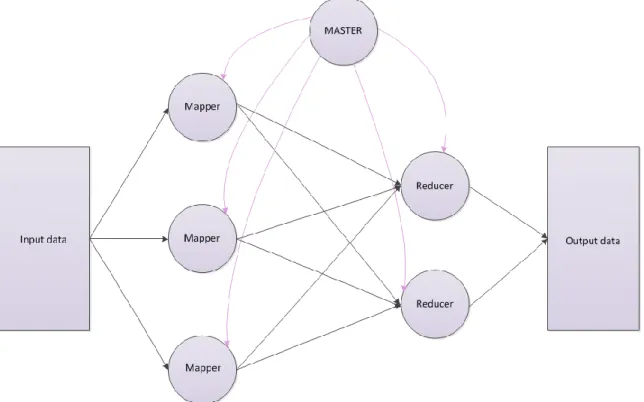
MapReduce - is a very successful programming model adopted for implementation of data-intensive applications to support distributed computing. Jeffrey et al. [17] introduces MapReduce as a master-slave model. The failure of a slave is managed by re-assigning its task to another slave, while master failures are not managed as considered unlikely to happen. Users specify a map and a reduce function. The map function processes key/value pairs and generates a set of intermediate key/value pairs. The reduce function merges all intermediate values associated with the same intermediate key and produces a result as a list of values [17]. The main advantage of MapReduce is that it allows for distributed processing of the map and reduces operations. All map processes can potentially perform in parallel and all reduce processes can potentially perform in parallel; provide that their operations is independent of the others. Figure 3.1 illustrates the execution phases in a generic MapReduce programming model.
Figure 3.1: Generic MapReduce execution phases
The current market of NoSQL is a “hodge-podge” of vendors and open source projects with different levels of maturity. CC prompted some companies like Amazon and Google to develop new management systems with elasticity, availability, and cost effectiveness as core features. These companies impelled other companies and the open source world into the same direction. Some of these systems which are today available are Google Bigtable [12], Amazon’s Dynamo [18], MongoDB [38], and others.
There are two aspects that need to be taken into consideration when looking at the NoSQL DBs, namely the CAP theorem and the data model of the different NoSQL DBs.
Availability, and Partition tolerance” [24] different NoSQL DBs focus on different properties. Some DBs focus on Consistency and Availability. Consistency here is implemented with the “eventual consistency” [52] concept which is based on the idea that “every change will be propagated to the entire DB eventually but some nodes may
not have the latest data at a given time” [7]. Some DBs focus on the Availability and Partition tolerance compromising on Consistency. They converge mainly to provide low latency and high throughput. Some DBs are in between the traditional RDBMS and NoSQL focusing on Consistency and Availability. They provide data consistency guarantees by supporting some types of transactions. Das et al. [15] proposes Elastrans where transactions are allowed but only at partition level. A second solution proposed by Francisco M. et al. [35] builds on top of the former, expanding the consistency to a group of partitions by introduction of a new layer of replication which also ensures higher availability.
Based on the data model, the different NoSQL DBs can be organized in the following categories: Key-value DS, Tabular/Columnar DS, Document DS [47; 34], graph DBs, object DBs, XML DBs, multi-value DBs, and other NoSQL related DBs [20]. The most popular are the first three categories.
3.2.2.2 Key-Value DBs
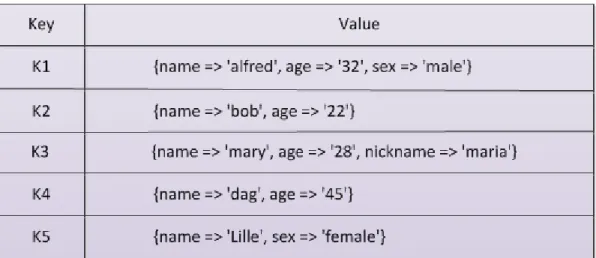
Key-value DBs have the least complex structure out of the NoSQL DBs. They store values indexed for retrieval by programmer-defined keys, and can hold structured and unstructured data. Some are built to run in-memory, some write to disk, and some do both to provide high-performance, scalable, and reliable DS. They have the flexibility to add new attributes that only apply to certain records at any point in time, without having
to rebuild tables or indices. Some of them follow the immediate or strong consistency model; others follow the eventually consistent model. The access is done through APIs (SOAP, REST-ful) and integrity is guaranteed by the application itself.
Figure 3.2: Representation of key-value store with arbitrary data (no schema)
Some of today’s more popular key-value stores are: Amazon’s SimpleDB [2] which is mostly used for small projects due to limitations (10 GB per domain, 100 domains per account, 256 attribute name-value pairs per item, manual partitioning), Oracle’s Berkeley DB [40] which now provides SQLIite-compatible SQL APIs, Scalaris [48] which offers multiple concurrent transactions across multiple keys, and Project Voldemort [44] a mature project and open source version of Amazon Dynamo [18] supporting versioning and eventual consistency.
3.2.2.3 Column-Based DBs
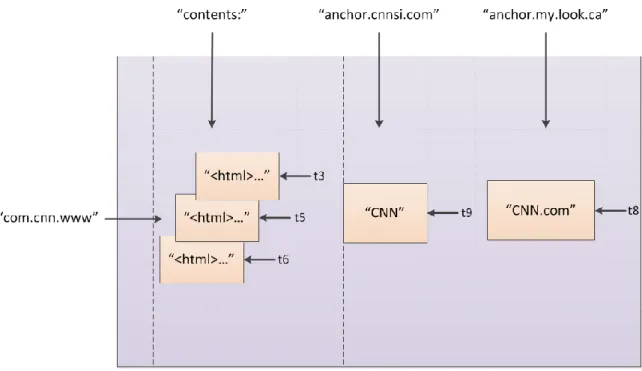
Tabular or Columnar DBs are based on the concept of grouping closely related data into one extendable column [34]. In particular, they offer advantages to compute aggregate values on a limited number of columns. They emerged as implementations designed to meet certain needs (e.g. small footprint, highly compressible distribution of data or spare matrix emulation) rather than provide a general purpose column-oriented DBs. Like any new technology, they evolved to become more mature products. Google’s BigTable model represented in figure 3.3 [12] was used for most DS in this class. BigTable can be described as a “…distributed storage system organized as a sparse,
multi-dimensional sorted map” [12]. Logically, data is organized in tables with rows and columns. The tables are indexed based on a row key, a column key, and a timestamp:
(row: string, column: string, time:int64) -> string.
In figure 3.3 a row is a reserved URL where “contents:” is a column family to
store versions of the page content and “anchor:” is another column family represented here by two names to store the text of the anchors which reference the page.
Partitioning is dynamic at the row range level. Data is stored in lexicographic order based on the row key. The rows of one table can have an arbitrary number of columns. Columns keys are grouped into column families (“following syntax: family: qualifier”) in order to store data of the same type together. Multiple versions of the same data can reside in the same BigTable cell, each versioned with a timestamp.
BigTable is a more mature proprietary DB that uses compression at the SSTable (Sorted Strings Table which is a file of key/value pairs sorted by keys) block level, yet not all columnar DS do that. The compression can be set by the clients and is usually a two pass compression. The first pass uses a long common string technique called also the Bentley and McIlroy scheme [8] and the second pass is a fast compression algorithm based on repetitions of small blocks (16 KB window of data). This scheme achieves a significant 10-to-1 reduction of space. This low level block compression is fast and avoids the decompression of the entire file when reading one small portion of an SSTable [12]. By introducing DD at the database level as well, the footprint of the data can be further reduced. Compared with the key-value data model, the columnar data model has by default some structural information available, like the column families where each cell can have multiple version of the same piece of data. This also gives valuable information where the potential duplicate data is located.
Some of the columnar DSs are: Google BigTable [12] used for many of Google’s applications like Google Maps and Google’s search engine; Facebook which created the high-performance Cassandra [4] which uses a gossip protocol to easily scale (the nodes in a cluster are aware of the state of each node), it also provides durability (writes once completed will survive permanently) by appending writes to a commit log first then, is fsync’d; Apache’s Hbase [6] is a distributed versioned store following Google’s Bigtable capabilities on top of their Hadoop Distributed File System (HDFS) [3]. HDFS is a distributed file system which operates on common hardware for a low cost implementation solution. The tables in Hbase can be used as the input and output for MapReduce jobs which run in Hadoop.
3.2.2.4 Document-Based DBs
Document–based DBs store and organize complex documents/objects which commonly refer to data items. The documents are indexed providing efficient queries, mostly rely on a new principle called BASE (Basically Available – appears to work all the time; Soft state – it doesn’t have to be consistent all the time; Eventual consistent – at some stage it will reach consistency) which trades some amount of consistency for availability. While ACID is pessimistic and forces consistency for all operations, BASE has an optimistic view and assumes that inconsistent operation will occur but will reach a consistent state at some point. Document-base stores support multiple types of documents and multiple indices per DB. The fact that they support multiple indices is the main difference between document and key-value DS. They also provide flexibility to add any numbers of fields of any length to any document at any time. This also means that some
structural information is available at the database level represented by the document attributes.
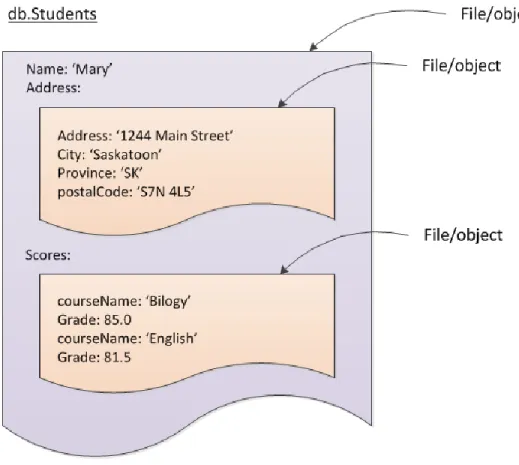
In CouchDB, the documents are the primary unit of data and consist of any number of fields and attachments. Metadata is also associated with the documents. The uniquely named document fields can contain values of varying types with no limit on text size or element count. JavaScript can be used for queries and indexes in a MapReduce fashion [5]. In MongoDB, the primary unit of data is an object; data is organized as one database collection for each top level objects; classes with embedded objects are used. The rule is that objects which follow an object modeling relationship should generally be embedded. There are limits on single object sizes [38].
In figure 3.3 there is a student collection where the student document embeds the address document and the score document.
Figure 3.4: Structural representation of a Document DS for MongoDB.
Some of the more prominent projects are: MongoDB [38] – manages JSON (Java Script Object Notation) object collections with full index support, provides auto-partitioning and fault tolerance, uses sharding (a method of horizontal auto-partitioning) and replication for distributed environments, and it also offers commercial support. CouchDB [5] – uses multi-master support for master-slave replication, works well in distributed environments, provides REST-ful (Representational State Transfer) HTTP APIs for reading and updating DB documents featuring ACID properties, and provides auto-partitioning and fault tolerance. Riak [46] – was inspired from Amazon’s Dynamo,
provides capability for pluggable storage, and uses the eventual consistency concept but it is a less mature project compared to MongoDB and CouchDB.
In conclusion, there are three main types of NoSQL DBs Key-value, Columnar, and Document DBs used for managing unstructured and partially structured data, providing high scalability, availability, and fast retrieval requirements. One downside of these databases is that they tend to store large amounts of duplicate data which gets further propagated into the backup footprint.
3.3 Data De-Duplication
DD is “…the process of identifying duplicates information using different
methods and, eliminates them by applying pointers to those duplicates instead of storing the same data multiple times” [23]. In the context of optimizing storage capacity, DD is one method of reducing storage consumption [23].
Figure 3.5 illustrates how the DD process will retain only one chunk of the same color, where the same color represents duplicate chunks.
Nagapramod at al. [37] developed a taxonomy to characterize and classify the different DD technologies available. They used three dimensions for their classification: the placement of the DD functionality, the timing, and the algorithm used, and created a comprehensive picture of the different aspects involved in the DD process. The choices of one dimension influence the choices of the other two dimensions. The three main DD algorithms presented are whole file hashing, sub file hashing, and delta encoding [37]. As their naming suggests, different types of hashing are used for a faster byte comparison. Sub file hashing has been further divided into fix sized blocks and variable sized blocks also called content defined blocks. Nagapramod at al. [37] experimented with different chunking techniques against real life data to investigate the DD inherent (changes of data where multiple backups were not taken into consideration) to conclude that no one algorithm can fit all.
One of the most popular algorithms to identify repetitions in strings is the Rabin Fingerprint algorithm. [45] It has been used to create the content-defined chunks of identical data or to discover near-duplicate documents in large collection of files [33; 36]. Policroniades at al. [43] evaluates three alternatives of identifying identical portions of data (whole file content, fixed size blocks, and Rabin fingerprints) against five different types of real-world data sets of different sizes. Some data sets were more prone to have a high level of duplicate data, some less. For the whole file and fixed size blocks granularity to identify the sharing patterns, they calculated the SHA-1 [50] digest
of the individual files, and correspondingly of each non-overlapping fixed size chunks of the files. For the third method of variable size chunks, they used Rabin’s fingerprinting which has the advantage that the chunks are created according to their contents. They conclude that the content defined chunking algorithm identifies the most redundant data, but when file access patterns, overhead storage, and computation are considered, the fixed block size strategy may be a better solution.
Different types of semantic information about the data have been also used to increase the percentage of duplicate data detection and narrow down the search space to reduce the total disk access.
Yujuan et al. [53] experimented with one type of semantic information, namely the data ownership and built a three layered DD approach which includes user level, group-level, and global-level DD. The system makes use of data stream locality, Bloom filters [10], and hash chunking.
Chuanyi et al. [13] experimented with two types of semantic information, file type and file format to direct the file chunking along with Rabin fingerprinting. They define these types of chunks as “variable sized, self-identifying, and self-describing logical units”. The files are divided into representative semantic chunks, implementing different file dividing algorithms for different file types. Because the semantic chunks have different length and variable size, they also implemented a storage scheme to alleviate the fragmentation and random disk access problems. Their results show a range between 20% and 50% of better compression ratio than the current conventional methods used in the archival storage.
Other hybrid DD approaches have been explored as well where two or more different algorithms are combined for enhancing the data DD ratio.
Guanlin et al. [26] proposes a two-step process which uses first the more common content defined chunk algorithm as a more coarse-grained chunking mechanism. It divides the files into content defined chunks and removes the duplicates identified. Second it applies a more finer-grain chunking mechanism using resemblance detection to perform delta-encoding and remove the duplicates detected. For the rest of the chucks, compression is applied.
Different chunking algorithms at file and sub-file level have been extensively explored, proving to make a big difference in the duplicate elimination process. The main steps followed by these algorithms are as follow:
Each chunk of data is processed using hash algorithms like MD5, SHA-1 etc.. A unique number for each chunk gets generated with this algorithm which is then stored in an index.
When duplicate data is detected, by comparing the hash number generated for a chunk of data with the ones existing in the index, it is not retained; instead a
“data pointer” is modified so that the system references an exact copy of the data object already stored on the disk.
A potential problem with DD is hash collisions. In very rare cases, the hash algorithm may produce the same hash number for a different chunk of data. This is also called “false positive”, and can result in data loss. A solution to avoid hash collision would be to combine different hash algorithms. Another solution would be to examine the metadata to identify data and prevent collision [9].
Collisions tend to happen more often when we deal with big chunks of data like an entire file. By using smaller chunks the probability is lower. In the context of this research, due to the need to split the attributes - “big unstructured data” – in smaller
chunks using the metadata, the probability of hash collision will be very low therefore it will not be taken into consideration.
In relational DBs, duplicate data was very minimal or almost nonexistent but with the increased interest in NoSQL DBs in the cloud environment, there is a new need to exploit possibilities of identifying duplicates within the DBs. While it made no sense to do DD at the databases for highly normalized data, it makes a lot of sense to approach it for NoSQL DBs which have highly de-normalized data, and where structural information may have a key role.
3.4 Database Backup
DB backups can have different purposes: to recover data after its loss (deleted, corrupted), and to recover data from an earlier time. Data loss is a very common experience but at the same time can be catastrophic if there is no way of getting it back. DBs can store sensitively personal and financial information and institutions, companies, and enterprises make sure that they have an option to recover lost data.
There are two main types of DB backups: consistent backups also called “cold
backups” and inconsistent backups also called “hot backups”. Consistent backups have the advantage that they take less time to perform and the DBs can be consistently recovered to the time of backup. This requires that the DB has to be down and most companies cannot tolerate such downtime windows. The alternative is the inconsistent backup. A backup that is made when the DBs is open, is inconsistent. When a DB is restored from an inconsistent backup, media recovery is required before the DBs can be
met by the DBs to be able to perform inconsistent backups which more or less consist of generation transaction logs.
“Hot backups” can also be of multiple types depending on the needs. They can be full backups (all the data is backed up), incremental backups (based on a full backup; only the changed blocks since the last full or incremental are backed up leading to smaller backups and backups window), and cumulative backups (based on a full backup; only the changed blocks since the last full backup are backed up; used to reduce the recovery time since only two backups are required to be restored, the last full and the last cumulative) [41].
The performance of backup tools is generally higher than using manual backups as they have in-depth knowledge of the format of data blocks, the order in which blocks will be read to be able to capture a known good checkpoint for the file, etc. [41]. The backups have usually a proprietary format which can only be read through those specific tools, and there is not much information available for the researchers as to how internally the backups are performed. Due to these restrictions, this research is using the manual backup option; hence the focus is on DD ratio and performance of the DD process through horizontal scaling.
In the context of backup, DD can occur at the source or target. Source DD is reducing the size of backup data at the client (e.g. exchange, file server, DB server) so that only unique data is sent across the local wide area network during the backup process. In these situations, the DD technology is embedded in the backup application. Target DD is reducing the size of backup after it crosses the local area network when it reaches a DD storage system. Each has its own advantages and disadvantages and
depends on the needs. To take advantage of the metadata form within the databases, the source DD is the choice for DDNSDB which besides the fact that it reduces the amount of data backed up, it also helps to optimize network bandwidth.
3.5 Conclusion
Although still maturing, the different types of NoSQL DBs are becoming more popular in the context of CC and web programming. When dealing with new needs of storing and retrieving large amounts of data, NoSQL DBs tend to become the choice. However, their highly de-normalized structures retain a lot of duplicate data. Because ultimately data is represented into a file, the current research in DD focuses mainly on algorithms implemented at file and sub-file level to help reduce the data footprint. Because of the dependencies between the placement of the DD process, timing of DD, and algorithm used to find and reduce redundancies in the data there is no one solution which fits all. It depends, and generally it depends on the type of data. For NoSQL DBs, the current DD algorithms can be brought at a different level where additional information about the data can be made available to help find and reduce the duplicate data in a highly efficient and scalable fashion.
Table 3-1 is listing and summarizing the reviewed literature grouped by the different area of interest for this research.
Area Papers Notes
Cloud concepts
Pinase et al. [42] Cloud computing components. Maia et al. [35] Cloud computing purpose.
Luis et al. [51] Infrastructure as a resource, Platform as a resource and Software as resources
Mathew D. [47] Effects of Cloud computing in the DBMS world
NoSQL databases
Mathew D. [47] NoSQL databases general characteristics and classification Daniel B. [7] Comparison between RDBMS and NoSQL database Werner V. [52] Eventually consistent
Das et al. [15] Elastras - NoSQL database with minimal transaction support Seth et al. [24] CAP theorem
Francisco M. et
al. [35] Higher level of transaction support for Elastras Neal L. [34] NoSQL database characterization and classification Stefan E. [20] NoSQL database extensive classification
Fay et al. [12] Google BigTable details [2, 40, 4, 5, 6, 3,
44, 46, 48]
Dedicated web sites for various NoSQL database with details about structure and functionality
Data De-duplication
David G. [23] Data De-duplication in storage systems Nagapramod et
al. [37] Taxonomy of data de-duplication technologies Rabin M. [54] Rabin fingerprint algorithm
Purushottam et
al. [33] De-duplication at file level to discover near-duplicate documents in large collection of files
Udi M [36] Policroiades et al. [43]
Evaluations of three de-duplication techniques against real-world data sets
Yujuan et al [53] Use of one type of semantic information in detecting duplicate data
Chuanyi et al. [13]
Use of multiple types of semantic information in data de-duplication
Guanlin et al. [26]
Hybrid duplication approaches combining different de-duplication algorithms.
Stephen et al. [9] Detailed description of how chunk comparison is done using hash values and the hash collision problems.
[21, 29, 30, 39,
28, 22] Implementation of data de-duplication in the industry. Database
Backup
[41] RMAN backup concepts in Oracle RDBMS. Theo et al. [27] Transaction oriented database recovery principals. MapReduce Jeffrey et al. [17] MapReduce framework, components and functionality.
Table 3.1: List of research solutions by area
In summary, the existing researches show the following:
CC, through properties like elasticity, reliability, and cost-effectiveness, provides a scalable platform for running distributed process applications. MapReduce is a successful programming model used to support distributed
computing.
All the different types of NoSQL DBs compared with the RDBMS have a highly de-normalized data structure therefor they store large amounts of duplicate data.
DD concepts focus only on the file and sub-file level algorithms.
Hash collision can lead to data loss, but in very rare circumstances, mostly when big chunks of data are dealt with.
DD has been implemented for backups both as synchronous and asynchronous processes.
However, there are still open questions namely:
Can one DD approach easily fit different types of NoSQL DBs?
How to use the metadata in the NoSQL DBs to identify duplicate data? How to improve the DD ratio in NoSQL DBs?
How to design a DD process to scale horizontally in a distributed environment using the MapReduce principles?
CHAPTER 4
DE-DUPLICATION APROACH
This section describes the data model of the three main types of NoSQL DBs, and why the key-value DB was chosen as the representative structure for the DD process. Then it presents the role of the NoSQL DBs metadata in identifying duplicate data, and how it can improve the DD ratio. The last part presents a high level architectural design for implementing DD in a key-value data store using a programming model called MapReduce [17] which supports distributed computing.
4.1 NoSQL DBs Data Model
Tables are one of the most commonly used conventions throughout many disciplines to organize and represent data, and for DBs, it is “the format”. NoSQL DBs are not considerable different from this perspective than relational DBs. Depending on what they are designed for, the difference is in their physical layout. Row oriented representations store row values together while Column oriented representations store column values together. Their logical representations can still be as a table with column and rows, although one cell may be a very complex object with its own structure as well. In their logical representation, based on what was the need for which they were designed, NoSQL DBs have one or more columns, sometimes more complex grouping of columns, etc..
4.1.1 Key-value DBs
Key-value DBs have a very simple data model and store their data by row. Entries are stored as key-value pairs in large hash tables. The data domains (possible values of an attribute) are similar to relational DBs tables but no specific schema is defined. Keys are arbitrary while values are big large objects. There are no explicit relationships between data domains. In consequence, to have this level of flexibility which is reflected as no structural information about the data in the DB itself requires that the applications have that knowledge. Implicitly, the lack of structure at the DB level results in lots of duplicate data.
4.1.2 Column-Based DBs
Column-based DBs store their data by column. This allows for big performance uplift when you need to query many rows for smaller sets of data (not all columns). There are three critical concepts which describe the column oriented DBs:
Column Family - logically can be represented as a table because it requires predefining column names from the beginning. Each column family is stored in a separate file with the purpose of grouping data of the same type together.
Super Column - is a dictionary; it is a column that contains other columns (but not other super columns).
Column - is a tuple of name, value, and timestamp.
The entries are indexed based on a row key and the data is stored based on the sort order of the column family. The sort order, unlike in a relational DB, isn’t affected by the columns values but by the column names. Considering a twitter model as an example, figure 4.1 illustrates three column families which can be defined: Users (a),
Users Tweets
Key "@nid" Key Tweets/000000000001
Columns Location Canada Data Application TweetDeck
Name
Nicoleta
Brad Private TRUE
Profession DBA Text "Hi there!"
(a) Key Tweets/000000000002
Data Application TweetDeck
Private TRUE Text "Hello World!"!" Version 1.2 (b) UserTweets Key "@nid" Data
Timeline Timeline/000000000003 Tweets/000000000001 Timeline/000000000004 Tweets/000000000002
(c)
Figure 4.1: Twitter model in a column oriented structure
Based on the representation form figure 4.1, each column family or super column can logically be represented as a table with multiple columns or as a more flattened version as a key-value table. The tuple structures would look like this:
Users:
{{key,@nid},{columns,{location, Canada},{name, Nicoleta Brad},{profession, DBA}}}.
[
{{Key,Tweets/000000000001},{Data,{Application, TweetDeck},{Private, true},{Text, Hi there!}}},
{{Key,Tweets/000000000002},{Data,{Application, TweetDeck},{Private, true},{Text, “Hello World!”}, {Version, 1.2}}}
].
UserTweets:
{{Key,@nid},{Timeline,{Timeline/000000000003,Tweets/000000000001}, {Timeline/000000000004, Tweets/000000000002}}}.
The attributes in a key-value DB can incorporate multiple column complexities therefore allowing for situations presented in figure 4.1 (b). In conclusion, the Columnar DBs can ultimately be represented as a set of key-value structure if needed.
4.1.3 Document DBs
Document based DBs are at their core, Key-value DBs, where each record is stored as a document/object (e.g. JSON) and can be identified by a unique ID. The objects consist of named fields which can be strings, numbers, dates, or more complex structures like associative maps, ordered lists, etc.. The benefits of document based DBs over the key-value DBs are that they allow multiple indices based on the uniquely name fields available, and offer additional query capabilities. They were designed to better deal with larger objects where key-value DBs were designed to deal with primarily smaller objects. There is no big difference in the data-model itself but in the way the data is
In conclusion, the document DBs can ultimately be represented as sets of key-value structures as well, if needed.
Columnar and document DBs are logically built with certain features in mind to manipulate data in different ways and serve different needs. At the same time, their structure can be flattened to the key-value structure. Hence, with minimal adaptation, key-value DD concept could be easily converted to fit the other main types of NoSQL DBs, namely columnar and document DBs. The analysis of the data-model of the three main types of NoSQL DBs answers one of the open questions presented at the end of Chapter 3 namely “Can one DD approach easily fit different types of NoSQL DBs?”.
4.2 NoSQL DBs Metadata
Today, chunking based data DD is the dominant technology to reduce the space requirements for both primary file systems and data backups. This technology approaches DD at file and sub-file level. There are two steps involved in this DD technology: chunking - splitting the data into non-overlapping data blocks – and duplicate detection – each chunk is compared with all other stored chunks to detect if they have the exact same content. Various elaborate chunking techniques have been developed to better identify duplicate data, and applied against data files with reasonable results. In the DB context, making use of information about the data structure (metadata) corresponds to the “chunking” technique.
Chunking - the key-value data store is very similar to a file system structure. The key is the name/inode of the file and the value is the content of the file. The chunking mechanism proposed in this research for the key-value store is also similar with the chunking mechanisms used for files. For example, some of the files chunking algorithms
use the semantic information about the file (e.g file structure) to obtain “semantically
meaningful data chunks” [13]. An email file consists of several semantic segments: sender, attachment, receiver, and so on embraced by tags. Using the semantic information, the file is chunked in variable sized chunks using the tags as delimiters. This results in identifying larger duplicate chunks for a better DD ratio and less burden on the management of future file retrieval. The metadata in the key-value store is used in a similar manner. A row in a key-value store has metadata associated with the value (e.g position and/or identifier - 3/application, 5 /text). Using the metadata information, data is chunked in variable sized chunks, using the position/identifier as delimiters.
( {key, Tweets/000000000001}, {data, [{application, TweetDeck}, {private, true}, {text, Hi there!}] } ).
Duplicate detection – stands for finding the duplicate values and replacing them with pointers. The duplicate detection step can be split into two sub steps: (1) computing a hash for each data chunk; (2) comparing the hash values of data chunk to detect duplicates. In this research, the same steps are used for detecting the duplicates for a key-value store.
To avoid confusions between the file chunks used as a unit of comparison in the file/sub-file DD process, this research will refer to the unit of comparison for key-value store as “data set”. For example the tuple {f,g} can be a data set, meaning that the data stored in that tuple position and format will be compared across table rows.
An important aspect for comparison accuracy is selecting a collision resistant hash function. This makes the probability of two different inputs to produce the same output so low that it is practical to assume that each chunk has a unique hash value. This research is using MD5 (Message-Digest Algorithm), a widely used cryptographic hash function that produces a 128-bit (16-byte) hash value. For the purpose of this research, the risk of losing data has no major consequences, and this algorithm was considered acceptable.
In conclusion, it is a natural/easy way to apply the existing DD steps used at file and sub-file level for the DB level as well, and use the metadata for chunking and defining how the duplicate data search should happen efficiently. This answers another open question presented in Chapter 3, namely “How to use the metadata in the NoSQL
DBs to identify duplicate data?”.
4.3 De-duplication Ratio
As explained by Duch [19], DD ratio or “Space reduction Ratio” is represented by the fraction:
This represents the number of bytes input to a data DD process divided by the number of bytes output, and are typically described as “ratio:X”. For example, if 100 GB of data consumes 10 GB of storage capacity, the space reduction ratio is 10:1 [19].
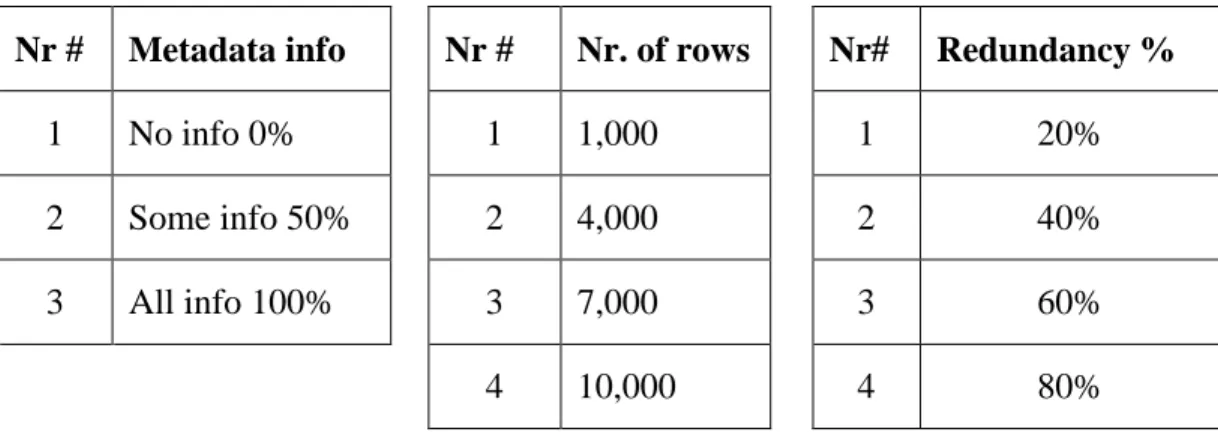
An intuitive assumption is that the more information about the data structure there is, the smaller the unit of comparison can be used implying a higher potential of identifying duplicate data. NoSQL DBs have very limited structure for various legitimate reasons. The lack of structural information at the DB level is compensated by incorporating it into the applications. Depending on the application needs, this information can have different granularity, varying form having no information at all to having all the information. There are different ways that this metadata could be collected to be made available to the DD process e.g: impose some level of structure automatically, ask for information about the structure at the DB creation time, collect information about the potential structure after the DB creation and presented to the user next time for confirmation, etc.. This research will assume that this information is available and is provided to the DD process through a configuration file.
4.4 Data DD with MapReduce
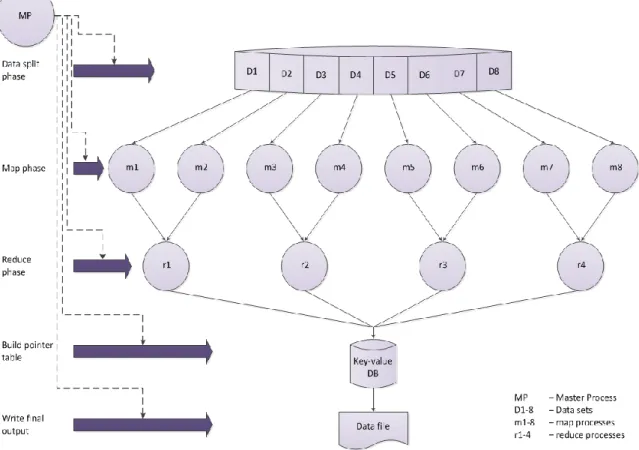
The architecture of the DDNSDB shares most of the design principals of MapReduce. It follows the master-slave design where the master node is responsible for managing the jobs, i.e., start the worker nodes, and assign the map/reduce tasks. Each worker can run a map or a reduce task at any given time. The job execution begins by splitting the input data and assigning it to individual map tasks. When a worker finishes
workers. A reduce task begins by retrieving its corresponding intermediary results from all map outputs and then it apply the reduce function.
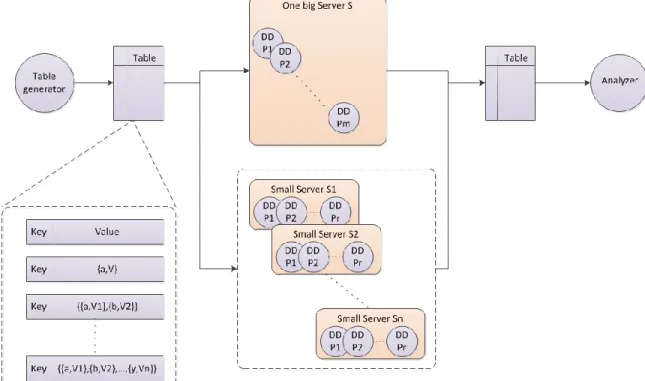
Figure 4.2 illustrates the DDNSDB execution phases following the MapReduce master-slave model.
Figure 4.2: Overview of the execution phases
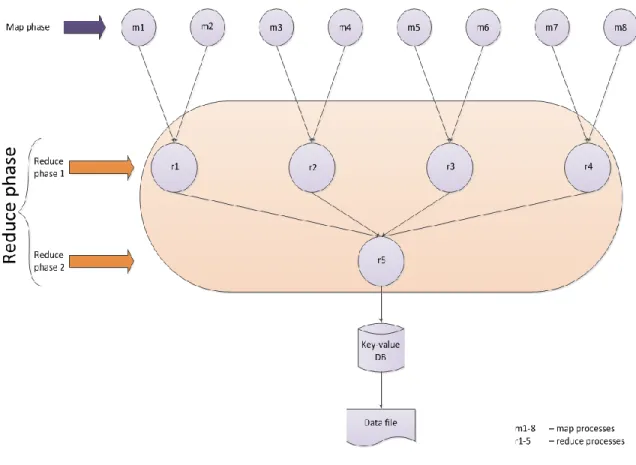
For the purpose of improving the DD ratio, the architecture leverages a two layer hierarchical reduction. Conceptually, the map and reduce tasks are organized as a tree where each level waits for all the tasks at the previous level to finish, before the work in the next level begins. Figure 4.3 outlines the map and the two reduce layers architecture.
The last layer of DD is executed by one reducer worker, which aggregates all the partially reduced results and creates a single output table with the data references resulted from the DD process.
Figure 4.3: Hierarchical reduction
Traditionally, the map function processes a key-value pair and returns a list of intermediate key-value pairs: map (k1, v1) -> list (k2, v2). The reduce function merges all intermediate values having the same intermediate key: reduce (k2, list (v2)) -> list (v3).
memory and then directly pipelined to the reduce tasks. The same principal is applied between the two layers of reduce tasks. Moreover, between the separate reduce layers the data is not transformed into key-value pairs but pipelined raw as is manipulated by the reduce function. This way 6 extra back and forth transformation and materializations steps are eliminated for each pair of data-sets.
In conclusion, the MapReduce framework has been adapted to the DD process of key-value DB to optimize the processing and increase the DD ratio. The metadata is the key element used for chunking the records into semantically aware data-sets, and to better identify duplicates by comparing only identical data-set types. There is a tight relationship between the degree of normalization and the amount of duplicate data. In the key-value store, it can be said that data is completely de-normalized.
This analysis demonstrates Goal 1 of this research, namely how we “adapt the
file and sub-file base DD approaches to the NoSQL DB DD”. Subsequently this is implemented into DDNSDB.
CHAPTER 5 IMPLEMENTATION
This chapter presents the prototype implementation of a DD process in the key-value DB, the representative NoSQL DB, using a MapReduce approach.
The implementation of this tool uses Erlang (http://www.erlang.org), a functional, concurrent programming language, and development platform. It was chosen because of its easy to implement scalability and the built in key-value store. For concurrency, Erlang uses light-weight “processes” and message passing, and comes with its own in memory key-value store called ETS, and the more permanent storage version of a key-value store called DETS.
Execution overview – depending on the amount of data which needs to be processed, the required number of worker processes can be passed in as parameters along with the data file. The number of mapping worker processes “M” is passed separately from the number of reducing worker processes “R”. There is no relationship between the number of mapping and reducer processes. The input data is read sequentially and partitioned into a set of “M” data-sets.
The map function parses each record, and based on the metadata information produces a sequence of {key,value} pairs which is then stored into a set of in memory temporary tables. There is one temporary table for each data-set type defined in the