Multi-scale modelling and canonical dual finite element
method in phase transitions of solids
q
David Yang Gao
*, Haofeng Yu
Department of Mathematics, Virginia Polytechnic Institute & State University Blacksburg, VA 24061, USA Received 3 April 2007; received in revised form 23 July 2007
Available online 14 September 2007
Dedicated to Professor K.C. Hwang on the occasion of his 80th birthday.
Abstract
This paper presents a multi-scale model in phase transitions of solid materials with both macro and micro effects. This model is governed by a semi-linear nonconvex partial differential equation which can be converted into a coupled quadratic mixed variational problem by the canonical dual transformation method. The extremality conditions of this variational problem are controlled by a triality theory, which reveals the multi-scale effects in phase transitions. Therefore, a poten-tially useful canonical dual finite element method is proposed for the first time to solve the nonconvex variational problems in multi-scale phase transitions of solids. Applications are illustrated. Results shown that the canonical duality theory
developed by the first author in nonconvex mechanics can be used to model complicated physical phenomena and to solve certain difficult nonconvex variational problems in an easy way. The canonical dual finite element method brings some new insights into computational mechanics.
2008 Published by Elsevier Ltd.
Keywords: Phase transitions; Multi-scale modelling; Landau–Ginzburg equation; Variational principle; Duality theory; Energy method; Finite element method
1. Multi-scale effects and nonconvex problem
Let the region of space XR3 occupied by the solid material be a smooth, bounded simply-connected domain with boundaryC=oX. The spontaneous polarization (i.e., dielectric displacement)l(x) is a vector-valued function (i.e. the so-called order parameter). Physically, l(x) is used to denote a field whose values describe the phase of the system under consideration (cf.Salje, 1993). Then, the total potentialPfor the solid can be written as
0020-7683/$ - see front matter 2008 Published by Elsevier Ltd. doi:10.1016/j.ijsolstr.2007.08.027
q
This research is supported by the National Science Foundation by Grant No. CCF-0514768. To appear in International Journal of Solids and Structures, 2007.
* Corresponding author.
E-mail address:[email protected](D.Y. Gao).
International Journal of Solids and Structures 45 (2008) 3660–3673
PðlÞ ¼ Z
X
½WLðlÞ þWGðrlÞ fqldX; ð1Þ
where WL(l) is Landau’s ‘‘coarse-grain’’ free energy (Salje, 1993), WG($l) is the micro-scale effect (or the
generalized Ginzburg energy), and the third term is the macro-scale effect, where the force fieldfqcould be
distributed defects, or random field (see Gao et al., 2004b).
In traditional Landau–Ginzburg theory of the second order ferroelectric transformations, the Landau potentialWL(l) is adouble-wellfunction
WLðlÞ ¼ 1 2a 1 2jlj 2 b 2 ; ð2Þ
wherea,b> 0 are material constants. The notationjjused here denotes the Euclidean norm. For example, if
¼ fig 2R3 is a vector, then jj ¼ ffiffiffiffiffiffiffiffiffiffiffiffiffiffiffiffiffiP3
i¼1ii q
. If ¼ fijg 2R33 is a second-order tensor, then
jj ¼pffiffiffiffiffiffiffiffiffiffiffiffiffiffiffiffitrðÞ¼ ffiffiffiffiffiffiffiffiffiffiffiffiffiffiffiffiffiffiffiffiffiP3i;j¼1ijij q
. For certain given material parameterb> 0, each potential well of WL(l(x))
defines the phase of materials at the point x2X. The Ginzburg energy WGis simply a convex function of
=$l, i.e. WGðÞ ¼12Djj2. In this case, the criticality condition of the total potential P(l) leads to the
well-known second order Landau–Ginzburg equation
DDlþa 1 2jlj 2 b l¼fq: ð3Þ
It is known that for a given force fieldfq(x), this nonlinear partial differential equation may have
multi-solu-tions at each material pointx2X. From the point view of convex analysis we know that, due to the noncon-vexity of the Landau potentialWL, very small perturbations of the Ginzburg term and the force field may lead
the system to different critical points with significantly different phase states (cf.Gao et al., 2004b, 2003b). To see the influence of the Ginzburg term on the double-well potential energy surface, the total potential as a functional of lwas determined using Gauss–Green integral transformation
PðlÞ ¼ Z X 1 2a 1 2jlj 2 b 2 lfðlÞ " # dXþ Z C lrðlÞ ndC; ð4Þ
wheref(l) =$Ær(l) +fqis the force field, andr(l) =D$lis the Ginzburg stress tensor field. In the case that
the order parameter l is a scalar-valued function u(x), which vanishes on the boundary, the graph of the stored energy density
JðuÞ ¼1 2a 1 2u 2b 2 uf
is shown inFig. 1. Increasingfresults in changes in the relative depths of the two minimizers and in the height of the local maximizer. The valueu at which the minimizer(s) occurred shifted slightly withf. Forf>fcthe
Fig. 1. Multi-scale effectsf(x) on potential diagramsJ(u) at each material pointx2X(wherefcis a critical force measure to be determined
in Section4): (a)J(u) has only one minimizer; (b)J(u) has two critical points: one minimizer and one stationary point; (c)J(u) has three extremum points: one global minimizer, one local minimizer, and one local maximizer.
results demonstrate that the potential energy surface has a single potential well which is a global minimizer, whereas forf<fc, it has a double potential well, which has two local minimizers with one local maximizer
in-between. Since the vector field fðxÞ ¼ r rþfq¼DDlðxÞ þfq
depends on the order parameters, the Landau–Ginzburg equation (3) may have at most three solutions li(x) (i= 1,2,3) at each material point x2X, and all these solutions are the critical points of the
noncon-vex energyP. From point view of numerical computation, any numerical discretization of the total poten-tial will lead to a global optimization problem in finite dimensional space (Gao, 2000c, 2003a,b). In order to find the global minimizer ofP(l), a mathematical theory is needed to identify the extremality conditions of the critical points at each material point and each numerical iteration. Otherwise, numerical results vary with the methods used. This is one of the main reasons why traditional perturbation analysis and direct approaches cannot successfully be applied to solve nonconvex variational problems. Actually, many non-convex problems in global optimization are NP-hard! (seeGao, 2007; Gao and Sherali, 2006). Also in the phase transitions of imperfect ferroelectric materials, the free energyWG depends on high order
deforma-tions of the order parameters. It turns out that a multi-scale modelling is needed to replace the traditional Landau–Ginzburg model.
In finite deformation theory, the well-known Hellinger–Reissner principle (see Hellinger, 1914; Ressner, 1953) and the Fraeijs de Veubeke principle (see Veubeke, 1972) hold for both convex and nonconvex problems. But, these well-known principles are not considered as the pure complementary variational prin-ciples since the Hellinger–Reissner principle involves both the displacement field and the second Piola– Kirchhoff stress tensor, and the Fraeijs de Veubeke principle needs both the rotation tensor and the first Piola–Kirchhoff stress as its variational arguments. Therefore, the question about the existence of a pure complementary variational principle in general finite deformation theory had been discussed by many researchers over several decades (see, for example, Ogden, 1975, 1977; Koiter, 1976; Lee and Shield, 1980a,b; Li and Gupta, 2006; Oden and Reddy, 1983). Moreover, since the extremality condition in non-convex variational analysis and global optimization is fundamentally difficult to resolve, none of the clas-sical complementary-dual variational principles in finite deformation theory could be used for reliable numerical computations.
Canonical duality theory is a newly developed, potentially useful methodology that consists mainly of a
canonical dual transformation and an associated triality theory. The canonical dual transformation can be used to formulate perfect dual variational problems without duality gap, i.e. the so-called pure comple-mentary variational principles in continuum mechanics, while the triality theory provides global and local extremality conditions for nonconvex problems. The canonical duality theory has been successfully applied for solving a large class of nonconvex and nonsmooth problems in nonconvex analysis and solid mechan-ics, general closed form solutions have been obtained for certain variational/boundary value problems in finite deformation elasto-plastic mechanics (Gao, 1998, 1999, 2000b, 2001; Gao et al., 2001; Gao and Ogden, 2007), and a primal-dual algorithm was suggested to solve phase transition problems (see Gao, 2003b, 2004a). In global optimization, some difficult constrained nonconvex minimization problems have been solved recently (see Gao, 2003a, 2007).
One of the main purposes of this paper is to illustrate the application of this canonical duality theory for solving phase transition problems. In the next section of this paper, a general multi-scale modelling is presented. By using the canonical dual transformation, a complementary extremum principle for generalized Landau–Ginzburg variational problem is formulated in Section3. The multi-scale effects on phase transitions are studied in Section4. Based on the triality theory, a criterion for multi-solutions at each material point x2X is proposed. This criterion should play an important role in multi-scale phase transitions. Section 5
presents a canonical dual finite element method for solving nonconvex generalized Landau–Ginzburg equa-tion. It shows that in finite dimensional space, the pure complementary variational principle can be explicitly formulated. The triality theory shows that if the Gao–Strang gap function is positive, the canonical dual problem is a concave maximization over an open convex set, which can be solved uniquely to obtain global minimizer of the primal problem. Applications are illustrated by an one-dimensional and a two-dimensional problems in Section6. Concluding remarks are given in the last section.
2. Multi-scale modelling and variational problem
In this paper, we simply assume that the generalized Ginzburg energy can be written in the following form
WGðKlÞ ¼ 1 2D1jrlj 2 þ1 2D2jr 2lj2 þ þ1 2Dmjr mlj2 ; ð5Þ
whereDi> 0 (i= 1,2,. . .,m) are material constants. Clearly,WGis the traditional Ginzburg energy ifm= 1.
The linear operator Kin this modelling is a vector-valuedm-th order differential operator, and we let e¼Kl¼ ðr;r2;. . .;rmÞT
l¼ feig: ð6Þ
Thus in terms of thei-th orderstrainei=$il, the free energyWL is simply a quadratic form ofe
WGðeÞ ¼
Xm i¼1
WiðeiÞ; WiðeiÞ ¼1 2Dijeij
2
;
and the dual variableriof eacheiis defined linearly by
ri¼oWiðeiÞ
oei ¼Diei; i¼1;2;. . .;m: ð7Þ
If the ordered parameterlis a vector field, thenei=$ilshould be ani+ 1 order tensor. Lethei,riidenotes
the bilinear form. Then for each operatorKi=$i, the formal adjointKi of Kican be well-defined by
hKil;rii ¼ hl;Kirii:
For example, if i= 1, thenK1¼ div can be simply obtained by the Gauss–Green theorem. If i= 2, then
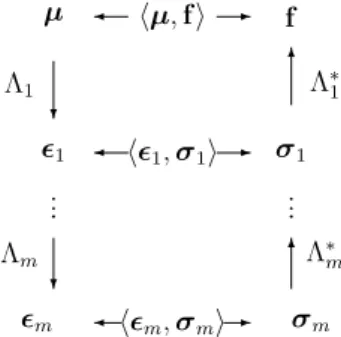
K2¼divdiv. The diagrammatic representation for this multi-scale duality pairs (ei,ri) and ðKi;KiÞis given in Fig. 2.
Let Ua denote the kinematically admissible space
Ua¼ fl2Wm;pðXÞjlðxÞ ¼0 8x2Cg; ð8Þ
where Wm;p
is the standard Sobolev space with p2(1,1). Then the application of the minimum potential principle to this multi-scale phase transitions leads to a nonconvex variational problem:
ðPÞ:minPðlÞ 8l2Ua: ð9Þ
The criticality condition of the total potential P(l) leads to the following generalized Landau–Ginzburg equation Xm i¼1 KiDiKilþ oWLðlÞ ol ¼fq: ð10Þ
This is the multi-scale modelling proposed in this paper for phase transitions of solid materials. Let
A¼Pmi¼1KiDiKi be a linear partial differential operator. In the case that the Landau energy WL is the
double-well function(2), the generalized Landau–Ginzburg theory of the second order ferroelectric transfor-mations is controlled by Alþa 1 2jlj 2 b l¼fq: ð11Þ
This is a semi-linear, nonconvex, partial differential equation. As indicated in the previous section, this non-linear equation may have multi-solutions at each material pointx2X. The global minimizer of the free energy
P(l) depends on the force field f=fqAl. In the case of p= 2, the abstract form (11) is a fourth-order
partial differential equation
D2DDlD1aDlþ 1 2jlj 2 b l¼fq: ð12Þ
In order to solve the nonconvex partial differential equation(11)and to clarify the phase states, we need to reformulate this high order partial differential equation as a canonical dual variational problem.
3. Canonical dual variational principle
Following the standard procedure of the canonical dual transformation (see Gao, 2000a, 2004a,b), we introduce a geometrical nonlinear operatornðlÞ ¼1
2jlj 2
and a convex function
VðnÞ ¼1
2aðnbÞ
2
such that the second order Landau energyWL(l) can be written in canonical form:
WLðlÞ ¼VðnðlÞÞ ¼
1
2aðnðlÞ bÞ
2
:
Then, the canonical dual variable1is uniquely defined as
1¼oV
on ¼aðnbÞ:
The complementary energyV*can be obtained by the Legendre transformation:
Vð1Þ ¼ fn1VðnÞ:n¼1=aþbg ¼ 1 2a1
2þb1; ð13Þ
which is also a convex function, and the following equivalent relations hold
1¼oV
on ()n¼
oV
o1 ()VðnÞ þV
ð1Þ ¼n1:
According to the definition introduced inGao (2000a), (n,1) is called to be acanonical dual pair. By using the Fenchel–Young equalityV(n) =n1V*(1), the Landau energy can be written as
WLðlÞ ¼nðlÞ1
1 2a1
2
b1:
Thus, in terms ofland1, the total potential energy of the multi-scale phase transition of solids can be written in the canonical mixed variational form, i.e. the so-calledtotal complementary energy(Gao, 2000a)
Nðl;1Þ ¼ Z X 1 2jlj 2 b 1 1 2a1 2þW GðrlÞ fql dX: ð14Þ
It is easy to see that for each givenl,N(l,1) is a strictly concave functional of the canonical dual variable1. The criticality conditiond N(l,1) = 0 leads to thecanonical Lagrangian equations
Alþ1l¼fq; ð15Þ 1¼a 1 2jlj 2 b : ð16Þ
Clearly, for each given1, the order parameterlcan be determined through the Eq.(15)in terms of1. Thus, the canonical dual functional Pdcan be well-defined by the following canonical dual transformation
Pdð1Þ ¼ fNðl;1ÞjdlNðl;1Þ ¼0g; ð17Þ
where dlN stands for the Gaˆteaux derivative of N with respect to l. The explicit form of the canonical dual functional Pd(1) depends on the linear operator A and the force field fq, which has a simple form
in finite dimensional space (see Section 5). Let Sa be a statically admissible space, on which the canon-ical dual functional Pd(1) is well-defined. Then, the canonical dual problem can be proposed as the following:
ðPdÞ:maxPdð1Þ 812Sa: ð18Þ
By the fact thatAis a linear operator defined onUa, its smallest eigenvaluek1> 0 can be defined by
k1¼min l2Ua kðlÞ; ð19Þ where kðlÞ ¼hl;Ali hl;li ¼ R X Pp i¼1 Dijrilj2 R Xjlj 2 dX : ð20Þ
Based on the triality theory developed in Gao (2000a), the canonical duality theorem for the generalized Landau–Ginzburg equation can be proposed as the following.
Theorem 1 (Canonical duality theorem). The problemðPdÞis canonically dual toðPÞin the sense that ifð
l;1Þis a critical point ofN(l,1), thenlis a critical point ofP(l),1is a critical point ofPd(1), and the following strong duality relation holds
PðlÞ ¼ Nðl;1Þ ¼Pdð1Þ: ð21Þ
Moreover, if1ðxÞ þk1>08x2X, thenlis a global minimizer ofP(l) overUa, and1is a global maximizer of
Pd(1) for all 1>k1, i.e. PðlÞ ¼ min
l2Ua
PðlÞ ¼max
1>k1
Pdð1Þ ¼Pdð1Þ: ð22Þ
Proof. The proof of the statement(21)follows from the canonical duality theory. By using the Gauss–Green integration theorem, the total complementary energy N((l),1) can be written as
Nðl;1Þ ¼1 2hl;ðAþ1Þli þ Z X Vð1Þ fql dX; ð23Þ
in which, the quadratic function
Gðl;1Þ ¼1
2hl;ðAþ1Þli ð24Þ
is the so-called complementary gap function defined by Gao and Strang inGao and Strang (1989). Clearly, if
1ðxÞ þk1P0 8x2X, the gap functionGðl;1Þis convex inl2Ua. Thus, the total complementary energy
Nðl;1Þis a saddle functional onUa ðk1;1Þ. By the general result proved in Gao and Strang (1989), the
critical point1>k1is a global maximizer ofPd(1) on the open domain (k1,1), andlis a global minimizer
ofP(l) onUa. h
This theorem shows that the global minimizer of the total potential energy depends on the canonical dual measure1and the first eigenvalue of the linear operatorA.
4. Multi-scale effects on phase transitions
Since the generalized Ginzburg energyWGis convex, the phase transition is due to the nonconvexity of the
Landau energyWL. From the Eq. (10)we can see that the effect of the micro-multi-scale stressAland the
macro-effectfqare identical, i.e. both contributions act as a driving force in the equation. The following
the-orem reveals an essential property of the phase transitions.
Theorem 2 (Multi-scale effects on phase transitions). For the given distributed parameterb>0 and the force field fq(x), letðl;1Þbe a critical point ofN, and fðxÞ ¼ jfqðxÞ AlðxÞj . If fðxÞ>fc¼
ffiffiffiffiffiffiffiffiffiffiffiffiffiffiffiffiffiffiffi 8a2b3=
27 q
8x2X, then the critical pointðl;1Þis the only solution of the generalized Landau–Ginzburg equation onX, and thelis a global minimizer of P(l). Otherwise, there exists a subdomain XrXsuch that f(x)<fc "x2Xr, then the generalized Landau–Ginzburg equation may have three sets of solutions ðli;1iÞ (i=1,2,3) in Xr satisfying 13<12<0<11. In this case, l1 is a global minimizer of P(l),l2 is a local minimizer ofP(l) andl3 is local maximizer ofP(l).
Proof. From the canonical Lagrange forms(15) and (16), the multi-scale effects on the canonical dual variable 1can be written as
212ð1=aþbÞ ¼f2¼ jfqðxÞ AlðxÞj2
: ð25Þ
This is the so-called canonical dual algebraic equation in nonconvex mechanics (see,Gao, 2000, p. 133). Let
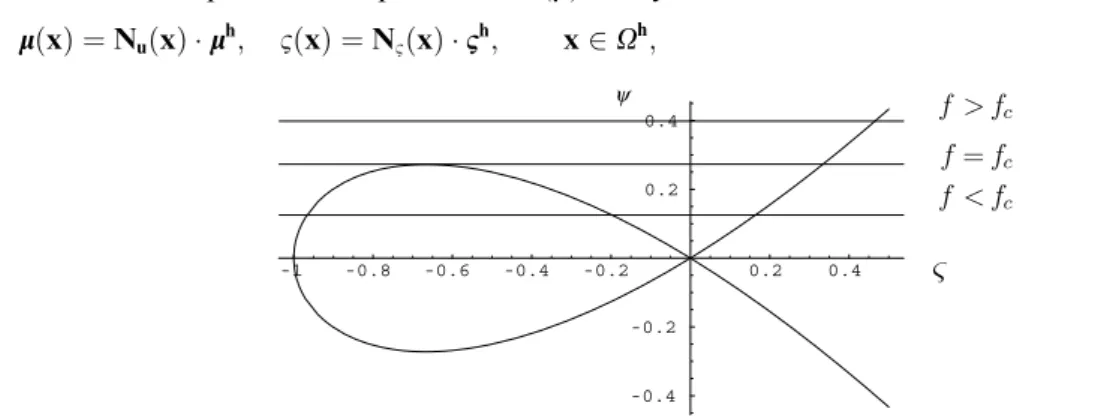
wð1Þ ¼ 1pffiffiffiffiffiffiffiffiffiffiffiffiffiffiffiffiffiffiffiffiffiffi2ð1=aþbÞ. The graph w(1) is the so-called singular elliptic curve (see Fig. 3). The singularity means that the curve passes through the origin. For fixed parameters b> 0, there exists a critical load
fc¼
ffiffiffiffiffiffiffiffiffiffiffiffiffiffiffiffiffiffiffi 8a2b3=
27 q
such that iff>fc, the level setw(1) =fhas only one cross point (see Fig. 3). In this case,
the algebraic equation(25)has one real root11> 0, which leads to a global minimizerlof the total potential
P(l) (seeFig. 1(a)).
However, whenf<fc, the level setw(1) =fhas three cross points (seeFig. 3). Thus, the algebraic equation (25)has three real roots1i(i= 1, 2, 3), satisfying13<12<0<11:In this case,P(l) has double potential well
(seeFig. 1(c)). The triality theory developed inGao (2000a)indicated that11 is corresponding to the global
minimizer l1 of P(l), 12 and 13 are corresponding to the local minimizer l2 and local maximizer l3,
respectively. h
5. Canonical dual finite element method and triality theory
In this section, we will useTheorem 1to develop a potentially important new method, i.e.,canonical dual finite element methodto solve the generalized Landau–Ginzburg equation in finite dimensional space.
Suppose the domainXcan be discretized by finite elements such thatX=[hXh. In each elementXh, we
choose suitable independent interpolation for (l) and1:
lðxÞ ¼NuðxÞ lh; 1ðxÞ ¼N1ðxÞ 1h; x2Xh; ð26Þ
where Nuand N1 are interpolation matrices expressing the local values ofl(x) and 1(x) in term of element parameterslhand1h, respectively. Thus, in finite dimensional space the total complementary energyN(lh,1h) can be written in the following discretized form
Nðlh;1hÞ ¼X Xh Z Xh WGðlÞ þ 1 2jlj 2 1 1 2a1 2þb1 fql dXh ¼1 2l h ðAþCð1ÞÞ lhVð1hÞ lhf; ð27Þ wherelh2Rn
is a vector, its components represent the order parameters at discretized material points in the domainX,1h2Rm
is the discretized canonical dual vector,A2Rnnis a symmetric matrix,Cð1hÞ:Rm!
Rnn
is symmetric linear matrix function, which depends on the numerical discretization,f2Rnis the force vector, andVð1hÞis a quadratic function of 1h
:
Vð1hÞ ¼1 21
hD1hþbðbÞ 1h;
whereD¼DT2Rmmis a positive definite matrix,b2Rmis a vector depends on the parameter b. LetUh
aR
nbe a discretized kinematically admissible space. The criticality condition of the discretized total complementary energyNðlh;1hÞ:Uh
aR
m!Rleads to the discretized canonical Lagrangian equations
ðAþCð1hÞÞlh¼f; ð28Þ
1 2l
hC0
lhD1h¼bðbÞ; ð29Þ
whereC02Rnmnis a third-order tensor. SinceD2Rmmis positive definite, the discretized constitutive equa-tion(29)has a unique solution
1h¼D1 1 2l hC0 lhbðbÞ :
Substitute this intoN(lh,1h) leads to the so-called mixed (or hybrid) finite element model of the total potential:
PhðlhÞ ¼Nðlh;
1hðlhÞÞ:Uh a!R:
It is known that direct methods for solving the discretized primal problem ðPhÞ:minPhðlhÞ 8lh2Uh
a ð30Þ
is very difficult due to the nonconvexity ofPh(l h
). On the other hand, for a givenf2Rn, the linear balance equation(28)has a unique solution
lh¼ ðAþCð1hÞÞ1
f
if and only if (A+C(1h)) is invertible. Hence, the canonical dual feasible setSh
a in this discretized problem should be written as
Sh a¼ f1
h2
RmjAþCð1hÞisinvertibleg:
Thus, over Sha, the canonical dual function Pdhð1hÞcan be well-defined by
Pd hð1 hÞ ¼ fNðlh; 1hÞ:lh¼ ðAþCð1hÞÞ1 fg ¼ 1 2f T ðAþCð1hÞÞ1 fVð1hÞ: ð31Þ
Generally speaking, this canonical dual function is nonconvex on the dual feasible spaceSh
awhich might have multiple critical points overSh
a. In order to determine the global minimizer and local extrema, we introduce the following subsets Sh þ¼ f12R mjðAþCð1ÞÞis positive definiteg; ð32Þ Sh ¼ f12R mjðAþCð1ÞÞis negative definiteg: ð33Þ
By the triality theory proposed inGao (1997, 2000a, 2003a), extremality conditions of the nonconvex varia-tional problem can be clarified by the following theorem.
Theorem 3 (Triality theorem). If1his a critical point of the discretized canonical dual functionPd hð1 hÞ, then the vector lh¼ ðAþCð1hÞÞ1 f ð34Þ
is a critical point ofPh(lh) and
PhðlhÞ ¼Pdhð1hÞ: ð35Þ
If1h2Sh
þ, then1h is a global maximizer ofP
d h onS
h
þ, whilelh is a global minimizer ofPhonU
h a, and PhðlhÞ ¼min l2Uh a PhðlÞ ¼max 1h2Sh þ Pdhð1hÞ ¼ Pdhð1hÞ: ð36Þ If1h2Sh
, then1hand the associatedlhare local critical points ofPdh andPh, respectively. In this case, on the
neighborhood1UhrSh r U
h aS
h
of ðlh;1hÞ, we have that either PhðlhÞ ¼ min lh2Uh r PhðlhÞ ¼min 1h2Sh r Pd hð1 hÞ ¼Pd hð1 hÞ; ð37Þ holds, or PhðlhÞ ¼max lh2Uh r PhðlhÞ ¼ max 1h2Sh r Pdhð1hÞ ¼ Pdhð1hÞ: ð38Þ
Proof. By the general triality theory developed inGao (2000a)we know that if1h2Sh
þ, then the
complemen-tary gap function
Gðlh;1hÞ ¼lh ðAþCð1hÞÞ lhP0 8lh2Uh a:
Thus by the general result given by Gao and Strang inGao and Strang (1989)we know that the critical point ðlh;1hÞis a saddle point of the discretized total complementary energy(27), the vectorlhis a global minimizer ofPhonUha and1h is a global maximizer ofPd
h onS h
þ.
However, if 1h2Sh
, then the critical point ðlh;1hÞ is a so-called super critical point of the discretized
total complementary energy (27). In this case, the bi-duality theory developed in Gao (2000a)shows that
lh and 1h are either local minimizers or local maximizers of P
h and Pdh on their neighborhoods U h r and
Sh r. h
This triality theorem clarifies critical points of the discretized nonconvex problem. By the fact that the canonical dual functionPdhð1hÞis strictly concave onSh
þ, the canonical dual problem
ðPd hÞ:maxP d hð1 hÞ 81h2Sh þ ð39Þ
can be solved by well developed optimization methods. Let oSh
þ¼ f1
h2
RmjdetðAþCð1hÞÞ ¼0g ð40Þ
denote the boundary of the dual feasible spaceShþ. The existence and uniqueness of global solution of this canonical dual problem are given by the following theorem.
Theorem 4 (Existence and uniqueness criteria). Suppose that for certain mixed finite element interpolations (26), the matrixCð1hÞ:Rm!
Rnnis a linear matrix-valued function,Vð1hÞ:Rm!
Ris strictly convex, and for the given matrixA2Rnnand a force vectorf 2Rm, if there exists at least one1h02Sh
þsuch thatPdhð1 h
0Þ>1 and the conditions
1
The sub-product spaceUh
rS
h
rUhaS
h
is said to be a neighborhood of the critical point pairðlh;1hÞiflhis the only critical point ofPhonUhr and1his the only critical point ofPdhonShr.
lim 1h!oSh þ Pd hð1 hÞ ¼ 1 81h2Sh þ; ð41Þ lim j1hj!1P d hð1 hÞ ¼ 1 81h2Sh þ ð42Þ
hold, the canonical dual problem ðPd
hÞexists a unique global maximizer 1h2S h
þ and lh¼ ðAþCð1hÞÞ 1
f is a unique global minimizer of the discretized primal problemðPhÞ.
Proof. By the definition, the canonical dual feasible spaceShþis an open convex subset ofRmwhose boundary oSh
þis a singular hyper-surface inR
m
. Since the canonical dual functionPdh:Shþ!R[ 1is strictly concave, if there exists at least one1h
02S h þsuch thatP d hð1 h
0Þ>1and the conditions(41) and (42)hold, the canonical
dual problemðPdhÞhas a unique critical point1hwhich is a maximizer ofPd hoverS
h
þ. Also the discretized total
complementary energyNðlh;1hÞ:Uh aS
h
þ!Ris a saddle point function which is strictly convex inlh2U
h a and strictly concave in1h2Sh
þ. Therefore, the saddle variational problem
min lh2Uh a max 1h2Sh þ Nðlh;1hÞ ¼max 1h2Sh þ min lh2Uh a Nðlh;1hÞ
has a unique saddle pointðlh;1hÞsatisfies the discretized canonical Lagrangian equations(28) and (29). By the triality theorem, we know that1his a global maximizer ofðPd
hÞ, andl
h¼ ðAþCð1hÞÞ1
fis a global minimizer
ofðPhÞ. h
6. Applications
In this section we shall present some applications of the canonical dual finite element method and the triality theory to one-dimensional and two-dimensional Landau–Ginzburg model. Detailed study on general problems of phase transitions will be given elsewhere.
In one-dimensional case, we simply let X= [0, 1]. Then, the order parameter is a scalar valued function
lðxÞ:X!Rwith boundary conditionl(0) =l(1) = 0. The Landau–Ginzburg total potential can be written as
PðlÞ ¼ Z 1 0 1 2ðl 0ðxÞÞ2 þ1 2a 1 2l 2b 2 lfq " # dx: ð43Þ
For simplicity, we choose linear interpolations for both l and 1 in each element Xi= (xi,xi+h),
i= 1,2,. . .,nand letb= 1, then, we have
Nðlh;1hÞ ¼1 2l h ðAþCð1hÞÞ lhVð1hÞ lhf; ð44Þ where lh¼ ðl2;l3;. . .;ln1;lnÞ T ; 1¼ ð11;12;. . .;1n;1nþ1Þ T ; A¼1 h 2 1 1 2 1 1 2 1 1 2 0 B B B B B @ 1 C C C C C A ; Cð1hÞ ¼h 11 12þ 12 2þ 13 12 12 12þ 13 12 12 12þ 13 12 12 12þ 13 2þ 14 12 13 12þ 14 12 1n2 12 þ 1n1 12 1n2 12 þ 1n1 2 þ 1n 12 1n1 12 þ 1n 12 1n1 12 þ 1n 12 1n1 12 þ 1n 2þ 1nþ1 12 0 B B B B B B @ 1 C C C C C C A
and Vð1hÞ ¼hX n i¼1 12 i þ1i1iþ1þ12iþ1 6 þ ð1iþ1iþ1Þb 2 : The canonical dual problem
max 1h2Sh þ Pdð1hÞ ¼ 1 2f ððAþCð1ÞÞ 1 fVð1hÞ ð45Þ can be solved easily by the BFGS method.
Example 1. We leta= 1,b= 30 and the force field is given asf(x) = 10 cos(px)ex. By choosing different mesh sizeh, the graphs of the global minimizerlð xÞare shown inFig. 4. Results of this problem shown that by using the canonical dual finite element method, the numerical solutions lð xÞ convergence to a unique global minimizer.
Example 2. We then fix the mesh sizeh= .025 and choose different force fieldsfi(x),i= 1, 2, 3. The graphs of
the global minimizersli are shown inFig. 5.
For two-dimensional problems, we simply letX= [0, 1]·[0, 1]. Then, the order parameter is a scalar valued functionlðx;yÞ:X!Rwithl(x,y) = 0 onC. The Ginzburg–landau potential is given in problem(3).
For simplicity, we choose linear triangular element to discretize and interpolate bothland1in each ele-ment. Following the standard procedure as inExample 1, we can form the matricesA,C, and the termVto
obtain(44). Then, the canonical dual problem
max 1h2Sh þ Pdð1hÞ ¼ 1 2f ððAþCð1ÞÞ 1 fVð1hÞ ð46Þ can be solved easily by the BFGS method.
0 0.2 0.4 0.6 0.8 1 −8 −7 −6 −5 −4 −3 −2 −1 0 x μ (x)
Example 3. Let a= 1,b= 20 andf(x) = 10 cos(px) ey. The domain is discretized by using uniform 8·8 and 16·16 meshes, respectively. The graphs of the global minimizerlðxÞare shown in Fig. 6.
These results illustrated that for any given force field, the canonical dual finite element method can be used to obtain a unique global minimizer for the discretized nonconvex optimization problem(30).
7. Concluding remarks
We have presented a multi-scale modelling in phase transitions of solids with random distributed force fields. This model leads to a semi-linear nonconvex variational/boundary value problem. In order to solve this difficult problem, a canonical duality theory and the associated finite element method have been pro-posed. Applications to finite dimensional space problems show that by certain numerical methods, the non-convex minimization problem can be converted into a concave maximization dual problem. Therefore,
0 0.2 0.4 0.6 0.8 1 −5 0 5 10 x μ (x) f 1(x) = 10 f2 (x) = 10 cos(πx) f 3 (x) = 10 cos(3πx) e 5x
Fig. 5. Graphs of global minimizerlðxÞwith different forcesfi(x).
global optimal solution can be obtained. The criteria for existence and uniqueness of the global optimal solution is presented.
This paper shows again that the canonical duality theory plays an important role in nonconvex analysis and modern mechanics. The inner beauty of the canonical duality theory is due to the fact that many different nat-ural phenomena can be put in the unified mathematical framework (Gao, 2000a). By the fact that most of physical variables appear in dual pairs. This one-to-one canonical duality relation serves as the foundation for the canonical duality theory. Therefore, the canonical duality theory can be used for solving a large class of nonconvex variational problems (seeGao, 1999, 2000b, 2007). The canonical dual finite element method will have certain impacts to large-scale computational mechanics.
Acknowledgements
This research was supported by NSF Grant CCF-0514768. Valuable comments and suggestions from three anonymous referees are gratefully acknowledged.
References
Gao, D.Y., 1997. Dual extremum principles in finite deformation theory with applications to post-buckling analysis of extended nonlinear beam theory. Applied Mechanics Reviews 50 (11), S64–S71.
Gao, D.Y., 1998. Duality, triality and complementary extremum principles in nonconvex parametric variational problems with applications. IMA Journal of Applied Mathematics 61, 199–235.
Gao, D.Y., 1999. General analytic solutions and complementary variational principles for large deformation nonsmooth mechanics. Meccanica 34, 169–198.
Gao, D.Y., 2000a. Duality Principles in Nonconvex Systems: Theory, Methods and Applications. Kluwer Academic Publishers, Dordrecht/Boston/London, xviii+454pp.
Gao, D.Y., 2000b. Analytic solution and triality theory for nonconvex and nonsmooth variational problems with applications. Nonlinear Analysis 42 (7), 1161–1193.
Gao, D.Y., 2000c. Canonical dual transformation method and generalized triality theory in nonsmooth global optimization. Journal of Global Optimization 17 (1/4), 127–160.
Gao, D.Y., 2001. Complementarity, polarity and triality in nonsmooth, nonconvex and nonconservative Hamilton systems. Philosophical Transactions of the Royal Society: Mathematical, Physical and Engineering Sciences 359, 2347–2367.
Gao, D.Y., 2003a. Perfect duality theory and complete solutions to a class of nonconvex optimization problems. Optimization 52 (4–5), 467–493.
Gao, D.Y., 2003b. Nonconvex semi-linear problems and canonical duality solutions. In: Gao, D.Y., Ogden, R.W. (Eds.), Advances in Mechanics and Mathematics. Kluwer Academic Publishers, Dordrecht/Boston/London.
Gao, D.Y., 2004a. Complementary variational principle, algorithm, and complete solutions to phase transitions in solids governed by Landau–Ginzburg equation. Journal of Mathematics and Mechanics of Solid 9, 285–305.
Gao, D.Y., 2007. Solutions and optimality criteria to box constrained nonconvex minimization problem. Journal of Industrial and Management Optimization 3, 293–304.
Gao, D.Y., Li, Jie-Fang, Viehland, D., 2004b. Complete solutions and triality theory to Landau–Ginzburg equation in imperfect ferroelectrics. In: Gao, D.Y. (Ed.), Proceedings of IUTAM Symposium on Complementarity, Duality, and Symmetry in Nonlinear Mechanics. Kluwer Academic Publishers, Dordrecht/Boston/London.
Gao, D.Y., Ogden, R.W., 2007. Closed-form solutions, extremality and nonsmoothness criteria in large deformation elasticity problem, to appear in Zeitschrift fr angewandte Mathematik und Physik.
Gao, D.Y., Ogden, R.W., Stavroulakis, G., 2001. Nonsmooth and Nonconvex Mechanics: Modelling, Analysis and Numerical Methods. Kluwer Academic Publishers, Boston/Dordrecht/London, xliv+471pp.
Gao, D.Y., Sherali, H.D., 2006. Canonical duality theory: connection between nonconvex mechanics and global optimization. In: Advances in Mechanics and Mathematics, vol. III. Springer.
Gao, D.Y., Strang, G., 1989. Geometric nonlinearity: potential energy, complementary energy, and the gap function. Quarterly Journal of Applied Mathematics 47 (3), 487–504.
Hellinger, E., 1914. Die allgemeine Ansa¨tze der Mechanik der Kontinua. Encyklopa¨die der Mathematischen Wissenschaften IV 4, 602– 694.
Koiter, W.T., 1976. On the complementary energy theorem in nonlinear elasticity theory. In: Fichera, G. (Ed.), Trends in Application of Pure Mathmatics to Mechanics. Pitman.
Lee, S.J., Shield, R.T., 1980a. Variational principles in finite elastics. Journal of Applied Mathematics and Physics (ZAMP) 31, 437–453. Lee, S.J., Shield, R.T., 1980b. Applications of variational principles in finite elasticity. Journal of Applied Mathmatics and Physics
(ZAMP) 31, 454–472.
Ogden, R.W., 1975. A note on variational theorems in non-linear elastostatics. Mathematical Proceedings of the Cambridge Philosophical Society 77, 609–615.
Ogden, R.W., 1977. Inequalities associated with the inversion of elastic stress-deformation relations and their implications, math. Proceedings of the Cambridge Philosophical Society 81, 313–324.
Oden, J.T., Reddy, J.N., 1983. Variational Methods in Theoretical Mechanics. Springer-Verlag.
Ressner, E., 1953. On a variational theorem for finite elastic deformations. Journal of Mathematical Physics 32 (2–3), 129–135. Salje, E.K.H., 1993. Phase Transitions in Ferroelastic and Co-elastic Crystals. Cambridge University Press, Cambridge, United Kingdom. Veubeke, B.F., 1972. A new variational principle for finite elastic displacements. International Journal of Engineering Science 10, 745–763.