Resource Allocation Schemes for Multiuser Wireless Communication
Systems Powered by Renewable Energy Sources
Zhao, Dan
The copyright of this thesis rests with the author and no quotation from it or information
derived from it may be published without the prior written consent of the author
For additional information about this publication click this link.
http://qmro.qmul.ac.uk/xmlui/handle/123456789/9865
Information about this research object was correct at the time of download; we occasionally
make corrections to records, please therefore check the published record when citing. For
more information contact [email protected]
Resource Allocation Schemes for
Multiuser Wireless Communication
Systems
Powered by Renewable Energy Sources
by
Dan Zhao
Doctor of Philosophy
School of Electronic Engineering and Computer Science
Queen Mary University of London
United Kingdom
Abstract
In the future cyber-physical systems, such as smart grids, a large amount of sensors will be distributively deployed in different locations throughout the systems for the purpose of monitoring and control. Conventionally, sensors are powered by fixed energy supplies, e.g., regular batteries, which can provide stable energy output. However, such energy sources require periodical recharging or replacement, which incurs high maintenance cost and may become impractical in hazardous environments. Self-sustaining devices powered by energy harvesting (EH) sources are thus highly desirable. However, energy provided by energy harvesters is fluctuating over time and thus introduces the EH constraints to the systems, i.e., the total energy consumed until an arbitrary time cannot be larger than the harvested amount up to this time, which invokes the need of advanced power control and scheduling schemes. This thesis studies both the offline and online resource allocation strategies for wireless communication systems empowered by EH sources.
First, the resource allocation problems for a Gaussian multiple access channel (MAC), where the two transmitters are powered by a shared energy harvester, are studied. For both infinite and finite battery capacity cases, the optimal offline resource allocation schemes for maximising the weighted sum throughput over a finite time horizon are derived. It is proved that there exists a capping rate for the user with stronger channel gain. Moreover, the duality property between the MAC with a shared energy harvester and its dual broadcast channel powered is demonstrated. Numerical results are pre-sented to compare the performance of several online schemes. Moreover, the utility of a greedy scheme against the optimal offline one is measured by using competitive analysis technique, where the competitive ratios of the online greedy scheme, i.e., the maximum ratios between the profits obtained by the offline and online schemes over arbitrary energy arrival profiles, are derived.
Then, the resource allocation schemes for the Gaussian MAC with conferencing links, where the two transmitters could talk to each other via some wired rate-limited channels and share a common EH source, are studied. The optimal offline resource allocations are developed for both infinite and finite battery cases. It is shown that the optimal resource allocation in this scenario is more complicated than in the traditional MAC scenario and there exists a capping rate at one of the two transmitters, depending on the weighting factors. Online resource allocation strategies are also examined. Numerical results are used to illustrate the performance comparison of the online schemes. Furthermore, the competitive ratios of the online greedy scheme are derived under different weighting factors.
Acknowledgments
First and foremost, I would like to express my great gratitude to my supervisor Dr Yue Chen. I appreciate her priceless guidance and advices throughout these years. Without her help and support this thesis would not have been possible. Her enthusiasm towards research and life is motivational and contagious for me. I would also like to thank her for the excellent role model she has provided as a successful woman in both career and life.
I would also like to take this opportunity to thank my parents and my boyfriend. They gave me enormous support and courage during my Ph.d. stage. They are always there for me and have always been my strength especially during hardships. 8
I would like to express my special thanks to Prof. Shuguang Cui (Texas A&M University) for inviting me to visit his lab in 2013. I would also like to thank Dr. Chuan Huang (The University of Electronic Science and Technology of China) for his suggestions and advices for my work on both technical development and writing skills.
I would like to thank Prof. Zhiguo Ding (Lancaster University) and Prof. Arumugam Nallanathan (King’s College London) for serving as my Ph.D examiners.
I would also like to thank my colleagues and friends, who made my time in London more enjoyable. I treasure every moment I spent with them and I wish all of them the best of luck in the future.
At last, I would like to thank China Scholarship Council (CSC) for their financial sup-ports during my Ph.d. stage.
Table of Contents
Abstract i
Acknowledgments iii
Table of Contents iv
List of Figures vii
List of Abbreviations xi 1 Introduction 1 1.1 Background . . . 1 1.2 Research Motivation . . . 2 1.3 Contributions . . . 3 1.4 Thesis Outline . . . 4 1.5 Notation . . . 5 1.6 Publication List . . . 6
2 Fundamental Concept and State-of-the-Art 7 2.1 Overview . . . 7
2.2 Fundamental Concepts . . . 7
2.2.1 Channel Capacities . . . 8
2.2.2 Convex Optimisation . . . 14
2.2.3 Online/Offline Problems and Competitive Analysis . . . 18
2.3 State-of-the-Art in Wireless Communication Systems Powered by
Renew-able Sources . . . 20
2.3.1 Point-to-Point Channel with Energy Harvester . . . 20
2.3.2 Multiuser Wireless Communication Systems with Energy Harvesters 23 3 Optimal Offline Resource Allocation Schemes for Multiple Access Chan-nels with a Shared Renewable Energy Source 27 3.1 Overview . . . 27
3.2 System Model and Problem Formulation . . . 28
3.2.1 System Model . . . 28
3.2.2 Problem Formulation . . . 30
3.3 The Optimal Offline Resource Allocation Scheme . . . 39
3.3.1 Optimal Sum Power Allocation . . . 40
3.3.2 Optimal Resource Allocation between the two Transmitters . . . . 47
3.4 MAC-BC Throughput Duality with Renewable Source . . . 50
3.5 Numerical Examples . . . 52
3.6 Summary . . . 57
4 Online Resource Allocation Schemes for Multiple Access Channels with a Shared Renewable Energy Source 58 4.1 Overview . . . 58
4.2 The Online Schemes . . . 59
4.3 Simulation Results . . . 60
4.4 Competitive Analysis . . . 64
4.4.1 Definition of Competitive Ratios . . . 64
4.4.2 Derivation of the Competitive Ratios . . . 65
4.4.3 A Numerical Example . . . 71
4.5 Summary . . . 72
5 Optimal Offline Resource Allocation Schemes for Multiple Access
nel with Conferencing Links and a Shared Renewable Source 74
5.1 Overview . . . 74
5.2 System Model and Problem Formulation . . . 75
5.2.1 System Model . . . 75
5.2.2 Problem Formulation . . . 76
5.3 Optimal Offline Resource Allocation Scheme . . . 88
5.3.1 Optimal Sum Power Allocation . . . 88
5.3.2 Optimal Resource Allocation between the two Transmitters . . . . 89
5.4 Numerical Examples . . . 97
5.5 Summary . . . 102
6 Online Resource Allocation Schemes for Multiple Access Channels with Conferencing Links and a Shared Renewable Source 103 6.1 Overview . . . 103
6.2 The Online Schemes . . . 104
6.3 Simulation Results . . . 105
6.4 Competitive Analysis . . . 108
6.4.1 Definition of Competitive analysis . . . 109
6.4.2 Derivation of the Competitive Ratios . . . 109
6.4.3 A Numerical Example . . . 123
6.5 Summary . . . 124
7 Conclusions and Future Work 126 7.1 Conclusions . . . 126
7.2 Future Work . . . 128
7.2.1 Extension to Current Work . . . 128
7.2.2 Threshold-Based Online Schemes . . . 129
Appendix A Proof of Remark 7 131 References . . . 132
List of Figures
2.1 Gaussian Channel (Figure 9.1 from [CT06]) . . . 8
2.2 Gaussian Multiple Access Channel . . . 10
2.3 The capacity region of the Gaussian MAC channel . . . 11
2.4 Gaussian Broadcast Channel . . . 13
2.5 The capacity region of the Gaussian Broadcast Channel . . . 13
2.6 An illustration of a convex function . . . 15
2.7 Optimal power allocation in point-to-point channel with energy harvester (infinite battery capacity case). . . 21
2.8 Optimal power allocation in point-to-point channel with energy harvester (finite battery capacity case). . . 22
2.9 Broadcast channel with energy harvester . . . 23
2.10 Multiple access channel with energy harvesters . . . 25
3.1 Gaussian MAC with a shared energy harvester . . . 29
3.2 The slot-based energy arrival model . . . 29
3.3 The capacity region of the Gaussian MAC . . . 31
3.4 Proof of the convexity of the maximum departure region of MAC with a shared energy harvester (infinite battery capacity case) . . . 34
3.5 An illustration of the maximum departure region of MAC with a shared energy harvester . . . 36
3.6 Proof of the convexity of the maximum departure region of MAC with a shared energy harvester (finite battery capacity case) . . . 39 3.7 The dual BC of the MAC with a shared energy harvester. . . 51 3.8 The accumulated amounts of harvested energy and the amounts of energy
consumed by the optimal offline schemes for ω1 in the Gaussian MAC with a shared energy harvester. . . 53 3.9 Transmission rates of the two transmitters (blue curves, correspond to the
left Y axis) whenµ1 = 0.7, µ2 = 0.3 and the sum power levels (red curve, corresponds to the right Y axis) during the 15 slots for the Gaussian MAC with a shared energy harvester. . . 54 3.10 Transmission rates of the two transmitters (blue curves, correspond to
the left Y axis) when µ1 = 0.485, µ2 = 0.515 and the sum power levels (red curve, corresponds to the right Y axis) during the 15 slots for the Gaussian MAC with a shared energy harvester. . . 55 3.11 The boundaries ofD(N) achieved by the optimal offline schemes for
serv-ing ω1 in the Gaussian MAC with a shared energy harvester with both infinite and finite battery capacites over 15 slots (150s). . . 56
4.1 Weighted sum throughput versus average energy arrival amounts with infinite battery capacity for Gaussian MAC when µ1 = 0.6, µ2 = 0.4. . . . 60 4.2 Weighted sum throughput versus average energy arrival amounts with
infinite battery capacity for Gaussian MAC when µ1 = 0.4, µ2 = 0.6. . . . 61 4.3 Weighted sum throughput versus average energy arrival amounts with
finite battery capacity for Gaussian MAC whenµ1 = 0.6, µ2 = 0.4. . . 62 4.4 Weighted sum throughput versus average energy arrival amounts with
finite battery capacity for Gaussian MAC whenµ1 = 0.4, µ2 = 0.6. . . 63 4.5 The competitive ratios and the ratios obtained with energy input sequence
ω1 and ω2 in the Gaussian MAC with a shared energy harvester. . . 72
5.1 MAC channel with conferencing links and a shared renewable energy source 76
5.2 CurveG with non-emptyR1 and empty R2,R3,R4. . . 91
5.3 CurveG with non-emptyR1,R3 and empty R2,R4. . . 91
5.4 CurveG with non-emptyR1,R2,R3 and empty R4. . . 92
5.5 CurveG with non-emptyR2,R3,R4 and empty R1. . . 92
5.6 An illustration of the optimal offline rate profile when−µ1 µ2 <−1 . . . 94
5.7 An illustration of the optimal offline rate profile when −µ1 µ2 >−1, (M1 = −1 + h1 h1+h22C12+C21 M2=−1 + h2 1−h22 h2 1+h1h22C12+C21). . . 96
5.8 An illustration of the optimal offline rate profile whenµ1 =µ2 . . . 97
5.9 The accumulated amounts of harvested energy and energy consumed by the optimal offline scheme with infinite/finite battery capacity givenω1 in the Gaussian MAC with conferencing links and a shared energy harvester. 98 5.10 Transmission rates of the two transmitters (blue curves, correspond to the left Y axis) whenµ1 = 0.6, µ2 = 0.4 and the sum power levels (red curve, corresponds to the right Y axis) during the 15 slots for the Gaussian MAC with conferencing links a shared energy harvester of infinite battery capacity. 99 5.11 The performance achieved by the optimal offline scheme with infinite and finite battery capacities givenω1for the Gaussian MAC with conferencing links a shared energy harvester over 15 slots (150s). . . 100
5.12 The performance achieved by the optimal offline scheme with infinite bat-tery capacity given ω1 for the Gaussian MAC with conferencing links a shared energy harvester over 15 slots (150s), with different conferencing links capacities. . . 101
6.1 Weighted sum throughput versus average energy arrival amounts with infinite battery capacity for Gaussian MAC with conferencing links when µ1 = 0.6, µ2 = 0.4. . . 105
6.2 Weighted sum throughput versus average energy arrival amounts with infinite battery capacity for Gaussian MAC with conferencing links when µ1 = 0.4, µ2 = 0.6. . . 106
6.3 Weighted sum throughput versus average energy arrival amounts with finite battery capacity for Gaussian MAC with conferencing links when
µ1 = 0.6, µ2 = 0.4. . . 107 6.4 Weighted sum throughput versus average energy arrival amounts with
finite battery capacity for Gaussian MAC with conferencing links when
µ1 = 0.4, µ2 = 0.6. . . 108 6.5 The competitive ratios and the ratios obtained with energy input sequence
ω1 and ω2 in the Gaussian MAC with conferencing links and a shared energy harvester. . . 124
List of Abbreviations
AWGN AdditiveWhite-Gaussian-Noise BC BroadcastChannel
CSCG CircularlySymmetricComplexGaussian CSI Channel State Information
DMC DiscreteMemorylessChannel EH Energy-Harvesting
ESI EnergyState Information
i.i.d. independentlyidentically distributed IoT Internet of Things
KKT Karush-Kuhn-Tucker MAC Multiple Access Channel RHS Right Hand Side
SNR Signal-to-NoiseRatio
IEEE Institute of Electrical andElectronics Engineers
Chapter 1
Introduction
1.1
Background
In the future cyber-physical systems, such as smart grids, a large amount of sensors will be distributively deployed in different locations throughout the systems for the purpose of monitoring and control. Conventionally, sensors are powered by fixed energy supplies, e.g., regular batteries, which can provide stable energy output. However, such energy sources require periodical recharging or replacement, which incurs high maintenance cost and may become impractical in hazardous environments. Moreover, the energy source for conventional wireless sensor networks consumes non-renewable energy resources, such as coal, petroleum, and natural gas. Estimates from international organisations suggested that if the world’s demand for energy from fossil fuels continues at the present rate, oil and gas reserves may run out within some of our lifetimes [ST09, ST08, SS12].
The recent hardware development in energy harvesting devices, i.e., the energy vesters, makes them viable substitutions to conventional energy supplies. Energy har-vesters, such as solar cells, water mills, vibration absorption devices, thermoelectric generator, microbial fuel cells [SET09], can harness and convert the otherwise wasted ambient energy from the environment into usable electrical energy, and thus contributes
Chapter 1. Introduction 2
to the reduction of the overall carbon footprint. Energy harvesters are envisaged to become one of the important components of future networks, such as smart grids and IoT networks [EKM11, MSPC12, PS05, SK11, Rou03, IGMH05, RAS+00].
1.2
Research Motivation
While EH technique can potentially provide unlimited energy, energy provided by har-vesters is intermittent over time due to the uncertain nature of the renewable energy resources, which introduces energy harvesting (EH) constrains to wireless communica-tion systems: at any time during the transmission, the energy used by transmitters for transmission is constrained to be no more than the amount of harvested energy available up to that instance. Moreover, if the batteries for the energy harvesters have limited capacities, then the transmitters should also be able to adjust the transmission power so that the upcoming energy will not overflow the battery (any energy that exceeds battery limit will be lost, which is clearly inefficient). Such unique constraints pose new challenges to wireless communication systems and thus invoke the need of properly designed resource allocation schemes that could adjust transmission power/rate adap-tively according to the energy harvesting process to maximise the system throughput.
For resource allocation in EH wireless communication systems, both offline and online schemes have attracted considerable attention in recent years.
1. With non-causal information about the energy arrival times and amounts over the whole transmission period, offline schemes determine the transmission powers/rates before transmissions start. The offline schemes provide the performance upper bound or benchmark for all online schemes and can also be directly applied to scenarios where the output of energy harvesters can be predicted with tolerable errors over a certain period, e.g., when harvesting the vibration energy from a washing/drying machine running on a pre-set program.
Chapter 1. Introduction 3
2. Online schemes, on the other hand, react upon each energy arrival without knowing the realisations of the future energy arrivals, with at most the statistical informa-tion of the EH process. Online schemes can be applied to more general and realistic scenarios where the energy harvesting processes are highly dynamic and thus hard to predict precisely.
Motivated by the aforementioned aspects, in this thesis, both the optimal offline schemes and online schemes for multiuser wireless communication systems are investi-gated. The optimal offline schemes for the considered scenarios are rigorously derived, based on which some online schemes are proposed. Moreover, since the EH processes vary significantly for different types of EH devices, to more comprehensively examine the performance of online schemes, both the numerical results, which provide the average performance measurement given some hypothesized random distributions of the energy arrival processes, and the competitive analysis [BEY98], which provides the theoretical worst-case performance bounds, are adopted.
1.3
Contributions
The contributions of this thesis are summarised as follows:
• The optimal offline resource allocation schemes for the Gaussian multiple access channel (MAC) with two transmitters powered by a shared energy harvester are developed with the assumption of both infinite and finite battery capacities. Par-ticularly, a slot-based energy-harvesting (EH) model is adopted. To develop the optimal offline resource allocation schemes, which assume that the energy arrival amounts are non-causally known before transmissions, optimisation problems that characterise the maximum departure regions over finite time horizon are formu-lated. By exploiting the convexity of the problems, both the structural properties of the optimal offline sum power profiles and the optimal resource allocation between the two transmitters are obtained. In particular, it is proved that there exists a
Chapter 1. Introduction 4
capping rate at the stronger transmitter (the transmitter with the higher channel gain). It is also demonstrated that under the same energy arrival profile, MAC with a shared energy harvester achieves the same maximum departure region as its dual broadcast channel (BC). Based on the optimal offline scheme, three online schemes are proposed. The performances of offline and online schemes are compared by numerical results. Furthermore, competitive analysis is carried out for the online greedy scheme to evaluate how well it performs against the optimal offline scheme under the worst input sequence.
• The resource allocation schemes for the Gaussian MAC with conferencing links and a shared energy harvester are developed where the battery capacity is assumed to be either infinite or finite. Via these wired rate-limited channels, the two transmitters could talk to each other, which helps to enlarge the achievable rate region. Similar to the Gaussian MAC without conferencing links scenario, the goals of the schemes are to maximise the system throughput during the transmission period. Both the optimal offline scheme and online schemes are proposed. The numerical results are used to illustrate the performance of the offline and online schemes. Also, the competitive ratios of the online greedy scheme are derived to further measure the utility of the online scheme against the optimal offline scheme.
1.4
Thesis Outline
The rest of the thesis is organised as follows:
• Chapter 2 provides background information about the theory of channel capacity and the capacity regions for relevant wireless channel models. The basic concepts, definitions and techniques in convex optimisation are introduced. Also, the concept and definitions of online/offline problems and competitive analysis are discussed. Furthermore, literature review of state-of-the-art resource allocation schemes for energy harvesters powered wireless communication systems is presented.
Chapter 1. Introduction 5
• Chapter 3 presents the optimal offline resource allocation scheme in a two-transmitter Gaussian MAC with a shared renewable source. The system/energy model, prob-lem formulation and the detailed development of the optimal offline scheme are described. Moreover, the duality property between the Gaussian MAC and the Gaussian BC powered by EH sources is presented.
• Chapter 4 investigates online resource allocation schemes for the Gaussian MAC with a shared renewable source. The performance comparison between the opti-mal offline and the online schemes are carried out by both numerical results and competitive analysis.
• Chapter 5 investigates the optimal offline resource allocation schemes in a two-transmitter Gaussian multiple access channel with conferencing links and a shared renewable resource. Similarly, the system/energy model, problem formulation and the detailed proof of the optimal offline scheme are described.
• Chapter 6 studies online resource allocation schemes for the Gaussian MAC with conferencing links. The numerical results show the performance differences between the optimal offline schemes and the online algorithms. The competitive ratio pro-vides the worst-case performance bound of the online scheme.
• Chapter 7 consists of conclusions and future work of this thesis. For future work, both extensions to the current work and some promising future research directions are presented.
1.5
Notation
In this thesis, (·)+= max(·,0); log(·) and ln(·) represent base-2 and natural logarithms, respectively; C(x) = log(1 +x).
Chapter 1. Introduction 6
1.6
Publication List
Journal Papers
1. D. Zhao, C. Huang, Y. Chen, F. Alsaadi, and S. Cui, “Resource Allocation for Multiple Access Channel with Conferencing Links and Shared Renewable Energy Sources”,IEEE Journal of Selected Areas in Communications (JSAC), vol.33, no.3, pp. 423-437, March 2015.
Conference Papers
1. D. Zhao, C. Huang, Y. Chen and S. Cui, “Optimal Resource Allocation for Mul-tiple Access Channel with Conferencing Links and a Shared Renewable Energy Source”,IEEE International Conference on Acoustics, Speech, and Signal Process-ing (ICASSP 2013), Vancouver, Canada, May 2013, pp. 4794-4798.
2. D. Zhao, C. Huang, Y. Chen and S. Cui, “Optimal Resource Allocation for Multi-ple Access Channels with a Shared Renewable Energy Source”,IEEE International Symposium on Personal, Indoor and Mobile Radio Communications (PIMRC 2013), London, UK, September, 2013, pp. 522-526.
3. D. Zhao, C. Huang, Y. Chen and S. Cui, “Competitive Analysis of Online Through-put Maximization Schemes for Multiple Access Channels with a Shared Renewable Energy Source”, IEEE Global Conference on Signal and Information Processing (GlobalSIP 2013), Austin, USA, December, 2013, pp. 375-378.
Chapter 2
Fundamental Concept and
State-of-the-Art
2.1
Overview
In this Chapter, first, the fundamental theory background about channel capacities, convex optimisation technique, and competitive analysis is introduced. Then, recent research results in energy harvester powered wireless communication system are sum-marised.
2.2
Fundamental Concepts
In this section, the fundamental concepts involved in our research will be explained.
First, the preliminary knowledge about channel capacities is discussed. In this research, the capacities of the considered wireless channels will be used to characterise the relationship between the achievable transmission rates and the allocated power.
Second, the convex optimisation technique is introduced briefly. In this research,
Chapter 2. Fundamental Concept and State-of-the-Art 8
convex optimisation techniques are used when developing the optimal resource allocation schemes.
Third, the online/offline problems and competitive analysis are explained. In this research, both offline and online algorithms are studied to be applied to different appli-cation scenarios. Competitive analysis provides a theoretic performance measurement for online schemes against the optimal offline schemes without the need of hypothesising random distributions on input sequences.
2.2.1 Channel Capacities
2.2.1.1 Gaussian Point-to-Point Channel and its Capacity
1. Real AWGN Channel
Figure 2.1: Gaussian Channel (Figure 9.1 from [CT06])
As depicted in Figure 2.1, the real Gaussian channel is a time-discrete continuous alphabet channel. At timet, the channel input-output relationship of the Gaussian channel is given as
Y(t) =X(t) +Z(t), Z(t)∼ N(0, N),
where X(t), Y(t) are the real input and output signals, respectively, and Z(t) is the Gaussian noise with zero mean and a variance ofN.
Chapter 2. Fundamental Concept and State-of-the-Art 9 channel is given as [CT06] C= max f(x):E X2≤PI(X;Y) = 1 2log 1 + P N
bits per transmission. (2.1)
Note that the maximum is achieved when X∼ N(0, P). 2. Complex AWGN Channel
The channel input-output relationship of the complex baseband AWGN channel is given as
Y(t) =X(t) +Z(t), Z(t)∼ CN(0, N), (2.2) whereX(t), Y(t) are the complex input and output signals, respectively, andZ(t) is the circularly symmetric Gaussian complex (CSGC) noise with zero mean and a variance of N.
There is an average power constraint of P per complex input. Each use of the complex channel can be regarded as two uses of a real AWGN channel, with the signal-to-noise ratio SNR = N/P /22 = NP. Therefore, the capacity of the complex channel is [CT06] 1 2log 1 + P N
bits per real dimension, (2.3)
or, equivalently, log 1 + P N
bits per complex dimension. (2.4)
2.2.1.2 Gaussian MAC/BC and Capacities
• Two-user Gaussian MAC
Chapter 2. Fundamental Concept and State-of-the-Art 10
Figure 2.2: Gaussian Multiple Access Channel
as illustrated in Figure 2.2. At timet, the channel input-output relationship of the Gaussian MAC channel is given as
Y(t) =ph1(t)X1(t) +
p
h2(t)X2(t) +Z(t), Z(t)∼ N(0, N),
where Xi(t), i = 1,2, are the input signals from transmitter i, respectively, h1(t) and h2(t) are the channel gains,Y(t) is the output signal received by the receiver and Z(t) is the Gaussian noise with zero mean and a variance of N.
Let the power constraints on transmitter i, i = 1,2 be Pi. The channel capacity
region of the Gaussian MAC is illustrated in Fig. 2.3 and is given as1 [CT06]
R1 ≤ 1 2log 1 +h1P1 N (2.5) R2 ≤ 1 2log 1 +h2P2 N (2.6) R1+R2 ≤ 1 2log 1 +h1P1 N + h2P2 N . (2.7)
The corner points A and B are achieved by adopting the superposition codes with successive interferencing cancellation. To achieve corner point A, the message of transmitter 1 is decoded first, treating transmitter 2’s message noise. The rate achieved for transmitter 1 is therefore given by R1 = 12log
1 + h1P1
h2P2+N
. Then,
1the channel considered here is a real channel therefore there is a coefficient of 1
2 in the channel
Chapter 2. Fundamental Concept and State-of-the-Art 11
transmitter 1’s message is subtracted from the received message. At last, trans-mitter 2’s message is decoded with only the system background noise and therefore achieving the rateR2 = 12log
1 +h2P2
N
. The corner point B could be achieved by similar scheme only with the reverse decoding order, i.e., decoding transmitter 2’s message first and then transmitter 1’s. Any point on the segment between points A and B could be achieved by time sharing between the two points.
A
B
Figure 2.3: The capacity region of the Gaussian MAC channel
• Two-user Gaussian MAC with conferencing links
On top of the traditional two-user Gaussian MAC described above, certain wired rate-limited two-way conferencing links connecting the two transmitters could be introduced into the system. Via the conferencing links, transmitter 1 can talk to transmitter 2 with a rate up toC12, similar for the opposite direction with a rate up to C21.
Let the power constraints on transmitter i, i= 1,2 bePi. For the Gaussian MAC
with conferencing links, the coding scheme is described as follows. Transmitter
i, i = 1,2, splits its message Xi, into two sub-messages: transmitter i’s private
messageXipand its common messageXic. The transmitters exchange their common messages, i.e., Xc
1 and X2c, with each other by using the conferencing links as in Willem’s scheme [Wil83]. As a result of conferencing, transmitteri,i= 1,2, has the
Chapter 2. Fundamental Concept and State-of-the-Art 12
common message Xc= (X1c, X2c) and its private message Xip, which are allocated with the powerPicandPip =Pi−Pic, respectively, and sent over the multiple access
channel to the receiver, where Pic and Pip denote power allocated to the common message of transmitteriand the private message of transmitteri, respectively. With the above coding scheme, the capacity region of the Gaussian MAC with conferencing links is given as [BLW08]
(R1−C12)+≤ 1 2log 1 +h1P p 1 N (2.8) (R2−C21)+≤ 1 2log 1 +h2P p 2 N (2.9) (R1−C12)++ (R2−C21)+≤ 1 2log 1 +h1P p 1 +h2P2p N (2.10) R1+R2 ≤ 1 2log 1 + h1P1+h2P2+ 2 p h1P1ch2P2c N ! . (2.11)
The traditional Gaussian MAC could be regarded as a special case of the Gaussian MAC with conferencing links (both conferencing links of zero capacities, i.e.,C12= 0, C21 = 0). When both conferencing links of zero capacities, there will be no common messages and therefore P1c= 0 and P2c = 0. It is worth nothing that in such case, the capacity region defined in (2.8)-(2.11) reduces to the capacity region of the traditional Gaussian MAC defined in (2.5)-(2.7).
• Two-user Gaussian BC
The broadcast channel (BC) is consists of one transmitter and two receivers, as illustrated in Figure 2.4. At time t, the channel input-output relationship of the Gaussian BC channel is given as
Yi(t) =
p
h1X(t) +Zi(t), Zi(t)∼ N(0, Ni), i= 1,2,
where X(t) is the input signal from the transmitter, Yi(t), i = 1,2, are the
Chapter 2. Fundamental Concept and State-of-the-Art 13
Figure 2.4: Gaussian Broadcast Channel
Z1(t) andZ2(t) are arbitrarily correlated Gaussian noises both with zero mean and variances ofN. Without loss of generality, it is assumed h1 ≥h2.
Let the power constraints on transmitter beP. The channel capacity region of the Gaussian BC is illustrated in Fig. 2.5 and is given as [CT06]
R1≤ 1 2log 1 +αh1P N (2.12) R2≤ 1 2log 1 +(1−α)h2P αh1P +N , (2.13)
whereα∈[0,1] represents the percentage of the powerP allocated to receiver 1’s message .
Figure 2.5: The capacity region of the Gaussian Broadcast Channel
Chapter 2. Fundamental Concept and State-of-the-Art 14
interference cancellation. The transmitter with the higher channel gain, i.e., transmitter 1, is encoded with fine resolution codes, whereas the other transmitter, transmitter 2, is encoded with coarse resolution codes. When transmitter 1 receives the signal, it firstly decodes the message of transmitter 2, and then decodes its own message after subtracting the message of transmitter 2 out. Therefore, the rate achieved is given as R1 = 12log
1 +αh1P
N
. When receiver 2 receives the signal, it cannot decodes the message of transmitter 1 because of its inferior channel condition. Therefore, it decodes its own message by treating transmitter 1’s message as interference and achieves the rate
R2 = 12log 1 +(1−α)h2P αh1P+N .
The points on the horizontal and the vertical axes are achieved when α = 1 and
α= 0, respectively.
2.2.2 Convex Optimisation
Convex optimisation is a subset of mathematical optimisation problems. It is widely used in various areas in both research and industry. This technique is adopted extensively in the research of optimal power allocation design in wireless communication systems with energy harvesters.
2.2.2.1 Basic Concepts
• Convex Set: For a set C, if for any two elements x1, x2 ∈C and anyθ∈[0,1],
θx1+ (1−θ)x2 ∈C
is always valid, thenC is convex set. Or, in other words, the line segment between any two points in a convex set also lies in this set [BV04].
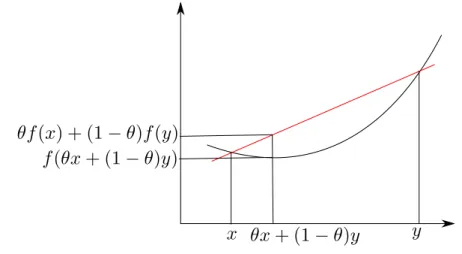
• Convex Function: Define a function f : Rn → R with domain dom f which
Chapter 2. Fundamental Concept and State-of-the-Art 15
inequality always holds:
f(θx+ (1−θ)y)≤θf(x) + (1−θ)f(y). (2.14)
The inequality in (2.14) is also calledJensen’s Inequality.
From the perspective of geometry, the above inequality reveals that for convex function, the segment between any (x, f(x)) and (y, f(y)) lies above the graph of
f as shown in Figure 2.6.
Figure 2.6: An illustration of a convex function
A function is strictly convex when strict inequality holds for (2.14).
• Optimisation Problem: The standard form of an optimisation problem which consistsm inequality constraints andp equality constraints is as follows
min
x f0(x)
s.t. fi(x)≤0, i= 1, ..., m
hi(x) = 0, i= 1, ..., p
(2.15)
Chapter 2. Fundamental Concept and State-of-the-Art 16
all the values of x that satisfy both the inequality constraints fi(x) ≤ 0 and
equality constraints hi(x) = 0. The domain of the problem (2.15) is defined as
D=Tm
i=0domfi∩Tpi=1domhi.
• Convex Optimisation Problem:
An optimisation problem becomes a convex optimisation problem when it has the following form: min x f0(x) s.t. fi(x)≤0, i= 1, ..., m aTi x=bi, i= 1, ..., p (2.16)
where f0, ..., fm are convex functions and T represents transpose operation. Note
that in convex optimisation problems, the objective function and all the constraints are convex.
2.2.2.2 Duality
• The Lagrange dual function: Consider the standard form optimisation problem (2.15) with variablex∈Rn. Denote its optimal value by p∗.
Associated with this problem, the Lagrangian L:Rn×Rm×Rp →R is defined as L(x, λ, ν) =f0(x) + m X i=1 λifi(x) + p X i=1 νihi(x),
withdomL=D ×Rm×Rp where the vectorsλandνare referred as theLagrange
multiplier vectors.
Chapter 2. Fundamental Concept and State-of-the-Art 17
be achieved by the Lagrangian over x:
g(λ, ν) = inf x∈DL(x, λ, ν) = infx∈D f0(x) + m X i=1 λifi(x) + p X i=1 νihi(x) ! .
Note that the dual function is always concave even though the problem (2.15) is not necessarily convex.
For each (λ, ν) withλ≥0 pair, the Lagrange dual function provides a lower bound on the value of optimalp∗ of problem (2.15), that is, for any λ≥0 and any ν, we always have
g(λ, ν)≤p∗.
• The Lagrange Dual Problem: The Lagrange dual problem is defined as
max
λ,ν g(λ, ν)
s.t. λ≥0.
(2.17)
The optimal valued∗ of the problem (2.17) gives the best (or largest) lower bound on p∗. Problem (2.15) is also called the primal problem.
The optimal (λ∗, ν∗) for problem (2.17) is referred as dual optimal or optimal Lagrange multipliers.
The difference p∗−d∗ is defined as optimal duality gap. Strong duality means that the optimal duality gap is 0.
Chapter 2. Fundamental Concept and State-of-the-Art 18
• Karush-Kuhn-Tucker (KKT) conditions is defined as:
fi(x∗)≤0, i= 1, ...m (2.18) hi(x∗) = 0, i= 1, ...p (2.19) λ∗i ≥0, i= 1, ...m (2.20) λ∗ifi(x∗) = 0, i= 1, ...m (2.21) ∇f0(x∗) + m X i=1 λ∗i∇fi(x∗) + p X i=1 νi∗∇hi(x∗) = 0. (2.22)
If strong duality holds for any optimisation problem (both convex and nonconvex), then any pair of primal and dual optimal points must satisfy the KKT conditions (2.18)-(2.22).
In addition to above facts, forconvex primal problem, the KKT conditions are also sufficient for the points to be primal and dual optimal (necessary and sufficient condition).
Therefore, for convex optimisation, if KKT conditions are satisfied, the optimal
x∗ can be found through solving the KKT conditions and the optimal value of the problem can subsequently be found.
2.2.3 Online/Offline Problems and Competitive Analysis
2.2.3.1 Online Problems and Offline Problems
Online problems are the optimisation problems in which the input and the output is produced in a serial fashion, i.e., the output must be produced in an online manner without knowing the entire input sequence in advance. In online algorithms, each online output have influences on the performance of the overall solution. On the other hand, offline problems are the optimisation problems in which the whole problem input is given
Chapter 2. Fundamental Concept and State-of-the-Art 19
from the beginning, i.e., the output is produced with the full knowledge of the input.
Many problems, such as the selection sort problem [BEY98], are intrinsically offline. There are also many problems that are intrinsically online, such as investment planning and telephone circuit switching. Interestingly, for some other problems, both the offline and online versions are naturally meaningful, such as bin packing and job scheduling.
2.2.3.2 Competitive Analysis
Competitive analysis is widely used in various areas for analyzing online algorithms. In the following, the basic ideas and terminology in competitive analysis will be introduced. Consider an optimisation problem, which may be either a profit maximization problem (for example, the throughput maximization problem) or a cost minimization problem (for example, the transmission completion time minimization problem), and denote it asP. A profit maximization problem (cost minimization problem)P consists of a setΩof input sequences and a profit (cost) functionB. Since this thesis focuses on throughput (profit) maximization problem, the discussion here is mainly in terms of profit maximization problems.
Denote an online algorithm for solving the problem P asA and the optimal offline algorithm asO. For any input sequenceω∈Ω, letBA(ω) andBO(ω) denote the profits earned by A and O for serving ω. An online algorithm A is ρ-competitive [BEY98] if for all feasible input sequences ω∈Ω,
BA(ω)≥ B O(ω)
ρ . (2.23)
Note that the competitive ratio ρ is at least 1. The competitive ratio serves as a worst-case performance bound of the online algorithm against the optimal offline algorithm.
Chapter 2. Fundamental Concept and State-of-the-Art 20
2.3
State-of-the-Art in Wireless Communication Systems
Powered by Renewable Sources
Due to the intermittent and random energy availability introduced by EH source, pro-tocols/policies in traditional wireless communication systems need to be revised to accommodate the new challenges. In the physical layer, throughput maximising trans-mission policies for various channel models were studied in [YU12b, HZ12, YU12a, TY12a, TY12b, YOU12, OYU12a, AUBE11, OYU12b, OYU13]; joint energy transfer and transmission scheduling policies were investigated in [LZC13, PC13, ZZH13, GOJU13a, GOJU12, GOJU13b, TY13, PFS13, DPEP14, DZN+15]. Multiple access control poli-cies for energy harvester powered wireless communication systems were considered in [ISS10, ISPS12, ISS12]. References [LSS07, CSSJ14, JSMK09] focused on the network-ing layer of wireless communication systems powered by EH and studied several routnetwork-ing protocols. In this section, literatures on throughput maximising transmission schemes, which are the main focuses of this thesis, will be summarised.
2.3.1 Point-to-Point Channel with Energy Harvester
2.3.1.1 AWGN point-to-point channel with energy harvester
The optimal offline resource allocation schemes for maximising the throughout over a finite time horizon in the single-user additive white Gaussian noise (AWGN) channel was investigated in [YU12b] (assuming infinite battery capacity) and [TY12a] (assuming finite battery capacity).
For a point-to-point AWGN channel, the relationship between the transmission rate
r and the power P is given as r=g(P) = 12log(1 +P).
A deterministic energy model was adopted in both papers, which assumes energy arrival instants, i.e., 0, s1, s2,· · ·, sn,· · ·, and amountsE0, E1, E2,· · ·, En,· · · are known
Chapter 2. Fundamental Concept and State-of-the-Art 21
to the system before the transmissions start.
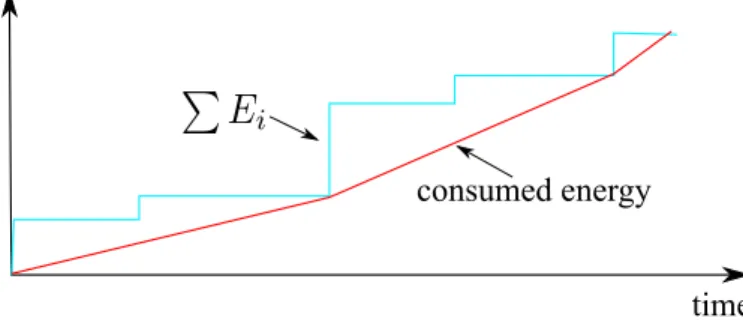
The optimal offline resource allocation scheme assuming infinite battery capacity was investigated in [YU12b]. It was proved that the optimal power/rate allocation satisfies the following structural properties: 1) the rate/power keeps constant between energy arrivals; 2) the rate/power is non-decreasing over time; 3) whenever the rate/power changes, the energy stored in the battery must be depleted. Based on these properties, the optimal power/rate allocation could be obtained, as indicated in Fig. 2.7. As shown in Fig. 2.7, the staircase curve represents the amount of accumulated harvested energy and the red piecewise linear curve is the accumulated amount of consumed energy, whose slopes indicate the power level.
time consumed energy
Figure 2.7: Optimal power allocation in point-to-point channel with energy harvester (infinite battery capacity case).
In [TY12a], the optimal offline resource allocation for finite battery capacity case was studied. It was proved that the rate/power should satisfy the following structural properties: 1) the rate/power keeps constant between energy arrivals; 2) whenever the rate/power changes, the battery is either full or depleted; 3) the rate/power only increases when the battery is depleted while only decreases when the battery is full. Based on these properties, the optimal rate/power could be obtained by the algorithm proposed in [TY12a]. As illustrated in Fig. 2.8, unlike the infinite battery capacity case where the power level only increases with time, in finite battery case, the power level may both increase and decrease, depends on the battery status.
Chapter 2. Fundamental Concept and State-of-the-Art 22
time
consumed energy
Figure 2.8: Optimal power allocation in point-to-point channel with energy harvester (finite battery capacity case).
2.3.1.2 Fading channel with energy harvester
In [HZ12], the authors studied the throughput maximisation problem for point-to-point channel with varying channel conditions over a finite horizon ofK time slots. Assuming causal side information at the transmitter, i.e., only information about channel condi-tions and energy amount of the past and presents slots is known, and modelling both the channel condition and energy profiles as first-order Markov processes, the optimal solution to maximise the summation of the expected mutual information over K slots can be obtained by dynamic programming. With full causal side information at the transmitter, i.e., information about channel conditions and harvested energy amount of theK slots is known before transmission starts, the authors obtained: 1) the closed-form optimal solution was when K= 2; 2) the structure of the optimal solution for arbitrary
K which has a water-filling interpretation where there are multiple non-decreasing water levels, based on which an algorithm was proposed that uses both forward-search and backward-search.
In [OTY+11], the throughput maximisation problem was considered in a point-to-point wireless fading channel with finite battery capacity. In this paper, a continuous system model was adopted, where the arrival times of harvested energy and the changing points of the channel gains are uneven over time. With the assumption of non-causal channel state information (CSI) and energy state information (ESI), the problem of
max-Chapter 2. Fundamental Concept and State-of-the-Art 23
imising the throughput given the deadlineT was investigated. Based on KKT condition analysis, a directional water-filling algorithm was proposed. The water level keeps con-stant between two adjacent energy arrivals and there may exist multiple water levels during the whole transmission process. Right permeable water taps are used at the points of energy arrival which only allows energy to flow to the right. Similar to the clas-sic water filling algorithms, the water level is used to make sure that the higher power level is granted when the channel gain is high where as lower power level (or even zero power) is used when the channel condition is poor.
2.3.2 Multiuser Wireless Communication Systems with Energy Har-vesters
2.3.2.1 Broadcast Channel with Energy Harvester
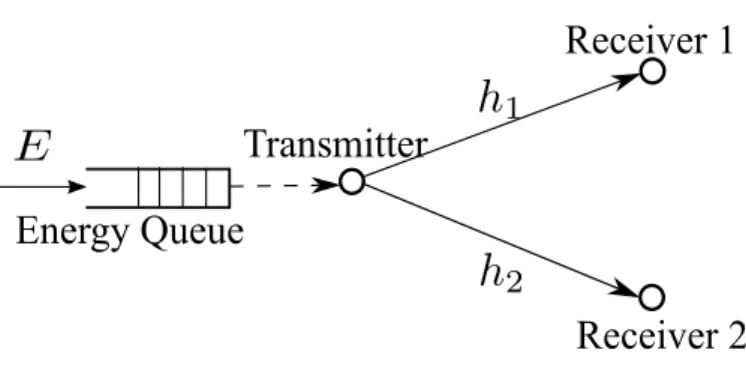
In [YOU12], [AUBE11] and [OYU12a], the Gaussian BC where the transmitter is pow-ered by an energy harvester, as shown in Figure 2.9, was studied. They adopted the same energy model as in [YU12b]. The data packages are assumed to be ready before transmissions start.
TX
RX 1
RX 2 energy queue
Figure 2.9: Broadcast channel with energy harvester
Chapter 2. Fundamental Concept and State-of-the-Art 24 given as r1≤ 1 2log 1 +αP σ12 , (2.24) r2≤ 1 2log 1 +(1−α)P αP +σ22 , (2.25)
where α represents the portion of the total power P that is allocated for the message for receiver 1 and σ21, σ22 are the variance of the zero mean Gaussian noise experienced by receiver 1 and receiver 2, respectively. Without loss of generality, it is assumed that
σ12 ≤σ22, which indicates receiver 1 experiences weaker noise interference than receiver 2.
It was proved that the smallest sum power needed to support data ratesr1 andr2 in this BC is given as
g(r1, r2) ∆
=σ1222(r1+r2)+ (σ2
2−σ21)22r2 −σ22. (2.26) The optimal offline resource allocation with infinite battery capacity assumption was studied in the parallel work in [YOU12] and [AUBE11].
In [YOU12], by analysing the KKT conditions of the optimisation problem, it was proved that the sum power allocation has the same structural properties as that in the point-to-point channel [YU12b] and thus could be obtained similarly. It is worth noting that the proof process only applies to the specific expression ofg(r1, r2) in (2.26). Then, it was proved that there exists a cut-off power for the stronger user: 1) if the sum power is smaller than the cut-off power, all the sum power will be allocated to the data for the stronger user; and 2) if the sum power is larger than cut-off power, then the amount of power allocated to the stronger user equals the cut-off power level while all the remaining power will be allocated to the weaker user.
Chapter 2. Fundamental Concept and State-of-the-Art 25
FlowRight algorithm.
The optimal offline resource allocation with finite battery capacity assumption was investigated in [OYU12a]. It was proved that the optimal sum power allocation has the same structure as that in the point-to-point channel with finite battery capacity [TY12a], and thus could be obtained by adopting the algorithm in [TY12a]. Note that, however, the above conclusion is proved by KKT conditions which involves the derivatives of
g(r1, r2). Therefore, their proof process only applies to the specific expression ofg(r1, r2) in (2.26). The optimal way of splitting the sum power for the two users is the same as that in the BC channel with infinite battery capacity [YOU12].
2.3.2.2 Multiple Access Channel with Energy Harvesters
Reference [YU12a] studied the resource allocation problem for maximising the weighted sum throughput in a two-transmitter Guassian MAC, where each transmitter is powered by an energy harvester, as illustrated in Fig. 2.10. Considering infinite battery capacities, the optimal offline generalised iterative backward water-filling scheme was proposed, which was based on the generalized iterative water-filling algorithm in [KU06]. Note that however, the optimal solution proposed in this paper is not an analytic solution and therefore has relatively high computational burden.
energy queue
Transmitter 1
Transmitter 2
Receiver
Chapter 2. Fundamental Concept and State-of-the-Art 26
2.3.2.3 Relay Channel with Energy Harvester
In [HZC13], the classic decode-and-forward Gaussian relay channel where the source and relay nodes are both powered by energy harvesting sources was investigated. With a slotted energy arrival model where the harvested energy arrives at the beginning of each slot, the optimal offline resource allocation algorithm to maximise the throughput over a finite horizon ofN slots for two traffic types, i.e., the delay-constrained traffic and the no-delay constrained traffic, were studied. With no-delay-constrained traffic, by examining the KKT conditions of the optimisation problem, it was proved that the resource allocation at the transmitter and relays should be jointly optimised. A forward search algorithm was proposed which gives the optimal offline power profiles. For the no-delay constrained traffic case, a two-stage offline resource allocation algorithm, which separately computes the optimal power profiles for the source and relay nodes, was proposed.
Reference [OE13] and [LZL13] studied the resource allocation problems in half-duplex decode-and-forward relay channel with no direct link between the source and the desti-nation, assuming the relay is powered by energy harvester and the source is powered by an energy harvester, respectively. Assuming infinite battery capacity, the optimal offline resource allocation schemes were developed in [OE13] and [LZL13] for their respective problems.
Chapter 3
Optimal Offline Resource
Allocation Schemes for Multiple
Access Channels with a Shared
Renewable Energy Source
3.1
Overview
In this Chapter, the optimal offline resource allocation for the Gaussian multiple access channel (MAC) with two transmitters powered by a shared energy harvester is investi-gated. The aim of the resource allocation schemes are to maximise the weighted sum throughput over a finite time horizon. Packets of both transmitters are assumed to be ready before transmissions start. Moreover, both infinite battery capacity and finite battery capacity cases are considered. The optimal offline resource allocation schemes for both cases are developed based on the assumption that the energy arrival amounts are non-causally known before transmissions.
Chapter 3. Optimal Offline Resource Allocation Schemes for Multiple Access Channels
with a Shared Renewable Energy Source 28
To develop the optimal offline schemes, first, the resource allocation problems that characterises the maximum departure regions over a finite time horizon is formulated. The structural properties of the optimal offline sum power profiles are investigated by exploiting the convexity of the sum power function. Then, the optimal offline resource allocation between the two transmitters, in which there exists a capping rate at the stronger transmitter, is obtained. It is also demonstrated that under the same energy arrival profile, the Gaussian MAC with a shared energy harvester achieves the same maximum departure region as its dual broadcast channel (BC).
3.2
System Model and Problem Formulation
3.2.1 System Model
As illustrated in Fig. 3.1, a two-user Gaussian multiple access channel is considered. The constant channel power gains from transmitter 1 and transmitter 2 to the receiver are denoted by h1 and h2, respectively. The assumption of constant channel gains can be validated by the practical scenario where the locations and the wireless medium between the transmitters and the receiver are relatively fixed and thus the channel gains are quasi-static over the considered transmission period. Such assumption has been widely adopted in several other papers in the same line of work, e.g., [YU12b], [TY12a], [GP13], [YOU12], [AUBE11], and [YU12a]. Without loss of generality, it is assumed h1 > h2, which indicates that the link from transmitter 1 to the receiver is stronger than that from transmitter 2 to the receiver. The transmitter with the higher (lower) channel gain is called the stronger (weaker) transmitter.
Consider a finite time horizon of N slots, each with a duration ofT. It is assumed that at the beginning of the n-th slot, n= 1,· · · , N, the EH source receives harvested energy with an amount ofEn∈[0, Emax], where Emaxdenotes the maximum amount of the harvested energy and is assumed to be known. Denote the sequence of theN energy
Chapter 3. Optimal Offline Resource Allocation Schemes for Multiple Access Channels
with a Shared Renewable Energy Source 29
Energy Queue
Transmitter 1
Transmitter 2
Receiver
Figure 3.1: Gaussian MAC with a shared energy harvester
arrivals as ω = (E1,· · · , EN) (which is also called the energy input sequence) and the
set of all possible energy input sequences as Ω={ω|0≤En≤Emax, n= 1,· · · , N}.
Figure 3.2: The slot-based energy arrival model
Denote the power and rate of transmitter i, i= 1,2, in the n-th slot,n= 1,· · · , N, as Pi,n and ri,n, respectively. The channel input/output relationship of the Gaussian
MAC in then-th slot is given as [CT06]
Yn=
p
h1P1,nX1,n+
p
h2P2,nX2,n+Zn, (3.1)
where Xi,n, i = 1,2, is the unit-power transmitted signals at transmitter i, Yn is the
received signal at the receiver andZnis the additive circularly symmetric complex
Gaus-sian (CSCG) noise with zero mean and unit variance.
As indicated in Fig. 3.2, the energy provided by the energy harvester is intermittent and discrete over time. As a result, the transmission scheme adopted by the EH system must guarantee that the total amount of energy consumed by the two transmitters during the first j slots must be smaller than or equal to the total amount of energy harvested in the first j slots, ∀j ∈ [1,· · · , N]. This constraint is called the EH constraint and is
Chapter 3. Optimal Offline Resource Allocation Schemes for Multiple Access Channels
with a Shared Renewable Energy Source 30
mathematically modeled as:
T j X n=1 (P1,n+P2,n)≤ j X n=1 En, j= 1,· · ·N . (3.2) 3.2.2 Problem Formulation
In this subsection, first, the minimum sum power g(r1,n, r2,n) required to achieve given
data rates (r1,n, r2,n) of the two transmitters in the n-th slot is derived. Then, for
both the infinite and finite battery cases, the maximum departure regions are defined and optimisation problems are formulated, whose optimal solutions give the resource allocation schemes that achieve the boundary points of the maximum departure region, respectively. In the sequel, the indexn is omitted whenever it causes no confusion.
3.2.2.1 Minimum Sum Power to Achieve Given Rates
First, the minimum sum power g(r1, r2) required to achieve given data rates (r1, r2) of the two transmitters is derived.
The capacity region of the Gaussian MAC is given by [CT06]
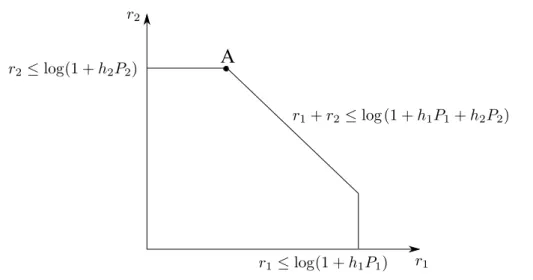
r1 ≤log(1 +h1P1) (3.3) r2 ≤log(1 +h2P2) (3.4) r1+r2≤log(1 +h1P1+h2P2), (3.5) which is convex over (r1, r2) [BV04].
An illustration of the capacity region of the Gaussian MAC is shown in Figure 3.3.
Chapter 3. Optimal Offline Resource Allocation Schemes for Multiple Access Channels
with a Shared Renewable Energy Source 31
A
Figure 3.3: The capacity region of the Gaussian MAC
power required can be obtained from the following problem
(P3.1) g(r1, r2) = min
{P1,P2}
P1+P2 (3.6)
s.t.(3.3)−(3.5). (3.7)
Proposition 1. For a given non-negative rate pair (r1, r2) and h1 > h2, the sum
min-imum transmit power is achieved when equality is achieved for (3.4) and (3.5). The minimum sum power and corresponding power allocation for the two transmitters are
g(r1, r2) ∆ = 2 r1+r2 −2r2 h1 + 2 r2 −1 h2 , (3.8) P1= 2r1+r2 −2r2 h1 , (3.9) P2= 2r2 −1 h2 . (3.10)
Proof. Note that problem (P3.1) is convex and its Lagrangian Lis defined as:
L(P1, P2, λ1, λ2, λ3) = 2 X j=1 λj(2rj −1−hjPj) +λ3(2r1+r2 −1−h1P1−h2P2) +P1+P2, (3.11)
Chapter 3. Optimal Offline Resource Allocation Schemes for Multiple Access Channels
with a Shared Renewable Energy Source 32
whereλ1 ≥0,λ2≥0, andλ3 ≥0 are the Lagrangian multipliers.
By letting the partial derivatives ofL with respective to P1 and P2 be equal to zero, respectively, the first set of optimality conditions is given as
1−λ1h1−λ3h1 = 0, (3.12)
1−λ2h2−λ3h2 = 0. (3.13)
Note that the complementary slackness conditions of this problem are:
λ1(2r1−1−h1P1) = 0, (3.14)
λ2(2r2−1−h2P2) = 0, (3.15)
λ3(2r1+r2 −1−h1P1−h2P2) = 0. (3.16) If λ2 = 0, solving (3.12) and (3.13) gives λ3 = h12 >0 and λ1 = h11 −h12 <0, which is infeasible as the condition λ1 ≥ 0 is violated. If λ3 = 0, solving (3.12) and (3.13) gives λ1 = h11 >0 and λ2 = h12 >0, which is also infeasible, since it would imply that constraints (3.3) and (3.4) should be achieved with equality, which violates the constraint (3.5). Thus, it is concluded thatλ2>0 andλ3>0 both hold.
Therefore, by complementary slackness, we have that the optimal solution of problem (P3.1) is achieved when constraints (3.4) and (3.5) are achieved with equality, while the constraint (3.3) would be inactive since (3.3) and (3.4) cannot be active at the same time as we argued above. Based on this, the power P1 and P2 allocated for transmitters 1 and 2, respectively, and the minimum sum powerg(r1, r2) =P1+P2 could be obtained.
Remark 1. The minimum sum power transmission given in Proposition 1 is achieved by adopting the following coding scheme: each transmitter encodes its data with a
capacity-Chapter 3. Optimal Offline Resource Allocation Schemes for Multiple Access Channels
with a Shared Renewable Energy Source 33
achieving AWGN channel code. When the receiver receives the data of the two transmit-ters, it first decodes transmitter 1’s data while treating the signal from transmitter 2 as Gaussian interference (the rate transmitter 1 could achieve is r1 = log
1 + h1P1
1+h2P2
); then, after the data from transmitter 1 is decoded, it could be subtracted from the received signal; at last, the signal from transmitter 2 could be decoded with only the system back-ground Gaussian noise and the resulted rate is given asr2 = log (1 +h2P2). Such scheme
corresponds to point A in Fig. 3.3
By (3.8), the causal EH constraints defined in (3.2) could be rewritten as:
T j X n=1 g(r1,n, r2,n)≤ j X n=1 En, j= 1,· · · , N . (3.17)
3.2.2.2 Problem Formulation for Infinite Battery Capaticy Case
Based on the definition of the EH constraints in (3.17), the maximum departure region is defined as follows.
Definition 1. Given an energy input sequenceω∈Ω, within the finite time horizon of
N slots, the maximum departure region D(N) of the Gaussian MAC with a shared energy harvester with infinite battery capacity is defined as the union of all achievable bits pair (B1, B2) under the EH constraint (3.17), i.e.,
D(N) = ( (B1, B2) Bi =T N X n=1 ri,n, i= 1,2, (3.17) ) , (3.18)
where Bi is the total amount of data transmitted from transmitter i, i= 1,2.
Proposition 2. The maximum departure region D(N) defined in (3.18) for the MAC with infinite battery capacity is convex.
Proof. Let (B1, B2) and (B10, B20) be two points in D(N) achieved by the rate profiles (r1,n, r2,n) and r01,n, r02,n
, n∈ {1,· · · , N}, respectively. Define another point B¯1,B¯2
Chapter 3. Optimal Offline Resource Allocation Schemes for Multiple Access Channels
with a Shared Renewable Energy Source 34
as B¯1,B¯2
=θ(B1, B2)+(1−θ) (B01, B20), θ∈[0,1], which is achieved by the rate profile
(¯r1,n,r¯2,n) =θ(r1,n, r2,n) + (1−θ) r01,n, r 0 2,n = θr1,n+ (1−θ)r01,n, θr2,n+ (1−θ)r20,n , for each n∈ {1,· · · , N}.
To prove thatD(N) is a convex region, we only need to prove that the point B¯1,B¯2
is also in D(N), i.e., the rate profile (¯r1,n,¯r2,n) is feasible (satisfies the EH constraints),
as illustrated in Fig. 3.5.
Figure 3.4: Proof of the convexity of the maximum departure region of MAC with a shared energy harvester (infinite battery capacity case)
Due to the convexity of g(r1, r2), we have
g(¯r1,n,r¯2,n)≤θg(r1,n, r2,n) + (1−θ)g r01,n, r02,n
,
Chapter 3. Optimal Offline Resource Allocation Schemes for Multiple Access Channels
with a Shared Renewable Energy Source 35
any j∈ {1,· · · , N}, T j X n=1 g(r1,n, r2,n)≤ j X n=1 En, T j X n=1 g r01,n, r02,n≤ j X n=1 En. Forj∈ {1,· · ·, N}, we have T j X n=1 g(¯r1,n,r¯2,n)≤T j X n=1 θg(r1,n, r2,n) + (1−θ)g r10,n, r20,n =θT j X n=1 g(r1,n, r2,n) + (1−θ)T j X n=1 g r10,n, r02,n ≤θ j X n=1 En+ (1−θ) j X n=1 En = j X n=1 En,
which indicates that the EH constraints are satisfied. Therefore, the point B¯1,B¯2
can be achieved and is in D(N).
Hence, we can conclude thatD(N) is a convex region.
As illustrated by Fig. 3.5, due to the convexity of this region and its special structure in the first orthant, the boundary ofD(N) can be characterized by solving the following problem, (P3.2) max {r1,n,r2,n} µ1 N X n=1 r1,nT+µ2 N X n=1 r2,nT (3.19) s.t. j X n=1 g(r1,n, r2,n)T ≤ j X n=1 En, j= 1,· · · , N, (3.20)
Chapter 3. Optimal Offline Resource Allocation Schemes for Multiple Access Channels
with a Shared Renewable Energy Source 36
Figure 3.5: An illustration of the maximum departure region of MAC with a shared energy harvester
on the boundary ofD(N) can be achieved.
3.2.2.3 Problem Formulation for Finite Battery Case
Denote the capacity of the battery as E1. During the transmission, if the amount of unconsumed energy is larger than the battery capacity, the battery can only store the amount ofE while the rest is discarded because of battery overflow. Notice that battery overflow might only happen at the beginning of each slot when new harvested energy arrives. The battery non-overflow constraints are mathematically modeled as:
j+1 X n=1 En ! − E ≤T j X n=1 g(r1,n, r2,n), j = 1,· · · , N −1. (3.21)
Based on the definition of the EH constraints (3.17) and the battery non-overflow constraints (3.21), the maximum departure region for the case of finite battery capacity is defined as follows.
Definition 2. Given an energy input sequenceω∈Ω, within the finite time horizon of
N slots, the maximum departure region D(N) of the Gaussian MAC with a shared energy harvester with finite battery capacity is defined as the union of all achievable bits
1In the finite battery case, E
n,n = 1,· · ·, N, and thusEmax are truncated atE since any energy
Chapter 3. Optimal Offline Resource Allocation Schemes for Multiple Access Channels
with a Shared Renewable Energy Source 37
pair (B1, B2) under the EH constraint (3.17) and the battery non-overflow constraints (3.21), i.e., D(N) = ( (B1, B2) Bi=T N X n=1 ri,n, i= 1,2, (3.17),(3.21) ) . (3.22)
Proposition 3. The maximum departure region D(N) defined in (3.22) for the MAC with finite battery capacity is convex.
Proof. Let (B1, B2) and (B10, B20) be two points in D(N) achieved by the rate profiles (r1,n, r2,n) and r01,n, r02,n
,n∈ {1,· · · , N}, respectively. Since (B1, B2) and (B10, B20) are both in D(N), we have that
T j X n=1 g(r1,n, r2,n)≤ j X n=1 En, j = 1,· · · , N, (3.23) T j X n=1 g r01,n, r02,n≤ j X n=1 En, j = 1,· · ·, N, (3.24) and j+1 X n=1 En ! − E ≤T j X n=1 g(r1,n, r2,n), j= 1,· · · , N −1, (3.25) j+1 X n=1 En ! − E ≤T j X n=1 g r10,n, r20,n, j = 1,· · · , N −1. (3.26) Define another point B¯1,B¯2
as B¯1,B¯2
=θ(B1, B2) + (1−θ) (B10, B20), θ∈[0,1], which is achieved by the rate profile
(¯r1,n,r¯2,n) =θ(r1,n, r2,n) + (1−θ) r01,n, r02,n
= θr1,n+ (1−θ)r10,n, θr2,n+ (1−θ)r20,n
, n= 1,· · · , N.
It is easy to see that the point B¯1,B¯2
is located on the segment formed by (B1, B2) and (B10, B20), as illustrated in Fig. 3.6. Therefore, to prove the convexity of maximum
Chapter 3. Optimal Offline Resource Allocation Schemes for Multiple Access Channels
with a Shared Renewable Energy Source 38
departure region, we only need to prove that the point B¯1,B¯2
is inD(N). Due to the convexity of g(r1, r2), we have
g(¯r1,n,r¯2,n)≤θg(r1,n, r2,n) + (1−θ)g r01,n, r02,n
,
for all n∈ {1,· · · , N}.
It is easy to check that for x1 > x2 and y1 > y2, we have g(x1, y1) > g(x2, y2). Also note that g(r1, r2) is a continuous function over (r1, r2). Therefore, for each n ∈
{1,· · ·, N}, we can always find some new rate profile (˜r1,n,r˜2,n) such that ˜r1,n > r¯1,n,
˜
r2,n>¯r2,n, and g(˜r1,n,˜r2,n) =θg(r1,n, r2,n) + (1−θ)g r01,n, r02,n
.
Denote the point achieved by the new rate profiles (˜r1,n,r˜2,n) by
˜ B1,B˜2 . Obviously, ˜
B1 >B¯1 and ˜B2 >B¯2. Clearly, the point B¯1,B¯2
is dominated by the point
˜ B1,B˜2 , and therefore, if ˜ B1,B˜2 is in D(N), so is B¯1,B¯2 . Forj= 1,· · · , N, we have T j X n=1 g(˜r1,n,r˜2,n) =T j X n=1 θg(r1,n, r2,n) + (1−θ)g r10,n, r 0 2,n =θT j X n=1 g(r1,n, r2,n) + (1−θ)T j X n=1 g r01,n, r02,n. (3.27) Based on (3.23)-(3.26), we have T j X n=1 g(r1,n, r2,n)≤ n X j=1 En, j = 1,· · · , N, (3.28) and j+1 X n=1 En ! − E ≤T j X n=1 g(r1,n, r2,n), j = 1,· · · , N −1, (3.29)
which indicates that both the EH constraints and the battery non-overflow constraints are satisfied. Therefore, the pointB˜1,B˜2
is inD(N), so is B¯1,B¯2
Chapter 3. Optimal Offline Resource Allocation Schemes for Multiple Access Channels
with a Shared Renewable Energy Source 39
Hence, we can conclude thatD(N) is a convex region.
Figure 3.6: Proof of the convexity of the maximum departure region of MAC with a shared energy harvester (finite battery capacity case)
Due to the convexity of this region and its special structure in the first orthant, the boundary ofD(N) can be characterized by solving the following problem,
(P3.3) max {r1,n,r2,n} µ1 N X n=1 r1,nT+µ2 N X n=1 r2,nT (3.30) s.t. j X n=1 g(r1,n, r2,n)T ≤ j X n=1 En, j= 1,· · ·, N, (3.31) j+1 X n=1 En ! − E ≤T j X n=1 g(r1,n, r2,n), j = 1,· · · , N −1. (3.32)
3.3
The Optimal Offline Resource Allocation Scheme
In this section, the optimal resource allocation schemes, denoted by O, for solving the Problem (P3.2) and (P3.3) will be described. First, for each problem, the structure of the optimal sum power sequence g(r1,n, r2,n), n= 1,· · ·, N, is analysed. Then, the optimal
rate allocation that achieve the boundary points of the maximum departure regionD(N) is derived.
Chapter 3. Optimal Offline Resource Allocation Schemes for Multiple Access Channels
with a Shared Renewable Energy Source 40
3.3.1 Optimal Sum Power Allocation
3.3.1.1 Optimal Sum Power Allocation for Infinite Battery Case
This section presents the structural properties of the optimal sum power profile for the optimisation problem (P3.2).
Lemma 1. The optimal offline solution for Problem (P3.2) satisfies g(r1,n, r2,n) ≤
g(r1,n+1, r2,n+1), ∀n ∈ {1,· · ·, N −1}, i.e., the optimal sum power can only stay
con-stant or increase over time.
Proof. Suppose that in the optimal offline solution, the rates of the two transmitters at some ˙n-th slot and the ( ˙n+ 1)-th slot satisfy g(r1,n˙, r2,n˙) > g(r1,n˙+1, r2,n˙+1), ˙n ∈
{1,· · ·, N −1}. The amounts of data sent for the two users over the ˙n-th slot and the ( ˙n+ 1)-th under such rate allocation is (r1,n˙ +r1,n˙+1, r2,n˙ +r2,n˙+1)T.
Define a new rate profile as
(˜r1,n˙,r˜2,n˙) = (˜r1,n˙+1,r˜2,n˙+1) = 1 2(r1,n˙, r2,n˙) + 1 2(r1,n˙+1, r2,n˙+1) = 1 2r1,n˙ + 1 2r1,n˙+1, 1 2r2,n˙ + 1 2r2,n˙+1 . (3.33)
With the new rate profile, the amounts of data sent for the two users in these two slots are still (r1,n˙ +r1,n˙+1, r2,n˙ +r2,n˙+1)T. From the convexity ofg(r1, r2) overr1 and
r2, we have g(˜r1,n˙,r˜2,n˙) =g(˜r1,n˙+1,r˜2,n˙+1) < 1 2g(r1,n˙, r2,n˙) + 1 2g(r1,n˙+1, r2,n˙+1) < g(r1,n˙, r2,n˙). (3.34)