Northumbria Research Link
Citation: Li, Zequn (2019) Explainable online recommendation systems with self-identity theory and attribute learning method. Doctoral thesis, Northumbria University.
This version was downloaded from Northumbria Research Link: http://nrl.northumbria.ac.uk/42906/
Northumbria University has developed Northumbria Research Link (NRL) to enable users to access the University’s research output. Copyright © and moral rights for items on NRL are retained by the individual author(s) and/or other copyright owners. Single copies of full items can be reproduced, displayed or performed, and given to third parties in any format or medium for personal research or study, educational, or not-for-profit purposes without prior permission or charge, provided the authors, title and full bibliographic details are given, as well as a hyperlink and/or URL to the original metadata page. The content must not be changed in any way. Full items must not be sold commercially in any format or medium without formal permission of the copyright holder. The full policy is available online: http://nrl.northumbria.ac.uk/pol i cies.html
Explainable Online
Recommendation Systems with
Self-Identity Theory and Attribute
Learning Method
Zequn Li
PhD
Explainable Online
Recommendation Systems with
Self-Identity Theory and Attribute
Learning Method
Zequn Li
A thesis submitted in partial fulfilment of the
requirements of the University of Northumbria at
Newcastle for the degree of
Doctor of Philosophy
Research undertaken in the Faculty of
Computer and Information Sciences
Declaration
I declare that the work contained in this thesis has not been sub-mitted for any other award and that it is all my own work. I also confirm that this work fully acknowledges opinions, ideas and contributions from the work of others.
Any ethical clearance for the research presented in this thesis has been approved. Approval has been sought and granted by the Faculty Ethics Committee on 11/11/2016.
I declare that the Word Count of this Thesis is 36187 words. I declare that parts of the following papers and works have been included in this thesis.
1. Li, Zequn, Honglei Li, and Ling Shao. ”Improving Online Customer Shopping Experience with Computer Vision and Machine Learning Methods.” In International Conference on HCI in Business, Government, and Organizations, pp. 427-436. Springer, Cham, 2016. (Chapter 2,3)
2. Li, Zequn, Honglei Li, and Ling Shao. ”Improving At-tribute Classification with Imperfect Pairwise Constraints” (2019). ICEB 2019 Proceedings. (Chapter 4)
3. Li, Honglei; Li, Zequn; and Tian, Jing, ”The Design of an Online Roommate Finding System for Property Manage-ment Portals—the Virtual Community Perspective” (2018). ICEB 2018 Proceedings. 4. And associate Industry project RoomMate Matching System funded by Nicelandlords New-castle (Chapter 7)
4. Wen, Zhenyu, Rawaa Qasha, Zequn Li, Rajiv Ranjan, Paul Watson, and Alexander Romanovsky. ”Dynamically parti-tioning workflow over federated clouds for optimising the monetary cost and handling run-time failures.” IEEE Trans-actions on Cloud Computing (2016). (Chapter 7)
Name: Zequn Li
Signature:
Acknowledgements
I would like to thank my supervisor Dr. Honglei Li for her guid-ance in research, support in life and encouragement to go through my difficulties. I would also like to thank my second supervisor Prof. Ling Shao and Dr. Longzhi Yang, without their support I cannot accomplish my research.
I would also like to thank the Northumbria University for provid-ing opportunity and scholarship to support me to complete my PhD research.
Finally, I would like to thank my parents for their unconditional support in my life and work.
Abstract
In recent years, Online Shopping plays an important role in daily life and how to improve the online shopping experience with Ma-chine Learning and Recommender System has been discussed by a group of researchers. As a sub-field of Machine Learning, Com-puter vision has achieved significant developments during the last decade. The computer vision techniques can help machine to view images and extract useful information from images like hu-man beings. However, the existing online recommender system has mostly used the labelled information and ignored the large amount of useful information extracted from images. This the-sis proposed that the extracted information from images through computer vision techniques can be used in the current online rec-ommender system for the improved online shopping experience. To do this, I firstly tackled the problem of insufficient data in the real online shopping environment. I proposed a pairwise con-straint random forest algorithm with associating transfer learning strategy. This new algorithm can make use of weakly supervised labelled data which is relatively easy to collect in the real online shopping environment to train the attribute classification model. Secondly, I developed an explainable recommender system with self-identity theory. This new recommender framework is built based on the weakly learning algorithm proposed above to anal-yse human behaviours by self-identity theory from information system research. Compared with previous recommender system, my work concentrates on different customer behaviours distin-guished by self-identity and result in an improved online shop-ping experience.
In summary, there are two major contributes for this thesis. Firstly, this thesis introduces a new weakly-supervised learning approach for semantic data classification in the online shopping environ-ment. This new algorithm can work with noise partially labelled
data to achieve better accuracy for attribute learning tasks. Sec-ondly, by analysing the recommender system with self-identity theory, a new explainable Recommender System is proposed to improve online shopping experience. Besides, we also indicate the potential of further research in combining Computer Vision in Computer Science with online shopping experience in Informa-tion System research which can determine how Computer Vision can help to solve real-world problems.
Contents
1 Introduction 1
1.1 Online Shopping Experience . . . 1
1.2 Online Recommendation System . . . 2
1.3 Visual Attribute from Images . . . 2
1.4 Research Questions . . . 3
1.5 Improving Online Shopping Experience with Computer Vision 5 1.5.1 Improving Attribute Classification with Imperfect Dataset 6 1.5.2 Self-identity Theory . . . 7
1.6 Aims and Objectives . . . 8
1.7 Contribution . . . 8
1.8 Structure of Thesis . . . 9
2 Literature Review 12 2.1 Online Shopping Experience . . . 12
2.1.1 Introduction . . . 12
2.1.2 Offline and Online Shopping Environment . . . 13
2.1.3 Customer Experience in the Online Shopping Envi-ronment . . . 14
2.1.3.1 Web Service . . . 15
2.1.3.2 Web Design . . . 18
2.1.3.3 Online Customer Behavior . . . 18
2.1.4 Personal Online Shopping Experience . . . 20
2.2 Online Shopping Experience with Machine Learning . . . 21
2.2.1 Machine Learning Methods . . . 23
2.2.1.1 Shallow learning methods . . . 23
2.2.1.2 Deep Learning Methods . . . 24
2.2.1.3 AutoEncoder . . . 25
2.2.2 Machine Learning with Imperfect Data in Online
Shop-ping Environment . . . 29
2.2.3 Recommendation System with Computer Vision . . . 30
2.3 Recommendation System with Self Identity Theory . . . 32
2.3.1 The Definition Self Identity . . . 34
2.3.2 How Self Identity is used in Recommendation System 36 2.4 Research Gaps . . . 37
2.5 Summary . . . 38
3 Methodology 39 3.1 Introduction . . . 39
3.2 Overall of the Problems . . . 41
3.3 Experiment Method . . . 43
3.4 Evaluation Method . . . 44
3.4.1 Classification Accuracy . . . 45
3.4.2 K-fold Cross Validation . . . 45
3.4.3 Hit-rate . . . 45
3.5 Random Forest with Imperfect Pairwise Data . . . 45
3.5.1 Data Collection and Experiment Design . . . 46
3.6 Recommendation with Self Identity Theory . . . 47
3.6.1 Data Collection and Experiment Design . . . 48
3.7 Summary . . . 49
4 Improving Attribute Classification with Imperfect Pairwise Con-straints 50 4.1 Introduction . . . 50
4.2 Related work . . . 52
4.2.1 Semantic attribute analysis . . . 52
4.2.2 Semi-supervised learning with pairwise constraints . . 53
4.2.3 Transfer Learning . . . 55
4.3 Robust Random Forest with Pairwise Constraints . . . 55
4.3.1 Random Forest with Supervised Learning . . . 56
4.3.2 Node Splitting with Pairwise Constraints . . . 58
4.3.3 Evaluation of Trees with OOB Error . . . 60
4.4 Transfer Learning with imperfect pairwise data . . . 62
4.5 Experiments and Analysis . . . 63
4.5.1 Dataset settings . . . 63
4.5.3 Compared with other pairwise algorithms . . . 66
4.5.4 Compared with Transfer Learning . . . 70
4.6 Conclusion . . . 72
5 Recommendation with Self Identity Theory 73 5.1 Introduction . . . 73
5.2 Background . . . 76
5.2.1 Recommendation System . . . 76
5.2.2 Deep Learning based Recommendation System . . . . 77
5.2.3 Recommendation and Self Identity . . . 79
5.3 Attribute classifier . . . 80
5.3.1 Deep Learning Architecture . . . 80
5.3.2 Loss Function for Multiple Dataset . . . 81
5.3.3 Training Strategy . . . 82
5.3.4 Transfer Learning . . . 83
5.4 Deep Learning based Recommendation System . . . 83
5.4.1 Recommendation System Model . . . 84
5.4.2 Personalize RS model . . . 85
5.4.3 Training strategy . . . 85
5.5 Recommendation with Self Identity Theory . . . 86
5.5.1 Attribute Level Recommendation . . . 86
5.5.2 Self Identity with View and Purchase History . . . 87
5.5.3 Analyzing shopping behavior with Self Identity . . . . 88
5.5.4 Enhanced RS with Self Identity and Attributes . . . . 90
5.6 Experiments and Analysis . . . 91
5.6.1 Attribute Classifier . . . 91
5.6.1.1 Dataset collection . . . 91
5.6.1.2 Training Strategy . . . 92
5.6.1.3 Results . . . 92
5.6.2 Recommendation System with deep features . . . 94
5.6.2.1 Dataset collection . . . 94
5.6.2.2 Training Strategy . . . 94
5.6.2.3 Results . . . 95
5.6.3 Analyzing Shopping Behavior with Self Identity . . . 96
5.6.3.1 Dataset collection . . . 96
5.6.3.2 Customer Behavior Clustering with Self Iden-tity Theory . . . 97
5.6.3.3 The influence of Self Identity in Online
Shop-ping . . . 97
5.6.3.4 The reflection from RS to Self Identity . . . 100
5.6.4 Improve RS with Self Identity . . . 101
5.6.4.1 Dataset Collection . . . 101
5.6.4.2 Results . . . 101
5.7 Summary . . . 102
6 Discussion, Conclusion and Future work 103 6.1 Discussion . . . 103
6.1.1 Research Gap between Machine Learning and Online Shopping Experience . . . 103
6.1.2 Machine Learning in Online Shopping Environment . 106 6.1.3 Analyzing and improving Recommendation System with Self Identity theory . . . 107
6.2 Conclusion . . . 108
6.3 Limitations and Implications . . . 109
6.4 Further . . . 112
6.4.1 Image analysis with the human in the loop . . . 112
6.4.2 Roommate Recommendation System . . . 113
6.4.3 Future Research Trend . . . 114
List of Figures
2.1 Basic Inception Convolution Block (Szegedy et al., 2015). . . 28
2.2 Finding tops to match with given bottom and shoes with im-age features (Hu, Yi, & Davis, 2015a). . . 32
3.1 The flowchart of overall experiment design . . . 43
3.2 Example from Clothing with attribute dataset . . . 47
3.3 Example from DeepFashion Dataset . . . 47
3.4 Example from Animal with Attribute datasets . . . 47
4.1 Example for pairwise constraint data . . . 52
4.2 Flowchart of Robust Random Forest With Pairwise Constraints 56 4.3 Results of PCRF on large Clothing with Attribute dataset . . . 66
4.4 Results of PCRF on small Clothing with Attribute dataset . . . 67
4.5 Results of PCRF on large Animal with Attribute dataset . . . . 67
4.6 Results of PCRF on small Animal with Attribute dataset . . . 68
4.7 Average accuracies on Animal with Attribute dataset . . . 69
4.8 Average accuracies on Clothing with Attribute dataset . . . 69
5.1 The architecture of deep learning models . . . 80
5.2 Example of good, average and poor prediction results . . . 93
5.3 Typical histogram of user in group 1 . . . 98
5.4 Typical histogram of user in group 2,3,4 . . . 99
5.5 Typical histogram of user in group 5 . . . 99
List of Tables
2.1 Different factors between Online and Offline Shopping. . . 13
2.2 Service Quality Analyzing in OSE . . . 17
2.3 Web Design Analyzing in OSE . . . 19
3.1 Features in three attribute level datasets . . . 46
3.2 Datasets for Recommendation and Self Identity theory . . . . 49
4.1 Chance of different data to be selected for training . . . 64
4.2 Chance of different data to be selected for training . . . 65
4.3 PCRF with Transfer Learning on Animal with Attribute dataset 71 4.4 PCRF with Transfer Learning on Clothing with Attribute dataset 71 5.1 Loss function with corresponding dataset types . . . 82
5.2 Datasets for Attribute Learning . . . 92
5.3 Accuracy of the Attribute Classifier . . . 93
5.4 Amazon Clothing Dataset Settings . . . 94
5.5 Accuracy of Recommendation Models . . . 95
5.6 Dataset properties with score filtering . . . 96
5.7 Dataset for analyzing mid behavior users . . . 97
5.8 Clustering result . . . 97
5.9 Clustering result . . . 100
5.10 Accuracy of Recommendation System with Self Identity . . . 101
5.11 Average number of attribute in Top 10 predictions of Recom-mendation System with Self Identity . . . 102
Chapter 1
Introduction
1.1
Online Shopping Experience
The research of personalized shopping experience has attracted a consider-able growth of interest in recent decades. Based on this research, there ex-ist plenty of theories about how to optimize shopping experience (Leventhal, Mascarenhas, Kesavan, & Bernacchi, 2006; Verhoef et al., 2009) and also a lot of successful systems to improve customers’ shopping experience (Freiberg, Tracy, Sanborn, & McKain, 2009). With the development of online shopping, the shopping experience of online customers has been investigated by many researchers (Bauer, Falk, & Hammerschmidt, 2006; Kuo & Chen, 2011; Lai, Shih, Chiang, & Chen, 2009; Park & Kim, 2003) from different perspectives. Among these studies an important issue of online shopping experiences lies in the difference between online and offline shopping experience (Childers, Carr, Peck, & Carson, 2002; Hern´andez, Jim´enez, & Jos´e Mart´ın, 2011). These researchers showed that the socioeconomic variables which are traditionally considered to be important have changed to be insignificant but security as-pects tend to be more relevant. Based on those findings, online shopping web-sites are built to improve the shopping experience from several perspectives including quality control of website (Kuo & Chen, 2011),interface design for elderly people (Kuo, Chen, & Hsu, 2012), service quality experience (Bauer et al., 2006) etc.Previous studies have identified that product uncertainty and low retailer visibility will have negative impact on customer satisfaction and thus poor online shopping experiences (Luo, Ba, & Zhang, 2012). Researchers have endeavored to capture more information about products and other fea-tures to enhance customers’ online shopping experience including utilizing
big data, computer vision, and machine learning techniques recently devel-oped. This research provides many theoretical methods on how to improve the shopping experience, but most of those methods are based on the exist-ing techniques used in websites and do not take new features from Machine Learning and Computer Vision into consideration (Kuo & Chen, 2011; Kuo et al., 2012; Luo et al., 2012). Therefore this kinds of new features which could provide positive effects on the online shopping experience still need to be analyzed.
1.2
Online Recommendation System
The online recommendation systems for improved customer online shopping experience have gained popularity because the past transaction data could be used to predict customers’ purchasing choices (Witten & Frank, 2005). At the same time, there are many successful solutions for online customer rec-ommendation systems (Andersen et al., 2008; Robillard, Walker, & Zimmer-mann, 2010). For example, Amazon had increased nearly 30% of its sales by developing the online recommendation system from customer browsing his-tory . At the same time, the online recommendation system also helps Ama-zon to control the security and price of the selling item by analyzing the big data provided by customers and products (Linden, Smith, & York, 2003; Ri-jmenam, 2016).However, most existing online recommendation systems are developed from readable text (Banko, Cafarella, Soderland, Broadhead, & Etzioni, 2007; Jacobs, 2014; Schmitz, Bart, Soderland, Etzioni, et al., 2012), leaving many new types of data such as image and multimedia data unused. Multimedia data and image data provides much richer information than read-able texts. How to use those multimedia data is still a question for the Online Shopping Environment.
1.3
Visual Attribute from Images
As living in an information explosion era, both quantity and variety of data are growing significantly fast. How to effectively use this information could be a big problem. Actually, there is already some research on mine mas-sive datasets (Witten & Frank, 2005)and this work get very successful solu-tion (Chu et al., 2007; Thusoo et al., 2009). However, the problem of those
solutions is that the focus of the research is on the technical side which does not highly relate to the marketing theories and also do not directly connect with marketing usage. Moreover, the data collected are mostly from readable text (Banko et al., 2007; Jacobs, 2014; Schmitz et al., 2012), so how to get useful information from multimedia resources like images is another prob-lem.
In previous design of online shopping websites, the focus of images is only on how to present it clearly, as mentioned in some studies (Fiore, Kim, & Lee, 2005), the Image Interactivity technology which enables the creating and manipulation of product images has a positive impact on online shopping experience, so how to use the information from images could be a interesting research. In recent years, thanks to the techniques from machine learning, Computer Vision has witnessed some big breakthroughs. And as one of major focus in Computer Vision, the recognition of image categories has also shown some substantial improvements (Fei-Fei & Perona, 2005; Lazebnik, Schmid, & Ponce, 2006; Torralba & Oliva, 2003). The aim of this recognition is known to just classify different objects, such as a shirt, shoe or hat, some business solutions had already used this method to do image mining. However, the problem of this kind of recognition is that it usually ignores some appearance of object such as the color and texture. In order to solve this problem, some new models were introduced to learn visual attributes (Ferrari & Zisserman, 2008). By using this method, some human understandable properties could be found from images, and if I put those properties as labels attached to images, then I can group images by a combination of labels (Farhadi, Endres, Hoiem, & Forsyth, 2009; Kovashka & Grauman, 2013). For example,I can describe a shirt with black and white stripes or a white shirt with red circles on it from learning from the image. By using those methods, I could extract some features from images by analyzing personal shopping history.
1.4
Research Questions
Machine Learning and Computer vision has achieved great developments in last decade, especially the feature categorizing and detection. How to exploit the new techniques in this research area is rarely discussed in the informa-tion systems field. Theoretically, the machine learning and computer vision techniques can be applied into many areas and transform the traditional pro-cess of doing things in computer aided artificial intelligence. For example,
education, health care, retailing, transportation and home development. How-ever, application side of the machine learning and computer vision is still in the early stage. I are trying to answer one particular question for the applica-tion of machine learning and computer vision in the online environment, i.e. can I have more personalized recommendations with computer vision tech-niques, especially in the online environment where recommendation system have been developed for years. Specifically, our research question are:
1. is there existing research gaps between Online Shopping Experience and Machine Learning?
Online shopping experience and Machine Learning are two popular re-search topics in Computer Science and Information System. Since both of them contain a lot of sub-field, is there a suitable way to combine those researches and the research gaps between them is the question I want to answer in this thesis.
2. How can I extract meaningful information from pictures from the on-line environment effectively?
Most Machine Learning and Computer Vision methods need high qual-ity data, but the currant online shopping environment cannot provide this information. I need to build more robust methods to make use of this imperfect/noise data. This thesis provides an algorithm to handle the imperfect data in online shopping environment.
3. How to explain the current online recommendation system with infor-mation theories and how those theories affect recommendation system and shopping behavior?
The previous research in Computer Science is mostly accuracy or dataset focused which explain their model in mathematical level. While, in Information Science research, the recommendation system is usually regarded as black box that the theory behind the system is not analyzed. This thesis proposes a framework of integrating theory from Information Science to a semantic explainable Recommendation System.
4. How can the enhanced online shopping recommendation system im-prove shopping experience?
Most recommendation system focus on accuracy calculated from a large amount of user. Since I introduce information science theories
to the recommendation model, I want to prove how recommendation system improve online shopping experience in theoretical level. In this thesis, I have used the Self Identity theory from information system field to evaluate and explain how the online shopping experience has been improved with the enhanced online recommendation system pro-posed above.
1.5
Improving Online Shopping Experience with
Computer Vision
Computer vision and pattern recognition has achieved significant develop-ments in the last decade, especially the feature categorizing and detection (Fei-Fei & Perona, 2005; Lazebnik et al., 2006; Torralba & Oliva, 2003). How to exploit the new techniques in this research area is rarely discussed in the in-formation systems field. This project aims to explore the opportunities from the most recent developments from the computer vision area so that the on-line shopping experience could be improved. I discussed the possibility of extracting meaningful information from images and applying this to the on-line recommendation system to improve onon-line customer shopping experi-ence. Implications for both researchers and practitioners are discussed. The contribution of this project is twofold, firstly, I have summarized the state-of-the-art of computer vision developments in the online shopping recommen-dation system, especially in the fashion industry; secondly, I have provided some potential research gaps for how the computer vision method could be used in the information systems field.
In this project, I considered the problem from three different aspects: extracting semantic attributes from images (Bossard et al., 2013), enriching recommendation system with image features (H. Chen, Gallagher, & Girod, 2012a; Di, Wah, Bhardwaj, Piramuthu, & Sundaresan, 2013a; Jagadeesh, Pi-ramuthu, Bhardwaj, Di, & Sundaresan, 2014) and image analyzing with hu-mans in the loop (Branson et al., 2010; Mensink, Verbeek, & Csurka, 2011). I reviewed previous work in the CV area and discussed why the previous work cannot be directly applied to the current online recommendation sys-tems. From this work I found out that, on the one hand, to apply the computer vision methods into online recommendation systems, is essential to gain in-sights and knowledge from the customers’ perspective. More research shall
focus on testing and investigating customer feedback on the current online recommendation systems through computer vision methods. On the other hand, most of the existing work relies on a large well-labeled dataset which is hard and expensive to collect from the Information System. There is a call for a method to deal with the noise and partially labeled data to obtain the desired results.
1.5.1
Improving Attribute Classification with Imperfect Dataset
Semantic attributes extracted from images could help to improve many in-teresting applications in information systems. However, as mentioned above, the learning of such attributes requires a large well-labeled dataset which is usually difficult and expensive to collect and sometimes requires human do-main experts to annotate. Partially labeled data, on the contrary, are relatively easy to obtain from social media websites or annotated by less experienced people. A partially labeled dataset usually contains a lot of noisy data which is challenging for previous methods to process. In this project, I proposed a semi-supervised Random Forest algorithm that can handle a small well-labeled attribute dataset and large scale pairwise data at the same time for classifying grouped attributes. Results on two typical attribute datasets show that the proposed method outperforms the state-of-the-art attribute learner.
There are some previous works in this field (Bossard et al., 2013; Di, Wah, Bhardwaj, Piramuthu, & Sundaresan, 2013b; Hu, Yi, & Davis, 2015b). How-ever, most of this research relied on well-labeled datasets which is hard to col-lect in real Information Systems. In order to solve this problem, one possible solution is transfer learning (Pan & Yang, 2010) or domain adaptation (Ben-David et al., 2010) which converts well trained models from a previous well-labeled dataset to the new dataset with limited well-labeled data. However, the lim-itation of both methods are that they require the well-labeled and new dataset to be related. This requirement is easy to satisfy when only category level information is considered. When applying these methods into our project, it causes problems because I mainly concentrate on attribute level categoriza-tion in Informacategoriza-tion Systems which are mostly dataset specified (e.g. dressing style in clothes dataset or sociality in animal dataset). I consider another pos-sible solution which is to make use of unlabeled and partially labeled data that can be easily obtained from the Internet or quickly annotated by humans. Utilizing both well-labeled and unlabeled/partially labeled data is a typical
semi-supervised learning scenario. However, partially labeled data usually contains a lot of noisy information, especially for abstract attributes such as the style of clothing or the design of fashion items. In our project I mainly concentrate on attribute level categorization in Information Systems which are mostly dataset specified (e.g. dressing style in clothes dataset or sociality in animal dataset).
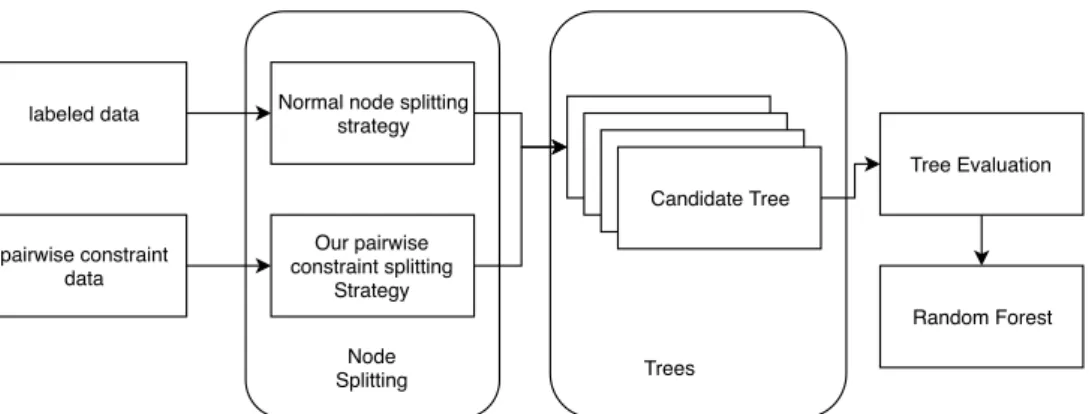
In this work, I take the noise pairwise labeled data into the training set and use ensemble methods to make it robust to noisy data. By applying pair-wise node splitting strategy to normal splitting methods and evaluating the OOB (Breiman, 2001) error when constructing trees, I generate the Pairwise Constraints Random Forest(PCRF) methods which performs better than other methods with noise dataset.
1.5.2
Self-identity Theory
Theory of planned behavior is a theory which explains how beliefs impact human behaviors. This theory shows that an individual’s behavior is influ-enced by personal attitude, subjective norms and perceived behavioral control respectively. Among those subjective norms are the perceived social pres-sure to engage or not to engage in a behavior (Charng, Piliavin, & Callero, 1988). It’s usually used to analyze social influence and how it impacts hu-man behaviors (Ajzen, 1991). However, subjective norm mainly focused on social influence, when customer has a chance to experience product, and all the choices are voluntary. Self-Identity has a more significant influence on it and SN has little effect (Hogg & Terry, 2000). So this project tries to explain what is self-identity and how it determines online shopping behaviors.
Self-identity is a kind of internally generated role-expectation (Thoits & Virshup, 1997), it discusses a question “who am I in my own eyes?”. This the-ory has a significant direct effect on the acceptance in voluntary and experi-enced situations, so it captures different aspects of social influences which are not captured by Subjective Norm (Sparks, 2000). Previous studies have found Self-Identity influence the individual behavior in many aspects (Granberg & Holmberg, 1990; Sparks, 2000). Compared with other social influence theo-ries, Self-Identity has two distinct characteristics. Firstly, Self-identify cap-tures the voluntary aspect of social influence (Thoits & Virshup, 1997) which means it initially compares other experience and transforms them into my own self-expectation, and then analyze behaviors based on the self-expectation.
Secondly, the effect of Self-Identity, unlike Subjective Norm, does not reduce with repeated experience of performing the relevant behavior (Terry, Hogg, & White, 1999). As a result, I use self-identity to describe customer shopping behaviors in the Online Recommendation System. In this project, I use Deep Learning to collect attribute level product features from visual images. Based on those features I then use self-identity to predict online customer behaviors and build a better Online Recommendation System.
1.6
Aims and Objectives
The previous research of online shopping (G.-G. Lee & Lin, 2005) shows the dimensions of web site design, reliability, responsiveness, and trust, affect overall service quality and customer satisfaction. This thesis mainly explores how online shopping experience could be improved from the web site design especially online recommendation system perspectives and explores what new type of technologies from Computer Vision could be used to improve the web-site design. Meanwhile, I also try to discuss how machine learning methods can be used in real online shopping environment. Those research solve the four research question proposed above and in-depth discuss the implications of computer vision technique in information systems area.
1.7
Contribution
In conclusion, by reviewing the recent research in Machine Learning and On-line Shopping Environment, the research gap has been summarized in this thesis. Based on the literature review, this thesis introduces two major con-tributions to the current Online Shopping Experience and Recommendation System research as following.
1. This thesis introduces a weakly supervised pairwise learning algorithm to solve the problem of insufficient data in the real online shopping en-vironment. This novel algorithm can effectively handle noise partially labelled data and generate a reasonable attribute classification model. Besides, I also propose a transfer learning strategy which can efficiently make use of noise pairwise data. In the experiment, the new algorithm outperforms the previous algorithm.
2. Based on previous findings and studies, this thesis proposes an explain-able recommendation system with Self Identity theory. The explainexplain-able recommendation system combines the classification results from visual product images and the self-identity analysis from online shopping cus-tomers for a better understanding of online shopping behaviours. With the help of Self Identity theory, the enhanced recommendation frame-work for a better online shopping experience was developed. Compared with previous recommender system, the new proposed recommender system does not focus on statistical evaluations such as accuracy, but particularly concentrates on customer behaviour toward a better online shopping experience.
1.8
Structure of Thesis
This thesis include seven chapters which introduce the research questions, reviews on previous research, design of the experiment and the conclusions. The detail of each chapter is described as following:
Chapter 1 introduction I address both online shopping experience and ma-chine learning especially computer vision are popular research topics in Information System and Computer Science. I also describe the po-tential to combine those two research fields and the problems I need to solve as our research target. In addition, I generally introduce Online Recommendation System and Self identity theory and the experiment I have done to answer the research questions.
Chapter 2 literature review I firstly review Online Shopping Experience and Machine Learning researches to introduce the previous works on how to optimize the online shopping experience by knowledge discovery in online shopping communities, and conclude the research gap and in-sufficient research fields in Online Shopping Experience and Computer Vision. Based on the review, I conclude our research mainly focus on two different sub-fields of online shopping experience and computer vi-sion. The first one is Computer Vision with imperfect data from online shopping environment, and the second one is how Self Identity explain and enhance Recommendation System.
Chapter 3 methodology As a cross-field research between Computer Sci-ence and Information System, I introduce the possible research method-ology of our experiments and discuss which is the best methods for our projects. Following, I describe the detail of our research protocol and the associate evaluation metrics in each experiment. In addition, I also discuss the choices of dataset selection for our project.
Chapter 4 weakly pairwise attribute learning algorithm Based on the pre-vious works in Chapter 2, it is realized that the insufficient well-labeled data could be a bottleneck for applying CV to online shopping environ-ment. To solve this problem, I developed a new algorithm which takes both well-labeled and partially labeled data as training set. Meanwhile, considering there are lots of noise information in current Information Systems, I also enhanced the transfer learning to be robust for the noise data.
Chapter 5 recommendation with self identity I have applied self-identity theory to fill the research gap between Information System and Com-puter Vision. In this experiment, I firstly extend the current online recommendation system with attribute level information for visual im-age data understanding. Then with personal shopping histories and re-lated visual features extracted above, I use the self-identity theory to describe and separate online shopping behaviors into different groups. Those different behavior groups are defined by unconscious belief dur-ing shoppdur-ing. Finally, I propose a new recommendation strategy con-sidering the Self Identity of customer as a important factor.
Chapter 6 conclusion and further work Based on the experiment results, I explain how I solve the research questions proposed in this thesis and how the result prove our algorithms and solutions. I also discuss the po-tential to combine Computer Vision and Online Shopping Experience researches, and explain the framework I created in this thesis to help for filling research gaps. Meanwhile, I conclude all the contributes of the thesis and describe the limitations of our work. Then I describe two fur-ther works which can be regarded as the new research trend in this field. One research trend is Online Shopping with human-in-the-loop which analyzing online shopping customers with real time feedbacks. The other is a industrial project, the Roommate Matching System. Room-mate matching system is a project cooperate with Road 51 company.
Online Property Renting is an subfield of online shopping that contains special factors and requirements. In this project, I plan to build a room-mate ratting system with complex personal and social factors to support the original Online Property Renting website. With the system I can help tenant to find the best properties and roommates.
Chapter 2
Literature Review
This thesis concentrates on two research fields, Online Shopping Experience and the related Machine Learning research. In this chapter, we firstly intro-duce the definition and recent research on Online Shopping Experience, and then we indicate the important factors which can be improved by Machine Learning. In the second part of this chapter, we review and discuss what kind of Machine Learning algorithms can be used to improve the Online Shopping Experience and address the research gap between Online Shopping Experi-ence and Machine Learning.
2.1
Online Shopping Experience
2.1.1
Introduction
The research on personalized shopping experience has attracted a consid-erable growth of interest during recent decades. Theories on how to opti-mize the shopping experience (Leventhal et al., 2006; Verhoef et al., 2009) and build some successful systems to improve customers’ shopping experi-ence (Freiberg et al., 2009). In recent years, with the burgeoning growth of various e-commerce websites, the Online Shopping Experience (OSE) has been discussed by a group of researchers (Hashim, Ghani, & Said, 2009; Hern´andez, Jim´enez, & Mart´ın, 2011; G.-G. Lee & Lin, 2005). In this view, we will discuss what is OSE in general and review how different re-searchers analyze the Online Shopping experience from different perspec-tives. We firstly reviewed the traditional definition of customer experience,
followed by the comparison between online and offline customer experience, and lastly define the scope of our study on the online shopping experience.
2.1.2
Offline and Online Shopping Environment
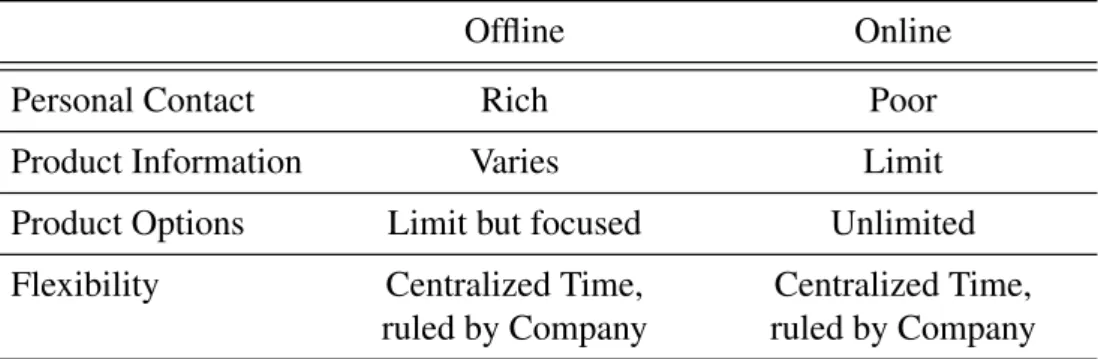
Before the existence of the online shopping environment, offline shopping ex-periences had already been investigated by many researchers (Arnold, Reynolds, Ponder, & Lueg, 2005; Jones, 1999) from various perspectives including cus-tomer behavior and purchase intention (Jones, 1999; Quan & Wang, 2004). To trace the origins of online shopping experience, it is necessary to evaluate the differences between online and offline shopping environments, meanwhile, consider whether the existing offline shopping experience could be moved or transferred to the online environment. The key differences between Offline and Online shopping are shown in Table 2.1.
Table 2.1: Different factors between Online and Offline Shopping.
Offline Online
Personal Contact Rich Poor
Product Information Varies Limit
Product Options Limit but focused Unlimited Flexibility Centralized Time,
ruled by Company
Centralized Time, ruled by Company Both the online and offline shopping experience can be viewed as con-sequences of many interacting or independent factors. The early researchers analyze the difference between online and offline shopping experience from the different shopping contexts and drew several key conclusions (Frow & Payne, 2007; Grewal, Levy, & Kumar, 2009; Levin, Levin, & Weller, 2005). The first key difference could be viewed from the information theory perspec-tive which is how much information the seller could get from the contacting customer. Traditional shopping usually happens in the face-to-face environ-ment where sellers have the opportunity to find out more information about customers (Frow & Payne, 2007). This information is usually sufficient for analyzing the customers experience towards different products and providing personal suggestions. On the contrary, online shopping is fulfilled through the Internet, the communications between customers and sellers are limited. Be-cause of this limitation, the shopping experience is hard to be customized in
the traditional way. Counter-wise, customers could get as much detailed prod-uct information in the offline shopping environment but could only find lim-ited text descriptions or pictures of products (Fatma, 2014; S. A. Lee & Jeong, 2014) in the online shopping scenario, which is the main cause of the higher perceived risk for e-customers. The third difference is the range of product options. According to the limited space of the offline sellers, the products that are available for selling are usually limited but well picked by compa-nies. On the contrary, in online shopping, customers face a large number of products and it is usually hard to distinguish which one is the best (Grewal et al., 2009). The last difference is the flexibility of time and space. Online customers can purchase via Internet at anytime and anywhere they prefer. In the offline shopping environment, the time and location are restricted by the retailer (Frow & Payne, 2007; S. A. Lee & Jeong, 2014).
In summary, when shopping happened in the Internet context, many key variables were different and many researchers believe it is hard to directly use offline shopping strategies to evaluate the online shopping experience. Thus, it is necessary to develop new models to define, analyze and evaluate the Online Shopping Experience (Frow & Payne, 2007; Grewal et al., 2009; S. A. Lee & Jeong, 2014).
2.1.3
Customer Experience in the Online Shopping
Envi-ronment
In recent years, there are many new researchers trying to evaluate the online shopping experience with much more detailed factors, but most of those fac-tors can be viewed as a sub-factor from the online shopping environment and online customers’ behavior. In the initial stage of online shopping, computer with Internet is usually considered as a hypermedia-mediated environment between customers and retailers (Hoffman & Novak, 1996), which means the internet has unique characteristics different from the traditional market-ing media. As a result, Novak, Hoffman, and Yung (2000) firstly describe the differences between online and offline shopping as happened in different commercial environment, and the behavior of online shopping customers is usually outside the firm’s control. From this work, the shopping experience in the online context had already been distinguished from the offline shopping experience and the major differences are the online environment itself and the corresponding online customers’ behavior.
Based on the above research, there are many different definitions of OSE. One of the most acceptable concepts defines the Online Shopping Experi-ence as the subjective response of customers to any direct or indirect contact with an online shopping progress (Frow & Payne, 2007; Grewal et al., 2009; H¨aubl & Trifts, 2000; Meyer & Schwager, 2007). The subject response in this concept means the response of customer’s interaction with different online organizations which include the website itself, the performance of product, packaging, pricing, advertising, customer service and so on (Rose, Hair, & Clark, 2011). From this definition, OSE tries to analyze the customers’ re-sponse to the Online Shopping Environment, then we can distinguish Online Shopping Experience from other related concepts such as Customer Satisfac-tion and Re-Purchase IntenSatisfac-tion (Kranzb¨uhler, Kleijnen, Morgan, & Teerling, 2018). In this case, this thesis will review the OSE from two aspects which is Online Shopping Environment (Web service) and online customers’ behavior. 2.1.3.1 Web Service
To identify the key factors of the Online Shopping Experience, a large number of studies focused on the website and service quality and tried to find the relationship between the quality and online shopping experience. This work has involved a range of different variables and develop different measurement methods to evaluate the web service quality.
In early web service quality research as shown in Table 2.2, the evalua-tion framework includes E-Qual (Kaynama & Black, 2000), WebQual (Loia-cono, Watson, & Goodhue, 2002) or .comQ (Wolfinbarger & Gilly, 2002), treating the online shopping as a whole and unseparated progress with basic requirements as variables (e.g. Navigation, Accessibility etc). Meanwhile, the online shopping customers are considered to be utilitarian to the qual-ity of service. Those kinds of early stage qualqual-ity research are clearly not sufficient to describe how Web quality influence the online shopping expe-rience. Therefore, E-S-QUAL (Parasuraman, Zeithaml, & Malhotra, 2005) and eTransQual (Bauer et al., 2006) is introduced Those evaluation frame-works not only consider the utilitarian reflection, but also investigate how he-donic emotional motives influence online shopping customers. For example, the customer experience in eTransQual is split into four phases, Information Phase, Agreement Phase, Fulfillment Phase, After-Sales Phase. Those four phases reflect four steps of customers‘ online shopping. By this splitting, the complex variables are logically sequenced, and the result is contributed to by
the four phases. The way we regard online shopping behavior as a transaction makes it easy to introduce more factors for analyzing, as a result they firstly found enjoyment as a hedonic factor also important in Online Shopping Expe-rience. Begin with this research, both customers’ behavior and online shop-ping environment are considered, and according to the definition, the result of this work could be seen as how Web Service influences OSE. In recent years, the new frameworks usually control more variables or combine with different theories. For example, H. Li, Aham-Anyanwu, Tevrizci, and Luo (2015) combines eTailQ with Value Perception theories and Xu, Benbasat, and Cenfetelli (2013) take a lot of information quality factors into the model. However all of them contain the relationship between Customer behavior and the Shopping environment, so they could see how the Web service contribute to OSE analyzing.
From Table 2.2 it is clear to find different work usually concentrates on different variables to evaluate service quality and how this influences OSE. Among all the works, the technology part (Website design and reliability), Customer Support and Security/Privacy is always considered as an important variable, contributing to Service Quality and then resulting better OSE. Those can be seen as the basic needs of Online Shopping (Sohn & Tadisina, 2008; Xu et al., 2013). In addition, different researchers usually concentrate on dif-ferent aspects of Web services, and introduce additional variables to evaluate the importance of them. Loiacono et al. (2002) firstly consider the quality of information provided by Shopping Websites and find it is highly related to Shopping Experience. Further, Xu et al. (2013) split the quality of infor-mation into different scopes (Completeness, Accuracy, Format and Currency) and figure out the importance of information quality, especially the Complete-ness and Accuracy. Those works find the importance of Information Quality and believe it is highly related to Service Quality and Customer Experience. However, those researchers only evaluate the basic type of information pro-vided by Website. With the development of Online Shopping websites, there are varieties of information provided by websites, such as recommendations from big data or complex multimedia resources. So, there os some work to define and evaluate the necessity of different information provided by web-sites, and this work is regarded as Design Quality Evaluation. Based on the research (Loiacono et al., 2002; Xu et al., 2013), better Design Quality leads to better Web Service, and finally results in a better customer shopping expe-rience.
T able 2.2: Service Quality Analyzing in OSE Authors Method V ariables Enjo ym-ent
Inform- ation Quality Person- alize V alue Perception W ebsite Design Reliability Customer Support Security /Pri v ac y Fulfill- ment Ef ficienc y Kaynama and Black (2000) E-Q U AL X X X X X X X X X X Loiacono et al. (2002) W ebQual X X X X X X X X X X W olfinbar ger and Gilly (2002) .comQ X X X X X X X X X X W olfinbar ger and Gilly (2003) eT ailQ X X X X X X X X X X P arasuraman et al. (2005) E-S-Q U AL/E-RecS- QU AL X X X X X X X X X X G.-G. Lee and Lin (2005) SER VQ U AL X X X X X X X X X X Bauer et al. (2006) eT ransQual X X X X X X X X X X Sohn and T adisina (2008) SER VQ U AL-(e xtened) X X X X X X X X X X Xu et al. (2013) 3Q X X X X X X X X X X H. Li et al. (2015) eT ailQ with V alue Perception X X X X X X X X X X
2.1.3.2 Web Design
The website and service design (also known as a part of Human Computer Interaction) are another major factor for online shopping experience (Dix, 2009; Zviran, Glezer, & Avni, 2006). We review the most used design char-acteristics in Table 2.3. Compared with Table 2.2 and 2.3, we may find a lot of common factors, but they are not exactly the same. For example, Ef-ficiency in Web Design quality only refers to the efEf-ficiency of the interface, but in Web Service it also refers to the efficiency of service. This relation-ship means Web Design quality generally can be regarded as a factor in Web Service quality. With the development of UI design technology, we usually split Web Design quality into lots of sub-factors and analyze how those vari-ables influence Web Design quality. According to research, better design of websites which include rich information content and ease of accessibility usu-ally result in better online shopping experience (Ranganathan & Ganapathy, 2002). The new technologies introduced to online shopping website usually have a positive impact on the shopping experience (Ha & Stoel, 2009). In re-cent years, a large amount of multimedia resources is used in online shopping websites and the additional multimedia information is a necessary supplement for product description (Aghekyan-Simonian, Forsythe, Kwon, & Chattara-man, 2012; Aljukhadar, Senecal, & Ouellette, 2010). However, most of the research focused on evaluating the existing design, what kind of new technol-ogy can improve Web Design quality still needs to be analyzed and then used to guide the design of new algorithms.
2.1.3.3 Online Customer Behavior
Another group of works focusses on the online customer behavior, which in-cludes the personal cogitative factors and the affective factors of the customer. Compared with Web Quality evaluation, those works are trying to analyze on-line shopping in personal feelings and behavior aspects, and they also result in OSE.
The theory of perceived risk has been discussed for many years and suc-cessfully describes lots of behaviors in different fields (Moorman, Zaltman, & Deshpande, 1992; Morgan & Hunt, 1994; Rousseau, Sitkin, Burt, & Camerer, 1998). There are also many researchers trying to use it to identify OSE. From studies (Kimery & McCord, 2002; Liao & Cheung, 2001; McKnight, Choud-hury, & Kacmar, 2002; Schoder & Yin, 2000)Perceived risk shows a
signifi-T able 2.3: W eb Design Analyzing in OSE Author Usab- ility Ease- of-use Layout T ech- nical T ext grap- hics V isual Speed adeq- uac y na vig-ation secu- rity relia- bility accu- rac y commun- ication Personal- contact Customer -support Currenc y Lin etal. (2011) X X X X X X X X X X X X X X X X X
Kaya and Kahra- man (2011)
X X X X X X X X X X X X X X X X X Y u et al. (2011) X X X X X X X X X X X X X X X X X Hu and Liao (2011) X X X X X X X X X X X X X X X X X Chiou et al. (2011) X X X X X X X X X X X X X X X X X Lin (2010) X X X X X X X X X X X X X X X X X ´ Ethier et al. (2008) X X X X X X X X X X X X X X X X X Lin (2007) X X X X X X X X X X X X X X X X X
Zviran 2006 Zvi- ran et
al. (2006) X X X X X X X X X X X X X X X X X
cant negative impact on the online shopping experience, and the risk mainly comes from the concern of system security (Miyazaki & Fernandez, 2001), privacy infringement (Doolin, Dillons, Thompson, & Corner, 2007) and the most important, product risk (Bhatnagar, Misra, & Rao, 2000). Based on this work, further studies extended the perceived risk theory with more online shopping attributes. For example, Perceived Ease of Use (Perea y Monsuw´e, Dellaert, & De Ruyter, 2004) which evaluates what website factors will lead to ease of use, Perceived Control (Chang, 2008) which refers to consumers’ feelings about how they have control over their own access and search of the content in online shopping, Perceived Benefits (Sarkar, 2011) which describes the feelings required to get reward and benefit though online shopping, and Perceived Enjoyment (Suki & Suki, 2007) which refers to the hopeful plea-sure felt by online customers. From this work, we may find when applying perceived risk to OSE, they usually control similar factors as Web Quality evaluation does, but constructed with different theories, which means both of them can be viewed as a part of OSE.
2.1.4
Personal Online Shopping Experience
With the development of computer technology, online shopping websites tried to separate customers into different groups to provide personalized shopping experience. Online shopping behavior happens between various customers and predefined static web pages. So to personalize the shopping experi-ence is a good way to satisfy different customer characteristics (G.-G. Lee & Lin, 2005). One possible way to analyze customer characteristics is to separate the customer by different shopping orientations (Brown, Pope, & Voges, 2003), for example, the easy use of websites usually has a positive impact on price oriented or time conscious customers. On the contrary, expe-riential oriented and brand conscious customers prefer to use a more complex website which usually contains more product information. Another way to differ customers is through sociological variables (e.g. Education Level, Gen-der, Age) (Hashim et al., 2009; Hern´andez et al., 2011; Verhoef et al., 2009). However, different work gives different results, some claim the influence of sociological in the online shopping experience is very limited (Hern´andez et al., 2011), but others believe sociology factors play an important role in the shopping experience (Hashim et al., 2009; Verhoef et al., 2009). Comparing
their results, the differences may come from the different products and dif-ferent websites they investigate, generally, sociological factors have difdif-ferent influences on products from different categories, which makes the personal-ized shopping hard to analyze with limited questionnaire data.
2.2
Online Shopping Experience with Machine
Learn-ing
In the last two decades, with requirement to abstract information from large amounts of data, Machine Learning as a sub-field of Knowledge Discovery has gained a lot of attention from both academic and industrial area. Machine learning is defined as ”A computer program is said to learn from experience
Ewith respect to some class of tasksT and performance measureP if its per-formance at tasks inT, as measured byP, improves with experienceE. (
Ma-chine Learning /, 1997)”. The development of machine learning in recently
years has resulted in successful project in different research fields, such as Bioinformatics (Min, Lee, & Yoon, 2017), Information retrieval (Manning & ChristopherD, 2008), natural language processing (C. D. Manning, 1999) and so on. With the development of Internet and Online Shopping website, the size and complexity of data is increasing dramatically (e.g. ImageNet (Deng, Dong, Socher, & Li, 2009) and contains 14 million complex images collected from social media and Amazon (R. He & McAuley, 2016) provides more than 100 million user-item relationship data). Many traditional machine learning methods( also known as shallow learning) cannot deal with such amount of data. In this case, Deep Learning is introduced to handle the large and com-plex data (Lecun, Bengio, & Hinton, 2015). Compared to shallow learning methods, deep learning usually contains much more processing layers and parameters which can automatically extract features rather than use hand-crafted features that is better to process complex data types (Lecun et al., 2015). Those features of deep learning algorithm make it possible to be used in Online Shopping Environment.
The current research trends of applying Machine Learning Methods to Online Shopping Environment are in three aspects:
1. Online Recommendation System with multimedia and personal infor-mation.
The original Online Recommendation System is based on big data an-alyzing algorithms such as collaborative filtering (Sarkar, 2011) and content-based filtering (Ricci, Rokach, & Shapira, 2015). In this stage, only the probability between customer and product is considered and the accuracy is highly reliant on the amount of data. As discussed in Chapter 2.1, there are lots of information that could be extracted from online shopping environments, but the original Online Recommenda-tion System does not include this informaRecommenda-tion because of the bottleneck of computation ability. With the development of Machine learning, an-alyzing more complex features such as personal information (e.g. gen-der, age, nationality) and product details (e.g. price, brand) becomes possible (Ricci et al., 2015). However, this additional information is mostly text data. Machine Learning methods are still hard to handle bi-nary data such as images and videos. In recent years Computer Vision with deep learning makes binary data analyzing possible, as a result, there is a lot of works been done to include Computer Vision methods to Recommendation System (Hu et al., 2015a; Jagadeesh et al., 2014; Yue, Wang, El-Arini, & Guestrin, 2014). The new Computer Vision enhanced Recommendation Systems take a lot of personal and prod-uct information into models, which makes the model too complex and hard to evaluate. As a result, in information system perspective, how to evaluate those complex models becomes a problem.
2. Machine Learning with imperfect data.
Most Machine Learning methods including shadow learning and deep learning are built based on clean and sufficient training data. However, in online shopping context most data are imperfect and noisy, which means most Machine Learning methods cannot be directly applied to the Online Shopping Environment (Qiu, Wu, Ding, Xu, & Feng, 2016). In order to solve this problem, transfer learning (Pan & Yang, 2010) and domain adaptation (Ben-David et al., 2010) are introduced. Those methods convert well trained models from a general clean and suffi-cient dataset to the new dataset with noisy data in the online shopping environment. However, for complex features in the online shopping environment, it is hard and expensive to build a well-labeled datasets for transfer learning and domain adaptation. A more robust method is needed in those scenarios.
3. Analyzing customers’ comments and feedback with NLP.
NLP is short for Natural Language Processing which is a machine learn-ing based method to understand the sentiment meanlearn-ing of a phase or a paragraph (C. D. Manning, 1999). Online Shopping Environment pro-vides a large amount of text based data, some of the data(e.g. price, brand) is easy to category and analyze but there are still some complex product descriptions and customer comments. NLP can be used to auto-mate analyzing those kind of complex text data (Jackson & Moulinier, 2007) and generating category or numerical labels. The results provided by NLP can be used as an additional feature in Online Recommenda-tion Systems and online shopping companies can get easy to understand feedback.
Those three research aspects attract a lot of researchers from both Machine Learning and Information System fields. In this Thesis, we will focus on the Online Recommendation System and handle the imperfect training data.
2.2.1
Machine Learning Methods
The architecture and training methods of Machine Learning is a huge topic, many concepts and models could be introduced under this topic. To make the structure more clear, we firstly introduce the different methods we used and experienced in this Thesis. Then we discuss what kind of training methods can be used to help the Online Shopping Experience, and the research gap between the existing Machine Learning methods and Online shopping envi-ronment.
In the Online Shopping Environment, there are various kinds of data such as categories (e.g. gender, brand), numerical data (e.g. age, price) and mul-timedia data (e.g. images and videos). To handle this complex data, joint using shallow learning and deep learning methods are necessary. The shallow learning methods, for example, Random Forest are efficient and robust to pro-cess category and numerical data. But, images and videos need deep learning based methods to process. In section, both shallow learning and deep learning methods are introduced.
2.2.1.1 Shallow learning methods
Before the wide use of deep learning, most Machine Learning methods used shallow architectures that only contain one or two nonlinear layers with
ex-tracted feature (Lecun et al., 2015). There are lots of successful and famous al-gorithms. For statistical learning there are Gaussian Mixture models(GMMs), conditional random fields(CRF), and maximum entropy (MaxEnt), for dis-criminate learning there are support vector machines (SVMs), logistic regres-sion(LR), and multilayer perceptrons (MLPs). Those shallow architectures are effective solutions to solve simple problems and learn well-constructed features, e.g. Microsoft uses random forest to do Human Pose Recognition in Kinect (Shotton et al., 2013). However, when dealing with large and complex realistic data, they usually cannot fit them very well and the quality of the model is highly depends on the quality of extracted features. In ILSVRC2012 challenge (Deng, 2012), the result of SVMs with well-constructed feature is 10% worse than deep learning model with raw images (Krizhevsky, Sutskever, & Hinton, 2012). However, training a deep learning model need a large amount of data which sometimes is hard and expensive to collect. When there is no sufficient data or the data contains a lot noise, shallow learning meth-ods may perform better. In detail, we introduce SVM and Random Forest as following:
Support Vector Machine The Support Vector Machine is a supervised learn-ing model for classification. The target of SVM is to find a hyper-plain to separate two classes with largest margin. The loss function for SVM is L(xi, yi) = max(0,1−yi(w·xi −b)) where x and y refers to the
features of data and its label, w and b is the parameters and bias for the SVM model. The training progress is to minimize the loss function. SVM is easy to train, but it can hardly handle complex unstructured features especially the image data.
Random Forest Random Forest is kind of ensemble learning methods which combine a lot of weak predictors together for better accuracy. A typi-cal Random Forest consists a lot of decision trees which integrated by bagging. This strategy makes the random forest robust for noisy data and prevent the model to be overfitting. The disadvantage of Random Forest is similar with SVM that it can easily handle structured data but hard to process unstructured data.
2.2.1.2 Deep Learning Methods
Historically, the concept of deep learning can be traced back to the artificial neural network, which usually refers to MLPs with many hidden layers also
called deep neural network (DNN) (Lecun et al., 2015). The concept of per-ceptron was firstly introduced by Marvin and Seymour in 1969 (Minsky & Papert, 1969). During that time, perceptron is an algorithm for learning a bi-nary classifier, which can be regarded as a function that maps its input and transfer to an output. As a linear model, perceptron cannot solve non-linear problem. To cope with more complex data, MLP or ANN was proposed. ANN is a kind of feed-forward model that mapping input data to multiple layers of nodes and give a set of outputs. ANN usually contains many pa-rameters which is hard and expensive to train. Back propagation was then introduced (Schmidhuber, 2015) in 1988 to use gradients to enable training large and deep ANN possible. With back propagation, ANN can be used to solve many real problems. However, back propagation also has vanishing of gradient problem (the gradients decrease exponentially from layer to layer), especially when the ANN contains more than one layers. From this point, traditional ANN only contains one hidden layer, which still belongs to shal-low learning models. In recent year, with the development of architectures and training methods, building a deep ANN has been possible. We introduce several deep learning models which we used in thesis.
2.2.1.3 AutoEncoder
The AutoEncoder introduced by Hinton and Salakhutdinov (2006) is a special type of DNN that consumes unlabeled data and output vectors which is a better representation of the origin data. The AutoEncoder is typically used for dimensionality reduction or generative models.
When there is more than one hidden layer, the AutoEncoder can be seen as a deep learning model. The architecture contains an input layer which repre-sents the input data, then connected to one or more hidden layers to transform features and finally an output layer which is usually a better representation of the input data. The whole structure contains two parts, the encoder which mapsx ∈ X toz ∈ F and the decoder which mapsz ∈ F tox ∈ X0, the
X refers to the origin space and F refers to the feature space. So the ob-jective of AutoEncoder is to minimize reconstruction errors (Bengio, 2009) which is L(x, x0) = x−x
0 2
. From the objective function, it is clear that AutoEncoder is an unsupervised learning methods. The dimension of the hidden layers can be either smaller or larger than the input dimension, when smaller, the AutoEncoder will do feature compression, otherwise, it will map features to a higher-dimension. By selecting different dimensions of hidden
layers and different objective function, the AutoEncoder can do various jobs such as denoising (Vincent, Larochelle, Bengio, & Manzagol, 2008), spars-ing (Le, 2013) or generatspars-ing. Since we use the minimize reconstruction error as the objective function, the training of AutoEncoder is still based on the back propagation. As a result, the vanishing gradient problems with the use of back propagation to train networks with many hidden layers still exists. To solve this problem,Hinton, Osindero, and Teh (2006) produced a layer by layer trained technique based on a restricted Boltzmann machine to pre-train the weights and then fine turn them by back propagation.
The AutoEncoder can help to reduce noise data in the online shopping context. The images from different website are usually in different quality and may contain mistakes, AutoEncoder is a potential way to cope with the quality and noisy problems that makes other Machine Learning algorithms works in the online shopping environment.
2.2.1.4 Convolutional Neural Network
As described above, the number of parameters in a network is directed based on the number of layers and number of neural in each layer, so when the net is getting deeper and larger, there will be too many parameters to learn which is usually hard and expensive (Krizhevsky et al., 2012). The Convolutional Neu-ral Network(CNN) solves this problem by sharing weight in convolutional layers. It is especially good for handing complex data e.g. images, and the Convolutional layers can be regarded as a learned feature extraction method which avoids building hand-craft features. To limit the number of training parameters, in 1990s CNN (LeNet-5), a ANN with additional Convolutional layers,was introduced by LeCun et al. (1995). In the Convolution layer, the output is generated by the input convolute a small kernel, and in the pooling layer, the input will be sub-sampled to lower dimension with some strategy (max polling, average polling, etc.). Compared with full-connected ANN, LeNet-5 contains two convolutional layers in which the number of parame-ters needed to train only equals to the size of convolutional kernels multiply the number of kernelsh∗w∗d(e.g. in LeNet-5 the parameters in (32*32*12) plus (16*16*12). In this case, CNN significantly reduces the number of pa-rameters. As a result, LeNet-5 has a very successful result on MINST dataset. However, LeNet-5 is still hard to train on huge and complex datasets (e.g. Im-ageNet). The reason is the vanishing of gradient in deep structure, and the lim-ited layers (only 2 convolutional layers) reduce its ability. In 2012, AlexNet,
a more deep CNN, was produced (Krizhevsky et al., 2012) and has a much better result than shallow learning methods (SVMs etc.). On ILSVRC (Deng et al., 2009). AlexNet, as shown in Fig 5, is known as one of the most suc-cessful deep learning architectures in recent years. Compared with LeNet-5, AlexNet choose a more deep structure and made the following main changes:
• Data Augmentation: AlexNet pprocesses images with horizontal re-flections, random crops and color transformation. With data augmenta-tion, there will be more data for training which will reduce the overfit-ting problem.
• Dropout: Dropout can randomly break connecting when training CNN which makes the CNN try to get the right result with a subset of neural. Compared with L2/L1 regularization, the use of Dropout can signifi-cantly reduce the overfitting problem.
• ReLU activation function: Instead of using Sigmoid or Tanh, AlexNet use ReLU f (x) = max(0, x) as the activation function. The advantage of ReLU is two-fold, on one hand it is easy to calculate for both forward and backward, on the other hand the linear right part avoids the vanish-ing of gradient and the left zero part makes the network sparse, which is similar to L1 regularization.
• Local Response Normalization: Instead of normalization on all the data, AlexNet chose to normalize on recent training data.
• GPU: the ability of using GPU to do fast matrix computation is one of the most important foundations of the deep learning. Due to the length of the thesis, we will not include the hardware parts of deep learning. After AlexNet, there are many successful deep learning architecture pro-posed, such as VGG (Simonyan & Zisserman, 2014), GoogLeNet (Szegedy et al., 2015) and ResNet (K. He, Zhang, Ren, & Sun, 2016). These works use different strategies and make the CNN more accurate and deep. A very successful network is ResNet which use identity mapping with batch normal-ization to add the origin data to output(H(x) = F (x) + x). With this simple strategy, the problem of vanishing of gradient can be avoided, as a result the ResNet could contain unbelievable 152 layers.
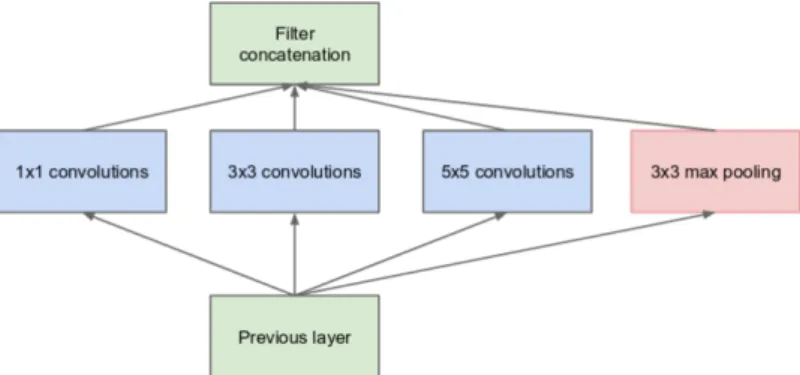
Meanwhile, instead of making the CNN deeper, Inception model was also proposed to add the different size of convolution filter into the same layer,