• No results found

Sieve Plateau Variance Estimators: A New Approach to Confidence Interval Estimation for Dependent Data

N/A
N/A
Protected

Academic year: 2021

Share "Sieve Plateau Variance Estimators: A New Approach to Confidence Interval Estimation for Dependent Data"

Copied!
35
0
0

Loading.... (view fulltext now)

Full text

(1)

University of California, Berkeley

U.C. Berkeley Division of Biostatistics Working Paper Series

Year



Paper



Sieve Plateau Variance Estimators: A New

Approach to Confidence Interval Estimation

for Dependent Data

Molly M. Davies

Mark J. van der Laan

University of California, Berkeley, molly [email protected]

University of California, Berkeley, [email protected]

This working paper is hosted by The Berkeley Electronic Press (bepress) and may not be

commer-cially reproduced without the permission of the copyright holder.

http://biostats.bepress.com/ucbbiostat/paper322

Copyright c

2014 by the authors.

(2)

Sieve Plateau Variance Estimators: A New

Approach to Confidence Interval Estimation

for Dependent Data

Molly M. Davies and Mark J. van der Laan

Abstract

<blockquote>Suppose we have a data set of n-observations where the extent of

dependence between them is poorly understood. We assume we have an estimator

that is squareroot-consistent for a particular estimand, and the dependence

struc-ture is weak enough so that the standardized estimator is asymptotically normally

distributed. Our goal is to estimate the asymptotic variance of the standardized

estimator so that we can construct a Wald-type confidence interval for the

esti-mate. In this paper we present an approach that allows us to learn this asymptotic

variance from a sequence of influence function based candidate variance

estima-tors. We focus on time dependence, but the method we propose generalizes to data

with arbitrary dependence structure. We show our approach is theoretically

con-sistent under appropriate conditions, and evaluate its practical performance with

a simulation study, which shows our method compares favorably with various

ex-isting subsampling and bootstrap approaches. We also include a real-world data

analysis, estimating an average treatment effect (and a confidence interval) of

ven-tilation rate on illness absence for a classroom observed over time.</blockquote>

(3)

1

Introduction

For the sake of defining the challenge addressed in this paper, let’s first suppose one observes

realizations of

n

independent and identically distributed (i.i.d.) random variables. Consider a particular

estimator

ψ

n

of a specified target parameter

ψ

0

. Statistical inference can now proceed in a variety

of ways. Suppose we can prove the estimator is asymptotically linear with a specified influence

function, i.e.

ψ

n

ψ

0

can be written as an empirical mean of the influence function applied to the

observation, plus a second order term assumed to converge to zero in probability at a rate faster than

n

. In that case, it is known that the

n

-standardized estimator converges to a normal distribution

with asymptotic variance

σ

2

equal to the variance of the influence function. An estimator of

σ

2

,

which we denote

σ

2

n

, provides an asymptotic

0.95

-confidence interval

ψ

n

±

1.96

p

σ

2

n

/n

. One way

to estimate

σ

2

is to estimate the influence function and set

σ

2

n

equal to the sample variance of the

estimated influence function values. We could also use other approaches such as the nonparametric

bootstrap or subsampling.

In this paper, we are concerned with obtaining valid statistical inference when the data are

known to be dependent, but the precise nature of that dependence is unknown. Specifically, we

are interested in a method that will work well for estimators of relatively complex parameters one

finds in semiparametric causal inference applications. We assume throughout that the estimator

behaves in first order like an empirical mean of dependent random variables. We refer to such

an estimator as (generalized) asymptotically linear and these random variables as (generalized)

influence functions. In addition, we assume the dependence between influence functions is sufficiently

weak so that the

n

-standardized estimator converges to a normal distribution with mean zero and

variance

σ

0

2

. We focus on time dependence, as it is well-represented in the literature. However,the

methods we propose are generally applicable. Dependence could be spatiotemporal, for example,

or over a poorly understood network. We discuss such extensions throughout. We limit ourselves to

the case of positive covariances, but again, the method has a natural extension to general covariance

structures.

(4)

unknown time dependence, and there are comprehensive book-length treatments of both (see for

example Lahiri [2013] for blocked bootstrap approaches and Politis et al. [1999] for subsampling).

These approaches involve estimating a tuning parameter

b

. In the context of blocked bootstraps,

b

corresponds to the size of the contiguous blocks resampled with replacement, or to the geometric

mean of the block size in the case of stationary block bootstrapping. Blocked bootstraps have been

shown to perform well when the optimal

b

is known or can be effectively estimated from the data.

However, these estimators are sensitive to the choice of

b

, which is frequently difficult to estimate.

The bootstrap approach also relies on some important regularity conditions not always met by

all asymptotically linear, normally distributed estimators. For example, if the influence function

depends on the true data generating distribution through densities, there is a literature warning

against the application of a nonparametric bootstrap, and refinements and regularizations will be

needed. See Mammen [1992] for a comprehensive discussion and examples.

In subsampling,

b

corresponds to the size of the contiguous subsample. One of subsampling’s

most attractive features is that it requires very few assumptions: the size of the subsample must

be such that as sample size

n

→ ∞

,

b

→ ∞

and

b/n

0

; and the standardized estimator

must converge to some limit distribution. One need not know the rate of convergence nor the

specific limit distribution. However, finite sample performance can be heavily dependent on the

choice of

b

, which must be large enough to capture dependence, yet small enough to adequately

approximate the underlying target distribution. Finding an optimal

b

for any given estimator is a

nontrivial undertaking [Politis and Romano, 1993], and for more complex estimators, the sample

sizes required in order to adequately estimate

ψ

0

in each subsample can be impractically large.

We present a method of learning from sequences of ordered, sparse covariance structures on

influence functions, where dependence decreases monotonically with distance. We assume there

exists an (unknown) distance threshold

τ

0

,t

for each time point

t

such that any observation farther

than

τ

0

,t

away from observation

t

is independent from observation

t

. Our proposed procedure seeks

to select a variance estimate close to what we would have obtained had we known the true distance

thresholds

(

τ

0

,t

:

t

= 1, ..., n)

. Assume for a moment this dependence structure is constant across

(5)

time, i.e.

τ

0

,t

is equal to some positive integer

τ

0

for all

t

. Theory tells us a variance estimator

ignoring this dependence will result in a biased estimate, and the magnitude of this bias will

decrease as the number of nonzero covariances used in the variance estimate increases, until all

true nonzero covariances are incorporated. Estimates assuming nonzero covariances beyond this

will be unbiased, but will become more variable. This simple insight provides the rationale for our

proposed approach. Intuitively, Sieve Plateau (SP) variance estimation searches for a ’plateau’ in

a sequence of variance estimates that assume increasing numbers of nonzero covariances. While

our approach requires stronger assumptions than subsampling, its performance does not depend

heavily on additional tuning parameters. It can also be used with complex estimators that require

substantial sample sizes for proper estimation, and in settings where contiguity of the dependence

structure is incompletely understood.

The remainder of this paper is organized as follows. In section 2, we define the formal estimation

problem. In section 3, we introduce SP variance estimation and the intuitive rationale behind the

approach. In section 4, we provide a more formal justification for why our proposed method

works and state conditions upon which our method relies. Section 5 describes several specific

implementations of our proposed approach within the context of estimating the variance of a

sample mean of a time series. We also present results of an extensive simulation study, which

demonstrate our approach works well in practice and consistently outperforms subsampling and

blocked bootstrapping in a context where they are known to perform well. In section 6, we present

a real data analysis, estimating the Average Treatment Effect (ATE) of ventilation rate on illness

absence in an elementary school classroom. We also discuss why subsampling and blocked bootstraps

are ill-suited to this particular estimation problem. We conclude with a discussion.

Notation conventions

. The distance between two points

x

and

y

is denoted

d(x, y)

. Parameters

with subscript 0 are features of the true data probability distribution. Subscript

n

indicates an

estimator or some quantity that is a function of the empirical distribution. If

f

is a function of the

observed data and

P

a possible probability distribution of the data, then

P f

is the expectation of

f

(6)

2

Target Parameter

Let

O

= (O

1

, . . . , O

n

)

be a data set consisting of

n

time-ordered observations on a certain random

process. Let

P

n

0

be the probability distribution of

O

. Let

ψ

0

be a real valued feature of

P

0

n

, i.e.

ψ

0

= Ψ(P

0

n

)

for some mapping

Ψ

from the statistical model for

P

0

n

into the real line. We are given

an estimator

ψ

n

based on

O

. We assume dependence structure in

O

is sufficiently weak so that

ψ

n

satisfies an expansion

ψ

n

ψ0

=

1

n

n

X

i

=1

D

i

(O;

θ0) +

r

n

,

where

r

n

is a second order term assumed to converge to zero in probability at a rate faster than

n

. The functions

D

i

(O;

θ

0

)

are called influence functions. They have expectation zero under

P

0

n

and depend on the unknown

P

n

0

through some parameter

θ

0

. For clarity, we often notate them as

D

i

0

)

, but it is important to remember that they are functions of

O

. Assume there is a function

f

that assigns a measure

S

=

f

(O)

to each unit observation

O

, and define

s

i

=

f

(O

i

)

,

i

= 1, . . . , n

.

Assume for all

s

i

there exists a bounded

τ

0

,i

such that

d(s

i

, s

j

)

>

τ

0

,i

implies the covariance

P

0

n

D

0

,i

D

0

,j

= 0

. Define

τ

0,i

= Ω

0

,i

to be the set of

j

such that

d(s

i

, s

j

)

τ

0

,i

. Define

σ

2

0

n

VAR

(

1

n

n

X

i

=1

D

i

0

)

)

=

1

n

n

X

i

=1

X

j

0

,i

P

0

n

{

D

i

0

)D

j

0

)

}

.

(1)

In many cases one might also assume

σ

2

0

n

σ

2

0

in probability for some fixed

σ

0

2

, but this is not

necessary. We assume that as

n

→ ∞

,

E

r

n

n

2

0

and

σ

0

n

1

Z(n)

σ

0

n

1

/

n

P

n

i

=1

D

i

0

)

d

N

(0,

1).

These assumptions imply that as

n

→ ∞

, the standardized estimator converges weakly to

a mean zero normal distribution with variance one, i.e.

σ

0

n

1

n(ψ

n

ψ

0

) =

σ

0

n

1

Z

(n) +

o

P

(1)

d

N

(0,

1).

If

σ

2

0

n

converges to a fixed

σ

0

2

, then

Z

(n)

d

N

(0, σ

0

2

)

and

n(ψ

n

ψ

0

)

d

N

(0, σ

2

0

)

. Thus

1/

n

denotes the rate at which

ψ

n

converges to

ψ0

. This paper is concerned with estimating

σ

0

2

n

so we

can construct an asymptotic 0.95-confidence interval

ψ

n

±

1.96

p

σ

2

n

/n

, where

σ

n

2

is an estimator

of

σ

2

0

n

.

(7)

σ

n

2

(

τ

)

1

n

n

X

i

=1

n

X

j

=1

δ

τ

(i, j)D

i

n

)D

j

n

),

(2)

where

τ

in a parameter space

T

is an

n

-dimensional vector defining

δ

τ

(i, j) =

I

{

d(s

i

, s

j

)

<

τ

i

}

. Our conditions require the size (as measured by entropy) of the parameter space

T

remains

controlled as

n

→ ∞

. An extreme example would be

τ

such that

τ

i

=

λ

for all

i

= 1, . . . , n

and a constant

λ >

0

. More generally, one might parametrize

τ

i

=

τ

i

(λ)

for a fixed dimensional

parameter

λ

, or one might assume

T

is a union of a finite number of such parametric subsets. An

influence function (IF) based oracle estimator of (1) is defined as (2) using

δ

τ

=

δ

τ

0

.

It will be convenient for us to define the notion of an arbitrary

τ

being ’at least as large as’

τ

0

. Let

τ

i

=

{

j

:

d(s

i

, s

j

)

τ

i

}

be the set defined by

τ

i

. Define

T

0

T

as the set of

τ

where

δ

τ

(i, j)

δ

τ

0

(i, j)

for all

i, j

. Thus,

T

0

contains

τ

0

and all other

τ

such that for all

i

, any element

in

τ

0,i

is also in

τ

i

. When we say

τ

’contains’

τ

0

, we mean

τ

is an element of

T

0

. In classical

time series where dependence decays over time, it also makes sense to say

τ

is at least as large as

τ

0

when

τ

T

0

.

3

Sieve Plateau Estimators

Suppose we have a collection of vectors

(

τ

n,k

:

k)

, a proportion of which are in

T

0

. Consider

the associated collection of variance estimators

n

2

(

τ

n,k

) :

k)

. Under conditions similar to those

required for asymptotic normality of

ψ

n

, estimators based on

τ

n,k

T

0

will be unbiased (see

Theorem 2). Suppose we could order these variance estimators so that they start out making too

many independence assumptions and end up making too few. A smoothed version of this ordered

sequence would give a curve with a plateau in the tail. In particular, since we are assuming all true

covariances between influence functions are positive, we would expect this curve to be monotone

increasing. We propose finding the plateau of this smoothed curve and using this knowledge to

estimate

σ

0

2

n

. The general approach is as follows.

Construct a sieve of variance estimators.

(8)

with independence of all influence functions or some other appropriate lower bound and

ending with covariance structures

τ

T

0

. These vectors can reflect true knowledge about

the dependence in one’s data. For instance, in the case of time dependence, if one knows

the dependence lag between all influence functions is constant, a simple sequence of vectors

could assume increasing constant dependence lags, starting with 0 and ending with an upper

bound

τ

0

. Alternatively, one might believe the dependence structure is either constant or

fluctuates smoothly over time according to seasonal trends. Note it is not necessary for

τ

0

to

be an element of

{

τ

n,k

:

k

}

. We describe more complex approaches to generating

τ

vectors

in section 5.

2. For each

τ

n,k

, compute

σ

2

n

(

τ

n,k

)

as defined in equation (2).

3. Order the variance estimates so that they become increasingly unbiased for

σ

2

0

. A valid

ordering need not be perfect. For example, we could define a matrix

M

τ

n,k

, whose

(i, j)

-th

element is

D

i

n

)D

j

n

)

if

δ

τ

n,k

(i, j) = 1

and zero otherwise. One could order the variance

estimates by

L

1

fit (average of absolute values) between its corresponding

M

τ

n,k

and the

matrix that assumes independence, starting with the smallest estimated

L

1

fit and ending

with the largest. We use this ordering in our simulation study. One could also order according

to another complexity criterion. In our practical data analysis, for example, we compare

L

1

fit ordering with ordering by a rough approximation of the variance of each estimator

σ

2

n

(

τ

n,k

)

in the sequence (see equation (3)). One could also order by the number of nonzero

pairs directly. This works reasonably well in time series, but could be more problematic in

settings with higher dimensional dependence. We implemented this ordering in our practical

data analysis, as well.

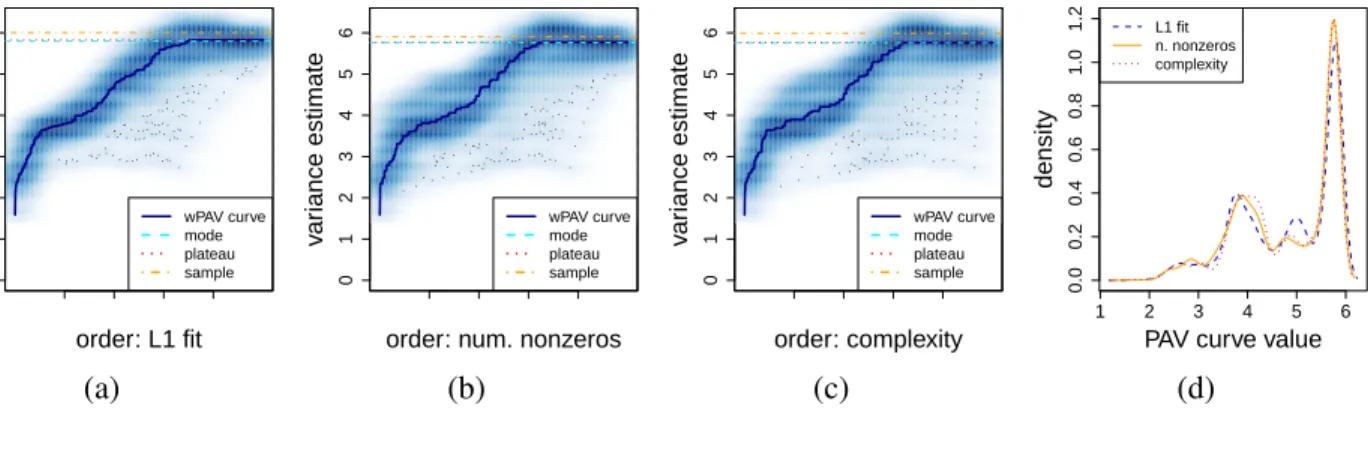
Find the plateau where variance estimators are unbiased.

4. Estimate a monotone increasing curve from the ordered sequence using weighted isotonic

regression. We use Pooled Adjacent Violators (PAV) for this purpose (Turner [2013]; Robertson

et al. [1988]), weighting each variance estimate according to the inverse of an approximation

(9)

of its variance (see equation (3)). Here we rely on the fact that covariances are known to be

positive. Without this assumption, one would have to use other nonparametric regression

methods.

5. Find the plateau where the variance estimates are no longer biased. To do this, we estimate

the mode of the PAV smoothed curve by first estimating its density using a Gaussian kernel

with bandwidth selected according to Silverman [1986] (pg 48, eqn. 3.31). Then we take

the maximum of that estimated density. We have found this approach works well under a

wide range of sieves and true dependence structures. We can use this estimated mode as a

variance estimate in its own right, or we can use it to locate the beginning of the plateau and

then take as our estimate either the value of the PAV curve at this location or the value of the

closest sample variance estimate to that location. We refer to estimators using the mode as

’mode-based’; those using the value of the PAV curve as ’step-based’; and those using the

closest sample variance estimate in the sequence as ’sample-based’. In principle, because the

mode-based estimator takes advantage of additional averaging, we would expect it to be less

variable than the sample-based estimator. Our simulation results and practical data analysis

appear to confirm this intuition. We have observed that the difference between step-based

and mode-based estimators is negligible under the three orderings mentioned above.

In practice, the choice of upper bound

τ

0

is critical to the success of this procedure. It must be

true that

τ

0

approximates elements in

T

0

as

n

→ ∞

. Preferably, the tail of the ordered sequence

contains a number of

τ

n,k

that approximate elements in

T

0

. In many applications where one feels

comfortable assuming some form of central limit theorem, a sufficiently maximal

τ

0

will not be

difficult to formulate.

3.1

Variance of Variance Estimators

For the sake of determining the weights in the PAV-algorithm, we need a reasonable approximation

of the variance of each variance estimator in the sieve. We use the following shorthand notation

in this section. Let

D

ij

denote

D

i

(θ)D

j

(θ)

, and

D

ijk`

denote

D

i

(θ)D

j

(θ)D

k

(θ)D

`

(θ)

. Let

ij

(10)

be the union of

i

and

j

. In the context of time-ordered dependence, this would correspond

to the union of the two time intervals

[O(i

τ

i

), ..., O(i)]

and

[O(j

τ

j

), ..., O(j)]

implied by a

candidate

τ

. Define an indicator function

γ(i, j, k, `)

I

{

ij

k`

=

∅}

, which equals one when

the intersection between

ij

and

k`

is empty. We have found that the following metric works well

in practice as an approximation of the variance of variance estimators of the form (2).

1

n

2

X

i,j,k,`

{

1

γ(i, j, k, `)

}

δ

τ

(i, j)δ

τ

(k, `)

(3)

This choice is inspired by formal calculations approximating the true variance and the use of

working models for the components of this approximation. We provide more detail in Appendix

A. In general, given that we have assumed the covariance between unit observations is positive

and decreases with distance, the variance of variance estimators defined in equation (2) is roughly

driven by the number of dependent pairs

{

(i, j) :

δ

τ

(i, j) = 1

}

as well as the number of intersecting

non-empty unions

ij

. We also propose using (3) as an ordering scheme, as it will tend to put the

more unbiased estimators in the tail of the sequence.

At first glance, one might assume calculating (3) for a sizable sequence of variance estimates

to be computationally impractical. This is certainly true if one uses a naive approach. We have

found that careful attention to symmetry, among other things, can reduce computation time by

several thousand fold. We discuss this further and provide optimized code suitable for generalized

dependence structures in this paper’s supplementary materials.

4

Supporting Theory

Theorem 1 establishes conditions under which a generalized SP-variance estimation procedure is

consistent for

σ

2

0

n

. Beyond an ordering of the sequence concentrating unbiased variance estimators

in the tail (a model assumption), the consistency of the SP-variance estimator relies on uniform

consistency of

2

n

(

τ

) :

τ

T

)

, a process indexed by

τ

T

, as an estimator of its limit process

2

0

n

(

τ

) :

τ

T

)

, where

σ

0

2

n

(

τ

) =

σ

0

2

n

if

τ

T

0

. Since this uniform consistency condition is

nontrivial, Theorem 2 considers a particular dependence structure on the influence functions for

which we formally establish uniform consistency and consistency of the variance estimator under

(11)

entropy conditions restricting the size of

T

.

Theorem 1.

Recall

T

=

T

0

T

0

c

. Assume the following.

1.

sup

τ

T

|

σ

2

n

(

τ

)

σ

0

2

n

(

τ

)

| →

0

in probability for a

σ

0

2

n

(

τ

)

process, where

σ

2

0

n

(

τ

) =

σ

2

0

n

for

τ

T

0

.

2. We are given a mapping

τ

ˆ

that takes as input a process

2

(

τ

) :

τ

T

)

and maps it into an

element of T. This mapping has the following properties:

(a)

τ

ˆ

2

0

n

(

τ

) :

τ

T

)

T

0

with probability tending to 1;

(b) continuity:

τ

ˆ

2

n

(

τ

) :

τ

T

)

τ

ˆ

2

0

n

(

τ

) :

τ

T

)

converges to zero in probability.

Then

τ

n

τ

ˆ

2

n

(

τ

) :

τ

T

)

converges to

τ

ˆ

0

2

n

(

τ

) :

τ

T

)

T

0

with probability tending to 1,

and thus

P

(

τ

n

T0)

1

and

σ

2

n

(

τ

n

)

σ

2

0

n

0

in probability as

n

→ ∞

.

Proving Theorem 1 is straightforward. Note that

τ

ˆ

represents the algorithm that is able to map

the limit process

2

0

n

(

τ

) :

τ

T

)

into a desired plateau value

σ

0

2

n

(

τ

n

0

)

with

τ

n

0

in

T

0

, where

T

0

defines the plateau of

2

0

n

(

τ

) :

τ

T

)

. The additional continuity condition 2b on

τ

ˆ

, combined

with the uniform consistency of

2

n

(

τ

) :

τ

T

)

to

2

0

n

(

τ

) :

τ

T

)

, then establishes that

σ

n

2

(

τ

n

)

is consistent for

σ

2

0

n

. In our concrete example of the SP method, we have that

τ

ˆ

is given by the

composition of (1) ordering the set of variance estimators

2

n

(

τ

) :

τ

)

in some way, (2) applying

the weighted PAV algorithm to this ordered sequence, and (3) finding its plateau value.

The conditions of Theorem 1 highlight an underlying tension between selecting

T

large enough

to ensure it contains a nonempty

T

0

, but not so large that

n

2

(

τ

) :

τ

T

)

fails to approximate

its limit process

2

0

n

(

τ

) :

τ

T

)

uniformly

in

T

. It also demonstrates the concrete challenge in

coming up with

τ

ˆ

. One needs to construct an algorithm that can map an unordered set of variance

estimators, a subset of which are consistent for

σ

2

0

n

, into a consistent variance estimator.

Theorem 2 shows that under a particular type of dependence structure on the influence functions,

the crucial uniform consistency assumption in Theorem 1 holds, and

σ

n

2

(

τ

n

)

is consistent for the

(12)

2 also gives a good rate of convergence for the variance estimator (essentially

1/

n

in many

applications). One could weaken the entropy condition stated below while still preserving the

asymptotic consistency of the variance estimator, but with a slower rate. However, for the sake

of having reliable confidence intervals in finite samples, a good rate of convergence for

σ

2

n

(

τ

n

)

is

important.

Theorem 2.

Let

F

=

{

(

τ

, θ) :

τ

T, θ

Θ

}

. Assume

n

,

τ

n

)

∈ F

with probability tending to

1. Let

k · k

F

be some norm or semimetric on

F

. Define

τ

u

to be such that for all

τ

T

,

τ

τ

u

.

Assume

max

i

|

i,

τ

u

|

< K

for some

K <

. Define the index set

A

=

{

(i, j) :

i

∈ {

1, . . . , n

}

, j

i,

τ

u

}

. Define

d

n

[(

τ

, θ),

(

τ

1

, θ

1

)]

1

n

X

(

i,j

)

A

P

0

n

{

δ

τ

(i, j)D

ij

n

)

δ

τ

1

(i, j)D

ij

1

)

}

.

Let

σ

2

n

(

τ

) = 1/n

P

(

i,j

)

A

δ

τ

(i, j)D

ij

n

)

, and

σ

2

0

n

(

τ

) = 1/n

P

n

i

=1

P

j

i,τ

P

n

0

{

D

ij

0

)

}

. Consider

an estimator

τ

n

and corresponding variance estimator

σ

n

2

(

τ

n

)

of

σ

0

2

n

.

Assume:

1.

d

n

[(

τ

n

, θ

n

),

(

τ

n

0

, θ

0

)]

n

→∞

−−−→

0

in probability, where

P

n

0

(

τ

n

0

T

0

)

n

→∞

−−−→

1

.

2.

k

(

τ

n

, θ

n

)

(

τ

n

0

, θ

0

)

k

F

0

in probability as

n

→ ∞

.

3. Sparsity: For each

(

τ

, θ)

∈ F

and

(i, j)

A

≡ {

(i, j) :

δ

τ

u

(i, j) = 1

}

, there exist at most

K

(universal constant in

n

) other elements

(k, `)

A

for which

δ

τ

(i, j

)D

ij

(θ)

depends on

δ

τ

(k, `)D

k`

(θ)

.

4. Linkage: For each

(

τ

, θ)

∈ F

and all integers

p >

0

, for all

(i, j)

A

we have

{

P

n

0

τ

(i, j)D

ij

(θ))

p

}

1

/p

C

k

(

τ

, θ)

k

F

for a universal

C <

.

5. Bounded entropy:

η >

0

so that the entropy integral

R

0

η

p

log

N

(,

F

,

k · k

F

)d <

.

Then,

σ

n

2

(

τ

n

)

σ

0

2

n

=

O

P

d

n

(

τ

n

, θ

n

),

(

τ

n

0

, θ

0

)

+

O

P

1/

n

,

(13)

As a side-result, if we also have

sup

τ

k

(

τ

, θ

n

)

(

τ

, θ

0

)

k

F

0

in probability, and

r(n)

sup

τ

T

d

n

[(

τ

, θ

n

),

(

τ

, θ

0

)]

n

→∞

−−−→

0

(4)

in probability, then

sup

τ

|

σ

n

2

(

τ

)

σ

0

2

n

(

τ

)

|

=

O

P

{

r(n)

}

+

O

P

{

1/

n

}

.

Theorem 2 is proved in Appendix B. The linkage condition is a weak one, as shown in van der

Laan [2014]. It allows us to link the entropy condition (5) on

F

to the desired entropy of the

functions

δ

τ

(i, j)D

ij

(θ)

. The sparsity condition (3) essentially corresponds with assuming that

D

i

(θ)

is independent of

(D

j

(θ) :

j

6∈

τ

u

,i

)

, uniformly in

θ

. Our proof hinges on establishing

the asymptotic equicontinuity of a process

(Z

n

(

τ

, θ) : (

τ

, θ))

, the mean-zero centered empirical

average of

δ

τ

(i, j)D

ij

(θ)

. This independence allows us to formally analyze this process. If the

sparsity condition does not hold marginally, but holds by conditioning on certain characteristics of

the observed data, one could simply apply this theorem with

P

n

0

being this conditional distribution.

In that same spirit, a refined theorem that significantly weakens the sparsity condition can be

obtained by first orthogonally decomposing the process

Z

n

(

τ

, θ)

into

Z

n

(

τ

, θ) =

P

M

m

=1

E

[Z

n

(

τ

, θ)

|

H

(m)]

E

[Z

n

(

τ

, θ)

| H

(m

1)]

, for an increasing sigma-field

H

(m)

so that

H

(M) = (O

1

, . . . , O

n

)

,

and

H

(0)

is empty; and second, applying the proof in Appendix B for weak convergence of

Z

n

(

τ

, θ)

to each

m

-specific process

E

[Z

n

(

τ

, θ)

| H

(m)]

E

[Z

n

(

τ

, θ)

| H

(m

1)]

conditional

on

H

(m

1)

. Now one only needs the sparsity assumption conditional on

H

(m

1)

. This is the

approach used in van der Laan [2014]. The resulting more general theorem assumes the necessary

conditions for each

m

.

5

Simulation Study: Variance of the Sample Mean of a Time Series

We undertook a simulation study to examine the effectiveness of our proposed SP variance estimation

approach and compare its performance to other existing methods in estimating the asymptotic

variance of the sample mean under several types of time-dependent data generating distributions.

Section 5.1 describes the simulated time series. Section 5.2 describes the three main types of

(14)

SP variance estimators we implemented and briefly outlines the existing estimators to which we

compared their performance. In section 5.3, we discuss our results.

5.1

Simulated Time Series

We simulated three main types of moving average (MA) time series. The first consisted of processes

with constant dependence lag structure over time, i.e.

O(t) =

u(t) +

β

1

u(t

1) +

β

2

u(t

2) +

· · ·

+

β

τ0

u(t

τ

0

), u(t)

N

(0,

1)

,

t

= 1, ..., n

, where the vector

β

= (β

1

, ..., β

τ0

)

was constant

across all time points. This corresponds to a

τ

0

(t)

that is constant over time and equal to the length

of the vector

β

. We used three different

β

vectors: 0.9, (0.9, 0.5, 0.1), and (0.9, 0.7, 0.5, 0.3, 0.1),

with associated asymptotic variances of the standardized sample mean of 3.61, 6.25 and 12.25,

respectively.

We also simulated two additional types of MA time series where the true dependence lag varied

with time. In one simulation,

(

τ

0

(t) :

t

= 1, ..., n)

had positive linear drift, starting with

τ

0

(1) = 0

and ending with

τ

0

(n) = 7

. The asymptotic variance of the standardized sample mean for this

type of time series is approximately 6.68. In another simulation,

(

τ

0

(t) :

t)

had a periodic structure

bounded between 1 and 5, with either one or two periods. The associated asymptotic variance of

the standardized sample mean for this time series type is approximately 7.12.

We simulated 16,384 instances of each time series type at each sample size of 250, 500, 750,

and 1000, for a total of

393,

216

iterations in our simulation study.

5.2

Types of SP Variance Estimators

The idea behind SP variance estimation is quite general: generate an ordered sequence of proposed

dependence relationships that can approximate the truth (a ’sieve’), then use smoothing techniques

to find the plateau in the ordered variance estimates. We implemented three different SP estimators,

all using an

L

1

fit ordering.

Model-based

τ

. Perhaps one knows the dependence structure in one’s data adheres to a particular

pattern. For instance, one might know the dependence lags increase over time. This estimator

takes advantage of such knowledge. When the true dependence lags were constant over time,

(15)

{

τ

n,k

:

k

}

consisted of constant-valued

n

-length vectors of dependence lags, starting with constant

values of zero (assuming independence) and ending with an upper bound of constant values of

10, comfortably exceeding the maximum true dependence lag value of 5 for this type of simulated

time series. When true dependence lags had positive linear trend,

{

τ

n,k

:

k

}

was a collection of

randomly generated nondecreasing

n

-length vectors, each with a unique combination of starting

and ending values. The starting values were bounded between 1 and 7, the ending values between 2

and 18, and the maximum span between starting and ending values was 10. When true dependence

lags fluctuated periodically,

{

τ

n,k

:

k

}

were all periodic

n

-length vectors, each with a unique

combination of number of periods (ranging from 1 to 6), phase shift, and minimum and maximum

values (bounded between 1 and 12 in this simulation study).

Constant

τ

. There are probably more instances where one has limited specific knowledge

about the dependence structure in one’s data other than some notion of sparsity. One approach in

this case is to use a sequence of constant-valued

n

-length

τ

vectors. We found we could improve

performance by incorporating some small decision criteria regarding determining a maximum

constant value. The algorithm is as follows:

1. For

{

τ

n,k

:

k

}

constant in time, start with

τ

n

(t) = 0

for all time points and compute (2).

Continue increasing this constant value and computing the corresponding variance estimate

until the first decreasing result or the constant value exceeds some large upper bound (30

in the present study). Let

τ

0

be the constant dependence lag vector associated with the last

variance estimate in the sequence.

2. Estimate the plateau value of the resulting sequence using weighted PAVA and density

estimation. Denote this result

e

σ

2

n

.

3. Let

τ

max

be a constant vector of the maximum credible dependence lag we expect to observe

(we used 10 in this study). If

τ

0

τ

max

, then

e

σ

2

n

is our variance estimate. Otherwise, our

estimate is the minimum of

e

σ

2

n

and (2) with

τ

=

τ

max

.

(16)

degree of sparsity is to generate a diverse set of vectors

{

τ

n,k

:

k

}

. In our simulation, at each

iteration we randomly generated a large collection of about 28,985 unique dependence lag vectors

that were constant, linearly increasing, linearly decreasing, periodic, and random walks bounded

between zero and five.

We compared these SP variance estimators with the following methods: an oracle benchmark,

(2) with

τ

=

τ

0

; variance estimates (2) with constant

n

-length vector

τ

max

equal to 10 for all time

points; and an i.i.d. IF-based estimator, as in (2) with constant

n

-length vector

τ

equal to 0 for all

time points. We also compared our performance to the stationary block bootstrap (SBB), circular

block bootstrap (CBB), and subsampling (SS), with block and subsample sizes selected in three

different ways: (1) data-adaptively according to the algorithm in Patton et al. [2009]; (2) enforcing

this data-adaptively selected block size to be at least 10; and (3) using a constant proportion as a

function of sample size (

b

= 0.1n

, SBB and CBB only).

5.3

Simulation Results

Our simulation results confirm our proposed approach works well in practice. All SP estimators

outperformed all variants of the SS, CBB and SBB estimators included in our study. This was true

across all sample sizes and time series types. It is possible some of this performance advantage

can be attributed to less than optimal estimated block sizes. However, estimating an optimal

b

is difficult, and not necessarily tractable for other parameters of interest. Our simulation can be

viewed as a comparison of these algorithms as they are typically used.

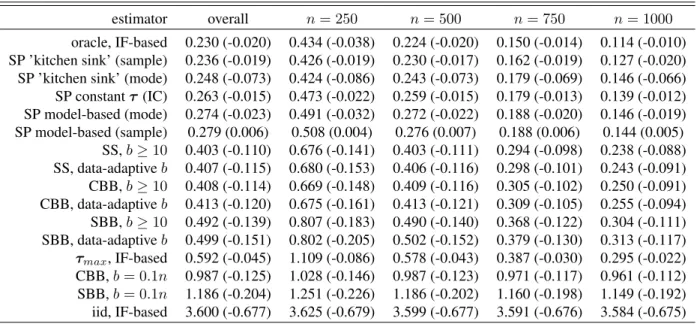
Table 1 compares average normalized MSEs,

2

n

σ

2

0

)

2

2

0

, across estimators and sample

sizes. Overall, the SP ’kitchen sink’ sample-based estimator performed best, with the corresponding

mode-based estimator a close second. As expected, the mode version was slightly less variable and

more biased than its sample-based counterpart. Notably, both of these estimators had normalized

MSEs that were actually smaller on average than the oracle benchmarks at the smallest sample

size

n

= 250

. The other SP estimators were close competitors, particularly when

n

250

. The

modified constant

τ

estimator was the least computationally intensive of the SP estimators we

implemented, and performed admirably even when the simulated time series did not have constant

(17)

τ

0

. When the dependence lag exhibited linear drift, for instance, the modified constant

τ

estimator

actually outperformed the (correct) model-based

τ

estimators. For very large sample sizes and a

rich collection of proposed dependence relationships, the time required to compute each variance

estimate and its PAV regression weight for a ’kitchen sink’-type estimator could become nontrivial.

In such settings, the modified constant

τ

estimator could be an attractive alternative. However, it

may be difficult to implement in settings where underlying dependence is more complex or is not

well understood.

estimator

overall

n

= 250

n

= 500

n

= 750

n

= 1000

oracle, IF-based

0.230 (-0.020)

0.434 (-0.038)

0.224 (-0.020)

0.150 (-0.014)

0.114 (-0.010)

SP ’kitchen sink’ (sample)

0.236 (-0.019)

0.426 (-0.019)

0.230 (-0.017)

0.162 (-0.019)

0.127 (-0.020)

SP ’kitchen sink’ (mode)

0.248 (-0.073)

0.424 (-0.086)

0.243 (-0.073)

0.179 (-0.069)

0.146 (-0.066)

SP constant

τ

(IC)

0.263 (-0.015)

0.473 (-0.022)

0.259 (-0.015)

0.179 (-0.013)

0.139 (-0.012)

SP model-based (mode)

0.274 (-0.023)

0.491 (-0.032)

0.272 (-0.022)

0.188 (-0.020)

0.146 (-0.019)

SP model-based (sample)

0.279 (0.006)

0.508 (0.004)

0.276 (0.007)

0.188 (0.006)

0.144 (0.005)

SS,

b

10

0.403 (-0.110)

0.676 (-0.141)

0.403 (-0.111)

0.294 (-0.098)

0.238 (-0.088)

SS, data-adaptive

b

0.407 (-0.115)

0.680 (-0.153)

0.406 (-0.116)

0.298 (-0.101)

0.243 (-0.091)

CBB,

b

10

0.408 (-0.114)

0.669 (-0.148)

0.409 (-0.116)

0.305 (-0.102)

0.250 (-0.091)

CBB, data-adaptive

b

0.413 (-0.120)

0.675 (-0.161)

0.413 (-0.121)

0.309 (-0.105)

0.255 (-0.094)

SBB,

b

10

0.492 (-0.139)

0.807 (-0.183)

0.490 (-0.140)

0.368 (-0.122)

0.304 (-0.111)

SBB, data-adaptive

b

0.499 (-0.151)

0.802 (-0.205)

0.502 (-0.152)

0.379 (-0.130)

0.313 (-0.117)

τ

max

, IF-based

0.592 (-0.045)

1.109 (-0.086)

0.578 (-0.043)

0.387 (-0.030)

0.295 (-0.022)

CBB,

b

= 0

.

1

n

0.987 (-0.125)

1.028 (-0.146)

0.987 (-0.123)

0.971 (-0.117)

0.961 (-0.112)

SBB,

b

= 0

.

1

n

1.186 (-0.204)

1.251 (-0.226)

1.186 (-0.202)

1.160 (-0.198)

1.149 (-0.192)

iid, IF-based

3.600 (-0.677)

3.625 (-0.679)

3.599 (-0.677)

3.591 (-0.676)

3.584 (-0.675)

Table 1:

Simulation results. Normalized MSE with respect to the true variance,

σ

2

n

σ

2

0

2

0

2

.

Normalized bias with respect to the true variance is in parentheses.

Boxplots in figures 1 and 2 clearly illustrate the performance differences between the SP and

the blocked sub/resampling estimators. Subsampling with

b

10

was the best of the latter group,

with normalized MSEs on average

2/3

larger than those of the SP ’kitchen sink’ sample-based

estimator. The corresponding CBB estimator had nearly equal performance. Enforcing the block

size to be at least 10 did not seem to affect either very much. The corresponding SBB estimators

performed substantially less well, with normalized MSEs on average

22%

larger than those of

subsampling and a little more than twice that of the SP ’kitchen sink’ sample-based estimator.

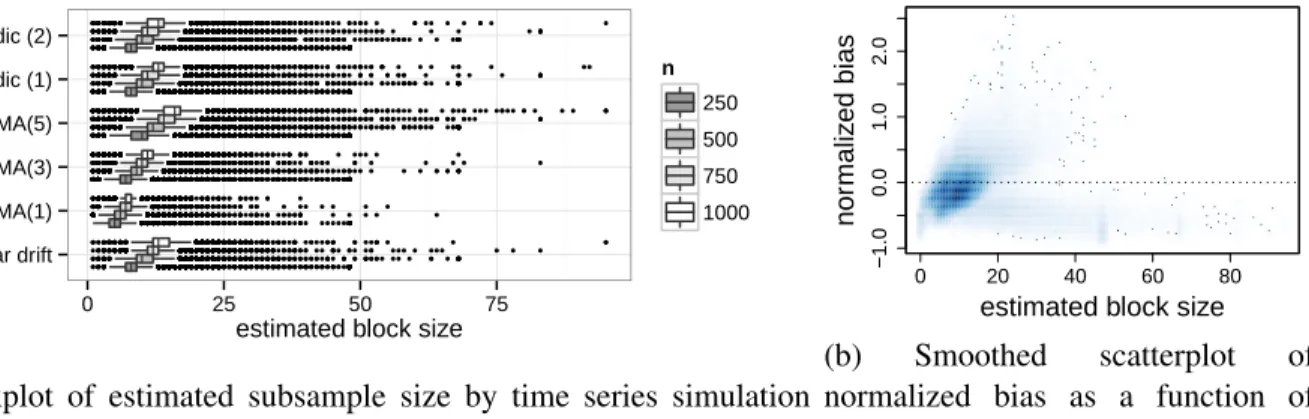
Figure 3 examines block sizes as a function of time series type, sample size and normalized bias.

Most

b

were less than 20, but the range of

b

was substantial, from 2 to 87. Not surprisingly, large

(18)

block sizes tended to be associated with negative bias overall. Average

b

increased with increasing

max

{

τ

0

}

, a reassuring sign that the algorithm we used to select

b

was performing reasonably.

The remaining estimators performed substantially less well. As expected, the estimator ignoring

dependence did poorly and significantly underestimated the variance. The

τ

max

estimators also did

not fair well. They were not defined in a way that prevented them from giving negative variance

estimates, which they did on rare occasions at the smallest sample size of

n

= 250

. They improved

substantially as sample size increased, and at

n

= 1000

, had slightly better average normalized

MSEs than the best performing SBB estimator. The CBB and SBB estimators with block size

b

= 0.1n

had very poor performance, a sobering reminder of the sensitivity of these algorithms to

block size selection. Clearly, one should not resort to ad hoc methods for selecting

b

.

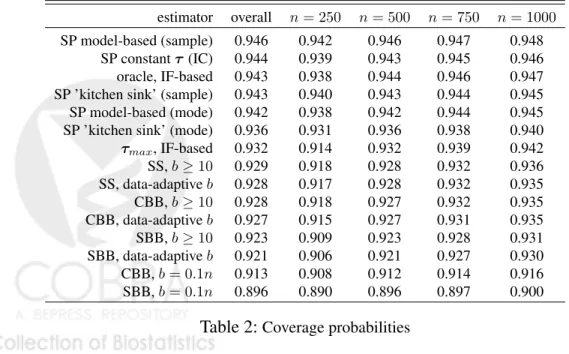
Table 2 lists the coverage of the confidence intervals using each of the estimators of the variance

of the sample mean, overall and by sample size. With the exception of SBB with

b

= 0.1n

, all

estimators that assume some form of dependence had adequate coverage. However, SP estimators

did have better coverage overall than the sub/resampling estimators, especially at smaller sample

sizes. That SS and CBB had reasonable coverage suggests the algorithm we used to estimate

b

worked as expected.

estimator

overall

n

= 250

n

= 500

n

= 750

n

= 1000

SP model-based (sample)

0.946

0.942

0.946

0.947

0.948

SP constant

τ

(IC)

0.944

0.939

0.943

0.945

0.946

oracle, IF-based

0.943

0.938

0.944

0.946

0.947

SP ’kitchen sink’ (sample)

0.943

0.940

0.943

0.944

0.945

SP model-based (mode)

0.942

0.938

0.942

0.944

0.945

SP ’kitchen sink’ (mode)

0.936

0.931

0.936

0.938

0.940

τ

max

, IF-based

0.932

0.914

0.932

0.939

0.942

SS,

b

10

0.929

0.918

0.928

0.932

0.936

SS, data-adaptive

b

0.928

0.917

0.928

0.932

0.935

CBB,

b

10

0.928

0.918

0.927

0.932

0.935

CBB, data-adaptive

b

0.927

0.915

0.927

0.931

0.935

SBB,

b

10

0.923

0.909

0.923

0.928

0.931

SBB, data-adaptive

b

0.921

0.906

0.921

0.927

0.930

CBB,

b

= 0

.

1

n

0.913

0.908

0.912

0.914

0.916

SBB,

b

= 0

.

1

n

0.896

0.890

0.896

0.897

0.900

Figure

Table 1: Simulation results. Normalized MSE with respect to the true variance, σ 2 n − σ 2 0  2
Table 2 lists the coverage of the confidence intervals using each of the estimators of the variance of the sample mean, overall and by sample size
Figure 1: Boxplot of overall standardized bias for a subset of estimators. Boxplots are ordered vertically (top is best, bottom is worst) according to average normalized MSE.
Figure 3: Diagnostic plots of subsample size for SS estimator with b estimated data-adaptively.
+3

References

Related documents

Anti-inflammatory effects of the preparation were studied according to the below methods: S.Salamon– burn induced inflammation of the skin, caused by hot water (80 0 C) in white

When the construction sector (which, again, benefits from the increased demand created by greater public expenditure) is excluded, export agriculture (Senegal and Uganda) or

• Develop and communicate a profession wide mantra regarding need for exams and other care. • Manage pricing and communicate value to avoid

Una posible interpretación, obviando las razones inmedia- tas que seguramente tuvo Meyrink para utilizar este escenario en su novela (que son, básicamente, que él habitaba en la

They would not only become aware of their own inner strengths and characteristics (Seligman et al., 2009), but they would also feel the use of true partnership of the family

L1-Japanese L2 learners of English were tested on three prosodic patterns–deaccentuation, a regular high pitch accent (H*), and a contrastive pitch accent (L+H*)–and their link

Based on the results, theory surpasses practice in which restructuring TESOL programs is a demand to utilize an optimal integration of a core and complimentary segments of

The instrument contained 13 attitudinal statements related to the newsletter received, measured on a seven-point Likert scale: reactions to the site (newsletter frequency, drop