A Constraint Programming Based Hadoop Scheduler for
Handling MapReduce Jobs with Deadlines on Clouds
Norman Lim
Dept. of Systems and Computer Engineering
Carleton University Ottawa, ON, Canada
[email protected]
Shikharesh Majumdar
Dept. of Systems and ComputerEngineering Carleton University Ottawa, ON, Canada
[email protected]
Peter Ashwood-Smith
Huawei, Canada Kanata, ON, CanadaABSTRACT
A novel MapReduce constraint programming based matchmaking and scheduling algorithm (MRCP) that can handle MapReduce jobs with deadlines and achieve high system performance is devised. The MRCP algorithm is incorporated into Hadoop, which is a widely used open source implementation of the MapReduce programming model, as a new scheduler called the CP-Scheduler. This paper originates from the collaborative research with our industrial partner concerning the engineering of resource management middleware for high performance. It describes our experiences and the challenges that we encountered in designing and implementing the prototype CP-based Hadoop scheduler. A detailed performance evaluation of the CP-Scheduler is conducted on Amazon EC2 to determine the CP-Scheduler’s effectiveness as well as to obtain insights into system behaviour and performance. In addition, the CP-Scheduler’s performance is also compared with an earliest deadline first (EDF) Hadoop scheduler, which is implemented by extending Hadoop’s default FIFO scheduler. The experimental results demonstrate the effectiveness of the CP-Scheduler’s ability to handle an open stream of MapReduce jobs with deadlines in a Hadoop cluster.
Categories and Subject Descriptors
C.2.4 [Computer-Communication Networks]: Distributed Systems. C.4 [Performance of Systems]: performance attributes, modeling techniques.
Keywords
Resource management on clouds; MapReduce with deadlines; Hadoop scheduler; Constraint programming.
1.
INTRODUCTION
Cloud computing has rapidly gained popularity and is now being used extensively by various types of users including enterprises as well as engineering and scientific institutions around the world. Some of the attractive features of the cloud that make it desirable to use include the “pay-as-you-go” model, scalability, and elasticity that lets a user dynamically increase or shrink the number of resources allocated. In cloud computing, hardware resources (including computing, storage, and communication), as well as software resources are exposed as on-demand services, and can be accessed by users over a network such as the Internet.
Cloud computing environments that provide resources on demand are of great importance and interest to service providers and consumers as well as researchers and system builders. Cloud service providers (e.g. Amazon) deploy large pools of resources that include computing, storage, and communication resources for consumers to acquire on demand. An effective resource management technique needs to be deployed for harnessing the power of the underlying resource pool, and efficiently provide resources on demand to consumers. Effective management of the resources on a cloud is also crucial for achieving user satisfaction and high system performance leading to high revenue for the cloud service provider. The important operations performed by a resource manager in a cloud include: matchmaking and scheduling. The matchmaking operation, when given a pool of requests, determines the resource or resources to be allocated to each request. Once a number of requests are allocated to a specific resource, a scheduling algorithm is used to determine the order in which each of the requests are to be executed for achieving the desired system objectives. Both matchmaking and scheduling are performed in a single step in Hadoop [1] by an entity referred to as the Hadoop scheduler in the literature [2]. A further discussion of Hadoop is provided in Section 2.2. Since such a single step operation is performed by the resource manager described in this paper, we refer to it as a Hadoop scheduler.
Two important components of performance engineering are performance optimization and performance modeling. One of the goals of this research is to engineer resource management middleware that can make resource management decisions that achieve high system performance, while also maintaining a low processing overhead. This paper describes how optimization theory and constraint programming (CP) [3] is used to devise a matchmaking and scheduling algorithm. Particular emphasis is placed on discussing our design and implementation experience and the performance implications of various system and workload parameters. CP is a well-known theoretical technique used to solve optimization problems, and is capable of finding optimal solutions with regards to maximizing or minimizing an objective function (see Section 2.1 for a further discussion).
A majority of the existing research on resource management on clouds has focused mainly on workloads that are characterized by requests requiring a best effort service. In this paper, workloads that comprise of requests with an associated quality of service often specified in a service level agreement (SLA) are considered. Most of the research on resource management for requests characterized by an SLA has only considered: (1) requests requiring service from a single resource and (2) a batch workload comprising a fixed number of requests. The focus of this research is on requests that need to be processed by multiple resources (called multi-stage requests) with SLAs specifying a required execution time, an earliest start time (release time), and an end-to-end deadline. Note that in line with the existing Hadoop
Permission to make digital or hard copies of all or part of this work for personal or classroom use is granted without fee provided that copies are not made or distributed for profit or commercial advantage and that copies bear this notice and the full citation on the first page. Copyrights for components of this work owned by others than ACM must be honored. Abstracting with credit is permitted. To copy otherwise, or republish, to post on servers or to redistribute to lists, requires prior specific permission and/or a fee. Request permissions from [email protected]. ICPE'15, Jan. 31–Feb. 4, 2015, Austin, TX, USA
scheduler [2], the earliest start time of a job is set to its arrival time in this research. Meeting an end-to-end deadline for requests that require processing by multiple system resources increases the complexity of the problem significantly. In addition, this paper considers a workload comprising an open stream of request arrivals (and not a workload with a fixed number of requests) that characterizes typical workloads on cloud data centres. Both the matchmaking and scheduling operations are well known to be computationally hard problems when they need to satisfy user requirements for a quality of service while also considering system objectives, such as high resource utilization and adequate revenue for the service provider.
A popular multi-stage application that is deployed by enterprises and institutions for processing and analyzing very large and complex data sets (for performing Big Data analytics for example) is MapReduce [4]. MapReduce, proposed by Google, is a programming model whose purpose is to simplify performing massively distributed parallel processing so that very large data sets can be processed and analyzed efficiently. In such cases, it is necessary to distribute the computation among multiple machines to facilitate parallel processing and reduce the total processing time. One of the benefits of MapReduce is that it provides an abstraction to hide the complex details and issues of parallelization. As its name suggests, the MapReduce programming model has two key functions [4]: map and reduce. The map function accepts a set of input key/value pairs and generates a new set of intermediate key/value pairs. These intermediary key/value pairs are grouped together and then passed to the reduce function, which is typically called the shuffle phase. The reduce function processes these intermediate key/value pairs to generally produce a smaller set of values.
A typical MapReduce application (or job) is comprised of multiple map tasks and multiple reduce tasks as illustrated in Figure 1. Reduce tasks cannot complete their execution until all the map tasks have finished. Many computations can be expressed using the MapReduce programming model. For example, a MapReduce application can be developed to process the logs of web servers to count the number of distinct URL accesses. This type of application is often referred to as a WordCount application. In this case, the input into the map function would be the logs of the web servers, and the map function would produce the following intermediate key/value pairs: {URL, 1}. This key/value pair indicates that one instance of a URL is found. Note that the intermediate data set may contain many duplicate key/value pairs (e.g. {www.google.com, 1} can appear multiple times). The reduce function sums all the values with the same key to emit the new data set: {URL, total count}.
t1 t2 t3 t5 t4 Output Map Tasks Reduce
Tasks
Input
Shuffling
Figure 1. Directed Acyclic Graph for a MapReduce job. More recently, resource management on clusters that execute MapReduce jobs with an associated completion time guarantee (deadline) has begun receiving attention from researchers (e.g., see [5] to [9]). Executing MapReduce jobs that have an associated end-to-end deadline is required for latency-sensitive applications such as live business intelligence, personalized advertising, spam/fraud detection, and real-time event log analysis applications [5]. By allowing users to specify deadlines, the
system can also prioritize jobs and ensure that time-critical jobs are completed on time. Developing an efficient resource management middleware on such an environment is the focus of attention for this research performed in collaboration with our industrial partners Huawei, Canada.
More specifically, in this paper we focus on devising a scheduler for Hadoop [1] that can effectively perform matchmaking and scheduling of an open stream of MapReduce jobs with SLAs comprising an execution time for the map and reduce tasks, an earliest start time, and an end-to-end deadline. Hadoop is a widely used open source implementation of the MapReduce programming model (discussed in more detail in Section 2.2). The formulation of the matchmaking and scheduling problem of MapReduce jobs with SLAs is achieved using constraint programming (CP) as discussed in Section 3. In our preliminary work [10], a detailed comparison of different resource management approaches based on CP as well as linear programming is presented. The results of the investigation showed the superiority of the CP-based approach implemented and solved using IBM ILOG CPLEX [11], including its more intuitive and simple formulation of constraints, lower processing overhead, and its ability to handle larger workloads.
In addition, our previous work [12] describes a novel MapReduce Constraint Programming based Resource Management (MRCP-RM) algorithm that can effectively perform matchmaking and scheduling of an open stream of MapReduce jobs with end-to-end deadlines. Using simulation a performance evaluation of MRCP-RM was conducted that demonstrated its effectiveness in generating a schedule where there is a low number of late jobs. The strong performance of MRCP-RM in simulation experiments has motivated this research that focuses on devising a revised version of the MRCP-RM algorithm and implementing the algorithm on a real system (i.e. Hadoop). A new CP-based Hadoop scheduler, named CP-Scheduler, which can handle matchmaking and scheduling an open stream of MapReduce jobs with deadlines is devised and implemented. To the best of our knowledge, there is no existing research describing a CP-based scheduler for Hadoop that can handle matchmaking and scheduling an open stream of MapReduce jobs with deadlines. The devising of the CP-Scheduler is based on the objective of providing user satisfaction while achieving high system performance. The main contributions of this paper include: A prototype CP-based Hadoop scheduler (called CP-Scheduler) for matchmaking and scheduling an open stream of MapReduce jobs with end-to-end deadlines.
o A discussion of our experiences and challenges that were encountered in designing and implementing the CP-Scheduler is provided.
A detailed performance evaluation of the CP-Scheduler was conducted on Amazon EC2. Insights into system behavior and performance are described.
o This includes a discussion of the impact of various system and workload parameters on performance and a performance comparison of the CP-scheduler compared to an earliest deadline first (EDF) based Hadoop scheduler, which was implemented by extending Hadoop’s default FIFO scheduler.
Experimental demonstration of the effectiveness of the CP-Scheduler’s ability to handle an open stream of MapReduce jobs with deadlines in a Hadoop cluster for a number of different workloads.
The results of this research will be of interest to researchers, cloud providers, as well as developers of resource management middleware for clouds and Hadoop-based systems.
The rest of the paper is organized as follows. In Section 2, background information is provided and related work is discussed. Section 3 discusses the problem formulation and how the MapReduce Constraint Program (MRCP) is devised. The focus of Section 4 is on the design and implementation of the Hadoop EDF and CP based schedulers, and includes a discussion of our experiences and challenges. In Section 5, the results of the experiments performed on Amazon EC2 to evaluate the EDF-Scheduler and CP-EDF-Scheduler are presented. Insights into system behavior and performance are described. Lastly, Section 6 concludes the paper and provides directions for future work.
2.
BACKGROUND AND RELATED WORK
A brief overview of constraint programming (CP), Hadoop, and Amazon EC2 are provided in Sections 2.1 to 2.3, respectively. In addition, related research is discussed in Section 2.4.
2.1
Constraint Programming (CP)
CP is a theoretical technique for solving optimization problems that was developed by computer science researchers in the mid-1980s using knowledge from artificial intelligence, logic and graph theory, and computer programming languages [3]. A typical CP problem consists of three key parts: decision variables, objective function, and constraints. The decision variables are the variables in the CP problem that need to be assigned values. The objective function is a mathematical function that generates the value that needs to be optimized (i.e. minimized or maximized). Lastly, the constraints are a set of mathematical formulas that restrict the values that the decision variables can be assigned. In summary, when solving a CP problem, a solver will assign values to the decision variables that optimize the objective function, while ensuring that none of the constraints are violated.
2.2
Apache Hadoop
Apache Hadoop [1][13] is an open-source software framework (written in Java) that implements the MapReduce programming model, and is aimed at data-intensive distributed computing applications. Hadoop’s software framework contains three sub-frameworks: Hadoop Common, Hadoop Distributed File System (HDFS), and Hadoop MapReduce. Hadoop Common provides utility functions including remote procedure call (RPC) and object serialization libraries. HDFS and Hadoop MapReduce are based on Google’s MapReduce programming model [4] and Google’s File System (a distributed file system implementation), respectively.
A typical Hadoop cluster comprises a single master node and one or more slave nodes. In Hadoop 1.2.1, which implements the MapReduce version one (MRv1) architecture, the master node comprises of two entities (which are often called Hadoop daemons): NameNode and JobTracker. Each slave node also consists of two Hadoop daemons: a DataNode and a TaskTracker. The NameNode and DataNodes are the Hadoop daemons in charge of managing HDFS. Each file that is written to HDFS is split into blocks (64MB by default) and each block is stored on the storage device where a DataNode is running. Each block is replicated multiple times (by default three times) and stored on different DataNodes. It is the job of NameNode to keep track of which DataNode stores the blocks of a particular file (which is called the metadata of the HDFS). Another important function of NameNode is to direct DataNodes (slaves) to perform HDFS I/O operations (read, write, delete). DataNodes keep in constant contact with NameNode to receive I/O instructions.
JobTracker is the link between user applications and the Hadoop cluster. In addition, JobTracker is the Hadoop daemon responsible for managing TaskTrackers. Some of the main
responsibilities of JobTracker include: initialize jobs and prepare them for execution, determine when the map and reduce tasks of jobs should be executed and which TaskTrackers should execute them (i.e. perform matchmaking and scheduling), as well as monitor all tasks that are currently running. TaskTrackers function as the JobTracker’s slaves, and their primary purpose is to execute the map or reduce tasks that they are assigned. Another responsibility of TaskTracker is to periodically send polling/ update messages (called heartbeats) to JobTracker. If JobTracker does not receive a heartbeat message from a TaskTracker within a specified time period (by default one minute), JobTracker will assume that the TaskTracker has been lost, and re-map all the tasks that was assigned to the lost TaskTracker.
2.3
Amazon EC2
Amazon Elastic Compute Cloud (abbreviated Amazon EC2) is a public cloud that provides Infrastructure-as-a-Service (IaaS). Amazon EC2 allows consumers to launch virtual machines (VMs) called instances. After launching these instances, consumers can connect to the instance, and deploy and run their own applications. Amazon EC2 also provides various instance types, which are pre-configured VMs that have various predetermined CPU, memory, storage, and networking capacity. The cost of running the instance depends on the type of instance deployed, and users are charged by the hour. As expected, Amazon EC2 provides the benefits of cloud computing including elasticity (scale up/scale down computing capacity dynamically), and pay-as-you-go (no upfront investment).
2.4
Related Work
The focus of this research is on developing resource management techniques for handling MapReduce applications, which are used by many companies and institutions to facilitate Big Data analytics [14]. A representative set of related work is provided next.
In [15] a MapReduce framework for heterogeneous and load-imbalanced environments is described. The research presented in [16] and [17] focuses on a formulation of the MapReduce matchmaking and scheduling problem using linear programming. In these works, the objective is to find a schedule that minimizes the completion time of jobs in the cluster. In [5] the authors present a resource allocation policy based on earliest deadline first (EDF) that attempts to allocate to each job the minimum number of task slots required for completing the job before its deadline. Dong et al. [6], describe a technique that can handle scheduling of MapReduce workloads that contain best-effort jobs as well as jobs with deadlines. Similar to [5], the proposed technique executes jobs at their minimum degree of parallelism to meet its deadline (i.e. attempts to use all of a job’s slack time). Mattess et al. [7], propose an approach that uses a cloud to dynamically provision resources to execute MapReduce jobs that cannot meet their deadlines on a local set of resources. Investigation of resource management algorithms for minimizing the cost of allocating virtual machines to execute MapReduce applications with deadlines is presented in [8]. The authors of [9] describe an execution cost model for MapReduce that considers the following job attributes: execution time of the map and reduce tasks, and the size of input data. A scheduler for Hadoop that could handle scheduling a fixed number of jobs was developed based on this concept.
The approaches described in [15], [16], and [17] do not consider jobs with end-to-end deadlines and focus on other aspects of MapReduce jobs. Furthermore, the works described in [5] to [9], which do consider MapReduce jobs with deadlines, use heuristic-based techniques for matchmaking and scheduling the
jobs. Handling of workloads comprising an open stream of MapReduce jobs with deadlines is not considered by [6] to [9], which the CP-Scheduler can effectively handle. The existing default schedulers for Hadoop that handle a fixed number of resources do not consider jobs with deadlines. To the best of our knowledge, no existing paper has proposed a CP-based Hadoop scheduler that can effectively perform matchmaking and scheduling of an open stream of MapReduce jobs with end-to-end deadlines on a cluster with a fixed number of processing resources, which is described in this paper.
3.
MAPREDUCE CONSTRAINT
PROGRAM (MRCP)
The MapReduce Constraint Program (MRCP) is a model of the MapReduce matchmaking and scheduling problem formulated using constraint programming. MRCP was discussed in full detail in our previous work [10]. In this section, a brief summary of MRCP is provided, along with a discussion of the new modifications made in this paper to improve MRCP and make it work with Hadoop. The objective of MRCP is to meet SLAs while achieving high system performance.
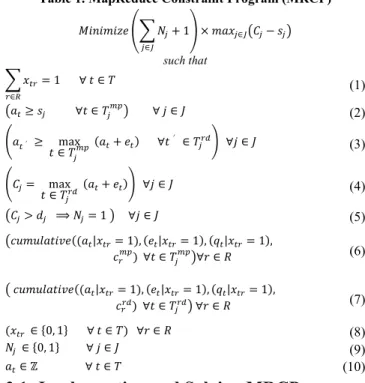
Table 1 shows the formulation of the improved MRCP. The inputs required include: a set of MapReduce jobs, J and a set of resources, R, on which to map J. Each job j in J has the following: an earliest start time (sj), a set of map tasks (Tjmp), a set of reduce tasks (Tjrd), and a deadline (dj). The tasks t in each job has an estimated execution time in seconds (et), and resource capacity requirement (qt) that specifies the number of resources the task requires to execute (typically set to one for most map and reduce tasks). Note that the estimated task execution times includes the time required to read the input data, and exchange data (e.g. intermediate keys) between the map and reduce phases. The resources are modelled after Hadoop’s TaskTrackers. Each resource r in R has a map task capacity (no. of map slots), crmp, and a reduce task capacity (no. of reduce slots), crrd. The map and reduce task capacity specifies the number of map tasks and reduce tasks, respectively, that the resource can execute in parallel simultaneously.
The decision variables of MRCP are outlined below. Note that the set T contains the tasks for all the jobs in J.
Matchmaking, xtr: a binary variable. If task t is assigned to resource r, xtr=1, otherwise xtr=0. Each task t in T has an xtr variable for each resource r in R
Scheduling, at: an integer variable. Each task t in T, has an at variable that specifies the assigned start time of t.
Nj: a binary variable. If a job j misses its deadline Nj is set to one. Each job j in J has an Nj that is initialized to zero.
Cj (new): an integer variable that stores the completion time of job j. Each job j in J has a Cjvariable.
Theobjective function of MRCP has been modified from previous work that focused only on the minimization of late jobs. The first part of the objective function minimizes the number of late jobs; whereas, the second part of the objective function minimizes the maximum turnaround time of all jobs. The net effect of the second part of the objective function is to distribute the tasks more evenly among the resources (i.e. load balancing). This is confirmed to be achieved by examining the output schedule generated after MRCP is solved.
A summary of the purpose of each of MRCP’s constraints outlined in Table 1 is provided. Constraint (1) states that each task t in the set of tasks, T, can only be assigned to one resource. The second constraint ensures that each job’s map task has an assigned start time that is after the job’s earliest start time. Constraint (3) enforces that each job’s reduce tasks are scheduled to start after
all of the job’s map tasks are completed. The fourth constraint, which is a new constraint that was not described in previous work states that the completion time of the job is set to the completion time of the job’s latest finishing reduce task. Constraint (5) makes sure that Nj for all the jobs that miss their deadlines is set to one. The next two constraints (6) and (7) are the resource capacity constraints, and enforce that the map and reduce task capacities of each resource are not violated at any point in time. Note that constraints (6) and (7) make use of CP’s global constraint function cumulative. Lastly, constraints (8)-(10) specify the valid values that the decision variables can be assigned.
Table 1. MapReduce Constraint Program (MRCP) 𝑀𝑖𝑛𝑖𝑚𝑖𝑧𝑒 (∑ 𝑁𝑗 𝑗∈𝐽 + 1) × 𝑚𝑎𝑥𝑗∈𝐽(𝐶𝑗− 𝑠𝑗) such that ∑ 𝑥𝑡𝑟 𝑟∈𝑅 = 1 ∀ 𝑡 ∈ 𝑇 (1) (𝑎𝑡≥ 𝑠𝑗 ∀𝑡 ∈ 𝑇𝑗 𝑚𝑝 ) ∀ 𝑗 ∈ 𝐽 (2) (𝑎𝑡′≥ max 𝑡 ∈ 𝑇𝑗𝑚𝑝 (𝑎𝑡+ 𝑒𝑡) ∀𝑡 ′∈ 𝑇 𝑗𝑟𝑑) ∀𝑗 ∈ 𝐽 (3) (𝐶𝑗= max 𝑡 ∈ 𝑇𝑗𝑟𝑑 (𝑎𝑡+ 𝑒𝑡)) ∀𝑗 ∈ 𝐽 (4) (𝐶𝑗> 𝑑𝑗 ⟹ 𝑁𝑗= 1 ) ∀𝑗 ∈ 𝐽 (5) (𝑐𝑢𝑚𝑢𝑙𝑎𝑡𝑖𝑣𝑒((𝑎𝑡|𝑥𝑡𝑟= 1), (𝑒𝑡|𝑥𝑡𝑟= 1), (𝑞𝑡|𝑥𝑡𝑟= 1), 𝑐𝑟 𝑚𝑝 ) ∀𝑡 ∈ 𝑇𝑗𝑚𝑝)∀𝑟 ∈ 𝑅 (6) ( 𝑐𝑢𝑚𝑢𝑙𝑎𝑡𝑖𝑣𝑒((𝑎𝑡|𝑥𝑡𝑟= 1), (𝑒𝑡|𝑥𝑡𝑟= 1), (𝑞𝑡|𝑥𝑡𝑟= 1), 𝑐𝑟𝑟𝑑) ∀𝑡 ∈ 𝑇𝑗𝑟𝑑) ∀𝑟 ∈ 𝑅 (7) (𝑥𝑡𝑟 ∈ {0, 1} ∀ 𝑡 ∈ 𝑇) ∀𝑟 ∈ 𝑅 (8) 𝑁𝑗 ∈ {0, 1} ∀ 𝑗 ∈ 𝐽 (9) 𝑎𝑡∈ ℤ ∀ 𝑡 ∈ 𝑇 (10)
3.1
Implementing and Solving MRCP
The software chosen to solve MRCP is IBM ILOG CPLEX Optimization Studio v12.5 [11] (abbreviated CPLEX). CPLEX is used because in our preliminary work [10] it was found that it was the most effective (had lower overhead and able to handle larger workloads) in solving MRCP. Before MRCP can be solved by CPLEX’s CP solving engine, called the CP Optimizer [18], MRCP needs to be implemented (modelled) using CPLEX’s Optimization Programming Language (OPL) [11]. OPL is an algebraic language that is specifically designed for developing and expressing optimization models. Note that the implementation of MRCP using OPL is referred to as the OPL model.
4.
HADOOP EDF-SCHEDULER AND
CP-SCHEDULER
As indicated in Section 1, a Hadoop scheduler performs both matchmaking and scheduling. This section discusses the design and implementation of two new Hadoop schedulers that can handle matchmaking and scheduling of an open stream of MapReduce jobs with deadlines. The first is the earliest deadline first scheduler, EDF-Scheduler, which was devised by extending Hadoop’s default FIFO scheduler (see Section 4.2). The second is a more advanced constraint programming based scheduler, called CP-Scheduler (see Sections 4.3-4.4), that performs matchmaking and scheduling by solving MRCP, which was discussed in Section 3.1. Our experiences and challenges in implementing these schedulers are discussed. The main challenge encountered is
understanding the Hadoop source code and determining which of the Hadoop classes need to be modified to implement the schedulers. A summary of the challenges encountered is provided. Determining the Hadoop classes that need to be modified to: (1) support user-specified job deadlines (discussed in Section 4.1), and (2) allow users to define the estimated task execution times of their jobs (see Section 4.3.2).
Determining how to implement a custom scheduler for Hadoop’s JobTracker (see Section 4.2.1). Examining the source code of Hadoop’s default FIFO scheduler to learn the intricacies of how job scheduling in Hadoop is performed (discussed in Section 4.2.2).
The main challenges of implementing the Hadoop CP-Scheduler include: (1) determining how to create the input data for MRCP from Hadoop classes (see Section 4.3.1), (2) integrating IBM CPLEX into Hadoop (see Section 4.3.3), (3) investigating how to handle IBM CPLEX’s lack of support for
long values to represent timestamps (see Section 4.4.2 and
4.3.1), and (4) developing an approach to ensure that a specific TaskTracker executes the task it has been assigned in the MRCP solution (see Section 4.4.1).
During testing a bug was discovered where the reduce tasks would stall and take a very long time to complete (discussed in Section 4.4.1.1).
4.1
Adding Support for Job Deadlines in
Hadoop
This section discusses the Hadoop classes that were modified to support user-specified job deadlines. First, in Hadoop’s org.
apache.hadoop.mapred.JobInProgress class a new private
field, long deadline, was added to store a job’s deadline. The
value stored in the deadline field represents the number of milliseconds elapsed from midnight, January 1, 1970 UTC. The
JobInProgress (JIP) class represents a MapReduce job that is
being tracked by JobTracker. The JIP class maintains all the information for a MapReduce job including: the job’s map and reduce tasks, its state (e.g. running, succeeded, failed), as well as accounting information (e.g. launch time and finish time). JIP’s deadline field is initialized via the JIP constructor by invoking
conf.getJobDeadline() where conf is an object that is an
instance of the org.apache.hadoop.mapred.JobConf class, and
getJobDeadline() is a new method that was implemented in the
JobConf class to retrieve the job’s deadline.
The JobConf class represents a MapReduce job configuration.
It is an interface for users to specify the properties (e.g. job name and number of map and reduce tasks) for their MapReduce job before submission to the Hadoop cluster. Two new methods are added to the JobConf class: getJobDeadline() and setJob
Deadline(). The method setJobDeadline(long deadline) sets
the job configuration property, mapred.job.deadline, to the
supplied parameter. Similarly, the getJobDeadline() method is
used to retrieve the value assigned to the mapred.job.deadline
property.
The last Hadoop class that needs to be modified to support user-specified job deadlines is the org.apache.hadoop. mapreduce.Job class. The Job class is the main user API that is
used to create and submit jobs to the Hadoop cluster (more specifically JobTracker). The Job class is the user’s view of the
MapReduce job, and it provides methods to allow the user to create, configure, and submit a job, as well as control its execution, and obtain status information (e.g. state of the job). Similar to the JobConf class, the two new methods added to the Job class are: setJobDeadline(), and getJobDeadline(). These
two methods in turn invoke conf.setJobDeadline() and
conf.getJobDeadline(), respectively, where conf is an instance
of a JobConf object. Note that conf is one of the private fields of
the Job class and is initialized when a Job object is created. The
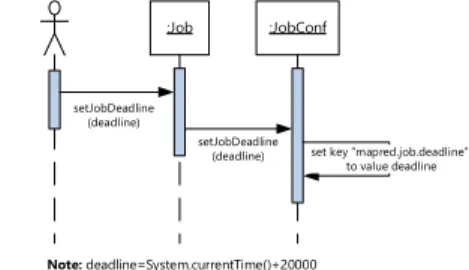
sequence of calls for setting the deadline of a job is illustrated in the sequence diagram shown in Figure 2.
:Job :JobConf setJobDeadline (deadline) setJobDeadline (deadline) Note: deadline=System.currentTime()+20000
set key mapred.job.deadline to value deadline
Figure 2. Sequence diagram for setJobDeadline().
4.2
Hadoop EDF-Scheduler
An earliest deadline first scheduler called EDF-Scheduler is implemented by extending Hadoop’s default FIFO (first-in-first-out) scheduler. This is done to investigate if the naïve solution of using the commonly known EDF policy is effective for handling an open stream of MapReduce jobs with deadlines (see Section 5). This section briefly discusses the key classes that were modified to implement the EDF-Scheduler, but first an overview of how to implement a custom scheduler for Hadoop is discussed in Section 4.2.1, and in Section 4.2.2, a discussion of the key classes of Hadoop’s FIFO Scheduler is provided.
4.2.1
Implementing a Custom Hadoop Scheduler
Hadoop provides a pluggable scheduler framework [2] that allows developers to implement custom schedulers using their own scheduling logic and algorithms. The key to implementing a custom scheduler for Hadoop is to extend Hadoop’s abstract classorg.apache.hadoop.mapred.TaskScheduler and implement the
abstract method List<Task> assignTasks(TaskTracker tt).
The assignTasks() method returns a list of tasks (including both
map and reduce tasks) that the supplied TaskTracker should
execute as soon as it receives the list. Note that the returned list can be empty meaning that there are no new tasks to assign to the
TaskTracker at the moment.
The Hadoop org.apache.hadoop.mapred.JobTracker class
implements the Hadoop JobTracker daemon, which is responsible for scheduling the tasks of the MapReduce jobs that are submitted. The JobTracker class has a TaskScheduler private
field named taskScheduler which stores the reference to the
scheduler (e.g. FIFO, EDF or CP) that is used to assign and schedule tasks on TaskTrackers. More specifically, the
JobTracker class invokes taskScheduler.assignTasks() each
time JobTracker receives and processes a heartbeat message from a TaskTracker (i.e. within the JobTracker class’ heartbeat()
method). Recall that heartbeats are the periodic status messages that TaskTrackers send to JobTracker.
4.2.2
Hadoop FIFO Scheduler
Hadoop’s default FIFO scheduler is implemented in the
org.apache.hadoop.mapred.JobQueueTaskScheduler class
(abbreviated JQTS), which extends Hadoop’s TaskScheduler
abstract class. The JQTS class keeps jobs that are ready to execute in priority order and by default, this order is FIFO. There are two other key classes required by JQTS: (1) JobQueueJobIn
ProgressListener (JQ-JIPL) and (2) EagerTaskInitialization
Listener (ETIL). The JQ-JIPL class represents the job queue
manager, and by default, it sorts the jobs in the queue in FIFO order, but it is possible to implement a custom ordering strategy such as EDF. JQ-JIPL extends Hadoop’s abstract class JobIn
ProgressListener (JIPL), which is a class that is used by the JobTracker class to listen for when a job's lifecycle in JobTracker
changes. The JIPL class has three key methods: jobAdded(),
jobRemoved(), and jobUpdated(), which are invoked when
JobTracker sees that a job is added, removed, or updated, respectively. For example, when a user submits a job to JobTracker, JQ-JIPL’s jobAdded() method is invoked by the
JobTracker class to add the submitted job to JQ-JIPL’s queue.
The ETIL class prepares a submitted job for execution by initializing/creating the job’s tasks. A thread pool with four worker threads is deployed by the ETIL class to concurrently initialize jobs. Similar to JQ-JIPL, the ETIL class also extends the JIPL abstract class. Thus, as soon as a job is submitted to JobTracker, ETIL places the submitted job into its job initialization queue called jobInitQueue (sorted using FIFO by
default). The job remains in the queue until there is a worker thread available to initialize the job.
4.2.3
Implementation of Hadoop EDF-Scheduler
The EDF-Scheduler is implemented in a class calledEDF_Scheduler (stored in the package org.apache.hadoop.
mapred), and is based closely on the implementation of Hadoop’s
FIFO scheduler (discussed in Section 4.2.2). The major changes that are made are in the JQ-JIPL and ETIL classes. More specifically, in the ETIL class the resortInitQueue() method is
modified to sort the queue with priority given to the jobs with an earlier deadline (i.e. earliest deadline first). Moreover, the JQ-JIPL class’ JobSchedulingInfo Comparator was also modified
to place jobs with an earlier deadline first. In Java, a Comparator
is an interface used by Java collection objects to sort elements of the collection in a specified order. The JobSchedulingInfo is a
static nested class of JQ-JIPL that assembles all the necessary job-related information (e.g. job id and deadline) for the EDF-Scheduler to schedule jobs.
4.3
Hadoop CP-Scheduler
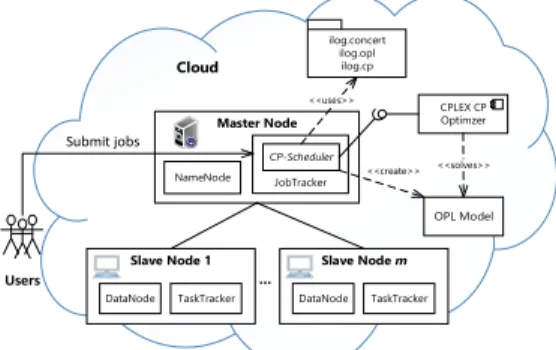
Figure 3 shows an overview of the CP-Scheduler being deployed on a Hadoop cluster. There is a single master node and m slave nodes (defined in Section 2.2). Users submit jobs to JobTracker which uses the CP-Scheduler to schedule the jobs onto TaskTrackers. CP-Scheduler uses three IBM CPLEX Java library packages (discussed in Section 4.3.3), and performs matchmaking and scheduling by creating a MRCP OPL model and using CPLEX’s CP Optimizer (a CP solving engine) to solve the OPL Model (discussed in detail in Section 4.4).
CPLEX CP Optimzer ilog.concert ilog.opl ilog.cp OPL Model Master Node NameNode JobTracker CP-Scheduler <<uses>> <<create>> <<solves>> Slave Node 1 DataNode TaskTracker Submit jobs Users Slave Node m DataNode TaskTracker Cloud ...
Figure 3. Overview of a Hadoop cluster deploying the CP-Scheduler.
Similar to the EDF-Scheduler the implementation of the CP-Scheduler starts with creating a class, called CP_Scheduler (in the
package org.apache.hadoop.mapred) which extends Hadoop’s
TaskScheduler abstract class. In addition, The CP-Scheduler also
has two classes: JobQueueManager and JobInitializer that
extend Hadoop’s JIPL class, and have similar functionality as the EDF-Scheduler’s JQ-JIPL and ETIL classes, respectively.
4.3.1
Entity Classes
The CP_Scheduler class also uses three entity classes:
Job_CPS, Task_CPS, and Resource_CPS. These classes represent
how the CP-Scheduler views MapReduce jobs, tasks, and TaskTrackers (resources), respectively, and stores the necessary information required by MRCP (discussed in Section 3) for scheduling the MapReduce tasks onto TaskTrackers. An abbreviated class diagram showing the important attributes and methods of the three entity classes is presented in Figure 4. Note that a discussion of the key attributes and methods of the
CP_Scheduler class is provided in Section 4.3.
+ Resource_CPS(tts : TaskTrackerStatus) + addScheduledTask(t : Task_CPS) : void + removeScheduledTask(t : Task_CPS) : void + scheduledTaskCompleted(t : Task_CPS): void - id : String - numMapSlots : int - numReduceSlots : int Resource_CPS CP_Scheduler + Job_CPS(jip:JobInProgress) + normalizeAndConvertTimes(baseTime : long) : void - id : JobID - releaseTime : long - deadline : long - origReleaseTime : long - isTimeNormalized : boolean Job_CPS + Task_CPS(tip:TaskInProgress, parentJob:Job_CPS, execTime:int) - id : TaskID - executionTime : int - isReduceTask : boolean - numSlotsReq : int - scheduledStart : int - isExecuting : boolean Task_CPS 1..* parentJob mapTasks 0..* assignedResource schedMapTasks 0..* jobsToSchedule 0..* resources 0..* parentJob reduceTasks 0..* assignedResource schedRedTasks
Figure 4. Class diagram (abbreviated) of CP-Scheduler’s entity classes.
The Job_CPS class contains information required by the
CP_Scheduler to map jobs onto TaskTrackers (resources). This
information is retrieved from Hadoop’s JobInProgress class, and
includes the job’s: id, release time, deadline, map tasks, and reduce tasks. Note that both the release time and deadline fields store the number of milliseconds elapsed from midnight, January 1, 1970 UTC. Since the release time field is constantly updated depending on when the job is being scheduled (discussed in Section 4.4), the origReleaseTime field stores the time of when
the job is first received by JobTracker. The isTimeNormalized
field indicates if the following calculations have been performed:
releaseTime = releaseTime –REFERENCE_TIME, and deadline
= deadline - REFERENCE_TIME (referred to as time
normalization). REFERENCE_TIME is a field in the CP_Scheduler
class that stores a timestamp which is taken when the CP-Scheduler maps a job for the first time. The job’s release time and deadline have to be normalized because CPLEX does not support values of type long (only int is supported). Normalization of the
times is discussed in more detail in Section 4.4.2.
The Task_CPS class holds the information that the
CP_Scheduler uses for matchmaking and scheduling tasks
including: the task’s id, estimated execution time (in seconds), task type, and the number of slots (resource capacity) required. This information, except the estimated task execution times (discussed in Section 4.3.2), is retrieved from Hadoop’s
TaskInProgress class. Once a task has been mapped, its
assignedResource and scheduledStart fields are initialized to
the resource that the task is scheduled to execute on, and the time the task is to start running, respectively. The isExecuting field is
set to true if the task is currently executing.
The Resource_CPS class contains TaskTracker information
id, the number of map slots, and the number of reduce slots. The tasks that are assigned to the resource are placed in either the
schedMapTasks list or the schedRedTasks list, depending on the
task type. Note that both these lists keep tasks sorted by earliest scheduled start time. The methods addScheduledTask() and
removeScheduledTask() are used to add, and remove tasks from
the scheduled tasks lists, respectively. The last method,
schedTaskCompleted(), is called when a task has completed its
execution. Completed tasks are moved from the scheduled tasks lists to the completed tasks lists.
4.3.2
Adding Support for Estimated Task Execution
Times
One of the inputs that MRCP (discussed in Section 3) requires is the estimated task execution times. Note that the estimation of task execution times can be accomplished by analyzing historical data such as system logs, and workload traces of previously executed tasks (discussed in Section 5.1.2). Similar to how support for job deadlines was added to Hadoop (discussed in Section 4.1), support to allow users to specify the estimated task execution times of their submitted jobs is accomplished by adding two new methods: setEstimatedTaskExecutionTimes() and
getEstimatedTaskExecutionTimes() (abbreviated setET and
getET, respectively) to Hadoop’s Job and JobConf classes.
The setET method accepts two parameters: a comma delimitated string of task execution times in seconds (e.g. “2,2,3”), and the task type (map or reduce). Depending on the task type, the setET method assigns either the mapred.job.mapTask
ExecTimes property or the mapred.job.reduceTaskExecTimes
property to the supplied string. The getET method accepts a single parameter the task type (map or reduce), and returns a string array containing the values assigned to the corresponding property.
4.3.3
Integration of IBM CPLEX
As discussed in Section 3.1, MRCP is solved using IBM CPLEX. Therefore, to model and solve MRCP, the CP-Scheduler requires importing IBM CPLEX’s Java libraries to make use of the following Java APIs [11]: ILOG Concert Technology (abbreviated Concert), ILOG OPL, and ILOG CP. These APIs allow the CP-Scheduler to embed CPLEX’s CP Optimizer solving engine and the MRCP OPL model into the CP_Scheduler class.
To use these APIs, the following CPLEX Java library packages need to be imported: ilog.concert, ilog.opl, and ilog.cp.
Before being able to import the required CPLEX Java libraries, IBM CPLEX v12.5 was installed on the machine where the master node executes. The IBM CPLEX v12.5 JAR (Java archive) file, named oplall12.5.jar, was placed in Hadoop’s /hadoop/lib folder. In addition, a modification is made to
Hadoop’s /hadoop/bin/hadoop script so that the JobTracker
would be able to locate the CPLEX libraries. More specifically, the java.library.path variable of the hadoop script is modified
to include the folder
<IBM_CPEX_Install_dir>/opl/bin/x86-64_sles10_4.1.
Two additional classes that are used by the CP_Scheduler for
aiding in the integration of CPLEX are: OPLModelSource and
OPLModelData. The former stores the implementation of MRCP
written in CPLEX’s Optimization Programming Language (OPL), which is referred to as the OPL model. The latter class is used by the CP_Scheduler class to create the input data for the OPL
model. OPLModelData extends the OPL APIs ilog.opl.Ilo
CustomOplDataSource class [11] and converts the
CP_Scheduler’s resources and jobsToSchedule lists to a format
that the OPL model can read (i.e. generates the OPL model’s input sets: Jobs, Tasks, and Resources).
4.4
CP-Scheduler Algorithm
This section provides details on the CP-Scheduler algorithm. A class diagram of the CP_Scheduler showing its key fields and
methods is presented in Figure 5. Note that these fields and methods are discussed in Sections 4.4.1-4.4.3.
+ CP_Scheduler()
+ assignTasks(tt : TaskTracker) : List<Task> - generateAndSolve() : void - createNewModelDefinition() : void - addConstraints(modelText:String, r:Resource_CPS, t:Task_CPS) : void
- extractSolution(keepLateTasks : boolean) : void - createResourcesForCP() : void - createJobsToScheduleForCP() : void - removeTask(Task_CPS t) : void - REFERENCE_TIME : long - jobQueueManager : JobQueueManager - jobInitializer : JobInitializer - oplFactory : IloOplFactory - settings : IloOplSettings - modelDefinition : IloOplModelDefinition - cpSolver : IloCP - oplModel : IloOplModel CP_Scheduler
Figure 5. Abbreviated class diagram of CP_Scheduler.
4.4.1
assignTasks()
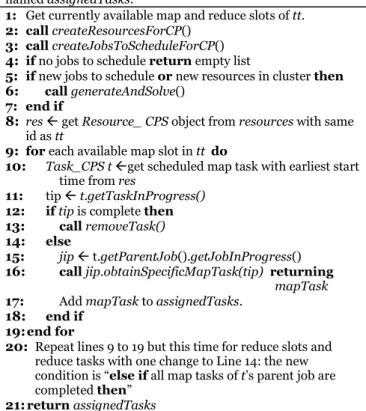
Table 2 shows the CP-Scheduler algorithm which is implemented in the CP_Scheduler class’ assignTasks() method.
The input required by the algorithm is a TaskTracker to assign tasks to. The algorithm returns a list of tasks for the supplied TaskTracker to execute (includes both map and reduce tasks). The first step (line 1) is to calculate the currently available map and reduce slots of the supplied TaskTracker (e.g. availMapSlots = mapCapacity – runningMaps). The next step (lines 2-3) is to
create the Resource_CPS list (called resources) and Job_CPS list
(called jobsToSchedule), which are required as input to the OPL
model. The createResourcesForCP() method (abbreviated CR)
invokes the JobTracker class’ activeTaskTrackers() method to
return a collection of TaskTrackerStatus (TTS) objects. The CR
method then uses the TTS objects to create Resource_CPS objects
via its constructor (recall Figure 4). The createJobsToSchedule
ForCP() method (abbreviated CJ) checks the JobQueueManager’s
jobQueue (a collection of JobInProgress objects) for new jobs
in the running state (i.e. setup is complete and tasks are initialized), and creates a new Job_CPS object for each one. If
there are new jobs or resources, the CP_Scheduler’s hasNewJob
and hasNewResources flags are set to true.
The next step is to check if CP_Scheduler’s jobsToSchedule
list is empty. If this condition is true, then an empty task list is returned (line 4). If either hasNewJobs or hasNewResources flags
are true CP_Scheduler’s generateAndSolve() method (discussed
in Section 4.4.2) is invoked (see lines 5-7). The two flags are used to prevent unnecessarily invoking generateAndSolve()when a
MRCP solution for the same input (jobs and resources) has already been found. Once a solution is found, the next step (line 8) is to retrieve the assigned map and reduce tasks from the
Resource_CPS object in resources (named res) that has the same
id as the supplied TaskTracker.
In lines 9-19, each available map slot of the supplied
TaskTracker is assigned the map task with the earliest scheduled
start time. This is accomplished by first retrieving the task (a
Task_CPS object) from res, as well as retrieving the task’s
corresponding TaskInProgress (TIP) (lines 10 and 11). Before
assigning the task, TIP is checked to see if the task has completed, and if true, the CP_Scheduler’s removeTask() method is invoked
(lines 12-13). The removeTask() method performs a number of
operations including: moving the task from its assigned resource’s scheduled tasks list to the completed tasks list, and moving the task from its parent job’s tasks to schedule lists to the completed task lists. Recall that a task’s assigned resource and parent job are
Resource_CPS and Job_CPS objects, respectively. Furthermore,
removeTask() also checks if the job’s mapTasks and
reduceTasks lists are empty (i.e. job has completed executing). If
this is true, the job’s release time is reset to its original release time, and the job is moved from the CP_Scheduler’s jobsToSchedule list to the completedJobs list. Otherwise, if the
task has not completed executing, the task is assigned to a TaskTracker for execution (lines 14-18). This is accomplished by invoking a new method named obtainSpecificMapTask()
(abbreviated OSMT) that is implemented in Hadoop’s
JobInProgress class. As the name suggests, given a
TaskInProgress object, OSMT returns the corresponding Task
object (i.e. Task that has the same id). The task that is returned by OSMT is added to the assignedTasks list.
Table 2. CP-Scheduler algorithm (implemented in CP_Scheduler::assignTasks()).
Input: TaskTracker tt
Output: List of Tasks for the supplied TaskTracker to execute,
named assignedTasks.
1: Get currently available map and reduce slots of tt.
2: call createResourcesForCP()
3: call createJobsToScheduleForCP()
4: if no jobs to schedule return empty list
5: if new jobs to schedule or new resources in cluster then
6: call generateAndSolve()
7: end if
8: res get Resource_ CPS object from resources with same id as tt
9: for each available map slot in tt do
10: Task_CPS tget scheduled map task with earliest start
time from res
11: tip t.getTaskInProgress()
12: if tip is complete then
13: call removeTask()
14: else
15: jip t.getParentJob().getJobInProgress() 16: call jip.obtainSpecificMapTask(tip) returning
mapTask
17: Add mapTask to assignedTasks.
18: end if
19:end for
20: Repeat lines 9 to 19 but this time for reduce slots and
reduce tasks with one change to Line 14: the new
condition is “else if all map tasks of t’s parent job are
completedthen”
21:return assignedTasks
Next, the same logic is executed for the TaskTracker’s
reduce slots (line 20), except with one change to the else statement (line 14). The else statement is changed to an else if statement, which checks if all the map tasks of the job has completed before assigning reduce tasks (see Section 4.4.1.1). A
new obtainSpecificReduceTask() method is implemented in
JobInProgress that returns the reduce task (Task object) with the
same id as the supplied TIP. Lastly, the assignedTasks list which
now contains the tasks that the supplied TaskTracker should
execute is returned (line 16).
4.4.1.1
Reduce Task Stalling Problem
During preliminary testing it was found that in some situations the reduce tasks of a job j would take a very long time to complete because its map tasks were not being executed in a timely fashion. This can be caused, for example, when the CP-Scheduler schedules the map tasks of a job with an earlier deadline before j’s tasks. It was observed that the reason j’s reduce task could not finish executing is because not all of j’s map
task were finished executing. In fact, it was discovered that Hadoop permits reduce tasks of a job to start executing once a few of its map tasks have finished executing (and does not wait until all the job’s map tasks have completed).
One approach to solve this problem is to give execution priority to all of j’s map tasks so that they can execute before other tasks. Initially, this approach was used, and implemented by adding constraints to the OPL model that stated that these task should be scheduled to execute at their originally scheduled times (and not be rescheduled). However, further testing showed that this solution is not ideal when it comes to minimizing the number of late jobs because jobs that have an earlier deadline may have to wait for execution. On the other hand, a problem with not ensuring that j’s reduce tasks can complete its execution in a timely manner, is that j’s reduce tasks will remain idle and unnecessarily consume reduce task slots of TaskTrackers. This can in turn also delay the execution of jobs that already have their map tasks completed. The solution that was used to avoid these problems is to prevent the CP-Scheduler from assigning reduce tasks to TaskTrackers until all the job’s map tasks are completed (recall Section 4.4.1). This guarantees that reduce tasks assigned to a TaskTracker can complete its execution.
4.4.2
generateAndSolve()
Table 3 presents CP-Scheduler’s generateAndSolve()
algorithm whose purpose is to generate the MRCP OPL model, and solve it. The first step is to initialize the CP_Scheduler’s
REFERENCE_TIME (abbreviated RT) if it has not already been done,
and initialize the mrcpCurrentTime variable to zero (line 1-3).
Recall that RT is required to normalize the Job_CPS’ release time
and deadline fields as discussed in Section 4.3.1. If RT has already been initialized, then the mrcpCurrentTimevariable is set to the
current time minus RT, and the value is converted into seconds (lines 4-7). As the name suggests, mrcpCurrentTime is the current
time value used when solving MRCP. Recall from Section 4.3.1 that OPL does not support values of type long.
Table 3. CP-Scheduler algorithm, generateAndSolve().
Input: none. Output: none.
1: if REFERENCE_TIME = -1 then 2: REFERENCE_TIME System.currentTimeMillis() 3: mrcpCurrentTime 0 4: else 5: mrcpCurrentTime System.currentTimeMillis() – REFERENCE_TIME
6: Convert mrcpCurrentTime to seconds.
7: end if
8: for each job j in jobsToSchedule do
9: call j.normalizeAndConvertTimes (REFERENCE_
10: TIME)
11: if mrcpCurrentTime > j.getReleaseTime() then j.setTempReleaseTime(mrcpCurrentTime )
12:end for
13:call createNewModelDefinition()
14:Create a new OPL model and attach the data source
containing jobsToSchedule and resources.
15:Generate and solve the OPL model.
16:call extractSolution()
In the next steps (lines 8-12), each job (a Job_CPS object) in CP_Scheduler’s jobsToSchedule list has its release time and
deadline normalized by invoking Job_CPS’ normalizeAnd
ConvertTimes() method (discussed in Section 4.3.1). In addition,
each job’s release time is updated to mrcpCurrentTime because a
job cannot start before mrcpCurrentTime. In line 13, a new OPL
createNewModelDefinition() method, which is discussed in
Section 4.4.3. After a new model definition has been created, a new OPL model is produced (line 14), and then solved (line 15) using CPLEX. After a solution is found, it is extracted by invoking CP_Scheduler’s extractSolution() (line 16). This
method retrieves values from MRCP’s decision variables: xtrand at (discussed in Section 3), and assigns the values to the Task_CPS objects’ assignedResource and scheduledStart fields,
respectively. In addition, the tasks (Task_CPS objects) that are
assigned to a particular resource r (a Resource_CPS object) are
added to r’s scheduledMapTasks or scheduledRedTasks lists
depending on its task type.
4.4.3
createNewModelDefinition()
Table 4 presents the CP-Scheduler’s createNewModel Definition() algorithm. The first step is to initialize the variable
modelSrc with a string value containing the OPL model’s source
code, which is obtained from OPLModelSource (discussed in
Section 4.3.3) The next step is to process all scheduled tasks (Task_CPS objects) to check the state of the task’s corresponding TaskInProgress (TIP) object (lines 2 to 11). If the task’s TIP
state is running then the Task_CPS’ isExecuting field is set to
true, and the CP_Scheduler’s addConstraints() method is
called (line 11). This method, as the name suggests, adds a new constraint to modelSrc that specifies the assigned start time, end
time, and assigned resource of the task that is currently executing. The purpose of the new constraint is to prevent the solver from scheduling new tasks on the same resource slot during the same time interval. In addition, the task’s isExecuting field is also set,
which will be passed on to the OPL model (via OPLModelData
class), to tell the CP solver that enforcing Constraint 2 is not required for tasks that are already executing. Conversely, if the task’s TIP state is completed then the CP_Scheduler’s remove Task() method (discussed in Section 4.4.1) is invoked (line 9).
The final step (line 13) is to create the new OPL model definition object from the updated OPL model source, modelSrc.
Table 4. CP-Scheduler algorithm, createNewModelDefinition().
Input: none. Output: none.
1: modelSrc OPLModelSource.getSource()
2: for each resource r in resources do
3: for each task t in r.getAllScheduledTasks() do
4: tipt.getTaskInProgress()
5: if tip is currently executing then
6: t.setCurrentlyExecuting(true)
7: call addConstraints(modelSrc, t, r)
8: else if tip is finished executing then
9: call removeTask(t)
10: end if
11: end for
12:end for
13:modelDefinition Create new OPL model definition using
the updated OPL model source, modelSrc.
5.
PERFORMANCE EVALUATION
This section describes the experiments that were conducted to evaluate the performance of the CP-Scheduler and EDF-Scheduler developed for Hadoop. In addition, a discussion of the experimental results and insights into system performance and behavior are provided.
5.1
Experimental Setup
5.1.1
System
The experiments were performed on an Amazon EC2 Hadoop cluster comprising one master node, and four slave nodes
configured to have one map and one reduce slot each. Recall from Section 2.2 and Figure 3 the definitions of the master and slave nodes. Each node is an Amazon EC2 m3.medium instance. The
m3.medium instances are fixed performance instances that provide a good balance of compute, memory, and network resources. Each m3.medium instance is launched with a 2.5GHz Intel Xeon E5-2670 v2 (Ivy Bridge) CPU, 3.75 GB of RAM, and runs Ubuntu 13.04. The cost of running an m3.medium instance is $0.07 per hour. Our experiments were performed on this cluster because it allowed us to confirm the functionality of the new prototype Hadoop CP-Scheduler by viewing the output of JobTracker and each TaskTracker in real-time. In addition, the chosen cluster fits within our current experimental budget. For future work, the plan is to perform experiments on a cluster with more nodes.
Initially, our experiments used Amazon’s t2 instances;
however, it was discovered that t2 instances are susceptible to performance degradation over time if the CPU usage is continuously high. This is because t2 instances are burstable performance instances and do not provide a fixed (consistent) performance. The t2 instances continuously receive CPU Credits at a fixed rated depending on the instance size. A CPU Credit supplies the instance with the performance of a full CPU core for one minute. If the instance is idle, it accumulates CPU Credits whereas the instance consumes CPU Credits when it is active. As a result of this, the m3.medium fixed performance instances are
used in the experiments.
5.1.2
Workload
A Hadoop WordCount application (as discussed in Section 1)
with three different input data sizes (i.e. job size) were used in the experiments: small: 3 files (~3MB), med: 10 files (~5MB), and large: 20 files (~10MB), to investigate the impact of different workload sizes on the performance of the system. The files are e-books (in plain text format) that are obtained from Project Gutenberg (www.gutenberg.org). Note that each job size has a number of map tasks that corresponds to the number of files it has, and one reduce task. For example, the medium workload job comprises ten map tasks and one reduce task. In these experiments, our goal is to use workloads with real input data, which is why e-books from Project Gutenberg were chosen. The number of files in each job was selected so that the cluster could execute the MapReduce job within a reasonable amount of time (small: ~50s, med: ~80s, large: ~100s) when there is no contention for resources. The reasonable execution time of these jobs results in a reasonable run time when conducting experiments with an open stream of job arrivals. The Hadoop/MapReduce framework is used with a variety of different data intensive applications. These include Big Data applications as well as applications processing data with sizes of 10s of megabytes (see [19] for example). This is in line with the size of data files we have experimented with. Analyzing the performance of the CP-Scheduler with other workloads characterized by large volumes of data forms a direction for future research.
A JobSubmitter (which runs on its own m3.medium
instance) was implemented in Java to submit an open stream of WordCount jobs at a specified arrival rate (λ) to the Amazon EC2 Hadoop cluster. The arrival of jobs was generated using a Poisson process. The earliest start time (sj) of the jobs is equal to its arrival time, and the job’s deadline (dj) is calculated as the sum of sj and the maximum execution time of the job multiplied by an execution time multiplier (em). The purpose of em is to give the job slack time, and it is generated using a uniform distribution within the interval [1, 5]. These parameters for the jobs are generated in a
similar manner to [5]. Note that the sample execution times of the jobs are obtained by performing a dry run—executing the jobs on the cluster when there is no resource contention.
Four different types of experiments were performed and each experiment type was conducted for the CP-Scheduler as well as for the EDF-Scheduler. In the first three experiment types, the
JobSubmitter was configured to submit only a single job type:
small, medium, or large. In the fourth experiment type, the
JobSubmitter submits a mix of the three job types with each job
type having an equal probability of being submitted. Note that the
JobSubmitter is initialized with a predetermined seed for its
random number generator so that the same sequence of jobs is submitted during the CP-Scheduler experiments and EDF-Scheduler experiments. Each experiment was run for at least five hours so that the system reached steady state.
5.1.3
Performance Metrics
The performance metrics that are considered in each experiment to evaluate the effectiveness and performance of the schedulers include:
Proportion of late jobs (P): calculated as the ratio of the number of late jobs (N) and the number of jobs executed (NE). Recall that a job j is considered late if its completion time (Cj) is after its deadline (dj).
Average job turnaround time (T): calculated as ∑𝑗∈𝐽(𝐶𝑗− 𝑠𝑗) divided by NE.
Average matchmaking and scheduling time of a job (O): calculated as the total time required to perform matchmaking and scheduling of jobs during an experiment divided by NE. Note that O is a measure of the schedulers’ processing overhead.
5.2
Experimental Results
5.2.1
Mixed Workload
Figure 6 and Figure 7 demonstrate that CP is able to effectively handle a complex workload with different types of jobs. CP outperforms EDF by a large margin in terms of P (up to 91%) and T (up to 57%). The CP-Scheduler is able to effectively interleave the execution of the tasks of multiple jobs such that jobs do not miss their deadlines. The EDF-Scheduler’s poor performance in terms of P and T can be attributed to its focus on only scheduling a single job at a time (i.e. the job with the earliest deadline), and not interleaving the execution of jobs.
Figure 6. Mixed Workload: P.
The results in Figure 7 show that CP’s O is larger (changing from 590ms to 3.5s as λ increases), compared to EDF’s O which remains close to 12ms for all λ. CP’s O is higher and is observed to increase with λ because the CP-Scheduler requires generating an OPL model that represents MRCP, and solving the OPL model using IBM’s CP Optimizer (see Section 4.4). When there are more jobs in the OPL model’s input, more time is required to generate and solve the OPL model because of the higher number of decision variables and constraints that need to be processed by the CP Optimizer. On the other hand, EDF’s O tends not to change
significantly with λ because the EDF-Scheduler selects the job to schedule by retrieving the first job in its job queue (i.e. the job with the earliest deadline). Although, CP’s O is high, the O/T ratio which is an indication of a scheduler’s processing overhead in relation to the average job turnaround time, is still relatively low in all cases (less than 0.393%).
Figure 7. Mixed Workload: T and O.
5.2.2
Small Workload
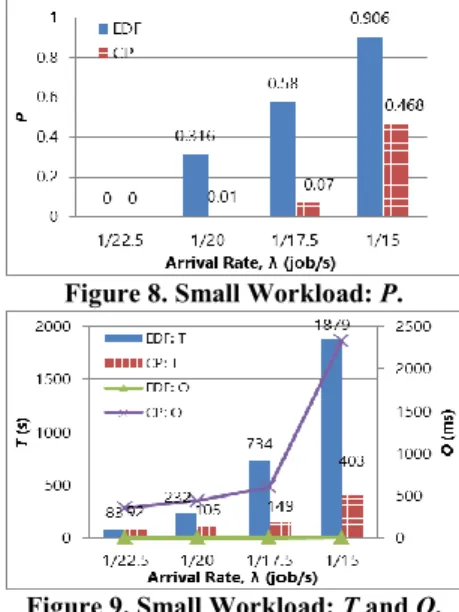
The experimental results using the small workload are presented in Figure 8 and Figure 9. As shown in Figure 8, CP achieves a much lower P compared to EDF. When λ<1/17.5job/s it is observed, that CP achieves a P of less than 0.07 which is close to the lower bound of zero. At 1/22.5 job/s P is zero for both systems; however, at higher arrival rates CP outperforms EDF and is observed to have a 100% decrease in P. At λ=1/15 job/s, both systems exhibit a high P due to high system load (average utilization of resources is 0.92) resulting in a high contention for resources. However, CP still has an approximately 50% lower P compared to EDF. As discussed, the lower P and T of CP can be attributed to MRCP interleaving the execution of jobs to minimize the number of late jobs; whereas, EDF simply schedules the job with the earliest deadline.
Figure 8. Small Workload: P.
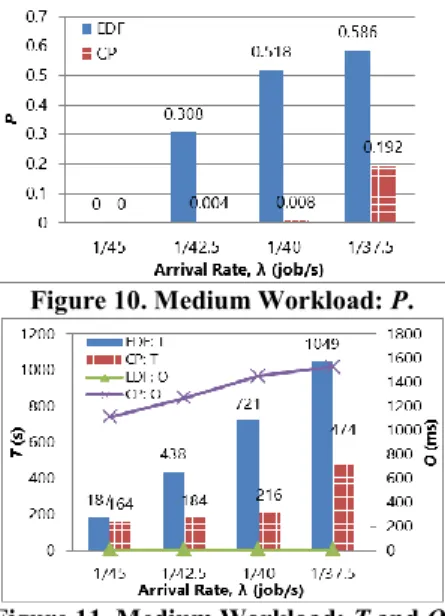
Figure 9. Small Workload: T and O.
Figure 9 shows that CP’s T is up to 80% lower than EDF’s T, except for when λ=1/22.5 job/s. At the lowest arrival rate, CP has a slightly higher (10%) T because of its higher O. When focusing on O it is observed that EDF achieves a much lower O compared to CP. EDF’s O is approximately 5ms for all λ, whereas CP’s O increases with λ, changing from 350ms to 2.3s. As discussed, the reason for CP’s higher O is due to the processing overhead of having to generate and solve MRCP. In comparison to the EDF-Scheduler, the CP-Scheduler puts more effort into deciding which jobs to map in order to minimize P. The benefits of this are captured in the superior performance demonstrated by CP with its lower P while still maintaining an O/T ratio of less than 0.6%.