1
stjoint CEN/ETSI-Progress Report to the European Commission
on Mandate M/453
Directory
1. Introduction and executive summary
2. Status of standardization activities from the list of minimum set of standards in the response to the Mandate
3. Coordination between CEN/TC278 and ETSI TC ITS
4. Involvement of other standards organizations ISO–IEEE–SAE–IETF-TISA – national SOs 5. Stakeholder consultation and involvement
6. European R&D projects and Field Operational Trials (FOTs)
7. International cooperation of standards activities (EU-U.S.-Japan co-operation) 8. Roadmap for Mandate activities during 2011
9. Conclusion
Annex 1:
ETSI TC ITS status of standardization activities on the list of minimum set of standards indicated in the Mandate report April 2010
Annex 2:
Part A: CEN status of standardization activities on the list of minimum set of standards indicated in the Mandate report April 2010 with information about responsible SDO and WG within CEN and ISO and priority indication.
Part B: Relationship between existing and developing standards and Co-operative Systems Part C: Financial support from the European Commission to M/453 activities at CEN
1. Introduction and executive summary
CEN and ETSI formally accepted the Mandate M/453 in January 2010 and provided a joint Response to the Mandate in April 2010. The Response to the Mandate included a list of minimum set of standards for interoperability and the split of responsibility between these two European standards organisations (ESO). This progress report refers to both the Response to Mandate M/453 and the comments from the European Commission DG Enterprise and Industry, dated May 2010.
The ESOs have initiated the standardization activity and a number of standards have been developed and published as European Norms (EN) or Technical Specifications (TS) in the typical process towards EN approval, as requested in the Commission Mandate.
Status of the standardization activities with an indication of the expected timeline and the priority of specific Work Items are provided in this interim report.
As requested in the Mandate, CEN and ETSI have taken initiatives to involve stakeholders and relevant external bodies in the standardization process including the European and national R&D projects in order to ensure that the results of the ongoing activities are brought into the standardization process. In order to achieve globally harmonised standards ongoing coordination and cooperation with global and regional standardization organisations is part of the standardization process. A workshop took place in Berlin in May 2010 and an open workshop with 140 representatives from stakeholders took place in Venice for 9-11 February 2011. Furthermore a website has been established at the ETSI TC ITS portal (www.etsi.org/m453) with detailed information about the Mandate activities and a similar website is planned under CEN/TC 278. This is to be delivered soon after the CEN/TC278 Spring 2011 plenary meeting. In general, it is up to the ESOs to provide information about standards developments. However, the European Commission Support Actions COMeSafety2 and iCar Support might provide assistance and support to such an activity.
Standardization and harmonisation of standards are also important topics within the EU-U.S. Task Force based on the EU-U.S. joint declaration of Intent on Research Cooperation in Cooperative systems. CEN and ETSI contribute to this process.
As envisaged in the Response to the Mandate cooperation with other global ITS standards organisations is increasingly important in order to achieve harmonised standards providing global interoperability. Detailed cooperation between the standards organisations has been initiated in addition to the already existing cross participation by membership in the relevant organisations. The ITS Coordination Group (ITS-CG) between CEN and ETSI has been established to ensure ongoing coordination of the standardization activities within the ESOs. This group will replace the previous ITS-SG.
2. Status of standardization activities from the list of minimum set of standards in the response to the Mandate
The standardization work for Co-operative systems has already been initiated in both CEN and ETSI prior to the issuing of Mandate M/453. Furthermore, other standardization organisations have provided standards relevant for Co-operative ITS, falling within the scope of Mandate M/453. Evaluation of the application of existing standards is an on-going activity in the standardization process in the relevant CEN, ISO and ETSI Technical Committees and their Working Groups.
2.1. ETSI TC ITS status report
Annex 1 to this progress report includes the list of standards required in the Response to the Mandate M/453 with status information about ETSI standards approved and published, or information about expected approval timeframe for the still outstanding standards. The list also includes information about critical and non-critical standards in the process. The list of standards reflects the agreed responsibility for standardization between CEN and ETSI.
2.2. CEN/TC278 status report
Annex 2 (Parts A – C) indicate all of the activities started within CEN/TC278 and ISO/TC204 during 2010. Furthermore, in addition to specific actions, general activities have been undertaken in every CEN/TC278 and ISO/TC204 Working Group in addition to the ones mentioned in Annex 2. These were:
- Examine the relevance of Co-operative ITS and the scope of M/453 to the existing and developing standards, technical specifications and technical reports developed under the specific Working Group
- Define and adopt appropriate Work Items, if not done yet - Develop the workplan
- Report to CEN/TC278/WG16, to ISO/TC204/WG18, and to other convenors in the cross-cutting meetings
- Progress cross-cutting activities - Liaise with ETSI TC ITS
- Monitor ETSI activities and activities in other SDOs working on the related subjects and report to CEN and ISO
It is essential too, that CEN activities in respect of Mandate M/453 are accompanied, supplemented and supported by ISO activities which significantly pre-date Mandate M/453, based on the well-proven CEN and ISO partnership for ITS Standards Development. The scope of the ISO/TC204 WG16 CALM activities is covered by M/453. Additionally the involvement and the contributions of CEN/TC278 Working Groups and the other ISO/TC204 Working Groups to Co-operative Systems standardization are described in this progress report in detail.
3. Coordination between CEN/TC278 and ETSI TC ITS
The split of responsibility for standards developments has been agreed between CEN and ETSI as indicated in the Response to the Mandate in April 2010. Ongoing coordination of the standardization activities is covered both by informal coordination with cross participation of standardization experts and ongoing contacts between chairmen/convenors on a number of occasions including several EC projects.
Formally a coordination group (ITS-CG) has been formed consisting of the chairmen of CEN/TC278 and ETSI TC ITS as well as the Commission representatives and specially invited stakeholders for particular agenda items. The first ad-hoc meeting took place in November 2010 and the second meeting was held on 8 February 2011 in connection with the ETSI TC ITS workshop. The terms of reference of the new group has been agreed within CEN and ETSI. The group will meet 3-4 times a year – preferably in connection with other meetings where the members would normally participate. The main objective of the ITS-CG is formal coordination of standardization activities between CEN and ETSI. Relevant stakeholders will be invited to participate in meetings on particular subjects. Active participation from the European Commission is appreciated. The coordination group will replace the previous ITS-SG.
4. Involvement of other standards organizations ISO–IEEE–SAE–IETF-TISA – national SOs ETSI liaison activities and views
As indicated in the Response to the Mandate ETSI has cooperation and liaison agreements with the standards organisations such as IEEE, ISO, IETF, and standardization supporting industry groups like TISA. Additionally ETSI have liaisons and contacts with regional and national standards organisations such as ARIB (Japan), CCSA (China) and TTA (Korea) as well as the Asian Pacific Telecommunication organisation (APT).
Alongside CEN/TC278, ETSI TC ITS has started a close cooperation with the ISO/TC204. In particular this liaison focuses on ISO/TC204 WG16 work on communication standards with cross participation between WG16 and ETSI TC ITS members and active exchange of information about standardization activities. ETSI has also initiated close cooperation on standards developments for applications and message sets with particular working groups of ISO/TC204 including WG14 and WG3. This cooperation includes a coordinated standardization process within the particular working groups in both organisations with exchange of documents and information as well as cross representation in meetings.
As indicated in the Annex 1 to this document reflecting the agreed split of responsibility in the Mandate report ETSI has the sole responsibility for the Network and Transport layer, the Access Layer, the Management layer, the Security layer and the conformance-and interoperability testing.
Cooperation between ETSI and IETF has been ongoing for the last couple of years and the cooperation agreement with IEEE has led to active formal participation and ongoing liaison with IEEE in the work of ETSI TC ITS.
There is a clear interest from all parties to coordinate the activities and successful arrangements are therefore envisaged. Furthermore workshops and coordination activities are being arranged between key persons from the automotive industry in Europe and USA also including detailed standardization issues.
CEN liaison activities and views
The existing organisational link between CEN and ISO contributes to the close cooperation at all levels – with many of the CEN/TC278 and ISO/TC204 Working Groups operating in a wholly joint manner under the Vienna Agreement. All meetings of the two working groups on cooperative systems CEN/TC278/WG16 and ISO/TC204/WG18 are organised as common meetings. TISA activities are also based on the long term partnership between CEN/TC278, ISO/TC204 and TISA.
As results of CEN/TC278 and ISO/TC204 cross cutting activities in 2010 as well as first results achieved in the EU – U.S. Task Force it should be recognised that there is a strong interest from Asia, North America and Europe to run coordination activities.
As a global initiative there is the potential for political issues and difficulties if any one party would take the lead in a majority of the work items. It could be also recognised that the boundaries of co-operative systems and “traditional” systems are not sufficiently clear, as well as that there are already many standards existing for co-operative systems. There are also many other standards which are closely relevant for co-operative systems, e. g. many application/service standards. Application standards are an important output of and part of the work programme of CEN/TC 278. Finally the SDOs are aware of the fact that there is an overlap between the work of ETSI and CEN. Coordination between both SDOs is essential.
The split of responsibility between ETSI and CEN in accordance with the agreed Mandate Report is based on the layers of the ITS Station Reference Architecture model for co-operative systems. From the CEN/TC278 point of view this agreement does not show a clear dispersion. As an example the ITS Application layer and the Facilities layer are fully overlapping part of the CEN/TC278 as well as the ETSI TC ITS work programmes.
For the standards development within the Application and Facility layer there is a need for close coordination of the activities within CEN and ETSI.
The ISO/TC204 Resolution 741 (approved in the 34th Plenary Meeting in Barcelona, 18 Sept. 2009) towards its WG18 facilitates the interaction between CEN/TC278, the ISO/TC204 Working Groups on matters related to ITS Cooperative Systems. From ISO/TC204/WG3, WG14 and WG16 views the cooperation with ETSI TC ITS is part of the above mentioned resolution and has to be coordinated and supported by ISO/TC204/WG18.
5. Stakeholder consultation and involvement
Contacts with stakeholder organisations have been initiated as indicated in the Response to Mandate M/453 and further stakeholder organisations have been included including ERTICO – ITS Europe, the
GSM-A organisation and the eSafety Forum. To provide detailed information about the standardisation activities ETSI and CEN/TC278 have developed open web sites
• www.etsi.org/m453
• www.itsstandards.eu and www.tc278.eu (launch in the 46th CEN/TC278 Plenary Meeting in Vienna, March 2011)
with information about standardisation activities and important events.
Following every TC meeting ETSI TC ITS provides detailed information on decisions and standard approvals in dedicated news mails for which more than 800 stakeholders have subscribed. Feed back from stakeholder indicates that this information is appreciated in the ongoing standardization process. The news and information spread provides contacts to stakeholders in particular the infrastructure operators and telecom operators and industry but in general the stakeholder activity and participation is limited and needs improvement.
The industry organisation Car-2-Car Communication Consortium is actively participating in the ETSI TC ITS work providing chairmanship for working groups and the committee itself. Similarly the iCar Support project provides the chairman of ETSI TC ITS WG2 on Architecture issues.
Many stakeholders are, however, not very active in participating and providing contributions to the standardization work within CEN/TC278 and ETSI TC ITS. The Response to Mandate M/453, from April 2010, has been distributed to the stakeholders and provided on the website but no comments and contributions have been received. In order to improve the stakeholder involvement experts from both SDO provide more detailed information about the status of essential work items, the standardization process and the expected timeline towards approval which would allow the stakeholders to contribute to the process and discuss particular issues of interest. CEN/TC278 and ETSI TC ITS contact points – Working Group chairmen etc. will be provided to the stakeholders to facilitate contacts and contributions to the work.
An important element of stakeholder contacts is the open workshops arranged by CEN and ETSI. A workshop between SDOs with stakeholder representation was arranged in Berlin May 2010 on the following standards related subjects:
- Applications and services
- Facilities with focus on exposed interfaces and APIs based on results from EU R&D projects - Data privacy and product liability
- Architecture (FRAME and the eFRAME project, communication architecture, framework architecture)
- CALM (Design principles of the CALM standards and interactive tutorial) - Local Dynamic Map - LDM (Activities in ISO, CEN, and ETSI)
It is intended to develop similar workshops during 2011 on particular technical issues as the basis for standardization within CEN and ETSI in accordance with the agreed split of responsibilities.
In February 2011 an open workshop with more than 140 participants was arranged in connection with the ETSI TC ITS yearly open workshop. A variety of stakeholders participated actively in the discussions and provided contributions to the discussions on standardization and deployment of cooperative ITS. European road organisations such as ASECAP underlined their intention to participate actively in the European ITS standardization activities including membership of ETSI.
Apart from the regular open workshops dedicated meetings and workshops will be arranged in order to discuss particular issues of interest to stakeholders and to collect contributions on particular standards. The stakeholders will be invited to request further information and as relevant meetings and workshops.
6. European R&D projects and Field Operational Trials (FOTs)
Standardization is based on contributions from and active participation by a range of members with strategic interest in standardization and deployment of cooperative ITS including the automotive industry, major suppliers, public authorities, road operators, public telecom operators, technical experts in standardization and testing.
The results of the European research and development projects as well as the ongoing FOTs are currently being included in the standardization process. Many CEN and ETSI TC ITS members have participated actively in the R&D projects such as the previous CVIS, Safespot, COOPERS and GEONET projects and are participating in the new projects as well as in preparation of the large scale field operational tests such as SIM-TD, SCORE@F and Drive C2x. CEN and ETSI experts are also involved in the EasyWay project. CEN and ETSI have ongoing liaison with EU Projects as the experience and results from this work is very important for the standardization process to ensure high quality standards.
7. International cooperation of standards activities (EU-U.S.-Japan co-operation) The EU-U.S.-Japan cooperation was initiated beginning 2010 with focus on
• Harmonise standards for ITS to achieve global interoperability • Harmonise applications for V2V – V2I and sustainability application • Test tools and methodologies
• Driver distraction
• Technical roadmap for deployment
On harmonisation of standards the following activities have been initiated:
- a high level assessment of existing and draft standards described in the Mandate Report - develop a detailed level of assessment on ITS standards
- provide recommendations to achieve harmonisation of standards - develop gap analyses on the needs for standards for Co-operative ITS
The objective and process for harmonisation of standards for cooperative ITS have only recently been defined. Detailed harmonisation activities are envisaged during the next 2 years in addition to the ongoing cooperation between SDOs on standards developments.
At the International workshop arranged jointly between EU-U.S.-Japan in connection with the ITS World Congress in Busan, in October 2010, standardization activities and international cooperation and coordination of ITS standardization were discussed. Both CEN and ETSI provided contributions to the conference and underlined the need for global coordination of standardization for cooperative intelligent transport systems.
8. Roadmap for Mandate activities during 2011 8.1 CEN standardisation
As indicated in Annex 2 new work items are adopted and the standardization activities are ongoing. Additionally CEN will focus in 2011 on
- Defining additional Work Items in the application area based on the need for standardisation from road operators and public authorities view. Results and suggestions from SmartWay and other RDT projects will be included;
- Coordination activities (cross all CEN/TC278 and ISO/TC204 Working Groups, cross CEN, ISO, ETSI and other SDO’s);
- Standards harmonisation activities to identify both, first the similarities between standards, and to develop strategies for harmonizing these similar standards, and second the differences between standards, and to develop strategies for harmonizing these dissimilar standards. - To involve the ISO/TC204 Working Groups in M/453 activities to support and to add ETSI TC ITS
activities where appropriate, in particular
• CEN/TC278/WG1 and ISO/TC204/WG5 (“Mitigation Techniques for ITS G5” and “Secure and Privacy-Preserving Messaging”)
• CEN/TC278/WG4 and ISO/TC204/WG10 (“Event Driven Road Hazard Warning V2V”) • CEN/TC278/WG12 and ISO/TC204/WG4 (“Identities Management” and “Identity, Trust and
Privacy Management”)
• CEN/TC278/WG13 and ISO/TC204/WG1 (“Security Architecture” and
“Confidentiality Services”) • ISO/TC204/WG16
ISO/TC204/WG16 already maintains a very close working relationship with ETIS TC ITS to ensure all of their standards are harmonised. Further, WG16 intends to incorporate ETSI standards into ISO deliverables via reference. Concerning M/453 ISO/TC204/WG16 is involved in ETSI TC ITS activities dedicated to the Facility layer, the Networking and Transport layer, the Access layer, the Management layer, and the Security layer.
CEN is going to define project teams (PT) and is looking for PT funding by the European Commission. The PT’s are listed in Annex 2, Part C.
8.2 ETSI standardization
The attached list of standards in accordance with the Response to Mandate M/453 provides information about Published standards as well as standards in preparation with indication of estimated time for approval of the relevant standard.
A typical process is development and adoption of a Technical Specification in relation to a work item followed by a process for adoption as an EN with public enquiry and national voting. Five new STFs funded by the European Commission have been established with strong support the standardization activities in response to the Mandate. The STFs includes both development of base standards and support for test specifications.
As indicated in Annex 1 ETSI TC ITS expects to finalise most of the standards before July 2012 while some test specifications and the process for transferring a standard from TS to an EN may take somewhat longer.
9. Conclusion
Standardization work in accordance with the Response to Mandate M/453 has been initiated and cooperation between the relevant standards organisations has been established. The ESOs have a strong focus on the minimum set of standards required for interoperability in the Mandate M/453. There is, however, also a general requirement for global harmonisation of existing and future standards for cooperative ITS which is related to the ongoing cooperation with other standards organisation. Careful priority of the limited expert resource needs to be considered between critical standardization activities, harmonisation of standards and non-critical but still relevant standards for cooperative ITS.
Furthermore contacts with stakeholders have been initiated but further activities are necessary in order to achieve the envisaged stakeholder involvement. This interim report has been wide distributed among potential stakeholders in order to achieve comments and contributions.
Annex 1
ETSI TC ITS status of standardization activities on the list of minimum set of standards indicated in the Mandate report April 2010.
General standards and Testing SDO ETSI Standard WI Approval Priority Definition and terminology CEN
Communication Architecture ETSI EN 302665 Published Critical
Framework architecture CEN
Com data dictionary (comm) ETSI Not started Critical
Com data dictionary (payload) CEN
Standards - Testing SDO ETSI Standard WI Approval Priority
ITS testing framework ETSI EG 202798 Published STF
ITS Conformance Testing • Basic Transport Protocol
(ATS, TSS&TP, PICS) ETSI
TS 102870-1 TS 102870-2 TS 102870-3
Published Critical STF
• Geonetworking ITS G5
(ATS, TSS&TP, PICS) ETSI
TS 102871-1 TS 102872-2 TS 102873-3
Published Critical STF
• IP packets over Geonetworking
(ATS, TSS&TP, PICS) ETSI
TS 102859-1 TS 102859-2 TS 102859-3
Published Critical STF
• CAM (ATS, TSS&TP, PICS) ETSI
TS 102868-1 TS 102868-2 TS 102868-3
Published Critical STF
• DNM (ATS, TSS&TP, PICS) ETSI
TS 102869-1 TS 102869-2 TS 102869-3
Published Critical STF
• Channel congestion 5.9
(ATS, TSS&TP, PICS) ETSI
TS 102917-1 TS 102917-2 TS 102917-3 0040025 0040026 0040027 Nov 2011 Critical
• Coexistence methods DSRC/ITS G5
(ATS, TSS&TP, PICS) ETSI
TS 102916-1 TS 102916-2 TS 102916-3 0040022 0040023 0040024 Nov 2011 Critical
• CALM – Medium service access
points ETSI TS 102760-1 TS 102760-2 TS 102760-3 0020021 published published Critical STF STF - • CALM - Architecture ETSI TS 102 984-1 TS 102 984-2 0020027-1 0020027-2 Critical
• CALM - Management ETSI
TS 102797-1 TS 102797-2 TS 102797-3 0020010 0020011 0020030 Critical
TS 102985-3 0020028-3 • CALM – M5 ETSI TS 102983-1 TS 102983-2 TS 102983-3 0020026-1 0020026-2 0020026-3 Critical
• CALM – Infra-red systems ETSI
TS 102982-1 TS 102982-2 TS 102982-3 0020025-1 0020025-2 0020025-3 Critical
• CALM – Ipv6 Networking ETSI
TS 102981-1 TS 102981-2 TS 102981-3 0020024-1 0020024-2 0020024-3 Critical Interoperability testing
• Validation of CAM ETSI TS 103061-1 0010011 OCT 2012 Critical • Validation of DENM ETSI TS 103061-2 0010012 OCT 2012 Critical • GeoNetworking Validation ETSI TR 103061-3 0030020 2012 Critical • Basic Transport Protocol validation ETSI TR 103061-4 0030019 2012 Critical • Ipv6 over GeoNetworking
validation ETSI TR 103061-5 0030018 2012 Critical
Standards – Applications SDO ETSI Standard WI Approval Priority Co-operative Awareness application ETSI TS 101539-1 0010017 Oct 2011 Critical Event driven hazard warning V2V
• Longitudinal Collision Risk warn ETSI TS 101539-3 0010016 Oct 2011 Critical • INTERSECTION Collision Risk Warn ETSI TS 101539-2 0010015 Oct 2011 Critical Event driven hazard warning V2I-I2I CEN
Floating car data collection for infrastructure
CEN
Traffic management V2V ETSI Not started Traffic management V2I – I2I CEN
Cooperative traveler assistance V2V ETSI Not started Cooperative traveler assistance V2I – I2I CEN
• Electrical Vehicle charging spot notification.
ETSI TS 101556-1 0010014 Oct 2011 Critical Value Added Services V2V ETSI Not started
Standards – Facilities SDO ETSI
Standard WI
Approval
Priority Facility layer architecture ETSI TS 102894 0010004 Dec 2011 Critical
SAP spec (APP/FAC) ETSI Not started
Cooperative awareness (CAM) ETSI TS 102637 Published Critical Decentralized Environ Not (DENM) ETSI TS 102637 Published Critical
Local Dynamic Maps ETSI
EN 302895 0010005 May 2012 Critical
TR 102863 Published STF
Service announcement ETSI TS 102890-2 0010009 May 2011 Critical Facility communication management ETSI TS 102890-1 0010010 Nov 2011 Critical ITS station position and time ETSI TS 102890-3 0010013 Apr 2012 Critical
HMI support ETSI Not started
Facility layer com congestion control ETSI Not started Priority / Traffic class consistency check ETSI Not Started Road geometry messages and Reg info. CEN
Traffic signal phase and timing CEN
GNSS correction data CEN
Localized traffic information CEN
Location referencing CEN
Standards – Network and Transport SDO ETSI Standard WI Approval Priority
Network architecture ETSI TS 102636 Published Critical
GeoNetworking Requirements and
scenarios ETSI TS 102636 Published Critical
Definition of GeoAreas ETSI EN302931 Published Critical
SAP (FAC/NET) ETSI TS 102723-11 0030008 Nov 2011
GeoNetworking media independent
functionalities ETSI TS 102636-4-1 0030001 May 2011 Critical GeoNetworking for ITS-G5A
Media dependent ETSI TS 102636-4-2 0030007 Nov 2011 Critical GeoNetworking for ITS-G5B/G5C ETSI Not started
Transmission Ipv6 over GeoNetworking ETSI TS 102636-6-1 Published Critical Basic Transport protocols for
GeoNetworking ETSI TS 102636-5-1 Published Critical
Ipv6 Networking in ITS ETSI Not started Advanced IP mobility support ETSI Not started
Standards – Access network and media SDO ETSI Standard WI Approval Priority SAP (N&T/Access) ETSI TS 102723-10 0040018 Nov 2011
European profile on ITS 5G ETSI ES 202663 Published Critical STF
Profile standard on ITS 5G ETSI EN 302663 0040028 Jun 2012 Critical Multichannel management G5 ETSI Not started
PHY/MAC Congestion control ETSI TS 102687 0040014 Nov 2011 Critical Mitigation DSRC 5.8/5.9 GHz ETSI TS 102792 0040013 Jun 2011 Critical STF
STDMA TR 102861 TR 102862 0040020 0040021 Nov 2011 Nov 2011 STF
ITS 5G channel configuration ETSI TS 102724 0040016 Nov 2011 Critical STF
Standards – Management SDO ETSI Standard WI Approval Priority ITS station internal management ETSI Not started 0020036 NWI AbC Critical
Congestion Management ETSI Not Started Critical
Identity Management
• ITS Object Identifier Tree ETSI TR 102707 Published
• Classification of applications ETSI TS 102860 0020023 Oct 2011 Critical • Addressing schemes ETSI TS 102723-1 0020015 Nov 2011 Critical • Management information base ETSI TS 102723-2 0020016 Nov 2011 Critical SAP (Man – N&T) ETSI TS 102723-4 0020018 Mid 2011
SAP (Man – FAC) ETSI TS 102723-5 0020019 Mid 2011
SAP (Man – Access) ETSI TS 102723-3 0020017 Mid 2011
SAP (Man – SEC) ETSI TS 102723-6 0020020 Mid 2011
Communication Management ETSI Not started NWI AbC Critical
Service discovery and multichannel
support ETSI TR 102919 0020029
WI canceled
Standards – Security SDO ETSI Standard WI Approval Priority
Security Architecture ETSI TS 102731 Published Critical
Threat Vulnerability and Risk
Analysis ETIS TR 102893 Published Critical
SAP (SEC – FAC) ETSI TS 102723-9 0050009 Apr 2011
SAP (SEC – N&T) ETSI TS 102723-8 0050008 Apr 2011
SAP (SEC – ACCESS) ETSI TS 102723-7 0050007 Apr 2011
Security mapping for IEEE 1609.2 ETSI TS 102867 0050013 May 2011 Critical STF ITS station security management ETSI ES 202910 0050010 Nov 2012 Critical STF Confidentiality Services ETSI TS 102943 0050017 May 2012 Critical STF Identity, trust and privacy ETSI TS 102941 0050015 Nov2011 Critical STF Access control, secure and
privacy-preserving services
ETSI
TS 102942 0050016 Nov 2011 Critical STF Security architecture and
management
ETSI
TS102940 0050014 Aug 2011 Crisital
Annex 2
Part A:
CEN status of standardization activities on the list of minimum set of standards indicated in the Mandate report April 2010 with information about responsible SDO and WG within CEN and ISO and priority indication.
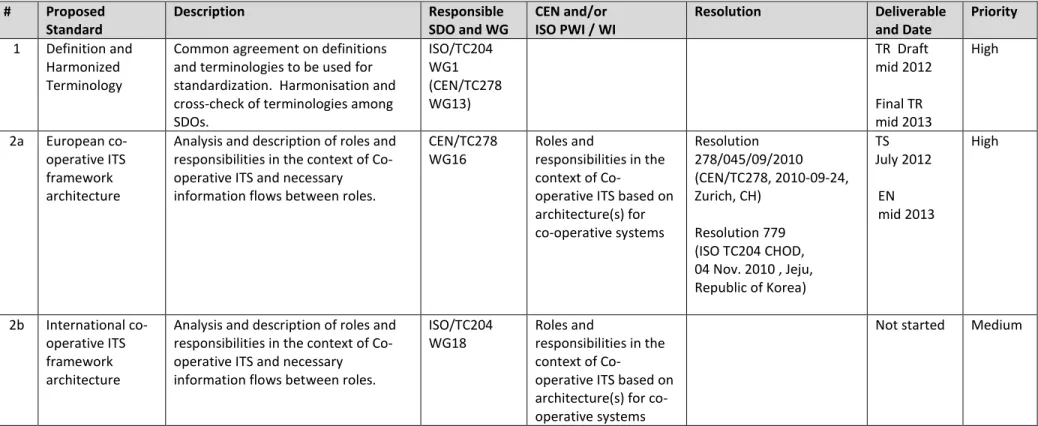
Table 1: General standards
# Proposed Standard Description Responsible SDO and WG CEN and/or ISO PWI / WI Resolution Deliverable and Date Priority 1 Definition and Harmonized Terminology
Common agreement on definitions and terminologies to be used for standardization. Harmonisation and cross-check of terminologies among SDOs. ISO/TC204 WG1 (CEN/TC278 WG13) TR Draft mid 2012 Final TR mid 2013 High 2a European co-operative ITS framework architecture
Analysis and description of roles and responsibilities in the context of Co-operative ITS and necessary information flows between roles.
CEN/TC278 WG16
Roles and
responsibilities in the context of
Co-operative ITS based on architecture(s) for co-operative systems Resolution 278/045/09/2010 (CEN/TC278, 2010-09-24, Zurich, CH) Resolution 779 (ISO TC204 CHOD, 04 Nov. 2010 , Jeju, Republic of Korea) TS July 2012 EN mid 2013 High 2b International co-operative ITS framework architecture
Analysis and description of roles and responsibilities in the context of Co-operative ITS and necessary information flows between roles.
ISO/TC204 WG18
Roles and
responsibilities in the context of
Co-operative ITS based on architecture(s) for co-operative systems
# Proposed Standard Description Responsible SDO and WG CEN and/or ISO PWI / WI Resolution Deliverable and Date Priority 3 Common Data Dictionary
Common definition and description of data elements, data frames to be used inside station and in transmitted messages. This common data dictionary will allow different in-vehicle system and road infrastructure system to have a common base of data. CEN/TC278 WG13 (ISO/TC204 WG1) TR mid 2012 High
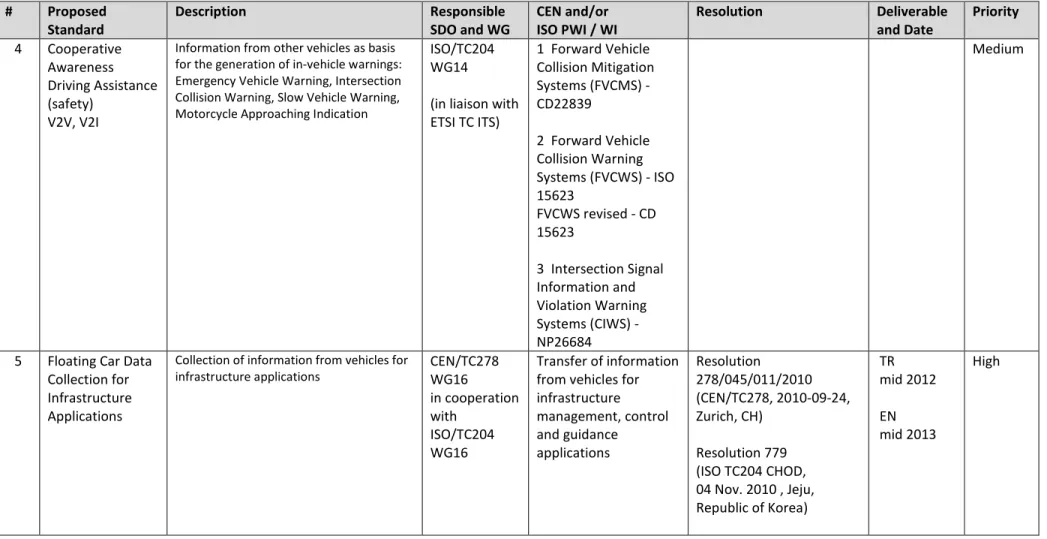
Table 2: Applications # Proposed Standard Description Responsible SDO and WG CEN and/or ISO PWI / WI Resolution Deliverable and Date Priority 4 Cooperative Awareness Driving Assistance (safety) V2V, V2I
Information from other vehicles as basis for the generation of in-vehicle warnings: Emergency Vehicle Warning, Intersection Collision Warning, Slow Vehicle Warning, Motorcycle Approaching Indication
ISO/TC204 WG14
(in liaison with ETSI TC ITS) 1 Forward Vehicle Collision Mitigation Systems (FVCMS) - CD22839 2 Forward Vehicle Collision Warning Systems (FVCWS) - ISO 15623 FVCWS revised - CD 15623 3 Intersection Signal Information and Violation Warning Systems (CIWS) - NP26684 Medium
5 Floating Car Data
Collection for Infrastructure Applications
Collection of information from vehicles for infrastructure applications CEN/TC278 WG16 in cooperation with ISO/TC204 WG16 Transfer of information from vehicles for infrastructure management, control and guidance applications Resolution 278/045/011/2010 (CEN/TC278, 2010-09-24, Zurich, CH) Resolution 779 (ISO TC204 CHOD, 04 Nov. 2010 , Jeju, Republic of Korea) TR mid 2012 EN mid 2013 High
# Proposed Standard Description Responsible SDO and WG CEN and/or ISO PWI / WI Resolution Deliverable and Date Priority 6 Event Driven Road Hazard Warning V2I
Based on event notification warning messages are sent out:
roadwork warning, wrong way driving warning, collision risk warning from an ITS-S roadside, traffic condition safety warning, weather condition warning
ISO/TC204 WG9
See Annex 2, Part B, Table 6
Medium
7 Traffic
Management
Various applications for traffic management including: optimum traffic throughput via managed or advisory speed limits; centrally determined routing; road network management; overtaking bans for trucks; and monitoring and routing of dangerous goods CEN/TC278 WG16 Involved WGs: CEN/TC278 WG8 ISO/TC204 WG9 1. Contextual speeds; (optimum traffic throughput via mandatory or advisory speed limits) 2. Data exchange specification for in-vehicle presentation of external road and traffic related data; “embedded VMS” Resolution 278/045/012/2010 (CEN/TC278, 2010-09-24, Zurich, CH) Resolution 779 (ISO TC204 CHOD, 04 Nov. 2010 , Jeju, Republic of Korea) Resolution 278/045/010/2010 (CEN/TC278, 2010-09-24, Zurich, CH) Resolution 779 (ISO TC204 CHOD, 04 Nov. 2010 , Jeju, Republic of Korea) TS Autumn 2012 EN mid 2013 TS Autumn 2012 EN mid 2013 High
# Proposed Standard Description Responsible SDO and WG CEN and/or ISO PWI / WI Resolution Deliverable and Date Priority 8 Cooperative Traveller Assistance (V2I)
Navigation considering information received about restricted access, etc. Parking information/booking, POI
ISO/TC204 WG3
Cooperative Traveller Assistance requires both, static and dynamic information. ISO/TC204/WG3 will standardise static information stored in a map database. 3 Work Items: - To identify whole requirements application “Cooperative Traveller Assistance” - To categorise static information as dynamic info - To define
requirements for static information
Medium
9 Value Added
Services
# Proposed Standard Description Responsible SDO and WG CEN and/or ISO PWI / WI Resolution Deliverable and Date Priority 10 Application management for co-operative systems in ITS
To enable real-time technical management of ITS applications for cooperative systems in implementations of ITS stations specified in ISO 21217 and EN 302 665. This real-time management requires, as a prerequisite, offline management, e.g. unique identification of ITS applications and their global registration. Support of the basic set of communication standards ISO CALM complemented by ETSI communication standards, and in support of the basic and extended sets of applications for
co-operative systems in ITS
CEN/TC278 WG16 and ISO/TC204 WG18 1. Classification and management of ITS applications in a global context 2. ITS application requirements for selection of communication profiles Resolution 278/043/15/2009 (CEN/TC 278, 2009-09-11, London, UK) Resolution 739 (ISO TC204 CHOD, 18 Sept. 2009, Barcelona) Resolution 278/043/17/2009 (CEN/TC 278, 2009-09-11, London, UK) Resolution 278/045/013/2010 (CEN/TC278, 2010-09-24, Zurich, CH) Resolution 739 (ISO TC204 CHOD, 18 Sept. 2009, Barcelona) Resolution 777 (ISO TC204 CHOD, 04 Nov. 2010 , Jeju, Republic of Korea) TS mid 2012 EN mid 2013 TS mid 2012 EN mid 2013 High
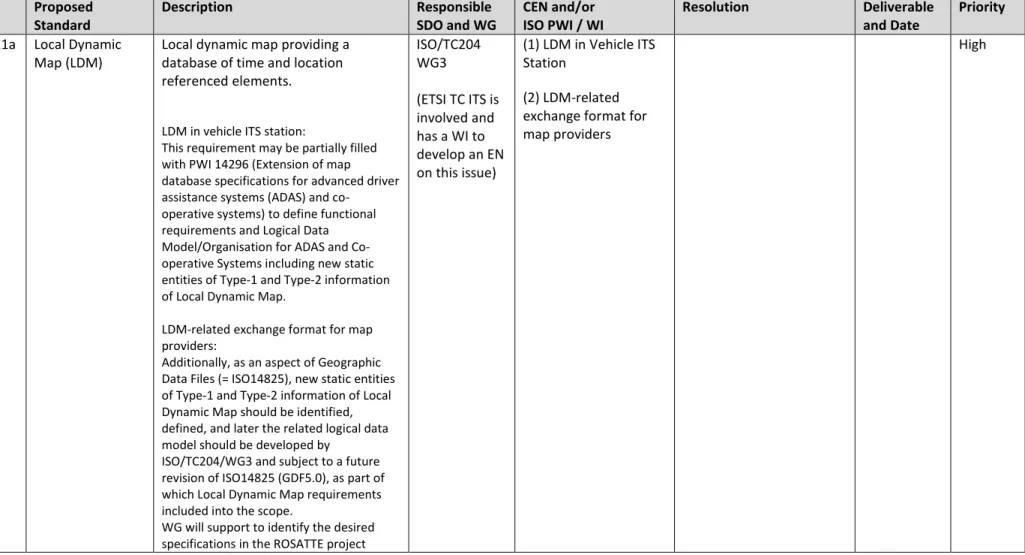
Table 3: Facilities # Proposed Standard Description Responsible SDO and WG CEN and/or ISO PWI / WI Resolution Deliverable and Date Priority
11a Local Dynamic
Map (LDM)
Local dynamic map providing a database of time and location referenced elements.
LDM in vehicle ITS station:
This requirement may be partially filled with PWI 14296 (Extension of map database specifications for advanced driver assistance systems (ADAS) and
co-operative systems) to define functional requirements and Logical Data Model/Organisation for ADAS and Co-operative Systems including new static entities of Type-1 and Type-2 information of Local Dynamic Map.
LDM-related exchange format for map providers:
Additionally, as an aspect of Geographic Data Files (= ISO14825), new static entities of Type-1 and Type-2 information of Local Dynamic Map should be identified, defined, and later the related logical data model should be developed by
ISO/TC204/WG3 and subject to a future revision of ISO14825 (GDF5.0), as part of which Local Dynamic Map requirements included into the scope.
WG will support to identify the desired specifications in the ROSATTE project
ISO/TC204 WG3 (ETSI TC ITS is involved and has a WI to develop an EN on this issue) (1) LDM in Vehicle ITS Station (2) LDM-related exchange format for map providers
# Proposed Standard Description Responsible SDO and WG CEN and/or ISO PWI / WI Resolution Deliverable and Date Priority 11b Local Dynamic Map (LDM) .
Local dynamic map providing a data base of time and location referenced elements CEN/TC278 WG16 and ISO/TC204 WG3 (ETSI TC ITS is involved) Definition of LDM concept Step 1: Description of existing LDM concepts Step 2: Concept definition Results of ETSI STF 404 are taken as input
Resolution 278/043/18/2009 (CEN/TC 278, 2009-09-11, London, UK) Resolution 739 (ISO TC204 CHOD, 18 Sept. 2009, Barcelona) TR Sept. 2011 High 12 Road geometry messages and regulation information provision
This facility provides functionalities to construct, sequence and transmit a message in a common format, providing road and intersection geometry, path and regulation information from road side station to on-coming vehicles
Road geometry messages and regulation information provision requires detailed description of messages (road and intersection geometry, path and regulation information) transmitted from Roadside ITS Station to Vehicle ITS Station. This requirement may be filled with the revised FDIS 24099 (Navigation Data Delivery Structures and Protocols). ISO/TC204 WG3 2 Work Items: - To identify requirements of “Road geometry messages and regulation information provision” - To detail message format and contents (road and intersection geometry, path and regulation information)
Medium
13 Traffic signal phase and timing
This facility provides functionalities to construct, sequence and transmitting a message in a common format,
providing traffic signal phase and timing from road side station to
on-ISO/TC204 WG9
See Annex 2, Part B, Table 6
# Proposed Standard Description Responsible SDO and WG CEN and/or ISO PWI / WI Resolution Deliverable and Date Priority 14 GNSS correction data
This facility provides functionalities to construct, sequence and transmit a message in a common format, providing GNSS correction data or positioning augmentation data from road side station to on-coming vehicles. no WG identified yet Low 15 Localised traffic information
This facility provides functionalities to construct, sequence and transmit a message in a common format, providing localised traffic information from road side station to on-coming vehicles. CEN/TC278 WG4 High 16 Location referencing
This facility provides location referencing functionalities and encoding specifications for geographic position used in V2X messages.
ISO/TC204 WG3
This requirement may be filled with the dynamic Location Referencing of ISO 17572. Further efforts to precisely confirm the requirement/ fulfilment should be expected. High
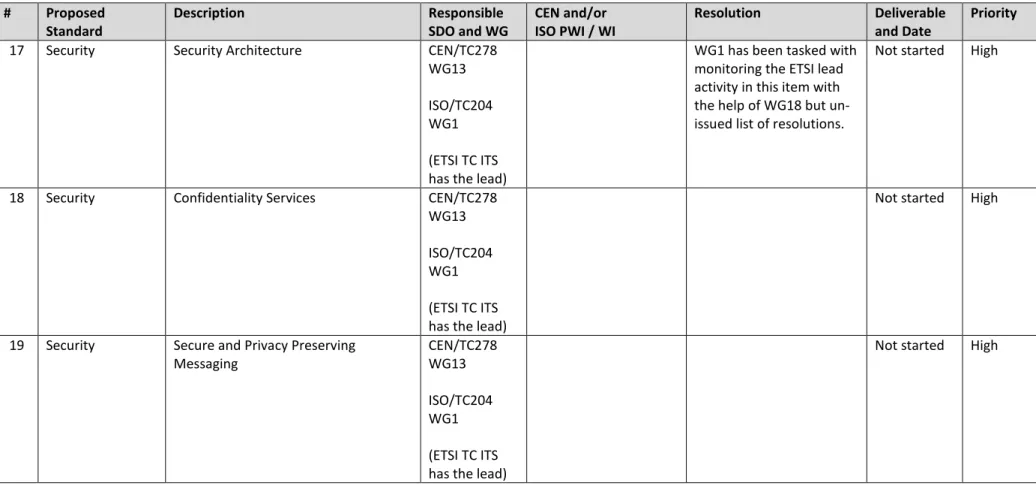
Table 4: Security # Proposed Standard Description Responsible SDO and WG CEN and/or ISO PWI / WI Resolution Deliverable and Date Priority
17 Security Security Architecture CEN/TC278
WG13 ISO/TC204 WG1 (ETSI TC ITS has the lead)
WG1 has been tasked with monitoring the ETSI lead activity in this item with the help of WG18 but un-issued list of resolutions.
Not started High
18 Security Confidentiality Services CEN/TC278
WG13 ISO/TC204 WG1 (ETSI TC ITS has the lead)
Not started High
19 Security Secure and Privacy Preserving
Messaging CEN/TC278 WG13 ISO/TC204 WG1 (ETSI TC ITS has the lead)
Annex 2
Part B:
Relationship between existing and developing standards and Co-operative Systems
The CEN/TC278 and ISO/TC204 Working Groups have started to more fully consider the interaction between existing standards and those required for co-operative systems. In many cases this introduces the challenge to existing and established domain operational models - often in domains that have not have significant exposure to the research and development activities on co-operative ITS. With the potential that co-operative systems offer careful consideration needs to be given about how existing and developing standards and guidance can or need to be adapted. This analysis reaches across each and every of the existing domains covered by the Working Groups of CEN/TC278 and ISO/TC204.
Table 5 and Table 6 illustrate as two examples the relevance of on-going standardization activities; here in ISO/TC204/WG3 (Table 5) and ISO/TC204/WG9 (Table 6), to M/453 activities:
Table 5 (ISO/TC204/WG3)
ISO 14825: Geographic Data Files (GDF 4.0)
FDIS 14825: Geographic Data Files (GDF 5.0)
1. These items basically cover the Type-1 information of Local Dynamic Map.
2. Data dictionary and data models for Geographic objects & properties (digital map database features, attributes, relationships) for road transportation and ADAS offer a common semantic foundation for Co-operative systems.
3. Regarding new static entities (of Type-1 + Type-2 information) of Local Dynamic Map should be identified / defined and later the related logical data model should be developed by ISO TC204 WG3 and subject to a future revision of ISO14825 (GDF5.0), as part of which Local Dynamic Map requirements included into the scope.
4. On the other hand, dynamic objects (of Type-3 + Type-4 information) of Local Dynamic Map should be standardized by ISO/TC204/WG18.
TS 20452:
Requirements and Logical Data Model for a Physical Storage Format (PSF) and an Application Program Interface (API) and Logical Data Organisation for a PSF used in ITS Database Technology
1. This item may partially cover the Logical Data Model / Organization for Type-1 + Type-2 information in a PSF of Local Dynamic Map.
2. Further standardization efforts will be done in the following PWI 14296 in response to new requirements of Local Dynamic Map.
PWI 14296:
Extension of map database specifications for advanced driver assistance systems (ADAS) and cooperative systems
This proposal is to define functional requirements and Logical Data Model/Organization for ADAS and Cooperative Systems including new relevant entities of Type-1 + Type-2 information under development in the Local Dynamic Map initiative undertaken by ETSI TC ITS.
ISO 17572:
Location Referencing
1. This item basically covers the Location Referencing function of Local Dynamic Map. 2. Within a single LDM simple coordinates can identify the location.
3. Between different LDMs dynamic Location Referencing/Location Matching of ISO 17572 can identify the location.
(As the positioning information transmitted from other sources may originate from other maps or sensors, the information should be map-matched and location-decoded as soon as the data are received.)
ISO 17267:
Application Programming Interface (API)
1. This item basically covers the API to access Type-1 information of Local Dynamic Map.
2. To make applications enable to access new static entities (of Type-1 + Type-2 information) of Local Dynamic Map and dynamic objects (of Type-3 + Type-4 information) of Local Dynamic Map, new API function should be standardized if necessary.
Table 6 (ISO/TC204/WG9)
ISO/TC204/WG9 Publications (Nov 2010)
Reference Title
ISO 14827-1:2005 Transport information and control systems -- Data interfaces between centres for transport information and control systems --
Part 1: Message definition requirements
ISO 15784-1:2008 Transport information and control systems -- Data interfaces between centres for transport information and control systems --
Part 2: DATEX-ASN
ISO 15784-1:2008 Intelligent transport systems (ITS) -- Data exchange involving roadside modules communication -- Part 1: General principles and
documentation framework of application profiles
ISO 15784-3:2008 Intelligent transport systems (ITS) -- Data exchange involving roadside modules communication -- Part 3: Application profile-data
ISO/TC204/WG9 Work Items (Nov 2010)
ISO/AWI 15784-2 Data Exchange Involving Roadside Modules Communication -- Part 2: Application Profile – SNMP
ISO/DIS 10711 Intelligent Transport Systems -- Interface Protocol and Message Set Definition between Traffic Signal Controllers and
Detectors(IPMSTSCD)
ISO/TC204/WG9 Possible New Work Items
Proposed NP for DATEX II Development
Data Exchange Mechanism and Messaging Rules for Data Dictionary Management Possible NP for signal phase and
timing method
Including pre-emption and transit signal priority. Drawing on work already available in this message set Codification of all roadside signs for
use in in-vehicle signage
Annex 2
Part C:
Financial support from the European Commission to M/453 activities at CEN
Mandate M/453 requires standardization development within a short time frame including ENs, technical specifications and reports. Even with a well planned standardization process in CEN and ISO it is clear that the normal public enquiry and approval process for ENs will take time and require extensive expert resources from the member organisations, national standards bodies' representatives and the standardization organisations. CEN intend to provide proposals for the 2010-2013 ICT standardization work programme suggesting project teams (PT) for expert contributions to the standardization activity in relation to Mandate M/453.
The draft list for PT proposals in 2011 is as follows: First Priority:
• Roles and responsibilities in the context of co-operative ITS based on architecture(s) for cooperative systems (see Annex 2A, Table 1, number 2a)
• Provision of a Common Harmonised Interoperable Data Registry and Dictionary (CHIRD) for ITS (see Annex 2A, Table 1, number 3)
• Application management for co-operative systems in ITS (Classification and management of ITS applications in a global context / ITS application requirements for selection of communication profiles)
(see Annex 2A, Table 2, number 10)
• Harmonisation, coordination, cooperation and information activities (linked to chapter 4 and 7 and to Annex 2B of this report)
Second Priority:
• LDM (LDM in Vehicle ITS Station, LDM-related exchange format for map providers, and definition of LDM concept) (see Annex 2A, Table 3, number 11b)
• Traffic Management: Contextual speeds, optimum traffic throughput via speed limits (see Annex 2A, Table 2, number 7)
• Traffic Management: Data exchange specification for in-vehicle presentation of external road and traffic related data; “embedded VMS” (see Annex 2A, Table 2, number 7)
• Floating Car Data Collection for Infrastructure Applications (Transfer of information from vehicles for infrastructure management, control and guidance applications)