Improved Coral Reef Images Segmentation
using Modified JSEG Algorithm
Mohammad Sameer Aloun
1, Muhammad Suzuri Hitam
1, Wan Nural Jawahir Hj Wan Yussof
1,Abdul Aziz K
Abdul Hamid
1, Zainuddin Bachok
2and Che Din Mohd Safuan
31School of Informatics and Applied Mathematics, 2School of Marine Science and Environment,
3Institute of Oceanography and Environment, Universiti Malaysia Terengganu, Kuala Nerus, Terengganu, Malaysia [email protected]
Abstract—Underwater coral reef image segmentation suffers
from various challenges due to various factors especially variation in illumination, different water turbidity, different water depth, variation in color, texture and shape of the coral reef species. In this paper, we modified an original automatic color image segmentation called JSEG to enable better coral reef segmentation process. The modification involves the substitution of General Lloyd Algorithm and agglomerative algorithm in the original JSEG version with the k-means algorithm. In addition, the newly modified JSEG algorithm process image in L*a*b color space to provide better processing of underwater image color property while k-means algorithm is used to segment the color within the specified cluster number. The experimental results showed that the modified JSEG algorithm could segment the coral reefs better than the original JSEG algorithm.
Index Terms—Clustering; Color Quantization; JSEG;
K-Means Algorithm; Segmentation. I. INTRODUCTION
The process of image segmentation plays an important role in image processing. It involves segmenting a region or an object of interest in an image so that further processing can be carried out in image analysis [1]. For this reason, image segmentation is used in a variety of fields such as in industrial application, medical image analysis, image retrieval. Since its inception in the 1970s, many researchers have proposed various segmentation algorithms for image segmentation. Its capability in segmenting object of interest depends on the nature of the object or region to be segmented. Thus, various approaches have been employed depending on specific image property such as edge, color, texture. Thus, different segmentation algorithms work differently depending on the nature of the region or object of interest to be segmented as well as the nature of specific applications.
One of the popular and effective methods for fully unsupervised color image segmentation is called JSEG. The JSEG method was proposed by Deng et al. [2] to automatically segment color-texture region in an image or video. In the JSEG algorithm, it assumed that an image contains homogenous (uniformly distributed) color-texture patterns or regions where color information can be quantized into a few color regions and the color in the two neighboring regions is perceptually distinguishable. These assumptions made the JSEG algorithm failed to discriminate between two neighboring regions that are similar in color, but vary in texture [3].
Notwithstanding its robustness in varying natural images,
JSEG algorithm still has some significant limitations including over segmentation problem. Deng et al. [2] also highlighted that the original JSEG suffers from spatially varying illumination. In the case of coral reefs image segmentation, the original JSEG method does not perform well for underwater image segmentation due to the aforementioned limitations as well as difficulty in distinguishing between different color-textures regions.
It should be highlighted that underwater images possess these challenges due to in an underwater environment, light were absorbed and scattered as water depth deepens. In addition, the clarity of underwater is much affected by different water turbidity due to various underwater particles and other disturbances. The light is reflected upon reaching the suspended particles floating in the water. This has causes change in the colors of images due to different light levels attenuation at differing wavelengths as well as different water level. Consequently, different in illumination caused image quality degrades and loss of contrast and brightness in the captured underwater images.
Marine scientists are in urgent need for a robust segmentation method for analyzing the coral reefs [4]. There have been many conservation programs and monitoring surveys globally for the purpose of preserving the coral reefs. Some basic segmentation method could be used by marine scientists for making the process of monitoring and surveying of the coral reefs easier and more efficient [5]. Among others, these include a method for the estimation of live coral, dead coral, rubble, sand. from a still image or video sequences.
The challenge for efficient segmentation is even more difficult because coral reefs grow in various form of color, texture and shape. At different water depth, the coral reefs will perceptually look different in color although it comes from similar species. In this paper, the algorithm of JSEG is applied to segment 4 type of regions in coral reef images; live coral, dead coral, sand and unknown region. The original JSEG algorithm has been proven to be highly robust on numerous natural images. However, it does not perform well for coral reef images segmentation; although it has been proven to be successfully applied in other natural scene images.
This paper is organized as follows. Section II provides a related works. Section III describes the theory of clustering and segmentation; Section IV presents implementation of JSEG. Section V describes the methodology used in this work and section VII presents the experimental results and discussion and the final conclusion is given in Section 7.
II. RELATED WORK
Based on the relation between the pixels in their local neighborhood, segmentation methods can be classified into two main categories; pixel that exhibit discontinuity and pixel that exhibit similarity. In the former category, to segment an image, a boundary based methods are used while in the later, region based methods are employed. Segmentation of natural scene can also be conducted using other methods such as JSEG cuts [2], normalized cuts [6], and mean shift cuts [7].
JSEG has been used by many researchers. However, due to some of its limitations, several modifications and alterations have been made in the past. Zheng et al. [8] introduced JSEG by including a fuzzy mechanism to construct a soft class map. The use of a soft class map makes JSEG superior and robust in unsupervised image segmentation than the original JSEG method. Their method has the ability to segment images even when there are smooth color transitions in the region of the object. Another modified JSEG method was proposed by Chang et al. [9] called the improved contrast JSEG (ICJSEG). This method allows segmentation based on both color and texture, and creates a map that represents the basic contours of the homogenous regions in the image. Noise is removed from the image and edge strength is enhanced to create a high contrast map by using two techniques known as the two serial type-based filters and the noise-protected edge detector.
Wang et al. [10] proposed another method where the image is also segmented based on color and texture. In this method, a combination of directional operators and the JSEG algorithm was used. This method identifies textural homogeneity and color discontinuity in local regions. Testing of color images resulted in an improvement in segmentation performance. Another method proposed by Kibria and Islam [11] improved the JSEG color image segmentation algorithm by integrating an edge detector. This method is able to detect edges between neighboring segments in a way that mimics human perception.
Recently, the combination of the original JSEG algorithm and a local fractal operator was proposed by Komati et al. [12]. In this method, the local fractal operator measures the fractal dimension of individual pixels, which enhances the boundaries and edges in the map. Later, three more JSEG modified techniques, called the Fractal-JSEG, Fractal-only and Local-FD, were shown to improve boundary detection and segmentation results [13]. Another method used fractal dimension approach to improve the accuracy of multi-class image semantic segmentation [14]. This method used to determine how a class specific value for a region merging parameter will improve the segmentation accuracy.
A novel approach for color image segmentation was suggested by Kumar et al. [15] where JSEG is applied on satellite image in the form of RGB. This method simplifies the texture and color of the satellite image in the form of RGB, without having to manually adjust the parameters for each image individually.
JSEG is powerful and successful on many types of natural image segmentation, however it frequently fails to accurately reproduce the segmented salient objects [16]. The main factor for these unsatisfactory results is due to JSEG algorithm has issue in curing the spatial difference of illumination, which generally leads to over-segmentation. Kaur and Randhawa [17] proposed modify means with JSEG where modified k-means is used to handle the noise and solve the problem of parameter evolution in the original k-means.
III. IMAGE CLUSTERING AND SEGMENTATION
Image clustering refers to separating image regions into several meaningful classes based on certain image properties such as color, texture and shape while image segmentation refers to segmenting region or object of interest in the image for extracting its properties from the background. Image clustering is carried out in unsupervised way where the algorithm could not determine which class it belongs to [19]. On the other hand, image segmentation is a supervised process where user has to point out the segment or class of interest for any targeted or desired purpose [20]. There are many methods for image clustering and segmentation in the literatures, each of which are normally performing very well on specific applications. One of the most popular clustering methods is perhaps the k-means algorithm [18]. This popularity is perhaps due to it is a simple pixel based method with low complexity and can work with large number of variable.
IV. ORIGINAL JSEGALGORITHM
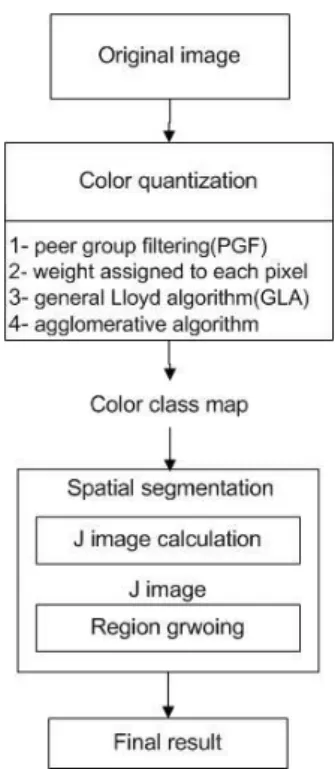
Basically, the original JSEG algorithm [2] composed of two main phase; the color quantization and spatial segmentation. The objective of the first phase is to remove noise in the image, smoothen it and finally reduce the number of colors in a given image so that it is representative to differentiate between different classes. In the second phase, spatial segmentation is carried out where the homogeneity of a region is calculated by using the concept of J-values. Figure 1 shows the general flow of the JSEG algorithm.
Figure 1: The flow of the original JSEG algorithm.
A. Color Quantization
The color quantization primarily aims to decrease the number of colors of the original image in order to mitigate the algorithm complexity. The colors in the given image are reduced by the Peer Group Filtering (PGF) algorithm [21] to quantize region with similar color where several representative classes are used to differentiate regions in the
image. The PGF algorithm refers to a nonlinear algorithm to smooth image and to remove impulsive noise at the same time maintain the edge and other information details. The output of this process is values representing the smoothness of the local areas.
By postulating that human vision perception is more sensitive to changes in smooth areas as compared to textured areas, the color quantization process is given more focus to smooth areas as compared to the textured areas. Thus, the second step in color quantization process is to assign weight to each pixel such that smooth areas are given more weight as compared to textured areas.
The third step in color quantization process is applying a modified General Lloyd Algorithm (GLA) [22] to vector quantize the pixel colors. The CIE LUV color space is used in this process. Finally, an agglomerative clustering algorithm [23] is employed on cluster centroids to merge clusters that are located close to each other based on certain preset threshold value defined by the user.
The resulting outcome is a class-map that relates a color class label to every pixel that belongs to the class. In this stage, the information of the color of the input image is replaced by a mitigated set of significant colors (from 10 to 20 colors) [24, 25].
This process is performed in color space without considering the spatial distributions of the color in the image. The output of this process is color class labels forming a class-map of the image [2].
B. Spatial Segmentation Algorithm
To perform spatial segmentation, the concept of J-value is employed. Consider for instance, let Z be the set of (x, y) image pixels within a specific class map. Z is classified into C classes Zi, i = 1, . . . , C, with m as the spatial mean of the entire points in Z, and the spatial mean of pixels in Zi is denoted by mi, then the total variance of the entire Z points are represented by the following [2].
𝑆𝑇 = ∑ ||𝑧 − 𝑚
𝑧∊𝑍
|| 2
(1)
We can calculate the total variance of points belonging to the same class as follows:
𝑆
𝑤= ∑ ∑ ||𝑧 − 𝑚
𝑖||
2𝑧∊𝑍𝑖
𝑐
𝑖=1 (2)
A measure of the distribution of color classes is then given by J-value as:
𝐽 =
(𝑆
𝑇− 𝑆
𝑤)
𝑆
𝑤(3)
This concept of J values is applied to local area of the class map so that it will provide a good indicator either a particular area is in the region center or near region boundaries. The introduction of this concept has led to the introduction of J-image concept. The J-images is a gray scale image whose pixel values are the J values obtained after its computation over local windows centered on these pixels. The local J values are calculated at varying scales. Table 1 shows the window size of different scales. The higher J value indicates
that the classes are more separated from each other and the members within each class are closer to each other, and vice versa. The following step in the spatial segmentation is applying the region growing algorithm followed by region merging. In region growing, two stages of interactive process are carried out, i.e. valley determination and valley growing. In the beginning of the region growing process, it starts with one single initial region, i.e., the whole image. Thus, the largest scale (largest window size) is used in this process until it repeats to the smallest scale (lowest window size) in Table 1. The region that has smallest J values are called valleys. Therefore, valley determination and valley growing process will repeat until certain preset threshold value is met. After region growing process, regions are merged based on the color similarity by using agglomerative method [23].
Table 1.
The scale related with window size
Scale Window (Pixel) Region Size (Pixels) 1 9 x 9 64 x 64 2 17 x 17 128 x 128 3 33 x 33 256 x 256 4 65 x 65 512 x 512 V. THE PROPOSED METHODOLOGY
In this paper, we replace the first few steps in color quantization phase of the original JSEG algorithm with k-means algorithm [26]. Instead of processing the image in CIE LUV color space in the original JSEG algorithm, we use L*a*b color model. The following sub-section describes further detail the different between the original color quantization and the modified color quantization. Due to this modification, we call the new modified algorithm as modified JSEG.
The following is the modified step in the color quantization stage of the modified JSEG algorithm.
i. Read image.
ii. Convert the original image to L*a*b color space. iii. Classify the colors in 'a*b*' space using k-means
Clustering.
iv. Label every pixel in the image using the results from k-means.
v. Create images that segment the image by color vi. Separate each group of colors.
vii. Complete the steps after color quantization as in the original JSEG algorithm.
A. K-Means Algorithm
In this paper, K means algorithm [27] is used to cluster the image color. Before computing the color class map, we need to select number of clusters to be used. In this particular work, we have selected 4 clusters to be used. The algorithm is computed based on the following steps:
i. Select the number of clusters.
ii. Produce k random points as center for clusters. iii. allocate each point to the closest cluster center, iv. Recalculate the new cluster centers.
v. Repeat the last two previous steps until no change between old and new centers
Figure 2: Modified JSEG algorithm.
VI. EXPERIMENTAL RESULTS
|In this paper, the performance of the proposed method was tested on the coral reef images obtained from the Institute of Oceanography and Environment, University Malaysia Terengganu (INOS), Malaysia. The aim of the experiment is to automatically segment four (4) types of regions in the coral reef image, i.e. live coral, dead coral, sand and unknown region. Normally, these segmentation process is being carried out manually by the marine scientists to estimate the coral reefs population growth.
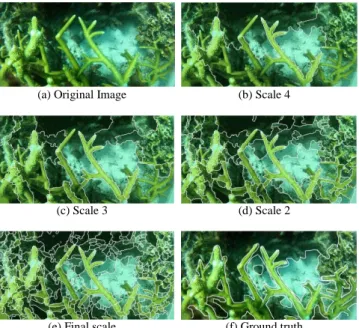
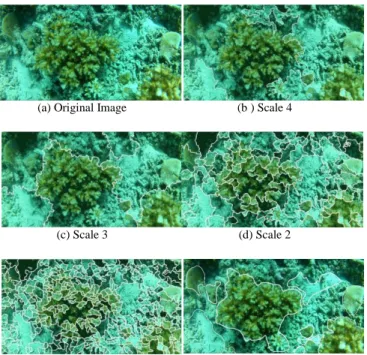
Figure 3 to Figure 8 show the results of segmentation method by original JSEG and modified JSEG on 3 sample coral reefs images with different environment. Figure 3, Figure 5 and Figure 7 show the results of image segmentation by original JSEG segmentation algorithm where it can be clearly observed in these figures that when the scale of the segmentation is set too low, it leads to under segmentation. Whereas, if the scale is set to too high, it resulted in over segmentation. Therefore, it is very difficult to find the correct scale that leads to the best segmentation results of four (4) types of region by using original JSEG algorithm. Although this algorithm can automatically segment the four (4) desired regions, but it has the problem of either under or over segmentation. The user has to find the correct setting of the scale to be used for segmenting the region in these figures.
In contrast to original JSEG algorithm, the modified JSEG operates with direct segmentation of the 4 regions in the image. The color quantization stage in original JSEG algorithm has been replaced with color segmentation process where the k-means algorithm automatically segments each group separately and later map these color cluster into color class map of the original JSEG algorithm. The rest of the algorithm still following the original JSEG algorithm. As can be observed in Figure 4, Figure 6 and Figure 8, all the regions can be separated with each other by the four (4) clusters initialized in k-means algorithm. In these figures, cluster 1, cluster 2, cluster 3 and cluster 4 refer to dead region, unknown region, live coral and sand, respectively. The final image refers to the final segmented image and can be compared directly to their respective counterpart in the original JSEG algorithm. The final segmented regions is perceptually better as compared to the final segmentation region produced by original JSEG algorithm.
(a) Original Image (b) Scale 4
(c) Scale 3 (d) Scale 2
(e) Final scale (f) Ground truth Figure 3: The segmentation results from the original JSEG algorithm for
image number 1.
Figure 4: The segmentation results from the modified JSEG for image number 1
(a) Original Image (b ) Scale 4 (a) The original image (b) Cluster 1 (dead coral)
(c) Cluster 2 (unknown region) (d) Cluster 3 (live coral)
(e) Cluster 4 (sand) (f) Final segmented region
(c) Scale 3 (d) Scale 2
(e) Final scale (f) Ground truth
Figure 5: The segmentation results from the original JSEG algorithm for test image number 2.
(a) The original image (b) Cluster 1 (dead coral)
(c) Cluster 2 (unknown region) (d) Cluster 3 (live coral)
(e) Cluster 4 (sand) (f) Final segmented region
(g) Ground truth
Figure 6: The segmentation results from the modified JSEG algorithm for test image number 2.
VII. CONCLUSION
In this paper, we have proposed a modified JSEG algorithm where the color quantization phase in the original JSEG algorithm has been replaced by the color segmentation phase by employing k-means algorithm. The proposed algorithm could automatically segment the regions of the test images better than the original JSEG algorithm. The problem of under segmentation and over segmentation in the original JSEG algorithm has been alleviated by the new implementation. Even though the proposed algorithm could
provide direct segmentation, but some of the regions still been incorrectly segmented. This problem arises due to the complex nature of underwater coral reef images and we intend to solve this problem by using the composition of texture, color and shape in the future research.
(a) Original Image (b ) Scale 4
(c) Scale 3 (d) Scale 2
(e) Final scale (f)Ground truth
Figure 7: The segmentation results from the original JSEG algorithm for test image number 3.
(a) original image (b) Cluster 1 (dead coral)
(c) Cluster 2 (unknown region) (d) Cluster 3 (live coral)
(e) Cluster 4 (sand) (f) Final segmented image
(g) Ground truth
Figure 8: The segmentation results from the modified JSEG algorithm for test image number 3.
REFERENCES
[1] T. H. Duong and L. L. Hoberock, “On Selecting the Best Unsupervised Evaluation Techniques for Image Segmentation,” in Proceedings of the International Conference on Image Processing, Computer Vision, and
Pattern Recognition (IPCV), Japan 2016, pp. 193-198.
[2] Y. Deng and B. Manjunath, “Unsupervised segmentation of color-texture regions in images and video,” IEEE Transactions on Pattern
Analysis and Machine Intelligence, vol. 23, no, 8, pp. 800-810, 2001.
[3] J. Zhang, Y.-W. Gao, S.-W. Feng, Z.-H. Chen, and Y.-B. Yuan, “Image segmentation with texture clustering based JSEG,” in 2015 International Conference on Machine Learning and Cybernetics
(ICMLC), 2015, pp. 599-603.
[4] K. Iqbal, R. Abdul Salam, M. Osman, and A. Z. Talib, “Underwater image enhancement using an integrated colour model,” IAENG
International Journal of Computer Science, vol. 32, no, 2, pp. 239-244,
2007.
[5] J. Y. Chiang and Y.-C. Chen, “Underwater image enhancement by wavelength compensation and dehazing,” IEEE Transactions on Image
Processing, vol. 21, no. 4, pp. 1756-1769, 2012.
[6] Y. Geng, J. Chen, and L. Wang, “A novel color image segmentation algorithm based on JSEG and Normalized Cuts,” in Image and Signal
Processing (CISP), 2013 6th International Congress on, 2013, pp.
550-554.
[7] D. Kavya and C. D. Desai, “Comparative Analysis of K means clustering sequentially and parallely,” International research journal
of engineering and technology (IRJET), vol. 3, no. 4, pp. 2311-2315,
2016.
[8] Y. Zheng, J. Yang, and Y. Zhou, “Unsupervised segmentation on image with JSEG using soft class map,” in Intelligent Data Engineering and
Automated Learning–IDEAL, 2004, pp. 197-202.
[9] Y.-C. Chang, D.-J. Lee, and Y.-G. Wang, “Color-texture segmentation of medical images based on local contrast information,” in CIBCB'07. IEEE Symposium on Computational Intelligence and Bioinformatics
and Computational Biology, 2007, pp. 488-493.
[10] Y.-G. Wang, J. Yang, and Y.-C. Chang, “Color–texture image segmentation by integrating directional operators into JSEG method,”
Pattern Recognition Letters, vol. 27, no. 16, pp. 1983-1990, 2006.
[11] A. G. Kibria and M. M. Islam, “Reduction of over segmentation in JSEG using canny edge detector,” in 2012 International Conference on
Informatics, Electronics & Vision (ICIEV) , 2012, pp. 65-69.
[12] K. S. Komati, E. O. Salles, and M. Sarcinelli Filho, “Fractal-JSEG: JSEG using an homogeneity measurement based on local fractal descriptor,” in 2009 XXII Brazilian Symposium on Computer Graphics
and Image Processing (SIBGRAPI), 2009, pp. 253-260.
[13] Y. Chang, J. K. Archibald, Y.-g. Wang, and D.-j. Lee, “Texture-based color image segmentation using local contrast information,”
International Journal of Information Technology and Intelligent
Computing, vol. 2, no. 4, pp. 12, 2007.
[14] K. Madhu and R. Minu, “Image segmentation using improved JSEG,”
in 2013 International Conference on Pattern Recognition, Informatics
and Mobile Engineering (PRIME), 2013, pp. 37-42.
[15] V. S. Kumar, S. A. SivaPrakasam, E. Naganathan, and M. Kavitha, “Combined approach for colour image segmentation on satellite images,” International Journal of Engineering Research and
Technology, vol. 2, no. 10, pp. 777-780, 2013.
[16] Y. Liu, D. Zhang, G. Lu, and W.-Y. Ma, “A survey of content-based image retrieval with high-level semantics,” Pattern Recognition, vol. 40, no. 1, pp. 262-282, 2007.
[17] A. Kaur and Y. Randhawa, “Image Segmentation using modified K-means algorithm and JSEG method,” International Journal of
Engineering and Computer Science, vol. 3, no. 6, pp. 6760-6766, 2014.
[18] M.-N. Wu, C.-C. Lin, and C.-C. Chang, “Brain tumor detection using color-based k-means clustering segmentation,” in Third International Conference on Intelligent Information Hiding and Multimedia Signal
Processing, 2007, pp. 245-250.
[19] J. Moreira and L. D. F. Costa, “Neural-based color image segmentation and classification using self-organizing maps,” Anais do IX SIBGRAPI,
vol. 12, pp. 47-54, 1996.
[20] K. S. Komati, E. O. Salles, and M. Sarcinelli Filho, “Unsupervised color image segmentation based on local fractal descriptor and J-images,” in 2010 IEEE International Conference on Industrial
Technology (ICIT), 2010, pp. 303-308.
[21] Y. Deng, C. Kenney, M. S. Moore, and B. Manjunath, “Peer group filtering and perceptual color image quantization,” in Proceedings of
the 1999 IEEE International Symposium on Circuits and Systems,1999,
pp. 21-24.
[22] G. Allen and M. Gray Robert, Vector Quantization and Signal
Compression. Spinger US, 1992.
[23] R. O. Duda and P. E. Hart, Pattern Classification and Scene Analysis. New York: Wiley-Interscience, 1973.
[24] T. Wan, N. Canagarajah, and A. Achim, “Multiscale color-texture image segmentation with adaptive region merging,” in IEEE
International Conference on Acoustics, Speech and Signal Processing,
2007, pp. 1213-1216.
[25] K. Abbas and M. Rydh, “Satellite image classification and segmentation by using JSEG segmentation algorithm,” International
Journal of Image, Graphics and Signal Processing, vol. 4, pp. 48-53,
2012.
[26] J. MacQueen, “Some methods for classification and analysis of multivariate observations,” in Proceedings of the Fifth Berkeley
Symposium on Mathematical Statistics and Probability, 1967, pp.
281-297.
[27] F. Meskine, S.N. Bahloul, “Privacy preserving k-means clustering: a survey research”, International Arab Journal of Information