1 Page 1-11 © MAT Journals 2020. All Rights Reserved
Comparison of Different Convolutional Neural
Network Structures Based on Keras
Pooja.V.Magdum*1, Mahadev.S.Patil2
1
Undergraduate Student, Department of Electronics and Telecommunication, Rajaramnagar, Uran Islampur, Maharashtra India
2
Head of Department, Department of Electronics and Telecommunication, Rajaramnagar, Uran Islampur, Maharashtra India
INFO
Corresponding Author:
E-mail Id: *[email protected] DOI: 10.5281/zenodo.3612801 Cite as:
Pooja.V.Magdum, & Mahadev.S.Patil. (2020). Comparison of Different Convolutional Neural Network Structures Based on Keras. Journal of Electronics and Communication Systems, 5(1), 1–11.
http://doi.org/10.5281/zenodo.36128 01
ABSTRACT
Deep learning is subfield of machine learning, which aims to learn hierarchy of features from input data. Deep learning technologies are becoming major approaches for natural signal and information processing like image classification and speech recognition. Deep learning is a technology inspired by functioning of human brain. Convolutional neural network (CNN) becomes very popular for image classification in deep learning. In this paper, it is discussed about the deep learning’s convolutional structures based on Keras. Four different structures of CNN are compared on CPU system with four different combinations of classifiers and activated functions.
Keywords:Convolutional neural network, deep learning, keras
INTRODUCTION
In recent years deep learning has garnered considerable interesting in many research fields such as computer vision and natural language processing. Deep learning is particular subset of machine learning methodologies using artificial neural networks. Deep learning is technology inspired by functioning of human brain. In deep learning networks of artificial
neurons analyze large dataset to
automatically discover underlying patterns without human intervention. Deep learning methods are group of machine learning
methods that can learn features
hierarchically from lower level to higher level by building a deep architecture as shown in Fig. 1.
Figure 1: Basic structure.
One of the most frequently used deep learning method for image classification is
the convolutional neural network.
Common problem in image classification using deep learning is low performance. CNN have fewer connections and hyper parameters that make CNN model easy to
2 Page 1-11 © MAT Journals 2020. All Rights Reserved train and perform slightly worse than other
models. In this paper deep learning convolutional neural network based on keras is deployed using python for binary image classification. Keras is high level neural networks API, written in python and capable of running on top of tensor flow. It was developed with focused on enabling fast experimentations. Use keras if you need deep learning library:
Allows for easy and fast prototyping.
Supports convolutional networks and
recurrent networks as well as
combination of both.
Runs seamlessly on CPU.
In deep learning, consider the neural networks that identify the image based on its features. The extractor of the integrated model should be able to learn extracting of the differentiating features from the training set of images accurately. CNN eliminate the need for manual feature
extraction like traditional features
extraction algorithms such as SIFT,LBP etc. the CNN directly extract the features from a set of raw image data.
BASIC THEORY Neural Network
A neural network is either a biological neural network made up of real biological neurons or artificial neural network for solving artificial intelligence (AI) problems. The connections of biological neurons are modelled as weights as shown in Fig. 2. A positive weight reflects an
excitatory connection, while negative values mean inhibitory connection. All inputs are modified by weight and summed. This activity is referred as linear combinations.
Figure 2: Neural Network.
Convolutional Neural Network
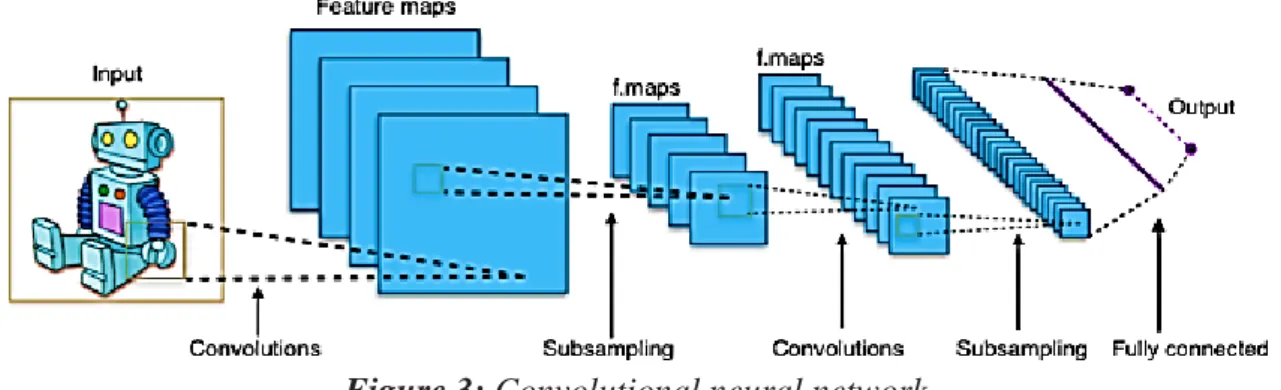
A convolutional neural network consists of an input and output layer as well as multiple hidden layers. Convolutional neural network is special type of feed forward artificial neural network which inspired by visual cortex. In CNN, the neuron in layer is connected small region of the layer before it instead of all the neurons in a fully connected manner so CNN handles fewer amounts of weights. Fig. 3 shows the basic structure of
convolutional neural network. The
working of each layer is described here.
3 Page 1-11 © MAT Journals 2020. All Rights Reserved 1. Input layer: This input layer accepts
input raw images and forwarded to further layers for extracting features. 2. Convolutional layer: In this layer
number of filters is applied on images for finding featured from images. These features are used for calculating the matches at testing phase.
3. ReLu (Rectified Linear Unit): This layer replaces the negative number of the convolutional layer with zero which helps for faster and effective training.
4. Pooling: Extracted features are sent to pooling layer. This layer captures large images and reduces them and reduces the parameters to preserve important
information. It preserves maximum value from each window.
5. Fully connected layer: Final layer is fully connected layer which takes up
high level filtered images and
translates them into labels with categories.
6. Softmax layer: This layer presents before the output layer. This layer gives the decimal probabilities to each class. These probabilities are between 0 and 1.
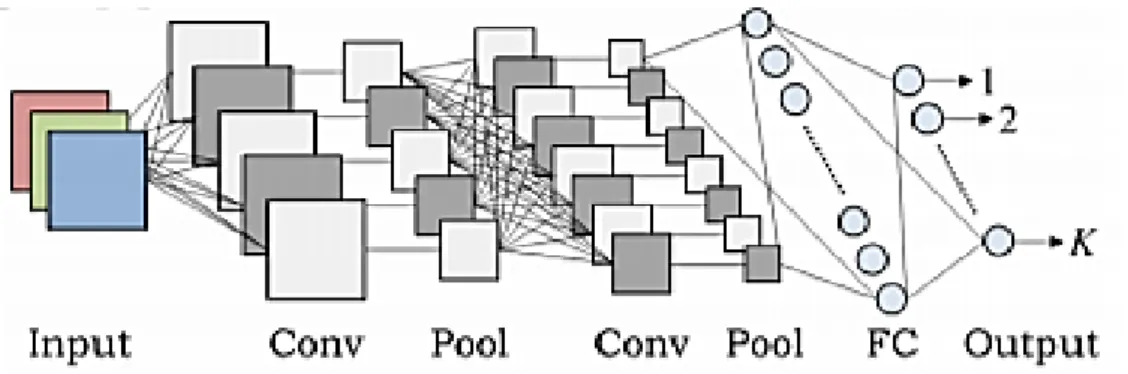
The first four stages are called feature extraction stages and last two stages are called classification stages shown in Fig. 4.
Figure 4: CNN layers. LITERATURE SURVEY
Bharat Hariharan, Pablo Arbel’aez, Ross Girshick, and Jitendra Malik have explained that detects all the instances of category in an image and for each instance mark the pixels that belong to it. They call this task Simultaneous segmentation and detection (SDS). Unlike classical bounding box detection, SDS requires segmentation and not just a box. Unlike classical semantic segmentation requires individual object instances [1].
Hasbi Ash Shiddieqy, Farkhad Ihsan Hariadi and Trio Adioni have explained deep learning algorithm based on convolutional neural network is implemented using python and teflon for image classifications in which two different structures of CNN are used,
namely with two and five layers and it concludes that the CNN with high layer performs classification process with much higher accuracy [2].
Ye Tao, Ming Zhang and Mark Persons have explained a deep learning based algorithm to differentiate photovoltaic events from other grid events and it concludes that a deep convolutional neural network can achieve higher classification accuracy than a fully connected model. Referred to the process of assigning an object label (e.g. building, road, sidewalk, car or pedestrian) to every pixel in an image. These models were trained to maximize the likelihood of the correct classification given in a training set. These approaches were based on hand designed features (e.g. texture) and a higher
4 Page 1-11 © MAT Journals 2020. All Rights Reserved computational time required in the
inference process. Therefore, they focused on estimating the unary potentials of a conditional random field via ensembles of learned features. They proposed an algorithm based on convolutional neural networks to learn local features from training data at different scales and resolutions. Then diversification between these features was exploited using a weighted linear combination. Experiments on a publically available database show effectiveness of the proposed method to perform semantic road scene segmentation in still images [3].
Rui Wang, Wei Li, Runnan Qin and Jin Zhong have explained a convolutional neural network (CNN) of Simplified Fast Alexnet (SFA) based on the learning features was proposed for handling the classification issue of defocus blur, gaussian blur, haze blur and motion blur, four blur types’ images. The experiment result demonstrates that the performance of classification accuracy SFA, which is 96.99% for simulated blur dataset and 92.75% for natural blur dataset is equivalent to Alexnet and superior to other classification methods [4].
Shuai Zhang, Lina Yao and Aixin Sun have explained the ever growing volume of online information recommender systems has been an effective strategy to overcome such information overloaded. The utility of recommender systems cannot be over stated, given its wide spread adoption in many web applications, along with its potential impact to ameliorate many problems related to over choices. In recent years, deep learning has garnered considerable interest in many research fields such as computer vision and natural language processing, owing not only to Steller performance but also attractive property of the learning feature representations from scratch. Influence of deep learning is also pervasive, recently
demonstrating its effectiveness when applied to information retrieval and recommender systems research. Evidently the field of deep learning in recommender system is flourishing. There aims to provide a comprehensive review of recent research efforts on deep learning based recommender systems. More concretely, provide and devise taxonomy of deep learning based recommendation models along with a comprehensive summary of state of the art. Finally expand on current trends and provide new perspectives pertaining to this new exciting development of the field [5].
Zhong Qiu Zhao, Peng Zeng, Shou Tao Xu, and Xindong Wu have explained that due to object detections close relationship with video analysis and image understanding has attracted much in research field and also attention in recent years. Traditional object detection methods are built on hand crafted features and shallow trainable architectures. Their performance easily gets stagnates by constructing complex ensembles which combine multiple low level image features with high level context from object detectors and scene classifiers. With the rapid development in deep learning, more powerful tools which are able to learn semantic, higher level and deeper features were introduced to address the problems existing in traditional architectures. These models behave differently in network architecture; training strategy and optimization function etc. provide a review on deep learning based object detection frameworks. Review begins with a brief introduction on the history of deep learning and its representative tools namely convolutional neural network (CNN). Focus on typical generic object detection architectures along with some modifications and useful tricks to improve detection performance starts further. As distinct specific detection tasks exhibit different characteristics also briefly
5 Page 1-11 © MAT Journals 2020. All Rights Reserved survey different specific tasks including
silent object detection, face detection and pedestrian detection. Experimental analysis provided to compare various methods and draw some meaningful conclusions. Finally several promising directions and tasks were provided to serve as guidelines for future work in both object detection and relevant neural network based learning systems [6].
Asif Ullah Khan, Anabia Sohail, Umme Zahoora and Aqsa Saeed Qureshi have explained deep convolutional neural networks which are special type of neural networks shown in state of the art performance on various competitive benchmarks. The powerful learning ability of deep CNN was largely due to the use of multiple feature extraction stages (hidden layers) that can automatically learn representations from the data. Availability of large amount of data and improvements in the hard processing units has accelerated research in CNNs and recently very interesting deep CNN architectures was reported. The recent race in developing CNNs shows that the innovative architectural ideas as well as parameter optimization can improve CNN performance. In this regard, different ideas in the CNN designs have been explored such as the use of different activation and loss functions, parameter optimization and regularization and reconstructing of the processing units. However the major improvement in representational capacity of deep CNN was achieved by reconstructing of processing units. Especially, the idea of using block as a structural unit instead of layer was receiving substantial attentions. This survey thus focused on the intrinsic taxonomy present in the recently reported deep CNN architectures and consequently and classifies the recent innovations in CNN architectures into seven different categories. These seven categories were based on spatial exploitation, depth, multi
path, width, future map exploitation, channel boosting and attention. Additionally this survey also covered the elementary understanding of CNN components and shed lights on its current challenges and applications [7].
Saptarshi Sengupta, Sanchita Basak, Pallabi Saikia, Vasilios Tsalavoutis, Frederick Ditliac Atiah, Vadlamani Ravi and Richard Alan Peters have explained that the deep learning has solved problems that was little as five years ago and was thought by many to be intractable the automatic recognition of patterns in data and it can also do so with an accuracy that often surpass that of human being. It has solved problems beyond the realm of traditional hand crafted machine learning algorithms and captured the imagination of practitioners trying to make sense out of the flood of data that now inundates our society. As public awareness of efficacy of deep learning increases so does the desire to make use of it. But even for highly trained professionals it could be daunting to approach rapidly increasing body of knowledge produced by experts in the field. Where does one starts? How does one determine if particular deep learning model is applicable to their problem? How does one train deploy such a network? Is a primer on the subject that good place to start with that in mind present an overview of some of the key multilayer artificial neural networks that comprise deep learning. Also some new automatic architecture optimization protocol that use multi agent approaches. Further since guaranteeing system uptime has become critical to many computer applications including section on using neural networks for fault detection and subsequent mitigation. This was followed by exploratory survey of several application areas where deep learning is emerged as game changing technology, anomalous behavior detection in financial applications or in financial time series forecasting,
6 Page 1-11 © MAT Journals 2020. All Rights Reserved predictive and prescriptive analytics and
medical image processing and analysis and power system research. The thrust of this review was outline emerging areas of application oriented research with in the deep learning community as well as to provide a handy reference to researchers seeking to use deep learning in their work for what it does best statistical patterns recognition with unparalleled learning capacity with the ability to scale information [8].
Alex Krizhevsky and IIya Sutskever Geoffrey E. Hinton have explained a large deep convolutional neural network to classify the 1.2 million high resolution images in the ImageNet LSVRC-2010 contest into the 1000 different classes. On the test data achieved top-1 and top-5 error rates of 37.5% and 17% which was considerable better than the previous state of the art. The neural network which has 60 million parameters and 650,000 neurons, consists of 5 convolutional neural layers, some of which followed by max pooling layers and three fully connected layers with a final 1000-way softmax. To make training faster, they used non saturating neurons and a very efficient GPU implementation of the convolutional operation. To reduce over fitting in the fully connected layers employed, a recently developed regularization method called “dropout” that proved to be very effective. Also entered variant of this model in the ILSVRC-2012 competition and achieved in winning the top test error rate of 15.3% compared to 26.2 % by the second best entry [9].
Sajja Tulsi Krishna and Hemantha Kumar Kalluri have explained deep learning is one of the machine learning areas applied in recent areas. Various techniques have been proposed depends on verity of learning including unsupervised, semi supervised and supervised learning. Some of the experimental results proved that the
deep learning systems performed well compared to conventional machine learning systems in image processing, computer vision and pattern recognition. Provides a brief survey beginning with deep neural network (DNN) in deep learning, the survey moved on the convolutional neural area network (CNN) and its architectures such as LeNet, AlexNet, GoogleNet, VGG16, VGG19, Resnet50 etc. included transfer learning by using the CNNs pre-trained architectures. These architectures are tested with large ImageNet data sets. The deep learning techniques were analyzed with the help of most popular datasets which are freely available on web. Based on this survey concludes the performance of the system depends on the GPU systems more number of images per class epochs, mini batch size [10].
Karan Chauhan and Shrawan Ram have explained deep learning technologies are becoming the major approaches for natural signal and information processing like image classification and speech recognition. Deep learning is technology inspired by the human brain. In deep learning networks of artificial neurons analyze large dataset to automatically discover underlying patterns without human intervention, deep learning identify patterns in unconstructed data such as images, sound, video and text. Convolutional neural networks are becoming very popular for image classification in deep learning. CNNs perform better than human subjects on many of the image classification datasets. Deep learning convolutional neural network based keras and tensorflow is deployed using python for binary image classifications. In this study number of different images which contain two types of image animals namely cat and dog are used for image classification. For binary image classification combination of sigmoid classifier Relu activation function
7 Page 1-11 © MAT Journals 2020. All Rights Reserved gives higher classification accuracy other
than any other combination of classifier and activation filter [11].
Lei Maa, Yu Liu, Xueliang Zhanga, Yuanxin Ye, Gaofei Yin and Brian Alan Johnson have explained that deep learning algorithms have seen a massive rise in popularity for remote sensing image analysis over the past few years. In this study major DL concepts pertinent to remote sensing are introduced and more than 200 publications in this field most of which were published during the last two years are reviewed an analyzed. Initially a meta-analysis was conducted, analyzed the status of remote sensing DL studies in terms of the study targets, DL models used image spatial resolutions, type of study area and level of classification accuracy achieved. Subsequently detailed review was conducted to describe or discuss how DL gas has been applied for remote sensing image analysis in tasks including image fusion, image registration, scene classification, object detection, land use and land cover (LULC) classification, segmentation and object based image analysis (OBIA). This review covers nearly every application and technology in the field of remote sensing ranging from preprocessing to mapping. Finally conclusion regarding the state of the art methods acritical conclusion on open challenges [12].
Cannor Shorten and Taghi M. Khoshghoftaar have explained that deep convolutional neural networks have performed remarkably well on many computer vision tasks. However these networks are heavily reliant on big data to avoid over fitting. Over fitting refers to the phenomenon when a network learns a function with vary high variance such as to perfectly model the training data. Unfortunately many application domains do not access to big data, such as medical image analysis. This survey focuses on
data augmentation a data space solution to the problem of limited data. Data augmentation encompasses a suite of techniques that enhance the size and quality of training datasets such as that the better deep learning models can be built using them. The image augmentation algorithms discussed in this survey including geometric transformations, color space augmentations, kernel filter, mixing images, random erasing, feature space augmentation adversarial training, generative adversarial networks, neural style transfer and meta-learning. The applications of augmentation methods based on GANs were heavily covered. In addition, augmentation techniques briefly discuss other characteristics of data augmentation such as test time augmentation, resolution impact, final dataset size and curriculum learning. This survey presented exiting methods for data augmentation, promising developments and meta level decisions for implementing data augmentation [13].
Saptarshi Sengupta, Sanchita Basak, Pallabi Saika, Sayak Paul, Vasilios Tsalavoutis, Frederick Dirliac Atiah, Vadlamani Ravi and Richard Alan Peters have explained deep learning which has solved a problem that is little as five years ago thought by many to be intractable the automatic recognition of patterns in data and it can do so with an accuracy that can surpass that of human beings. It has solved problems beyond the realm of traditional, hand- crafted machine learning algorithms and captured the imagination of practitioners trying to make sense out of the flood of data that now inundates our society. As public awareness of efficacy of deep learning increases so does the desire to make use of it. But even for highly trained professionals it can be daunting approach the rapidly increasing body of knowledge produces by experts in the field. Where does one start? How does one determine if a particular deep learning
8 Page 1-11 © MAT Journals 2020. All Rights Reserved model is applicable to their problem? How
does one train and deploy such a network? Is primer on the subject that can be a good place to start? With that in mind, they present an overview of the key multilayer artificial neural networks that compromise deep learning; also discuss some new automatic architectures optimization protocols that use multi agent approaches. Further since guaranteeing systems uptime was becoming critical to many computer applications, including section using neural networks for fault detection and subsequent mitigation. This was followed by an exploratory survey of several application areas where deep learning has emerged as a game changing technology anomalous behavior detection in financial applications or in financial time series fore-casting and power system research [8].
Ajay Shrestha and Ausif Mohmood have explained that deep learning is playing an increasingly important role in our lives. It has made a huge impact in areas such as cancer diagnosis, precision medicine,
self-driving cars, predictive forecasting and speech recognition. The painstakingly handcrafted feature extractors used in traditional learning, classification and pattern recognition system are not scalable for large sized data sets. In many cases, depending on the problem of complexity, DL can also overcome the limitations of earlier shallow networks that prevented efficient taring and abstraction of hierarchical representation of multi- dimensional training data. DNN uses multiple layers of units with highly optimized algorithms and architectures. Reviews on several optimization methods to improve the accuracy of the training to reduce training time and delve into the math behind training algorithms used in recent deep networks. Describe current shortcomings, enhancements and implementations. The review also covers different types of deep architectures such as deep convolutional neural networks, deep residual networks, recurrent neural networks and variational auto encoders [14].
RESEARCH METHODOLOGY
Figure 5: Proposed methodology.
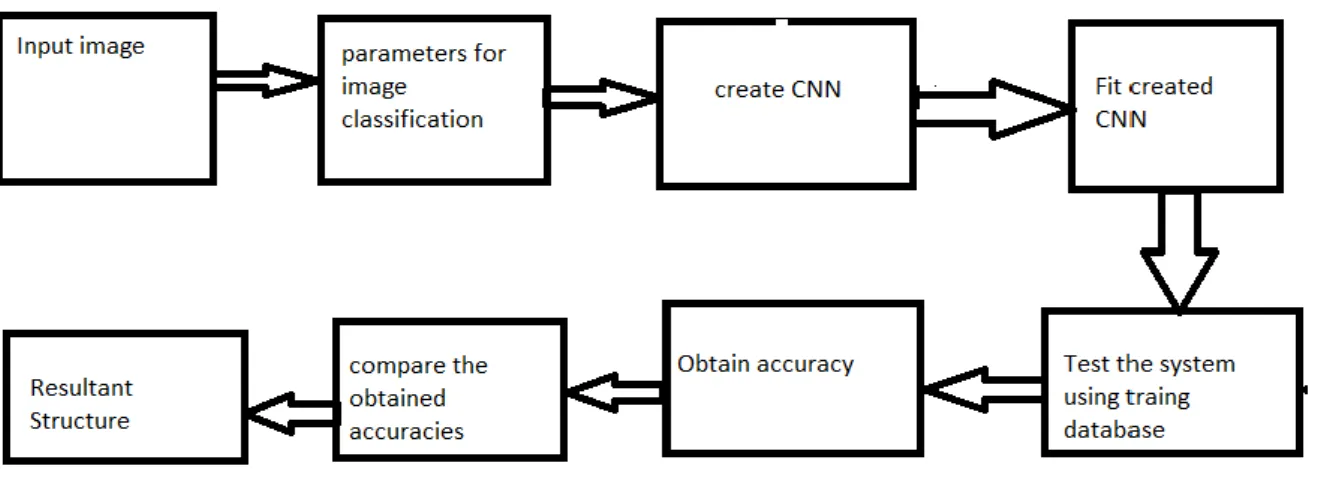
The flow diagram shown in Fig. 5. was the first step image prepared, there are 4 files in this, which contains a lot of images of animals where few images used for training and remaining images were used for testing purpose. Second step defines
parameters for image classifications to python. Third step creates CNN with two convolutional neural layers than we select different combination of activation functions and classifiers for comparison purpose. In next step, it fit the created
9 Page 1-11 © MAT Journals 2020. All Rights Reserved CNN to image dataset and train, test the
system with training and tests datasets respectively. Finally we obtain the accuracy of different CNN structures and compare these accuracies for performance measurement, and then get the resultant CNN structure.
EXPERIMENTAL SETUP AND
RESULTS
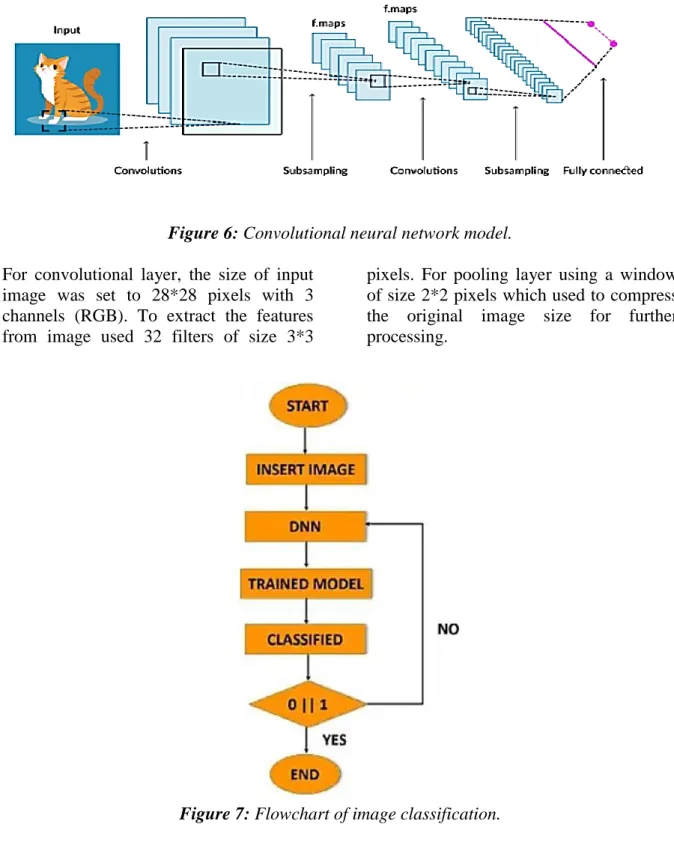
In this paper, performed experiments on windows 10 in python 3.6 on CPU system and create the CNN model based on Keras libraries. The CNN model used for experiments is shown in Fig. 6.
Figure 6: Convolutional neural network model.
For convolutional layer, the size of input image was set to 28*28 pixels with 3 channels (RGB). To extract the features from image used 32 filters of size 3*3
pixels. For pooling layer using a window of size 2*2 pixels which used to compress the original image size for further processing.
10 Page 1-11 © MAT Journals 2020. All Rights Reserved Fig. 7 shows the flowchart of image
classification that will be implemented using Keras. The flowchart shows that the system starts collecting the images of animals. After that DNN is applied to train the model. The process ends after
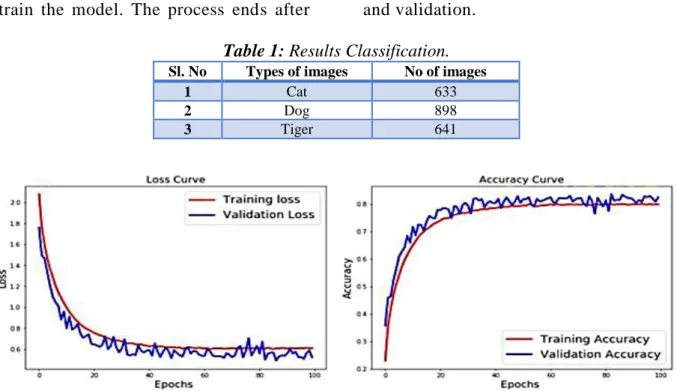
the image is classified into the right type of animals. Also there accuracy of images is shown. Training loss and validation loss is nothing but the already mentioned above images for training and validation.
Table 1: Results Classification.
Sl. No Types of images No of images
1 Cat 633
2 Dog 898
3 Tiger 641
Figure 8: Accuracy Curve.
CONCLUSION
In conclusion, this research is about image classification using deep learning with the help of Keras libraries. Deep learning is a learning method for data analysis and predictions now days it has also become very popular for image classification problems. In this paper, a deep learning convolutional neural network based on Keras and it was deployed using python for binary image classification as shown in Table 1. In this study, it has compared four different structures of CNN on CPU system with different combinations of classifier and activation functions. Displayed results show the accuracy of image detection as sown in Fig. 8. The objectives are linked directly with conclusions because it can determine whether all objectives are successfully achieved or not. It can be concluded that all results that have been obtained, showed quite impressive outcomes. The
convolutional neural network (CNN) becomes the main agenda for this research, especially in image classification technology. CNN technique was studied in more details starting from assembling, training model and to classifying images into categories. The role of CNN was able to control accuracy and also prevent any problems such as fitting. Implementation of deep learning by using keras also gave good results as it is able to simulate, train and classify with up to 90% of accuracy. REFERENCE
1. Bharath Hariharan, Pablo Arbelaez, Ross Girshick, and Jitendra Malik (November, 2014), “Hypercolumns for object segmentation and fine grained localisation”, IEEE, Volume 39, Issue 4, pp.627-639, DOI:10.1109/ TPAMI.2016.2578328. 2. Hasbi Ash Shiddieqy, Farkhad Ishan Haridi, Tri Adiono (2017),
11 Page 1-11 © MAT Journals 2020. All Rights Reserved “Implementation of Deep Learning
based Image Classification on single Board computer”, Int. Symposium on Electronics and Smart Devices (ISESD), pp.133-137, DOI: 10.1109/ ISESD.2017.8253319.
3. Ye Tao, Ming Zhang and Mark Parsons (2017), “Deep Learning in photovoltaic Penetration classification”, IEEE Power and Energy Society General Meeting, pp.1-5, DOI:10.1109/PESGM.2017. 8274395.
4. Rui Wang, Wei Li, Runnan Qin and Jin Zhong Wu (October, 2017), “Blur Image Classification based on Deep Learning”, IEEE Int. Conference, pp. 1-6, DOI: 10.1109/IST.2017.8261503. 5. Zhang, Shuai, Lina Yao, Aixin Sun, and Yi Tay (2019), “Deep learning based recommender system: A survey and new perspectives”, ACM
Computing Surveys (CSUR),
Volume 52, Issue 5, Available at: https://doi.org/10.1145/3285029. 6. Zhong-Qiu Zhao and Peng Zheng and
Shou-tao Xu and Xindong Wu Wu (2018), “Object detection with Deep learning: A Review”, IEEE Transactions on Neural Networks and Learning Systems, Volume 30, Issue 11, pp.3212-3232, DOI: 10.1109/ TNNLS.2018.2876865.
7. Asifullah Khan, Anabia Sohail, Umme Zahoora and Aqsa Saeed Qureshi (2019), “A survey of the recent architecture of deep convolutional neural networks”, pp. 1-69, Available at: https://arxiv.org/ftp/ arxiv/papers/ 1901/1901.06032.pdf. 8. Saptarshi Sengupta, Sanchita Basak,
Pallabi Saikia, Sayak Paul, Vasilios Tsalavoutis, Frederick Ditaliac Atiah, Vadlamani Ravi and Richard Alan Peters 9 July 2019, “A review of deep learning with special emphasis on
Architectures, Applications and Recent Trends”, pp. 1-20, Available at: https://arxiv.org/pdf/1905.13294. pdf.
9. Krizhevsky, Alex, Ilya Sutskever, and Geoffrey E. Hinton (2012), “Imagenet classification with deep convolutional neural networks”, Advances in neural information processing systems, pp. 1097-1105.
10.Sajja Tulasi Krishna and Hemantha Kumar Kalluri (2019), “Deep learning and transfer learning approaches for image application”, Int. J. of Recent Tech. and Eng. (IJRTE), Volume 7, Issue-5S4, pp.427-432, ISSN: 2277-3878.
11.Karan Chauhan and Shrwan Ram (February 2018), “Image classification with Deep learning and comparison between different convolutional neural network structures using tensorflow and Keras”, International Journal of Advance Engineering and Research Development, Volume 5, Issue 02, February 2018.
12.Lei Maa, Yu Liu, Xueliang Zhanga, Yuanxin Ye, Gaofei Yin, Brian Alan Johnson (June, 2019), “Deep learning in remote sensing application”,
Elsevier, Volume 152, pp. 166-177, Available at: https://doi.org/10.1016/ j.isprsjprs.2019.04.015.
13.Connor shorten and Taghi M. Khoshgoftaar (2019), “A survey on image data augmentation for deep learning”, Journal of Big Data, Volume 6, Article 60, DOI: 10.1186/s40537-019-0197-0.
14.Ajay Shrestha and Ausif Mohmood (April, 2019), “Review of Deep learning algorithms and architectures”, IEEE, Volume 7, pp. 53040-53065, DOI:10.1109/ACCESS. 2019.2912200.