Effects of Alcohol Retail Privatization
on Excessive Alcohol Consumption
and Related Harms
A Community Guide Systematic Review
Robert A. Hahn, PhD, MPH, Jennifer Cook Middleton, PhD, Randy Elder, PhD,
Robert Brewer, MD, MSPH, Jonathan Fielding, MD, MPH, MBA, Timothy S. Naimi, MD, MPH,
Traci L. Toomey, PhD, Sajal Chattopadhyay, PhD, Briana Lawrence, MPH,
Carla Alexia Campbell, MHSc, and the Community Preventive Services Task Force
Context:Excessive alcohol consumption is the third-leading cause of preventable death in the U.S. This systematic review is one in a series exploring effectiveness of interventions to reduce alcohol-related harms.
Evidence acquisition:The focus of this review was on studies evaluating the effects of the priva-tization of alcohol retail sales on excessive alcohol consumption and related harms. Using Commu-nity Guidemethods for conducting systematic reviews, a systematic search was conducted in multiple databases up to December 2010. Reference lists of acquired articles and review papers were also scanned for additional studies.
Evidence synthesis:A total of 17 studies assessed the impact of privatizing retail alcohol sales on the per capita alcohol consumption, a well-established proxy for excessive alcohol consumption; 9 of these studies also examined the effects of privatization on the per capita consumption of alcoholic beverages that were not privatized. One cohort study in Finland assessed the impact of privatizing the sales of medium-strength beer (MSB) on self-reported alcohol consumption. One study in Sweden assessed the impact of re-monopolizing the sale of MSB on alcohol-related harms. Across the 17 studies, there was a 44.4% median increase in the per capita sales of privatized beverages in locations that privatized retail alcohol sales (interquartile interval: 4.5% to 122.5%). During the same time period, sales of nonprivatized alcoholic beverages decreased by a median of 2.2% (interquartile interval: ⫺6.6% to⫺0.1%). Privatizing the sale of MSB in Finland was associated with a mean increase in alcohol consumption of 1.7 liters of pure alcohol per person per year. Re-monopolization of the sale of MSB in Sweden was associated with a general reduction in alcohol-related harms.
Conclusions:According toCommunity Guide rules of evidence, there is strong evidence that privatization of retail alcohol sales leads to increases in excessive alcohol consumption.
(Am J Prev Med 2012;42(4):418 – 427) Published by Elsevier Inc. on behalf of American Journal of Preventive Medicine
Context
E
xcessive alcohol consumption, including both binge drinking and underage drinking, is respon-sible for approximately 79,000 deaths per year in the U.S., making it the third-leading cause of preventable death in the nation.1In 2009, approximately 23% of adult drinkers (aged ⱖ18 years) in the U.S. reported binge drinking (consuming fıve or more drinks per occasion for men and four or more drinks per occasion for women) in the past 30 days, as did 25.2% of high school students.2,3 Among full-time college students in 2008, 48.6% of men and 34.4% of women reported binge drinking.4In 2006,From the Community Guide Branch, Epidemiology and Analysis Program Offıce (Hahn, Middleton, Elder, Chattopadhyay, Lawrence, Campbell), National Center for Chronic Disease Prevention and Health Promotion (Brewer), CDC, Atlanta, Georgia; Los Angeles County Department of Health Services (Fielding); University of Minnesota School of Public Health (Toomey), Minneapolis, Minnesota; and the Schools of Medicine and Pub-lic Health (Naimi), Boston University, Boston, Massachusetts
Author affıliations are shown at the time the research was conducted. Names and affıliations of the Task Force members can be found at
www.thecommmunityguide.org/about/task-force-members.html. Address correspondence to: Robert A. Hahn, PhD, MPH, Community Guide Branch, Epidemiology and Analysis Program Offıce, CDC, 1600 Clifton Road, Mailstop E-69, Atlanta GA 30333. E-mail:[email protected].
0749-3797/$36.00
the estimated economic cost of excessive drinking in the U.S. was $223.5 billion.5The reduction of excessive
alco-hol consumption is thus a matter of major public health and economic interest.
Following the end of Prohibition in the U.S. in 1933, some states continued prohibition at the state level. “Control” states allowed alcohol to be sold, but only through government-run retail stores; “license” states al-lowed retail sales by commercial interests.6In all states, wholesale of alcoholic beverages is under state control. Currently, no states prohibit alcohol sales, and the num-ber of states that have retained control over retail sales has been reduced through privatization. However, in all states with government control over certain beverage types, government control is restricted to off-premises sales outlets (i.e., outlets where alcohol is sold for con-sumption elsewhere); government control does not affect theon-premisessale of alcohol in any state.
In the U.S. and Canada, privatization most often affects wine and spirits (e.g., vodka and whiskey). In the U.S., all states and counties that permit the sale of alcohol allow privatized retail sales of beer, and most allow privatized retail sale of all alcoholic beverages. In contrast, in the Scandinavian countries where most other studies of privatization have been conducted, privatization and re-monopolization generally affect beer sales. The National Alcohol Beverage Control Association (NABCA; www. nabca.org) classifıes state retail alcohol sales control pol-icies as shown inTable 1.
The predominant trend in the U.S. and elsewhere is toward relaxing government control over the sale of alco-holic beverages, including by privatizing alcohol sales. The formation of the European Union has also led to a loosening of national control and increased privatization in some member nations.7,8However, because
privatiza-tion could plausibly lead to increases in excessive alcohol consumption and related harms, a public health interven-tion of possible interest to some jurisdicinterven-tions and deci-sion makers may be the reversal of privatization ( re-monopolization) or the maintenance of government control where it exists currently.
This review addresses three research questions related to the effect of privatizing retail sales of alcoholic beverages. (1) Does retail privatization of a specifıc type of alcoholic beverage increase its excessive consumption and associated harms (e.g., alcohol-impaired driving, assaults, and cirrhosis of the liver)? (2) Does privatization of sales of one type of alcoholic beverage also reduce excessive consumption of alcoholic beverages for which sales are not privatized (e.g., does the retail privatization of wine sales lead con-sumers to reduce their consumption of liquor, if liquor sales are still subject to government control)? (3) Does the re-establishment of state control over the retail sales of an
alcoholic beverage (re-monopolization) reduce the ex-cessive consumption of that beverage and the harms re-lated to excessive consumption?
Findings, Recommendations, and
Directives from Other Reviews and
Advisory Groups
The 2010 WHO-sponsored reviewAlcohol: No Ordinary Commodity,8 a consensus narrative review of a broad array of alcohol interventions, assessed government con-trol of the retail sale of alcohol, and rated it 3⫹ (the highest rating) for effectiveness in reducing excessive al-cohol consumption and related harms and for the extent of research supporting the fınding and 2⫹ on cross-cultural testing, suggesting generalizability across set-tings. The cost of implementing government control was rated as low. The reviewers concluded that “the evidence is quite strong that off-premise government control systems limit alcohol consumption and alcohol-related problems,
Table 1.The National Alcohol Beverage Control Association (NABCA;www.nabca.org/) classification of state retail alcohol sales control policies
State Wine Spirits
Alabama Private Government
Idaho Private Government and
agents
Iowa Private Private
Maine Private Agents
Maryland (Montgomery County only)
Government Government
Michigan Private Private
Mississippi Private Private
Montana Private Agents
New Hampshire Private Government
North Carolina Private Government
Ohio Private Agents
Oregon Private Agents
Pennsylvania Government Government
Utah Government and
agents
Government and agents
Vermont Private Agents
Virginia Private Government
Washington Private and
government
Government and agents
West Virginia Private Private
and that elimination of government off-premise monop-olies can increase total alcohol consumption.”8The
pres-ent analysis adds more recpres-ent evidence on effects of priva-tization and applies a more formal protocol to the evaluation and synthesis of available scientifıc evidence on this topic. The intervention reviewed here may be helpful in addressing several national health objectives related to substance abuse prevention, as specifıed in Healthy People 2020.9
Evidence Acquisition
TheGuide to Community Preventive Services(Community Guide) systematic review process was used to assess whether privatization leads to increases in excessive alcohol consumption and related harms. More details on theCommunity Guidereview process are presented elsewhere.10,11In brief, this process involves forming a systematic
review development team; developing a conceptual approach to orga-nizing, grouping, and selecting interventions; prioritizing these inter-ventions; searching for and retrieving the existing research evidence on the effects of the interventions; assessing the quality of each study; abstracting information from each study that meets qualifying criteria; drawing conclusions about the body of evidence on intervention ef-fectiveness; and translating the evidence on effectiveness into recom-mendations. To help ensure objectivity, the systematic review devel-opment team consists of systematic review methodologists and subject matter experts from a range of agencies, organizations, and academic institutions. The review team works under the oversight of the non-federal, independent Community Preventive Services Task Force (Task Force), which directs the work of theCommunity Guide.
The systematic review development team collects and summarizes evidence on (1) the effectiveness of interventions in altering the health-related outcomes of interest; and (2) benefıts and harms of the inter-vention on other health and nonhealth outcomes. When an interven-tion is shown to be effective, informainterven-tion is also included about (3) the applicability (or generalizability) of the evidence to diverse population segments and settings; (4) the economic impact of the intervention; and (5) barriers to implementation. The systematic review develop-ment team then presents the results of this review process to the Task Force, which considers all of the evidence presented and determines whether it is suffıcient to warrant a recommendation for practice or policy.10The rules of evidence under which the Task Force makes its
determination require consideration of several aspects of the body of evidence, including the number of studies of different levels of design suitability and execution, as well as judgments regarding the consis-tency of the fındings, the public health importance of the overall effect size, and the balance of the outcome of interest with other conse-quences of the intervention.
Conceptual Approach and Analytic Framework
Six intermediate consequences of privatization are hypothesized to affect alcohol consumption (Figure 1). First, privatization generally leads to increases in the density of off-premises alcohol outlets.12
Second, privatization may increase the availability of alcohol by increasing the days and hours during which it is sold.13,14Third,
privatization may increase the availability of specifıc types and brands of alcoholic beverages.
Fourth, privatization may affect the retail price of alcohol be-cause of various factors that may either increase or decrease prices;
overall, prices tend to increase with privatization.13,14However,
the wider range of alcohol products typically available in privatized systems may result in more low-priced products that would appeal to high-volume or high-risk drinkers, even if the average price for all alcohol products were similar in state-owned and privatized systems. Fifth, because it introduces competition among alcohol outlets, privatization may lead to increased alcohol advertising in various venues, including TV, radio, billboards, and at the point of purchase.13 Sixth, because of increased numbers of outlets and
less direct governmental control, privatization may lead to de-creased enforcement of and compliance with sales regulations (e.g., minimum-drinking-age laws).15
Many of these consequences of privatization may increase the demand for the privatized beverage, substitution to or from other beverages, and access to alcoholic beverages. In turn, these con-sequences may affect excessive consumption and related harms. In contrast, re-monopolization is expected to have effects oppo-site to those of privatization.
Inclusion and Exclusion Criteria
To qualify as a source of primary evidence for this review, a study had to meet several criteria. It had to evaluate retail privatization or re-newed government control; be conducted in a country with a high-income economy16; be primary research (rather than a review of other
research); be published in English; and have a comparison group and/or compare conditions before and after privatization. Optimally, alcohol consumption in locations that experienced changes in govern-ment control (e.g., privatization) would be compared with alcohol consumption in similar locations that did not experience this change. A study also had to report outcomes related to excessive alcohol consumption or related harms. Some specifıc harms of interest included alcohol-related medical conditions (e.g., liver cirrhosis), alcohol-impaired driving and alcohol-related crashes, uninten-tional injuries, intenuninten-tional injuries, and crime. Government re-ports were included, but unpublished papers were not, as they may be diffıcult for others to access and are not peer-reviewed.
When studies assessed multiple outcomes of interest, those with the strongest known association with excessive alcohol consump-tion were given more weight. Outcome measures in the studies that had the strongest association with excessive alcohol con-sumption included binge drinking, heavy drinking, liver
cirrho-Figure 1. Analytic framework
Note: Privatization of retail sales of alcoholic beverages: Oval indicates intervention; rectangles with rounded corners indicate mediators or intermedi-ate outcomes; rectangles indicintermedi-ate health outcomes.
sis mortality, related hospital admissions, and alcohol-related motor vehicle crashes (or strong proxies for such crashes, e.g., single-vehicle nighttime crashes for alcohol-related motor vehicle crashes).17Less-direct measures included per capita ethanol
con-sumption, a well-recognized proxy for estimating the number of ex-cessive drinkers in a population8,18,19; unintentional injuries; suicide;
and crime (e.g., homicide and aggravated assault).
Cross-sectional and panel studies in which the sequence of events was not taken into account (e.g., counting year as an ordinal variable) were considered secondary evidence in this review. Secondary evi-dence was regarded as useful for generating hypotheses and for strengthening or weakening conclusions based on primary evidence, but was insuffıcient alone for assessing intervention effectiveness. Many of the studies qualifying for this review used per capita alcohol sales as a proxy for excessive drinking. In assessing the quality of study execution, a penalty (described below) was assigned to studies that assessed changes in population-level consumption rather than changes in excessive drinking by individuals. This was a conservative approach because excessive drinking and per capita alcohol consump-tion are strongly related both theoretically and empirically.18 –20
This empirical relationship is conceptualized in the “single dis-tribution theory,” which asserts that excessive drinkers, including binge and heavy drinkers, account for a consistent proportion of the drinking population in a given setting,19such that the
preva-lence of excessive alcohol consumption is directly related to per capita alcohol sales. Further, the theory proposes that the relation-ship between per capita sales and “heavy” or excessive drinking is quadratic, meaning that, “If population A has twice the average consumption of population B, then A has about four times (i.e., 22)
the prevalence of heavy drinking.” Cook and Skog19report
evi-dence from multiple countries supporting this proposition. Thus, changes in per capita alcohol consumption would be expected to have a greater effect on excessive alcohol consumption, including binge drinking, than on non-excessive alcohol consumption. This evidence supports the Task Force’s use of per capita alcohol con-sumption based on sales as an outcome measure for assessing the impact of privatization on excessive alcohol consumption.
Search for Evidence
The following databases were searched for this review: Econlit, PsycINFO, Sociology Abstracts, MEDLINE, Embase, and EtOH. All years were searched up to October 2007. (Details of the search strategy are available atwww.thecommunityguide. org/alcohol/supportingmaterials/SSalcoholuse.html.) This search was updated in the ISI Web of Knowledge through December 2010 by the Alcohol Epidemiology Program at the University of Minnesota. Reference lists of articles reviewed as well as lists in review articles were searched, and subject matter experts were consulted.
Assessing the Quality and Summarizing the Body of Evidence on Effectiveness
Each study that met the criteria for candidate studies was read by two reviewers, who used standardized criteria (available atwww. thecommunityguide.org/about/methods.html) to assess suitability of study design and threats to validity. Uncertainties and disagree-ments between reviewers were reconciled by consensus among the team members. The team’s classifıcation of the designs of studies reviewed corresponds with the research questions of the review and the standards of theCommunity Guidereview process11and
may differ from the classifıcation reported in the original studies.
The quality of studies that were candidates as primary evidence for this review was evaluated both in terms of design and execution. Studies with greatest design suitability were those in which data on exposed and comparison populations were collected prospectively; studies with moderate design suitability were those in which data on exposed and comparison populations were collected retrospec-tively or in which there were multiple pre- or post-intervention measurements, but no concurrent comparison population; and studies with least-suitable designs were cross-sectional studies or those in which there was no comparison population or only a single pre- and post-measurement in the intervention population. On the basis of the number of threats to validity—such as poor measure-ment of exposure or outcome, lack of control of potential con-founders, or high attrition—studies were characterized as having good (at most one threat to validity), fair (two to four threats), or limited (fıve or more threats) quality of execution. Studies with good or fair quality of execution and any level of design suitability (greatest, moderate, or least) qualifıed for the body of evidence.
Effect estimates were calculated as relative percentage change using the following formulas:
● For studies with before–after measurements and concurrent comparison groups:
Effect estimate ⫽
关共
Ipost⁄Cpost兲
⁄共
Ipre⁄Cpre兲
⫺1兴
⫻100%where:
Ipost⫽last reported outcome rate or count in the intervention
group after the intervention;
Ipre⫽last reported outcome rate in the intervention group before
the intervention;
Cpost⫽last reported outcome rate in the comparison group after
the intervention;
Cpre⫽last reported outcome rate in the comparison group before
the intervention.
● For studies with before–after measurements but no concurrent comparison:
Effect estimate ⫽
关共
Ipost⫺Ipre兲
⁄Ipre兴
⫻100%.Several events of privatization (e.g., the privatization of wine in Iowa in 1985) were assessed by more than one team of researchers, thus resulting in multiple studies of the same event. Effect estimates are reported for each research group, noting which were associated with a single event. Median effect sizes are calculated using the means of privatization events with differing fındings from different researchers.
Evidence Synthesis
Intervention Effectiveness
The effects of 12 distinct privatization events were as-sessed in 17 studies and reported in 13 publica-tions.14,21–32 In addition, there was one study of
re-monopolization, described separately below.33 The
privatization events assessed were in seven U.S. states (Alabama, Idaho, Iowa [two events], Maine, Montana,
New Hampshire, West Virginia); two Canadian provinces (Quebec [two events] and Alberta); and Finland. Several publica-tions described a single privatization event, and several publications each assessed more than one privatization event.
All studies used alcohol sales data as an index of population-level alcohol consumption except one25
that assessed changes in individual-level consump-tion (in Finland). Fitzgerald and Mulford14,22 also
as-sessed changes in self-reported consumption in addition to sales data (in Iowa). However, as they
note, their measures of alcohol consumption were prob-lematic (e.g., separate cross-sectional studies collected under different sampling procedures with different interview procedures), and thus only the assessments of changes in alcohol sales from their study are in-cluded in this review.
In the U.S., privatized beverages were limited to wine and spirits, as beer was already privatized. In Canada, sale of beer was privatized in addition to sales of wine and spirits, and in Scandinavia, privatization (and re-monopolization) focused on beer sales. The privatization events assessed in these studies occurred between 1950 and 2000. Three studies used autoregres-sive integrated moving average (ARIMA) time se-ries.27–29 Fourteen studies (presented in eight publica-tions)14,23,26 –30,32 were of greatest design suitability; three studies (presented in two publications)24,25were of moderate design suitability. All studies were of fair qual-ity of execution.
The qualifying studies provided information on sev-eral of the intermediate consequences of privatization discussed above (Figure 1). These consequences include increased numbers of alcoholic beverage outlets, in-creased hours and days of sale, advertising, greater brand selection, and acceptance of alternate forms of payment (e.g., credit card).13,14,23,26 –30,32,34All of these intermedi-ate outcomes would be expected to result in increased consumption.
Most studies reviewed reported generally higher prices for alcoholic beverages in the privatized than in the state control setting. The higher prices may be the
conse-quence of relative ineffıciencies of scale (e.g., multiple smaller outlets and increased overhead expenses).35In contrast to other intermediate outcomes, higher pri-ces would be expected to result in decreased consump-tion. However, Fitzgerald and Mulford21 assessed whether the increase in the price of spirits following privatization of retail sales in Iowa had affected consum-ers’ purchasing behavior, and found that only 37.4% of those surveyed who purchased liquor in the past month recognized that prices had increased, and⬍2% of Iowa consumers reported increasing their purchase of liquor from adjacent states.
Effects of privatization on consumption of privatized beverages. Overall, the median increase in per capita sales of privatized beverages was 44.4%, with an interquartile interval of 4.5% to 122.5% (Figure 2). Some differences, however, were observed across studies in the impact of privatization on retail sales of privatized beverages and in the relationship between privatization and other public health outcomes, described below.
Studies assessing the effects of the privatization of wine (1985) and spirits (1987) sales in Iowa had inconsistent fındings. Wagenaar and Holder31reported that wine con-sumption increased 93.0% (95% CI⫽69.3%, 120.2%) from baseline to 44 months after privatization of wine sales in Iowa, with no decrease in spirits or beer con-sumption. Following the subsequent privatization of spirits sales in Iowa 2 years later, these researchers23 re-ported a 9.5% (95% CI⫽3.5%, 15.9%) increase in spirits consumption, along with a 12.1% (95% CI⫽ ⫺20.6%, ⫺2.7%) decrease in wine consumption and no change in
Figure 2. Percentage change by location of privatization event in consumption of privatized alcoholic beverages attributable to privatization
beer consumption. They23,31also found no evidence that
privatization affected alcohol purchasing across state lines (effect estimate 0.1%, 95% CI⫽ ⫺3.1%, 6.2%).
In contrast, Mulford and Fitzgerald27 found that wine privatization was associated with a nonsignifıcant long-term increase of only 0.5% (95% CI⫽ ⫺6.8%, 8.3%) in wine sales, and that spirits privatization was associated with a non-signifıcant long-term increase of 0.7% (95% CI⫽ ⫺1.9%, 3.4%) in spirits sales. For both beverages, the nonsignifıcant long-term effects were preceded by 3-year spikes in sales. The differences between the conclusions of these two re-search teams about the effects of the privatization of wine and spirits in Iowa may be the consequence of different modeling strategies, different time periods covered, and dif-ferent forms of alcoholic beverages included—particularly the inclusion of “wine coolers” in measures of wine sales by Wagenaar and Holder.31,32
Finally, Makela25 assessed the impact on alcohol
con-sumption of a law in Finland that allowed the sale of medium-strength beer (MSB) in grocery stores. This was the only study included in the review that assessed changes in self-reported alcohol consumption by individuals over time. Survey participants were specifıcally asked about their levels of consumption before implementation of the new law and then again in the year following its implementation. The researchers stratifıed their fındings based on drinking pat-terns of respondents before and after privatization. Con-sumption of all alcoholic beverages (not just the privatized beverage) increased by a mean of 1.7 L of pure alcohol per year per person interviewed (approximately 137 ounces of 80° proof liquor). Makela reports that 86% of the increase in overall alcohol consumption was attributable to increases in the privatized beverage (MSB). The greatest increase in al-cohol consumption after privatization was observed among those who reported drinking between 17 and 68 ounces of pure alcohol per year at fırst interview. However, there was also an increase in consumption in the population that re-ported no alcohol consumption within the past 30 days when fırst interviewed.
Effects of privatization on alcohol-related harms. Two studies assessed the association between retail privatization and motor vehicle crashes. One study estimated that incre-mental privatization over a 20-year period was associated with a nonsignifıcant 11.3% (95% CI⫽ ⫺33.9%, 19.0%) decrease in traffıc fatalities in Alberta, Canada.29This study estimated the degree of privatization over a long period preceding fınal privatization in 1994, had only 1 year of follow-up, and used a proxy outcome measure.
A second study assessed changes in alcohol-related harms associated with the Iowa privatization of wine in 1985 and spirits in 1987.14,26The researchers compared the period before 1985 with the period after 1989, when
both wine and spirits sales were privatized. Despite in-creased per capita sales of both wine and spirits, there was a reported 1.6% decline in nighttime motor vehicle crashes and a 5.5% decline in liver cirrhosis. However, initial mortality data were for 1985—the same year in which the privatization of wine occurred; thus these data included deaths both prior to and following privatization, weakening the analysis. Moreover, no comparison data were provided to adjust for national or regional trends in these outcomes over the time period evaluated.
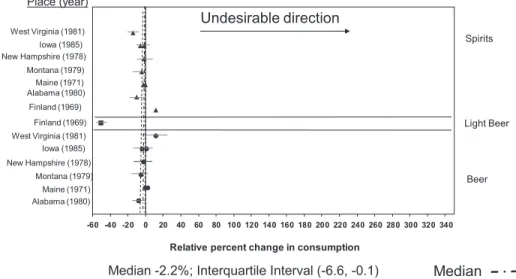
Effects of privatization on the consumption of non-privatized alcoholic beverages. Many of the stud-ies14,25,26,31,32,36 reviewed also assessed the effect of privatizing the sale of one type of alcoholic beverage on the sale of other nonprivatized beverages. In the seven settings assessed, the sales of nonprivatized alcoholic beverages decreased a median of 2.2%, with an inter-quartile interval ranging from a decrease of 6.6% in sales to a decrease of 0.1% (Figure 3). These decreases are not of suffıcient magnitude to offset the overall increase in per capita sales of privatized beverages. Effects of re-monopolization on alcohol-related out-comes. One study in Sweden33directly assessed effects of a 1977 re-monopolization of the sale of MSB (2.26%– 3.50% alcohol by volume; beer in the U.S. is generally 4%– 6% alcohol by volume). The study was of moderate design suitability and fair execution. Re-monopolization resulted in a substantial decline in the number of outlets for MSB, from 11,550 to 300. The effects of this policy change on hospitalization for several alcohol-related out-comes (alcoholism, alcohol intoxication, alcoholic psy-chosis, hospitalizations for acute alcohol intoxication, suicides, falls, motor vehicle crashes, and assaults) were assessed using time-series design, comparing the 4 years before and after re-monopolization. The results were stratifıed by four age categories (10 –19 years, 20 –39 years, 40 –59 years, andⱖ60 years), and the study did not provide data to allow aggregation across age groups.
The researchers identifıed a number of positive changes in health outcomes following re-monopolization. Hospital admissions for the treatment of alcoholism, alcohol intoxication, and alcohol psychosis decreased across all age groups (p⬎0.05), and there was a 20% decline (p⬍0.05) in these outcomes among people aged 10 –19 years. Hospitalizations for acute alcohol intoxica-tion decreased across all ages from 3.5% to 14.7% (p⬎0.05). Suicides decreased from 1.7% to 11.8% (p⬎0.05). Falls decreased from 3.6% to 4.9% (p⬎0.05). Motor vehicle crashes decreased 14% (p⬍0.05) for three age categories (10 –19 years, 40 –59 years, andⱖ60 years) and by 4.4% for those aged 20 –39 years (p⬎0.05). In contrast, assaultsincreasedfrom 6.9% to 14.8% (p⬎0.05)
in three of four age catego-ries, and decreased by 1.4% among those aged 20 –39 years (p⬎0.05). In summary, the re-monopolization of MSB in Sweden was associated with reductions in most of the alcohol-related harms assessed across all age groups; however, many of these effects were not signifıcant.
Cross-sectional studies, panel studies, and sum-marized studies in trans-lation. The team found 20 cross-sectional and panel studies29,35,37–54 as-sessing the association of privatization with alcohol consumption and related
harms; fıve studies35,38,43,47,48 had multiple outcomes. (Panel studies were included in this section if they did not include time as an ordinal covariate or compare alcohol-related outcomes before and after events of privatiza-tion.) Seventeen studies29,35,37,38,40,42– 48,50 –54found that
privatization was associated with greater consumption (nine were signifıcant,37,40,42– 44,46,48,52,53 seven were not,29,35,38,45,47,50,54 and one51 did not report
signifı-cance). Four studies found decreased consumption (three were signifıcant,40,43,44one not38). Three studies37,41,50 assessed the association of privatization with cirrhosis mortality; all were positive and two37,41were signifı-cant. Finally, two studies assessed the association of privatization with motor vehicle fatalities,39,46 and
both found a positive, but nonsignifıcant association; one study found a negative, signifıcant association of privatization and drunk driving. Overall, this evidence is consistent with evidence from primary studies indi-cating positive associations between privatization and increased population-level consumption and between privatization and alcohol-related harms.
Makela, Rossow, and Tryggvesson36 published (in English) a review of studies conducted in Finland, Swe-den, and Norway that were not published in English translation and thus were not included in this review. These studies examined the effect of either privatizing or re-monopolization of the sales of medium or strong beer between the mid-1960s and the early 1990s on various kinds of alcohol-related harms (e.g., arrests for drunken-ness and alcohol-related illdrunken-nesses).
The researchers found that when beer sales were privatized, there were increases in alcohol consump-tion and alcohol-related harms such as arrests for drunkenness and alcohol-related illnesses. They also found that re-monopolization generally resulted in de-creased population-level consumption of the affected al-coholic beverage, decreases in excessive alcohol con-sumption, and decreases in alcohol-related harms. In addition, they found that when a particular strength of beer became more or less accessible, consumers tended to purchase the beverage type that was more readily acces-sible. This beverage substitution effect appeared to be stronger among different strengths of beer than among different types of alcoholic beverages.
Summary of Intervention Effectiveness
Across the studies qualifying for this review, the privati-zation of off-premises retail sales of an alcoholic beverage was associated with a median 44.4% increase (interquar-tile interval 4.5%, 122.5%) in the per capita sales of the beverage and with a 2.2% decline (interquartile interval ⫺6.6%,⫺0.1%) in the per capita sales of beverages for which sales were not privatized. One study (in Finland)25 found that the increases in consumption occurred among drinkers at all consumption levels. A single study33
eval-uating the effects of re-monopolization of alcohol sales found that this change was associated with a subsequent decrease in several alcohol-related harms (e.g., hospital-izations for acute alcohol intoxication).
-60 -40 -20 0 20 40 60 80 100 120 140 160 180 200 220 240 260 280 300 320 340
Relative percent change in consumption
Alabama (1980) Maine (1971) Montana (1979) New Hampshire (1978) Iowa (1985) West Virginia (1981) Alabama (1980) Finland (1969) Maine (1971) Beer Light Beer Spirits Montana (1979) New Hampshire (1978) Iowa (1985) West Virginia (1981)
Median -2.2%; Interquartile Interval (-6.6, -0.1) Undesirable direction Median Interquartile interval Place (year) Finland (1969)
Figure 3. Percentage change in consumption of nonprivatized alcoholic beverages attributable to privatization of other alcoholic beverages
Other Harms and Benefits
Government control over retail alcohol sales generally results in lower alcohol outlet density. In addition to potential public health benefıts, lower outlet density may improve quality of life by reducing property damage and public disturbance (e.g., public intoxication). However, the studies reviewed did not assess these effects. The review team did not postulate any serious harms associ-ated with the maintenance of government control over retail alcohol sales.
Applicability
Consistent evidence of the association between privatization and increased per capita alcohol sales comes from studies done in multiple settings in the U.S., Canada, and Europe. Most of these studies evaluated the effects of privatizing the sales of wine and spirits. Only one Swedish study33 specifı-cally assessed the impact of re-monopolization (of MSB). The fındings from the current review apply most directly to the impact of privatizing the sale of wine and spirits in high-income nations such as the U.S.
Economic Efficiency
The present systematic economic review identifıed one study55in Canada that used simulation modeling to
esti-mate healthcare and law enforcement costs and costs of lost productivity due to disability and premature mortal-ity in the event all Canadian provinces and territories were to privatize alcohol sales. The study was judged to be satisfactory by Community Guide economics criteria (www.thecommunityguide.org/about/EconAbstraction_ v5.pdf). Study authors concluded that these costs were substantially greater than the tax and mark-up revenue gained from increased sales associated with privatization; however, benefıt data were not documented.
Research Gaps
Although the studies reviewed have demonstrated an association between privatization and increases in the per capita consumption of the privatized beverages without substantial reductions in consumption of other alcoholic beverages, additional research is needed to clarify the relationship between privatization and various patterns of excessive alcohol consumption (e.g., binge drinking) as well as harms related to it. Most useful would be cohort studies in the U.S. similar to the one conducted by Makela et al.25in Finland, assessing the effects of privatization on patterns of excessive alcohol consumption (e.g., binge drinking) and alcohol-related harms. It would also be useful to evaluate the impact of increased government control over alcohol sales (e.g., re-monopolization) on excessive alcohol consumption and related harms, were
such events to occur in the U.S. or other high-income nations.
Privatization has assumed different forms in different states and localities. Thus, it would be useful to determine how the effects of privatization observed in this review vary by the degree of government regulation and other specifıc parameters of the privatization. Although, in general, government control establishes a greater degree of regulation over retail alcohol sales than systems in which sales have been privatized, Her et al.13have noted
that “privatization might involve a change from a very restrictive alcohol management system to a loosely regu-lated private one; it would also potentially involve a change from a commercially orientated public system to a private sector operation that is heavily regulated.”
No peer-reviewed studies were found that evaluated economic effects of privatizing the sale of alcoholic bev-erages in the U.S. The anticipated effects of privatization include a large, but short-term, source of revenue to states; a potential increase in healthcare and criminal justice costs; and productivity losses from expected in-creases in excessive alcohol consumption owing to greater availability and/or lower prices. Studies assessing these economic impacts would be useful for informing future discussions of this issue. It would be useful to assess the effects of different specifıc approaches to priva-tization on state revenues associated with sales and taxes on alcoholic beverages.
Conclusion
The evidence consistently showed that privatization of retail alcohol sales was associated with a substantial in-crease in per capita sales of the privatized beverages, a well-established proxy for excessive alcohol consump-tion. There was also evidence that re-monopolization is associated with a decrease in alcohol-related harms. Therefore, according toCommunity Guiderules of evi-dence, there was strong evidence that retail privatization of alcohol sales leads to increases in excessive alcohol consumption.
In the U.S., many states have privatized the retail sales of alcoholic beverages. Currently, three states control the off-premises consumption retail sales of both wine and spirits, and an additional ten states maintain control over the retail sale of spirits alone. In addition, one county in the state of Maryland has county-level control over the retail sale of spirits and wine. The fındings of the present report are based solely on evidence related to the public health consequences of privatization, which may be one of several factors considered in making decisions on whether to privatize retail alcohol sales. The maintenance of government control of off-premises sale of alcoholic
beverages is one of many effective strategies to prevent or reduce excessive consumption, which is one of the lead-ing causes of preventable death and disability.
We would like to thank Steve Wing (SAMHSA) and Ralph Hingson, ScD, MPH, National Institute of Alcohol Abuse and Alcoholism, for participation in this review. We also thank our team of consultants for their comments: Edward Bernstein, MD, Boston University School of Public Health; Richard J. Bonnie, LLB, University of Virginia; Raul Caetano, MD, MPH, PhD, University of Texas at Dallas; Frank Chaloupka, PhD, University of Illinois at Chicago; Norm Giesbrecht, PhD, Centre for Addiction and Mental Health, Canada; Thomas Greenfıeld, PhD, National Alcohol Research Center/Alcohol Research Group, California; Joel Grube, PhD, and Harold Holder, PhD, Pacifıc Institute for Research and Evaluation (PIRE), California; Mel Kohn, MD, Oregon Department of Human Services; Jurgen Rehm, PhD, Centre for Addiction and Mental Health, Canada; Robin Room, PhD, Stockholm Univer-sity; Henry Saffer, PhD, National Bureau of Economic Re-search; Leslie Snyder, PhD, University of Connecticut; Tim Stockwell, PhD, University of Victoria; Alex Wagenaar, PhD, University of Florida College of Medicine.
No fınancial disclosures were reported by the authors of this paper.
References
1. CDC. Alcohol-attributable deaths and years of potential life lost—U.S., 2001. MMWR Morb Mortal Wkly Rep 2004;53(37):866 –70. 2. Miller JW, Naimi TS, Brewer RD, Jones SE. Binge drinking and
asso-ciated health risk behaviors among high school students. Pediatrics 2007;119(1):76 – 85.
3. National Center for Health Statistics. Health, U.S., 2010, with special feature on death and dying.www.cdc.gov/nchs/data/hus/hus10.pdf.
4. Johnston LD, O’Malley PM, Bachman JG, Schulenberg JE. Monitoring the future: National survey results on drug use, 1975–2008. Volume II, College students and adults ages 19 –50. Bethesda MD: National Insti-tute on Drug Abuse, 11-1-2009. NIH Publication No. 09-7403. 5. Bouchery EE, Harwood HJ, Sacks JJ, Simon CJ, Brewer RD. Economic
costs of excessive alcohol consumption in the U.S., 2006. Am J Prev Med 2011;41(5):516 –24.
6. Aaron P, Musto D. Temperance and prohibility in America: an histor-ical overview. In: Moore MH, Gerstein DR, editors. Alcohol and public policy: beyond the shadow of prohibition. Washington DC: National Academy Press, 1981:127– 81.
7. Holder HD, Giesbrecht N, Horverak O, et al. Potential consequences from possible changes to Nordic retail alcohol monopolies resulting from European Union membership. Addiction 1995;90(12):1603–18. 8. Babor TF. Alcohol: no ordinary commodity. Research and public
pol-icy. 2nd ed. New York: Oxford University Press, 2010.
9. DHHS. Healthy People 2020. www.healthypeople.gov/2020/default. aspx.
10. Briss PA, Zaza S, Pappaioanou M, et al. Developing an evidence-based Guide to Community Preventive Service—methods. Am J Prev Med 2000;18(1S):35– 43.
11. Zaza S, Wright-De Aguero LK, Briss PA, et al. Data collection instru-ment and procedure for systematic reviews in the Guide to Community Preventive Services. Am J Prev Med 2000;18(1S):44 –74.
12. Campbell AC, Hahn RA, Elder RA, et al.; Task Force on Community Preventive Services. The effectiveness of limiting alcohol outlet density as a means of reducing excessive alcohol consumption and alcohol-related harms. Am J Prev Med 2009;37(6):556 – 69.
13. Her M, Giesbrecht N, Room R, Rehm J. Privatizing alcohol sales and alcohol consumption: evidence and implications. Addiction 1999; 94(8):1125–39.
14. Fitzgerald JL, Mulford HA. Consequences of increasing alcohol avail-ability: the Iowa experience revisited. Br J Addict 1992;87(2):267–74. 15. Rossow I, Karlsson K, Raitasalo K. Old enough for a beer? Compliance
with minimum legal age for alcohol purchases in monopoly and other off-premise outlets in Finland and Norway. Addiction 2008;103:1468 –73. 16. World Bank. World Development Indicators 2006. devdata.
worldbank.org/wdi2006/contents/cover.htm.
17. Gruenewald PJ, Millar AB, Treno AJ, Yang Z, Ponicki WR, Roeper P. The geography of availability and driving after drinking. Addiction 1996;91(7):967– 83.
18. Nelson D, Naimi TS, Brewer RD, Roeber J. U.S. State alcohol sales compared to survey data, 1993–2006. Addiction 2010;105:1589 –96. 19. Cook PJ, Skog OJ. Alcool, alcoolisme, alcoolisation— comment.
Alco-hol Health Res World 1995;19(1):30 –1.
20. Greenfıeld TK, Rogers JD. Who drinks most of the alcohol in the U.S.? The policy implications. J Stud Alcohol 1999;60(1):78 – 89.
21. Fitzgerald JL, Mulford HA. Privatization, price and cross-border liquor purchases. J Stud Alcohol 1993;54(4):462– 4.
22. Fitzgerald JL, Mulford HA. Alcohol availability, drinking contexts and drinking problems: the Iowa experience. J Stud Alcohol 1993;54(3):320–5. 23. Holder HD, Wagenaar AC. Effects of the elimination of a state
monop-oly on distilled spirits’ retail sales: a time-series analysis of Iowa. Br J Addict 1990;85(12):1615–25.
24. Macdonald S. The impact of increased availability of wine in grocery stores on consumption: four case histories. Br J Addict 1986;81:381–7. 25. Makela P. Whose drinking does the liberalization of alcohol policy increase? Change in alcohol consumption by the initial level in the Finnish panel survey in 1968 and 1969. Addiction 2002;97(6):701– 6. 26. Mulford HA, Fitzgerald JL. Consequences of increasing off-premise
wine outlets in Iowa. Br J Addict 1988;83(11):1271–9.
27. Mulford HA, Ledolter J, Fitzgerald JL. Alcohol availability and con-sumption: Iowa sales data revisited. J Stud Alcohol 1992;53(5):487–94. 28. Smart RG. The impact on consumption of selling wine in grocery
stores. Alcohol Alcohol 1986;21(3):233– 6.
29. Trolldal B. An investigation of the effect of privatization of retail sales of alcohol on consumption and traffıc accidents in Alberta, Canada. Addiction 2005;100(5):662–71.
30. Trolldal B. The privatization of wine sales in Quebec in 1978 and 1983 to 1984. Alcohol Clin Exp Res 2005;29(3):410 – 6.
31. Wagenaar AC, Holder HD. A change from public to private sale of wine: results from natural experiments in Iowa and West Virginia. J Stud Alcohol 1991;52(2):162–73.
32. Wagenaar AC, Holder HD. Changes in alcohol consumption resulting from the elimination of retail wine monopolies: results from fıve U.S. states. J Stud Alcohol 1995;56(5):566 –72.
33. Ramstedt M. The repeal of medium-strength beer in grocery stores in Sweden: the impact on alcohol-related hospitalizations in different age groups. In: Room R, ed. The effects of Nordic alcohol policies: what happens to drinking and harm when alcohol controls change? Finland: Nordic Council for Alcohol and Drug Research (NAD), 2002:69 –78. 34. Mustonen H, Sund R. Changes in the characteristics of drinking
occa-sions resulting from liberalization of alcohol availability: A reanalysis of the 1968 and 1969 Finnish panel survey data. In: Room R, ed. The effects of Nordic alcohol policies: what happens to drinking and harm when alcohol controls change? Nordic Council for Alcohol and Drug Research, 2002:49 –55.
35. Simon JL. The economic effects of state monopoly of packaged-liquor retailing. J Polit Econ 1966;74:188 –94.
36. Makela P, Rossow I, Tryggvesson K. Who drinks more and less when policies change? The evidence from 50 years of Nordic studies. In: Room R, editor. The effects of Nordic alcohol policies: what happens to drinking and harm when alcohol controls change? Finland: Nordic Council for Alcohol and Drug Research, 2002:42–55.
37. Andreano RL, Li JY. Death rates from liver cirrhosis in alcohol monop-oly and free-market states. Q J Stud Alcohol 1974;35(Pt A):649 –54. 38. Beard TR, Gant PA, Saba RP. Border-crossing sales, tax avoidance, and
state tax policies: an application to alcohol. South Econ J 1997; 64(1):293–306.
39. Colon I. The influence of state monopoly of alcohol distribution and the frequency of package stores on single motor vehicle fatalities. Am J Drug Alcohol Abuse 1982;9(3):325–31.
40. Goel RK, Morey MJ. The interdependence of cigarette and liquor demand. South Econ J 1995;62(2):451–9.
41. Heien D, Pompelli G. Stress, ethnic and distribution factors in a dichot-omous response model of alcohol abuse. J Stud Alcohol 1987; 48(5):450 –5.
42. Hoadley JF, Fuchs BC, Holder HD. The effect of alcohol beverage restrictions on consumption: a 25-year longitudinal analysis. Am J Drug Alcohol Abuse 1984;10(3):375– 401.
43. Kenkel DS. Drinking, driving, and deterrence: The effectiveness and social costs of alternative policies. J Law Econ 1993;36(2):877–913. 44. Kenkel DS. New estimates of the optimal tax on alcohol. Economic
Inquiry 1996;34(2):296 –319.
45. McCornac DC, Filante RW. The demand for distilled spirits: an empir-ical investigation. J Stud Alcohol 1984;45(2):176 – 8.
46. Miller T, Snowden C, Birckmayer J, Hendrie D. Retail alcohol monop-olies, underage drinking, and youth impaired driving deaths. Accid Anal Prev 2006;38(6):1162–7.
47. Nelson JP. State monopolies and alcoholic beverage consumption. J Regulatory Econ 1990;2(1):83–98.
48. Nelson JP. Advertising bans, monopoly, and alcohol demand: testing for substitution effects using state panel data. Rev Industrial Org 2003;22(1):1–25.
49. Ornstein S, Hanssens D. Alcohol control laws and the consumption of distilled spirits and beer. J Consum Res 1985;12(2):200 –13.
50. Popham RE, Schmidt W, de Lint J. Government control measures to prevent hazardous drinking. In: Ewing JA, Rouse BA, editors. Drink-ing: alcohol in American society: issues and current research. Chicago: Nelson-Hall, 1978:239 – 66.
51. Spellman WE, Jorgenson MR. Liquor control and consumption. J Stud Alcohol 1983;44(1):194 –7.
52. Stockwell T, Zhang J, Macdonald S, Pakula B, Gruenewald P, Holder H. Changes in per capita alcohol sales during the partial privatization of British Columbia’s retail alcohol monopoly 2003–2008: a multi-level local area analysis. Addiction 2009;104:1827–36.
53. Trolldal B. Alcohol price elasticities in control and license states in the U.S., 1982-99. Addiction 2005;100(8):1158 – 65.
54. Zardkoohi A, Sheer A. Public versus private liquor retailing: an inves-tigation into the behavior of the state governments. South Econ J 1984;50(4):1058 –76.
55. Popova S, Patra J, Sarnocinska-Hart A, Gnam WH, Giesbrecht N, Rehm J. Cost of privatization versus government alcohol retailing systems: Canadian example. Drug Alcohol Rev 2011;Epub ahead of print.