An efficient algorithm for the blocked pattern matching
problem
Fei Deng
1, Lusheng Wang
1,∗and Xiaowen Liu
2,3∗1Department of Computer Science, City University of Hong Kong, Kowloon, Hong Kong. 2Department of BioHealth Informatics, Indiana University–Purdue University Indianapolis, Indianapolis, IN 46202, United States.
3Center for Computational Biology and Bioinformatics, Indiana University School of Medicine, Indianapolis, IN 46202, United States.
Received on XXXXX; revised on XXXXX; accepted on XXXXX
Associate Editor: XXXXXXX
ABSTRACT
Motivation: Tandem mass spectrometry has become the method of choice for protein identification and quantification. In the era of big data biology, tandem mass spectra are often searched against huge protein databases generated from genomes or RNA-Seq data for peptide identification. However, most existing tools for mass spectrometry-based peptide identification compare a tandem mass spectrum against all peptides in a database whose molecular masses are similar to the precursor mass of the spectrum, making mass spectral data analysis slow for huge databases. Tag-based methods extract peptide sequence tags from a tandem mass spectrum and use them as a filter to reduce the number of candidate peptides, thus speeding up the database search. Recently, gapped tags have been introduced into mass spectral data analysis because they improve the sensitivity of peptide identification compared with sequence tags. However, the blocked pattern matching problem, which is an essential step in gapped tag-based peptide identification, has not been fully solved.
Results: In this paper, we propose a fast and memory-efficient algorithm for the blocked pattern matching problem. Experiments on both simulated and real data sets showed that the proposed algorithm achieved high speed and high sensitivity for peptide filtration in peptide identification by database search.
Contact:[email protected] [email protected]
1 INTRODUCTION
With the developments of high throughput genomics, transcriptomics, and proteomics, combining multiple omics data provides a new way for studying complex biological systems. In multiple omics data analysis, tandem mass (MS/MS) spectra are searched against protein databases generated from genomes or RNA-Seq data for peptide identification. These protein databases are often huge. For example, in human microbiome studies, MS/MS spectra are searched against databases containing protein sequences generated from hundreds, even thousands, of genomes (Rudneyet al., 2010; Dewhirstet al., 2010).
∗To whom correspondence should be addressed
Most mass spectrometry (MS)-based peptide identification tools match an MS/MS spectrum against all peptides in a database whose molecular masses are similar to the precursor mass of the spectrum (Enget al., 1994; Perkinset al., 1999; Craig and Beavis, 2003; Geer et al., 2004). These tools become slow when the database is large. An alternative approach is based on peptide sequence tags: Peptide sequence tags are extracted from an MS/MS spectrum and searched against a database to identify a small number of candidate peptidesthat match at least one of the tags, then a rescoring function is applied to report the highest scoring candidate peptide (Mann and Wilm, 1994; Tabbet al., 2003; Tanneret al., 2005; Maet al., 2011). The trade-off between speed and sensitivity is an important problem in tag-based methods. To increase the sensitivity, it is essential that the set of sequence tags extracted from a spectrum contains a correct one that matches the target peptide. To increase the speed, long sequence tags (length≥5) are preferred because they are efficient in filtering out incorrect peptides. As a result, correct long sequence tags are extremely useful in tag-based methods because they speed up database searches without losing sensitivity. However, correct long sequence tags may not be found in MS/MS spectra because of missing and noise peaks (Jeonget al., 2011).
To utilize long sequence tags, Kim et al. (2009) proposed to generate a spectral dictionary containing full-length peptide constructions from an MS/MS spectrum for peptide identification. A drawback of this approach is that a spectral dictionary of an MS/MS spectrum with a large precursor mass may contain billions of peptides. Jeonget al.(2011) introduced gapped peptides to solve this problem. Since a gapped peptide represents many non-gapped peptides, the use of gapped peptides significantly reduces the sizes of spectral dictionaries and speeds up peptide identification without losing sensitivity.
Similar to the method proposed by Jeonget al.(2011), replacing sequence tags withgapped tagscan achieve both high speed and high sensitivity in tag-based peptide identification. A gapped tag is represented by a sequence of mass values instead of amino acids. Each mass value is the mass of one amino acid residue or the sum of the masses of several consecutive amino acid residues. Many MS/MS spectra do not contain long sequence tags because of missing peaks, but contain long gapped tags.
c
Oxford University Press 2014. 1
This is the author's manuscript of the article published in final edited form as:
Gapped tags and gapped peptides give rise to the blocked pattern matching (BPM) problem in which a blocked pattern generated from a gapped tag is searched against a text to find matched substrings. Ng et al. (2011) proposed an O(m) algorithm for querying a blocked pattern of lengthmagainst a text of lengthn. However, the time and space needed for the preprocessing step of the algorithm is
O(2k), wherekis the length of the longest substring to identify. When k = 30, the preprocessing step is slow and the space required by the algorithm is huge. In this paper, we present a fast and memory-efficient algorithm for the BPM problem. The time and space complexity of the preprocessing step of the algorithm isO(n). In the application of MS-based peptide identification, the time complexity for querying a blocked pattern is sublinear inn. Experiments on both simulated and real MS/MS data sets showed that the proposed algorithm achieved high speed and high sensitivity for peptide filtration in peptide identification by database search.
2 METHODS
2.1 The blocked pattern matching problem
LetN be the set of all natural number andΣa subset ofN. A string overN is called apattern string, and a string overΣis called atext string. When a pattern string is searched against a text string, the pattern string is called ablocked pattern. LetS = s1, s2, . . . , sn
be a text string. The mass of a substringsi, si+1, . . . , sj ofS is
the sum of all numbers in the substring, i.e.,si+si+1+. . .+
sj. Substrings si, si+1, . . . , sj and sj+1, sj+2, . . . sk are called consecutive substringsofS. ApartitionRofS is a sequence of consecutive substringsA1, A2, . . . , AkofS, whereA1starts from
s1andAkends atsn. Themass stringof the partitionRis a string
comprised of the masses of the consecutive substrings ofR. For example, whenΣ = {71,113,114,128},S = 71,113,114,128,
A1 = 71, A2 = 113,114, and A3 = 128, the substrings
A1, A2, A3 is a partition ofS and the corresponding mass string is71,227,128, where227is the mass ofA2. A blocked pattern
matchesa text string if there is a partition of the text string such that the mass string of the partition is identical to the blocked pattern. In the previous example, the blocked pattern71,227,128matches the text string71,113,114,128.
The blocked pattern matching (BPM) problemGiven a textT = t1, t2, . . . , tnover a finite alphabetΣ ⊂ N and a blocked pattern P=p1, p2, . . . , pmoverN, find all substrings inTthat matchP.
2.2 An efficient algorithm for the BPM problem
In this subsection, we present an efficient algorithm for the BPM problem, in which the textT is represented by a suffix tree. While the proposed algorithm works for suffix trees in which each edge is labeled with a text string with one or more letters, here we assume that each edge is labeled with only one letter to simplify the following analysis. Before discussing the new algorithm, we review the steps to search a text string against a suffix tree. To find substrings in T matching a text string a1, a2, . . . , am, we
start from the rootN0 of the suffix tree and find a list of nodes
N1, N2, . . . , Nmsuch that the path from the root toNi, for1 ≤ i≤m, spells out the prefixa1, a2, . . . , ai. In addition, the letterai
is the label on the edge connectingNi−1andNi.
The BPM Algorithm
Input: A textT of lengthnover a finite alphabetΣ⊂ N and a blocked patternPof lengthmoverN.
Output: All substrings inTthat matchP.
1. Use a suffix tree to represent T, initialize U0 as the set containing only the root of the tree, and compute
V1, V2, . . . , Vm.
2. Fori= 1tomdo
3. Foreach nodeu∈Ui−1and each text stringS∈Vido
4. SearchSagainst the suffix tree starting fromu. If there exists a path fromuto a nodevthat spells out the text stringS, addvintoUi.
5. EndFor
6. EndFor
7. Report all substrings corresponding to Um and their
positions inT.
Fig. 1. An efficient algorithm for the BPM problem.
We cannot search the blocked pattern P against the suffix tree directly since the textT is overΣ(Σ⊂ N), whereasPis overN. Alternatively, we can first convertPinto the setΩof all text strings matchingP and then search each text string inΩagainst the suffix tree. LetVibe the set of all text strings whose masses equalpi. An
example ofVi is shown in Table 1 in the supplementary material.
Each text string inΩis the concatenation of a list of text strings
v1, v2, . . . , vmin whichvi ∈ Vifor1≤ i≤ m. The number of
text strings inΩisΠmi=1|Vi|, which may introduce a combinatorial
explosion when|Vi|>1for mostpiinP. As a result, it is not fast
to searchPby converting it toΩexplicitly.
Prefixes ofP are used to speed up blocked pattern searches. A text stringSis aprefix text stringofPifSmatches a prefix pattern string ofP. Moreover, if a prefix text string ofP is identical to a substring ofT, we say it is anidentifiable prefix text stringofP. For example, whenΣ = {71,113,114,128},P = 71,227,128, and
T = 87,71,113,114,128,97, both71,113,114and71,114,113
are prefix text strings ofP. The string71,113,114is an identifiable prefix text string ofP, but71,114,113is not. If a prefix text string
Sis not identifiable, then all text strings inΩwith the prefix are not identifiable, making it not necessary to generate and search these text strings.
The idea of the BPM algorithm is to speed up blocked pattern searches by removing non-identifiable prefix text strings (Fig. 1). Each identifiable prefix text string corresponds to a unique node in the suffix tree. LetUi be the set of nodes corresponding to all
identifiable prefix text strings that match the prefixp1, p2, . . . , pi
ofP. Similar to searching a text string, we initialize U0 as the set containing only the root of the tree and findU1, U2, . . . , Um
progressively. The setUmcontains the solution to the BPM problem
because the identifiable prefix text strings that matchp1, p2, . . . , pm
are substrings inT that matchP. To findUifromUi−1, we start from each nodeu∈Ui−1 and search for each text stringS ∈ Vi.
If there exists a nodevsuch that the path fromutovspells out the stringS, then the nodevis added toUi. The total number of
searches in the iteration, i.e., findingUifromUi−1, is|Ui−1| × |Vi|.
After the last setUm is found, the BPM problem is solved by
T, which are stored inUm. Since the textT is represented by a
suffix tree, the space complexity of the algorithm isO(n).
2.3 Time complexity
Representing the text T as a suffix tree is a preprocessing step for pattern queries. Its time complexity is O(n). Let
G be the largest number in the blocked pattern P, that is,
G = maxm
i=1pi. We denote by Wk the set of all text strings
whose masses equal k. To obtain V1, V2, . . . , Vm, we generate
a lookup table W0, W1, . . . , WG. The number of operations for
computing W0, W1, . . . , WG is an exponential function of G.
(See the supplementary material.) In peptide identification by tandem mass spectra, the value G is not extremely large and the setsW0, W1, . . . , WGcan be computed in a short time. (See
Section 3.2.) Below we focus on the query time complexity of the BPM algorithm (steps 2-7 of the algorithm in Fig. 1).
When prefix text strings of P are long, most of them cannot be found in the textT (i.e., they are not identifiable) and will be removed from further consideration. As a result, the size ofUiis
often smaller than|Ui−1| × |Vi|. That is the reason why pattern
queries in the BPM algorithm are fast.
LetN = maxmi=1|Vi|. The running time of searchingPagainst
the suffix tree is determined byPm
i=1|Ui| ·N. LetLbe the length
of the longest prefix text string ofP. We defineXlas the set of
all lengthlprefix text strings ofP andYlas the set of all length l identifiable prefix strings of P, for 1 ≤ l ≤ L. Since each node in∪m
i=1Uicorresponds to an identifiable prefix text string in ∪L
l=1Yl, we havePmi=1|Ui|=PLl=1|Yl|. The expectation of|Yl|
is determined by the size ofXland the probability that a lengthl
text string is found inT. As a result, the running time of the pattern query is related to the sizes ofYlandXl.
Each length l prefix text string in Xl has only one partition A1, A2, . . . , Ak such that the mass string of the partition, which
is a lengthkpattern string, is the same to a prefix ofP. Letlibe the
length ofAifor1≤i≤k. We sayl1, l2, . . . , lkis theconfiguration
of the prefix text string. For example, when Σ = {2,3} and
P = 3,6,4, we haveV1 = {(3)}, V2 = {(3,3),(2,2,2)}and
V3 ={(2,2)}. The configuration of the length4prefix text string
3,2,2,2 is 1,3 because it has only one partition A1 = 3 and
A2 = 2,2,2such that the mass string of the partition matches the prefix3,6ofP. The total number of configurations of lengthlprefix text strings ofPis bounded by2l
.
Let XlC be the set of all prefix text strings in Xl with a
configuration C = l1, l2, . . . , lk satisfying l = Pki=1li. Each
prefix text string in XlC is the concatenation of k text strings v1, v2, . . . , vk such that vi ∈ Vi and the length ofvi is li for 1 ≤ i ≤ k. We divideViinto subsetsVi,1, Vi,2, . . . , Vi,d, where d is the length of the longest text string in Vi. The subset Vi,j
contains all lengthjtext strings inVi. The size ofXlCisΠki=1|Vi,li|. Because the probability that a prefix text string inXlC is found in T is a function ofl, we want to represent the upper bound of|XC
l |
as a function ofl. To this end, we introduce anexpansion factor ri,j = |Vi,j|1/j for each setVi,j. The largest expansion factor is
denoted asr= maxi,jri,j. Since|Vi,li| ≤r
lifor1≤i≤k, |XlC|= Π k i=1|Vi,li| ≤Π k i=1r li=rPki=1li =rl. Because the number of configurations of prefix text strings inXlis
bounded by2l, we can prove that(2r)lis an upper bound of|Xl|
m/z 200 400 600 A 227.13 Q R e la ti v e I n te n si ty ( % ) 50 100 800 0
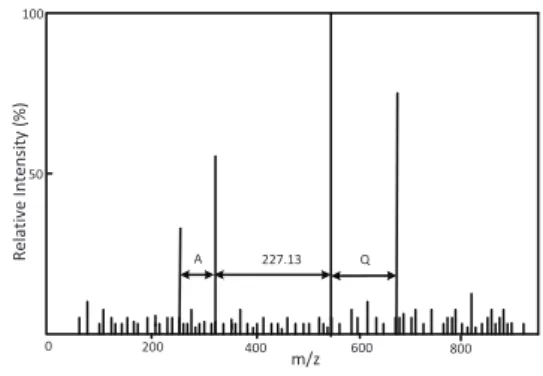
Fig. 2. An example spectrum for the peptide FTALNQVR. A gapped tag 71.04,227.13,128.08is extracted from the spectrum based on the distances between peak pairs, where71.04is the mass of the amino acid residue A,227.13is the sum of the masses of the amino acid residues L and N, and128.08is the mass of the amino acid residue Q. A blocked pattern 71,227,128is generated by rounding each mass in the gapped tag to an integer.
and further give the average-case time complexity of a pattern query in the BPM algorithm.
THEOREM1. When the size ofΣis a constant and1<2r <|Σ|, the average-case time complexity of a pattern query in the BPM algorithm is O(nlog|Σ|2rN +M), where M is the number of matched substrings inT.
A proof of the above theorem is given in the supplementary material. The average-case time complexity is obtained by analyzing the expectation of the size ofYl. In the worst case, the
size ofYlis bounded by the length of the text. Consequently, the
worst-case time complexity of a pattern query in the BPM algorithm isO(mnN).
2.4 Peptide identification by blocked pattern matching
In peptide identification, blocked patterns are often obtained from gapped tags. A gapped tag of a spectrum is represented by a list of masses, each of which is the distance between two peaks in the spectrum, which may correspond to one or more amino acids. Fig. 2 gives an example spectrum for the peptide FTALNQVR from which we can generate a gapped tag 71.04,227.13,128.06
rather than a sequence tag ALNQ because the peak for the fragment FTAL is missing. A gapped tag is converted into a blocked pattern by rounding each mass in the gapped tag into an integer. Although rounding masses to integers has been successfully applied to analyzing low accuracy mass spectra (Kimet al., 2008), it may introduce large errors in analyzing high accuracy mass spectra. For example, a large error 0.23is introduced by rounding the mass
426.23(with an accuracy of0.01) of the fragment ion ALNQ in Fig. 2 to426. To avoid this problem, mass values are multiplied by a scale factor before rounded to integers (Liu et al., 2013). For example, when the scale factor is 100, the mass of the amino acid residue A is converted into 7,104. High accuracy fragment ion peaks and a large scale factor are important in reducing the number of text strings matched to a blocked pattern and speeding up pattern queries. Since the BPM algorithm is designed for high accuracy MS/MS spectra with high accuracy precursors, it may fail
to efficiently search blocked patterns generated from low accuracy MS/MS spectra.
Blocked patterns can also be generated from sequence tags when local confidence scores of amino acids in the sequence tags are available (Maet al., 2003; Tabbet al., 2003). In general, amino acids with low confidence scores tend to be incorrect. A sequence tag is converted into a gapped tag by replacing neighboring amino acids that have low confidence scores with the sum of their masses and substituting an amino acid that has a high confidence score with its single mass. The gapped tag is further converted into a blocked pattern by rounding its masses to integers. In practice, gaps in gapped tags are no larger than 500 Dalton (Da) (Nget al., 2011). When a sequence tag contains several consecutive amino acids with low confidence scores such that the sum of their masses is larger than 500 Da, the sequence tag is broken into two short sequence tags by the large gap from which gapped tags are generated. The threshold for confidence scores determines which amino acids in a sequence tag are combined. When the threshold is lower than the smallest confidence score in a sequence tag, every amino acid in the sequence tag is converted to a mass in the gapped tag. When the threshold is extremely high, all amino acids in a sequence tag is combined to a large mass and the search of the blocked pattern is equivalent to peptide identification by using its precursor mass.
In peptide identification, the residue mass values of the 20
standard amino acid are converted into integers by using a scale factor. The alphabet Σof text strings is the set of the resulting integers. Since leucine (L) and isoleucine (I) have the same mass, they are treated as the same in blocked pattern searches. As a result, the size ofΣis19. A protein database is converted to a text overΣ
by replacing each amino acid in the database by its corresponding integer inΣ.
Blocked patterns are generated from a tandem mass spectrum and searched against the text translated from a protein database to find candidate peptides. After the candidate peptides are identified, they are filtered by the precursor mass of the spectrum. The resulting peptide-spectrum-matches (PSMs) are further rescored to find the highest scoring one (Fig. 2in the supplementary material). Any scoring function can be utilized in the rescoring step to improve the sensitivity of peptide identification. Searching blocked patterns against the text generated from a database is an essential step that determines the speed and sensitivity of peptide identification.
In peptide identification by tandem mass spectra, the numbers (letters) in P are usually not extremely large. When the largest gap in gapped tags is 500 Da and the scale factor is 100, the largest number in P is 50,000. In this case, the number N in Theorem 1 can be treated as a constant value. In addition,log|Σ|2r
in Theorem 1 is usually smaller than 1. In this application, the average-case time complexity for a pattern query is sublinear in the size of the database.
The numbers in a blocked pattern may have small errors that are introduced in measuring them/zvalues of fragment ions. To account for these errors, an error tolerance is allowed when blocked patterns are searched against a text. In the BPM algorithm, a text string is included into the setViif the difference betweenpiand the
sum of all the numbers in the text string is within a predefined error tolerance.
3 RESULTS
We implemented the BPM algorithm in Java and tested it on both simulated and real data sets. All the tests were performed on a Linux (64-bit) desktop PC with a 1.4GHz CPU and 32GB RAM. We were not able to compare the BPM algorithm with that described in Ng
et al.(2011) because it is not available.
3.1 Data set
A data set generated from human cell lysate (Freseet al., 2011) was used to test the BPM algorithm. In the preparation of the data set, the protein mixture was analyzed on an Orbitrap Velos (Thermo Fisher Scientific) coupled with a high-performance liquid chromatography (HPLC) system. High accuracy MS and MS/MS spectra were collected at a resolution of 30,000 and 7,500, respectively. Triplicate higher energy collisionally activated dissociation (HCD) data sets were then acquired, of which only one with37,810tandem mass spectra was selected to evaluate the BPM algorithm. Details of the experiment can be found in Freseet al.(2011).
3.2 Running time analysis
The human proteome database (about 12 MB) was downloaded from the Swiss-Prot database. We constructed a suffix tree from the human proteome database using the Ukkonen’s algorithm (Ukkonen, 1995) implemented by Nelson and ported to Java by Havsiyevych1. The running time for the suffix tree construction was about30seconds.
In the implementation of the BPM algorithm, the scale factor is
100. LetΣbe the alphabet generated from the19amino acids (the amino acids I and J are treated as the same). In practice, gapped tags typically do not exceed 500 Da (Nget al., 2011), and the largest number in blocked patterns is50,000. For each numberkbetween
0and 50,000, we generated the setWk of all text strings on Σ
such that the sum of the numbers in the text string is the same to k with an error tolerance of 5. The size of the lookup table
W1, W2, . . . , W50000, that is,P50000k=1 |Wk|, is about3.34×106.
The running time for generating the lookup table was about 1 second. In the following analyses, we will ignore the preprocessing time for generating the suffix tree and the lookup table and only consider spectral query time unless otherwise stated.
The valuelog|Σ|2rdefined in Section Methods is the exponent
that determines the time complexity of the BPM algorithm. We estimated the value of r when the largest number in a blocked pattern is 50,000. We divided Wk into subsets Wk,1, Wk,2, . . . , Wk,j, . . ., whereWk,j contains all lengthj text
strings in Wk. Let rk = maxj|Wk,j| 1
j. The histogram of r k
shows thatrk ≤5.7(Fig.3in the supplementary material). Since log19(2×5.7) ≈ 0.83, the average-case time complexity of the BPM algorithm is sublinear in the size of the database in this application.
When a blocked pattern of lengthmis generated from a sequence tag withn amino acids, we definen/m as the gap ratioof the pattern. For example, the blocked pattern 71,227,128 can be generated from a sequence tag ALNQ (71,113,114,128), and
1 The source code of the implementation can be found at
http://illya-keeplearning.blogspot.com/2009/04/suffix-trees-java-ukkonens-algorithm.html
(a) (b)
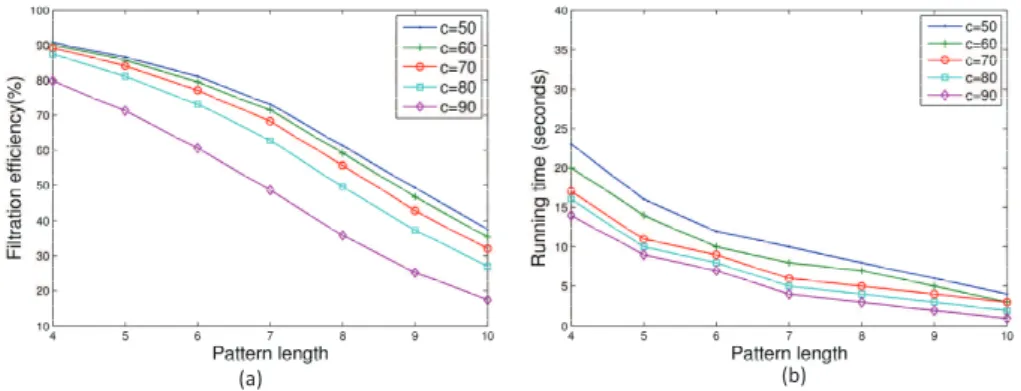
Fig. 3. Performance of the BPM algorithm with various settings of the pattern length and the confidence score thresholdcon the HUMAN data set.
the gap ratio is4/3. We tested the BPM algorithm on simulated data to find the relationship between the running time and the gap ratio. Blocked patterns were generated directly from peptides in the human proteome database: A total of 1 million peptides of length
20 were randomly selected from the database. Given a peptide
A = a1, a2, . . . , a20, a blockA[i, j] (1 ≤ i≤ j ≤ 20)denotes the substring of ai, ai+1, . . . , aj. To construct a blocked pattern
fromA, we first partition it into blocks of lengthk(possibly except for the last block), i.e. A[1, k], A[k+ 1,2k], . . . , A[lk+ 1,20] (l= d20
ke −1), and then sum up the rounded scaled masses (the
scale factor is100) of the amino acids in each block. The resulting list ofd20
kenumbers is a blocked pattern with a gap ratio aboutk.
Four patterns were constructed for each peptide fork= 1,2,3, and
4. When the gap ratio increases from2to4, the range of the largest extension factorsrfor the blocked patterns changes from[1,4.3]
to [2.1,5.7] (Fig.4in the supplementary material). The blocked patterns were then searched against the suffix tree constructed from the human proteome database. The average query time for blocked patterns was fast for all four gap ratios (Fig.5in the supplementary material). When the gap ratio was4, the average query time was less than0.003seconds per pattern. In addition, the average query time significantly increased as the gap ratio increased, so large gaps should be avoided to guarantee that the query time is fast in practice.
3.3 Evaluation on the real data set
To evaluate the performance of the BPM algorithm, we generated a set of peptide-spectrum-matches (PSMs) from the human lysate data set. MS-GF+ (Kimet al., 2008) was employed to search each spectrum in the data set against a target-decoy concatenated human proteome database. With 1% spectrum level false discovery rate (FDR), MS-GF+ identified 13,135 spectra (in about 18 minutes), which are assumed correct and used as a gold standard for the following evaluation. The 13,135 spectra are called identifiable spectra. For brevity, the set of13,135spectra is referred to as the HUMAN data set.
Evaluation criteria In peptide identification, a set of blocked patterns are extracted from a spectrum and searched against a protein database to find candidate peptides that contain at least one blocked pattern. If one of the extracted blocked patterns is correct (in the target peptide) and the filtration based on the blocked patterns reports a set of candidate peptides that contains the target one, then
the spectrum is said to be efficiently filtered. The filtration efficiency is defined as follows:
filtration efficiency
=# of identifiable spectra that can be efficiently filtered
# of identifiable spectra . The second evaluation criterion is the query speed of blocked patterns. The speed of peptide identification is also related to the number of the candidate peptides reported by blocked pattern based filtration, which is the third evaluation criterion.
Pattern generation We performed de novo sequencing on the HUMAN data set using PEAKS 6.0 (Maet al., 2003) and reported
10peptides with the highest scores for each spectrum. Each peptide was converted into a blocked pattern as follows. Consecutive amino acids were replaced by the sum of their masses if they all had a local confidence score< c(a predefined threshold), while an amino acid with a local confidence score≥cwas replaced by its single mass. The masses were multiplied by the scale factor100and rounded to integers.
Pattern length and confidence score thresholdsWe tested the filtration efficiency and speed of the BPM algorithm by varying the two parameters, i.e., the length of blocked patterns and the threshold
c for confidence scores, on the HUMAN data set. To obtain length l blocked patterns, we enumerated all lengthl substrings of the blocked patterns generated from the data set. The filtration efficiency of the algorithm decreases and the speed of the algorithm improves with the increase of the length of blocked patterns (Fig. 3). As the patterns become longer, the average number of candidate peptides for each spectrum decreases (Table 1). Particularly, when the pattern length≥7, most spectra contain only 0 or 1 candidate peptide. When the pattern length is 5or 6, the BPM algorithm achieves a good balance between the speed and filtration efficiency. Moreover, when the pattern length is fixed, the filtration efficiency decreases as the parametercincreases, while the running time is almost the same (Fig. 3). Therefore, a relative low cutoff valuec
should be used in practice.
There are three parameters: the pattern length, the confidence score threshold, and the number of blocked patterns, that affect the filtration efficiency of the BPM algorithm. When the confidence score threshold is fixed, the number of blocked patterns extracted
Table 1.The average number of candidate peptides reported by the filtration based on blocked patterns for the spectra in the HUMAN data set. The local confidence score cutoffcis fixed as 60.
Pattern length 4 5 6 7 8 9 10
#candidate peptides 4.18 1.15 0.84 0.74 0.60 0.47 0.36
from a spectrum decreases when the pattern length increases and more shorter blocked patterns can be extracted from a spectrum than longer ones. The high filtration efficiency of short blocked patterns has two possible reasons: the large number of short patterns and the short pattern length. To find which is the main reason, we tested the filtration efficiency of the BPM algorithm by fixing the confidence score threshold and the number of patterns and varying the pattern length. The experiment results show that the main reason that short gapped tags have high filtration efficiency is the short pattern length, not the large number of short patterns. (See the supplementary material.)
Comparison with a baseline algorithmWe compared the running time of the BPM algorithm with a trivial baseline algorithm. Given a blocked patternP =p1, p2, . . . , pmand a textT =t1, t2, . . . , tn,
the baseline algorithm simply examines, for each positioni, 1 ≤
i ≤ n, if there is a prefix ofti, ti+1, . . . , tnthat matchesP and
outputs matched prefixes. The time complexity of the algorithm is
O(nL), whereLis the length of the longest text string that matches
P. By setting the pattern length as 4 and the confidence score threshold as60, a total of 170,149 blocked patterns were extracted from the HUMAN data set using the described method. While the baseline algorithm took about9 hours to search all the patterns against the human proteome database, the BPM algorithm took only less than1minute, which is a significant540times speedup.
Comparison with sequence tagsFor each spectrum in the HUMAN data set, we generated both ordinary patterns (sequence tags) and blocked patterns from the 10 peptides reported by PEAKS. When ordinary patterns were generated, the confidence score threshold was set as0, and all amino acids in a peptide were replaced by their single masses. Note that the length of a blocked pattern may not be the same to its corresponding sequence tag. For example, the length of the sequence tag ALNQ(71,113,114,128)is 4, and the length of the blocked pattern71,227,128is 3. To compare blocked patterns with ordinary patterns, we redefine the length of a blocked pattern as the length of the sequence tag (i.e. number of amino acids) from which the blocked pattern is generated.
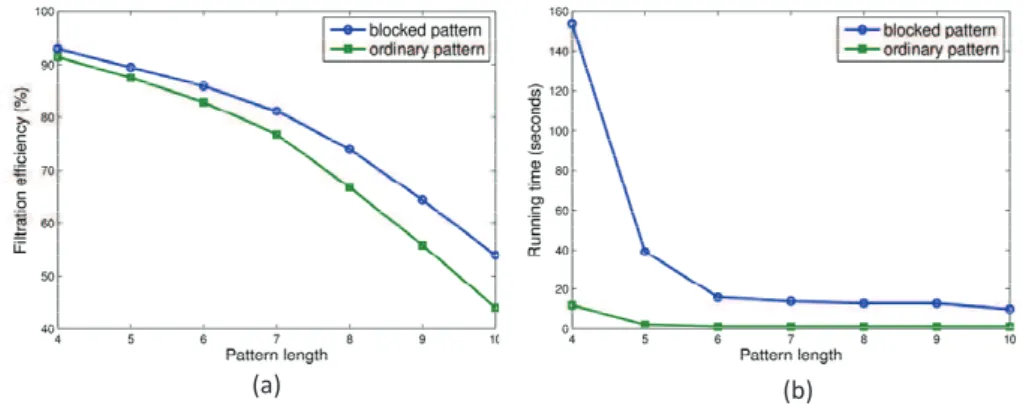
Both the blocked patterns and ordinary patterns were searched against the suffix tree. The parameter c was fixed as 60 for generating blocked patterns. The BPM algorithm with blocked patterns achieved a higher filtration efficiency than that with ordinary patterns (Fig. 4(a)). The difference in the filtration efficiency increases as the pattern length increases (Fig. 4(a)). By contrast, the running time of the BPM algorithm with blocked patterns is longer than that with ordinary patterns (Fig. 4(b)), especially when pattern length is4. However, the difference in the running time becomes smaller when the pattern length increases. Particularly, when the pattern length ≥ 6, the running time is within20seconds for both methods. The experiments demonstrated
that replacing sequence tags with blocked patterns improved the filtration efficiency without significant increase of the running time.
Comparison with MASCOTTo further investigate the filtration efficiency of the BPM algorithm, we ran MASCOT (Perkins
et al., 1999) on the whole human cell lysate data set with 37,810 tandem mass spectra. The error tolerances for precursor masses and fragment ion masses were set as 20 ppm and 0.05 Da, respectively. Using the target-decoy approach, MASCOT identified 10,953 spectra and 9,284 distinct peptides with1%spectrum level FDR in 6.1 minutes. Without any filtering algorithm, MS-GF+ identified 13,135 spectra and 10,800 peptides with the same FDR. It identified 2,141 peptides missed by MASCOT and missed 625 peptide identified by MASCOT. When the BPM algorithm (pattern length = 4, confidence score threshold = 60) was used as a filtering step for MS-GF+, a total of 982 peptides were missed because of the filtration, and MS-GF+ identified 11,845 spectra and 9,818 peptides. MS-GF+ with the BPM filtering algorithm identified 1,456 peptides missed by MASCOT and missed 922 peptides identified by MASCOT. When coupled with the BPM algorithm, the sensitivity of MS-GF+ is still comparable to MASCOT because of the high filtration efficiency of the BPM algorithm.
Searching spectra against the human genomeMost existing software tools for peptide identification by database search are slow when the protein database is huge. We evaluated the speed of the BPM algorithm by searching the HUMAN data set against the six-frame translation of the human genome. This approach has found many important applications in proteogenomics studies (Yateset al., 1995; Andersen and Mann, 2001; Bittonet al., 2010).
The complete human genome (Homo sapiens.GRCh37.74) was downloaded from Ensembl. The translation of each chromosome starts from the first, second and third nucleotide on each strand according to the standard genetic code regardless of the position of the start codon. The HUMAN data set was searched against the translated putative protein sequences using both MS-GF+ and the BPM algorithm. The translated protein database was split into parts of about 100 MB to reduce the memory usage of MS-GF+ and the BPM algorithm. The largest memory usage of the BPM algorithm for searching a 100 MB database was about 12 GB. The average running time for MS-GF+ was 3 seconds per spectrum while it was 0.3 seconds for the BPM algorithm when the pattern length was4
(Fig.7in the supplementary material). The running time of the BPM algorithm decreased with the increase of the pattern length. When the pattern length was6, the running time was about0.08seconds per spectrum.
4 CONCLUSIONS
Peptide identification of MS/MS spectra by database search has been dominated by the approach of comparing a spectrum against all peptides in the protein database whose molecular masses are similar to the precursor mass of the spectrum. However, in the era of big data biology, this approach may become slow with the rapid growth of the sizes of protein databases. An alternative approach based on sequence tags or blocked patterns (gapped tags) is fast for identifying peptides when the database is huge. In this paper, we proposed an efficient BPM algorithm for filtering peptides using blocked patterns and tested it on simulated and real data sets. The
(a) (b)
Fig. 4. Comparisons between blocked patterns and ordinary patterns: (a) the filtration efficiency, (b) the running time.
experiments showed that the BPM algorithm achieved high speed in filtration of peptides, even when the database is huge, e.g., the six frame translation of the human genome. We also compared blocked patterns with sequence tags for peptide filtration and found that blocked patterns outperformed sequence tags in terms of the sensitivity of peptide filtration. Because the BPM algorithm is fast and sensitive, it is a promising tool for searching MS/MS spectra against huge protein databases. In practice, the length of blocked patterns plays an important role in the performance of the BPM algorithm. The experiments on the length of blocked patterns showed that the BPM algorithm achieved a good balance between the filtration efficiency and the running time when the length was5
or6.
ACKNOWLEDGEMENTS
L.W. and F.D. were supported by National Science Foundation of China (NSFC 61373048) and a grant from the Research Grants Council of the Hong Kong Special Administrative Region, China (CityU 122511). X.L. was supported by a startup fund provided by Indiana University-Purdue University Indianapolis.
REFERENCES
Andersen, J. S. and Mann, M. (2001). Mass spectrometry allows direct identification of proteins in large genomes.Proteomics,1, 641–650.
Bitton, D. A., Smith, D. L., Connolly, Y., Scutt, P. J., and Miller, C. J. (2010). An integrated mass-spectrometry pipeline identifies novel protein coding-regions in the human genome.PLoS ONE,5, e8949.
Craig, R. and Beavis, R. C. (2003). A method for reducing the time required to match protein sequences with tandem mass spectra.Rapid Communication of Mass Spectrometry,17, 2310–6.
Dewhirst, F. E., Chen, T., Izard, J., Paster, B. J., Tanner, A. C., Yu, W.-H., Lakshmanan, A., and Wade, W. G. (2010). The human oral microbiome.Journal of Bacteriology,
192, 5002–5017.
Eng, J. K., McCormack, A. L., and Yates III, J. R. (1994). An approach to correlate tandem mass spectral data of peptides with amino acid sequences in a protein database.Journal of the American Society for Mass Spectrometry,5, 976–989. Frese, C. K., Altelaar, A. F. M., Hennrich, M. L., Nolting, D., Zeller, M., Griep-Raming,
J., Heck, A. J. R., and Mohammed, S. (2011). Improved peptide identification
by targeted fragmentation using CID, HCD and ETD on an LTQ-Orbitrap Velos.
Journal of Proteome Research,10, 2377–2388.
Geer, L. Y., Markey, S. P., Kowalak, J. A., Wagner, L., Xu, M., Maynard, D. M., Yang, X., Shi, W., and Bryant, S. H. (2004). Open mass spectrometry search algorithm.
Journal of Proteome Research,3, 958–964.
Jeong, K., Kim, S., Bandeira, N., and Pevzner, P. A. (2011). Gapped spectral dictionaries and their applications for database searches of tandem mass spectra.
Molecular&Cellular Proteomics,10, M110.002220.
Kim, S., Gupta, N., and Pevzner, P. A. (2008). Spectral probabilities and generating functions of tandem mass spectra: a strike against decoy databases. Journal of Proteome Research,7, 3354–3363.
Kim, S., Gupta, N., Bandeira, N., and Pevzner, P. A. (2009). Spectral dictionaries: Integrating de novo peptide sequencing with database search of tandem mass spectra.Molecular&Cellular Proteomics,8, 53–69.
Liu, X., Hengel, S., Wu, S., Toli´c, N., Paˇsa-Toli´c, L., and Pevzner, P. A. (2013). Identification of ultramodified proteins using top-down tandem mass spectra.
Journal of Proteome Research,12(12), 5830–5838.
Ma, B., Zhang, K., Hendrie, C., Liang, C., Li, M., Doherty-Kirby, A., and Lajoie, G. (2003). PEAKS: Powerful software for peptide de novo sequencing by tandem mass spectrometry.Rapid Communication of Mass Spectrometry,17, 2337–42. Ma, Z. Q., Chambers, M. C., Ham, A. J., Cheek, K. L., Whitwell, C. W., Aerni,
H. R., Schilling, B., Miller, A. W., Caprioli, R. M., and Tabb, D. L. (2011). ScanRanker: Quality assessment of tandem mass spectra via sequence tagging.
Journal of Proteome Research,10, 2896–904.
Mann, M. and Wilm, M. (1994). Error-tolerant identification of peptides in sequence databases by peptide sequence tags.Analytical Chemistry,66, 4390–4399. Ng, J., Amir, A., and Pevzner, P. A. (2011). Blocked pattern matching problem and its
applications in proteomics. InProceedings of 15th Annual International Conference on Research in Computational Molecular Biology (RECOMB 2011), pages 298– 319.
Perkins, D. N., Pappin, D. J., Creasy, D. M., and Cottrell, J. S. (1999). Probability-based protein identification by searching sequence databases using mass spectrometry data.Electrophoresis,20, 3551–3567.
Rudney, J., Xie, H., Rhodus, N., Ondrey, F., and Griffin, T. (2010). A metaproteomic analysis of the human salivary microbiota by three-dimensional peptide fractionation and tandem mass spectrometry.Molecular Oral Microbiology,
25, 38–49.
Tabb, D. L., Saraf, A., and Yates, J. R. (2003). GutenTag: High-throughput sequence tagging via an empirically derived fragmentation model.Analytical Chemistry,75, 6415–6421.
Tanner, S., Shu, H., Frank, A., Wang, L.-C., Zandi, E., Mumby, M., Pevzner, P. A., and Bafna, V. (2005). InsPecT: Identification of posttranslationally modified peptides from tandem mass spectra.Analytical Chemistry,77, 4626–4639.
Ukkonen, E. (1995). On-line construction of suffix trees.Algorithmica,14, 249–260. Yates, J. R., Eng, J. K., and McCormack, A. L. (1995). Mining genomes: Correlating
tandem mass spectra of modified and unmodified peptides to sequences in nucleotide databases.Analytical Chemistry,67(18), 3202–3210.