Titel der Dissertation
The Quality-Aware Service Selection Problem:
An Adaptive Evolutionary Approach
Application to the Selection of Distributed Data and Software
Services in the ATLAS Experiment
Verfasserin
Mag. Elisabeth Vinek
angestrebter akademischer Grad
Doktorin der technischen Wissenschaften
(Dr. techn.)
Wien, 2011
Studienkennzahl lt. Studienblatt: A 786 175
Dissertationsgebiet lt. Studienblatt: Wirtschaftsinformatik
Abstract
Quality of Service (QoS) is an important aspect in distributed, service-oriented systems. When several concrete services exist that implement the same functionality, the choice of a service instance
among many can be made based on QoS considerations, objectives and constraints. Typically
considered properties are performance, availability, and costs. When several services need to be composed in order to respond to a request, the resulting problem is more complex, as local QoS attributes have to be aggregated into global QoS values for the overall workflow, which is often spawned across organizational boundaries. To perform this aggregation, the specific attributes as
well as the involved workflow patterns have to be known. Aiming for anoptimalservice selection can
contribute to significantly reduce overall execution times, costs, or any other specifically formulated
objective. The resulting challenge is referred to as theQoS-aware service selection problem.
In this thesis, aspects of the service selection problem are studied in the context of a distributed, service-oriented system from ATLAS, a high-energy physics experiment at CERN, the European
Organization for Nuclear Research. In this so-called TAG system, data and modular services are
distributed world-wide and need to be selected and composed on the fly, as a user starts a request. There are two conflicting optimization viewpoints, one of the user who wants requests to be executed as fast as possible, and one of the system managers seeking to load-balance between all available resources, thus optimizing the system throughput. The service selection is modeled as a dynamic multi-constrained optimal path problem, which allows considering both QoS attributes of service
instances and of the network. The dynamic aspects of the system, such as removed or added
resources, changing attributes and changing optimization objectives are included in the problem definition, as they represent a specific challenge.
To address these issues regarding dynamics and conflicting viewpoints, this work proposes a service selection optimization framework based on a multi-objective genetic algorithm capable of efficiently dealing with changing conditions by using a persistent memory of good solutions, and a stepwise adaptation of the mutation rate. A system and QoS attribute ontology as well as a descrip-tion of dynamics of distributed systems build the basis of the framework. The presented approach is evaluated in terms of optimization quality (approximation of the Pareto front), adaptability to changes, runtime performance and scalability. Several parts of the overall optimization framework are ultimately integrated into the TAG system and evaluated therein. Although motivated by a concrete application, the framework is generally applicable to service selection challenges with spe-cific characteristics close to the ones of the TAG system. A discussion about the operational effort of developing and maintaining such an optimization framework is provided and presents a guideline for the integration in further applications.
Kurzfassung
Die Qualit¨at der Serviceerbringung (kurz QoS f¨ur “Quality of Service”) ist ein wichtiger Aspekt in
verteilten, Service-orientierten Systemen. Wenn mehrere Implementierungen einer Funktionalit¨at
koexistieren, kann die Wahl eines konkreten Services aufgrund von QoS-Aspekten getroffen werden.
Leistung, Verf¨ugbarkeit und Kosten sind Beispiele f¨ur QoS-Attribute eines Services. Wenn mehrere
Services ben¨otigt werden, um einen Workflow zu bilden, m¨ussen lokale QoS-Attribute zu globalen
Workflow-Attributen aggregiert werden, wobei der resultierende Workflow Services von
verschiede-nen Organisatioverschiede-nen umfassen kann. F¨ur eine solche Aggregation m¨ussen sowohl die Attribute als
auch die Workflowstrukturen bekannt und dokumentiert sein. Eineoptimale Selektion von
verteil-ten Services ist erstrebenswert, um zum Beispiel die gesamte Ausf¨uhrungsdauer, entstehende Kosten
oder sonstige definierte Ziele zu optimieren. Das resultierende Problem wird “QoS-aware Service
Selection Problem” genannt.
In der vorliegenden Dissertation werden Aspekte dieses Selektionsproblems anhand eines
kon-kreten, Service-orientieren Systems vertieft. Es handelt sich dabei um dasTAG-System in ATLAS,
einem Hochenergiephysikexperiment am CERN, der Europ¨aischen Organisation f¨ur Kernforschung.
Die Daten und Services des TAG-Systems sind weltweit verteilt und m¨ussen auf Anfrage selektiert
und zu einem Workflow zusammengesetzt werden. Die Optimierung wird aus zwei unterschiedlichen
Blickwinkeln durchgef¨uhrt: dem eines Benutzers, der seine Anfrage so schnell wie m¨oglich
beant-wortet haben m¨ochte, und dem der Systemmanager, deren Ziel es ist, die Last auf alle zur Verf¨ugung
stehenden Ressourcen zu verteilen und somit den Durchsatz des Systems zu optimieren. Die Se-lektion wird als ein dynamisches Pfadoptimierungsproblem unter Nebenbedingungen modelliert,
wodurch QoS-Attribute sowohl der Knoten (Services) als auch der Kanten (Netzwerk) ber¨ucksichtigt
werden k¨onnen. Die dynamischen Aspekte (z.B. wechselnde Ressourcen, Attribute,
Optimierungs-funktionen oder Gewichte) sind in der Problemformulierung integriert, da sie eine spezifische
Her-ausforderung und Anforderung an L¨osungsalgorithmen stellen.
F¨ur die dynamische Pareto-Optimierung von Serviceselektionsproblemen wird im Rahmen dieser
Arbeit ein Optimierungsansatz mit einem genetischen Algorithmus pr¨asentiert, der ¨uber einen
persis-tenten Speicher von fr¨uheren L¨osungen sowie eine automatische Adaptierung der Mutationsrate eine
effiziente Anpassung an das sich st¨andig ver¨andernde System gew¨ahrleistet. Eine Ontologie der
Sys-temkomponenten sowie deren QoS-Attribute bildet die Basis f¨ur die Optimierung. Der Ansatz wird
im Rahmen der Dissertation hinsichtlich der Qualit¨at der erzielten L¨osungen, der Adaptierung an
¨
Anderungen sowie der Laufzeit evaluiert. Teile des Ansatzes wurden schließlich in das TAG-System integriert und darin evaluiert. Obwohl der Ansatz im Rahmen eines spezifischen
Serviceselektion-sproblems entwickelt wurde, ist er in anderen Szenarien oder Systemen mit ¨ahnlichen Charakeristika
iv
einsetzbar. Die Herausforderungen w¨ahrend der Entwicklung und des Betriebes des
Optimierungs-frameworks werden beschrieben und bilden somit eine Anleitung f¨ur dessen m¨ogliche Integration in
Acknowledgements
First and foremost, I would like to thank my adviser, Prof. Erich Schikuta. He has provided me with excellent guidance through my studies, carefully showing the way to a successful completion as a balance of curiosity, enthusiasm, and pragmatism. I also particularly thank David Malon from the Argonne National Laboratory for accepting to review my thesis, and for providing such a motivating work environment in the ATLAS TAG group.
This thesis work has been carried out at CERN, and I would like to thank Richard Hawkings for welcoming me in his section, introducing me to the subject and always taking the time to meet and discuss, while being very busy with first physics at the LHC. I would like to address special thanks to my office mate Florbela Viegas for discussing with me all aspects of my work, and letting me profit from her immense knowledge and experience in many areas of computer science. Thanks also to Gancho Dimitrov, who has been a great office mate during the past three years. It has been an amazing experience to work in an international team of researchers and engineers – I thank the members of the ATLAS TAG team for the friendly and encouraging atmosphere.
I am particularly thankful to Peter Paul Beran for numerous fruitful discussions and for being
such a great co-author. Our cross-motivation in the last year has been crucial for completion.
Further, I would like to thank Armin Nairz for his very detailed proof-reading and in general for the great “TAG - Tier-0” cooperation.
I am grateful to my friends here in Geneva, Austria and elsewhere, for their (remote) support and the great moments we shared, even if we had little time together in the past three years.
Friedrich, thank you for your encouragement and patience, and for “keeping me in balance,” by opening my eyes (and ears!) to exciting new things, and enriching my life in so many ways.
Finally, I would like to thank my mother for being a constant support in all matters and encour-aging me whenever I have doubts.
This work has been supported by the Austrian “Bundesministerium f¨ur Wissenschaft und Forschung”.
Contents
Abstract i
Kurzfassung iii
Acknowledgements v
List of Figures xii
List of Tables xiii
List of Algorithms xv
1 Introduction 1
1.1 The QoS-Aware Service Selection Problem . . . 2
1.2 Motivation for a Dynamic and Adaptive Service Selection Optimization Framework . 4 1.3 Challenges and Contributions . . . 6
1.4 Thesis Structure . . . 8
2 Motivation and Application Scenario: TAG-based Metadata Queries in the ATLAS Experiment 13 2.1 The ATLAS Experiment at the LHC . . . 14
2.2 From RAW Data to Event-Level Metadata: TAGs . . . 15
2.3 TAG Data and Services . . . 17
2.3.1 TAG Content . . . 17
2.3.2 TAG Use Cases . . . 17
2.3.3 TAG Databases . . . 19
2.3.4 TAG Services . . . 20
2.4 Typical TAG Workflows . . . 21
2.5 Distribution of Data and Services and Resulting Challenge . . . 22
3 Background and Related Work: Service Selection in Heterogeneous Environ-ments 27 3.1 Basic Concepts . . . 28
3.2 Overview and Comparison of Related Research Areas . . . 29 vii
viii CONTENTS
3.3 Modeling Service-Oriented Systems . . . 32
3.3.1 System Models . . . 32
3.3.2 QoS Attributes . . . 33
3.3.3 Motivation for an Ontology for QoS-Aware Service Selection . . . 35
3.4 Approaches to solve the QoS-Aware Service Selection Problem . . . 37
3.4.1 Linear Mixed Integer Programming . . . 37
3.4.2 Graph-based Approaches . . . 40
3.4.3 Network Topology Approaches . . . 41
3.4.4 Game Theory and Bidding . . . 42
3.4.5 Evolutionary Approaches . . . 43
3.4.6 Swarm Intelligence Approaches . . . 44
3.4.7 Artificial Neural Networks . . . 45
3.5 Multi-Objective Service Selection Optimization . . . 47
4 An Ontology of Components and Attributes of Distributed, Service-Oriented Systems 49 4.1 Methodology . . . 50
4.2 System Ontology . . . 52
4.2.1 Generic System Ontology . . . 52
4.2.2 Application: TAG System Components . . . 54
4.3 Attribute Ontology . . . 59
4.3.1 Generic Attribute Ontology . . . 59
4.3.2 Application: TAG System Attributes . . . 62
4.3.3 Attribute Aggregation . . . 67
4.4 TASK - TAG Application Service Knowledge Base . . . 69
4.4.1 TASK Schema and Services . . . 69
4.4.2 Gathering System Statistics . . . 72
4.4.3 Performance and Usage Indexes . . . 75
4.5 Summary . . . 76
5 QoS-Aware Service Selection: A Dynamic Multi-Objective Optimization Prob-lem 77 5.1 Dynamic Aspects of Service-Oriented Systems . . . 78
5.2 Detecting and Assessing Changes in the Environment . . . 82
5.2.1 System Monitoring and Profiles . . . 82
5.2.2 Optimization Profiles . . . 84
5.2.3 Quantifying System Changes . . . 85
5.3 Concrete Problem Formulation . . . 86
5.3.1 Mathematical Model . . . 87
5.3.2 Optimization Objectives and Profiles . . . 89
5.3.3 Discussion . . . 91
5.4 Multi-Objective Optimization in Dynamic Environments . . . 92
5.4.2 Pareto-Optimal Solutions . . . 93
5.4.3 Classical Solving Methods . . . 94
5.4.4 Dealing with Dynamic Environments . . . 96
5.5 Analysis of the Multi-Objective Optimization Problem in the TAG System . . . 98
5.6 Summary . . . 99
6 Designing Genetic Algorithms for Service Selection Optimization Problems 103 6.1 Background on Genetic Algorithms . . . 104
6.1.1 Basic Concepts . . . 104
6.1.2 Genetic Algorithms for Multi-Objective Optimization . . . 106
6.2 Dynamic Genetic Algorithms . . . 109
6.2.1 Algorithm Restart or Re-Initialization . . . 110
6.2.2 Diversity after Changes: Adapting the Mutation Rate . . . 111
6.2.3 Diversity along the Runtime: Modifying the Selection . . . 111
6.2.4 Memory-based Techniques . . . 111
6.2.5 Multi-Population Techniques . . . 112
6.2.6 Comparison . . . 112
6.3 Motivation for Using GAs in QoS-Aware Service Selection . . . 112
6.4 An Adaptive and Dynamic Multi-Objective Genetic Algorithm for QoS-aware Service Selection Problems . . . 114
6.4.1 Problem Encoding . . . 114
6.4.2 Fitness Functions . . . 114
6.4.3 Genetic Operators and Multi-Objective Design Considerations . . . 116
6.4.4 Adaptability to Changes . . . 118
6.4.5 Integrated Optimization Approach with AD-MOGA . . . 120
6.4.6 Tuning Possibilities . . . 121
6.5 Related Work . . . 124
6.6 Summary . . . 128
7 Implementation and Evaluation 131 7.1 Simulation and Evaluation Setup . . . 132
7.2 Evaluation Scenario I: Applicability of AD-MOGA, Pareto Approximation and Input Parameters . . . 133
7.3 Evaluation Scenario II: Adaptability to Changes . . . 137
7.3.1 Formal Evaluation Criteria for Dynamic GA . . . 137
7.3.2 Implementation of the Persistent Memory . . . 137
7.3.3 Changes During or Between Optimization Runs . . . 138
7.3.4 Stepwise Adaptation of the Mutation Rate . . . 143
7.4 Evaluation Scenario III: Runtime Performance and Scalability . . . 145
7.5 Application to the TAG System . . . 148
7.6 Practical Considerations for the Implementation . . . 152
7.7 Possible Extensions in Future Work . . . 154
x CONTENTS
8 Conclusion 159
A System and Attribute Ontology: OWL Schemas 161
A.1 OWL Definitions Used in the Ontologies . . . 161
A.2 System Ontology: OWL Schema . . . 162
Glossary 171
Bibliography 183
List of Figures
1.1 Mapping of Abstract to Concrete Workflow . . . 3
1.2 Multi-Dimension Multi-Choice Knapsack Problem . . . 4
1.3 Challenges Addressed in the Thesis . . . 7
2.1 Computer-generated view of the ATLAS Detector . . . 14
2.2 LHC Tier-0 and Tier-1 Sites and Network Overview . . . 16
2.3 Data Reconstruction Chain . . . 18
2.4 iELSSI Screenshots . . . 22
2.5 Typical TAG Workflows . . . 23
2.6 Distributed TAG System . . . 24
2.7 Execution Times for Query Involving TAG Database and iELSSI . . . 25
3.1 Selected Elements of the CIM Core Model . . . 33
3.2 Selected Elements of the CIM Metrics Model . . . 34
3.3 Classification of Non-Functional Properties . . . 36
3.4 Overview of Optimization Approaches for Service Selection Problems . . . 37
3.5 Total Enumeration Tree for Branch-and-Bound Algorithms . . . 39
3.6 Service Candidate Graph (General Flow Structure) . . . 41
3.7 ANN Components and Simplified Mathematical Model . . . 46
4.1 Areas for Ontology Uses . . . 51
4.2 Methodology Applied for Building the Ontologies . . . 52
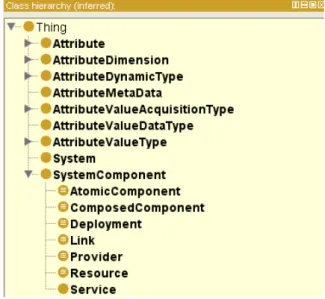
4.3 Generic System Ontology: Inferred Class Hierarchy . . . 54
4.4 Generic System Ontology: OntoGraf Representation . . . 57
4.5 TAG System Model (UML Class Diagram) . . . 58
4.6 Subclasses of NonFunctionalAttribute . . . 63
4.7 Attribute (and System) Ontology: Classes Overview . . . 64
4.8 Workflow Patterns for Composition . . . 68
4.9 TASK Architecture Overview . . . 72
4.10 TASK: Data Catalog . . . 73
4.11 TASK: Service Catalog . . . 74
5.1 Similarity Index and Change Impact . . . 86 xi
xii LIST OF FIGURES
5.2 Abstract and Concrete Workflow Mapping . . . 89
5.3 Multi-Objective Optimization Problem: Decision and Objective Space . . . 93
5.4 Dynamic Online Optimization . . . 98
5.5 Abstract and Concrete Workflows in a Simple Example . . . 101
5.6 Pareto Optimal Points for the Simple Example . . . 101
5.7 Pareto Optimal Points for the Simple Example with Changed Attributes . . . 102
6.1 Genetic Algorithm: Cycle of Operations . . . 106
6.2 Steps of a Genetic Algorithm . . . 108
6.3 Chromosome Encoding . . . 115
6.4 Schema of the Persistent Memory of Solutions . . . 120
6.5 Overview of the Optimization Process . . . 122
7.1 Simulation Setup: Database Schema . . . 132
7.2 Classes and Packages in the Prototype Implementation . . . 133
7.3 Approximation of the Pareto Front: Even Deployment Distribution . . . 135
7.4 Approximation of the Pareto Front: Uneven Deployment Distribution . . . 136
7.5 Schematic Query of the Persistent Memory . . . 138
7.6 Changes Between Optimization Runs . . . 140
7.7 10% Change Rate Between Optimization Runs . . . 141
7.8 50% Change Rate Between Optimization Runs . . . 142
7.9 Impact of Adding Deployments with Different Change Rates . . . 144
7.10 Impact of Varying Mutation Rates, Similarity Index 0.9 . . . 145
7.11 Impact of Varying Mutation Rates, Similarity Index 0.8 . . . 146
7.12 Impact of Varying Mutation Rates, Similarity Index 0.7 . . . 146
7.13 Runtime for Increasing System Setups . . . 149
7.14 Composition of the Runtime . . . 150
7.15 Integration of the Optimization Approach into the TAG System . . . 151
7.16 Outline of Design and Implementation Steps . . . 153
7.17 Areas for Future Extensions . . . 156
7.18 Anytime Learning System for Service Selection Optimization . . . 156
List of Tables
1.1 TAG System Requirements . . . 6
2.1 Nominal LHC Operational Parameters and ATLAS Trigger Rate . . . 15
2.2 Nominal Event Data Sizes . . . 17
3.1 Comparison of Related Research Areas . . . 31
4.1 System Ontology: Classes . . . 55
4.2 System Ontology: Properties . . . 56
4.3 Attribute Aggregation Functions . . . 70
5.1 Qualitative Categorization of Changes in the TAG System . . . 81
5.2 Services and Deployments in a Simple Example . . . 100
5.3 Links in a Simple Example . . . 100
6.1 MOGA Design Considerations . . . 110
6.2 Change-Action Mapping in AD-MOGA . . . 119
6.3 Comparison of Approaches to QoS-Aware Service Selection with GA (1) . . . 129
6.4 Comparison of Approaches to QoS-Aware Service Selection with GA (2) . . . 130
List of Algorithms
1 Relaxation Function of the Multi-Constraint Shortest Path Algorithm . . . 42
2 Particle Swarm Optimization Algorithm . . . 44
3 Genetic Algorithm . . . 107
4 Genetic Algorithm with Pareto Pool . . . 107
5 AD-MOGA: General Outline . . . 118
6 SPEA2: Strength Pareto Evolutionary Approach 2 . . . 125
7 NSGA-II: Non-Dominated Sorting Genetic Algorithm-II . . . 126
8 Global Optimization of Dynamic Web Services Selection (GODSS) . . . 126
9 Distributed Multi-Objective Genetic Algorithm . . . 127
Chapter 1
Introduction
In distributed, service-oriented systems, an abstract functionality – orService – often exists in
sev-eral concrete instances, implementations orDeployments only differing in non-functional attributes
such as performance, availability, and reliability. When mapping an abstract service chain to a concrete one in response to a request, there are thus several options for substituting each service
with a deployment. This choice influences the behavior of the concrete workflow in terms ofQuality
of Service. It is thus required to not randomly select deployments, but base the choice on considera-tions regarding QoS requirements, objectives and constraints. The resulting challenge is commonly
referred to as the QoS-aware Service Selection Problem. This problem has recently been studied
intensively, and many different approaches exist. They all aim at allowing some optimization, de-pending on the system requirements. Minimize the execution time of jobs, minimize costs associated with a task, maximize the overall throughput, and maximize some custom-defined utility function are example objectives for such an optimization.
This thesis is motivated by a concrete service selection challenge arising in the TAG System, a
distributed, service-oriented system in the context of ATLAS [10], a High-Energy Physics (HEP) experiment at the Large Hadron Collider (LHC) [24, 26]. In the TAG system, services need to be selected and composed to form scientific workflows allowing an efficient preselection of ATLAS data. The service selection optimization is approached from two different, usually conflicting, angles, namely the user and the system provider perspectives. It is thus a multi-objective optimization problem. Additionally, the system is highly dynamic in several aspects. To address these issues, an adaptive and dynamic framework for the selection of services is proposed and its applicability is shown and evaluated in the ATLAS TAG system. The broader vision is to propose a global approach to QoS-aware service selection problems applicable to scenarios of various characteristics and sizes.
This introductory chapter is organized as follows. In Section 1.1 theQoS-aware Service Selection
Problem is outlined and defined. Section 1.2 presents the motivation and research questions under-lying this thesis. Section 1.3 outlines the challenges and main contributions of this work. Finally, Section 1.4 presents the structure of the thesis.
1.1
The QoS-Aware Service Selection Problem
A Service is a software component described by functional and non-functional attributes. The functional attributes, as the name suggests, describe the functionality a service exposes to the users, be they humans or other software components. This generally encompasses inputs, behavior,
and outputs. These attributes thus describe what a service is doing. Non-functional attributes
describehow a service accomplishes its functionality, i.e., they refer to characteristics related to the operations of services. Examples of non-functional attributes include performance, costs, reliability and availability. They are often referred to as Quality of Service (QoS) attributes. Although in literature the terms “non-functional attribute” and “QoS attribute” are often used likewise, in this work QoS attributes are defined as a subclass of non-functional attributes. For example, service configuration issues can be considered as non-functional attributes, but not directly related to a
quality of service measure. In the remainder of this work, the termnon-functional attributesis thus
used when referring to the superclass, and the term QoS attributes is used when referring to the
subclass.
Several abstract services can be composed to form an abstract workflow. When each service is
substituted with a concrete deployment, the abstract workflow is mapped to aconcrete workflow.
Figure 1.1 shows three views of a simple sequential workflow. The user wants to perform four tasks (select a set of data, define a query, count the resulting events and extract data), for which five abstract services are needed. The service selection optimization process transforms the abstract service workflow into a concrete deployment workflow. Mathematically, this is commonly modeled as a multi-dimension multi-choice knapsack problem (MMKP). In an MMKP, a knapsack has to be filled with items that are classified into mutually exclusive object groups, each containing several different objects. The knapsack itself has a set of constraints. The objective of the MMKP is to pick exactly one item from each class in such a way as to maximize the total profit of the collected objects, subject to resource constraints of the knapsack [42]. In the same way, the QoS-aware service selection problem is to pick one deployment for each abstract service to build the concrete workflow, meeting defined QoS constraints and maximizing a total utility value (see Figure 1.2). The QoS-aware service selection problem can be mapped to an MMKP as defined by Yu et. al. [104]:
• Each abstract service is mapped to an object group.
• Each deployment of a service is mapped to an object in an object group.
• QoS attributes of deployments are mapped to resources of an object.
• The utility of a deployment is mapped to the profit of an object.
• QoS constraints are mapped to the resources available in the knapsack.
Let there benabstract services, and li deployments for service i. Each deployment hasm QoS
attributes and a utility valuecij (utility of thejthdeployment for service i). q~ij = (qij1, . . ., qijm) is the QoS vector for thejth deployment for servicei, andQ~ = (Q1,. . ., Qm) is the QoS bound of
1.1. THE QOS-AWARE SERVICE SELECTION PROBLEM 3 max n X i=1 li X j=1 cijxij (objective function) (1.1) subject to n X i=1 li X j=1 (qij)kxij ≤Qk, k= 1,2, . . . , m(QoS constraints) li X j=1 xij= 1, i= 1,2, . . . , n xij∈0,1,∀i, j C o n c re te S e rv ic e W o rk fl o w U s e r W o rk fl o w A b s tr a c t S e rv ic e W o rk fl o w
Select set of data Define query Count resulting events Extract data
D(Service 1) D(Service 2) D(Service 3) D(Service 4) D(Service 5) D(Service 6) Service 2 Service 3 Service 4
Service 1 Service 5 Service 6
Figure 1.1: Mapping of Abstract to Concrete Workflow
This model does not take into account links between the services. Links cannot be considered as separate items or object groups, because of their dependencies to services. If one service is changed, then the incoming and outgoing links automatically change as well. Therefore, while conceptually being a knapsack problem (“take one item out of each group”), the service selection problem taking into account the links between services cannot be represented in the form of Equation 1.1. This is why the second common approach found in literature is to establish a graph-based model of the QoS-aware service selection problem [104]. This is referred to as the Multi-Constrained Optimal Path Problem (MCOP). An MCOP is defined as follows [58]:
LetG= (V, E) be a directed graph, whereV is the set of vertexes andE the set of edges of the
graph. Each edge (i, j)∈ E has an associated non-negative cost parameter c(i, j) andK additive
non-negative QoS parameters wk(i, j), k = 1,2, ..., K. Given K constraints ck, k = 1,2, ..., K, the
QoS1 = x(13) QoS2 = y(13) P = p(13) S1D3 QoS1 = x(12) QoS2 = y(12) P = p(12) S1D2 QoS1 = x(11) QoS2 = y(11) P = p(11) S1D1 Service 1
Resource (QoS) Constraints: SUM(QoS1) < X
SUM(QoS2) > Y
Total Profit (Utility): SUM(P)
QoS1 = x(22) QoS2 = y(22) P = p(22) S2D2 QoS1 = x(21) QoS2 = y(21) P = p(21) S2D1 Service 2 QoS1 = x(33) QoS2 = y(33) P = p(33) S3D3 QoS1 = x(32) QoS2 = y(32) P = p(32) S3D2 QoS1 = x(31) QoS2 = y(31) P = p(31) S3D1 QoS1 = x(34) QoS2 = y(34) P = p(34) S3D4 Service 3 Knapsack Multi‐dimension Multi‐choice Knapsack Problem QoS1 = x(43) QoS2 = y(43) P = p(43) S4D3 QoS1 = x(42) QoS2 = y(42) P = p(42) S4D2 QoS1 = x(41) QoS2 = y(41) P = p(41) S4D1 Service 4 QoS1 = x(53) QoS2 = y(53) P = p(53) S5D3 QoS1 = x(52) QoS2 = y(52) P = p(52) S5D2 QoS1 = x(51) QoS2 = y(51) P = p(51) S5D1 Service 5 QoS1 = x(13) QoS2 = y(13) P = p(13) S1D3 QoS1 = x(21) QoS2 = y(21) P = p(21) S2D1 QoS1 = x(34) QoS2 = y(34) P = p(34) S3D4 QoS1 = x(42) QoS2 = y(42) P = p(42) S4D2 S4D4 QoS1 = x(34) QoS2 = y(34) P = p(34) S5D2 QoS1 = x(52) QoS2 = y(52) P = p(52) QoS1 = x(52) QoS2 = y(52) P = p(52)
Figure 1.2: Multi-Dimension Multi-Choice Knapsack Problem
min cp= X (i,j)∈p c(i, j) (objective function) (1.2) subject to wk= X (i,j)∈p
wk(i, j)≤ck fork= 1, ..., K (QoS constraints)
MMKPs as well as MCOPs are NP-hard, which means that most likely there are no polynomial-time algorithms to solve them [58, 71]. In modern, service-oriented systems, the problem space, i.e., the number of abstract services and concrete deployments, can be big enough for exact algorithms not to perform in acceptable time. Many heuristic approaches have thus been proposed for solving QoS-aware service selection problems, as presented in Chapter 3.
1.2
Motivation for a Dynamic and Adaptive Service
Selec-tion OptimizaSelec-tion Framework
The motivation and application scenario of this thesis is the so called TAG System of the ATLAS experiment at CERN, the European Organization for Nuclear Research. The TAG system (described in detail in Chapter 2) supports metadata-based queries on data recorded at the ATLAS detector, in order to allow a quick preselection of relevant data to consider for further physics analysis. It supports a set of well-defined use cases through distributed Web and Grid services, using distributed data sources. The ATLAS Computing Model [9] defines a Tier structure, in which various sites around the world host data and services. Several deployments exist for each abstract service from the TAG system, each having the same implementation and version, but varying non-functional attributes depending on the site and resource they run on. When a user starts a request, a concrete process has to be instantiated, selecting one deployment per abstract service needed to deliver the functionality related to the request.
The TAG system has the following characteristics relevant to properly address the service selec-tion challenge:
1.2. MOTIVATION FOR A DYNAMIC AND ADAPTIVE SSOP FRAMEWORK 5
• Central control: although the data and services are distributed, there is a central instance at CERN that has knowledge about all services and can monitor them. This allows gathering statistics by aggregating logging information, and the status of the deployments is known at any time.
• Tightly coupled components: the individual abstract services are designed to work to-gether. There are thus no compatibility issues in service composition.
• Dynamic environment: as in distributed systems in general, resources can be temporarily unavailable or decommissioned, new resources can be deployed, and attributes change over time. The system is thus dynamic, and a given system state is only valid for a certain period in time.
• Known problem size: although the system is dynamic, it is changing in a controlled way, and the problem size is known. For example, there will not be a sudden increase in the number of deployments by an order of magnitude.
• Changing objectives: in an application of a long-lasting scientific experiment like ATLAS, optimization objectives and/or their weights can change periodically. For example, in periods with low system usage, a single request can be optimized, whereas in periods of high system usage it is preferable to ensure a fair usage and request distribution. This requires the ability to monitor system activity and derive usage profiles.
• Changing priorities: in the TAG system as in other real-world application scenarios, it can be a requirement to prioritize some use cases over others in a defined time frame. For example, in a period of high data analysis activity (e.g., before conferences), single and composed services supporting efficient data extraction can be given priority over other use cases.
In many service selection studies (e.g., [3, 56, 105]), the optimization problem is addressed from the user’s perspective only. A single user requests a certain functionality (e.g., video compression as in [56]), which requires several services to be selected and composed. The selection of deployments is done such that a user-defined utility function is optimized. For example, the response time can be minimized, while having constraints on the costs, or a utility function aggregating several QoS measures can be maximized. In any case, the optimization is carried out from the user’s perspective, without taking into account the impact of the selection on other users. In the approach adopted in this work, however, two optimization perspectives are taken into account, the user’s and the system provider’s perspective. The goal is not only to maximize the utility of a single process, but also to optimize the system throughput, and to ensure a fair and efficient usage of the resources. The overall requirements and challenges of the TAG system are highlighted in Table 1.1.
To summarize, the overall problem can be formulated as follows. How can deployments be selected and composed in the TAG system, such that
• for each individual user, the overall response time is minimized,
• while, from a system perspective, ensuring a fair and efficient usage of all available resources,
Perspective Requirements
User
Transparent data and services distribution. Minimal execution time for each request. Reliable system with maximal availability.
System Provider
Use all resources and services efficiently.
Allow fail-over mechanisms for TAG resources and services. Maximize the system’s throughput.
Planning (Management)
Adapt to changing objective functions. Adapt to changing environment.
Potentially, allow monitoring system capacity limitations. Table 1.1: TAG System Requirements
• system changes are taken into account,
• while keeping the selection process efficient and without considerable impact on the overall
performance?
The optimization process itself thus has to be adaptive to changing situations in terms of
op-timization requirements, and the underlying algorithm has to be able to react to dynamics of the
system, i.e., changing conditions. A stand-alone algorithm, running each time a request is made, is thus not a sufficient solution. Based on the characteristics and requirements stated above, this thesis introduces an adaptive and dynamic QoS-aware service selection approach, and applies it to concrete scientific workflows. Although the described motivation and application environment is very specific, the proposed solution is generic and can be adapted to different scenarios.
1.3
Challenges and Contributions
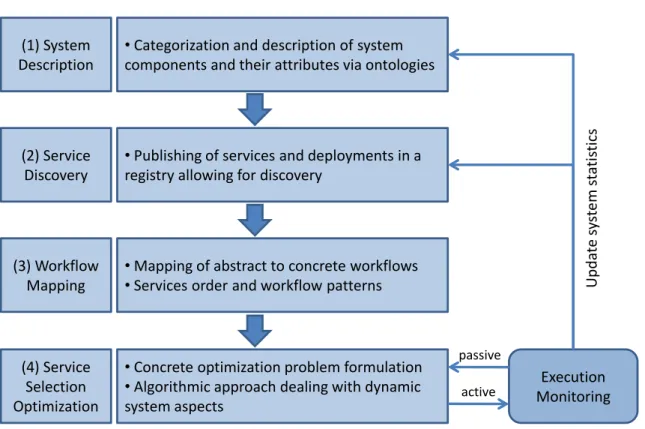
Several building blocks had to be investigated to realize the presented service selection approach, each representing a contribution to the research topic. Figure 1.3 summarizes the issues that need to be addressed to realize service selection and composition. The main contributions of this thesis reside in system description (1) and algorithmic approach (4). They are addressed in Chapters 4 to 7. Service discovery (2) and workflow mapping (3) are briefly addressed from an implementation point of view in Chapter 4. In more detail, the contributions are the following:
Building a model of distributed systems, their components and attributes. In order to implement a service selection optimization framework into an existing distributed system, this system first has to be analyzed and described in detail. This analysis consists of the identification of the system components and attributes, and their interactions. To address this challenge, a system ontology and an attribute ontology have been developed. They are generic and meant to provide a high-level common language for the description of heterogeneous, dis-tributed, service-oriented systems. These ontologies and the derived formal system description build the basis for the optimization framework. This contribution is presented in Chapter 4.
1.3. CHALLENGES AND CONTRIBUTIONS 7
•
Categorization and description of system
components and their attributes via ontologies
(1) System
Description
•
Publishing of services and deployments in a
registry allowing for discovery
(2) Service
Discovery
•
Mapping of abstract to concrete workflows
•
Services order and workflow patterns
(3) Workflow
Mapping
•
Concrete optimization problem formulation
•
Algorithmic approach dealing with dynamic
system aspects
(4) Service
Selection
Optimization
Execution
Monitoring
U
pda
te
sy
st
em
s
ta
ti
sti
cs
active passiveFigure 1.3: Challenges Addressed in the Thesis
Modeling dynamic aspects of QoS-aware optimization problems. As put forward in the previous section, the TAG system is dynamic in several aspects. In order to take this into ac-count in the optimization problem formulation and in the algorithmic approach, these dynamic aspects have to be analyzed. Several questions arise: how can dynamic aspects be represented? How can they be detected? How can they be taken into account in the optimization process? To address these questions, a system representation through time-dependent profiles is pro-posed and the profiles are considered in the concrete problem formulation. This contribution is presented in Chapter 5.
Design and implementation of a genetic algorithm reflecting dynamics and adaptivity to changes. AnAdaptive andDynamicMulti-ObjectiveGeneticAlgorithm (AD-MOGA) is proposed for addressing all requirements of the service selection optimization in the TAG system. AD-MOGA is designed to be able to detect system changes and react to them. It is implementing a persistent memory and self-adapting mutation rate allowing the adaptation to changes in the optimization environment. AD-MOGA is presented in Chapter 6 and the results of its evaluation are discussed in Chapter 7.
Practical considerations for implementing a service selection optimization framework.
Implementing a service selection optimization framework in a real-world system requires a logging, monitoring, implementation and maintenance effort. Based on the experience from the TAG system acquired in the context of this thesis work, an assessment of the operational effort
and the achieved gains is provided, serving as guideline for the integration of the framework into other systems. This contribution is presented at the end of Chapter 7.
1.4
Thesis Structure
The thesis is structured in chapters as follows.
Chapter 2: Motivation and Application Scenario: TAG-based Metadata Queries in the ATLAS Experiment. This chapter presents the motivational environment that led to the research questions and that has been used as application domain. The thesis work has been carried out at CERN in the context of the TAG system, a distributed metadata system of the ATLAS experiment. The questions addressed in this chapter include:
• What is the TAG system and what is its role in the ATLAS experiment?
• What are the main TAG services that need to be selected and composed to respond to a
request?
• Which aspects of the ATLAS TAG system motivated the research questions addressed in
this thesis?
Chapter 3: Background and Related Work: Service Selection in Heterogeneous En-vironments. In this chapter, related work in the area of service selection in distributed, heterogeneous environments is discussed, leading to a state of the art study. The questions addressed in this chapter include:
• Which research areas are comparable to the QoS-aware service selection problem? What
are the similarities and differences?
• How have distributed systems been modeled in previous work?
• How has the QoS-aware service selection problem been approached in previous work?
Chapter 4: An Ontology of Components and Attributes of Distributed, Service-Oriented Systems. In order to apply service selection optimization techniques to a system, this system and its characteristics and behavior first have to be understood and described. To do so, ontologies can be applied. This chapter presents a generic system and attribute ontology and a concrete derived model of the TAG system. The questions addressed in this chapter include:
• How can distributed systems in general and the TAG system in particular be modeled in
order to identify all components that need to be included in a service selection optimiza-tion process?
• What are QoS attributes, how can they be gathered, classified and represented?
• Which design choices have been made for theTAG Application Service Knowledge Base
1.4. THESIS STRUCTURE 9
Chapter 5: QoS-Aware Service Selection: A Dynamic Multi-Objective Optimization Problem. Distributed, heterogeneous systems are usually highly dynamic. When selecting services, the underlying system thus has to be considered as constantly changing. In this chapter, the dynamic aspects are defined in detail, and the concrete optimization objectives for the TAG system, taking into account the dynamics, are derived. The questions addressed in this chapter include:
• What are dynamic aspects of distributed systems in general and the TAG system in
particular, and how can they be represented in system profiles?
• What are the exact optimization objectives being studied in the context of the TAG
system?
• How can multi-objective optimization in dynamic environments be addressed?
Chapter 6: Designing Genetic Algorithms for Service Selection Optimization Prob-lems. Genetic Algorithms (GA) can be used to solve dynamic multi-objective optimiza-tion problems, and different concrete techniques can be applied to capture the dynamic
as-pects. This chapter investigates those approaches and presents an adaptive and dynamic
multi-objective genetic algorithm (AD-MOGA) tailored to service selection problems. The questions addressed in this chapter include:
• Why and how can genetic algorithms be used for multi-objective optimization in dynamic
environments?
• What are the design considerations for dynamic genetic algorithms applied to service
selection problems?
• What are the characteristics of the proposed algorithm, AD-MOGA?
Chapter 7: Implementation and Evaluation. In this chapter the AD-MOGA approach is evaluated regarding several relevant criteria such as quality, runtime and adaptability to changes. Further, the integration of the proposed service selection optimization framework into the TAG service selection is described. The questions addressed in this chapter include:
• How well does AD-MOGA approximate the Pareto solutions in simulated service selection
problem scenarios?
• How does AD-MOGA adapt to changes in the underlying system, and what are the
resulting advantages?
• What are the performance benchmarks of AD-MOGA in terms of runtime and scalability?
• What are the main operational challenges in designing, implementing and maintaining
the presented optimization framework?
• What are the arising future research directions?
Chapter 8: Conclusion. This chapter summarizes and concludes the thesis. Chapters 4, 5, 6 and 7 are partly derived from the following publications:
• E. Vinek, P.P. Beran and E. Schikuta. Mapping Distributed Heterogeneous Systems to a
Common Language by Applying Ontologies. In Proceedings of the 10th IASTED
Interna-tional Conference on Parallel and Distributed Computing and Networks, Innsbruck, Austria, 2010. [88]
• E. Vinek and F. Viegas. Composing Distributed Services for Selection and Retrieval of Event
Data in the ATLAS Experiment. In Conference on Computing in High Energy and Nuclear
Physics (CHEP), Taipei, Taiwan, October 2010. [89]
• E. Vinek, P.P. Beran and E. Schikuta. Classification and Composition of QoS Attributes in
Distributed, Heterogeneous Systems. In 11thIEEE/ACM International Symposium of Cluster,
Cloud and Grid Computing (CCGrid), Newport Beach, USA, 2011. [86]
• E. Vinek, P.P. Beran and E. Schikuta. A Dynamic Multi-Objective Optimization Framework
for Selecting Distributed Deployments in a Heterogeneous Environment. InThe International
Conference on Computational Science (ICCS), Singapore, 2011. [85]
• E. Vinek, P.P. Beran and E. Schikuta. Comparative Study of Genetic and Blackboard
Algo-rithms for Solving QoS-Aware Service Selection Problems. Poster at The 2011 International
Conference on High Performance Computing & Simulation (HPCS 2011), Istanbul, Turkey, 2011. [87]
• P.P. Beran, E. Vinek and E. Schikuta. A Distributed Database and Deployment Optimization
Framework in the Cloud. Accepted as short paper at The 13th International Conference on
Information Integration and Web-based Applications & Services (iiWAS2011), Ho Chi Minh City, Vietnam, December 2011. [13]
Most of these publications have been done together with Peter Paul Beran, who is currently working on a blackboard-based approach for the optimization of distributed database queries. While the motivation and key contributions from the two approaches are different, some ideas have been developed and implemented together, in joint work. This applies specifically to the following parts:
• Categorization of components and attributes of distributed, service-oriented systems
(Chap-ter 4): the main classes and attributes have been identified, classified and published together. The development of the ontology itself, its implementation using a specific toolkit, and the application of the ontology to the TAG system have however been carried out by the author herself and are thus contributions specific to this thesis.
• Quantifying system changes (Chapter 5, Section 5.2.3): the main ideas of this section have
been developed together.
• Service selection strategies: general service selection strategies have been discussed together,
and applied to a common simulation environment. The genetic algorithm presented in Chap-ter 6 has been developed by the author herself and is a contribution of this thesis only. P.P.
Beran uses a blackboard with anA∗algorithm for a similar problem and his particular
appli-cation scenario. The implementation and evaluation environment (Chapter 7) in its original form has been developed together and has then been customized by each author for his/her particular needs.
1.4. THESIS STRUCTURE 11 The differences in the optimization approaches can be explained by the differing characteristics of the application scenarios. While the TAG system is centrally controlled, has tightly coupled components and a known problem size, the scenario studied in P.P. Beran’s work has no central control instance, loosely coupled components and in general incomplete knowledge about the system components and their attributes. Different approaches are thus required to deal with those issues. Additionally, P.P. Beran focuses specifically on the optimal combination of distributed database operators. Despite those differences, the two works can be regarded as complementary, because each investigates specific aspects and application scenarios of a similar problem.
Chapter 2
Motivation and Application
Scenario: TAG-based Metadata
Queries in the ATLAS Experiment
This chapter presents the thesis environment that serves as motivation as well as application and evaluation domain. The presented work has been performed at CERN, the European Organization for Nuclear Research, located on the outskirts of Geneva, at the border between Switzerland and France. CERN hosts the Large Hadron Collider (LHC), currently the world’s largest and most powerful particle accelerator [24]. The LHC is made up of a ring of superconducting magnets, in which two beams travel with high energy in opposite directions inside dedicated beam pipes, before finally colliding. Collisions are recorded within detectors that reside along the 27 km long LHC ring. ATLAS (A Toroidal LHC ApparatuS) is one of the HEP experiments at the LHC [26]. This thesis work has been carried out in the context of the ATLAS TAG system. This system is composed of data sources that host metadata describing the Events (i.e., particle collision instances) recorded at the ATLAS detector, and services needed to access and process this data.
For studying the service selection problem in general, it it not necessary to know the specific functionality of services – it can be treated in a generalized, abstract way. However, as our approach is motivated by and applied to a specific system, it is useful to describe the nature and scope of the services in question in more detail. This chapter also serves as a general description of the current status of the TAG system.
The organization of this chapter is as follows. Section 2.1 gives a brief overview of the ATLAS experiment. In Section 2.2 the standard data reconstruction process, from RAW data recorded at the detector to the production of metadata, is described. Section 2.3 lists and briefly outlines the main TAG services. A typical TAG workflow is described in Section 2.4. Finally, Section 2.5 describes the data and services distribution and outlines the thesis challenge arising from this distribution.
2.1
The ATLAS Experiment at the LHC
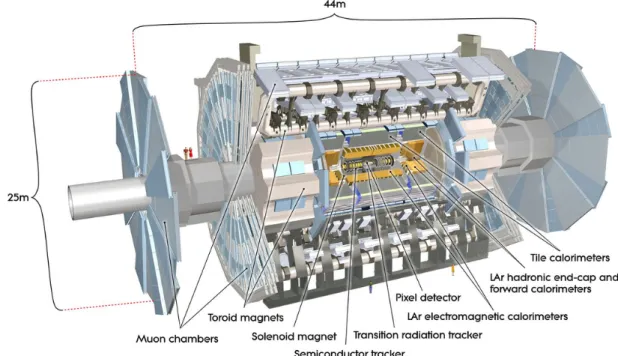
ATLAS [10] is one of the particle detectors (“experiments”) at the LHC. It is a multi-purpose detector designed to investigate a large range of physics, including the search for dark matter, new physics like supersymmetry or extra dimensions, and the origin of mass. The latter involves the search for the so-called Higgs boson, a missing piece in the Standard Model that would explain how particles gain mass. The detector has several subsystems, each detecting specific types of particles and determining their momentum and energy [7]. Figure 2.1 shows a computer-generated view of the ATLAS detector, with its subsystems and dimensions.
Figure 2.1: Computer-generated view of the ATLAS Detector
ATLAS produces around three petabytes of RAW data per “nominal year” (i.e., the projected LHC duty cycle, see Table 2.1). This important amount of data needs to be written, filtered, trans-formed, processed, reprocessed, and analyzed, which requires a powerful computing infrastructure. CERN and all sites participating in any LHC experiment are linked through the Worldwide LHC Computing Grid (WLCG), a distributed computing infrastructure for the storage and analysis of data from LHC experiments [37]. These sites are organized in a hierarchical Tier structure. CERN is the central, data-taking site and is called Tier-0. About ten so-called Tier-1 sites are linked with Tier-0 through high-speed network connections and provide important storage and processing capa-bilities. Tier-2 sites are smaller data centers that mainly provide analysis and simulation capacity for physics groups. Each Tier-2 site is logically attached to a Tier-1. Additionally, smaller structures
2.2. FROM RAW DATA TO EVENT-LEVEL METADATA: TAGS 15
Parameter Value
E (Energy) 14 TeV (two 7 TeV proton beams)
L (Luminosity) 1034 cm−2 s−1 (design luminosity)
Collision rate 109Hz p-p collisions at design luminosity, resulting from a
bunch-crossing rate of 40 MHz
Trigger rate 200 Hz independent of the luminosity
Operation time 50000 seconds per day
Operation time 200 days per year
Table 2.1: Nominal LHC Operational Parameters and ATLAS Trigger Rate [9].
such as institute clusters are organized in Tier-3 centers. Figure 2.2 [25] shows the Tier structure of the WLCG sites. At the time of writing, this rather rigid structure is however being rethought by the ATLAS collaboration.
Table 2.1 summarizes the main LHC and ATLAS operational parameters. In terms of computing infrastructure, the Trigger rate is the main parameter to consider. ATLAS has a sophisticated trigger system, consisting of three levels: the Level-1 trigger (LVL 1), based on fast on-detector hardware components, selects max. 75 - 100 kHz out of the initial 40 MHz bunch-crossing rate. The subsequent two stages, the High-Level-Trigger (HLT), consisting of the Level-2 trigger (LVL 2) and the Event Filter, are software-based and run on dedicated online CPU farms; they further reduce the event rate to several kHz and a nominal rate of 200 Hz respectively. Those 200 Hz of most “interesting” events are eventually passed to offline processing. While the nominal trigger rate is 200 Hz, higher rates can be achieved during data taking. For a detailed description of the ATLAS Computing Model the reader is referred to [9].
2.2
From RAW Data to Event-Level Metadata: TAGs
RAW data from the detector is stored in a byte stream format and transferred from the event filter to Tier-0, the central ATLAS data processing unit at CERN. At Tier-0, the so-called Tier-0 Management System [38] provides the framework to process the data in several steps, as depicted in Figure 2.3. First, RAW data are reconstructed to Event Summary Data (ESD), which is intended to make access to RAW data unnecessary for the bulk of analyses. ESD, as all the subsequently produced data, is stored in an object-oriented format in ROOT files. Describing ROOT structures is out of the scope of this work, details can be found in [5]. Analysis Object Data (AOD) is then derived from ESD, by condensing the quantities most used in physics analysis. In Figure 2.3, temporary data products (before the merging steps) as well as stored data (right after the merging steps) are represented. Temporary AOD files are merged into final ones – the merging step reduces the number of data files. AOD is already more than a factor 10 smaller than RAW data, but still 100 kB in size per event. In order to allow a rapid filtering of events based on key physics quantities, so-called TAG files are produced at the end of the reconstruction chain. TAGs are event-level metadata that contain event descriptors, physics quantities, and sufficient information for back-navigation, i.e., for reaching a specific event in upstream data, based on a TAG selection. Table 2.2 summarizes
T0-T1 and T1-T1 traffic Alice T1-T1 traffic only Atlas (thick) >= 10Gpbs CMS (thin) <= 10Gpbs LHCb
TAG site
Figure 2.2: LHC Tier-0 and Tier-1 Sites and Network Overview
the approximate sizes of the main data formats in ATLAS [9]. Note that TAG, like RAW and as
opposed to ESD and AOD, is not an acronym, but is used in analogy totags, referring to keywords
or metadata related to a piece of information and allowing to search for it.
TAGs are stored as POOL [82] Collections, with a physical back-end either as ROOT files or in
a relational database. The latter are referred to asrelational TAGs, as opposed to file-based TAGs.
The Tier-0 management system uploads TAG data from files to several Oracle databases around the world, making them easily accessible through a services suite. The TAG upload and “posttag upload” are the last steps of the event reconstruction process at Tier-0, as shown in the top right corner of Figure 2.3. “Posttag upload” refers to database internal procedures and transformations applied to TAG data to make them efficiently accessible. An advantage in using databases is the ability to index the data as required, in order to allow fast and efficient queries.
2.3. TAG DATA AND SERVICES 17 Item Value RAW Size 1.6 MB ESD Size 0.6 MB AOD Size 100 kB TAG Size 1 kB
Table 2.2: Nominal Event Data Sizes
2.3
TAG Data and Services
In order to gain an understanding of the TAG system and its challenges, it is important to briefly discuss the content of TAGs, the main use cases and the services provided to enable those use cases.
2.3.1
TAG Content
In a TAG record, an event is described by approximately 300 variables. The TAG content has originally been defined by a special task force in 2006 [6], and is since then under constant evaluation by the ATLAS physics and combined performance groups. The aim is to provide content that can be used for an efficient event preselection and covers all use cases defined by the physics groups. The exact content is beyond the scope of this overview, but the classes of variables are interesting to understand the TAG use cases. The variables can be classified as follows.
• Event quantities: include event number, Run number (a run/event number pair uniquely identifies an event), luminosity block and missing energy values.
• Data quality: bit-encoded words representing error codes per sub-detector.
• Trigger information: bit-encoded word specifying if an event passed a certain trigger or not.
• Number of objects and their properties: number of electrons, photons, muons, jets, etc. in the event, and basic object properties (e.g., momentum).
• Physics TAG attributes: words for each physics and performance group, free to encode in a “true/false” manner to mark an event as interesting for a specific analysis.
• Collection information: references to the same event in upstream data products, namely AOD, ESD and RAW data. These references (called Globally Unique Identifiers, or GUID) allow for back-navigation to the correct AOD, ESD and RAW file to retrieve the event.
TAGs are write-once, read-many – once written, the content is never updated. If
already-processed RAW data are reconstructed with a new software version and new calibration, a new version of all data products, including TAGs, is produced. This process is referred to as a Repro-cessing.
2.3.2
TAG Use Cases
In [32], the role of the TAG database (and more generally the TAG system) is described as “to support seamless discovery, identification, selection and retrieval of ATLAS event data held in the
merge AODtoAOD recon RAWtoESD posttag at DB upload to DB merge TAGtoTAG recon ESDtoAOD merge AODtoTAG RAW AOD TAG ESD AOD TAG
Figure 2.3: Data Reconstruction Chain, from RAW Data to TAGs [8].
multipetabyte distributed ATLAS Event Store.” TAGs are not meant for physics analysis, but for preselecting interesting events for further analysis. This preselection can be done on any of the TAG variables. From the selected events physicists can then navigate to the corresponding AOD, ESD or RAW data, to perform their specific analysis. As this analysis process can be very resource-intensive, it is preferable to run it only on events that are known to satisfy basic query predicates. An example TAG query is provided in Equation 2.2.
RunNumber≥52280 AND RunNumber≤52304 AND (2.1)
(LooseElectronPt1≥20000 OR LooseMuonPt1≥20000 OR TauJetPt1≥20000)
According to [6], [30], [31] and recently arisen requirements, the main TAG use cases can be summarized as follows:
2.3. TAG DATA AND SERVICES 19 events are recorded, the TAG database can be used to “check what data is there,” in order to get a general overview. The TAGs are thus used as an index of the recorded data.
2. Using a TAG selection as input to a physics analysis. For example, let’s consider that all the TAGs for a specific set of data (ESD, AOD) have been created. A physicist looks at the TAGs for this entire set of data and finds some interesting classes of events. He then wants to take the result of this TAG-based preselection and use it as input to a job which looks at the upstream AOD data. This can mean:
(a) to locally extract a TAG file from the database and use it as input to an analysis job, or (b) to skim the data and directly get a RAW/ESD/AOD file containing only the events
passing the provided TAG query.
3. Locate events based on a run and event number, and get the corresponding identifiers of the files containing these events. This functionality is referred to asevent lookupand is integrated into central ATLAS Grid tools.
These generic use cases are addressed by the services of the TAG system, as described in the following two subsections. More specific use cases continually arise in physics groups, as the analyses evolve.
2.3.3
TAG Databases
As soon as TAG files are available, their content is uploaded to the TAG databases by the Tier-0 management system, using tools provided by POOL [82]. The TAG databases are relational Oracle
databases. There are several deployments at several tiers of ATLAS, and their federation can
be considered as a distributed database system, as the data can be queried transparently on any database, using a metadata registry (described in Chapter 4, 4.4).
Per year of data taking, the overall volume of relational TAGs grows by approximately 15 ter-abytes. Considering the operational parameters defined in Tables 2.1 and 2.2, a much lower volume is computed (Equation 2.3).
Trigger rate×seconds/day×days/year×TAG size = 200×5000×200×1 kB (2.2)
= 2×109kB'1.8 TB
However, these numbers do not account for indexes in the database, taking up a considerable amount of space. Additionally, the above parameters are valid for first-pass processing at Tier-0. However, data are regularly reprocessed, resulting in several versions of TAGs. Finally, TAGs of simulated events are also uploaded to the database. There are referred to as Monte Carlo TAGs.
Deletion policies are in place, so that unneeded data are being deleted regularly. However,
at any given point in time during the experiment, several terabytes of TAGs are in each TAG database. Providing an Oracle service of this scale is a challenge and requires an important technical management effort. Much effort has thus been put in the optimization of data storage and query
management. As part of the posttag process depicted in the right corner of Figure 2.3, TAGs are indexed, horizontally and vertically partitioned, and compressed.
For details on the operational challenges of the multi-terabyte TAG databases the reader is referred to [84].
2.3.4
TAG Services
The TAG system is composed of a suite of tightly coupled services, allowing access to TAG data and supporting the use cases defined in 2.3.2. The main TAG services are listed and briefly described below, with emphasis being put on providing an overview of the functionality instead of technical details.
TAG Database. Although being the data source, the TAG database is also considered as a service. See 2.3.3.
TASK Lookup. Service that allows looking up the TAG registry to locate a given set of data. TASK (TAG Application Service Knowledgebase) is described in detail in Chapter 4 (Sec-tion 4.4).
iELSSI. interactive Event Level Selection Service Interface, also referred to as TAG browser. It is a web interface, implemented using PHP and AJAX technologies, that allows browsing relational TAG data [107]. It requires a connection to one or more TAG databases and allows defining queries on all TAG attributes. The attributes are displayed in an ordered manner mimicking a typical selection process. Based on the entered selection criteria, it allows count queries and display of results, and can invoke the extract, skim and histogram services defined below. To properly display and process TAG information, it further uses the trigger decoding, extract XML builder and Lumiblock range builder services (see below). Figure 2.4(a) shows an example TAG query entered in iELSSI.
Extract. Service producing a TAG ROOT file containing the specified attributes of the TAGs for the selected events. The extract service uses POOL [82] utilities wrapped in Python. The output of extract can be used as input to a local or distributed analysis job, in the latter case using Grid job submission tools [30]. Extract can be invoked from iELSSI or directly from the command line, in both cases using an interface defined in XML. Figure 2.4(b) shows the integration of the extract service in iELSSI (panel “Retrieve without skimming”).
Skimming. Service producing an AOD or ESD ROOT file for the events passing the TAG-based preselection. The main use case of the skimming service is that of a physicist who wants to first find interesting events satisfying a specified query, and then run some analysis on those events, without having to have any knowledge about where these events are, neither in terms of files, nor in terms of sites hosting the files. Figure 2.4(b) shows the integration of the skimming service in iELSSI (panel “Retrieve with skimming”).
Event Lookup. The information contained in the TAGs allows determining in which physical RAW, ESD and AOD file a particular event is residing. As such it is the only event-level file reference. Event lookup is a service returning the GUIDs of the files containing specific events
2.4. TYPICAL TAG WORKFLOWS 21 provided as input. It is integrated into Grid tools and used for determining the files needed for an analysis job.
Histogram. Java-based service allowing to draw histograms. It can be invoked from iELSSI and is used to create histograms displaying TAG variables.
Trigger Decoding. PHP service mapping a trigger name to the appropriate bit in the TAG trigger words. It is used by iELSSI to decode trigger words inside the TAGs. It can be invoked from
a web browser or with acurl call.
Extract XML Builder. Builds an XML file needed for extract. It is designed to be used by the
command line extract application. It can also be invoked from a web browser or with a curl
call.
Lumiblock Range Builder. Web service that builds the trigger active domain run and lumiblock range into an XML document. It is designed to be used by any independent application that needs the run-lumiblock range for its calculations.
runBrowser. Web-based interface that allows users to select runs based on all available conditions data (data describing the detector status) and conditions metadata [19]. Conditions data refer to data about the detector status at a given interval in time. The information presented in runBrowser is an integration of conditions and TAG data.
2.4
Typical TAG Workflows
The services described above are designed to be plugged together in order to build workflows tailored to allow an event preselection based on TAGs. In general, the input is a user-defined query, and the output can be a custom TAG or other file, that is then in turn used as input to a detailed analysis process. Example typical workflows are depicted in Figure 2.4. It shows the user actions and lists the needed services for displaying events that satisfy a certain user query. The user calls iELSSI, defines a query based on the available TAG attributes, and finally displays events. If he is not satisfied with the selection, he can refine the query and display events again, until the selection is satisfactory. In order to allow for this user workflow, several services need to be instantiated. First, the metadata registry (TASK) has to be called to locate the data. Second, a trigger decoding service and iELSSI have to be instantiated, so that the user can define his query. Finally, a TAG database has to be chosen to run the query on. The second activity diagram on Figure 2.4 shows the user actions and lists the needed services for extracting TAG data based on a query defined within iELSSI. An extract query can be spawned over several databases, either because no site hosts the entire set of required data, or for performance reasons. Several patterns (e.g., sequence, parallelism, loop) can thus occur in TAG workflows.
(a) iELSSI Query Overview
(b) Extract and Skimming Integration in iELSSI
Figure 2.4: iELSSI Screenshots
2.5
Distribution of Data and Services and Resulting
Chal-lenge
At the time of writing, there are five ATLAS sites acting as TAG sites, four in Europe and one in Canada. They all host one or more TAG services as defined in Section 2.3.4. More sites are currently considering joining the TAG project.
Regarding the data distribution, there is a central unit at Tier-0 configuring the TAG uploads with regards to the sites the data are sent to. The general strategy is to have at least two copies of
2.5. DISTRIBUTION OF DATA AND SERVICES AND RESULTING CHALLENGE 23
Call iELSSI Define Query Review Selection
Selection ok? yes no
Extract data Extracted TAG File
Extract TAG data.
Involved services: TASK Lookup, Trigger Decoding, iELSSI, TAG Database, Extract XML Builder, Extract Display events in iELSSI.
Involved services: TASK Lookup, Trigger Decoding, iELSSI, TAG Database
Call iELSSI Define Query Review Selection
Selection ok? yes no
Stored Selection Count/Display Events
Figure 2.5: Typical TAG Workflows
each set of data for backup purposes, and the latest data available at more sites, because it is queried most frequently. The distributed TAG databases currently have an overall capacity of 80 terabytes.
Data are grouped in so-called projects and reprocessing passes, and usually a whole reprocessing
set it sent to a site, not only a fragment. However, such a fragmentation can happen and might even be emphasized in the future, when space limitations arise. A system keeping track of the data distribution in real time has been implemented in the context of this thesis work. The so-called
TASK -TAG Application Service Knowledge base- is described in detail in Chapter 4 (Section 4.4).
This knowledge base also records all available services, together with monitoring information and computed metrics. It allows treating all TAG databases as a single distributed database management system.
TAG sites are hosting other services than the TAG database on a voluntary basis, as resources are available. The minimum requirement is to have a set of web services per continent, in order not to suffer from high network latencies. However, it is preferable to have more service deployments, in order to allow for load balancing and fail-over.
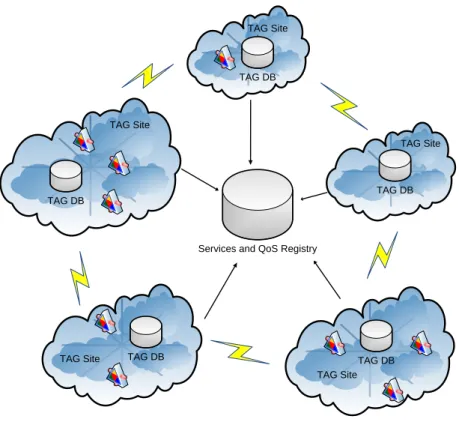
To summarize, the TAG system is composed of several data sources, several abstract services and one or more concrete deployment(s) per service. All deployments of a service are identical in terms of functionality and software version, but have different QoS attributes, as they run on heterogeneous hardware, the hosting sites have different availabilities, different access policies, etc. Figure 2.6 is a simplified schematic representation of the distributed TAG system.
When a concrete workflow, such as one of the examples described in Section 2.4, is built to respond to a request, there are thus several choices for composing deployments. The choice of data sources and service deployments should be made automatically and based on rational decisions, conforming to the goals stated in Section 1.2 (minimize the response time per request and ensure a fair and efficient usage of all available resources). As TAG services are getting used more frequently, since data taking at ATLAS is a continuous process, and an important amount of data are available