Chalmers Publication Library
yStreX: yeast stress expression database
This document has been downloaded from Chalmers Publication Library (CPL). It is the author´s
version of a work that was accepted for publication in:
Database-the Journal of Biological Databases and Curation (ISSN: 1758-0463)
Citation for the published paper:
Wanichthanarak, K. ; Nookaew, I. ; Petranovic, D. (2014) "yStreX: yeast stress expression
database". Database-the Journal of Biological Databases and Curation
http://dx.doi.org/10.1093/database/bau068
Downloaded from:
http://publications.lib.chalmers.se/publication/201710
Notice: Changes introduced as a result of publishing processes such as copy-editing and
formatting may not be reflected in this document. For a definitive version of this work, please refer
to the published source. Please note that access to the published version might require a
subscription.
Chalmers Publication Library (CPL) offers the possibility of retrieving research publications produced at Chalmers University of Technology. It covers all types of publications: articles, dissertations, licentiate theses, masters theses, conference papers, reports etc. Since 2006 it is the official tool for Chalmers official publication statistics. To ensure that Chalmers research results are disseminated as widely as possible, an Open Access Policy has been adopted. The CPL service is administrated and maintained by Chalmers Library.
Original article
yStreX: yeast stress expression database
Kwanjeera Wanichthanarak
1, Intawat Nookaew
1,2and
Dina Petranovic
1,*
1
Department of Chemical and Biological Engineering, Chalmers University of Technology, Gothenburg,
Sweden and
2Comparative Genomics Group, Biosciences Division, Oak Ridge National Laboratory, Oak
Ridge, TN 37831, USA
*Corresponding author: Tel:þ46 31 772 3836; Fax:þ46 31 772 3801; Email: [email protected]
Citation details: Wanichthanarak,K., Nookaew,I. and Petranovic,D. yStreX: yeast stress expression database.Database (2014) Vol. 2014: article ID bau068; doi:10.1093/database/bau068
Received 28 February 2014; Revised 9 June 2014; Accepted 11 June 2014
Abstract
Over the past decade genome-wide expression analyses have been often used to study
how expression of genes changes in response to various environmental stresses. Many of
these studies (such as effects of oxygen concentration, temperature stress, low pH stress,
osmotic stress, depletion or limitation of nutrients, addition of different chemical
com-pounds, etc.) have been conducted in the unicellular Eukaryal model, yeast
Saccharomyces
cerevisiae
. However, the lack of a unifying or integrated, bioinformatics platform that would
permit efficient and rapid use of all these existing data remain an important issue. To
facili-tate research by exploiting existing transcription data in the field of yeast physiology, we
have developed the yStreX database. It is an online repository of analyzed gene expression
data from curated data sets from different studies that capture genome-wide transcriptional
changes in response to diverse environmental transitions. The first aim of this online
data-base is to facilitate comparison of cross-platform and cross-laboratory gene expression
data. Additionally, we performed different expression analyses, meta-analyses and gene
set enrichment analyses; and the results are also deposited in this database. Lastly, we
con-structed a user-friendly Web interface with interactive visualization to provide intuitive
ac-cess and to display the queried data for users with no background in bioinformatics.
Database URL:
http://www.ystrexdb.com
Introduction
All organisms encounter various and dynamic changes in their environments. This also applies to single-cell organ-isms such as yeastSaccharomyces cerevisiae. The ability to respond appropriately to such variations is required for op-timal growth, competitive fitness and cell survival. In case
of yeast it was found that the stress-response strategies needed to deal with fluctuations in temperature, pH, nutri-ents, oxygen, induction of osmotic stress and the presence of various agents such as drugs and toxic compounds, rely extensively on genome-wide transcriptional changes (1–3). To study stress responses to diverse environmental changes
VCThe Author(s) 2014. Published by Oxford University Press. Page 1 of 7
This is an Open Access article distributed under the terms of the Creative Commons Attribution License (http://creativecommons.org/licenses/by/3.0/), which permits unrestricted reuse, distribution, and reproduction in any medium, provided the original work is properly cited.
(page number not for citation purposes)
doi: 10.1093/database/bau068 Original article
at Chalmers Tekniska Hogskola on August 26, 2014
http://database.oxfordjournals.org/
and understand transcriptional regulations, DNA micro-array technology has often been used (1,2).
These genome-wide transcription studies have gener-ated large and diverse data. The challenge is thus to create a unifying bioinformatics platform and resource where all relevant data from numerous sources are collected, making it possible to integrate and effectively query and exploit these data. Several databases such as ArrayExpress (4) and GEO (5) have been developed aiming to store and ex-change gene expression data and associated information. However, if one would like to use the data deposited in these databases, one will still need to download and reana-lyze the data to answer specific biological questions related to specific research questions. SPELL (6) and MEM (7) are examples of the databases that put an effort to maximize exploitation of gene expression data. Their scope lies spe-cifically on gene coexpression searches over several data sets. Other databases such as Gene Expression Atlas (8) have also addressed this issue by providing features to query readily analyzed gene expression, but they do not in-clude additional information such as enriched biological features of gene lists, which are useful for interpretation of the data.
Here we introduce yStreX, an online resource for yeast research with specific focus on stress responses. Here, we use the term ‘stress’ broadly and we apply it to different types of physical or chemical stresses, such as temperature or osmotic stress, nutrient stresses, oxygen limitation or addition of specific compounds that induce stress re-sponses. We also included transcription data for aging; aging is not an external agent that induces a stress re-sponse, but rather an inherent property of the cell that
can be influenced by environmental and genetic
factors. However, an aging cell shows specific transcrip-tional responses that are related to stress responses, so we believe it is a valuable and appropriate addition to this database.
yStreX addresses the growing need to efficiently collect, utilize, distribute and query analyzed gene expression data from different original studies. Information from the gene expression analysis, including statistical values of genes and enriched biological features of gene lists under specific conditions can be easily explored through an intuitive user-friendly Web interface. In addition, creating the specific compendia of gene expression data allow us to conduct meta-analyses across different platforms and laboratories (i.e. combining gene expression data from independent but related studies), which can enhance statistical power, reli-ability of the results and generalization of conclusions (9). To demonstrate different features and illustrate how the database can be used in original research, we include two examples.
Data preparation
Gene expression data were retrieved from ArrayExpress (4) and GEO (5). To enhance statistical reliability, data sets ‘with less than 2’ repeats/repetitions (biological or technical replicates, depending on what was available from the original published study) were discarded. The terms ‘stress’, ‘treat’ and ‘respond to’ were used to search and se-lect putative data sets that were then manually curated. The selected data sets came from experiments that included one or more variations of environmental factor(s), such as physical or chemical factors mentioned above. We have retrieved 82 stress-related data sets from both Affymetrix gene chip and complementary DNA (cDNA) two-color platforms. For the Affymetrix platform, Piano R package (10) was used to preprocess the data. The microarray ana-lysis functions in Piano include important functions in affy packages (11) including normalization, annotation and quality control. For the cDNA platform, normalized data were imported and manually evaluated with GEO2R (5).
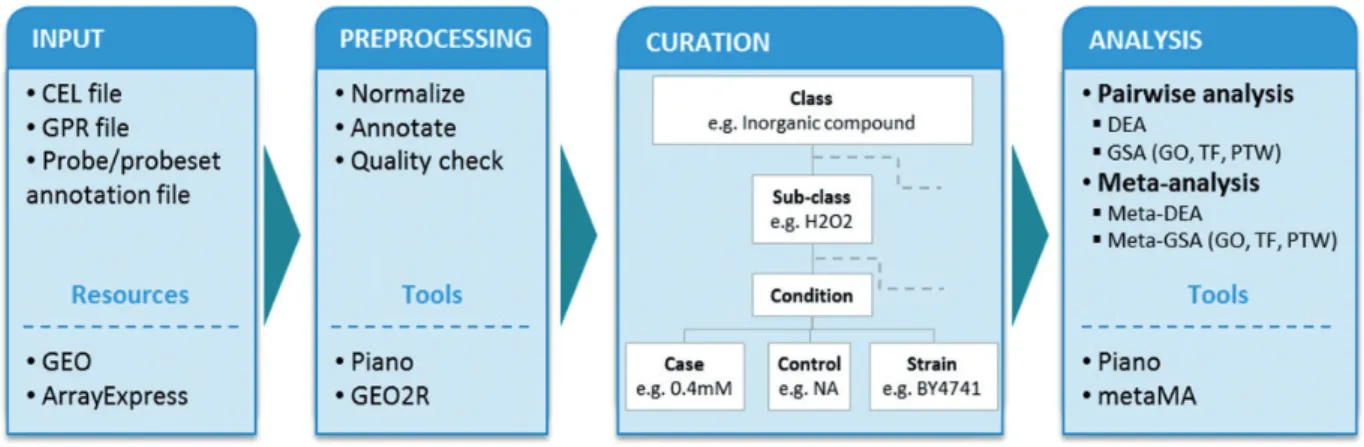
To describe experimental conditions in a unified way (i.e. to allow for comparison between independent experi-mental setups, and for pooling the data in meta-analyses), we adapted the concepts of experimental factors (EFs) and EF values from Gene Expression Atlas (8). In our studies, we defined an experimental class as a major EF (e.g. C-source, aeration, inorganic compound) that is examined for gene expression changes and termed an experimental subclass as the specific experimental value of the class (e.g. within the class ‘inorganic compound’, the subclass can be ‘hydrogen peroxide’). Within the subclass, we further con-sidered in detail for controls and cases (detailed or varied values) that are to be compared in differential expression analyses (DEA). We include strains’ description, and where applicable, we provide information about repeats/ repetitions, as found in the original publication (Figure 1).
Statistical analyses
Each gene expression data set was preprocessed, then mapped into classes, subclasses and curated as described above (seeSupplementary Table S1 for the list of experi-mental conditions). Then for each experiexperi-mental condition, we performed pairwise DEA to identify significantly differ-entially expressed genes. We then conducted the gene set analyses (GSA) on three levels of existing biological know-ledge: gene ontology (GO) gene sets, transcription factor (TF) gene sets and pathway (PTW) gene sets (Figure 1). The GO term gene sets are based on GO annotations for yeast genes from the SGD database (http://www.yeastge nome.org). TF gene sets are based on TF–gene interaction from YEASTRACT (12) and (13), and the PTW gene sets
Page 2 of 7 Database, Vol. 2014, Article ID bau068
at Chalmers Tekniska Hogskola on August 26, 2014
http://database.oxfordjournals.org/
are based on the genome-scale metabolic model iTO977 (14). The Piano R package was used for these analyses (10).
For DEA, the Piano uses the linear model fitting proced-ure of the limma package (15) to compute gene-level statis-tics (e.g. fold change,t-value andP-value) for each gene in each experimental condition. TheP-values were adjusted for multiple testing with false discovery rate (FDR) at 5%. Then the adjustedP-values were used as the input of the Reporter algorithm (16), which was used for GSA to com-pile significant gene sets (gene set P-values) among GOs, TFs and PTWs in each experimental condition. In addition, fold changes were used to classify the directionality of gene expression changes, which can facilitate the interpretation of significant gene sets as described in (10).
Currently, there are 20 subclasses (Supplementary Table S1) that contain data from two or more independent but relevant studies. Meta-analysis was performed on each of those subclasses using metaMA R package (17). The metaMA uses a moderated effect size combination method, in which effect sizes were calculated from moderated t-test (i.e. we used limma) for each study and then were com-bined before testing for differentially expressed (DE) genes (FDR at 5%) of a specific subclass. Similar to DEA, the re-sulting test statistics or gene-level statistics (meta-z-scores) were the input for GSA, for computing significant gene sets and for directionality classification of the gene sets. With provided functions in the Piano, we ran multiple GSAs using five GSA methods (mean, median, sum, maxmean and page; see Varemoet al.(10) for details), which only accept z-scores as input and then combined GSA results to obtain gene set consensus scores. The Piano uses rank aggregation approaches to assess consensus scores, and in
this study, the gene set consensus score was the median rank of each gene set given by different GSA methods (i.e. the lower the score, the higher rank given by most GSA methods). Results from all analyses including DEA and GSA for each condition, and meta-DEA and meta-GSA for each subclass were deposited in the database, and these re-sults can be accessed through different functions on the Web interface.
Database and Web interface
yStreX is a document-oriented NoSQL database, which is managed under MongoDB (http://www.mongodb.org). Data stored in the database are results from statistical analyses, and the data are deposited as sets of documents within differ-ent collections. We store a considerable amount of data and results from analyses, i.e. 121 conditions and 410 of statis-tical comparisons for6000 genes produces about 2 million records that we store and manage in the database. The NoSQL database was chosen because it has emerged as a preferred database choice for big data applications, and it does not require a predefined schema in contrast to relational databases. This is beneficial for scaling out the database (splitting data across many servers) when the amount of data grows and cloud computing technology becomes increasingly available (18–20). The Web interface to explore the data was implemented on PHP (http://php.net) and JavaScript (http://en.wikipedia.org/wiki/JavaScript). The Shiny package (http://www.rstudio.com/shiny) was integrated to present results from both GSAs and meta-GSAs in the form of heat-maps and data tables, which can be downloaded from the functions provided.
Figure 1.Analysis workflow. The diagram shows the workflow in the following steps: input, preprocessing, curation and statistical analyses. Tools and resources are also listed in the boxes. Microarray data sets from Affymetrix gene chip (CEL file) and cDNA two-color (GPR file) platforms were retrieved from GEO and ArrayExpress database together with probe/probeset annotation file. The data sets were preprocessed using Piano for Affymetrix and GEO2R for cDNA platform. Each data set was curated into defined experimental classes and subclasses, and it was considered in de-tail of experimental conditions (control values, case values, strains and type of repeats) based on its experimental dede-tails. Statistical analyses were performed including pairwise and meta-analysis. Both types of analyses were used to identify differentially expressed genes and enriched biological features: GO, TF and PTW.
at Chalmers Tekniska Hogskola on August 26, 2014
http://database.oxfordjournals.org/
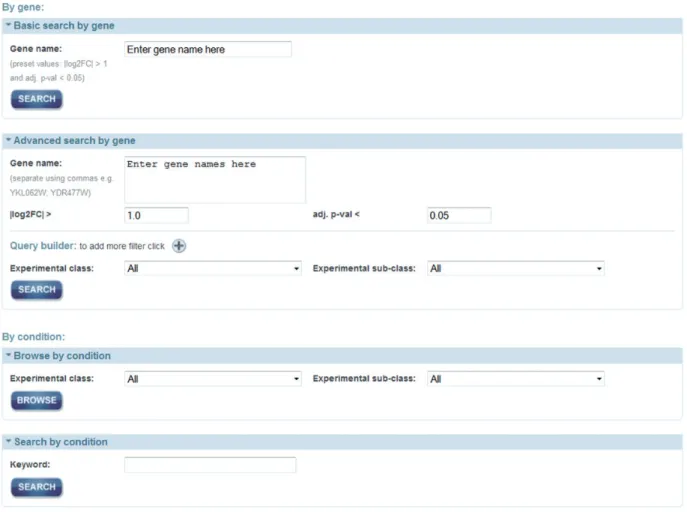
As shown inFigure 2, there are two main approaches to query the data: by gene and by condition. By searching by a gene or a set of genes (i.e. systematic name, gene symbol or alias), one can retrieve a list of conditions where the gene(s)’ expression exhibited a significant change. For ‘Basic’ search by gene, it allows for searching by one gene with default properties; an absolute log2 fold change (jlog2FCj)>1 and an adjusted P-value (adj. P-val)<0.05, which are set for simple and quick queries. Alternatively, it is possible to search by a set of genes with different properties such as log2FC, adj.P-val, experimental class and subclass to con-strain the query in ‘Advanced’ search. Querying by a condi-tion will retrieve a set of differentially expressed genes, as a result of the meta-analyses. This search can be accessed through a browsing option or searching by a text keyword.
Results
Here we present two different examples of how to query yStreX and illustrate different features and practicality of the database.
Example from differential gene expression
analysis: expression of apoptosis genes
during H
2O
2treatment
Apoptosis is a type of programmed cell death (PCD) that has not only been extensively studied in mammalian cells but also in unicellular Eukarya such as yeast. PCD pathways can be induced by various environmental factors such as temperature stress, oxidative stress or induction with several types of drugs/chemicals. In this example, we queried yStreX with a set of 51 apoptosis-related genes that were retrieved from the yApoptosis database (21), and we searched for genes that significantly changed expression under oxidative stress induced by H2O2. This example pre-sents features of the ‘Query by gene’, the retrieval of results from DEA (seeSupplementary Figure S1A) and exemplifies what can be concluded by analyzing data from differ-ent studies. With the cutoff of jlog2FCj>2 and adj. P-val<0.01, we found 14 apoptosis genes with significantly changed expression in 15 different studies where yeast was treated with H2O2. Of the 15 genes, 9 genes were signifi-cantly upregulated, and 5 genes were signifisignifi-cantly downre-gulated (seeSupplementary Table S2). These 15 studies use a different yeast strain, or different concentrations of H2O2 for induction, or the exposure time to H2O2. Because most of the apoptosis-related genes are regulated posttranscrip-tionally (e.g. proteolyic activation, phosphorylation and subcellular localization) (22), it is not surprising that less than half of apoptosis-related genes are differentially expressed in this apoptosis-inducing condition.
In this example, we show how we can use analyses of the existing data to find new results and propose hypothe-ses. For example, we found that OYE3 (coding for a NADPH oxidoreductase) was significantly upregulated in all 15 studies. It has previously been reported that OYE3 can promote H2O2-induced PCD in yeast (23). This could imply that ‘specifically’ transcriptional regulation of OYE3 might be an important step in H2O2-induced cell death. We also found that UBP10 (coding for a deubiquitylating protease) is significantly downregulated in all H2O2 -inducing conditions. This could imply that there is another apoptosis gene that is ‘specifically’ transcriptionally regu-lated under oxidative stress. The yeast metacaspase has been shown to be activated upon H2O2 treatment (24); however, genes related to the caspase-dependent cell death pathway (e.g. DNM1 and MCD1) were not found to be significantly differently expressed in any study implying that this pathway is mostly posttranscriptionally regulated. We show the possibility to retrieve information by browsing through the genes, in this case AIF1 (Apoptotic Inducing Factor 1). The ‘Gene summary’ page contains brief details about the selected gene and shows the list of condi-tions in which the expression of this gene was found to be significantly up- or downregulated, which is indicated by a red or green arrow, respectively. The list of presented condi-tions where the AIF1 gene is differentially expressed is
arranged by the deceasing fold change (LogFC)
(Supplementary Figure S1B). Yeast AIF1p is a caspase-independent cell death mediator that translocates from mitochondria to nucleus, leading to chromatic condensation and DNA degradation upon apoptotic induction (e.g. with addition of H2O2 or acetic acid or due to ageing) (25). There are 33 conditions in which the expression of AIF1 was found to be significantly changed (jlog2FCj>1 and adj. P-val<0.01) (Supplementary Table S2). AIF1 was found to be downregulated only upon addition of rapamycin.
Lastly, we show the option to retrieve information through the conditions. The ‘Condition summary’ page comprises a brief description of the experimental condition (class and subclass of the experimental setup, case and con-trol, yeast strain and the type of repeats if applicable) and a list of significant genes sorted by fold changes (Supplementary Figure S1B). In this example, yeast strain BY4742 was exposed to 0.4 mM H2O2. From comparison between the case (0.4 mM) and the control (untreated), there are 652 genes with significantly changed expres-sion, within the specified cutoff jlog2FCj>1 and adj. P-val<0.01). Genes (e.g. OYE3, CTT1, DDR2 and SOD2) having a role in oxidative stress response and cell death were strongly upregulated (log2FC>2) (Supplementary Table S2). Moreover, well-known general stress response regulators such as MSN2, MSN4, XBP1
Page 4 of 7 Database, Vol. 2014, Article ID bau068
at Chalmers Tekniska Hogskola on August 26, 2014
http://database.oxfordjournals.org/
and GIS1 were identified from GSA, meaning that genes regulated by these TFs have significantly changed tran-scription. Enriched TF gene sets can be searched and downloaded as a heatmap or a tab-delimited text file through provided links (Supplementary Figure S1B).
Example from the meta-analysis:
rapamycin-induced gene expression
Inhibition of the TOR complex 1 (TORC1) by rapamycin resembles nutrient starvation, leading to changes in expres-sion of genes shown to respond to starvation and stress (26,27). In this example, we searched for common genes and consensus gene sets from independent studies that measured transcription profiles of genes under rapamycin treatment. This example illustrates how to retrieve infor-mation from meta-analysis (Supplementary Figure S2A). By using the ‘Query by condition’, we searched the ‘Rapamycin’ subclass, which contains data sets of 18 con-ditions from five related studies, done on two different
platforms. Genes with significantly changed expression, identified by the meta-DEA (with FDR of 5%), were listed and sorted by the number of conditions that found upregu-lated genes. ‘Condition summary’ provided at the end of the page shows every condition combined in the meta-DEA and the gene-level statistics from DEA of the selected gene (Supplementary Figure S2B).
In this analysis, we found that genes related to autoph-agy, cytosol-to-vacuole targeting (CVT) pathway and heat shock response (e.g. ATG1, ATG3, ATG8, ATG14, APE1, AMS1, HSP26, HSP78 and HSP42) were upregulated, whereas genes involved in cell growth or encoding ribo-some subunits (e.g. TEF4, RPL24, RRP9 and RPL12A)
were downregulated. Subsequently, autophagy
(GO:0006914), CVT pathway (GO:0032258) and cellular response to oxidative stress (GO:0034599) were found in the top rank and as the significant GO term gene sets from meta-GSA. Upon TORC1 inhibition, stress-response TFs are also identified. These TFs include MSN4, RIM15 and GIS1 meaning that genes under their regulation were found Figure 2.Query page. Two main approaches for query data are either by gene of interest or by condition of interest. Advanced search can be used to set additional properties that can add constrains in the query by gene name. Querying by a condition can be either by selection of the experimental classed or subclasses from the menu or by using a keyword.
at Chalmers Tekniska Hogskola on August 26, 2014
http://database.oxfordjournals.org/
to be upregulated in all five studies. Besides this, metabolic adaptation was observed from both GO term and PTW gene sets, and this included tricarboxylic acid cycle, gly-cerol metabolism, glycogen metabolism and glutamate me-tabolism. This result was also confirmed by studies of essential roles of TORC1 during starvation, as described previously (28). Enriched gene sets (GO, TF or PTW) can be explored and downloaded as a heatmap or a tab-de-limited text file through provided links in the Meta-GSA result (Supplementary Figure S2B).
Conclusions and Perspectives
Over the past decade, several tools have been proposed for genome-wide gene expression analysis, as can be found in Bioconductor packages (http://www.bioconductor.org/). Typically, these tools carry out tasks to identify differen-tially expressed genes in a certain condition and infer cor-relation of differential expression information with existing biological knowledge (usually referred to as gene set enrichment analysis) (10).
We have developed yStreX, an online database to col-lect and distribute results of genome-wide gene expression analyses, including DEA and GSA. Based on the availabil-ity of gene expression data from the main repositories GEO and ArrayExpress, and our criteria about minimal number of repeats, we identified two main experimental platforms of interest: Affymetrix and the two-channel arrays. Because more studies aiming at transcriptional re-sponses will be using RNA sequencing technology in the future, we envisage including gene expression data from this platform into yStreX. The database is specifically tar-geted for yeast data sets of experiments under several stress conditions, but it also includes transcriptional data of aging yeast, as its transcriptional response resembles a stress response, and direct comparison might be relevant for many members of the yeast research community.
A well-organized and user-friendly interface allows fast access and facilitates inference from the readily analyzed data, which is of practical use for experimental molecular biologists who do not wish to reanalyze data. This aspect is usually the limiting factor with databases that are just collecting and storing raw data, as they require the user to know in advance about the data and know how to carry out data analysis. However, such databases can be used in broader applications. To overcome this issue, we provided a link back to the original data allowing users to rapidly access raw data and carry out additional work (which might not be within the scope of the yStreX).
In addition, bringing together gene expression data and adapting the concepts of EFs make it possible to perform meta-analysis, which consequently increases statistical
power, reliability and generalizability of the results, and makes use of the many experiments that have been carried out in different laboratories over the years. We demon-strated with two examples how the database can be readily used. The first shows the possibility to query many genes of interest concurrently (in this case, 51 apoptosis-related genes). Furthermore, we show that one can zoom-in on a gene of interest (e.g. AIF1) and retrieve the data of its tran-scriptional regulation under a stress of interest (e.g. oxida-tive stress by H2O2induction). The second example shows the possibility to find common features, thanks to the meta-analysis approach, which combines data from many independent but related experiments.
Because of the limited number of high-throughput RNA sequencing data particularly for stress response studies in yeast, yStreX currently includes solely data sets from microarray-based assays. However, by using a document-oriented database, it is simple and flexible to scale out yStreX for including large and varied gene expression data in the near future.
An additional future challenge will be to uncover the transcriptional regulation of genes as the net result of mul-tiple stimuli, as for now all results are based on compari-sons of control versus one case (one stimulus or one testing condition). We are currently investigating statistical meth-ods that would be appropriate for such situations. Moreover, in the future version of the database, we plan to include more features, more diverse download options and interactive pathway visualization that will continuously provide a useful service to the yeast research community.
Supplementary Data
Supplementary dataare available atDatabaseOnline.
Acknowledgements
K.W. wishes to thank Natapol Pornputtapong for assistance with software installation and technical advice and also Leif Va¨remo for valuable discussions regarding a moderated effect size combination method. K.W., I.N. and D.P. are thankful to Jens Nielsen for general advice and support.
Funding
This project was supported by The Chalmers Foundation and BILS (Bioinformatics Infrastructure for Life Science). Funding for open access charge: Chalmers Library.
Conflict of interest. None declared.
References
1. Causton,H.C., Ren,B., Koh,S.S. et al. (2001) Remodeling of yeast genome expression in response to environmental changes.
Mol. Biol. Cell, 12, 323–337.
Page 6 of 7 Database, Vol. 2014, Article ID bau068
at Chalmers Tekniska Hogskola on August 26, 2014
http://database.oxfordjournals.org/
2. Gasch,A.P., Spellman,P.T., Kao,C.M.et al. (2000) Genomic ex-pression programs in the response of yeast cells to environmental changes.Mol. Biol. Cell, 11, 4241–4257.
3. Gibson,B.R., Lawrence,S.J., Leclaire,J.P.et al. (2007) Yeast re-sponses to stresses associated with industrial brewery handling.
FEMS Microbiol. Rev., 31, 535–569.
4. Rustici,G., Kolesnikov,N., Brandizi,M. et al. (2013) ArrayExpress update–trends in database growth and links to data analysis tools.Nucleic Acids Res., 41, D987–D990. 5. Barrett,T., Wilhite,S.E., Ledoux,P. et al. (2013) NCBI GEO:
archive for functional genomics data sets–update.Nucleic Acids Res., 41, D991–D995.
6. Hibbs,M.A., Hess,D.C., Myers,C.L.et al. (2007) Exploring the functional landscape of gene expression: directed search of large microarray compendia.Bioinformatics, 23, 2692–2699. 7. Adler,P., Kolde,R., Kull,M.et al. (2009) Mining for
coexpres-sion across hundreds of datasets using novel rank aggregation and visualization methods.Genome Biol., 10, R139.
8. Kapushesky,M., Emam,I., Holloway,E.et al.(2010) Gene ex-pression atlas at the European bioinformatics institute.Nucleic
Acids Res., 38, D690–D698.
9. Ramasamy,A., Mondry,A., Holmes,C.C.et al. (2008) Key issues in conducting a meta-analysis of gene expression microarray datasets.PLoS Med., 5, e184.
10. Varemo,L., Nielsen,J. and Nookaew,I. (2013) Enriching the gene set analysis of genome-wide data by incorporating direc-tionality of gene expression and combining statistical hypotheses and methods.Nucleic Acids Res., 41, 4378–4391.
11. Gautier,L., Cope,L., Bolstad,B.M. and Irizarry,R.A. (2004) Affy–analysis of Affymetrix GeneChip data at the probe level.
Bioinformatics, 20, 307–315.
12. Abdulrehman,D., Monteiro,P.T., Teixeira,M.C. et al. (2011) YEASTRACT: providing a programmatic access to curated transcriptional regulatory associations inSaccharomyces cerevi-siaethrough a web services interface.Nucleic Acids Res., 39, D136–D140.
13. Harbison,C.T., Gordon,D.B., Lee,T.I. et al. (2004) Transcriptional regulatory code of a eukaryotic genome.Nature, 431, 99–104.
14. Osterlund,T., Nookaew,I., Bordel,S. and Nielsen,J. (2013) Mapping condition-dependent regulation of metabolism in yeast through genome-scale modeling.BMC Syst. Biol., 7, 36.
15. Smyth,G.K. (2005) In: Gentleman,R., Carey,V., Dudoit,S., Irizarry,R. et al. (eds). Bioinformatics and Computational
Biology Solutions using R and Bioconductor. Springer, New
York, pp. 397–420.
16. Patil,K.R. and Nielsen,J. (2005) Uncovering transcriptional regulation of metabolism by using metabolic network topology.
Proc. Natl Acad. Sci. USA, 102, 2685–2689.
17. Marot,G., Foulley,J.L., Mayer,C.D. and Jaffrezic,F. (2009) Moderated effect size and P-value combinations for microarray meta-analyses.Bioinformatics, 25, 2692–2699.
18. Stein,L. (2013) Creating databases for biological information: an introduction.Curr. Protoc. Bioinformatics, Chapter 9, Unit9 1. 19. Chodorow,K. (2010) MongoDB: The Definitive Guide.
O’Reilly.
20. Dai,L., Gao,X., Guo,Y.et al. (2012) Bioinformatics clouds for big data manipulation.Biol. Direct., 7, 43.
21. Wanichthanarak,K., Cvijovic,M., Molt,A. and Petranovic,D. (2013) yApoptosis: yeast apoptosis database. Database
(Oxford), 2013, bat068.
22. Martinet,W., Schrijvers,D.M., De Meyer,G.R. et al. (2002) Gene expression profiling of apoptosis-related genes in human atherosclerosis: upregulation of death-associated protein kinase.
Arterioscler. Thromb. Vasc. Biol., 22, 2023–2029.
23. Odat,O., Matta,S., Khalil,H.et al.(2007) Old yellow enzymes, highly homologous FMN oxidoreductases with modulating roles in oxidative stress and programmed cell death in yeast.J. Biol.
Chem., 282, 36010–36023.
24. Madeo,F., Herker,E., Maldener,C. et al. (2002) A caspase-related protease regulates apoptosis in yeast. Mol. Cell, 9, 911–917.
25. Madeo,F., Carmona-Gutierrez,D., Ring,J.et al. (2009) Caspase-dependent and caspase-inCaspase-dependent cell death pathways in yeast.
Biochem. Biophys. Res. Commun., 382, 227–231.
26. Galdieri,L., Mehrotra,S., Yu,S. et al. (2010) Transcriptional regulation in yeast during diauxic shift and stationary phase.
OMICS, 14, 629–638.
27. Cebollero,E. and Reggiori,F. (2009) Regulation of autophagy in yeast Saccharomyces cerevisiae.Biochim. Biophys. Acta, 1793, 1413–1421.
28. Wei,M., Fabrizio,P., Madia,F.et al.(2009) Tor1/Sch9-regulated carbon source substitution is as effective as calorie restriction in life span extension.PLoS Genet., 5, e1000467.
at Chalmers Tekniska Hogskola on August 26, 2014
http://database.oxfordjournals.org/