S O F T W A R E
Open Access
π
BUSS: a parallel BEAST/BEAGLE utility for
sequence simulation under complex
evolutionary scenarios
Filip Bielejec
1*, Philippe Lemey
1, Luiz Max Carvalho
2, Guy Baele
1, Andrew Rambaut
3and Marc A Suchard
4,5Abstract
Background: Simulated nucleotide or amino acid sequences are frequently used to assess the performance of phylogenetic reconstruction methods. BEAST, a Bayesian statistical framework that focuses on reconstructing time-calibrated molecular evolutionary processes, supports a wide array of evolutionary models, but lacked matching machinery for simulation of character evolution along phylogenies.
Results: We present a flexible Monte Carlo simulation tool, calledπBUSS, that employs the BEAGLE high
performance library for phylogenetic computations to rapidly generate large sequence alignments under complex evolutionary models.πBUSS sports a user-friendly graphical user interface (GUI) that allows combining a rich array of models across an arbitrary number of partitions. A command-line interface mirrors the options available through the GUI and facilitates scripting in large-scale simulation studies.πBUSS may serve as an easy-to-use, standard sequence simulation tool, but the available models and data types are particularly useful to assess the performance of complex BEAST inferences. The connection with BEAST is further strengthened through the use of a common extensible markup language (XML), allowing to specify also more advanced evolutionary models. To support simulation under the latter, as well as to support simulation and analysis in a single run, we also add theπBUSS core simulation routine to the list of BEAST XML parsers.
Conclusions: πBUSS offers a unique combination of flexibility and ease-of-use for sequence simulation under realistic evolutionary scenarios. Through different interfaces,πBUSS supports simulation studies ranging from modest endeavors for illustrative purposes to complex and large-scale assessments of evolutionary inference procedures. Applications are not restricted to the BEAST framework, or even time-measured evolutionary histories, andπBUSS can be connected to various other programs using standard input and output format.
Keywords: Simulation, Monte Carlo, Phylogenetics, BEAST, BEAGLE, Evolution
Background
Recent decades have seen extensive development in phy-logenetic inference, resulting in a myriad of techniques, each with specific properties concerning evolutionary model complexity, inference procedures and performance both in terms of speed of execution and estimation accuracy. With the development of such phylogenetic inference methods comes the need to synthesize evolu-tionary data in order to compare estimator performance *Correspondence: [email protected]
1Department of Microbiology and Immunology, Rega Institute, KU Leuven, Leuven, Belgium
Full list of author information is available at the end of the article
and to characterize strengths and weaknesses of different approaches (e.g. [1,2]). Whereas the true underlying evo-lutionary relationships between biological sequences are generally unknown, Monte Carlo simulations allow gener-ating test scenarios while controlling for the evolutionary history as well as the tempo and mode of evolution. This has been frequently used to compare the perfor-mance of tree topology estimation (e.g. [3]), but it also applies to evolutionary parameter estimation and ances-tral reconstruction problems (e.g. [4]). In addition, Monte Carlo sequence simulation has proven useful for assess-ing model adequacy (e.g. [5]) and for testassess-ing competassess-ing © 2014 Bielejec et al.; licensee BioMed Central Ltd. This is an Open Access article distributed under the terms of the Creative Commons Attribution License (http://creativecommons.org/licenses/by/2.0), which permits unrestricted use, distribution, and reproduction in any medium, provided the original work is properly credited. The Creative Commons Public Domain Dedication waiver (http://creativecommons.org/publicdomain/zero/1.0/) applies to the data made available in this article, unless otherwise stated.
Bielejecet al. BMC Bioinformatics2014,15:133 Page 2 of 8 http://www.biomedcentral.com/1471-2105/15/133
evolutionary hypotheses (e.g. [6]). It is therefore not sur-prising that several general sequence simulation programs have been developed (e.g. Seq-Gen [7]), but also inference packages that do not primarily focus on tree reconstruc-tion, such as PAML [8] and HyPhy [9], maintain code to simulate sequence data under the models they implement. As a major application of phylogenetics, estimating divergence times from molecular sequences requires an assumption of roughly constant substitution rates throughout evolutionary history [10]. Despite the restric-tive nature of this molecular clock assumption, its applica-tion in a phylogenetic context has profoundly influenced modern views on the timing of many important events in evolutionary history [11]. Following a long history of applying molecular clock models on fixed tree topolo-gies, the Bayesian Evolutionary Analysis by Sampling Trees (BEAST) package [12] fully integrates these mod-els, including more realistic relaxed clock models [13,14], in a phylogenetic inference framework. Despite its pop-ularity this framework has lacked a flexible and efficient simulation tool. Here, we address this pitfall by intro-ducing a parallel BEAST/BEAGLE utility for sequence simulation (πBUSS) that integrates substitution models, molecular clock models, tree-generative (coalescent or birth-death) models and trait evolutionary models in a modular fashion, allowing the user to simulate sequences under different parameterizations for each module.
πBUSS readily incorporates the temporal dimension of evolution through the possibility of specifying different molecular clock model. Further, many models and data types available for BEAST inference are matched by their simulation counter-parts in πBUSS, including relatively specific processes, such as for discrete phylogeography with rate matrices that can be sparse or non-reversible [15] that are generally beyond the scope of most sequence simulation tools. The BEAST-πBUSS connection is fur-ther reinforced by the fact thatπBUSS can easily gener-ate simulation specification in XML format for BEAST. Finally, we implement the core simulation routine within the BEAST code-base to ensure a shared XML syntax between the two packages and to allow for joint simulation and inference analysis using a single input file.
Implementation
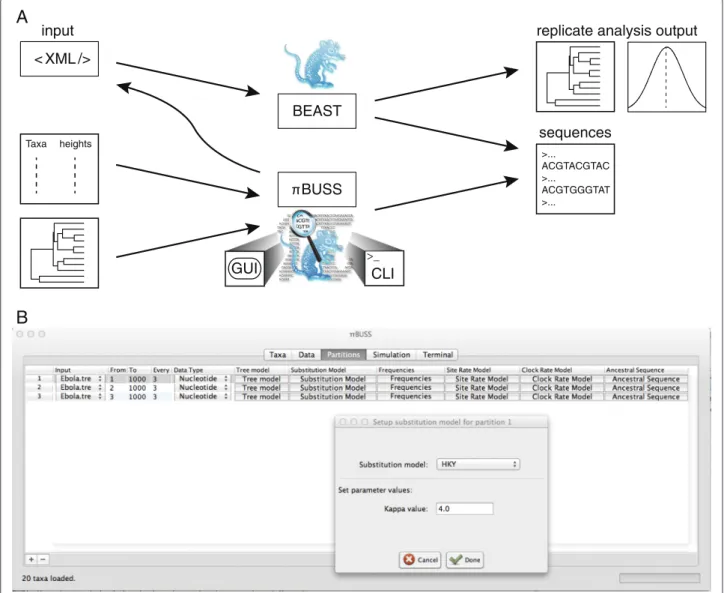
Through different implementations, we support several sequence simulation procedures that balance between ease-of-use and accessibility, to model complexity. On the one hand, the core simulation routine can be per-formed following specifications in an XML input file that is understood by BEAST (Figure 1A). This procedure provides the most comprehensive access to the πBUSS arsenal of models, but may require custom XML edit-ing. On the other hand,πBUSS also represents a stand-alone package that conveniently wraps the simulation
routines in a user-friendly graphical user interface (GUI), allowing users to set up and run simulations by load-ing input, selectload-ing models from drop-down lists, settload-ing their parameter values, and generating output in differ-ent formats (Figure 1B). To facilitate scripting, πBUSS is further accessible through a command-line interface (CLI), with options that mirror the GUI. The simula-tion routines are implemented in Java and interface with the Broad-platform Evolutionary Analysis General Likeli-hood Evaluator (BEAGLE) high-performance library [16] through its application programming interface (API) for computationally intensive tasks.
The core ofπBUSS consists of a recursive tree-traversal that is independent of the BEAST inference machinery. The algorithm simulates discrete state realizations by vis-iting the tree nodes in pre-order fashion, i.e., parental nodes are visited before child nodes. When a child node is visited, πBUSS samples its state from the conditional probabilities of changing to state j given state i at the parental node. For a branch lengthtand clock rater, the finite-time transition probability matrix P(r×t) is cal-culated through the eigen-decomposition of the infinites-imal rate matrix Q along that branch. For a review of methods to numerically approximate a matrix exponen-tial, we refer to [17]. By sharing the set of XML parsers with BEAST, we simplify the simultaneous development of both packages and facilitate the ability to perform joint simulation and inference analyses.
Program input
The core implementation of the software can be invoked by loading an XML file with simulation settings in the BEAST software. The simulation procedure requires a user-specified tree topology or a set of taxa with their heights (inversely proportional to their sampling time) for which a tree topology can be simulated using a coales-cent model. Setting all heights to 0 would be equivalent to contemporaneously-sampled taxa. InπBUSS, such a tree can be loaded in NEXUS or NEWICK format, or a taxa list can be set-up in the Data panel for subsequent coa-lescent simulation of the genealogy. Creating the latter is further facilitated by the ability to load a tab-delimited file with a set of taxa and their corresponding heights. The input tree or taxon list can also be specified through the command-line interface ofπBUSS.
Program output
πBUSS generates sequence output in FASTA or NEXUS format but it also supports XML output of the simula-tion settings. The XML provides a notasimula-tion for the models used, it can also be used to store a record of the set-tings. Similar to BEAuti for BEAST,πBUSS can generate an xml template for editing more complex simulations, or this can be amended with BEAST analysis settings
CLI < XML />
Taxa heights
BEAST
sequences
replicate analysis output input BUSS >... ACGTACGTAC >... ACGTGGGTAT >... GUI G ACAGG TACA TTAACCC TAC ACTTA TA GTA TAACCCA AGTA ACAGGACT TAACCCAGGAGAGT ACAGGAC ACAGG
A
B
Figure 1Overview of theπBUSS simulation procedures and GUI screenshot.A. Schematic representation of the different ways to employ the πBUSS simulation software. Based on an XML input file, simulations can be performed using the core implementation. BEAST can parse the specifiedπBUSS instructions and generate sequence data as well as analyze the replicate data in a single run. Using both the GUI or CLI,πBUSS can run simulations based on an input tree or a list of taxa and their heights. The software can also write the simulation settings to an XML file that can be then read by BEAST.B. The screenshot example shows the set-up of a codon position partitioned simulation in the Partitions panel of the graphical user interface. The Hasegawa, Kishino and Yano (HKY) model is being set as the substitution model for partition 1, with aκ(the transition-transversion bias) parameter value of 4.0.
order to directly analyze the generated sequence data, which avoids writing to an intermediate file. The tuto-rial hosted onπBUSS webpage provides examples of these possibilities.
Models of evolution
πBUSS is capable of generating trees from a list of taxa using simple coalescent models, including a constant population size or exponential growth model. The soft-ware supports simulation of nucleotide, amino acid and codon data along the simulated or user-specified phy-logeny using standard substitution models. For nucleotide
data, the Hasegawa, Kishino and Yano model (HKY; [18]), the Tamura Nei model (TN93; [19]) and the general time-reversible model (GTR; [20]) can be selected from a drop-down list, and more restrictive continuous-time Markov chain (CTMC) models can be specified by tai-loring parameters values. Coding sequences can be sim-ulated following the Goldman and Yang model of codon evolution (GY94; [21]), which is parameterized in terms of a non-synonymous and synonymous substitution rate ratio (dN/dS or ω) and a transition/transversion rate ratio (κ) or following the Muse and Gaut model (MG94; [22]). Several empirical amino acid substitution models
Bielejecet al. BMC Bioinformatics2014,15:133 Page 4 of 8 http://www.biomedcentral.com/1471-2105/15/133
are implemented, including the Dayhoff [23], JTT [24], BLOSUM [25], WAG [26] and LG [27] model. Equilibrium frequencies can be specified for all substitution models as well as among-site rate heterogeneity through the widely-used discrete-gamma distribution [28] and proportion of invariant sites [29].
An important feature ofπBUSS is the ability to set up an arbitrary number of partitions for the sequence data and associate independent substitution models to them. Such settings may reflect codon position-specific evolu-tionary patterns or approximate genome architecture with separate substitution patterns for coding and non-coding regions. Partitions may also be set to evolve along dif-ferent phylogenies, which could be used, for example, to investigate the impact of recombination or to assess the performance of recombination detection programs in spe-cific cases. Finally, partitions do not need to share the exact same taxa (e.g. reflecting differential taxon sam-pling), and in partitions where a particular taxon is not represented the relevant sequence will be padded with gaps.
πBUSS is equipped with the ability to simulate evolu-tionary processes on trees calibrated in time units. Under the strict clock assumption, this is achieved by spec-ifying an evolutionary rate parameter that scales each branch from time units into substitution units. πBUSS also supports branch-specific scalers drawn indepen-dently and identically from an underlying distribution (e.g. log normal or inverse Gaussian distributions), modeling an uncorrelated relaxed clock process [13]. Simulations do not need to accommodate an explicit temporal dimension and input trees with branch lengths in substitution units will maintain these units with the default clock rate of 1 (substitution/per site/per time unit).
The data types and models described above are avail-able through theπBUSS GUI or CLI, but additional data types and more complex models can be specified directly in an XML file. This allows, for example, simulating any discrete trait, e.g. representing phylogeographic locations, under reversible and nonreversible models [15,30], with potentially sparse CTMC matrices [15], as well as sim-ulating a combination of sequence data and such traits. As an example of available model extensions is the abil-ity to specify different CTMC matrices over different time intervals of the evolutionary history, allowing for example to model changing selective constraints through differ-ent codon model parameterizations or seasonal migration processes for viral phylogeographic traits [31].
Results and discussion
We have developed a new simulation tool, calledπBUSS, that we consider to be a rejuvenation of Seq-Gen [7], with several extensions to better integrate with the BEAST inference framework. Compared to Seq-Gen and other
simulation software (Table 1),πBUSS covers a relatively wide range of models while, similar to Mesquite, offer-ing a cross-platform, user-friendly GUI.πBUSS is imple-mented in the Java programming language, and therefore requires a Java runtime environment, and depends on the BEAGLE library. Although speed is unlikely to be an impeding factor in most simulation efforts, the core implementation using the BEAGLE library provides substantial increases in speed for large-scale simula-tions, in particular when invoking multi-core architec-ture to produce highly partitioned synthetic sequence data.
Program validation
We validate πBUSS in several ways. First, we compare the expected site probabilities, as calculated using tree pruning recursion [56], with the observed counts resulting from πBUSS simulations. To this purpose, we calculate the probabilities for all 43 possible nucleotide site pat-terns observed at the tips of a particular 3-taxon topology using an HKY model with a discrete gamma distribution to model rate variation among sites. We then compare these probabilities to long-run (n = 100, 000) site pat-tern frequencies simulated under this model and observe good correspondence in distribution (Pearson’s χ2 test,
p=0.42).
We also perform simulations over larger trees and esti-mate substitution parameters (e.g. κ in the HKY model) using BEAST for a large number of replicates. Not only do the posterior mean estimates agree very well with the simulated values, but we also find close to nominal coverage, and relatively small bias and variance (mean squared error). These good performance measures have also recently been demonstrated for more complex substi-tution processes [31].
Example application
We illustrate the use of simulating sequence data along time-calibrated phylogenies to explore the limitations of estimating old divergence times for rapidly-evolving viruses. Wertheim and Kosakovsky Pond [57] examine the evolutionary history of Ebola virus from sequences sampled over the span of three decades. Although main-taining remarkable amino acid conservation, the authors estimate nucleotide substitution rates on the order of 10−3substitutions/per site/per year and a time to most recent common ancestor (tMRCA) of about 1,000 years ago. These estimates suggest a strong action of purifying selection to preserve amino acid residues over longer evo-lutionary time scales, which may not be accommodated by standard nucleotide substitution models. The authors demonstrate that accounting for variable selective pres-sure using codon models can result in substantially older origins in such cases.
BMC Bioinformatics 2014, 15 :133 Page 5 o f 8
Table 1 Comparison between a selection of sequence simulation packages
Evolutionary modelling Implementation
Program Codons1 Amino acids2 Indels Partitions Molecular clocks Ancestral sequences Coalescent models3 GUI Multi-core Cross-platform4
πBUSS X X X X X X X X X Seq-Gen [7] X X X indel-Seq-Gen2 [32] X X X X X PhyloSim [33] X X X X X X Recodon [34] X X X X X NetRecodon [35] X X X X X Indelible [36] X X X X X DAWG [37] X X X X Mesquite [38] X X X X Rose [39] X X Evolver [8] X X X X X ProteinEvolver [40] X X X X X ALF [41] X X X X X X X X GenomePop [42] X X X5 X SIMCOAL [43] X X X SIMPROT [44] X X X X X
1πBUSS: GY94, MG94; PhyloSim: GY94 x M0 - M4; Recodon: GY94 x M0, M1, M7, M8; NetRecodon: GY94 x M0, M1, M7, M8; Indelible: GY94 x M0 - M10; Evolver: GY94 x M0, M1, M2, M3, M7, M8; ALF: GY94 x M0, M1, M7 and M8; GenomePop: MG94.
2πBUSS: BLOSUM [25], CPREV [45], Dayhoff [23], FLU [46], JTT [24], LG [27], MTREV [47], WAG [26]; Seq-Gen: JTT, WAG,
PAM [48], BLOSUM, MTREV; indel-Seq-Gen2: PAM, JTT, MTREV, CPREV; PhyloSim: CPREV, JTT, LG , MTART [49], MTMAM [50], MTREV24 [51], MTZOA [52], PAM, WAG; Indelible: Dayhoff, JTT, WAG, VT [53], LG, BLOSUM, MTMAM, MTREV, MTART, CPREV, RTREV [54], HIVb [55], HIVw [55]; Evolver: Dayhoff, JTT, WAG, MTMAM, MTREV; ProteinEvolver: BLOSUM, CPREV, Dayhoff, HIVb, HIVw, JTT, Jones [24], LG, MTART, MTMAM, MTREV24, RTREV, VT, WAG; ALF: PAM,GTT,LG,WAG; SIMPROT: PAM, JTT, PMB.
3πBUSS: demography; Recodon: recombination, migration, demography; NetRecodon: recombination, migration, demography; Mesquite: speciation; ProteinEvolver: recombination, migration, demography; SIMCOAL: demography and migration.
4PhyloSim: R package; Indelible: Executables for Windows and MacOS; ALF: Web interface; GenomePop: Executables for Windows and Linux; SIMCOAL: Executables for Windows; SIMPROT: GUI, Web interface; SIMPROT: Executables for Windows and Linux.
Bielejecet al. BMC Bioinformatics2014,15:133 Page 6 of 8 http://www.biomedcentral.com/1471-2105/15/133
Here, we explore the effect of temporally varying selection pressure throughout evolutionary history on estimates of the tMRCA using nucleotide substitution models. In particular, we model a process that is char-acterized by increasingly stronger purifying selection as we go further back in to time. To this purpose, we set up an ‘epoch model’ that specifies different GY94 codon substitution processes along the evolutionary history [31], and parameterize them according to a log-linear relation-ship between time andω. Specifically, we let the process transition from ω = 1.0, 0.2, 0.1, 0.02, 0.01, 0.002, and 0.001 at time = 10, 50, 100, 500, 1000 and 5000 years in the past, respectively. We simulate a constant population size genealogy of 50 taxa, sampled evenly during a time interval of 25 years, and simulate sequences according to the time-heterogeneous codon substitution process with a constant clock rate of 3×10⁻³codon substitutions/codon site/year. We simulate 100 replicates over genealogies with varying tMRCAs, by generating topologies under different population sizes parameterized by the product of effec-tive population size (Ne) and generation time scaled in
years (τ):
Ne×τ =1, 5, 10, 50, 100, 500, 1000
We note that under this model, trees with tMRCAs of about 10,000 years still result in sequences with a notice-able degree of homology (resulting in a mean amino acid distance of about 0.5, which is in the same range of the mean amino acid distance for sequences represen-tative of the primate immunodeficiency virus diversity).
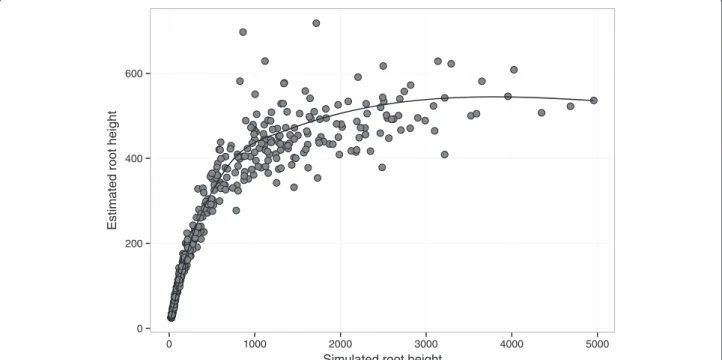
Using a constant ω of 0.5 on the other hand results in fairly randomized sequences. We subsequently ana-lyze the replicate data using a codon position partitioned nucleotide substitution model in BEAST and plot the cor-respondence between simulated and estimated tMRCAs in Figure 2.
Our simulation exercise shows that a linear relationship between simulated and estimated tMRCAs only holds for 100 to 200 years in the past, and estimates quickly level off after about 1000 years in the past. This can be explained by the unaccounted decline in amino acid substitutions and saturation of the synonymous substitutions as we go further back in time. Although we are not claiming that evolution occurs quantitatively or even qualitatively according to the particular process we simulate under, and we ignore other confounding factors (such as potential selective constraints on non-neutral synonymous sites), this simulation does conceptualize some of the limita-tions to estimating ancient origins for rapidly evolving viruses that experience strong purifying selection over longer evolutionary time scales.
Conclusion
πBUSS provides simulation procedures under many evolutionary models or combinations of models avail-able in the BEAST framework. This feature facilitates the evaluation of estimator performance during the development of novel inference techniques and the gen-eration of predictive distributions under a wide range of evolutionary scenarios that remain critical for testing
0 200 400 600
0 1000 2000 3000 4000 5000
Simulated root height
Estimated root height
Figure 2Correspondence between simulated and estimated tMRCAs when purifying selection increases back in time in simulated data sets.
competing evolutionary hypotheses. Combinations of dif-ferent evolutionary models can be accessed through a GUI or CLI, and further extensions can be specified in XML format with a syntax familiar to the BEAST user community. Analogous to the continuing effort to sup-port model set-up for BEAST in BEAUti, future releases ofπBUSS aim to provide simulation counterparts to the BEAST inference tools, both in terms of data types and models, while also maintaining general purposes simula-tion capabilities. Interesting targets include discrete traits, which can already be simulated through XML specifica-tion, continuously-valued phenotype data [58] and indel models. Finally,πBUSS provides opportunities to pursue further computational efficiency through parallelization on advancing computing technology. We therefore hope that πBUSS will further stimulate the development of sequence and trait evolutionary models and contribute to advancement of our knowledge about evolutionary processes.
Availability and requirements
Project name:πBUSS;
Project home page: www.rega.kuleuven.be/cev/ecv/ software/pibuss;
Operating system(s):Platform independent;
Programming language:Java;
Other requirements:Java 1.5 or higher, BEAGLE library;
License:GNU Lesser GPL;
Any restrictions to use by non-academics:None. Source code of the parallel BEAST/BEAGLE utility for sequence simulation is freely available as part of the BEAST Google Code repository: www.code.google.com/ p/beast-mcmc/.
The Broad-platform Evolutionary Analysis General Likelihood Evaluator (BEAGLE) library has it’s both source code and binary installers available from www. code.google.com/p/beagle-lib.
Scripts and input files required for repeating the simu-lation study presented inExample applicationare hosted at www.github.com/phylogeography/DeepRoot.
Competing interests
The authors declare that they have no competing interests. Authors’ contributions
FB designed and implemented the software. Large portions of code extend or are based on interfaces designed and developed by AR and MAS. PL and GB conceived the original idea and helped with the design of the software. PL designed the simulation study employing the software. LMC wrote the software tutorial, tested and commented on the software. All authors contributed to the writing of this manuscript. All authors read and approved the final manuscript.
Acknowledgments
The research leading to these results has received funding from the European Research Council under the European Community’s Seventh Framework Programme (FP7/2007-2013) under Grant Agreement no. 278433-PREDEMICS and ERC Grant agreement no. 260864, the Welcome Trust (grant no. 092807)
and the National Institutes of Health (R01 GM086887 and R01 HG006139) and the National Science Foundation (IIS 1251151 and DMS 1264153). The National Evolutionary Synthesis Center (NESCent) catalyzed this collaboration through a working group (NSF EF-0423641). LMC would like to thank the Program for Scientific Computing staff for operational support.
Author details
1Department of Microbiology and Immunology, Rega Institute, KU Leuven,
Leuven, Belgium.2Program for Scientific Computing (PROCC), Fundação
Oswaldo Cruz, Rio de Janeiro, Brazil.3Institute of Evolutionary Biology,
University of Edinburgh, Edinburgh, UK.4Departments of Biomathematics and
Human Genetics, David Geffen School of Medicine at UCLA, University of California, Los Angeles, CA, 90095, USA.5Department of Biostatistics, UCLA
Fielding School of Public Health, University of California, Los Angeles, CA, 90095, USA.
Received: 10 October 2013 Accepted: 24 April 2014 Published: 7 May 2014
References
1. Arenas M:Simulation of molecular data under diverse evolutionary scenarios.PLoS Comput Biol2012,8(5):e1002495.
2. Hoban S, Bertorelle G, Gaggiotti OE:Computer simulations: tools for population and evolutionary genetics.Nat Rev Genet2011, 13(2):110–122.
3. Stamatakis A:An efficient program for phylogenetic inference using simulated annealing.InParallel and Distributed Processing Symposium, 2005. Proceedings. 19th IEEE International. New York, USA: IEEE; 2005. 4. Blanchette M, Diallo AB, Green ED, Miller W, Haussler D:Computational
reconstruction of ancestral DNA sequences.Methods Mol Biol2008, 422:171–184.
5. Brown JM, ElDabaje R:PuMA: Bayesian analysis of partitioned (and unpartitioned) model adequacy.Bioinformatics2009,25(4):537–538. 6. Goldman N:Statistical tests of models of DNA substitution.J Mol Evol
1993,36(2):182–198.
7. Rambaut A, Grass NC:Seq-Gen: an application for the Monte Carlo simulation of DNA sequence evolution along phylogenetic trees. Comput Appl Biosci1997,13(3):235–238.
8. Yang Z:PAML 4: Phylogenetic Analysis by Maximum Likelihood. Mol Biol Evol2007,24(8):1586–1591.
9. Kosakovsky Pond SL, Frost SDW, Muse SV:HyPhy: hypothesis testing using phylogenies.Bioinformatics2005,21(5):676–679.
10. Zuckerkandl E, Pauling LB:Molecular Disease, Evolution, and Genetic Heterogeneity. New York: Academic Press; 1962.
11. Arbogast BS, Edwards SV, Wakeley J, Beerli P, Slowinski JB:Estimating divergence times from molecular data on phylogenetic and population genetic timescales.Annu Rev Ecol Evol Systemat2002, 33:707–740.
12. Drummond AJ, Suchard MA, Xie D, Rambaut A:Bayesian phylogenetics with BEAUti and the BEAST 1.7.Mol Biol Evol2012,29(8):1969–1973. 13. Drummond AJ, Ho SYW, Phillips MJ, Rambaut A:Relaxed phylogenetics
and dating with confidence.PLoS Biol2006,4(5):e88.
14. Drummond A, Suchard M:Bayesian random local clocks, or one rate to rule them all.BMC Biol2010,8:114.
15. Lemey P, Rambaut A, Drummond AJ, Suchard MA:Bayesian
Phylogeography Finds Its Roots.PLoS Comput Biol2009,5(9):e1000520. 16. Ayres DL, Darling A, Zwickl DJ, Beerli P, Holder MT, Lewis PO, Huelsenbeck
JP, Ronquist F, Swofford DL, Cummings MP, Rambaut A, Suchard MA: BEAGLE: an application programming interface and
high-performance computing library for statistical phylogenetics. Syst Biol2012,61:170–173.
17. Moler C, Loan CV:Nineteen dubious ways to compute the exponential of a matrix.SIAM Rev1978,20:801–836.
18. Hasegawa M, Kishino H, Yano Ta:Dating of the human-ape splitting by a molecular clock of mitochondrial DNA.J Mol Evol1985,22:160–174. 19. Tamura K, Nei M:Estimation of the number of nucleotide
substitutions in the control region of mitochondrial DNA in humans and chimpanzees.Mol Biol Evol1993,10(3):512–526.
20. Tavaré S:Some probabilistic and statistical problems in the analysis of DNA sequences.Lect Math Life Sci (American Mathematical Society)
Bielejecet al. BMC Bioinformatics2014,15:133 Page 8 of 8 http://www.biomedcentral.com/1471-2105/15/133
21. Goldman N, Yang Z:A codon-based model of nucleotide substitution for protein-coding DNA sequences.Mol Biol Evol1994,11(5):725–736. 22. Muse SV, Gaut BS:A likelihood approach for comparing synonymous
and nonsynonymous nucleotide substitution rates, with application to the chloroplast genome.Mol Biol Evol1994,11(5):715–724. 23. Dayhoff MO, Schwartz RM:A model of evolutionary change in
proteins.InAtlas of Protein Sequence and Structure. Washington, D.C., USA: Citeseer, National Biomedical Research Foundation; 1978. 24. Jones DT, Taylor WR, Thornton JM:The rapid generation of mutation
data matrices from protein sequences.Comput Appl Biosci1992, 8(3):275–282.
25. Henikoff S, Henikoff JG:Amino acid substitution matrices from protein blocks.Proc Natl Acad Sci1992,89(22):10915–10919.
26. Whelan S, Goldman N:A general empirical model of protein evolution derived from multiple protein families using a maximum-likelihood approach.Mol Biol Evol2001,18(5):691–699.
27. Le SQ, Gascuel O:An improved general amino acid replacement matrix.Mol Biol Evol2008,25(7):1307–1320.
28. Yang Z:Among-site rate variation and its impact on phylogenetic analyses.Trends Ecol Evol1996,11(9):367–372.
29. Gu X, Fu YX, Li WH:Maximum likelihood estimation of the heterogeneity of substitution rate among nucleotide sites. Mol Biol Evol1995,12(4):546–557.
30. Edwards CJ, Suchard MA, Lemey P, Welch JJ, Barnes I, Fulton TL, Barnett R, O’Connell TC, Coxon P, Monaghan N, Valdiosera CE, Lorenzen ED, Willerslev E, Baryshnikov GF, Rambaut A, Thomas MG, Bradley DG, Shapiro B:Ancient hybridization and an Irish origin for the modern polar bear matriline.Curr Biol2011,21:1251–1258.
31. Bielejec F, Lemey P, Baele G, Rambaut A, Suchard MA:Inferring heterogeneous evolutionary processes through time: from sequence substitution to phylogeography.Syst Biol2014. [http://sysbio.oxfordjournals.org/content/early/2014/04/21/sysbio. syu015]
32. Strope CL, Abel K, Scott SD, Moriyama EN:Biological sequence simulation for testing complex evolutionary hypotheses: indel-Seq-Gen version 2.0.Mol Biol Evol2009,26(11):2581–2593. 33. Sipos B, Massingham T, Jordan G, Goldman N:PhyloSim - Monte Carlo
simulation of sequence evolution in the R statistical computing environment.BMC Bioinformatics2011,12:104. [http://www. biomedcentral.com/1471-2105/12/104]
34. Arenas M, Posada D:Recodon: coalescent simulation of coding DNA sequences with recombination, migration and demography.BMC Bioinformatics2007,8:458.
35. Arenas M, Posada D:Coalescent simulation of intracodon recombination.Genetics2010,184(2):429–437.
36. Fletcher W, Yang Z:INDELible: a flexible simulator of biological sequence evolution.Mol Biol Evol2009,26(8):1879–1888. 37. Cartwright RA:DNA assembly with gaps (Dawg): simulating
sequence evolution.Bioinformatics2005,21(Suppl 3):i31–i38. 38. Maddison WP, Maddison D:Mesquite: a modular system for
evolutionary analysis.2011. [http://mesquiteproject.org] 39. Stoye J, Evers D, Meyer F:Rose: generating sequence families.
Bioinformatics1998,14(2):157–163.
40. Arenas M, Dos Santos HG, Posada D, Bastolla U:Protein evolution along phylogenetic histories under structurally constrained substitution models.Bioinformatics2013,29(23):3020–3028.
41. Dalquen DA, Anisimova M, Gonnet GH, Dessimoz C:ALF–a simulation framework for genome evolution.Mol Biol Evol2012,29(4):1115–1123. 42. Carvajal-Rodriguez A:GENOMEPOP: a program to simulate genomes
in populations.BMC Bioinformatics2008,9:223.
43. Excoffier L, Novembre J, Schneider S:SIMCOAL: a general coalescent program for the simulation of molecular data in interconnected populations with arbitrary demography.J Hered2000,91(6):506–509. 44. Pang A, Smith AD, Nuin PA, Tillier ER:SIMPROT: using an empirically
determined indel distribution in simulations of protein evolution. BMC Bioinformatics2005,6:236.
45. Adachi J, Waddell PJ, Martin W, Hasegawa M:Plastid genome phylogeny and a model of amino acid substitution for proteins encoded by chloroplast DNA.J Mol Evol2000,50(4):348–358.
46. Dang C, Le Q, Gascuel O, Le V:FLU, an amino acid substitution model for influenza proteins.BMC Evol Biol2010,10:99. [http://www. biomedcentral.com/1471-2148/10/99]
47. Adachi J, Hasegawa M:Model of amino acid substitution in proteins encoded by mitochondrial DNA.J Mol Evol1996,42(4):459–468. 48. Dayhoff M, Eck R, (US) NBRF:Atlas of Protein Sequence and Structure 1965. t.
1, National Biomedical Research Foundation 1965. [http://books.google. be/books?id=9Hp5nAEACAAJ]
49. Abascal F, Posada D, Zardoya R:MtArt: a new model of amino acid replacement for Arthropoda.Mol Biol Evol2007,24:1–5.
50. Cao Y, Janke A, Waddell PJ, Westerman M, Takenaka O, Murata S, Okada N, Paabo S, Hasegawa M:Conflict among individual mitochondrial proteins in resolving the phylogeny of eutherian orders.J Mol Evol
1998,47(3):307–322.
51. Adachi J, Hasegawa M:MOLPHY Version 2.3: Programs for Molecular Phylogenetics Based on Maximum Likelihood. Tokyo, Japan: Computer science monographs 28, Institute of Statistical mathematics Tokyo; 1996. 52. Rota-Stabelli O, Yang Z, Telford MJ:MtZoa: a general mitochondrial
amino acid substitutions model for animal evolutionary studies.Mol Phylogenet Evol2009,52:268–272.
53. Muller T, Vingron M:Modeling amino acid replacement.J Comput Biol
2000,7(6):761–776.
54. Dimmic MW, Rest JS, Mindell DP, Goldstein RA:rtREV: an amino acid substitution matrix for inference of retrovirus and reverse transcriptase phylogeny.J Mol Evol2002,55:65–73.
55. Nickle DC, Heath L, Jensen MA, Gilbert PB, Mullins JI, Kosakovsky Pond SL: HIV-specific probabilistic models of protein evolution.PLoS ONE
2007,2(6):e503.
56. Felsenstein J:Evolutionary trees from DNA sequences: A maximum likelihood approach.J Mol Evol1981,17:368–376.
57. Wertheim JO, Kosakovsky Pond SL:Purifying selection can obscure the ancient age of viral lineages.Mol Biol Evol2011,28(12):3355–3365. 58. Lemey P, Rambaut A, Welch JJ, Suchard MA:Phylogeography takes a
relaxed random walk in continuous space and time.Mol Biol Evol
2010,27(8):1877–85.
doi:10.1186/1471-2105-15-133
Cite this article as:Bielejecet al.:πBUSS: a parallel BEAST/BEAGLE utility for sequence simulation under complex evolutionary scenarios. BMC Bioinformatics201415:133.
Submit your next manuscript to BioMed Central and take full advantage of:
• Convenient online submission
• Thorough peer review
• No space constraints or color figure charges
• Immediate publication on acceptance
• Inclusion in PubMed, CAS, Scopus and Google Scholar
• Research which is freely available for redistribution
Submit your manuscript at www.biomedcentral.com/submit