Intermediated Reality
Llogari Casas Cambra
School of Computing
Edinburgh Napier University
A thesis submitted in partial fulfilment of the requirements of Edinburgh
Napier University, for the award of
Doctor of Philosophy
Declaration
I hereby declare that except where specific reference is made to the work of others, the contents of this dissertation are original and have not been submitted in whole or in part for consideration for any other degree or qualification in this, or any other university. This dissertation is my own work and contains nothing which is the outcome of work done in collaboration with others, except as specified in the text and acknowledgements.
External examiner Prof. Anthony Steed Internal examiner Dr. Augusto Abreu Esteves Director of studies Prof. Kenny Mitchell
Additional supervisors Dr. Kevin Chalmers, Dr. Gergory Leplatre
Llogari Casas Cambra May 2020
Copyright in the text of this thesis rests with the author. Copies (by any process) either in full, or of extracts, may be made only in accordance with instructions given by the author and lodged in the Edinburgh Napier University library. Details may be obtained from the librarian. This page must form part of any such copies made. Further copies (by any process) of copies made in accordance with such instructions may not be made without the written permission of the author. The ownership of any intellectual property rights which may be described in this thesis is vested in Edinburgh Napier University, subject to any prior agreement to the contrary, and may not be made available for use by third parties without the written permission of the university, which will prescribe the terms and conditions of any such agreement.
Abstract
Real-time solutions to reducing the gap between virtual and physical worlds for photo-realistic interactive Augmented Reality (AR) are presented. First, a method of texture deformation with image inpainting, provides a proof of concept to convincingly re-animate fixed physical objects through digital displays with seamless visual appearance. This, in combination with novel methods for image-based retargeting of real shadows to deformed virtual poses and environment illumination estimation using inconspicuous flat Fresnel lenses, brings real-world props to life in compelling, practical ways.
Live AR animation capability provides the key basis for interactive facial performance capture driven deformation of real-world physical facial props. Therefore,Intermediated Reality(IR) is enabled; a tele-present AR framework that drives mediated communication and collaboration for multiple users through the remote possession of toys brought to life.
This IR framework provides the foundation of prototype applications in physical avatar chat communication, stop-motion animation movie production, and immersive video games. Specifically, a new approach to reduce the number of physical configurations needed for a stop-motion animation movie by generating the in-between frames digitally in AR is demonstrated. AR-generated frames preserve its natural appearance and achieve smooth transitions between real-world keyframes and digitally generated in-betweens. Finally, the methods integrate across the entire Reality-Virtuality Continuum to target new game experiences called Multi-Reality games. This gaming experience makes an evolutionary step toward the convergence of real and virtual game characters for visceral digital experiences.
Acknowledgements
Firstly, I would like to express my sincere gratitude to my advisor Prof. Kenny Mitchell for the continuous support of my Ph.D study and related research, for his patience, motivation, and immense knowledge. His guidance helped me in all the time of research and writing of this thesis. I could not have imagined having a better advisor and mentor for my Ph.D study.
Besides my advisor, I would like to thank the rest of my dissertation committee members (Dr. Gregory Leplatre and Dr. Kevin Chalmers), my panel chairs (Prof. Ben Paechter and Prof. David Benyon), my external examiner (Prof. Anthony Steed) and my internal examiner (Dr. Augusto Abreu Esteves) for their great support and invaluable advice.
Further, I would like to thank my Napier and DISTRO project colleagues for their continued support over the course of my Ph.D. studies. Thanks are also due to the European Commission. This project has received funding from the European Union’s Horizon 2020 research and innovation programme under the Marie Sklodowska-Curie grant 642841.
Last but not least, I would like to express my deepest gratitude to my family and friends. This dissertation would not have been possible without their warm love, continued patience, and endless support.
Vull dedicar aquesta tesi a la meva estimada germana, Laura, als meus pares, Mercè i Llogari, i als meus avis, Montse, Joan, Emilia i Manel.
Table of contents
List of figures xi
List of tables xiii
1 Introduction 1 1.1 Research Questions . . . 2 1.2 Contributions . . . 3 1.3 Publications . . . 4 1.4 Thesis Overview . . . 5 2 Related Work 7 2.1 Collaborative Mixed-Reality Systems . . . 7
2.2 Physical Avatars for Remote Collaboration . . . 9
2.3 Experimental Framework . . . 9 2.4 Appearance Retargeting . . . 10 2.4.1 Light estimation . . . 11 2.4.2 Scene Relighting . . . 12 2.4.3 Augmented-Reality Shadows . . . 13 2.4.4 Image Inpainting . . . 15 2.5 Applications . . . 16
Table of contents viii
2.5.2 Spanning the Reality-Virtuality Continuum . . . 18
2.5.3 Gaming between reality and virtuality . . . 19
2.5.4 Stop Motion Animation . . . 19
2.6 Summary . . . 20
3 Appearance Retargeting 22 3.1 Introduction . . . 22
3.2 Props Alive Software Framework . . . 24
3.3 Flat Fresnel Lens Light-Source Estimation . . . 24
3.3.1 Anisotropic Reflection Handling . . . 26
3.3.2 Light Penumbra and Direction Estimation Algorithm . . . 26
3.3.3 Results of Light Source Estimation . . . 28
3.4 Deformable Object Retargeting . . . 30
3.4.1 Texture Warping . . . 30
3.4.2 Texture Reconstruction . . . 31
3.5 Shadow Retargeting . . . 32
3.5.1 Virtual Shadow Re-sampling Overview . . . 34
3.5.2 Shadow Warping . . . 34
3.5.3 Shadow Reconstruction . . . 35
3.5.4 Retargeting Model . . . 36
3.5.5 Shadow Retargeting Algorithm . . . 38
3.5.6 Retargeted Soft Shadows . . . 40
3.5.7 Shadow Composition Masks . . . 40
3.5.8 Depth Coherent Selection . . . 40
3.5.9 Handling Multiple-Shadow Overlap . . . 41
3.5.10 Non-Grounded Occluder . . . 41
Table of contents ix 3.5.12 Background Inpainting . . . 42 3.5.13 Retargeted Results . . . 45 3.6 Discussion . . . 49 3.7 Summary . . . 51 4 Intermediated Reality 52 4.1 Introduction . . . 52
4.2 Tele-Puppetry Model of Interaction . . . 53
4.3 Media Richness in Intermediated Reality . . . 56
4.4 ToyMeet . . . 57
4.4.1 Capturing Sender’s Information . . . 57
4.4.2 Playing Messages on Objects Brought to Life . . . 59
4.4.3 Performance Broadcast . . . 60 4.5 Experimental Assessment . . . 61 4.5.1 SUS Questionnaire . . . 61 4.5.2 Rendering Performance . . . 63 4.5.3 System Latency . . . 64 4.6 Discussion . . . 66 4.7 Summary . . . 66 5 Reality Mixer 68 5.1 Distributed Communication . . . 68 5.2 Multi-Reality Games . . . 70 5.2.1 Background . . . 71 5.2.2 Approach . . . 72 5.2.3 Game experience . . . 73
Table of contents x
5.3.1 Augmented Stop Motion Animation In-betweening . . . 75
5.3.2 Fast Facial Posing of Physical Puppets in Stop Motion Animation . 77
5.4 Discussion . . . 78
5.5 Summary . . . 78
6 Conclusion 80
6.1 Summary . . . 80
6.2 Answers to Research Questions . . . 81
6.3 Future Work . . . 83
References 85
List of figures
1.1 Reality-Virtuality Continuum . . . 2
3.1 Props Alive Software Framework’s structure . . . 25
3.2 Flat Fresnel Lenses Results . . . 29
3.3 Deformable Object Retargeting Sequence . . . 30
3.4 Appearance Reconstruction . . . 32
3.5 Shadow Retargeting Method . . . 33
3.6 Shadow Warping Approach . . . 34
3.7 Shadow Sampling Masks . . . 35
3.8 Discretised Concentric-ring Search Algorithm . . . 36
3.9 Background Inpainting . . . 43
3.10 Shadow Retargeting Ground Truth Comparisons . . . 44
3.11 SSIM Comparisons . . . 46
3.12 Shadow Retargeting Under Complex Settings . . . 48
3.13 Reconstruction Visualizations . . . 49
4.1 Tele-Puppetry Model of Interaction . . . 55
4.2 Tele-puppetry Architectural Pattern . . . 56
4.3 Media richness in Intermediated Reality . . . 57
List of figures xii
4.5 System Usability Scale Results . . . 63
5.1 Remote Telepresence Among Peers in IR . . . 69
5.2 Multi-Reality Games Spectrum . . . 71
5.3 Narrator Embodied in a Enlivened Toy . . . 73
5.4 Augmented Stop Motion Animation In-betweening . . . 76
5.5 Fast Facial Posing of Stop Motion Animation Puppets with IR . . . 77
A.1 Puppet for stop motion animation . . . 96
A.2 Lighting setup and camera rig for stop motion animation . . . 97
A.3 Stop motion animation key-frames . . . 98
List of tables
3.1 Shadow Retargeting Frame Time Breakdown . . . 47
4.1 ToyMeet Frame Time Breakdown . . . 64
4.2 ToyMeet Frame Data Size . . . 65
Chapter 1
Introduction
The concept of enhancing the real-world with overlaid content has been present since the very beginning of the 16th century. "Magia Naturalis", from [Giambattista della Porta, 1584], is the first documented reference conceptualizing this idea with thePepper’s ghost
illusion technique. Early in the 20th century, [L. Frank Baum, 1901] envisioned the use of electronic displays to overlay characters into the real-world through his novel,"The Master Key". He introduced an approximation of what it is currently known asAugmented Reality (AR). This technology uses the capabilities of a computer generated display to enhance the user’s real-world experience. It belongs to a set of environments defined asMixed Reality (MR)experiences that aim to present the real and virtual world unified in the same space and time. This term was first defined by [Milgram et al., 1994] in the Reality-Virtuality Continuum (RVC).
Mixed Reality (MR)experiences start at the real environment itself and cover technologies such asAugmented Reality (AR),Augmented Virtuality (AV)andVirtual Reality (VR)(see figure1.1). These environments can either be experienced by sole or multiple participants at the same time. When multiple users interact through a MR environment, these experiences got defined asCollaborative Mixed Reality (CMR)by [Billinghurst and Kato, 1999].
1.1 Research Questions 2
Fig. 1.1Reality-Virtuality Continuum (RVC)[Milgram et al., 1994].
Intermediated Reality (IR)addresses the gap between virtual and physical worlds using photo-realistic interactive AR to convincingly re-animate physical objects through digital displays and proposes a CMR framework to stimulate mediated collaboration among dis-tributed peers. By altering the camera video feed with a reconstructed appearance of the object in a deformed pose, we perform the illusion of movement in real-world objects to realize collaborative tele-present AR.
Our framework aims not only to allow users to collaborate remotely in a novel way, but also to enhance creativity, imagination and interaction with inanimate objects of our daily lives. In this sense, an AR system capable of animating real world objects and toy figurines is proposed. The research presented in this thesis allows participants to collaboratively interact with each other using inanimate objects and toys as if they were brought to life. This is done through a framework that traverses the RVC.
1.1
Research Questions
The following research questions address the gap between virtual and physical worlds using interactive AR to convincingly re-animate physical objects through digital displays.
• RQ1. How are physical objects convincingly re-animated through digital displays using mobile AR?
1.2 Contributions 3 – RQ1.1. How are areas not present in the physical object reconstructed when
revealed in AR?
• RQ2. How are physical shadows plausibly retargeted according to the animated movement of the real-world object in AR?
– RQ2.1.How is the environmental illumination estimated employing a portable approach that seamlessly blends with everyday objects?
• RQ3. How are objects brought to life integrated into a collaborative distributed environment?
1.2
Contributions
This thesis makes a number of contributions to the field of tele-present AR by addressing the gap between virtual and physical worlds to convincingly re-animate physical objects through digital displays.
• we introduceDeformable Object Retargeting. This method achieves an illusion of movement from the real-world object through image retargeting techniques using AR (see section3.4, [Casas et al., 2017]).
• we introduce appearance reconstruction, a method that is capable of reconstructing areas not present in the physical reference model when revealed in AR (see section
3.4.2, [Casas and Mitchell, 2019]).
• we presentShadow Retargeting. This method is an efficient and focused approach in which already present shadows from static real objects in the scene are retargeted according to virtual overlaid AR movement (see section3.5, [Casas et al., 2018b]).
1.3 Publications 4
• we introduce a novel light-estimation approach employing a flat light probe fabricated using a flat reflective Fresnel lens. Unlike three-dimensional sampling probes, such as reflective spheres, Fresnel lenses can be incorporated into any type of object, such as a book or product packaging, providing a seamless light-estimation approach for AR experiences (see section3.3, [Casas et al., 2019]).
• we introduce,Intermediated Reality (IR), a tele-present AR framework that enables mediated communication and collaboration for multiple users through the remote possession of toys brought to life (see chapter4, [Casas and Mitchell, 2019]).
• we showcase applications of IR is for distributed communication and collaboration. Further, we presentMulti-Reality Games, an innovative form of gaming that encom-passes interactions with real and virtual objects throughout the spectrum of the RVC (see chapter5, [Casas et al., 2018a] [Casas and Mitchell, 2019]).
1.3
Publications
[Casas et al., 2017]. Casas, L., Kosek, M., & Mitchell, K. (in press). Props Alive: A Framework for Augmented Reality Stop Motion Animation. In 2017 IEEE 10th Workshop on Software Engineering and Architectures for Realtime Interactive Systems.
[Casas et al., 2018a]. Casas, L.*, Ciccone, L.*, Cimen, G., Wiedemann, P., Fauconneau M., Mitchell K. & Sumner B. Multi-Reality Games: an Experience Across the Entire
Reality-Virtuality Continuum. ACM SIGGRAPH International Conference on Virtual-Reality Continuum and its Applications in Industry (VRCAI 2018).
[Casas et al., 2018b]. Casas, L., Fauconneau, M., Kosek, M., McLister, K., & Mitchell, K. Image Based Proximate Shadow Retargeting. In Computer Graphics and Visual Computing (CGVC) 2018.
1.4 Thesis Overview 5
[Casas et al., 2019]. Casas, L., Fauconneau, M., Kosek, M., McLister, K., & Mitchell, K. Enhanced Shadow Retargeting with Light-Source Estimation Using Flat Fresnel Lenses.
MDPI Journal in Computers - Special Issue "Selected Papers from the Computer Graphics & Visual Computing (CGVC 2018).
[Casas and Mitchell, 2019]. Casas, L., & Mitchell, K. Intermediated Reality: A Framework for Communication through Tele-Puppetry.Frontiers in Robotics and Artificial Intelligence -Special issue "Collaboration in Mixed-Reality" 2019.
[Casas, 2019]. Casas, L. Intermediated Reality.SA ’19: SIGGRAPH Asia 2019 Doctoral Consortium.
1.4
Thesis Overview
The remainder of this document is structured as follows:
• Chapter2discusses the current state of the field and helps further define the scope of the research by grounding it in the literature.
• Chapter3introducesObjectandShadow Retargetingwith appearance reconstruction. These methods allow static real-world objects to be animated seamlessly in AR as if they were brought to life.
• Chapter4describes Intermediated Reality and introducesToyMeet, a CMR system that uses toys brought to life for distributed communication.
• Chapter5introduces IR as a communication tool and showcases an industrial applica-tion for stop moapplica-tion animaapplica-tion. Further, it presentsMulti-Reality Games, an innovative form of gaming that encompasses interactions across the RVC.
1.4 Thesis Overview 6
• Chapter6summarises the contributions of this thesis to the research field, provides answers to the posed research questions and outlines how the work presented here can be extended in the future.
Chapter 2
Related Work
Intermediated Reality relates to a variety of research areas in AR to integrate a CMR system. Our framework bases its structure on related works in MR and graphical user interfaces (section2.1). IR relates to physical avatars and robots to support remote collaboration in a mediated communication environment (section2.2). We build upon previous experimental systems to develop a novel framework that enables bringing props to live (section 2.3). Concretely, this thesis draws fromImage Retargetingtechniques to animate physical puppets and shadows (section2.4). Further, related applications for IR are described (section2.5). Finally, section2.6summarises related work and highlights the contributions of this thesis to the research field.
2.1
Collaborative Mixed-Reality Systems
[Billinghurst and Kato, 1999] defined CMR systems as a natural medium for Computer Supported Collaborative Work (CSCW). [Billinghurst et al., 1998] proposed an early example of CMR cooperation with face-to-face experiences using hand-held and Head Mounted Displays (HMD) in AR. [Kiyokawa et al., 2002] validated that cooperation through MR technologies could significantly improve collaboration within users by merging the real and
2.1 Collaborative Mixed-Reality Systems 8
virtual world together. This shared MR context allows to use the same non-verbal cues used in face-to-face conversations, while also interacting with AR content overlaid in front of users. More recently, [Zünd et al., 2015] proposed a system in which multiple collaborators could simultaneously enhance creativity in AR. [Fairchild et al., 2017] and [Steed et al., 2012] embody processes of capturing remote participants beamed into the shared space with visual depictions of them displayed digitally in mixed reality. Our system provides a real-world physical intermediary for the remote person’s presence with animated expression synchronized with transmitted vocal audio.
While research on CMR systems has focused primarily on real-time collaboration, less work has been done on the use of AR for asynchronous participation. [Renevier and Nigay, 2001] introduced an early CMR system that allowed the creation and visualization of AR messages in real-world space for archaeologists. Such system was extended by [Nassani et al., 2015] to allow users to place virtual labels on any object or location in the real world. [Kooper and MacIntyre, 2003]’s work is another pioneering example of an asynchronous CMR system. This research developed an AR browser that could get registered to a specific real-world location and became visible by other participants.
Related schemes for asynchronous messaging have been introduced by [Everitt et al., 2003] and [Kjeldskov et al., 2009] using interactive boards for enhanced communication between team members. These systems allow users to leave non synchronized messages to other participants. Our research builds on these foundations to create a turn-based interactive avatar chat for tele-puppetry in a tele-presentIntermediated Realitysystem. Each participant first sees his own vocalization and facial expressions captured locally, then transmits the message to a database and is finally made available to the receiver’s physical puppet when the user accesses the chat (see chapter4).
2.2 Physical Avatars for Remote Collaboration 9
2.2
Physical Avatars for Remote Collaboration
The use of physical objects as avatars for remote collaboration has been conceived previously. For instance, [Sekiguchi et al., 2001] usedRobotic User Interfaces (RUI)to communicate shapes and movements with each other using snake-like robots equipped with servomotors that responded to information transmitted through a network. Another example proposed by [Sekiguchi et al., 2004] isRobotPHONE, a RUI system that enabled users to communicate shapes and motions with each other using physical toys robots. We base our approach on the same foundations, triggering the AR animations on real-world according to the information received from the remote participant.
[Yim and Shaw, 2011] proposed interactive bidirectional robot intermediaries for per-forming tasks and applications. Our approach draws from this concept to use toys figurines as interlocutors in both ends of a remote communication.
Drawing fromClayVisionby [Takeuchi and Perlin, 2012], a framework capable of photo-realistically animate city buildings through AR, this thesis aims to create the illusion of movement on static puppets by seamlessly rendering synthetic objects into a real-world scene. Our system brings the advantages of both distributed and mediated avatars, to propose an AR system capable of animating real world objects and toy figures with photo-realistic results. The research presented in this thesis allows participants to interact with inanimate objects and toys as if they were brought to life (see chapter4).
2.3
Experimental Framework
Over the literature course, software design frameworks have been developed and applied to a large variety of use-cases in computer graphics. [Kennedy et al., 1996] introduced a novel object oriented design framework in information visualization that mapped different development platforms and use cases. This framework unified models of
Model-View-2.4 Appearance Retargeting 10
Controller (MVC)with others, such asPresentation-Abstraction-Control (PAC)andUser Interface Management Systems (UIMS). [Bauer et al., 2001] proposed an AR component-based framework capable of being used for a variety of proposes by handling hardware and software separately. This structure set the design basis for module-based structures in AR. Their framework implemented three main core modules: Application, Tracking and
Interaction.
Research by [Bauer et al., 2001] presented a solid approach to solve low-level interaction with the device hardware. This facilitated developing AR-based frameworks mapped to specific solutions. For instance, a framework for creating AR presentations was introduced by [Ledermann and Schmalstieg, 2005]. In this specific solution, a component-based framework was employed following [Bauer et al., 2001]’s approach. This was further extended to accommodate application-specific modules. In this thesis, we develop a software framework that implements each research contribution as an independent module (see section 3.2). This framework uses the foundations ofexperimental designwith the aim to determine if formulated research questions in section1.1can consistently relate to acquired results.
2.4
Appearance Retargeting
Drawing from the research introduced by [Karsch et al., 2011], in which they achieved to render photo-realistic synthetic objects into legacy images, we aim to create the illusion of movement on static puppets by seamlessly rendering synthetic objects into a real-world scene. To create such appearance, we draw from Image Retargetingapproaches. These techniques aim to retarget an image to a form with visual constraints while preserving its main features. Maintaining an aesthetically plausible output when performing deformations on an image can be a challenging problem to address. Approaches from [Setlur et al., 2005] and [Goferman et al., 2010] use content-aware importance maps and regions of interest to perceptually guide and steer image sampling in the retargeted reconstruction. In this thesis,
2.4 Appearance Retargeting 11
we apply the concept of image retargeting to AR usingObject Deformed Retargeting(see section3.4), in the case where we have known segmented 3D geometry of physical objects in the image and the ability to register the mesh pose in real-time with marker-less tracking introduced by [Comport et al., 2006].
2.4.1
Light estimation
[Knecht et al., 2011] observed that if photorealism wants to be achieved in AR, virtual meshes need to be adequately relighted according to the real-world environment. This problem introduced what is known as the relighting approach, in which an already illuminated virtual mesh needs to be correctly shaded according to real-world light sources.
[Ramamoorthi and Hanrahan, 2001] introduced an efficient approximate, but reasonably accurate, light representation using spherical harmonics. This early method used nine coefficient models for calculating its low-frequency spherical harmonic representations. A quadratic or higher order polynomial equation was employed to shade virtual meshes according to their surroundings. Subsequently, [Jung et al., 2007] extended this technique using precomputed radiance functions. Further, [Franke and Jung, 2008] enabled real-time relighting using environment maps under a pre-set of conditions. Currently, spherical harmonics are widely used in AR as they provide a compact mathematical model for the global lighting environment around a point in space, describing the distribution and colors of multiple directional light sources.
[Grosch, 2005] proposed a related technique to calculate lighting variance in the scene using differential photon mapping. Using this approach, virtual objects were relighted according to the shading difference between real and virtual scenes. [Grosch et al., 2007] further extended this approach using light fields to enable consistent augmentation of virtual objects with both direct and indirect lighting. [Knecht et al., 2010] added instant radiosity to his line of work to achieve a plausible MR environment in real-time.
2.4 Appearance Retargeting 12
More recent results approached light estimation with real-world scene helpers. These are predefined artefacts used for reflectance estimation. [Basri and Jacobs, 2001] proposed the use of a reflective chrome sphere to extract distant light sources using their surface normal vector. [Calian et al., 2013] used a 3D-printed shading probe to capture both hard and soft shadow behaviour from general illumination environments. [Knorr and Kurz, 2014] and [Calian et al., 2018] used human faces as light probes for coherent rendering of virtual content. However, face tracking inaccuracy is a limiting factor on the values estimated. This approach was limited to outdoor environments. A variant of light estimation from faces further developed in [ARKit, 2019]. [Weber et al., 2018] extended this line of work by providing a general solution for indoor and outdoor environments. [Boom et al., 2017] observed that image and depth textures can provide enough information to reconstruct light-source positions using shape from shading, given shadow observation from depth map geometry. [Mandl et al., 2017] enabled a related scheme for relighting using every-day objects usingConvolutional Neural Networks (CNN). This method used learned light probes over a pre-established object to detect environment lighting. Nonetheless, this technique requires to previously train a CNN with all possible types of lighting of an object, and to extract and store spherical harmonics for each view.
In this thesis, we introduce a light-estimation approach that enables light-source detection using flat Fresnel lenses embedded in every-day objects (see section3.3). Drawing from the reflective chrome sphere method from [Basri and Jacobs, 2001], we estimate light-source positions through a 180 degree planar Fresnel film. We embed this reflector in detectable objects, enabling light-source estimation in mobile devices without additional gadgets.
2.4.2
Scene Relighting
Image Retargetingapproaches for AR are relatively novel and the first method introduced by [Leão et al., 2011],Altered Reality, is a relatively isolated work. This method deformed
2.4 Appearance Retargeting 13
the appearance of a physical cube by projecting a virtual mesh on top of it and performing texture deformation from the cube. This demonstration was very limited to basic shapes and did not address indirect re-lighting in the form of shadow retargeting. Additionally, real-time performance was limited to high-end desktop computers. In contrast, our method introduces direct and indirect relighting on mobile devices in real-time.
[Takeuchi and Perlin, 2012] introducedClayVision, a related scheme for building large scale objects in the city. This method pre-scanned a set of known locations and reconstructed them into meshes. Their camera feed was patched with a pre-modified version of the background image, in which the appropriate building was previously removed and manually inpainted. Upon the movement of the building’s virtual animated mesh, the desired deformed pixels were overlaid on the camera image. While this achieved real-time performance in mobile devices, it did not address any means of indirect relighting. This thesis extends state of the art work with a dynamic texture lookup according to the overlaid animation over time for the purpose of shadow retargeting (see section3.5).
2.4.3
Augmented-Reality Shadows
[Sato et al., 1999] introduced an early off-line method to recover scene illumination for AR using shadow brightness. [Haller et al., 2003] first provided a method to recreate real-time shadow volumes in a MR scenario. [Jacobs et al., 2005] further extended this by addressing multiple light sources and shadow overlapping. [Nowrouzezahrai et al., 2011] presented an approach that captured and factorized external lighting in a manner that allowed for realistic relighting of both animated and static virtual objects. [Castro et al., 2012] depicted an AR soft shadow estimation approach using a reflective light-probe sphere. This method only recovered a single light source and shadows cast by static objects. [Calian et al., 2013], using the3D-printed Shading Probe, captured shadow behaviour into a piecewise constant spherical harmonics basis representation that was directly applied to rendered diffuse global
2.4 Appearance Retargeting 14
illumination. The design of a single 3D-printed shading probe that captured both hard and soft shadow behaviour from general illumination environments proved to be complex.
Methods for removing shadows in computer graphics have been developed to alter the real-world. [Jaynes et al., 2001] introduced a technique that detected and corrected transient shadows in a multi-projector display. [Baba and Asada, 2003] proposed an off-line method to remove shadows from images based on color space analysis and showed experimental results of shadow removal and virtual shadow overlay. [Kakuta et al., 2008] described a method to detect moving objects and remove their shadows for superimposing them on MR systems. They provided an approach to cut out the foreground from a real image using a probability-based segmentation method and superimpose virtual objects using the stencil buffer. [Iwai et al., 2014] described a shadow removal technique for a multiple overlapping projection system. In particular, research situations where cameras could not be placed between the occluder and projection surface. [Zhang et al., 2015] presented a related case for shadow inpainting in which an illumination recovering optimization method was used for static shadow removal. Nonetheless, due to the need of high performance real-time graphics for mobile devices, our approach presented in this thesis is based on proximity coherence with direct sampling (see section3.5.3).
In this thesis, we focus onShadow Retargetingby performing shadow reconstruction to a pose different from its observed one (see section 3.5). We showcase our Shadow Retargeting approach in a variety of estimated real and accurate synthetic light-environment scenarios ranging from single-point light illumination to area sources and natural illumination environments.
2.4 Appearance Retargeting 15
2.4.4
Image Inpainting
As defined by [Mann, 2001], in an ideal MR environment, the user should be able to add and subtract visual content on equal basis. Image inpainting, also known asDiminished Reality (DR), aims to subtract information from a live camera feed achieving plausible results.
Real-time scene reconstruction with structural and perceptual consistency has demon-strated to be computationally expensive and early inpainting examples from [Bertalmio et al., 2003] were limited to off-line techniques. PixMixby [Herling and Broll, 2012] achieved real-time inpainting with few background constraints and without the need of a multi-view approach. This algorithm iteratively minimized the spatial and appearance cost into a func-tion achieving consistency over patterned backgrounds. Nevertheless, on-line performance was still limited to high end processors on portable computers.
The use of machine learning to solve the inpainting problem has been introduced recently. [Yeh et al., 2017] proposed a method to perform semantic image inpainting with deep generative models. [Yang et al., 2017] achieved high-resolution image inpainting using multi-scale neural patch synthesis. Nonetheless, these techniques are still limited to off-line performance.
In the case of mobile devices, methods often require additional information. [ Jarusiri-sawad and Saito, 2007] introduced an approach that used multiple hand-held devices to perform background inpainting. [Kawai et al., 2013] proposed a scene reconstruction ap-proach based on depth segmentation for non-planar backgrounds. In our work, we use a background observation method, similar toClayVisionfrom [Takeuchi and Perlin, 2012], in which the user captures the background of the scene before initializing IR (see section
2.5 Applications 16
2.5
Applications
Section2.5.1describes related experiences across the RVC that are alike toMulti-Reality Gamesin IR. Further, a flexible and optimized tool for Stop Motion animation artists is presented in this thesis. Section2.5.4compares related work in the field with our approach.
2.5.1
Mixed Reality experiences
During the last decade of the 20th century, MR experiences had an exponential growth due to the advancement of computing capabilities and resources. Research performed on the field of AR got divided into three main subcategories: Head-Mounted Augmented Reality, Spatial Augmented Reality and Hand-held Augmented Reality.
Head-Mounted Augmented Reality
HMDs were present since the very beginning of MR technologies. The first HMD connected to a computer was invented by [Sutherland, 1968] and was named"The Sword of Damocles", due to its heaviness and uncomfortableness, as an allusion to the classical Greek mythology of homonymous name. [Rosenberg, 1992] created the first functioning HMD AR system, entitled"Virtual Fixtures", proving objectively to be beneficial for trainees. [Feiner et al., 1993] presented the first research paper featuring an AR prototype entitled"KARMA", an AR tool for maintenance assistance.
In Head-Mounted AR, computer-generated objects tend to be displayed on the screen as holograms. [Gabor, 1948] was the inventor of holography, a technique that refracts light wavelengths with the aim to recreate virtual objects in a physical three-dimensional space. [Haines and Haines, 1992] first applied holography to the field of computer graphics. HMD AR displays have applications in a variety of scenarios and are currently used in some of the modern headsets, such as Microsoft Hololens or Meta 2. This thesis focuses on mobile AR, but the technology researched on it, could be applied to HMD AR devices in the future.
2.5 Applications 17 Spatial Augmented Reality
Spatial Augmented Reality (SAR)alters real-world objects through the use of projectors. This technology allows modification of shapes and textures of physical objects without the use of a screens or display. This technique is also known asProjectionorVideo Mapping.
An early example of projection-based augmentation can still be found inDisneyland California Parkwith projected heads in theHaunted Mansion. These projections include
Madame Leota, the ghostly head appearing inside a crystal ball in the séance scene, and the quintet of singing busts from the graveyard scene. [Mine et al., 2012] reviewed the use of SAR in Disney theme parks. Nonetheless, the term of SAR is much more recent and it was not first introduced until [Raskar et al., 1998b]. [Raskar et al., 1998a] also explored and foresaw how this technology could revolutionize future offices.
Projection mapping relies on the projector and target position to augment physical objects. To do so, the mapped image is masked according to the object’s shape from a specific point of view. [Raskar et al., 2001] introduced this approach to enable animations on real-world objects through image-based illumination. To allow for interactive projections, [Beardsley et al., 2005] introduced hand-held projectors to enhance portability and provide a practical addition to mobile computing. SAR has applications in a variety of scenarios. [Ishii et al., 2002] used SAR for overlaying urban planning drawings. [Shelton and Hedley, 2002] used SAR to enhance geography teaching to undergraduate students. [Liao et al., 2010] guided MRI surgeries through the use of SAR projections. This thesis foresees the use of SAR for future use cases of IR.
Hand-held Augmented Reality
Technological improvements of the late 1990s and early 2000s allowed an extended use of AR and VR to a broader scope of researchers and users. Hand-held AR is a clear proof of such advancements, as it emerged from the first generation of mobile phones with cameras in
2.5 Applications 18
the early 2000s. At that time, [Wagner and Schmalstieg, 2003] described the first stand-alone AR system running in an unmodified hand-held device. Its main advantage over other types of AR is the fact that mobile devices are widely available to the general public.
A broad spectrum of potential applications have been introduced using hand-held AR. For instance, [Besbes et al., 2012] proposed this technology as a tool for industrial maintenance training. [Lehtonen et al., 2016] introduced an extended panorama tracking capable of performing context-aware applications. [Magnenat et al., 2015] used hand-held AR as a tool to enhance creativity and child development. This thesis mainly focuses on using hand-held AR to enable IR as a framework for distributed collaboration.
2.5.2
Spanning the Reality-Virtuality Continuum
Creating experiences that interact across the entire spectrum of the RVC is a relatively isolated field of research. [Davis et al., 2003] presented the first research in this domain. They proposed a continuum of virtual environment experiences for the bookAlice’s Adventures in Wonderland. They presented an adapted version of this classic which transitioned between realities throughout the story. This initial prototype was followed by [Nijholt, 2005] with work on virtual avatars along the RVC. Participants were captured in the real-world and ported to the virtual one allowing the participants to experience themselves throughout the continuum. [Andre, 2006] further extended this by engaging conversations between synthetic and human agents.
Our research presents a novel approach to this concept in which the user can interact throughout the RVC using only a mobile device in a single scenario (see section5.2). Previous experiences required multiple sets and devices to be able to experience the different realities across the continuum, which does not allow a seamless transition between them.
2.5 Applications 19
2.5.3
Gaming between reality and virtuality
Gaming between reality and virtuality is a form of playing that combines components from the real and virtual world. This form of play is often found in location-based games. [Kasapakis et al., 2013] evaluated the design aspects founding them to beneficial for a broad scope of uses. [Jantke et al., 2013] applied them toAliens on the Bus, a family pervasive game in AR. [Zarzycki, 2012] proposedUrban Games, with the aim to simultaneously inhabit real and virtual cities. Further, [Karl et al., 2010] proposedUndercurrents, a computer-based game-play tool to support tabletop role-playing. Popular examples ofTrans-Realitygames arePokemon GOby [Niantic and Company, 2016] orBirdlyby [Rheiner, 2014]. We extend this concept with what we define asMulti-Reality games, where the player evolves across the entire RVC (see section5.2).
2.5.4
Stop Motion Animation
Stop motion animation techniques can be a demanding process for movie productions, which can lead up to many person years of effort. An approach to solve this was introduced by [Zheng and Wang, 2013] through a hand-driven video-based interface. Their method created automatic temporal interpolation between key-frames in a two-phase based capturing and processing work-flow. It achieved smooth transitions between poses, but did not contemplate reconstructing over occluded areas when those were not present on the initial frame of reference.
[Emerson, 2015] proposed an approach based on an additive manufacturing pipeline. They produced puppets and facesen masseto reduce effort and costs. [Zilly et al., 2016] introduced a light-field method to decrease costs using a static multi-camera system. It provided an approach for speeding up post-processing effects and enabled changes in the depth-of-field and smooth camera moves. Nonetheless, this approach did not address the
2.6 Summary 20
need to manually create in-between deformation frames and requires a calibrated camera array.
This thesis introduces IR as a tool that reduces the number of 3D printed puppet com-ponents required in a traditional stop motion animation (see section 5.3). To do so, the in-between frames of the key poses are computer-generated, having the only requirement to have the key poses physically present. To achieve this transition, we use AR to perform deformation of the surface samples projected from the video feed. Further, a diminished reality technique is implemented to deal with virtual deformations which digitally reveal visually erroneous surfaces obscured by the physical prop.
2.6
Summary
IR relates to a variety of research areas in AR to integrate a CMR system as defined by [Billinghurst and Kato, 1999]. This thesis draws from [Zünd et al., 2015], [Fairchild et al., 2017] and [Steed et al., 2012] as related examples of MR cooperation to enable collaboration through the remote possession of toys that come to life. [Zünd et al., 2015] introduced a system in which multiple collaborators could simultaneously enhance creativity in AR. [Fairchild et al., 2017] and [Steed et al., 2012] proposed to embody processes of capturing remote participants beamed into the shared space with visual depictions of them displayed digitally in mixed reality. Our system provides a real-world physical intermediary for the remote person’s presence with animated expression synchronized with transmitted vocal audio.
The use of physical objects as avatars for remote collaboration has been conceived previously. [Sekiguchi et al., 2001] introduced a RUI for interpersonal communication using robots as physical avatars. Drawing from the research introduced by [Karsch et al., 2011], in which they achieved to render photo-realistic synthetic objects into legacy images, we aim to create the illusion of movement on static puppets by seamlessly rendering synthetic
2.6 Summary 21
objects into a real-world scene. To create such appearance, we draw from image retargeting techniques. This approach aims to retarget an image to a form with visual constraints meanwhile preserving its main features. In this thesis, we apply this concept to AR, in the case where we have known segmented 3D geometry of physical objects in the image and the ability to register the mesh pose in real-time using marker-less 3D object tracking by [Comport et al., 2006]. Drawing from related schemes, such as Altered Realityby [Leão et al., 2011], orClayVisionby [Takeuchi and Perlin, 2012], we introduce deformable object retargeting and shadow retargeting.
With the aim to create a seamless experience, we introduce a light-estimation approach that enables light-source detection using flat Fresnel lenses embedded in every-day objects. Drawing from the reflective chrome sphere method introduced by [Basri and Jacobs, 2001], we estimate light-source positions through a 180 degree planar Fresnel film. We embed this reflector in detectable objects without the need of additional gadgets.
IR is designed to account for a diversity of MR applications in which a collaborative environment can be highly beneficial for distributed participants. Following the work on computational imaging for stop motion animated video productions by [Zilly et al., 2016], this thesis introduces IR as a tool that reduces the number of 3D printed puppet components required in a traditional stop motion animation. To do so, the in-between frames of the key poses are computer-generated, having the only requirement to have the key poses physically present. Further, we present Multi-Reality Games, a novel game experience in which the user can interact throughout the RVC using only a mobile device in a single scenario. Drawing from previous related schemes, such an adapted version of the bookAlice’s Adventures in
Wonderlandby [Davis et al., 2003] that transitioned between realities throughout the story, or from avatars meetings in the virtuality continuum by [Nijholt, 2005], participants are able to transition across the RVC seamlessly in a unique device.
Chapter 3
Appearance Retargeting
This chapter addresses the gap between virtual and physical worlds using interactive AR to convincingly re-animate physical objects through digital displays. Section3.1introduces this novel approach for interactive AR. Section3.2introduces theProps Alive Framework. This framework draws fromImage Retargetingtechniques to animate physical puppets. Section
3.3 details how to seamlessly estimate scene light sources to correctly retarget animated objects. Section3.4 details how to achieve an illusion of movement from the real-world object through image retargeting techniques using AR. Section3.5shows how already present shadows from static real objects in the scene can be retargeted according to a virtual overlaid AR movement over time. Section3.6provides a discussion of the work presented in the chapter. Section3.7concludes with a summary of the chapter.
3.1
Introduction
Producing visually realistic compositions at interactive rates in AR is becoming of increasing importance in both research and commercial applications. It requires relighting techniques to achieve plausible integrations between virtual objects and real-world scenes. Such reality mixing, when done in mobile computing, becomes specifically challenging due to the limited
3.1 Introduction 23
amount of available resources. Nonetheless, this seamless integration between virtuality and reality is becoming more achievable due to the recent advances in high-performance mobile computing. Such cutting-edge algorithms achieve enhanced real-time capabilities for MR applications in commercial mobile devices. This trend enables our goal to combine the virtual and physical worlds seamlessly together and create a convincing illusion of movement for normally static and inanimate objects. This chapter introduces the following contributions:
• we introduce a software framework, titled Props Alive, that provides the structure required to bring objects to life in mobile AR (see section3.2, [Casas et al., 2017]). • we introduce a novel light-estimation approach employing a flat light probe fabricated
using a flat reflective Fresnel lens. Unlike three-dimensional sampling probes, such as reflective spheres, Fresnel lens can be incorporated into any type of object, such as a book or product packaging, providing a seamless light-estimation approach for AR experiences (see section3.3, [Casas et al., 2019]).
• we describe Deformable Object Retargeting. This method achieves an illusion of movement from the real-world object through image retargeting techniques using Augmented Reality (see section3.4, [Casas et al., 2017]).
• we introduce appearance reconstruction, a method that is capable of reconstructing areas not present in the physical reference model when revealed in AR (see section
3.4.2, [Casas and Mitchell, 2019]).
• Shadow Retargetingis presented. This method is an efficient and focused approach in which already present shadows from static real objects in the scene are retargeted according to virtual overlaid AR movement (see section3.5, [Casas et al., 2018b]).
3.2 Props Alive Software Framework 24
3.2
Props Alive Software Framework
Bringing props to life in a realistic manner using AR is a complex task. In order to tackle this, we have createdProps Alive Software Framework, an ad-hoc framework developed exclusively for such propose. We base our system design on the framework for information visualisation introduced by [Kennedy et al., 1996], which generically considers user interac-tion with data. We implement our framework with [Unity, 2019]. This technology provides a cross-platform solution that enables development for an extended variety of devices with rapid prototyping. In this particular case, our framework runs on contemporary mobile devices as a deployable app. In addition, [Vuforia, 2019] is used to support tracking of the real-world object in the scene and delivers the video image and pose registration parameters to ourProps Alive frameworkcomponents. As figure3.1indicates, our framework is split into three main core parts:
• Flat Fresnel Lens Light-Source Estimation (see section3.3). • Object Retargeting(see section3.4).
• Shadow Retargeting(see section3.5).
3.3
Flat Fresnel Lens Light-Source Estimation
To accurately account for pose deformations in the scene, we must estimate the main light source directions that cast shadows to the object that we intend to retarget. In this research, we introduce a method that allows automatic detection of distant light sources using a flat grooves-out reflective Fresnel lens. These use a concentric ring arrangement to form an optical equivalent of a solid 3D light probe as the ones introduced by [Debevec, 1998].
The proposed solution covers a more flexible and adaptable method for light estimation than previous approaches as very little configuration is needed.The Shading Probeby [Calian
3.3 Flat Fresnel Lens Light-Source Estimation 25
Fig. 3.1 The data flow diagram details how our Props Alive frameworkis built on top of an augmented reality platform ([Vuforia, 2019]) and a cross-platform game engine ([Unity, 2019]).
et al., 2013], required a 3D-printed and pre calibrated light probe. [Castro et al., 2012] and [Nowrouzezahrai et al., 2011] relied on using a reflective light-probe sphere to pre-calibrate the scene. [Knorr and Kurz, 2014] and [Calian et al., 2018] used human faces as light probes for coherent rendering of virtual content. However, the accuracy of the face tracking is a limiting factor on the quality of the recovered illumination. Moreover, the method is limited to applications where only frontal face views are available. A variant of light estimation from faces further developed in [ARKit, 2019].
[Mandl et al., 2017] usedConvolutional Neural Networks (CNN)to relight every-day objects. However, this technique required to previously train a CNN with finite number of light configurations in a given 3D object. For each view, spherical harmonics were extracted and stored in a lookup table. Here, instead, we propose a method in which the flat Fresnel lens can be integrated into any time of objects with increased design freedom and flexibility than previous approaches. Section 3.3.1describes the method that addresses anisotropic
3.3 Flat Fresnel Lens Light-Source Estimation 26
artefacts for Fresnel lens reflection. Section 3.3.2 details the light estimation algorithm implementation.
3.3.1
Anisotropic Reflection Handling
Our method for light estimation relies on flat grooves-out Fresnel lens embedded on pre-registered objects to detect distant light sources in the scene. We use marker-less tracking to recognise objects that have embedded lenses. These detection targets are mesh, which enables us to segment the object’s region in which the flat Fresnel lens is embedded. It draws from the light source estimation algorithm using reflective chrome spheres from [Basri and Jacobs, 2001], to extend its reproducibility using flat Fresnel lens films.
In essence, a flat grooves-out Fresnel lens film is the reproduction of a chrome-ball sphere in a two-dimensional surface. Such film is able to reproduce the reflection of a 180-degree sphere over a plane. Light beams reflecting over this lens are refracted by the Fresnel coefficients of the surface film. These describe the ratio of the reflected and transmitted electric fields to that of the incident beam. As such complex coefficients shift the phase of the pulse between waves, highly saturated anisotropic reflections appear. In order to segment the light-source origin within the Fresnel lens, and avoid false positives given by anisotropic reflections, we additionally capture the Fresnel lens with a very low exposure setting. This procedure reveals the light-source origin due to its highly saturated values. Section3.3.2
details the algorithm’s steps to estimate the light source in the scene using flat Fresnel lenses.
3.3.2
Light Penumbra and Direction Estimation Algorithm
Using [Vuforia, 2019]’s marker-less tracking, we can make virtual-world space coordinates coincident with the real-world detected object in the environment. As we use mesh-prior, meaning that we place the virtual mesh on the exact same location as the physical object, we pre-establish the geometry that contains the flat Fresnel lens film for segmentation. This
3.3 Flat Fresnel Lens Light-Source Estimation 27
allows us to detect the image region that we would use for reflectance estimation. Once the region where the flat grooves-out Fresnel lens is segmented, we first determine its center by calculating its radiusr. We do so by taking the maximum distance (equation3.1) from segments pixels (p[n](x,y)) to the flat Fresnel lens center (Fc(0,0)) within regionn. We account for image perspective correction by obtaining the virtual AR camera field of view, which is coincident with the real camera from the mobile device. This radiusris used to compute the
penumbraregions of the virtual shadow when an area light source is present in the scene.
r=max ( p
∑
n=1 dist(Fc(0,0),p[n](x,y)) ) (3.1) Within this area, we look for specific pixels where RGB channels are highly saturated following equation3.2.⃗his a two-dimensional vector that contains the co-ordinates of highly saturated pixels. pis the total number of pixels within the segmented region. ˆR, ˆG, and ˆBare the normalized channels of each pixel pwithin regionn. t is the predefined saturated threshold for detection of highlight regions.
⃗ h(x,y)= p
∑
n=1 p[n]Rˆ >t∧p[n]Gˆ >t∧p[n]Bˆ >t (3.2)The Fresnel lens follows the same principle of geometrical optics used for other com-mercial lenses. The focal length and aperture are the two main parameters of this principle, which define the center of the reflection based on the prism angleα. We estimate this center
(c(x,y)) by calculating the average co-ordinates of adjacent saturated pixels p[n](x,y)within a region. We do this for each highlighted area on the image following equation3.3. This approach is capable of detecting the N main light sources of the scene as we are able to estimate its center c(x,y) for each real-world light source and then apply them toShadow Retargeting(see section3.5).
3.3 Flat Fresnel Lens Light-Source Estimation 28
c(x,y)= ∑ |h|
n=1p[n](x,y)
|h| (3.3)
Once the center of the highlight is defined, we use the normal vector of the flat Fresnel lens surface to projectc(x,y)along itszaxis. We then use the radiusrto compute a hemisphere from the flat Fresnel lens center (Fc(0,0)). The intersection point between both surfaces in the euclidean space is noted asP(x,y,z). Since the normalNof the pointP(x,y,z)over the surface of the hemisphere is known at any given point, we can reconstruct light sources directions in the environment for each projected highlight center. To obtain the light-source direction
L(x,y,z), we follow equation3.4, in whichN is the normal vector at the highlight center point, andRis the reflection vector,R= (0,0,−1).
L(x,y,z)=2(N·R)N−R (3.4)
3.3.3
Results of Light Source Estimation
Figure 3.2shows the results of estimated light-source directions following the approach described in section3.3.2. Row 1displays the environment lighting of the scene captured through flat Fresnel lenses. Row 2shows underexposed images capturing the light-source point represented as highly saturated pixels within the image. Row 3displays a visualization of the light-estimation algorithm following the projection from a flat Fresnel lens to a virtual superimposed hemisphere. Row 4shows ground-truth shadows under real-world lighting.
Row 5shows synthetic hard shadows cast from the centre of the highly saturated region with the flat Fresnel lens using our light-estimation algorithm.Row 6shows a comparison between ground truth and synthetic hard shadows.Row 7uses the radius of the highly saturated region to compute the penumbra area using PCSS. As can be seen in therow 8, our algorithm is able to consistently estimate the light direction of the scene. Inaccuracies are prone to be present on the penumbra area. This can be observed in the normalized comparison between
3.3 Flat Fresnel Lens Light-Source Estimation 29
Fig. 3.2(1)Environment lighting captured through flat Fresnel lenses. (2)Underexposed images that capture the light-source point represented as highly saturated pixels within the image. (3)Visualization of light-estimation algorithm. (4)Ground-truth shadows. (5)
Synthetic hard shadows cast from the centre of the highly saturated region with the flat Fresnel lens. (6)Comparison between ground truth and synthetic hard shadows.(7)Synthetic soft shadows using the radius of the highly saturated region for the penumbra area using PCSS.
3.4 Deformable Object Retargeting 30
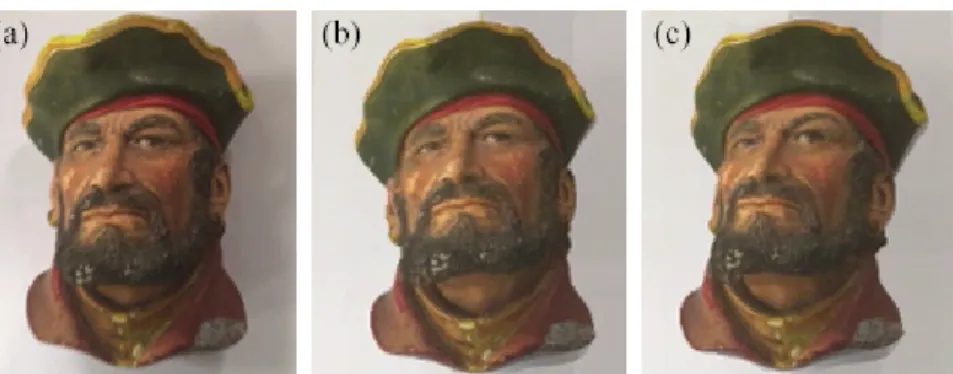
Fig. 3.3(a)Hand-painted pirate headBossonsplaster model. (b)The virtual pirate head ren-dered at the same pose. (c)The virtualretargeted pose usingDeformable Object Retargeting. ground truth and those that are synthetically generated. Such inaccuracy is low and could further be reduced by enhancing the computation of the virtual light-source radius.
3.4
Deformable Object Retargeting
Our framework requires to have a physical puppet, either 3D printed or manually formed, with its key physical poses present in the real-world. In the case of our pirate head, (see figure
3.3), a hand-paintedBossonsplaster model. Our digital equivalent meshes are created through photogrammetric software. To animate our real-world puppet, we rig and retopologize the mesh obtained from the photogrammetric scan using a standard 3D editor software. We use image markers or point cloud registration to detect the real-world object location. Virtual meshes use that tracked position to match the same location in the virtual coordinate system and use the resulting texture coordinates for warping (see section3.4.1) and reconstructing (see section3.4.2) the live camera video feed texture.
3.4.1
Texture Warping
In order to perform real-time deformed texturing, we place a proxy object locator in the pivot position of the real-world marker and we assume that norootmovement will be performed on it. To achieve an accurate registration of the physical object, we use marker-less tracking
3.4 Deformable Object Retargeting 31
for augmented reality using [Vuforia, 2019]. This consists of a system based on point clouds that recognises rigid, opaque physical objects. When detected, this point cloud registers the origin of the world-space co-ordinate system. The virtual mesh is placed coincident at the origin of this Euclidean space. Using this procedure, we can simulate where the physical object is in our virtual co-ordinate system. We can estimate the position of the ground plane also from the origin of the Euclidean space, since we assume that the detected object is in contact with the ground. Texture coordinates of the overlaid animation are back projected to the initial rest pose. This achieves real-time deformed texturing sampled from the real world object’s vertex locations in the projected video camera source image. With the aim to obtain coherency on the deformation of the texture, we use a direct map between initial rest pose vertices and animated ones. Look-up coordinates are updated on a per frame basis, in accordance to the position of the camera and the virtual mesh animation.
Our approach enables an optimized lookup of the animated vertex position as gives us a
O(1)constant access time. Any changes applied to the surroundings of the physical object will perform its expected lighting effects to the virtual mesh. This method holds plausibly for small-proximity displacements as seen in figure3.5. Large translations in the virtual object from the physical reference position cause lighting inconsistencies with spatial variations in the environment.
3.4.2
Texture Reconstruction
For areas not present in the physical reference model, we need to reconstruct the puppet appearance in a plausible way. This is often the case for teeth and the interior part of the mouth which only gets revealed when the puppet retargets certain facial expressions (i.e. mouth opened). As our method uses a three-dimensional mesh that matching the physical object shape, we can accurately establish beforehand regions that will be revealed and are
3.5 Shadow Retargeting 32
Fig. 3.4(a)Frame of an animated physical puppet in AR without reconstructing occluded areas that become revealed. Teeth and interior parts of the mouth get rendered with the aspect of lips. (b)With appearance reconstruction, these parts get rendered plausibly from alike regions of reference. (c)Unwrapped texture map of the virtual mesh. (d)Color encoded texture map segmenting regions to be reconstructed in real-time.
not visually seen in the reference puppet. Those areas need to be paired off-line with an alike albedo estimation in order to get reconstructed plausibly in real-time.
To do so, we unwrap the texture map (see figure 3.4c) of the model onto the mesh. Through the visualization of the mesh in a standard 3D editor, we identify and segment occluded regions of the mesh that have no correspondence on the real-world reference and will need to be reconstructed when blend shapes values are applied to the augmented toy. We do so by pre-identifying vertices from the geometry that will need to be reconstructed, and hence,inpainted. We segment by area according to the element that they represent. Each element is color encoded in a texture map (see figure3.4b) and paired to an area present in the real-world object that contains a desired similar appearance. This method applies only for cases in which the desired albedo can be sampled from a region that contains a similar appearance. Nonetheless, this in essence generalises to most puppets and humanoids as these tend to mimic and resemble the outlook and characteristics of humans.
3.5
Shadow Retargeting
Shadow retargeting leverages the constraints of shadow visibility and appearance with known geometry to efficiently steer source shadow samples for retargeted reconstruction with high
3.5 Shadow Retargeting 33
Fig. 3.5 (a) Reference physical toy lion as observed by a mobile phone camera. (b) The virtual lion rendered at the same pose with (b) a regular shadow map approach and (c) with
Shadow Retargeting. (d) Its movement retargeted according to a sequence of geometry poses in AR towards seamless appearance preservation.
quality. Section3.5.1offers an overview of the method. Section3.5.2details the warping of the physical projected shadow. Section3.5.3illustrates our sampling search for shadow reconstruction. Section3.5.4describes the retargeting model. Section3.5.5gives an overview of theShadow Retargetingalgorithm. Section3.5.6contains our procedure for retargeting soft shadows. Section 3.5.7 details the use of auxiliary masks for optimized rendering performance. Section3.5.8performs depth coherent selection for multiple candidates eligible to be rendered in the same fragment. Section3.5.9handles multiple shadow overlapping. Section3.5.10deals with non-grounded occluders. Section3.5.11handles multiple receiver surfaces. Section3.5.12shows how our approach deals with background inpainting. Finally, section3.5.13showcaseShadow Retargetingresults.
3.5 Shadow Retargeting 34
Fig. 3.6(p)is the real-world static object. (q)is the physical projected shadow.(v)is a vertex from the coincident overlaid mesh. (s)isvbeing projected to the floor. (p’)is the deformed real-world object. (q’)is the retargeted projected shadow. (v’)is same initial vertexvbeing animated over time. (s’)isv’being projected to the floor.
3.5.1
Virtual Shadow Re-sampling Overview
Our approach synthesizes virtual shadows directly by sampling the image that contains the shadow of the object presented in the real world (see figure3.5c). As the virtual mesh is animated, we warp the real shadow to retarget its appearance to the virtual one (see figure
3.5d). This process approximates the shadow as being directly linked to the projection along the principal light direction of the caster on the receiver. Our method requires to estimate the direction of thenmain light sources in the scene. We compute this information at the time of initialization following the method described in section3.3. Our method holds plausibly for small proximity displacements and exploits visibility as a smooth function of the given geometry displacement for natural lighting warped reconstruction.
3.5.2
Shadow Warping
Our goal is to warp the shadow from the image to its displaced version. We rely on prior knowledge of mesh geometry and register it with its 3D printed or scanned physical version.
3.5 Shadow Retargeting 35
Fig. 3.7 (a) Mask for physical-object pose. (b) Mask for physical-shadow pose. (c) Mask containing the valid shadow area eligible for appearance sampling.
In a first step, we project the object’s mesh vertices in their world-space positions along the light direction on the receiver geometry. We then re-project to image space in order to associate each mesh vertex to its position on the shadow. As a second step, we project the animated mesh to the ground using the position of those vertices in the virtual deformed pose and use previously mapped texture co-ordinates to interpolate the original shadow across the virtual shadow (see figure3.6). This approach supports unique and multiple receiver surface (see section3.5.11).
3.5.3
Shadow Reconstruction
The shadow warping step acquires as much as possible of the whole real shadow visible in the image. In the base case, it does not take into account any further shadow occlusion (see section3.5.9for overlapping shadow considerations). We are able detect occlusion from the mesh since it is registered in the image. We then search for another reference point to synthesise the reconstructed shadow appearance.
We synthesise a mask of eligible shadow area valid for sampling, by first rasterizing the projected shadow of the real-world object (see figure3.7b), and then rasterizing the object itself to remove its own shadow occlusion (see figure3.7a). This results in an eligible shadow area (see figure3.7c).
Where the shadow warp would sample an invalid texel, we perform a discretized con-centric ring search to find the closest valid (i.e., onocludded-shadow) texel (see figure3.8).
3.5 Shadow Retargeting 36
Fig. 3.8 Discretised concentric-ring search algorithm for plausible shadow reconstruction. Red samples are trivially masked and rejected as ineligible. The closest eligible texel, illustrated as a green sample, was used for appearance sampling.
The search samples all the candidates for each iteration at a time. It stops once it finds a candidate that is valid. In the case of having multiple eligible candidates, the one closest to the invalid texel is sampled. To compensate for appearance discontinuities resulting from the inpainting process, we performed a smoothing pass using an edge-aware box linear filter. Samples outside the shadow are discarded in this pass, as we assume a uniform light source.
3.5.4
Retargeting Model
By retargeting shadows, the albedo of the receiver can change over non-regular backgrounds. To take into account materials with non-uniform albedo, we need to relate the outgoing radiance of the receiver in shadow with its radiance in light. The calculated ratio is applied to a new point in the retargeted shadow. For both reference points, in shadow and light, we assume that there is no emissive radiance or subsurface-scattering events. We express the outward radiance Lo as a derivation from the rendering equation 3.5 introduced by
![Fig. 1.1 Reality-Virtuality Continuum (RVC) [Milgram et al., 1994].](https://thumb-us.123doks.com/thumbv2/123dok_us/11054521.2992424/15.892.174.746.164.337/fig-reality-virtuality-continuum-rvc-milgram-et-al.webp)
![Fig. 3.1 The data flow diagram details how our Props Alive framework is built on top of an augmented reality platform ([Vuforia, 2019]) and a cross-platform game engine ([Unity, 2019]).](https://thumb-us.123doks.com/thumbv2/123dok_us/11054521.2992424/38.892.270.641.160.513/diagram-details-framework-augmented-reality-platform-vuforia-platform.webp)