Tuberculosis Treatment in Resource-Poor Settings
Derek J. Sloan,a,b,cElizabeth L. Corbett,a,b,dAnthony E. Butterworth,b,dHenry C. Mwandumba,a,bSaye H. Khoo,eAaron Mdolo,b Doris Shani,bMercy Kamdolozi,bJenny Allen,fDenis A. Mitchison,gDavid J. Coleman,gand Geraint R. Daviesc,h
Malawi Liverpool Wellcome Trust Clinical Research Programme, Blantyre, Malawia
; Department of Microbiology, College of Medicine, University of Malawi, Blantyre, Malawib
; Institute of Global Health, University of Liverpool, Liverpool, United Kingdomc
; Clinical Research Department, London School of Hygiene and Tropical Medicine, London, United Kingdomd
; Department of Pharmacology, University of Liverpool, Liverpool, United Kingdome
; TB Research Unit: Clinical and Biomedical, Medical Research Council, Durban, South Africaf
; Department of Medical Microbiology, St. George’s Medical School, London, United Kingdomg
; and Institute of Translational Medicine, University of Liverpool, Liverpool, United Kingdomh
Serial Sputum Colony Counting (SSCC) is an important technique in clinical trials of new treatments for tuberculosis (TB). Quantitative cultures on selective Middlebrook agar are used to calculate the rate of bacillary elimination from sputum collected from patients at different time points during the first 2 months of therapy. However, the procedure can be complicated by high sample contamination rates. This study, conducted in a resource-poor setting in Malawi, assessed the ability of different antifun-gal drugs in selective agar to reduce contamination. Overall, 229 samples were studied and 15% to 27% were contaminated. Fun-gal organisms were particularly implicated, and samples collected later in treatment were at particular risk (P<0.001). Ampho-tericin B (AmB) is the standard antifungal drug used on SSCC plates at a concentration of 10 mg/ml. On selective Middlebrook 7H10 plates, AmB at 30 mg/ml reduced sample contamination by 17% compared with AmB at 10 mg/ml. The relative risk of con-tamination using AmB at 10 mg/ml was 1.79 (95% confidence interval [CI], 1.25 to 3.55). On Middlebrook 7H11 plates, a combi-nation of AmB at 10 mg/ml and carbendazim at 50 mg/ml was associated with 10% less contamicombi-nation than AmB at 30 mg/ml. The relative risk of contamination with AmB at 30 mg/ml was 1.79 (95% CI, 1.01 to 3.17). Improved antifungal activity was ac-companied by a small reduction in bacillary counts, but this did not affect modeling of bacillary elimination. In conclusion, a combination of AmB and carbendazim optimized the antifungal activity of selective media for growth of TB. We recommend this method to reduce contamination rates and improve SSCC studies in African countries where the burden of TB is highest.
T
uberculosis (TB) is a major global health problem. In 2009, an estimated 9.4 million cases were reported, with 1.7 million deaths. A total of 85% of the disease burden is in Asia and Africa. A total of 80% of African TB is associated with HIV (25). “Short course” chemotherapy takes 6 months, overburdening health care services in resource-poor regions, particularly those with high HIV prevalence.The gold standard for assessing new anti-TB regimens is the proportion of patients who relapse 1 to 2 years after completing treatment. Phase III clinical trials using this endpoint are long and expensive. Rigorous phase II studies are essential to ensure that regimens taken forward have a high chance of success (13).
Historically, phase II studies used the proportion of patients whose TB sputum culture converted from positive to negative at 8 weeks as a surrogate of outcome since this correlates moderately well with posttreatment relapse rates (18). However, this proce-dure is inefficient, as it measures a binary (positive or negative) outcome rather than a continuous variable. Recently, attention has been drawn to repeated quantitative counts of viable Mycobac-terium tuberculosisbacilli during the 8-week period (2). This tech-nique, known as Serial Sputum Colony Counting (SSCC), has been used in Kenya, South Africa, and Thailand (23) and has two advantages. First, using “nonlinear mixed effects” (NLME) statis-tical analysis, the rate of decline (in CFU per milliliter) in expec-torated sputum can be calculated, demonstrating that bacillary killing by TB treatment is biphasic; rapid “early bactericidal activ-ity” in the first 5 days is followed by a lower elimination rate in the “sterilization phase” over the next 2 months (5). Second, differ-ences in the elimination rate in the sterilization phase can be used
to compare drug regimens. SSCC studies have shown faster bacil-lary clearance in cases of drug-sensitive TB when 8-methoxyfluo-roquinolones replace ethambutol (21) and in cases of multidrug-resistant (MDR) TB when TMC-207 is added to optimized standard therapy (7).
Although useful, SSCC studies are prone to plate contamina-tion by bacteria and fungi from sputum. Sputum decontamina-tion with sodium hydroxide (NaOH) prior to inoculadecontamina-tion of cultures selectively destroys nonmycobacterial organisms but ad-versely affects recovery ofM. tuberculosis(8), lowering the sputum bacillary load (3,17). Colony-counting studies following sputum decontamination have revealed monophasic bacillary elimination (10,11), suggesting a distortion of treatment response that makes NaOH inappropriate for SSCC. Alternatively, SSCC culture me-dia can be made selective by supplementation with antimicrobial agents (14,19). The usual antifungal drug used is amphotericin B (AmB) at a dose of 10 mg/liter. This may be insufficient in tropical environments with high fungal contamination.
During a TB treatment study among Malawian outpatients, we
Received7 January 2012 Returned for modification5 April 2012
Accepted27 April 2012
Published ahead of print9 May 2012
Address correspondence to Derek J. Sloan, [email protected].
Copyright © 2013 Sloan et al. This is an open-access article distributed under the
terms of anAttribution-ShareAlike 3.0 Unported Creative Commons license.
http://dx.doi.org/10.1128/JCM.00043-12
on May 16, 2020 by guest
http://jcm.asm.org/
compared SSCC plates treated with AmB at 10 mg/ml (AmB10) to plates with different antifungal compositions: AmB at 30 mg/liter (AmB30) or AmB at 10 mg/ml supplemented with carbendazim (AmBC). Carbendazim is a benzimidazole antifungal compound used in crops which inhibits fungal (eukaryotic) mitotic microtu-bulin formation to prevent sporulation and germination of spores (24). The compound is stable and cheap to use but is insoluble in water. We assessed the effect of these different antifungal agents on viable bacillary counts, the observed pattern of bacillary elim-ination, and rates of culture contamination to optimize SSCC me-dia for our setting.
MATERIALS AND METHODS
Patients and sputum sample collection.A longitudinal cohort study of clinical, pharmacological, and bacteriological responses to TB treatment among smear-positive Malawian adults is ongoing at Queen Elizabeth Central Hospital in Blantyre, Malawi. Patients with sputum smear-posi-tive pulmonary tuberculosis microscopically graded “⫹⫹” or “⫹⫹⫹” for acid-fast bacilli (AFB) according to International Union Against Tuber-culosis and Lung Disease (IUALTD) guidelines for assessment of Ziehl-Neelsen (ZN)-stained slides (9) had overnight sputum samples collected on days 0, 2, 4, 7, 14, 28, 49, and 56 of treatment.
On sampling days, patients were issued 100-ml wide-mouthed, opaque polypropylene collection pots. After eating at 6 pm, they were instructed to rinse their mouth with water, collect all expectorated spu-tum until 6 a.m. the following morning, and not eat again until the col-lection was complete. Sampling was done on an unsupervised outpatient basis. FRIO medication wallets (Frio Ltd. UK, Haverfordwest, United Kingdom) were used to keep sputum pots at⬍15°C during sample col-lection and transportation. Sputum was analyzed within 24 h at the Col-lege of Medicine TB Laboratory, Department of Microbiology, at the Uni-versity of Malawi.
Media preparation.Middlebrook 7H10 and 7H11 media were made according to manufacturer’s instructions to produce comparator plates as follows: 7H10-AmB10 (Middlebrook 7H10 in combination with AmB at 10 mg/ml), 7H10-AmB30, 7H11-AmB30, and 7H11-AmBC. A total of 19 g (7H10) or 21 g (7H11) of agar powder (Becton, Dickinson) was added to 895 ml of distilled water and 5 ml of glycerol and autoclaved at 121°C for 15 min. After cooling to 45°C, the mixture was supplemented with 100 ml of oleic acid-albumin-catalase (OADC; Becton, Dickinson) and antimi-crobial drugs. 7H10-AmB10 plates were made by adding two Selectatabs (Mast 24) to give final antimicrobial concentrations of polymyxin B (200 U/ml), ticarcillin (100 mg/liter), trimethoprim (10 mg/liter), and AmB (10 mg/liter). For 7H10-AmB30 and 7H11-AmB30 plates, an additional solution of AmB at 20 mg/ml was prepared in dimethyl sulfoxide (DMSO). A 1-ml volume was added with the Selectatabs, giving a final AmB concentration of 30 mg/liter. For 7H11-AmBC medium, a 2% (wt/ vol) suspension of carbendazim in 70% (vol/vol) ethanol was prepared and stored at room temperature in the dark. A 2.5-ml volume of the suspension was added to the medium prior to autoclaving; at an acid pH in the presence of phosphate and heat, such a mixture converts to a soluble compound with no loss of activity during the autoclaving process (per-sonal communication with David Coleman). OADC and Selectatabs were added as described above. Final antifungal concentrations in 7H11-AmBC medium were AmB at 10 mg/liter and carbendazim at 50 mg/liter. An 8-ml volume of the appropriate medium was transferred by sterile pipette into each compartment of 100-mm-diameter triple-segment petri dishes. Plates were inverted, dried overnight at 37°C, stored at 4°C, and used within 3 weeks.
SSCC plate comparisons.From August to December 2010, compari-sons of AmB10 to AmB30 were done. Sputum samples from sequentially processed collections were used to inoculate parallel sets of 7H10-AmB10 and 7H10-AmB30 plates. From April to July 2011, the comparison of AmB30 to AmBC was done. Sputum samples from sequentially processed
collections were used to inoculate parallel sets of AmB30 and 7H11-AmBC plates. Plate sets were not blinded.
Plate setup and reading of results.Sputum samples were homoge-nized by vortex agitation with glass beads. Aliquots (1 ml) were liquefied by incubation with an equal volume of dithiothreitol (Oxoid) (1 g/liter) for 1 h. A total of five serial 10-fold dilutions of homogenized and liquefied sputum were prepared in sterile phosphate-buffered saline (PBS). A 50-l volume of neat sputum and all five dilutions from each sample were in-oculated onto duplicate plate sets of appropriate media for both study arms of the relevant comparison. Culture plates were placed in ziplock polyethylene bags and incubated in the dark at 37°C.
Plates were read at 3 weeks. If characteristic TB colonies were visible, ZN smears were done to confirm AFB growth and the sample was re-ported to be positive. If no growth was seen on either plate set, it was reported to be negative.
For positive plate sets, a dilution yielding 10 to 100 TB colonies was selected for colony counting. Counts of sputum CFU per milliliter were calculated as follows:
CFU ⁄ ml⫽no. of colonies counted in plate segment
⫻2(dithiothreitol dilution)⫻20 (50l was inoculated per segment )
⫻ dilution factor Counts from both plate sets were used to calculate mean CFU counts per milliliter and log10CFU counts per milliliter for all positive samples.
The difference in mean log10CFU counts per milliliter between study
arms for each sample was used to establish whether medium alterations affected bacillary growth.
Weekly contamination checks were done during incubation. Contam-inating organisms were classified as fungal or bacterial based on macro-scopic appearance and Gram staining results. Plates were regarded as con-taminated if there were sufficient contaminating organisms to prevent TB colony counting.
On each day of sample setup, negative-control plates of diluted SSCC reagents without sputum were prepared to ensure that observed contam-inants originated from sputum rather than from laboratory factors. After homogenization, 1-ml aliquots of each sputum sample were separately decontaminated with NaOH and set up for culture using liquid broth and mycobacterial growth indicator tubes (Becton, Dickinson).
Data analysis and statistical methods.Results were entered into a Microsoft Access database and analyzed using “R” version 2.12.1. Differ-ences between bacillary counts on different media were analyzed by paired two-samplettests. Modeling of bacillary elimination was done by previ-ously described NLME methods (5). Differences in the frequencies of clean or contaminated sample results were compared by assessment of relative risk ratios and 95% confidence intervals (CI). Assessment of pa-tient factors contributing to sample contamination was done by logistic regression, with incorporation of random effect modeling in the multi-variate analysis to account for repeated sampling from some patients.
Ethical approval.Ethical approval for this study was given by the Liverpool School of Tropical Medicine and the College of Medicine Re-search Ethics Committee, University of Malawi.
RESULTS
Patients and samples.Overall, the mean age of the 96 patients in the study was 32 years; 64 (67%) patients were male, and HIV prevalence was 67%. The median CD4 count of HIV-infected pa-tients was 159 cells/l. A total of 31 (32%) patients could refrig-erate samples. There were no significant differences in demo-graphic parameters between patients contributing samples to the two comparisons.
For the comparison of AmB10 to AmB30, 127 sputum samples were collected from 52 patients. Due to the longitudinal sampling protocol, some patients provided multiple samples on different days of treatment. The mean number of samples per patient was
on May 16, 2020 by guest
http://jcm.asm.org/
2.5. For the comparison of AmB30 to AmBC, 102 sputum samples were studied from 44 patients, and the mean number of samples per patient was 2.3.
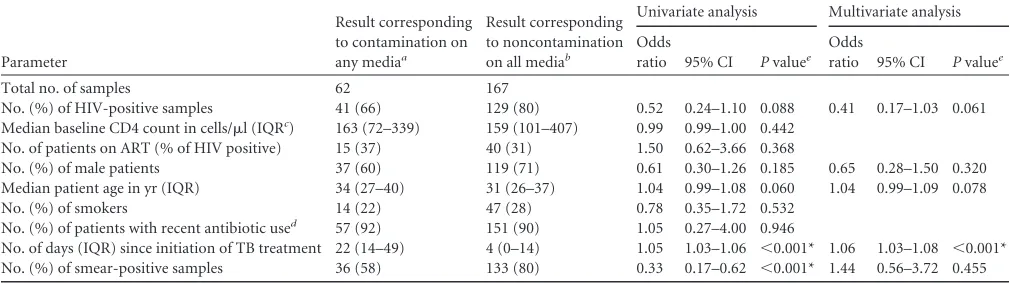
Patient factors associated with sample contamination.To as-sess the effect of patient factors on sample contamination, data from the two comparisons were analyzed together (Table 1). Sam-ples were regarded as contaminated if there was contamination in either study arm. There was a trend toward lower contamination rates in HIV-positive individuals, but this did not reach signifi-cance on univariate or multivariate analysis. AFB smear negativity in samples from patients who were initially smear positive but had smear conversion during treatment was associated with contam-ination on univariate analysis only. The only significant factor affecting both univariate and multivariate analysis was that
sam-ples collected later in therapy were more likely to be contaminated (odds ratio [OR], 1.06; 95% CI, 1.03 to 1.08).
Effects of medium alteration: comparison of AmB10 to AmB30. (i) Differences in bacillary counts.Table 2shows mean log10CFU counts per milliliter for samples collected at different time points.
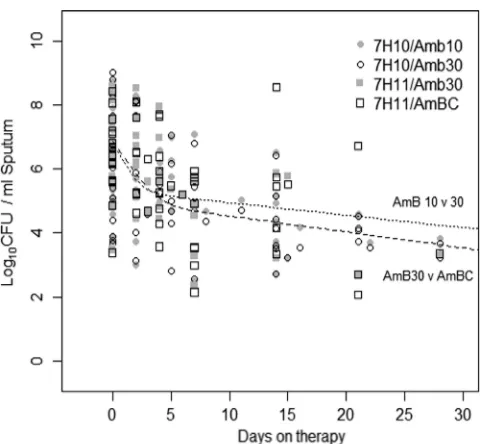
7H10-AmB10 sample counts were 0.19 log10CFU/ml higher (95% CI, 0.10 to 0.27) than 7H10-AmB30 counts. Although sta-tistically significant, this difference was small (Table 1). Biphasic bacillary elimination curves were observed by data modeling (Fig. 1) and suggested that the change in bacillary counts did not distort treatment response.
[image:3.585.40.545.79.221.2](ii) Differences in sample contamination.A total of 34 of 127 (27%) 7H10-AmB10 plates were contaminated: 28 by fungi and 6
TABLE 1Patient factors influencing sputum sample contamination
Parameter
Result corresponding to contamination on any mediaa
Result corresponding to noncontamination on all mediab
Univariate analysis Multivariate analysis
Odds
ratio 95% CI Pvaluee Odds
ratio 95% CI Pvaluee
Total no. of samples 62 167
No. (%) of HIV-positive samples 41 (66) 129 (80) 0.52 0.24–1.10 0.088 0.41 0.17–1.03 0.061 Median baseline CD4 count in cells/l (IQRc) 163 (72–339) 159 (101–407) 0.99 0.99–1.00 0.442
No. of patients on ART (% of HIV positive) 15 (37) 40 (31) 1.50 0.62–3.66 0.368
No. (%) of male patients 37 (60) 119 (71) 0.61 0.30–1.26 0.185 0.65 0.28–1.50 0.320 Median patient age in yr (IQR) 34 (27–40) 31 (26–37) 1.04 0.99–1.08 0.060 1.04 0.99–1.09 0.078 No. (%) of smokers 14 (22) 47 (28) 0.78 0.35–1.72 0.532
No. (%) of patients with recent antibiotic used 57 (92) 151 (90) 1.05 0.27–4.00 0.946
No. of days (IQR) since initiation of TB treatment 22 (14–49) 4 (0–14) 1.05 1.03–1.06 ⬍0.001* 1.06 1.03–1.08 ⬍0.001* No. (%) of smear-positive samples 36 (58) 133 (80) 0.33 0.17–0.62 ⬍0.001* 1.44 0.56–3.72 0.455 aContamination on any media: the sample was contaminated in at least one arm of the comparison in which it was studied.
b
Noncontamination on all media: the sample gave a positive or negative result in both arms of the comparison in which it was studied (i.e., the sample never got contaminated). cIQR, interquartile range.
d
Not including cotrimoxazole prophylactic therapy given routinely to HIV-positive individuals. e*, statistically significant (P⬍0.05).
TABLE 2Sputum bacillary counts on Middlebrook media containing different antifungal drugs collected during the first 8 weeks of TB therapy
Comparison
Day of TB treatment when sputum was collected
No. of samples
Bacillary count (mean log10CFU/ml)
Mean of differences between mediaain log
10 CFU/ml counts (95%
confidence interval) Pvalueb
AmB10 vs AmB30
7H10–AmB10 7H10–AmB30
Baseline 32 6.815 6.527 0.267 (0.061 to 0.473) 0.014* Day 1–14 44 5.318 5.072 0.163 (0.071 to 0.255) 0.001* Day 15–28 26 3.914 3.744 0.217 (0.002 to 0.432) 0.048* Day 28–56 25 4.078 4.373 ⫺0.143 (⫺1.025 to 0.737) 0.557 Total 127 5.616 5.370 0.189 (0.103 to 0.275) ⬍0.001*
AmB30 vs AmBC
7H11–AmB30 7H11–AC
Baseline 22 6.552 6.340 0.108 (0.010 to 0.207) 0.031* Day 1–14 46 5.606 5.355 0.113 (⫺0.027 to 0.253) 0.110 Day 15–28 18 3.917 4.076 0.263 (⫺0.546 to 1.072) 0.293 Day 28–56 16 3.150 3.400 ⫺0.250 (⫺0.631 to 0.131) 0.076 Total 102 5.757 5.506 0.106 (0.020 to 0.193) 0.017* aFor samples in the AmB10-versus-AmB30 comparison, the difference in log10CFU/ml counts between media was calculated by subtracting the log10CFU/ml on 7H10-AmB30 from the log10CFU/ml on 7H10-AmB10. The mean of the differences for all positive samples at each time interval is shown in the table. For samples in the AmB30-versus-AmBC comparison, the difference in log10CFU/ml counts between media was calculated by subtracting the log10CFU/ml on 7H11-AmBC from the log10CFU/ml on 7H11-AmB30. The mean of the differences for all positive samples at each time interval is shown in the table.
b*, statistically significant (P⬍0.05).
on May 16, 2020 by guest
http://jcm.asm.org/
[image:3.585.41.543.484.680.2]by bacteria. A total of 15 of 127 (12%) 7H10-AmB30 plates were contaminated: 11 by fungi and 4 by bacteria (Table 3). The relative risk of sample contamination with AmB10 was 2.10 (95% CI, 1.25 to 3.55). Individual plate segment contamination on 7H10-AmB10 was 18%. This was reduced to 8% on 7H10-AmB30. The main reduction was in fungal growth (from 15% to 6% of seg-ments). Taken together, these data suggest that increasing the AmB dose resulted in better selective media for growth ofM. tu-berculosis.
Samples collected at later time points in therapy were at higher risk of contamination. A total of 24 (71%) of the contaminated
samples on 7H10-AmB10 were collected after day 14. However, 11 (46%) of these were not contaminated on 7H10-AmB30, suggest-ing that better media minimized data loss at later, more vulnerable study time points.
We believe that the contaminants originated from sputum rather than the laboratory, because the negative-control plates were persistently clean. When samples were treated with NaOH and inoculated in liquid culture, only 7/127 (5%) were contami-nated. In both media, plate segment contamination was highest in neat sputum and was sequentially reduced in serial dilutions ( Ta-ble 3). This is consistent with the presence of organisms in sputum which were gradually diluted below the growth threshold on se-lective plates.
Effects of medium alteration: comparison of AmB30 to AmBC. (i) Differences in bacillary counts.Due to a protocol change in the parent study, Middlebrook 7H11 was used instead of 7H10 medium. Separate comparisons (not shown) indicated that this change had no effect on bacillary counts or contamina-tion. As AmB at 30 mg/ml had performed well in the comparison of AmB10 to AmB30, 7H11-AmB30 medium was compared with 7H11-AmBC.
7H11-AmBC bacillary counts were 0.11 log10CFU/ml lower (95% CI, 0.02 to 0.19) than 7H11-AmB30 counts (Table 2). As with the comparison of AmB10 to AmB30, the difference was statis-tically significant but small and did not affect the biphasic bacillary elimination curve after NLME modeling of the data (Fig. 1).
(ii) Differences in sample contamination.A total of 26 of 102 (25%) 7H11-AmB30 plates were contaminated: 21 by fungi and 5 by bacteria. A total of 15 of 102 (15%) 7H11-AmBC plates were contaminated: 11 by fungi and 4 by bacteria. The relative risk of sample contamination with 7H11-AmB30 was 1.79 (95% CI, 1.01 to 3.17). Individual plate segment contamination fell from 24% on 7H11-AmB30 to 11% on 7H11-AmBC. Again, the major re-duction was in fungal growth (from 19% to 5%). Overall, 7H11-AmBC was a better selective medium forM. tuberculosis.
A total of 20 (77%) samples which were contaminated on 7H11-AmB30 were collected after day 14. As 9 (45%) of these were not contaminated on 7H11-AmBC, we again conclude that
[image:4.585.43.286.63.285.2]im-FIG 1Modeling bacillary elimination. Changes in bacillary load (in log10 sputum CFU counts per milliliter) over time on therapy are plotted for the two comparisons in the study. NLME methods were used to demonstrate that a biphasic bacillary elimination model fits the data for both comparisons, sug-gesting that the effect of different antifungal drug concentrations in selective plate media does not adversely affect analysis of bacillary elimination in SSCC studies.
TABLE 3Contamination of samples and plate segments in both study comparisons
Comparison and
combination Result
Total no. (%) of plate results
No. (%) of contaminated plate segments inoculated with indicated 10-fold sputum dilution
Total Neat 10⫺1 10⫺2 10⫺3 10⫺4 10⫺5
AmB10 vs AmB30
7H10-AmB10 No contamination 93 (73) 163 (64) 190 (75) 199 (79) 228 (90) 232 (91) 232 (91) 1,244 (81) Fungal contamination 28 (22) 71 (28) 46 (18) 41 (16) 24 (9) 22 (9) 22 (9) 226 (15) Bacterial contamination 6 (5) 20 (8) 18 (7) 14 (6) 2 (1) 0 0 54 (4) 7H10-AmB30 No contamination 112 (88) 203 (84) 213 (88) 218 (90) 232 (96) 232 (96) 234 (97) 1,331 (92)
Fungal contamination 11 (8) 27 (11) 19 (8) 16 (7) 9 (4) 9 (4) 7 (3) 87 (6) Bacterial contamination 4 (4) 11 (5) 9 (4) 7(3) 0 0 0 27 (2)
AmB30 vs AmBC
7H11-AmB30 No contamination 76 (75) 128 (62) 137 (66) 151 (73) 172 (83) 174 (84) 177 (86) 939 (76) Fungal contamination 21 (20) 54 (26) 46 (22) 45 (22) 32 (15) 30 (14) 29 (14) 236 (19) Bacterial contamination 5 (5) 25 (12) 24 (12) 11 (5) 3 (1) 3 (1) 1 (0) 67 (5) 7H11-AmBC No contamination 87 (85) 157 (77) 168 (82) 181 (89) 195 (96) 196 (96) 197 (97) 1,094 (89)
Fungal contamination 11 (11) 21 (10) 12 (6) 9 (4) 6 (3) 5 (2) 6 (3) 59 (5) Bacterial contamination 4 (4) 26 (13) 24 (12) 14 (7) 3 (1) 3 (1) 1 (0) 71 (6)
on May 16, 2020 by guest
http://jcm.asm.org/
[image:4.585.39.546.535.723.2]proved selective media reduced data loss at vulnerable late sam-pling time points.
As in the first comparison, negative-control plates were persis-tently clean, confirming that contaminants originated from spu-tum samples rather than the laboratory. Only 7/102 (8%) samples grew contaminants in broth after treatment with NaOH, and plate segment contamination progressively diminished in serial sample dilutions (Table 3).
DISCUSSION
The main findings of this study are that SSCC studies are feasible even in resource-poor tropical settings despite problems with fun-gal contamination. We have shown significant reductions in the risk of plate contamination by optimizing the antifungal compo-sition of selective media, particularly by using carbendazim, which has practical storage and shipping advantages over AmB. HIV infection was not a risk factor for plate contamination, but speci-mens collected later in the course of TB treatment were at signif-icantly greater risk of contamination (P⬍0.001).
Shorter treatment regimens could significantly reduce global mortality from TB (22). Recently developed compounds (e.g., the 8-methoxyfluoroquinolones [4, 21] and the diarylquinonolone ATP synthase inhibitor TMC-207 [20]) used alongside existing drugs offer the possibility of shorter therapy. Phase II SSCC stud-ies are urgently required to select the best regimens for assessment in phase III clinical trials. However, SSCC studies in tropical set-tings are complicated by high contamination rates.
Overall, plate contamination in our study was 15% to 27%. As negative-control plates were repeatedly clean and contamination was much lower (5% to 8%) when the same samples were treated with NaOH and inoculated in broth, we concluded that the rec-ommended standard selective medium was not appropriate for our setting.
Older studies performed with selective media and nondecon-taminated sputum showed fewer difficulties (15,19) but were not conducted in resource-poor tropical settings. Only 30% of our patients had electricity to refrigerate samples at home, consistent with data from the Malawian Integrated Household Survey (2004 to 2005) (16), and patients traveled for 2 h or more to deliver specimens to hospital. Prolonged exposure of unrefrigerated sam-ples to high ambient temperatures (⬎30°C) during transportation may encourage contaminant overgrowth. Use of a FRIO medica-tion wallet helps to keep specimens cool, but the wallets are ex-pensive ($16 each) for investigators in resource-poor settings.
In a recent study using undecontaminated sputum in Peru, investigators reported a culture contamination rate of 18% (8), similar to ours. Over 80% of their contaminants were bacterial, while⬎80% of ours were fungal. HIV prevalence in the Peruvian TB patients was 3% compared to 67% in our patients. Although we did not find a significant association between HIV status and contamination, we saw a trend toward lower contamination in HIV-positive individuals. Malawian HIV treatment guidelines recommend daily cotrimoxazole prophylactic therapy for all in-fected persons (12). This may kill oral and respiratory commen-sual bacteria, conferring partial protection against contamination and explaining variations between populations in the organisms grown.
Prior studies all assessed contamination in baseline samples, whereas we collected serial samples during TB therapy (as oc-curs in phase II clinical trials). In multivariate analysis, longer
time on therapy was the only patient factor associated with a higher risk of sample contamination. Samples collected later in therapy may be more prone to contamination, as elimination ofM. tuberculosismay facilitate easier growth of other organ-isms. However, valid data from later time points are essential when evaluating time to culture conversion or bacillary elimi-nation rates in SSCC studies (6).
Two alterations to the standard antimicrobial recipe for selec-tive media were evaluated to reduce fungal contamination. Tradi-tional SSCC protocols recommend addition of AmB at 10 mg/ml to either 7H10 or 7H11 medium. However, AmB is sensitive with respect to light and temperature, loses activity 3 to 15 days after reconstitution (1), and may have diminishing efficacy during me-dium storage or prolonged incubation. By increasing the dose to 30 mg/ml in 7H10 media, we demonstrated a 17% reduction in contaminated samples. A more novel approach was the introduc-tion of carbendazim to 7H11 plates containing AmB at 10 mg/ml. Carbendazim has several advantages over AmB; it has a wide range of antifungal activity, is more stable and cheaper, and can be stored and shipped at ambient temperature. Compared with 7H11-AmB30 media, plates containing AmB at 10 mg/ml and carbendazim at 50 mg/ml displayed a 10% reduction in contam-ination. Medium containing both AmB and carbendazim was best overall.
In both comparisons, better antifungal activity was accompa-nied by a small drop in bacillary load. This had no effect on mod-eling of bacillary elimination and would be unlikely to affect the outcome of SSCC studies. Additionally, in samples collected after day 14 in both comparisons, better antifungal activity allowed recovery of data from 45% of the samples which were contami-nated on the weaker medium. This is important for the future design of SSCC studies, as their power would improve consider-ably if more valid results were available in the second month of treatment.
There are several limitations to this work. The study was not blinded, overall contamination was high, and the two compari-sons were not performed simultaneously. The benefit of altering media may be smaller in settings with less fungal contamination. Due to resource limitations, we did not precisely identify contam-inants or perform drug sensitivity testing. As availability of AmB is low in Malawi, it is unlikely that antimicrobial resistance contrib-uted to plate contamination.
Overall, quantitative bacteriology methods are essential for TB drug development. We have demonstrated for the first time re-duced contamination in selective media by increasing the AmB dose or, preferentially, supplementing it with carbendazim. By optimizing our media, we have shown that SSCC studies can be successfully performed using outpatient samples in resource-poor tropical settings of HIV endemicity. If shown to be a replicable finding, this would contribute to the development of the capacity to undertake phase II treatment studies in African countries where the TB burden is highest. We recommend that others carrying out SSCC studies consider switching to the carbendazim method de-scribed here.
ACKNOWLEDGMENTS
Bright Chisale and Gertrude Banda recruited patients and collected spu-tum samples. Peter MacPherson assisted with statistical data analysis.
This study was funded by a Wellcome Trust Clinical Ph.D. Fellowship awarded to D.S.
on May 16, 2020 by guest
http://jcm.asm.org/
REFERENCES
1.Block ER, Bennett JE. 1973. Stability of amphotericin B in infusion bottles. Antimicrob. Agents Chemother.4:648 – 649.
2.Brindle R, Odhiambo J, Mitchison D.2001. Serial counts of Mycobterium tuberculosis in sputum as surrogate markers of the sterilising ac-tivity of rifampicin and pyrazinamide in treating pulmonary tuberculosis. BMC Pulm. Med.1:2. doi:10.1186/1471-2466-1-2.
3.Chambers HF, Kocagoz T, Sipit T, Turner J, Hopewell PC. 1998. Activity of amoxicillin/clavulanate in patients with tuberculosis. Clin. In-fect. Dis.26:874 – 877.
4.Conde MB, et al.2009. Moxifloxacin versus ethambutol in the initial treatment of tuberculosis: a double-blind, randomised, controlled phase II trial. Lancet373:1183–1189.
5.Davies GR, Brindle R, Khoo SH, Aarons LJ.2006. Use of nonlinear mixed-effects analysis for improved precision of early pharmacodynamic measures in tuberculosis treatment. Antimicrob. Agents Chemother.50: 3154 –3156.
6.Davies GR, Khoo SH, Aarons LJ.2006. Optimal sampling strategies for early pharmacodynamic measures in tuberculosis. J. Antimicrob. Che-mother.58:594 – 600.
7.Diacon AH, et al.2009. The diarylquinoline TMC207 for multidrug-resistant tuberculosis. N. Engl. J. Med.360:2397–2405.
8.Grandjean L, et al.2008. Tuberculosis diagnosis and multidrug resistance testing by direct sputum culture in selective broth without decontamina-tion or centrifugadecontamina-tion. J. Clin. Microbiol.46:2339 –2344.
9.International Union Against Tuberculosis and Lung Diseases. 2000. Technical guide: sputum examination for tuberculosis by direct micros-copy in low income countries. International Union Against Tuberculosis and Lung Diseases, Paris, France.http://www.tbrieder.org/publications /books_english/microscopy.pdf.
10. Kennedy N, et al.1996. Randomized controlled trial of a drug regimen that includes ciprofloxacin for the treatment of pulmonary tuberculosis. Clin. Infect. Dis.22:827– 833.
11. Kennedy N, et al.1993. Early bactericidal and sterilizing activities of ciprofloxacin in pulmonary tuberculosis. Am. Rev. Respir. Dis.148:1547– 1551.
12. Ministry of Health, Malawi.2011. Clinical management of HIV in chil-dren and adults, 1st ed. Ministry of Health, Malawi.http://www.who.int /hiv/pub/guidelines/malawi_art.pdf.
13. Mitchison DA.2006. Clinical development of anti-tuberculosis drugs. J. Antimicrob. Chemother.58:494 – 495.
14. Mitchison DA, Allen BW, Carrol L, Dickinson JM, Aber VR.1972. A selective oleic acid albumin agar medium for tubercle bacilli. J. Med. Mi-crobiol.5:165–175.
15. Mitchison DA, Allen BW, Lambert RA.1973. Selective media in the isolation of tubercle bacilli from tissues. J. Clin. Pathol.26:250 –252. 16. National Statistics Office of Malawi.2005. Second integrated
house-hold survey 2004 –2005. National Statistics Office, Zomba, Malawi.
http://siteresources.worldbank.org/INTLSMS/Resources/3358986 -1181743055198/3877319-1181928149600/IHS2_Basic_Information2 .pdf.
17. Peres RL, et al.2009. Comparison of two concentrations of NALC-NaOH for decontamination of sputum for mycobacterial culture. Int. J. Tuberc. Lung Dis.13:1572–1575.
18. Phillips P, Fielding K.2008. Surrogate markers for poor outcome to treatment for tuberculosis: results from extensive multi-trial analysis. Int. J. Tuberc. Lung Dis.12:S146 –S147.
19. Rothlauf MV, Brown GL, Blair EB.1981. Isolation of mycobacteria from undecontaminated specimens with selective 7H10 medium. J. Clin. Mi-crobiol.13:76 –79.
20. Rustomjee R, et al.2008. Early bactericidal activity and pharmacokinetics of the diarylquinoline TMC207 in treatment of pulmonary tuberculosis. Antimicrob. Agents Chemother.52:2831–2835.
21. Rustomjee R, et al.2008. A phase II study of the sterilising activities of ofloxacin, gatifloxacin and moxifloxacin in pulmonary tuberculosis. Int. J. Tuberc. Lung Dis.12:128 –138.
22. Salomon JA, et al.2006. Prospects for advancing tuberculosis control efforts through novel therapies. PLoS Med. 3:e273. doi:10.1371/ journal.pmed.0030273.
23. Sloan DJ, Davies GR.2011. Anti-tuberculous chemotherapy: serial spu-tum colony counting in drug development, p 277–324.InDonald PR, Van Helden PD (ed), Progress in respiratory research, vol 40. Karger, Basel, Switzerland.
24. Wang X, et al.2012. Response of soil bacterial community to repeated applications of carbendazim. Ecotoxicol. Environ. Saf.75:33–39. 25. World Health Organization. 2009. Global tuberculosis control 2009.
Epidemiology, strategy, financing. World Health Organization, Geneva, Switzerland. http://www.who.int/tb/publications/global_report/2009/en
/index.html.