4 (3), Fall 2012, Ser. 68/4 ISSN: 2008-8191. pp. 103-126
The Typology of EFL Teachers’ Codeswitching: A Validation Study
S. Moradkhani Ph. D. Student, TEFL Tarbiat Modares University email: [email protected]
Abstract
The use of L1 in language classroom has been traditionally repressed by applied linguists. However, in recent years, it is believed that switching to L1 can be considered a pedagogical instrument by teachers rather than a heterodox. Consequently, this two-phase study was an attempt to investigate the functions that are fulfilled by EFL teachers through their use of L1. In the first phase (i.e., theoretical phase), a thorough analysis of the available literature on teacher codeswitching was conducted with the aim of developing a typology which would encompass various functions of teachers’ L1 use. In the second phase (i.e., empirical phase), in order to test the construct validity of the typology, data was collected from four EFL teachers by videorecording an entire session of their teaching. The instances of codeswitching in their performance were transcribed and coded in the light of the typology. The results of data analysis indicated that the typology has external manifestations in teachers’ instances of codeswitching. It was also discovered that, among the selected participants, L1 was mostly used to fulfill pedagogical functions rather than social ones. Implications of the findings are discussed and suggestions for further research are provided.
Keywords: language teacher, codeswitching, construct validation
–––––––––––––––––––––––––––––––––––––––– Received: 03/06/2012 Accepted: 09/01/2012
1. Introduction
As a term originally borrowed from sociolinguistics, codeswitching (CS) refers to “the use of more than one language or code in a single stretch of discourse” (Belz, 2002, p. 61). Sankoff and Poplock (1981) believe that there are three types of CS: in the first type, known as tag switching, a short fixed phrase in one language is inserted into an utterance which is entirely in the other language. The second type of CS, called
inter-sentential switching, happens when speakers switch at clause or sentence
boundaries, uttering either of the clauses or sentences in one of the two languages. And, the last type of CS, named intra-sentential switching, involves switching within a single clause or sentence boundary and constitutes the greatest syntactic risk and needs that the speaker be fluent in both languages.
justification stems from the notion of language compartmentalization which has its roots in contrastive analysis and suggests that L1 and L2 exist as separate systems in bilinguals’ brain and that the application of L1 in L2 learning hinders rather than helps the process. But such a claim is no longer supported because, according to the dynamic systems theory (DST), it is nowadays believed that SLA is a dynamic system in which many variables interact with each other and since L1 is part of this system, it is in close interaction with the L2 (Bot, Lowie, & Verspoor, 2005). Consequently, learning an L2 is not a matter of just adding rooms to your house, but rebuilding the entire house from the beginning (Cook, 2001).
From the socio-affective vantage point, the proponents of the exclusive use of the target language believe that it makes the language real for the students and helps them experience unpredictability and develop their in-built language system (Macaro, 2001; Mugla & Seedhouse, 2005). Moreover, it leads to greater motivation on the part of the students because they see the immediate use of the target language to fulfill their needs (Turnbull & Arnet, 2002). It also maximizes the exposure to the target language, especially in the EFL settings where students have little, if any, contact with the FL outside the classroom (Cook, 2001). The studies conducted on teacher CS from such a perspective (e.g., Duff & Polio, 1990) adopted a virtual position
(Macaro, 2001) according to which the class is like the L2 community and nobody, including the teacher, is supposed to speak in the L1. The outcome of these studies was prescribing some guidelines for minimizing the use of the mother language (ML) in the classroom (Mugla & Seedhouse, 2005).
from a political perspective, Philipson (1992) claims that the exclusive use of the target language has been a strategy used by western colonizers to exercise and perpetuate linguistic imperialism. On the other hand, language teaching experts believe that the careful use of L1 can be an instrument in the hand of teachers to promote student learning (Atkinson, 1993; Kharma & Hajjaj, 1989; Cook, 2001; Macaro, 2005). In addition, according to Atkinson (1987), we should not ignore the value of the use of L1 in the classroom because it is not only the preferred strategy for students to surmount their obstacles of speaking in the target language, but also a humanistic approach to permit learners express their feelings and an efficient way for saving time. Also, the use of the ML provokes discussion and speculation, develops clarity and flexibility of thinking, facilitates teachers and students’ relationships, and increases their awareness of the inevitable interaction between the ML and the FL (Harbord, 1992). Research studies that have scrutinized teacher CS from such a perspective are closer to the optimal position which states that L1 has some value in the learning process and should be utilized in the appropriate time and place (Macaro, 2001). These investigations have tended to describe non-judgmentally when and how teachers codeswitch in the classroom, rather than prescribe what they ought to do to reduce the amount of the L1 use.
With respect to language teachers, a quick look at the history of language teaching indicates that CS has been considered a pedagogical instrument in the hand of teachers despite the criticisms that have been traditionally waged against the use of students’ L1 in the classroom (Cook, 2001). Teachers have used it as an interactional resource (Mugla & Seedhouse, 2005) and an effective pedagogical tool (Castelotti & Moore, 1997 - as cited in Turnbull & Arnet, 2002) to achieve their desired goals. It seems that the time has come to abandon repressive measures against teachers’ use of L1 and instead try to look for its pedagogical implications.
accuracy of the typology through empirical data. As a result, the following research questions are addressed in this study:
1. What are the main functions achieved by teachers through their use of L1?
2. How these functions can be practically manifested in instances of teacher CS?
1.2 Functions of teacher CS
Functions encompass all the tasks that are accomplished in the classroom through the use of L1. They are different from the reasons, in the sense that, the latter entails the logic behind classroom CS. For instance, a teacher might use L1 to translate a word for students (i.e., function) because s/he believes that the class time is limited and cannot be spent on providing excessive description on a single word (i.e., reason).
Different studies have been conducted to discover the functions of CS in language classrooms. The research done by Duff and Polio (1990) is one of the first attempts. They audio-recorded two sessions of the classes taught by thirteen native teachers of different foreign languages at University of California at Los Angeles (UCLA). The results showed that there was a wide variety among teachers in terms of the amount of time they used L1 ranging from 10 to 100 percent.
In another study, Macaro (2001) asked six student teachers of French to discuss some arguments and counter arguments about the use of L1 in the classroom and attend a one day class in which they were taught French in order to experience and reflect upon the exclusive use of the L2. Moreover, they observed experienced French teachers’ classroom with a focus on their practices of CS. They then were given six separate French classes to teach over a 14-week period. Their classroom performance was videotaped followed by the transcription of the occasions in which they had codeswitched to English (which was both teachers’ and students’ L1). The results of the analysis of transcripts showed that CS was mostly utilized for providing the meaning of difficult words, reprimanding students and forcing them to follow the class orders, and giving instructions to the students. This study, however, suffers from some defects in its “ecological validity” (Mullock, 2006, p. 50); that is, since the classes were formed only for research purposes and participant teachers were aware of the focus of the study from the very beginning, their classroom performance might not be as natural as desirable.
Another research was conducted by Rolin-Lonziti & Brownlie (2002) who audiorecorded four French teachers’ classroom performance followed by the transcription of those sections where CS had occurred. Analyzing the transcripts revealed that teachers used English for translation (e.g., switching from FL to native language (NL) to make input comprehensible), metalinguistic purposes (e.g., switching from talking in FL to talking about FL in NL), and communicative aims such as managing the classroom and expressing teachers' state of the mind. Also, the highest density of teachers’ use of L1 could be observed in the occasions of grammar explanation. A methodological flaw of this study was that the four participant teachers were aware of the aim of the research (i.e., teacher CS) from the very beginning. Therefore, their classroom performance might have been negatively affected by their consciousness leading to less natural teacher talk.
by Kim & Katherine (2005). They audiorecorded and then transcribed three sessions of each of the four native teachers of different languages. Once the transcripts were analyzed, it was found that in most of the cases target language was used for accomplishing core goals which aimed at teaching the target language. The first language, on the contrary, was utilized to achieve framework goals whose purpose was setting up and managing classroom activities. More specifically, the target language was usually used in cases which did not need much elaboration, whereas the first language was the most convenient instrument when the teachers needed to provide more explanation (e.g., explaining classroom rules).
In their research on the functions of teacher CS, Mugla & Seedhouse (2005) differentiated between teacher initiated CS and teacher induced CS. The former refers to the situation in which the teacher himself/herself switches to the L1, whereas the latter occurs when teacher uses one language in order to induce learners to speak the other language. Their study involved videorecording an entire session of six EFL teachers’ classroom performance in a Turkish university followed by the selection of eight instances of teacher CS for further analysis. The findings indicated that teachers initiated CS when they did not receive any response to their questions from the students, when they wanted to translate an item into L1, when they intended to provide a prompt for L2 use (e.g., providing some grammatical explanation), and when they came across procedural problems and wanted to give clear instructions to students. Moreover, examples of teacher induced CS happened when teachers asked students to translate an item into the L1 and when they gave a prompt for L2 use by, for instance, using L1 to ask students to make a specific type of question in the L2.
cultural aspects of the target community, building rapport and connecting with students, and translating difficult parts. Again, the methodological problem here was that the researcher/teacher was aware of the purpose of the study which might have influenced her classroom practices. Moreover, since the researcher and the teacher was a single person, her procedure for data analysis might have been biased in the sense that she has inadvertently imposed her own ideas on writing and analyzing the journals with the aim of reaching the desired outcomes.
One of the latest studies that investigated the functions of teacher CS was conducted by Qian et al. (2009) who selected two Chinese EFL teachers for this purpose. They videorecorded ten sessions of classes taught by each of the participants and then transcribed the instances of classroom CS verbatim. Using Kim and Elder’s (2005) functional language alternation analysis framework, the researchers identified two broad categories of teachers’ CS: methodological and social. The former, which was used when teachers were concerned with the effectiveness of instruction, was applied for L1 translation, clarification, highlighting, and efficiency in the case of lack of enough time. Instances of social codeswitching, which was at work when teachers were preoccupied with increasing or decreasing the social distance, included the use of L1 for praise, encouragement, and disapproval of students’ behavior. Also, in some cases teachers switched to L1 in order to fulfill a mixture of both methodological and social functions.
specific context in which the research has been conducted at the expense of connecting the findings to other ones in other places. As a result, the present research project is a partial attempt to address these challenges by, first, designing a comprehensive typology of teacher CS based on the available literature and, then, examining its validity in an EFL context.
1.3 The study
The present study was conducted in two theoretical and experimental phases. The theoretical phase was mainly concerned with developing a typology which encompasses all the instances of language teacher CS within a comprehensive framework. The experimental phase, on the other hand, focused on testing the validity of this typology in an EFL context with Iranian teachers. In this section, each of these two stages is addressed in detail.
1.4 The theoretical phase
As mentioned above, one of the essential drawbacks of the available studies on teacher CS is their lack of a comprehensive perspective toward its functions. In other words, every single study has been able to touch certain parts of the elephant and make their interpretations accordingly while the biggest picture has been ignored. Therefore, as the beginning stage and in order to answer the first research question, the researchers tried to develop a typology of teacher CS. Efforts were made to come up with a comprehensive classification as much as possible so that the maximum number of imaginable functions would be included in the typology.
rather than the function (or role) fulfilled by it. Consequently, in the present typology, attempts were made remove this misleading mixture by distinguishing functions from reasons.
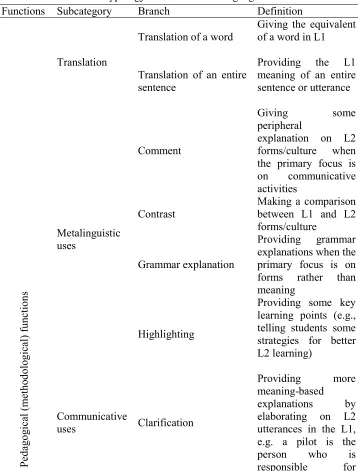
The functions extracted from the literature were divided into two broad categories in the developed typology: pedagogical (or methodological) and social (or affective) functions. The former entails all the instances of teacher CS which intend to fulfill some language-related roles with the purpose of improving target language comprehension. In other words, in this category, the main function of CS is to teach the target language. This category includes Translation, Metalinguistic Uses, and Communicative Uses. Translation is the function through which the teacher provides the L1 equivalent of the target item. Metalinguistic Uses involve functions that deal with the provision of further explanation about the target language forms through students’ L1. Finally, Communicative Uses include the functions that teachers resort to in order to move from one stage of teaching to another or to switch the responsibility to students.
related functions. A complete version of the designed typology along with the definition and examples (when necessary) of each category and subcategory can be found in the following table (Table 1).
Table 1. The typology for functions of language teacher CS Functions Subcategory Branch Definition
P ed ag og ic al (m et ho do lo gi ca l) fu nc ti on s Translation
Translation of a word
Giving the equivalent of a word in L1
Translation of an entire sentence
Providing the L1 meaning of an entire sentence or utterance
Metalinguistic uses
Comment
Giving some peripheral
explanation on L2 forms/culture when the primary focus is on communicative activities
Contrast
Making a comparison between L1 and L2 forms/culture
Grammar explanation
Providing grammar explanations when the primary focus is on forms rather than meaning
Highlighting
Providing some key learning points (e.g., telling students some strategies for better L2 learning)
Communicative
uses Clarification
Providing more meaning-based
Functions Subcategory Branch Definition driving an airplane Checking
comprehension
Assessing whether students have comprehended
something, e.g. no problem?
Directives
Asking students whether they can handle some responsibilities, e.g.,
can you answer the question?
Marker
Using utterances that demonstrate a change of activities, e.g. ok, now, well S oc ia l( af fe ct iv e) fu nc ti on s Managing the class/building rapport with students Reprimand/disapprove
Using utterances that show students have done something wrong, e.g. why did you come late?
Giving feedback
Providing positive/negative feedback on students’ language based performance, e.g. good, very well, excellent
Reminder
Using utterances that tap into students’ memory, e.g. which page should we cover today?
Telling jokes/revealing emotions
Sharing the emotional status with students, e.g. I’m glad
Providing instructions
Giving instructions
Providing necessary guidelines for doing different activities Giving prompts
Functions Subcategory Branch Definition
be accomplished, e.g. quickly, be fast, etc. Pointer
Asking students to refer to a specific part of the book, e.g. next page please
Nominate
Directly addressing one of the students to do an activity, e.g. you please!
Using administrative vocabulary
Using words that are related to the school administrative issues, e.g. exam, test, quiz
1.5 The experimental phase
In order to answer the second research question and also to put the validity of the developed typology into test, data was gathered from four different classes of EFL teachers with special focus on the instances in which they resorted to L1 (Persian) during their teaching. In this section, the information for the second phase of the study is presented.
1.5.1 Participants
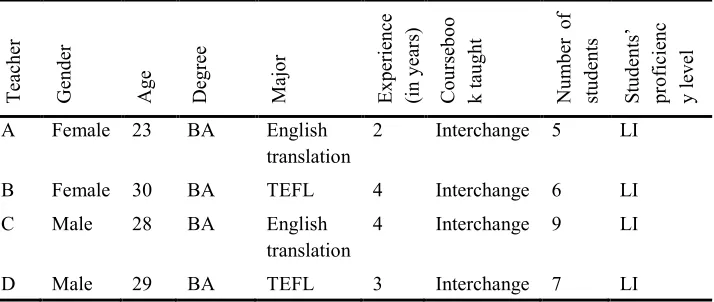
The number of students in the participating classes ranged from 5 to 9 with a total of 25. All of them were between 15 to 27 years of age and shared the same native language with that of the teachers, i.e. Persian. They were attending English classes twice a week with each session lasting for 75 minutes. Here again efforts were made to minimize the effect of extraneous variables through selecting intact classes which had as homogeneous students as possible in terms of their native language, age, ethnic background, and proficiency level (i.e., lower intermediate or LI).
According to the pedagogical policy of the language institute, the Interchange series were taught in the classes with the primary focus on developing oral skills (i.e., listening and speaking). Based on the claim made by the head of the institute, Communicative Language Teaching (CLT) was the dominant methodology and the teachers were supposed to base their classroom practices on the basic tenets of this method. This macro objective was the bedrock which derived teachers toward a unified classroom practices despite the existing variations. A summary of teachers’ biographical details and the courses they taught are presented in table 2.
Table 2. Teachers' biographical information and their course/lessons specifications
T ea ch er G en de r A ge D eg re e M aj or E xp er ie nc e (i n ye ar s) C ou rs eb oo k ta ug ht N um be r of st ud en ts S tu de nt s’ pr of ic ie nc y le ve l
A Female 23 BA English translation
2 Interchange 5 LI
B Female 30 BA TEFL 4 Interchange 6 LI
C Male 28 BA English
translation
4 Interchange 9 LI
D Male 29 BA TEFL 3 Interchange 7 LI
1.5.2 Data collection
the nature of the study and data collection procedure. They were also assured of their freedom to participate in or drop out of the research at any time they would like. Moreover, teachers were reminded of the confidentiality of the information they would provide. At the end of the meeting, their questions about the study were responded by the researcher and a schedule was planned for conducting the videorecording sessions.
At the beginning session of data collection in each classroom, the students were informed of the research project verbally in order to obtain their consent for ethical clearance purposes. They were told that the aim of the study was investigating teachers’ classroom behavior and that the camcorder would be zoomed in on teachers. They were encouraged to follow their ordinary classroom performance and do whatever they do in a normal situation.
Several measures were taken to make sure that the reliability and validity of the research findings will not be greatly affected by the use of this data collection approach. First, although participant teachers received some explanation about the nature of data collection procedure and the following interview, they were not explicitly informed about the purpose of the research; that is, they were not told that the focus of the study was on teachers’ CS. By so doing, it was hoped that they would not be negatively affected by their conscious attention to the CS phenomenon and their classroom practice would be closer to the natural situation. Second, in order to minimize the effect of the presence of camera on teachers’ and students’ classroom conduct, , the main video-taping phase started in the third session after having kept the camera off on the tripod in the rear of the class for two sessions. Finally, the videorecording was completed without the presence of any of the researchers so that teachers’ and students’ classroom performance would not be negatively influenced by the presence of an intruder.
1.5.3 Data analysis
teachers switched from English (FL) to Persian (ML) were transcribed. Criteria for determining the beginning and the end of the transcripts included either linguistic or behavioral features in teachers’ performance. For example, the time a teacher asked for the Persian equivalent of a difficult English word was supposed to constitute the beginning of a transcript. A pause, a repetition of students’ utterance, or a switch to a new activity were considered as the indices demonstrating the end of the transcript. Overall, care was taken to include as much contextual clues in the transcribed segments as possible in order to be able to recognize the functions fulfilled by the instances of CS.
Subsequently, all the transcribed passages were coded by one of the researchers following the categories of the typology. Intra-coder reliability was established by recoding the same segments after a lapse of one month with a resultant level of agreement of 93 percent. Those situations in which a new categorization emerged in the second round of coding were reconsidered and a final decision was made by classifying the segments under the category which seemed to describe the function of the CS passage in a better way. In addition, some of the passages which displayed a combination of several functions simultaneously were classified under several categories. For example, in the following excerpt from teacher A’s talk, both clarification (a subcategory of Communicative Uses) and grammar explanation (a subcategory of Metalinguistic Uses) are performed in a single utterance:
T: ((while explaining some grammatical point on the board)) look at irregular verbs. Can you find a pattern for irregular verbs or not? Mitunid ye ghaede baraye afhale bighaede begid? [can you state a rule for irregular verbs?]
2. Results and Discussion
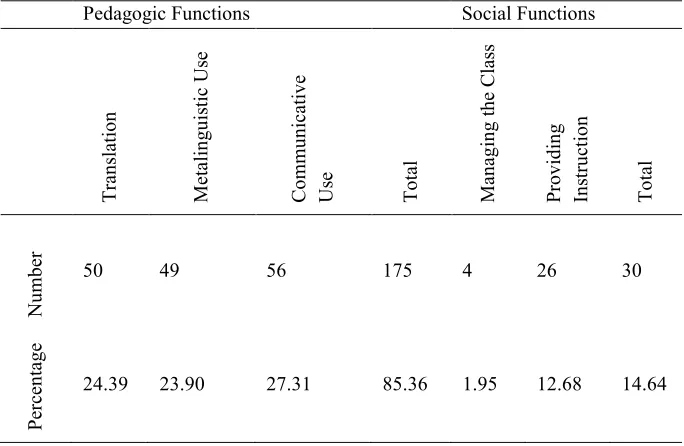
pedagogical function, a slight variation could be observed with Communicative Uses registering the highest percentage (27.31%) followed by Translation (24.39%) and Metalinguistic Uses (23.90%). Among the subcategories of the social function, on the contrary, a big difference could be detected, in that, Providing Instructions was the dominant subcategory with a percentage of 27.31% compared to that for Managing the Class (1.95%). The following table (Table 3) provides a schematic representation of the frequency (in both number and percentage) for each of the subcategories of pedagogical and social functions.
Table 3. Frequency of the use of two main categories and their subcategories Pedagogic Functions Social Functions
T ra ns la ti on M et al in gu is ti c U se C om m un ic at iv e U se T ot al M an ag in g th e C la ss P ro vi di ng In st ru ct io n T ot al N um be r
50 49 56 175 4 26 30
P er ce nt ag e
24.39 23.90 27.31 85.36 1.95 12.68 14.64
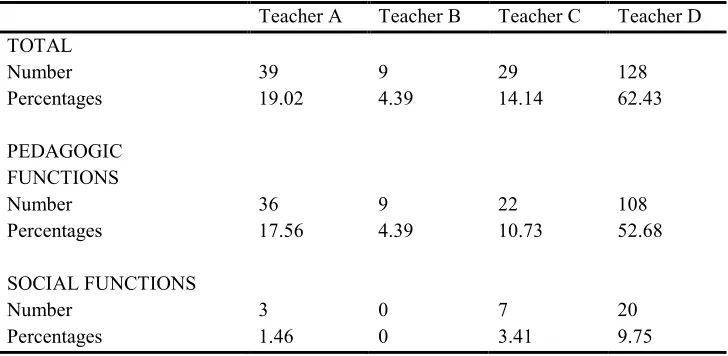
in between. While the same order could be detected among the four teachers with regard to their frequency of the use of CS to fulfill pedagogical functions, a slight change was observed in the case of social functions, in that, teacher C was placed higher than teacher A with frequencies of 3.41% and 1.46% respectively. Moreover, a comparison across the two main categories reveals a homogeneous pattern as all of teachers utilized CS for pedagogical aims far more than for social purposes. In fact, among none of the participants the frequency of the use of CS for fulfilling social functions exceeded 10 percent and even in one case (teacher B) it was never resorted to.
Table 4. Frequency of the total and the two main categories by each teacher
Teacher A Teacher B Teacher C Teacher D
TOTAL
Number 39 9 29 128
Percentages 19.02 4.39 14.14 62.43
PEDAGOGIC FUNCTIONS
Number 36 9 22 108
Percentages 17.56 4.39 10.73 52.68
SOCIAL FUNCTIONS
Number 3 0 7 20
Percentages 1.46 0 3.41 9.75
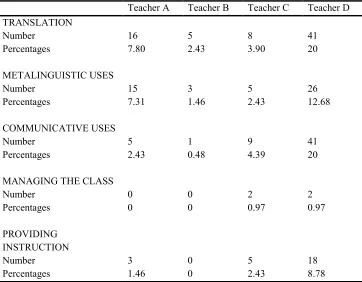
frequency (in both number and percentage) of the use of CS for fulfilling the subcategories of pedagogical and social functions.
Table 5. Frequency of the use of subcategories by each teacher Teacher A Teacher B Teacher C Teacher D TRANSLATION
Number 16 5 8 41
Percentages 7.80 2.43 3.90 20
METALINGUISTIC USES
Number 15 3 5 26
Percentages 7.31 1.46 2.43 12.68
COMMUNICATIVE USES
Number 5 1 9 41
Percentages 2.43 0.48 4.39 20
MANAGING THE CLASS
Number 0 0 2 2
Percentages 0 0 0.97 0.97
PROVIDING INSTRUCTION
Number 3 0 5 18
Percentages 1.46 0 2.43 8.78
all the four teachers through CS compared to the other one – Managing the Class.
The wide range of variety in the amount of ML use by the four participants is supported by the literature. Duff and Polio (1990), for example, found that their participant teachers’ use of the ML ranged from 0 to 90 percent. Also, Kim and Katherine’s (2005) study demonstrated that teachers’ resort to the ML varied greatly from one participant to the other. Contextual factors such as students’ proficiency level and the possession of a common language by teacher and students can be influential factors in determining how much teachers use the first language in the classroom.
Considering the subcategories of the pedagogical functions, previous studies show that Translation has always been one of the most frequently fulfilled functions through the use of ML (Macaro, 2001; Rolin-Loniziti & Brownlie, 2002; Mugla & Seedhouse, 2005; Edstorm, 2006; Qian et al., 2009). By the same token, in the present study, it had the highest frequency (32.68%). It seems both convenient and time saving to use the L1 in order to provide the meaning of unknown words, especially the abstract ones which are much more difficult to be explained or demonstrated in the target language.
Translation with the exception that in this case the teachers usually did not resort to the literal, exact translation of the target words, but provided some extra information. For example, in the following extract, teacher A gave some extended explanation on one of the cultural aspects of the target community to make the concept clear for students:
T: Karaoke bar jaeeye ke dusta baham miran va ba
misighi ke unja pakhsh mishe avaz mikhunan [karaoke
bar is a place where friends go with each other and sing songs with the music that is played]
In the same vein, among the subclasses of the Communicative Uses, there are two functions (i.e., Clarification with a frequency of 15.12% and Checking Comprehension with one of 10.24%) which are more frequently fulfilled through the use of L1. While the first subclass needed the use of a complex language (which again seems a little complicated for students), the second one was usually achieved through teacher-induced CS; that is, teachers asked students to translate parts of their talk so that they would demonstrate their comprehension. In contrast, the other two subclasses (i.e., Directives and Marker) were among the ones that could easily be accomplished through the use of the TL as they consist of some fixed and widely applied phrases which are more or less familiar to the students.
number of students in each classroom little language was used for disciplining or managing the students. Consequently, hardly ever did teachers codeswitch to, for example, reprimand students. Additionally, based on the observation of videorecordings, the classes were more teacher-centered with teachers trying to keep a distance from students leading to their reluctance to build rapport with students through telling jokes or revealing personal emotions.
3. Conclusion
The second phase of the study provides evidence-based support for the developed typology. The categories and subcategories of functions of language teachers’ CS were manifested in the collected data. It was demonstrated that the EFL teachers resorted to the L1 to fulfill both pedagogical and social functions. Therefore, it might be claimed that the typology is valid enough to describe functions of teacher CS. The typology can be implemented by language teaching experts to discover the main functions of teacher CS in different contexts. Once these functions have been identified, measures can be taken to find appropriate procedures to utilize the benefits of L1 use in the class (instead of repressing it). By so doing, one might hope that in EFL contexts L1 could be considered a pedagogical tool which can help the development of L2 skills among language learners.
References
Ary, D., Jacobs, C. A., & Razavieh, A. (2005). Introduction to research
in education (7 ed.). Reston, Virginia: Wordsworth Publishing.
Atkinson, D. (1987). The mother tongue in the classroom: A neglected resource? ELT Journal, 41(4), 241-247.
Belz, J. A. (2002). The myth of the deficient communicator. Language
Teaching Research, 61(1), 59-82.
Bot, K. D., Lowie, W., & Verspoor, M. (2005). Second language
acquisition: An advanced resource book. London: Routledge.
Cook, V. (2001). Using the first language in the classroom. The
Canadian Modern Language Review, 57(3), 402-423.
Duff, P., & Polio, C. (1990). How much foreign language is there in the foreign language classroom? The Modern Language Journal , 74
(2), 154-166.
Edstorm, A. (2006). L1 use in the L2 classroom: One teacher's self-evaluation. The Canadian Modern Language Review , 63(2), 275-292.
Gass, S. M., & Mackey, A. (2000). Stimulated recall methodology in
second language acquisition. Mahwah, NJ: Erlbaum.
Harbord, J. (1992). The use of the mother tongue in the classroom. ELT
Journal, 46(4), 350-355.
Kim, S. H., & Katherine, E. (2005). Language choices and pedagogic functions in the foreign language classroom: A cross-linguistic functional analysis of teacher talk. Language Teaching Research , 9(4), 355-380.
Kim, S., & Elder, C. (2005). language choices and pedagogic functions in the foreign language classroom: A cross-linguistic functional analysis of teacher talk. Language Teaching Research , 9(4), 355-380.
Larsen-Freeman, D. (2000). Techniques and principles in language
teaching. Oxford: Oxford University Press.
Macaro, E. (2001). Analysing student teachers' codeswitching in foreign language classrooms: Theories and decision making. The Modern
Mugla, E. Ü., & Seedhouse, P. (2005). Why that, in that language, right now? Code-switching and pedagogical focus. International Journal
of Applied Linguistics, 15 (3), 302-325.
Mullock, B. (2006). The pedagogical knowledge base of four TESOL teachers. The Modern Language Journal, 90(1), 48-66.
Philipson, R. (1992). Linguistic imperialism. Oxford: Oxford University Press.
Polio, C. G., & Duff, P. A. (1994). Teachers' language use in university foreign language classrooms: A qualitative analysis of English and target language alternation. The Modern Language Journal, 76(3), 313-326.
Qian, X., Tian, G., & Wang, Q. (2009). Codeswitching in the primary EFL classroom in China: Two case studies. System, 37, 719-730. Rolin-Ianziti, J., & Brownlie, S. (2002). Teacher use of learners' native
language in the foreign language classroom. The Canadian Modern
Language Review, 58(3), 402-426.
Sankoff, D., & Poplock, S. (1981). A formal grammar for code-switching. Papers in Linguistics: International Journal of Human
Communication, 14, 3-45.
Turnbull, M. (2001). There is a role for L1 in second and foreign language teaching, but ... The Canadian Modern Language Review, 54 (4), 531-540.
Turnbull, M., & Arnet, K. (2002). Teachers' uses of the target and first languages in secocnd and foreign language classrooms. Annual