IOT Based Smart Stick with Voice Module
Mrs. M. Deepthi1, P. Sowmya2, N. Naga Mounika3, K. Pavani Sai4, N. Sripriya5, N. Balasaida6
1
Assistant Professor, 2,3,4,5,6U.G Students, Department of ECE Vasireddy Venkatadri Institute of Technology(VVIT), Andhra Pradesh, India
Abstract: This paper presents the smart idea to assist the blind persons without the human need. It is known that the blind carry a stick with them whenever they need the support. Even they carry a stick with them there is no guarantee that they are safe and secured in reaching their required places. Even if there may be an obstacle in their path but it may not noticed by the person with the help of the normal hand stick. Due to this the blind may be injured if the obstacle is dangerous. To avoid this problem, a smart stick comes as a proposed solution. Here we are using ultrasonic sensors to find any obstacles in front of the blind. If any obstacle is detected, voice messages alerts the blind. This system uses Arduino Uno and GPS to track the blind. The smart stick is of low cost, gives fast response, and uses low power and weights very light. The entire controlling unit is fixed to the hand stick. If any obstacle comes in front of blind person, they can easily get to know about the obstacle through the audio generated by the voice module and the location of blind people can be known by passing the information into cloud using IoT.
Keywords- Smart Stick, Arduino Uno, Ultrasonic Sensors, GPS, Soil moisture Sensor, WI-FI Module, Voice module.
I. INTRODUCTION
Visually defective people find difficulties while detecting obstacles in front of them during walking on the road, which makes it
dangerous. So in our proposed system, the above mentioned cases are taken into consideration and implementation is provided by
adding ultrasonic sensors and soil moisture sensor. One ultrasonic sensor is used to find the obstacle in front of the stick and another one is placed below the stick for stair cases. Moreover, moisture sensor is placed at bottom of the stick for avoiding slippery nature.
The stick has capacity of finding all obstacles in the range 1 meter and gives a suitable respect voice message permit blind to move
twice his normal speed. The system makes use of GPS and WIFI modules to find the location. The main objective of this project is
to reduce the cost and to provide a better solution for the visually impaired people and help the blind to move safely to their destination.
II. PROPOSED METHODOLOGY
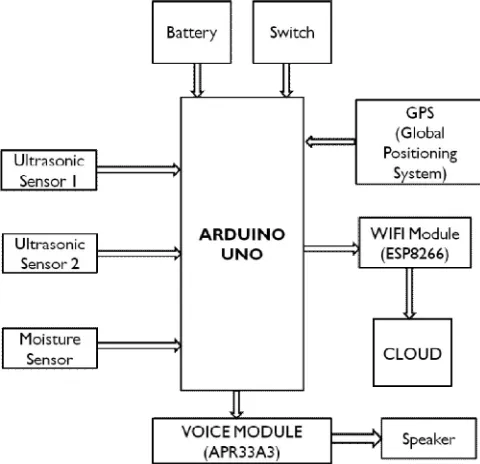
[image:2.612.186.426.485.717.2]The design of the proposed system shown in Fig.1 is composed of the following units:
A. Arduino Uno
Arduino Genuino Uno is a microcontroller board based on the ATmega328P (datasheet). It has 14 digital input/output pins (of which 6 can be used as PWM outputs), 6 analog inputs, a 16 MHz quartz crystal, a USB connection, a power jack, an ICSP header and a reset button. It contains everything needed to support the microcontroller; simply connect it to a computer with a USB cable or power it with an AC-to-DC adapter or battery to get started.
Microcontroller ATmega328
Operating Voltage 5V
Input Voltage (recommended) 7-12V
Input Voltage (limits) 6-20V
Digital I/O Pins 14 (of which 6 provide PWM output)
Analog Input Pins 6
DC Current per I/O Pin 40 mA
DC Current for 3.3V Pin 50 mA
Flash Memory 32 KB (ATmega328) of which 0.5 KB used by bootloader
SRAM 2 KB (ATmega328)
EEPROM 1 KB (ATmega328)
Clock Speed 16 MHz
Fig.2. Arduinouno B. Ultrasonic Sensor
It is used for obstacle avoidance. It transmits ultrasonic waves into the air and detects reflected waves from an object. Generally ultrasonic range is from 3cm to 3 m. An Ultrasonic sensor is a device that can measure the distance to an object by using sound waves. It measures distance by sending out a sound wave at a specific frequency and listening for that sound wave to bounce back. By recording the elapsed time between the sound wave being generated and the sound wave bouncing back, it is possible to calculate the distance between the sonar sensor and the object.
C. Moisture Sensor
Soil moisture sensors measure the amount of water content in soil. It mainly uses the property of the electrical resistance of the soil. The relationship among the measured property and soil moisture is calibrated and it varies depending on environmental factors such as temperature, soil type, or electric conductivity. Here, It is used to sense the moisture in field and transfer it to Arduino Uno in order to give the out as audio message. It helps the blind to avoid slippery surfaces. The Soil Moisture Sensor uses capacitance to measure the water content of soil (by measuring the dielectric permittivity of the soil, which is a function of the water content).
Fig.4. Moisture Sensor
D. Internet of Things (IoT)
The Internet of things (IoT) is the network of physical devices, vehicles, home appliances and other items embedded with electronics, software, sensors, actuators, and connectivity which enables these objects to connect and exchange data. Each thing is uniquely identifiable through its embedded computing system but is able to inter-operate within the existing internet infrastructure.
Fig.5.Posting the information through cloud
E. Wi-Fi(ESP8266) Module
Wi-Fi generally allows connectivity in peer-to-peer mode, which allows devices to connect directly with each other. Wi-Fi technology includes personal computers, Smart phones and tablet. Devices with Wi-Fi technology can directly connect to the internet via WLAN network and a wireless access point. Most of the Wireless communication systems consist of transmitters, antennas and receivers.
Fig.6. WI-FI module F. GPS (Global Positioning System)
The GPS is a system for knowing the position from signals sent by a network of satellites. To accurately determine the position and it is able to determine the strong signals. GPS tracking system is easy to use, mobile friendly, as intuitive user interface and is designed to communicate with a wide variety of GPS devices. The GPS receivers were much simpler than today, they provided only the latitude and longitude position, the rest was on account of the user who needed to calculate the map.
Fig.7. GPS module
Arduino Uno Google
Cloud
G. Voice Module(APR33A3)
[image:5.612.233.386.178.330.2]Audio playback board using APR33A3 IC contain 8 channels(M0 to M7)each channel having 1.3 minutes recording length totally 11 minutes of recording time. It consists of onboard MIC will automatically be used for recording with 12v DC/AC. It is user friendly and Non-Volatile flash memory technology, no battery backup required. Whatever we speak will be captured by MIC and recorded, status LED will on in record mode indicating that chip is currently recording. Once duration is full the LED will off means that segment is full. Now you can disconnect the GND Connection from channel, if before the duration is this connection is removed, then that many seconds are recorded and rest duration is kept empty.
Fig.8. Voice module
III. WORKING PRINCIPLE
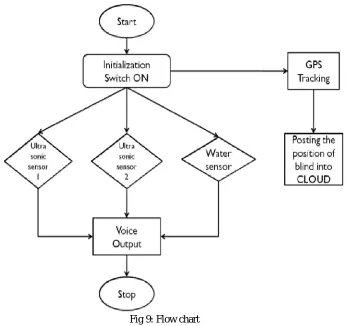
When the switch is turned ON, Arduino starts receiving data from all the sensors. When an obstacle is detected, sensors will send the information to Arduino. Then the Arduino will send the information to the voice module which gives voice message when there is an obstacle in front of the blind. The above process repeats for moisture sensor also. When the surface is slippery or the water content is more in soil then immediately it gives the voice massage. We can also track the location of blind by using GPS and WiFi, by posting information to the cloud using IoT.
[image:5.612.142.488.408.734.2]IV. RESULTS AND DISCUSSION
The below two charts represents the latitude and longitude of the blind and they varies according to the distance travelled by him/her.
Fig.9. Charts representing the latitude and longitude of blind
The figures below shows the experimental setup of the system. The setup gives a brief information about the interfacing of components to the arduino and also the arrangements of sensors and different modules to the stick.
V. CONCLUSION
IoT based smart stick with voice module is successfully developed. This paper proposed the construction and architecture of a new concept of Smart Stick which is designed for blind people. The advantage of the system lies in the fact that it can prove to be a very low cost solution to millions of blind person worldwide. So that they can reach their destination without any problem and risk. By providing GPS tracking we can get the location of the blind and check whether the blind is reaching his destination correctly or not.
REFERENCES
[1] B.S.Sourab, B.S.Sourab and Sachith D’Souza, India. ISSN: 978-1-4799-8371-1 /2015 IEEE. “Design and Implementation of Mobility Aid for Blind People” [2] Ayat A. Nada, Mahmoud A.Fakhr, Ahmed F.Seddik, Egypt. IEEE Conference. “Assistive Infrared Sensor Based Smart Stick for Blind People”
[3] C. H. Lin, P. H. Cheng and S. T. Shen, IEEE Member. ISSN: 978-1-4244-7929-0/14/2014 IEEE. “Real-time Dangling Objects Sensing: A Preliminary Design of Mobile Headset Ancillary Device for Visual Impaired”.
[4] Ahmed EL-KOKA, Gi-Hyun HWANG, Dae-Ki Kang, Korea. ISSN: 978-89-5519-163-9. “Advanced Electronics Based Smart Mobility Aid for the Visually Impaired Society”
[5] Alshbatat, Abdel IlahNour. "Automated Mobility and Orientation System for Blind or Partially."INTERNATIONAL JOURNAL ON SMART SENSING AND INTELLIGENT SYSTEMS, 568-582, 2013
[6] Mahdi Safaa A., MuhsinAsaad H. and Al-Mosawi Ali I. "Using Ultrasonic Sensor for Blind and Deaf persons Combines Voice." International Science Congress Association, 50-52, 201
[7] HarshadGirishLele, Viten Vilas Lonkar, VarunVasantMarathe, Mrunmayi Mohan Modak. "electronicpathGuidance for visually impaired people." The International Journal of Engineering And Science (IJES), 09-14, 2013
[8] K. Steed-Terry, “Integrating GIS and the Global Positioning System,” 2nd ed. ESRI inc. pp.1–12, 2001
[9] S. SaiSanthosh, T. Sasiprabha, R. Jeberson,. "BLI – NAV Embedded Navigation System for Blind People." IEEE, 277-282, 2010:.
[10] Hashino, S.; Ghurchian, R.; A blind guidance system for street crossings based on ultrasonic sensors. Information and Automation (ICIA),2010 IEEE International Conference on June 201
[11] David Castells, Joao M.F. Rodrigues, J.M. Hans du Buf “Obstacle detection and avoidance on sidewalks” In Proc. Int. Conf. on ComputerVision-Theory and Applications, Vol. 2, pp. 235-240, 20