1549
©IJRASET (UGC Approved Journal): All Rights are ReservedDuplicate Detectable Opportunistic Forwarding in
Duty-Cycled Wireless Sensor Networks
Sowmya P D1, Kiran Babu T S2
1
Computer Network Engineering, 2Associate Professor, Department of Computer Science CMRIT, Bangalore, Karnataka, India
Abstract: Wireless Sensor Network (WSN) is normally dutycycled to develop the lifetime of system. In dutycycled sensor systems, Opportunistic steering offering moderately proficient and versatile sending, for the most part enables distinctive hubs to forward the comparable parcel all the while, particularly in systems with concentrated movement. Awkward transmissions frequently present various copy bundles, which are additionally sent in the system, possess the restricted system asset, and thwart the parcel conveyance execution. Catching or coordination based methodologies, either can't scale up with the framework estimate, or endure high control overhead. Copy Detectable Opportunistic Forwarding (DOF), a copy perceivable entrepreneurial sending that is versatile to various activity loads. DOF principally takes care of the channel debasement issue in view of the opened affirmation, brought about by the expansive measure of copies in customary shrewd sending and holds the advantages of the sharp steering however much as could be expected.
Keywords: DOF; duty cycle; Wireless Sensor Networks; Opportunistic routing; Overhearing.
I. INTRODUCTION
Remote Sensor Networks are by and large obligation cycled to broaden the lifetime of network. Low power Listening in (LPL) is a generally received low-obligation cycled media get to component is. In LPL, taking X-MACc[4]iis a commonplace case. Here every node occasionally awakes and checks the received flag quality for recognizing the potential movement. On the off chance that the channel is clear, then for a specific period it kills the radio to rest. Take note of that diverse nodes sleep timetable is typically unsynchronized. Sender needs to spending much vitality for its relating forwarder to get up to send information. Amid the holding up time, the sender persistently transmits similar information bundle until the preset clock terminates or an affirmation is gotten. As in the result, if the forwarder is deterministic then end-to-end defer is high. Plainly, sender vitality is squandered on sitting tight for the forwarder. Dutycycled correspondence nature made the deterministic sending plans wasteful.
To abbreviate holding up time, a typical believed is to acknowledge the earliest forwarding opportunity as contradicted to sitting tight for the deterministic forwarder, as sharp directing. Transiently accessible connections might be mishandled to diminish the
transmission cost in wireless mesh networks. Landsiedeletal Proposed ORW(opportunistic routing in WSN)w[6], an artful sending
convention for low-dutycycled unsynchronized sensor networks. In.ORW, any forwarder with certain steering advancement can perceive the introduction transmission in LPL. The first wake-up intermediate that successfully gets the bundle is picked as the following bounce forwarder. Nevertheless, ORW cannot support high-activity stack applications because of channel capacity degradation caused by the inherent copy issue.
With a particular ultimate objective to address the above issues, we propose Duplicate Detectable Opportunistic Forwardingg(DOF). Instead of direct data transmission in LPL, a sender sends a test and demands that the potential forwarders to recognize the test individually in different time-slots. By using the temporal qualities of numerous acknowledgments, the sender identifies the quantity and separates the need of all potential forwarders. The sender then forwards its data in the deterministic approach to avoid multiple forwarders shearing the same packets. A few procedures are made to resolve possible collisions among different acknowledgments and exploit worldly long great connections for entrepreneurial sending. With the lightweight component to stifle copies, DOF can adjust to different traffic loads in duty-cycled sensor networks and improves the system performance as for both network yield and vitality efficiency.
II. THEORETICALBACKGROUND
A. Overview on Wireless Sensor Networks
Volume 5 Issue VII, July 2017- Available at www.ijraset.com
1550
©IJRASET (UGC Approved Journal): All Rights are Reservedchange into an electric flag. Taking care of such a flag discloses a couple of properties about items initiate or potentially occasions occurring in section of the sensor.
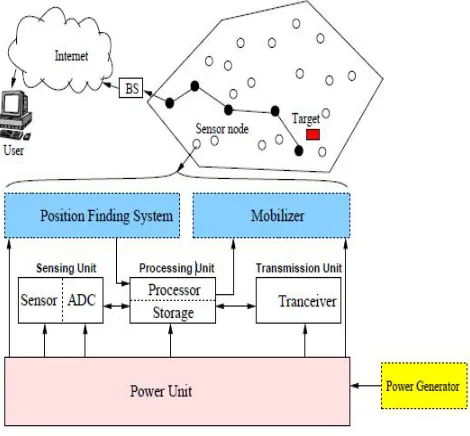
Fig 1demonstrates the schematic outline of sensor hub parts. In a common sense, every single sensor hub involves detecting, handling, spread, mobilizer, spot discovering frame, and power entities. Comparable figure demonstrates the correspondence engineering of a WSN. Sensor nodes are by and large scattered in a sensor field. Sensor nodes orchestrate among themselves to make incredible information nearly the physical condition. Every one sensor hub constructed its selections in light of its central end, the data it right now has, and vitality assets, its learning of its computing and correspondence. Each of these scattered sensor hubs had the capability to assemble and course information either to diverse sensors or back to an exterior base station. A base-station might be a settled hub or a useful hub equipped for correlating the sensor system to in progress communications infrastructure or else to the Internet.
[image:3.612.196.431.224.442.2]Fig. 1 Segments of sensor nodes
B. Duty Cycled Wireless Sensor Networks
Rest booking (additionally called obligation cycling) has been a basic plan thought for broadening a remote sensor arrange lifetime, since the wireless sensor hubs sit without moving or catching state is very energy consuming. In an obligation cycled WSN[10], a hub kills its radio, when no correspondence and sensing tasks are required and goes to sleep. Then hub awakens to test nature and checks channel movement. The strategy for a node arranging its rest/get up time is typically called sleep planning. duty cycling is characterized as the division of time hubs are dynamic amid their lifetime. When all is said in done, the lesser the obligation cycle is, the higher the system lifetime will be. However, sleep planning additionally gets extraordinary challenges to the outline of proficient conveyed directing protocols aimed at multi-jump remote sensor networks. Traditional steering conventions show problems when they are sent in such duty cycled wireless networks.
III.SYSTEMDESIGN
A. System Architecture
The general intelligent structure of the venture is isolated into preparing modules and a calculated information structure is characterized as Architectural Design.
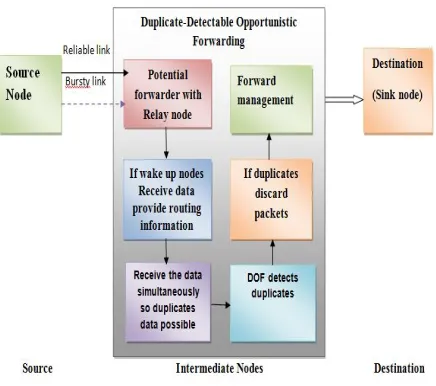
Fig 2 demonstrates the Architecture outline where the system will arrange utilizing the sensor hubs. The setup will be as far as the quantity of hubs, vitality example of the hubs, and so forth.
1551
©IJRASET (UGC Approved Journal): All Rights are ReservedFig. 2 System architecture
B. Network Deployment
First define the Network configuration parameters i.e., specify the number of nodes ,initial energy, MAC, propagation, Receiver power, sleep power, transmission power, Channel Type, Propagation or TwoRayGround i.e., radio-engendering model, organize interface (Phy/Wireless Phy), MAC type(Mac/802_11),interface line type(CMUPriQueue), connect layer sort, recieving wire show (Antenna/OmniAntenna), maxpacket in ifq, number of versatile hubs, X hub remove, Y hub separate Initial Energy, Initial vitality in Joules Then deploy all the nodes into the network with some moving velocityt.
The system stack for a hub comprises of a connection layer (LL), an ARP module associated with LL, an interface need line (IFq), a mac layer (MAC), a system interface (netIF), all associated with the channel. These system parts are made and plumbed together in OTcl. The pertinent Node strategy include interface ()
1) Create the instance for the super class Simulator and make use of this reference variable for creating and specifying the parameters for the node
2) Create the nam file for invoking the nam window with the set command and opening the nam file in the write mode .For this
file reference variable give the command ns-namtrace-all.
3) Creating the topology with set topo command and specifying the type of the topology as flatgrid and specifying x value and y
value.
4) Configuring the nodes by specifying the values of the network parameters.
5) Creating the nodes using the for loop and “$ns-node” command.
6) Assign the positions for all the nodes with the setdest command and xvalue, yvalue
7) Attach the udp agent to the node.
8) Attach the CBR traffic from source to sink by setting the packet size, packet interval.
9) Connect the agents
C. Network/Node Discovery
1) After the nodes are created then assign the node positions with the set destination of x value, y value and h distance.
2) Configuration of the nodes in the network by specifying values to network configuration parameters.
3) First in the neighbor node discovery those nodes that are at a distance less than 300 are neighbors. 4) For the neighbor node discovery write a procedure that calculates the distance between the two nodes. 5) Later only nodes that are at a distance less than 150 send hello packets to the neighbors.
6) For sending the hello packets write a procedure that takes the starting node, end node, start time and time interval as the parameters and write it into the file.
Volume 5 Issue VII, July 2017- Available at www.ijraset.com
1552
©IJRASET (UGC Approved Journal): All Rights are Reserved8) At last write all the information of the source, neighbors, xdistance, ydistance and hdistance in to the neighbor file and attach the CBR traffic from source to its neighbors by writing the loop into the END block.
9) Once all the packets will be received by the neighbor node then the source node will declare that node as the neighbors. Like this all the neighbors will perform the discovery phase.
D. Shortest Route
1) All the wakeup nodes are taking consider while finding the shortest route. 2) Based on the neighbor nodes distance shortest route is calculated.
E. Duplicate Packet Detection
1) Intermediate node detects the duplicate packet if it receives the same packet from source node
F. Performance Analysis
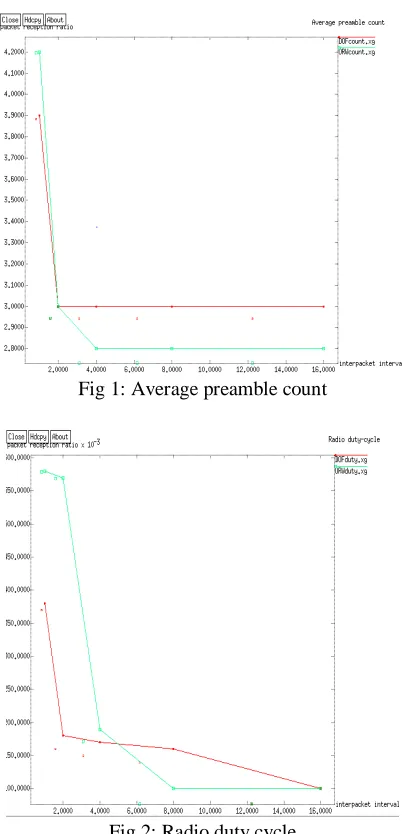
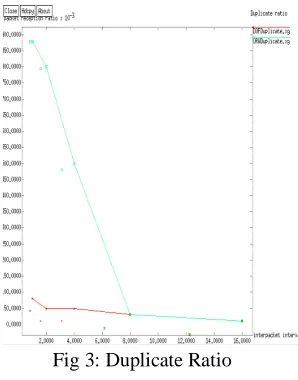
1) Based on the above implementation we can obtain the performance analysis with the graphical representation of our proposed
scheme and the existing scheme.
[image:5.612.210.411.299.716.2]IV.SIMULATIONGRAPHS
Fig 1: Average preamble count
1553
©IJRASET (UGC Approved Journal): All Rights are ReservedFig 3: Duplicate Ratio
V. CONCLUSION
Building up a versatile and proficient sending convention is earnest for a dutycycled wireless sensor network. In this work, we propose DOF, a copy perceivable astute sending that is versatile to different activity loads. In view of the affirmation, DOF mostly takes care of the channel debasement issue caused by the extensive measure of copies in customary deft sending and holds the advantages of the sharp steering however much as could be expected.
REFERENCES
[1] M. Ceriotti et al., “Is there light at the ends of the tunnel? Wireless sensor networks for adaptive lighting in road tunnels,” in Proc. IPSN, 2011, pp. 187–198. [2] X. Wu, M. Liu, and Y. Wu, “In-situ soil moisture sensing: Optimal sensor placement and field estimation,” Trans. Senor Netw., vol. 8, no. 4, p. 33, 2012. [3] J. Polastre, J. Hill, and D. Culler, “Versatile low power media access for wireless sensor networks,” in Proc. Sensys, 2004, pp. 95–107.
[4] M. Buettner, G. V. Yee, E. Anderson, and R. Han, “X-MAC: A short preamble MAC protocol for duty-cycled wireless sensor networks,” in Proc. Sensys, 2006, pp. 307–320
[5] S. Biswas and R. Morris, “Exor: Opportunistic multi-hop routing for wireless networks,” Comput. Commun. Rev., vol. 35, no. 4, pp. 133–144, 2005. [6] O. Landsiedel, E. Ghadimi, S. Duquennoy, and M. Johansson, “Low power, low delay: Opportunistic routing meets duty cycling,” in Proc. IPSN, 2012, pp.
185–196.
[7] S. Liu, K.-W.Fan, and P. Sinha, “CMAC: An energy-efficient MAC layer protocol using convergent packet forwarding for wireless sensor networks,” Trans. Senor Netw., vol. 5, no. 4, pp. 29:1–29:34, 2009.
[8] C. Szymon, J. Michael, K. Sachin, and K. Dina, “MORE: Network coding approach to opportunistic routing,” MIT-CSAIL-TR-2006-049, 2006.
[9] E. Ghadimi, O. Landsiedel, P. Soldati, S. Duquennoy, and M. Johansson. 2013. Opportunistic Routing in Low Duty-Cycled Wireless Sensor Networks. ACM Trans. Embedd. Comput. Syst. 0, 0, Article 0 ( 20xx), 35 pages.
[10] Y. Gu and T. He, “Data Forwarding in Extremely Low Duty-Cycle Sensor Networks with Unreliable Communication Links,” Proc. ACM SenSys’07, Nov. 2007, pp. 321–34.
[11] R. Beraldi, R. Baldoni, and R. Prakash, “Lukewarm Potato Forwarding: A biased Random Walk Routing Protocol for Wireless Sensor Networks,” Proc. IEEE SECON’09, June 2009, pp. 1–9.
[12] J. Kim, X. Lin, and N. Shroff, “Optimal Anycast Technique for Delay-Sensitive Energy-Constrained Asynchronous Sensor Networks,” Proc. IEEE INFOCOM’09, Apr. 2009, pp. 612–20.
[13] S. Lai and B. Ravindran, “On Distributed Time Dependent Shortest Paths Over Duty-Cycled Wireless Sensor Networks,” Proc. IEEE INFOCOM’10, Mar. 2010, pp. 1685–93.
[14] K. P. Naveen and A. Kumar, “Tunable Locally-Optimal Geographical Forwarding in Wireless Sensor Networks with Sleep-Wake Cycling Nodes,” Proc. IEEE INFOCOM’ 10, Mar. 2010, pp. 1–9.
[15] Y. Xue, M. C. Vuran, and B. Ramamurthy, “Cost Efficiency of Anycast-Based Forwarding in Duty-Cycled WSNs with Lossy Channel,” Proc. IEEESECON’10,June2010,pp.1–9.