DOES SERIOUS OFFENDING LEAD TO HOMICIDE?
EXPLORING THE INTER-RELATIONSHIPS AND
SEQUENCING OF SERIOUS CRIME
Keith Soothill
1, Brian Francis
2and Jiayi Liu
31Emeritus Professor of Social Research, Department of Applied Social Science, 2Professor of Social Statistics, 3Research Officer, Centre for Applied Statistics,
Lancaster University, UK
Word count of manuscript – 7,393 words (including references, footnotes, tables and figures).
Corresponding Author: Brian Francis Address for correspondence:
Brian Francis,
Centre for Applied Statistics Fylde College
Lancaster University, Lancaster LA1 4YF UK
Tel: +44 (0)1524 593061 Fax: +44 (0)1524 592681
E-mail: [email protected]
DOES SERIOUS OFFENDING LEAD TO HOMICIDE?
EXPLORING THE INTER-RELATIONSHIPS AND SEQUENCING OF SERIOUS CRIME
Abstract
The inter-relationships between serious types of crime have been
neglected. Focusing on those convicted of arson (n=45,915), blackmail
(n=5,774), kidnapping (n=7,291) and threats to kill (n=9,816) in England and
Wales (1979-2001), we examine the specialisation and sequencing of these
crimes in relation to the risk of subsequent homicide.
All four offences have a heightened likelihood of subsequent homicide
compared to the general population. Arson, blackmail and threats to kill have
a similar homicide risk (0.8%) after a 20-year follow-up; in contrast,
kidnapping has a higher likelihood (1.0%). Sequencing is also relevant, with
those convicted of more than one type of serious offence being at higher risk
of a homicide conviction.
Additionally, there is evidence of specialisation (particularly for
arsonists) among serious offenders who recidivate.
Keywords
Introduction
Much of the criminological focus in recent years has been on high
frequency/low tariff offences where the versatility of most offenders’ behaviour
has been identified. With these offenders the case for specialisation has been
limited although elsewhere (Soothill et al., 2000) we have argued that the
conceptualisation of the issue needs further development. In contrast, there
has been much less criminological focus on low frequency/high tariff offences.
The exception over the past decade has been the increased interest in sexual
offending. In relation to other high tariff serious crime, the focus is usually on
one type of offence, such as arson (e.g. Soothill et al., 2004) and there is the
apparent criminological neglect of many such crimes, such as blackmail or
threats to kill. More pertinently, there seems to have been little discussion
about possible comparisons and inter-relationships between different types of
serious offences. Are those convicted of kidnapping more likely than those
convicted of blackmail to go on to be reconvicted for homicide, for example?
Similarly, are those convicted of, say, both arson and threats to kill more likely
to go on to be convicted of homicide than those convicted of only one type of
serious crime? The questions are important ones both for theoretical and
practical reasons.
In thinking theoretically about serious offenders who recidivate one
needs to ask how many types of offending domain they occupy. This question
relates to the fraught issue of specialisation. Are kidnappers distinct from
blackmailers? Are those convicted of threats to kill (a potentially serious
serious offence on property)? And so on. If they are distinct, this would
perhaps suggest that one needs different types of theoretical explanations for
different types of serious crimes. In contrast, if there is quite considerable
overlap between those committing different types of serious offences – that is,
those who are convicted of blackmail also tend to get convicted of kidnapping
during their criminal careers, then there is perhaps more scope for a more
general explanation, such as the low self-control approach espoused by
Gottfredson and Hirschi (1990) who have espoused a general theory of crime.
This paper is a demonstration project probing the overlap between
different kinds of serious offences. It is a demonstration rather than a
definitive study simply in terms of probing whether a largely uncharted journey
is worth undertaking.
Certainly the overlap issue may be important for explanation. However,
the practical issue is a different but related one. If, for example, someone with
a kidnapping and a blackmail conviction is more likely to kill subsequently
rather than someone with a single blackmail conviction, then one can make
a better appraisal of the type of risk that is at issue and the type of support or
surveillance that may be needed.
Previous literature
There seems little work that considers the overlap between different
types of serious crime. However, we have previously ventured into this area.
murder that “a previous conviction for kidnapping was shown to be a
statistically significant risk factor for murder, when compared against general
criminal controls and against violent controls” (Soothill et al., 2002: 33).
Similarly, for blackmail, “those with a blackmail conviction were over five times
as likely to become murderers as the general controls” (Ibid. p.34].
More recently Liu et al. (in press) examined the time from the first
conviction for kidnapping to some specific subsequent serious crimes: a
subsequent kidnap, murder, manslaughter, and rape of a female. Using
survival analysis procedures, this work estimated that 5 out of every 100
kidnap offenders convicted of kidnapping will be reconvicted for this offence.
In contrast, one in every 100 kidnap offenders will be convicted of homicide
after 20 years and close to 2 out of every 100 will be convicted of rape of a
female in 20 years. It was further demonstrated that kidnappers are over 30
times more likely than males in the general population to be convicted of
homicide and four times more likely than sex offenders.
Further, it seemed from our earlier research (Soothill et al., 2002) that
those who were subsequently convicted of murder following a kidnapping
conviction seemed to be much closer in time to the earlier kidnapping
conviction compared, for instance, to those who were convicted of blackmail
where the subsequent killing often seemed to be more distant in time.
In brief, this earlier work certainly suggests that those convicted of
murder, but it falls short of comparing systematically various kinds of serious
offences and probing the possible inter-relationships between them. In a
hierarchy of potential dangerousness, how do offenders committing various
kinds of serious offences measure up? Also to what extent is there an overlap
between serious offences – in brief, do offenders who commit these types of
offences specialise in certain types of offending or is their serious criminal
behaviour much more versatile?
Aims of the current paper
This paper probes the issues of comparison and possible
inter-relationships by considering four specific types of serious crime – arson,
blackmail, kidnapping and threats to kill. The choice of these offences was
occasioned by three factors. Firstly, an earlier study identified that among
general offenders with a previous criminal history these offences indicated an
increased risk of murder (Soothill et al. 2002, especially Table 10). Secondly,
these are seemingly very different types of serious offences and, finally, the
availability of the data for these four offences. We refer to these four offences
as “focus offences”. Other offences could certainly claim attention but, as
indicated earlier, this is a demonstration rather than a definitive study.
Certainly these four chosen offences do seem very different. While
there will be variants, ‘kidnapping’ seems essentially a ‘hands-on’ potentially
violent offence with face-to-face interaction, ‘blackmail’ seems a more
‘hands-off’ offence with little or no face-to-face interaction, ‘threats to kill’ seems a
face-to-face interaction, and ‘arson’ is a serious property which may or may not
endanger human life.
The choice of considering the likelihood of subsequent homicide
provided continuity with our earlier work (Soothill et al. 2002). However, the
choice of homicide (murder or manslaughter) rather than any other offences
was also for reasons of both parsimony and pragmatism. There are, of
course, other social harms, such as rape, which are potentially relevant, but
the very low conviction rate for this offence, to take this example, may lead to
a serious underestimate of this particular danger. By focusing on just one
subsequent serious offence (namely, homicide) beyond the four serious
offences already under consideration, we hope this will aid the clarity of the
presentation. Pragmatically, in considering potential dangerousness, the
relevance of a future homicide seems unquestionable.
The questions
The two main questions posed are straightforward ones:
1) For each of the four serious offences under consideration – the focus
offences - what proportions go on to be reconvicted for the same offence, or
get reconvicted for one of the other three serious offences, or for homicide
(murder or manslaughter). Essentially this question is focusing on offence
specialisation within each offence, and within the four focus offences . It is
also concerned with escalation – how many escalate their activity to homicide,
We will investigate this in two ways – firstly, by an uncontrolled descriptive
analysis, which does not take into account the different follow-up times of our
for time at risk. The latter analysis allows us to examine the speed of
reconviction for the most serious type of reconviction, namely homicide.
2) For all cases in the dataset, are certain combinations and sequences of
focus convictions risk factors for subsequent homicide? Again, we investigate
this in two ways – firstly by means of a descriptive tabular analysis which
does not control for differential follow up and time at risk, and then through a
survival analysis which controls for these factors.
Datasets and methods
The study of serious offences is often doomed by the numerical lack of
cases. However, this study does not suffer from this problem. We used the
Offenders Index, which is an administrative dataset which consists of records
of convictions for all standard list offences for all offenders in England and
Wales since 1963. Extracts from the dataset are available for research
purposes.
The datasets were constructed in two stages. First, we consider all
those offenders convicted between 1979 and 2001 in England and Wales of
arson, blackmail, kidnapping or threats to kill. Four separate datasets were
constructed by following two restrictions. First of all, we wished to ensure that
our offenders were convicted of their first focus offence (one of the four types
above) between 1979 and 2001. Thus, those offenders who were convicted of
any of the serious crimes of arson, blackmail or threats to kill, or of homicide
between 1963 and 1978 (inclusive)1 were discarded. For example, a person
of blackmail in 1980 would be removed from both the arson dataset and the
blackmail dataset2.
For each of the four datasets, we then defined the target conviction for
an offender to be the first conviction of the offence of interest; thus the target
conviction for an individual in the blackmail dataset would be the first
blackmail conviction.
A second restriction was then applied. All those known to have been
convicted of homicide prior to or as a co-conviction to the target conviction
were eliminated from the relevant data set. The reason for that is we were
interested in first –time subsequent homicide following a particular serious
offence .
The resulting four datasets were arson (n=45,915), blackmail
(n=5,774), kidnapping (n=7,291) and threats to kill (n=9,816). As they were
separate datasets, a person could be part of more than one dataset. In fact,
there is overlap between the datasets; of the 67,052 persons in the four
datasets (eliminating overlaps), 1,702 persons (or 2.5%) were in two or more
datasets.
Each dataset is sizeable, but the limitation of each dataset, however, is
the paucity of the information on these offenders beyond their criminal history.
The OI database, first started in 1963, provides information on gender, age at
there is little or no detail on the nature of the crime, for instance. An exception
is with arson where we can distinguish between offences that were
considered to endanger life and those that were not.
The second stage was to combine the four datasets into a single
dataset. This resulted in a dataset of 67,052 offenders in total. In this dataset,
we define the target conviction to be the first conviction of any of the four
serious focus crimes. The construction of this dataset allowed us to examine
temporal sequences of serious crime convictions and the subsequent risk of
first time homicide following these sequences.
This study is primarily concerned with reconviction. With this data,
there are two methodological problems to confront. The first relates to
follow-up time – those offenders having their first focus conviction in 2000 have only
a limited follow up compared to those having a first focus conviction in 1979.
The second problem relates to time spent in custody. Serious offenders are
likely to spend part of their follow-up time in custody, and this is time then they
are not at risk (or more exactly, at substantially reduced risk) of committing a
further serious offence.
We have therefore carried out two analyses for each of the stages
described above. We start the analysis of each stage by carrying out a
straightforward descriptive analysis, examining the numbers of reconvictions
of various offences without adjusting for follow-up time and time at risk. We
spent in custody. For the individual datasets at the first stage, we examine
Kaplan-Meier survival curves; for the combined dataset (where we wish to
examine risk factors) we carry out a Cox proportional hazards analysis,
Adjustment for time spent in custody is not straightforward, for while we
have a record of sentence awarded including the length of any custodial
sentence there is no indication of the actual time served since conviction on
the OI data. Again certain assumptions must be made. For the target
conviction and for every conviction after that date which had a custodial
sentence, we make an estimate of the custodial time served from the
sentence length. We then adjust the time at risk by the sum of these times
spent in custody. There are various unpredictable circumstances that can
change the imprisonment time, such as whether the offenders will get
remission or not, whether they get parole, and whether it is at the first, second
or later opportunity. We estimate the time served as some fraction of the
sentence length, taking the fraction to be 0.33 in this paper.
By making this estimate for time at risk, there will be some individuals
who are convicted of a homicide while our estimate says that they will still be
serving time in custody. We deem these convictions pseudo-reconvictions.
They are assumed not to be true reconvictions, but will relate to offences
committed before the appropriate conviction, but discovered or admitted to
Results
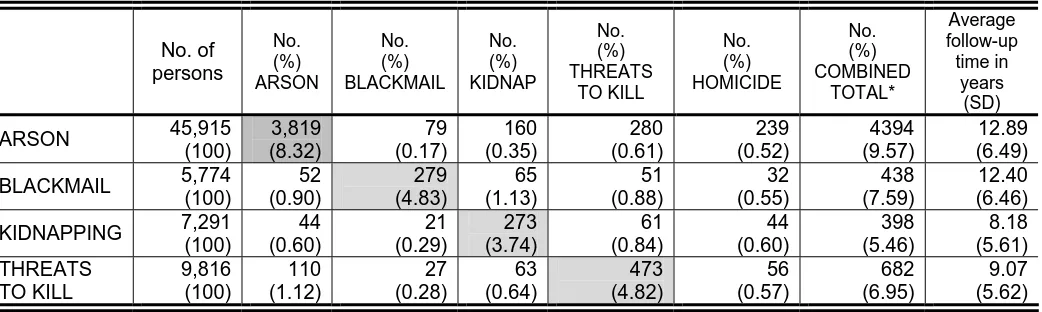
Using the four separate datasets constructed as the first stage, Table 1
shows the subsequent reconvictions for the four offences of arson, blackmail,
kidnapping and threats to kill in terms of whether they were subsequently
convicted for any of these focus offences, or of homicide. This preliminary
analysis provides both clues and concerns. The concerns are the
methodological ones that length of follow-up and time at risk have not been
systematically taken into account. Nevertheless, using the four separate
datasets with what was expected as an average follow-up period of around
ten years, Table 1 presents some clues for a judge who is sentencing a
person who has not been previously convicted of the particular offence of
interest.
(Table 1 around here)
Our questions which relate to proportions, specialisation and the
likelihood of a homicide reconviction have some preliminary answers:
1. Proportions. For each of the four separate offences (or datasets), an
important minority go on to be convicted of at least one or more of the
five serious offences of interest. The cumulative numbers of persons
convicted for at least one of the four focus offences, shown as the
penultimate column in Table 1, range from 9.57% for those convicted
of arson for the first time to 5.46% of those convicted of kidnapping for
2. Specialised serious offending. The shaded diagonal in Table 1 shows
the numbers and proportions who are reconvicted of the same type of
offence as their original target conviction. Table 1 demonstrates that,
within the four focus offences, the offenders tend to specialise in the
type of subsequent offence they commit, by being more likely to be
reconvicted of the same offence than one of the other three focus
offences . Arsonists seem the most specialised with around 1 in 12 of
those convicted of arson being later reconvicted for arson again. For
the other three offences (blackmail, kidnapping and threats to kill),
around 1 in 25 are reconvicted for the same offence again.
3. Subsequent homicide. Homicide can be regarded as the most serious
reconviction and the four focus offences – arson, blackmail, kidnapping
and threats to kill – have quite remarkably the same proportion
(approaching 0.6%) – that is, just over 1 in 200 - who are reconvicted
for homicide. However, the figures are uncontrolled and there is no
focus on the speed of reconviction for homicide.
While a useful guide, Table 1 has some limitations. The final column in
Table 1 shows that the average follow-up time (in years) varies quite markedly
for the four offences. Arson and blackmail offenders have the longest
follow-up on average of around 12 years – this is because there has been a fall in
the numbers convicted of these offences over the follow-up period. In
contrast, threats to kill and kidnapping (with average follow-ups of 9 and 8
years respectively) have much lower follow-up periods; again the explanation
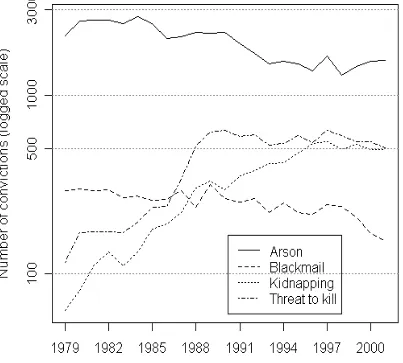
these two offences the number of convictions have risen over the follow-up
period. This feature is demonstrated in Figure 1 which shows the first-time
convictions for the four offences during the period under investigation.
(Figure 1 around here)
The other limitation of Table 1 as discussed above is that there is no
control for periods genuinely at risk.
.
Following Liu et al. (in press) the differential follow-up periods can be
dealt with by using a survival analysis technique. Using time at risk rather than
calendar time, we estimate a Kaplan-Meier survival curve for each of our four
offences, which gives an estimate of the proportion of offenders not
reconvicted of homicide at any time t after reconviction. Offenders contribute
to the analysis from when they are convicted of their target offence up to
when they get a homicide reconviction or until the end of the study in 2001,
whichever is earlier. Nevertheless, there are still certain assumptions that
need to be recognised. Most importantly, the procedure assumes that those
convicted in the early years (thus with long follow-up periods) will have similar
characteristics to those convicted in the later years (with shorter follow-up
periods). However, this assumption of no social change seems reasonable in
these datasets.
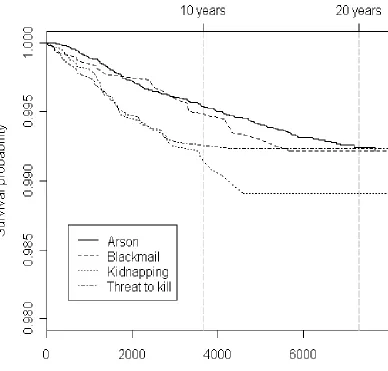
Figure 2 shows the estimated homicide reconviction survival curves for
have different trajectories. At the twenty-year point, arson, blackmail and
threats to kill all eventually reach very similar estimated proportions, that is,
around 0.8%. Kidnapping shows a different trajectory with an estimated rate
of homicide reconviction at 1% (roughly, one in a 100) in a 20-year period at
risk. Kidnapping, moreover, has a more rapid gradient and there were no
more homicides in the second half of the follow-up. The gradients are also
meaningful for the other offences with arson having a constant slope
throughout the follow-up, while threats to kill and blackmail have intermediate
trajectories with no further homicides after 12 and 15 years respectively. In
other words, the gradients provide some clues as to whether the risk of
homicide remains constant, falls or rises over periods of time. This feature has
relevance for the length of supervision which may be required for different
offences.
(Figure 2 around here)
However, despite using the survival analysis technique and controlling
for actual time at risk, there is still a concern about comparing the four
datasets. After all, there are 1,702 persons who are in two or more of the
datasets. Perhaps these persons contribute disproportionately to the homicide
reconviction rate and may be the reason why the reconviction rates for
homicide look so similar for the four offences.
At stage two, we now consider the combined dataset of 67,052
first occurred in 1979 or after. Table 2 presents the outcome in terms of
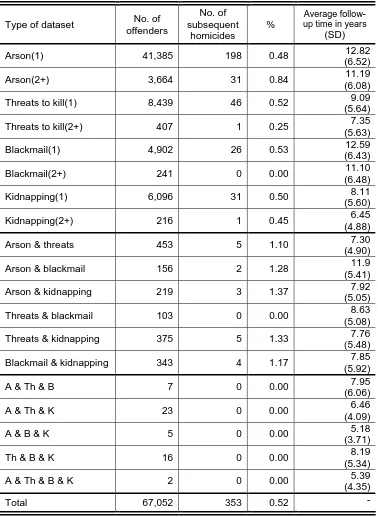
subsequent homicide and reveals that the overall homicide rate is 0.52%
(roughly 1 in 200). However, the important feature of Table 2 is that it shows
the effect of (1) being convicted of one of these focus offences on two or more
occasions (but without being convicted of one of the other serious offences)
and of (2) being convicted of two or more different kinds of serious focus
offences.
(Table 2 around here)
First, considering those who were convicted of one of these serious
offences on two or more occasions, the pattern is different for arson
compared to the other three offences. With arson, the chances of being
convicted of homicide almost doubles when the person has two or more two
occasions with an arson conviction (from 0.48% after being convicted for
arson on just one occasion to 0.84% after being convicted for arson on more
than one occasion). With the other three offences, the proportions
subsequently convicted for homicide actually declines – albeit only marginally
for kidnapping - when a person is convicted of one of these offences on two or
more occasions. This seems to be counter-intuitive but one can perhaps
recognise that it is conceivable that more threats to kill are evidence of a
lower likelihood of subsequent homicide – as we suggest elsewhere (Soothill
et al., 2007), perhaps dogs that continue to bark don’t bite. However, also of
course, by the time that a person has been convicted of a second serious
feature is shown in the last column of Table 2. For each offence, those with
two or more convictions have on average a shorter follow-up period than
those with just one relevant conviction.
Now moving on to the offenders who have been convicted between
1979 and 2001 of two or more of the four focus offences being considered.
For almost every combination shown in Table 2 there is at least a doubling of
the likelihood of being subsequently convicted of homicide compared with the
figures when the offender has been convicted of just one of these serious
offences. The exception is the combination of ‘threats to kill and blackmail’
where none of the 103 individuals convicted of this combination was
subsequently convicted of homicide. This outcome supports the earlier finding
that, for both threats to kill and blackmail, the likelihood of a subsequent
homicide declines if offenders are convicted more than once for these
offences.
There seems to be a further curious twist to Table 2. None of the
persons who were convicted of three or four of these serious offences was
reconvicted for homicide. However, the numbers are small – a total of 53
persons – and the average follow-up period for each of these combinations is,
not surprisingly, comparatively short.
Table 2 has focused on the various combinations of serious convictions
during the period 1979 and 2001. A feature which Table 2 currently masks is
offence is involved. Table 3 attempts to do this. Where a serious offence
occurs at one court appearance and another serious offence is convicted on
another occasion, the two events are separated by a slash line (e.g. A/T);
where the two serious offences are convicted on the same occasion, then
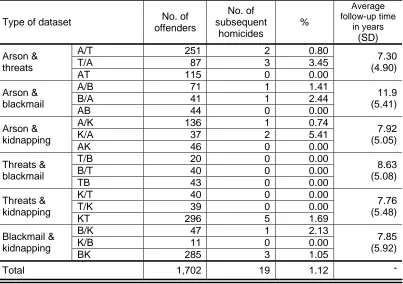
there is no such separation.
(Table 3 around here)
The number of homicides are comparatively few in each combination
so the problem of chance fluctuations is heightened. Mostly there are no
subsequent homicides. Nevertheless, tentatively one could point to two
possible patterns which can be identified. Firstly, for arson & threat, arson &
blackmail and arson & kidnapping, there seems to be more danger of a
reconviction if the two offences are convicted on separate occasions – Iin
other words, when they are co-convictions, there is no evidence of any
subsequent homicides. In contrast, for threat & kidnapping and blackmail &
kidnapping, there is no such relationship – indeed, co-convictions for threats &
kidnapping seem to be a particular concern, and so endorsing the worry about
the behaviour of kidnappers after release (see Liu et al. in press). Finally, as
mentioned earlier, the combination of threat & blackmail does not produce any
subsequent homicides.
With three or more serious offences involved, the combinations are
various but, as already noted, the remarkable feature is that there are no
Probing risk factors for homicide
Tables 2 and 3 have described the observed rate of subsequent
conviction of homicide following various combinations of arson, threats to kill,
blackmail, and kidnapping. It suggested that those offenders who were
specialised in their serious crime behaviour, involving only one type of crime
of interest, have a lower risk of being subsequently convicted of homicide than
those who involving two or more types of serious crime. However, in this
essentially descriptive analysis, there was no attempt to control for follow-up
time or time at risk.
We now need to proceed more formally in controlling for these effects,
and in doing so, to assess the evidence of difference in risk of subsequent
homicide convictions between those offenders who were convicted of only
one of our focus offences and whose who had mixed types of convictions. We
also wish to explore if any types of sequencing are related to a higher risk of
subsequent homicide conviction. We use the Cox proportional hazards model
to look for risk factors for a subsequent homicide conviction following one or
more serious crimes of interest.
By doing so, we will also be able to control for other important risk
factors such as gender, age at conviction, and previous convictions; it is
recognised that these three risk factors are important in the prediction of
The sequencing of the serious focus crimes starts with the first focus
conviction, and ending with the last focus conviction prior to homicide. We
take the last of these convictions and examine time from that conviction to
homicide, adjusting for periods spent in custody as described earlier in the
paper.
To summarize the sequencing of an offender’s serious criminal
history we take five measures which will be potential risk factors in the Cox
analysis.
a) The type of the first focus conviction in the sequence (i.e. arson,
blackmail, kidnapping, threats to kill or a mix of more than one of these
offences).
b) The type of the last conviction in the sequence.
c) The number of different types of focus offences involved in the
sequence. This measures the diversity of serious offending.
d) The number of focus offences, giving a measure of serious offence
frequency.
e) The length of the sequence; that is, the time between the first and last
focus offence in the sequence.
We have also used gender of offender, number of previous convictions and
age at the last focus conviction as general criminological risk factors. We
logged the number of previous convictions as previous work has shown that
We fitted a series of Cox proportional hazard models, selecting a final
model by examining the AIC (Lindsey and Jones, 1998) for each model,
removing insignificant risk factors. The final model with the lowest AIC
included age, gender, logged previous convictions, the type of the first serious
offence, and the number of different types of serious offence. All other
potential risk factors were not significant.
The Cox analysis models the underlying hazard rate (rather than
survival time), and the results are shown in Table 4. As we expected, males
are more at risk of a homicide conviction than females (p<0.042), with the risk
doubling compared to females. Also as expected, the risk of homicide
declines with age (p<0.001), with around a 5% decline in risk for each year of
age and increases with the number of prior convictions (p<0.001).
(Table 4 around here)
Turning our attention to the risk factors summarising the sequencing
of the four focus offences, we found that two of our five measures were
important. Firstly, the type of the first serious offence is a significant risk factor
for subsequent homicide. An offender who began their serious offending with
kidnapping has about 48% higher risk of homicide compared with one who
started with arson; similarly an offender who began with threats to kill has
around 55% higher risk over the arson offender. Other types of starting
offence shows no significant difference from arson. This is consistent with the
kidnapping then followed by arson (K/A) had a high rate of subsequent
homicides (5.41%). Similarly, the offence of threats to kill followed by arson
has a similarly high homicide rate (3.45%).
Secondly, the number of distinct types of serious offences was also a
significant risk factor, with increasing homicide risk as the number of types
increases. Thus, the offender who had two types of serious offence has nearly
double (1.82) the risk of subsequent homicide conviction compared with an
offender with only a single type of serious offence. This is also consistent with
Table 2.
The specialist/generalist debate among serious offenders
Earlier we suggested that has been little consideration of the
specialist/generalist debate in relation to serious offences. In brief, do
offenders who continue with serious crime specialise in certain types of
serious offending or is their criminal behaviour more versatile? Our view of
specialisation in this study is somewhat different to other specialisation
studies- here we are concerned solely about “serious offence” specialisation
within the four focus offences. Thus, someone with two arson convictions but
no convictions for blackmail, threats to kill or kidnap would be deemed a
specialist whether or not they had additional convictions for theft, criminal
damage etc.
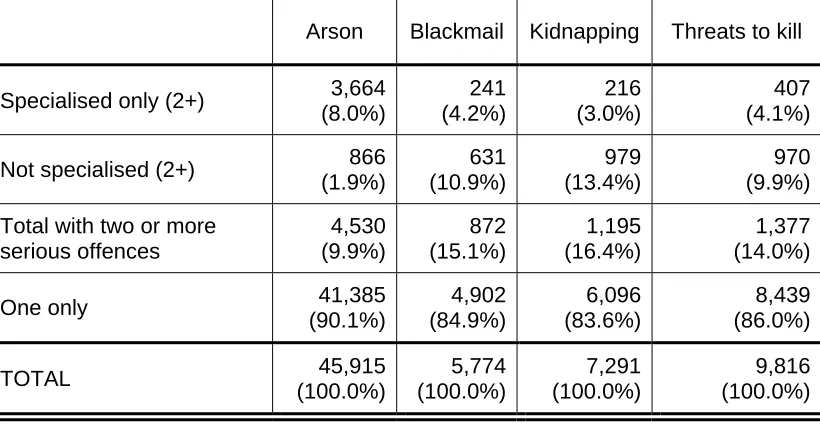
Table 5 shows that, during the full observation period, the vast majority of the
consideration. However, now considering all the persons who have been
convicted on at least two occasions of one or more of these serious offences
produces some further clues in relation to the specialist/generalist debate.
(Table 5 around here)
Table 5 shows that there is a range on the specialist/generalist
continuum. Those convicted of arson are the most likely to specialise – they
are four times more likely to be only convicted of arson subsequently than
being convicted of one of the other serious offences being considered (3664
persons compared to 866 in Table 5). In contrast, the other three offences are
in the opposite direction. Those first convicted of kidnapping are over four
times more likely to be considered as a generalist than a specialist (979 are
not specialised, while only 216 are). Similarly, those convicted of blackmail or
threats to kill are around two and a half times more likely to be considered to
be generalists rather than specialists. These findings have important
implications for considering serious offending.
Discussion and Conclusions
This article has been an attempt to open up a discussion about the
inter-relationships between serious types of crime, for we maintain that this
feature of criminal careers has been neglected in the criminological literature.
However, a further analysis is perhaps unlikely to challenge the following
points:
• There is evidence that those convicted of one of the four focus
offences often specialise in the types of serious offences for which they
get convicted. . However, they vary in this respect with those convicted
of arson the most likely to specialise. Evidence of specialisation is
contrary to low-tariff high-volume offenders.
• Those convicted of arson, blackmail, and threats to kill all have very
similar proportions in terms of subsequent convictions for homicide
(0.8%) in a 20-year period at risk – that is, around 1 in 160. However,
kidnapping offenders seem to be more dangerous in this respect with a
higher proportion (1.0%) – around 1 in 100 - being subsequently
convicted of homicide. This compares with the likelihood of around 1 in
3,000 male members of the general population being convicted for
homicide over a 20-year follow-up period (Francis and Soothill, 2000).
• The speed of reconviction for homicide varies for these four offences.
In particular, kidnapping shows the most rapid gradient with a
heightened risk of homicide in the early years after conviction. In
contrast, arson offenders have a fairly constant rate over the 20-year
period.
• The effect of having two or more convictions for one or more of the four
offences is complex. However, the effect becomes clearer when
incorporated into a statistical analysis of risk factors for homicide. In
offence and the number of the distinct types of serious offences are the
two significant risk factors (as well as age, gender and the number of
previous convictions).
The results are clear but what of the theoretical implications? In truth,
the material in this paper tells nothing of the underlying motivations of the
perpetrators and we can make no compelling case for any particular
theoretical approach. However, there are still some signposts that are
evident. First, though, one needs some caveats and warning notices. While
approaching nine out of ten persons in the study were only convicted once for
one of these serious offences, there could be convictions for other serious
offences we have not considered; also this group could range from those
being convicted of just this one offence to those whose serious offence
resides among a vast range of lesser crime. Nevertheless, we can say with
some confidence that nine of out ten are neither candidates for specialisation
in the narrow sense4 nor for overlap in terms of the four offences. Whatever
explanation one might have for the remaining ten per cent or so, the majority
convicted of just one focus offence seem different in their involvement in
serious crime in terms of it seemingly being much more transient.
The remaining ten per cent also have their differences beyond that of
committing different kinds of offences. We have divided the total series into
those we have termed as ‘specialist’ and those we have termed as ‘not
specialised’. Again, each of these two sub-groups can be involved in other
observations relating to the specialist/generalist debate and to the issue of
sequencing/switching As Piquero et al. (2003: 457) note, these two issues
are directly related..
The specialist/generalist debate has been plagued by the notion that
this needs to be a simple dichotomy, while we have argued that the
interpretation is more complex and relates to the level of analysis being
undertaken. In brief, an offender can be both a specialist and a generalist
(Soothill et al., 2000). So, an offender can display a vast range of offending
behaviour but, when he is involved in sexual offending, he may only engage,
for example, in supposedly consensual sex with a girl under 16 years – the
former vast range of offending behaviour may classify him as a generalist
while the latter as a specialist within the realm of sexual offending.
Something similar may be happening in this analysis.
When arson is the first serious offence, then arson is four times more
likely to be the second serious offence rather than one of the other three
offences considered in this study. For the other three offences, there is not
the same relationship. Indeed, for these offenders it is more than twice as
likely to be one of the other three offences. In short, even though we are not
investigating the full repertoire of offending for each offender in this study, it
still seems valid to speak of arson recidivists are being more likely to be
specialised at a serious crime level than the members of the other three
We have also probed sequencing or switching. Apart from
specialisation, the criminal justice system is also interested in whether
offenders are likely to desist and, if not, whether they are likely to switch their
offending focus. Elsewhere we made a modest attempt to consider offending
pathways in terms of showing what offenders are doing in one five-year period
compared to the following five-year period (Francis et al., 2004). However, as
Armstrong and Britt (2004: 843) stress, “Virtually all research on patterns of
offense types across the criminal career has focused on establishing whether
offenders tend to commit the same or more serious types of offenses over
time.” Indeed, Armstrong and Britt’s own work continues this tradition by
focusing on specialisation and escalation. Hence, the focus on switching or
sequencing has been somewhat limited. There seems, for example, to have
been little interest in whether offenders switch from one serious offence to
another. In this article we use the term ‘sequencing’ rather than ‘switching’ as
the former term seems to imply that a particular behaviour may still continue
although the criminal repertoire may increase, while the latter term seems to
imply a more complete change of focus. The present analysis suggests that a
study of sequencing has some merit. So, for example, being convicted of
arson and threats to kill on different occasions seems to present a greater
danger of subsequent homicide than being convicted of these two offences on
the same occasion. Nevertheless, it is also useful to remind that another
interpretation is quite simply that two separate court appearances are a
greater danger than one court appearance. However, this, in turn, can be
countered from the evidence in this study that threats to kill followed by an
danger than the convictions for these two offences occurring in the reverse
order. In brief, the value of sequencing is not really proven in this study, but
we can endorse that there should be more interest in the topic.
While reiterating the usual need for more research, we suggest that our
study does provide a methodology and some results which chart the way
forward for considering serious offences. In probing the risk for homicide
(which is, after all, a rigorous measure of future danger), it is clear that the
type of the first serious offence and the number of distinct types of serious
offences are both serious risk factors for subsequent homicide. This supports
our wider belief that in studying and understanding criminal careers both the
quality and the quantity of the offending is relevant.
Acknowledgments
Earlier versions of this paper were presented at the International
Symposium on Forensic Sciences, February 2006, at the Amity University,
Uttar Pradesh, India. and at the American Society of Criminology conference
in Los Angeles in November 2006. This work was partially funded under the
ESRC National Centre for Research Methods Lancaster-Warwick node - grant
number RES-576-25-5020.
References
Armstrong, T. A. and Britt, C. L. (2004) ‘The effect of offender characteristics
on offence specialization and escalation’, Justice Quarterly, 21(4),
Francis, B. and Soothill, K. (2000) ‘Does sex offending lead to homicide?’
Journal of Forensic Psychology, 11 (1), 49-61.
Francis, B., Soothill, K., and Fligelstone, R. (2004) ‘Identifying patterns of
offending behaviour: A new approach to typologies of crime’, European
Journal of Criminology, 1(1), 47-87.
Gottfredson, M R and Hirschi, T (1990) A General Theory of Crime. Stanford,
California: Stanford University Press.
Home Office (1996). Prison Statistics England and Wales 1995. London:
HMSO.
Lindsey, J. K. & Jones, B. (1998) Choosing among generalized linear models
applied to medical data. Statistics in Medicine, 17, 59-68.
Liu, J., Francis, B. and Soothill, K. (In press) Kidnapping offenders: Their risk
of escalation to repeat offending and other serious crime. The Journal
of Forensic Psychiatry and Psychology.
Piquero, A. R., Farrington, D. P. and Blumstein, A. (2003) ‘The criminal career
paradigm’, Crime and Justice: A Review of Research, 30, 359-506.
Soothill, K., Francis, B., Sanderson, B. and Ackerley, E. (2000) ‘Sex
Offenders: Specialists, Generalists – or Both?’ British Journal of
Criminology, 40, 56-67.
Soothill, K., Francis, B., Ackerley, E. and Fligelstone, R.. (2002) Murder and serious
sexual assault: What criminal histories can reveal about future serious
offending. London: Home Office.
Soothill K, Ackerley E and Francis B (2004) The criminal careers of arsonists.
Soothill, K., Francis, B. and Ackerley, E. (2007) ‘Do dogs that bark also bite? Threats
to kill: a criminal profile of persons convicted 1963-2001’. Paper presented at
Figure 2: Survival curves for risk of homicide (adjusted for time at risk)
Table 1: The number of offenders with subsequent convictions for
serious offences following the target (first time) conviction.
No. of persons No. (%) ARSON No. (%) BLACKMAIL No. (%) KIDNAP No. (%) THREATS TO KILL No. (%) HOMICIDE No. (%) COMBINED TOTAL* Average follow-up time in years (SD)
ARSON 45,915 (100) 3,819 (8.32) 79 (0.17) 160 (0.35) 280 (0.61) 239 (0.52) 4394 (9.57) 12.89 (6.49) BLACKMAIL 5,774
(100) 52 (0.90) 279 (4.83) 65 (1.13) 51 (0.88) 32 (0.55) 438 (7.59) 12.40 (6.46) KIDNAPPING 7,291
(100) 44 (0.60) 21 (0.29) 273 (3.74) 61 (0.84) 44 (0.60) 398 (5.46) 8.18 (5.61) THREATS TO KILL 9,816 (100) 110 (1.12) 27 (0.28) 63 (0.64) 473 (4.82) 56 (0.57) 682 (6.95) 9.07 (5.62)
Table 2: Percentage of serious offenders of various types who are
subsequently convicted of homicide from 1979 to 2001 in England and
Wales.
Type of dataset No. of offenders No. of subsequent homicides % Average follow-up time in years
(SD)
Arson(1) 41,385 198 0.48 12.82
(6.52)
Arson(2+) 3,664 31 0.84 11.19
(6.08)
Threats to kill(1) 8,439 46 0.52 9.09
(5.64)
Threats to kill(2+) 407 1 0.25 7.35
(5.63)
Blackmail(1) 4,902 26 0.53 12.59
(6.43)
Blackmail(2+) 241 0 0.00 11.10
(6.48)
Kidnapping(1) 6,096 31 0.50 8.11
(5.60)
Kidnapping(2+) 216 1 0.45 6.45
(4.88)
Arson & threats 453 5 1.10 7.30
(4.90)
Arson & blackmail 156 2 1.28 11.9
(5.41)
Arson & kidnapping 219 3 1.37 7.92
(5.05)
Threats & blackmail 103 0 0.00 8.63
(5.08) Threats & kidnapping 375 5 1.33 7.76 (5.48) Blackmail & kidnapping 343 4 1.17 7.85 (5.92)
A & Th & B 7 0 0.00 7.95
(6.06)
A & Th & K 23 0 0.00 6.46
(4.09)
A & B & K 5 0 0.00 5.18
(3.71)
Th & B & K 16 0 0.00 8.19
(5.34) A & Th & B & K 2 0 0.00 5.39
(4.35)
Table 3: Percentage of serious offenders convicted of two types of serious offences who are subsequently convicted of homicide from 1979
to 2001 in England and Wales.
Type of dataset No. of offenders No. of subsequent homicides % Average follow-up time in years (SD)
A/T 251 2 0.80
T/A 87 3 3.45
Arson & threats
AT 115 0 0.00
7.30 (4.90)
A/B 71 1 1.41
B/A 41 1 2.44
Arson & blackmail
AB 44 0 0.00
11.9 (5.41)
A/K 136 1 0.74
K/A 37 2 5.41
Arson & kidnapping
AK 46 0 0.00
7.92 (5.05)
T/B 20 0 0.00
B/T 40 0 0.00
Threats & blackmail
TB 43 0 0.00
8.63 (5.08)
K/T 40 0 0.00
T/K 39 0 0.00
Threats & kidnapping
KT 296 5 1.69
7.76 (5.48)
B/K 47 1 2.13
K/B 11 0 0.00
Blackmail & kidnapping
BK 285 3 1.05
7.85 (5.92)
Total 1,702 19 1.12
Table 4: Cox proportional hazards model (adjusted for time at risk) for
subsequent homicide conviction following one or more sample
offences.
coef s.e. Relative
Risk z p
Log(No. previous
convictions) 0.7949 0.0622 2.214 12.781 <0.001
Age at conviction -0.0493 0.0079 0.952 -6.238 <0.001
Gender: Male - - - - -
Female -0.5798 0.2846 0.56 -2.037 0.042
First serious conviction:
Arson - - - - -
Blackmail -0.1267 0.2043 0.881 -0.62 0.540
Kidnapping 0.394 0.189 1.483 2.084 0.037
Threats to kill 0.4387 0.1699 1.551 2.582 <0.001
Co-conviction 0.2872 0.4669 1.333 0.615 0.540
No. different types of
serious sample offences 0.6015 0.2946 1.825 2.041 0.041
Table 5: Relationship of specialised and non-specialised serious
offending for four types of offences.
Arson Blackmail Kidnapping Threats to kill
Specialised only (2+) 3,664 (8.0%) 241 (4.2%) 216 (3.0%) 407 (4.1%)
Not specialised (2+) 866
(1.9%) 631 (10.9%) 979 (13.4%) 970 (9.9%)
Total with two or more serious offences 4,530 (9.9%) 872 (15.1%) 1,195 (16.4%) 1,377 (14.0%)
One only 41,385
(90.1%) 4,902 (84.9%) 6,096 (83.6%) 8,439 (86.0%)
TOTAL 45,915
[image:36.595.95.505.487.699.2]Footnotes
1
This procedure was possible for the offences of arson, blackmail and threats to kill, but not for kidnapping. Kidnapping was only coded as a separate offence in the Offenders Index in 1979 – previously it was included in the ‘Others’ category. Hence, in theory, the kidnapping dataset could include persons who were convicted of kidnapping prior to 1979; however, we believe that this would involve few persons.
2
In theory, a person could, in fact, have a conviction for any of these offences prior to 1963 when the Offenders Index started. However, this could only happen with offenders aged 27 years or more in 1979. For someone to have a conviction for one of the four serious offences and then have a gap of at least 16 years before being convicted of one of these four offences again would be rare.
3
The estimate of the time from conviction to release being around 30% of sentence awarded was made as follows. 1995 Prison Statistics in England and Wales (Home Office, 1996) contain an estimate that, for adult males, between 40% and 50% of sentence awarded is actually served (Table 4.14). However, this includes time spent on remand before conviction. 48% of the prison population spent time on remand, with an average of around 60 days increasing to around a year for some cases. (Chapter 2, ibid). This gave a reduction of between 10% and 15 % depending on sentence awarded, giving the final result of 30%. Data for other years are similar and 1995 figures are representative of the period under study 4
The ‘narrow sense’ of specialisation means, for example, a conviction for arson followed by another conviction for arson. However, there is scope for similar behaviour being included in the notion of specialisation – a conviction for criminal damage may, for example, be