Munich Personal RePEc Archive
Modeling the set-up and management of
a spin-out: Evidence from a case study
Veldhoven, Joris and Cloodt, Myriam and Vanhaverbeke,
Wim
Shell Upstream International, Eindhoven University of Technology,
Hasselt University
2008
Online at
https://mpra.ub.uni-muenchen.de/26489/
MODELLING THE SET-UP AND MANAGEMENT OF A SPINOUT:
EVIDENCE FROM A CASE STUDY
23 October 2010
JORIS VELDHOVEN
Shell Upstream International
Department of Opportunity Identification & Growth P.O. Box 541, 2501 CM The Hague, The Netherlands
Phone: +31 20 588 7680 E-mail: [email protected]
MYRIAM CLOODT
Eindhoven University of Technology School of Industrial Engineering
P.O. Box 513, 5600 MB Eindhoven, The Netherlands
Phone: +31 40 247 5242 Fax: +31 40 246 8054 E-mail:[email protected]
WIM VANHAVERBEKE
Hasselt University Department BEW
Agoralaan Gebouw D, 3590 Diepenbeek, Belgium
Vlerick Leuven Gent Management School Vlamingenstraat 83, 3000 Leuven – Belgium
ESADE Business School
Av. Pedralbes, 60-62, 08034 Barcelona, Spain
Mobile phone: + 32 478 33 24 40 Phone/ Fax: + 32 16 62 36 63 E-mail: [email protected]
Acknowledgements:
MODELLING THE SET-UP AND MANAGEMENT OF A SPINOUT:
EVIDENCE FROM A CASE STUDY
Abstract
INTRODUCTION
In a business environment characterized by rapid, complex and radical technological
changes, large established companies are increasingly looking for ways to acquire
new technological capabilities and explore new business opportunities in order to
survive in the long run (Govindarajan and Trimble, 2005; Vanhaverbeke and Peeters,
2005). Accordingly firms increasingly rely on corporate venture capital as a means of
developing new competencies and expanding into new businesses (Dushnitsky and
Lenox, 2005; Gompers and Lerner, 2001; Maula et al., 2003; Katila et al. 2008).
Corporate venture capital can be defined as minority equity investments by
established firms in external entrepreneurial ventures (Sahaym et al, 2009, p.2).
In this paper we explore a special case of corporate venturing, i.e. the spinout
approach, which has become increasingly popular in business life in the past few
years (Jagersma and van Gorp, 2003). A spinout refers to a certain type of corporate
venture capital whereby a company "splits off" sections of itself as a separate
entrepreneurial business. Moreover, the parent company receives (minority) equity
stakes in the newly spun out venture. Although we witness a strong growth in spinout
activity during the last decades, an academic-wide accepted definition is still missing
(Tubke, Saavedra and Gonzalez, 2004). We define a spinout as a divestiture of the
parent firm's assets (which can include structures, products, patents or personnel) into
a newly created entity that is open to separate external financing (adapted from
Ledbetter and Zipkin, 2002). In addition we would like to stress that in our definition
of spinouts the spun-out venture is not seen as an entity gone forever, but over time
might be bought back and integrated into the parent company again.
Spinouts have been a topic of interest in many scientific fields such as
Saavedra & Gonzalez, 2004). Nonetheless, despite this increasing interest, there
seems to be no clear understanding of how to come to a systematic approach with
respect to the set up and management of a spinout. For example, previous research
(i.e. Burgelman et al., 2004; Chesbrough 2003a, 2003b; Ito, 1995; McElroy, 2003) has
elucidated on key motives for organizations to create spinouts, which are strongly
related to the benefits for the parent firm when undertaking a spinout and to a lesser
extent to the benefits from the venture's point of view. However, this still leaves
unexplained how to realize the potential benefits of spinouts, and equally important
how to avoid the high failure rate of spinouts. Other studies of spinouts include the
rate at which incumbent firms generate spinouts, the factors that underly the
performance of spinouts and the effects of spinouts on their parent firms (Klepper,
2009). Yet, a lot of attention in these studies is focused on the spinout creation itself
and not on its further development by the parent firm into a sustainable venture
(Hellmann, 2007; Siegel et al., 2007).
So, based on the above, we can state that with a few exceptions (see Agrawal
et al., 2004; Lord et al., 2002), literature has largely been silent with respect to the
advanced set up and management of a spinout. This is an important limitation of
current research as we argue that a parent firm can only profit from the advantages of
using spinouts in a strategic manner when it is able to set-up and manage spinouts in a
systematic way. The latter implies that spinouts are set up with full awareness of all
potential advantages and disadvantages related to the choice for this path to bring a
technology to the market and that success factors of the spinout approach are fully
leveraged. It also entails that spinout management focuses on a continuous
reconfiguration of the initial set-up dimensions and in doing so, management can
contribution of this paper is to address the above mentioned void in the literature by
offering a coherent model illustrating how to setup and manage a spinout in a
systematic and ongoing way.
This paper is structured as following. In the next section, we will discuss the
different reasons for organizations to set-up spinouts. Next, we elaborate on the set-up
structure of the spinout venture and its management. Thereafter, the research
methodology is discussed, followed by a qualitative empirical analysis of a spinout at
Royal Dutch Shell. In the last section, we discuss the main findings, draw a number of
conclusions from this research and briefly present some topics for future research.
THEORY
To assess whether the option to spin out a venture is a realistic path to commercialize
a company’s ideas we will first discuss the reasons for organizations to set-up
spinouts. Generating this understanding is very useful, as a complete consideration of
the existing advantages and disadvantages is a prerequisite for solid decision-making
concerning the selection of spinouts with relatively high chances of success. Second,
although we take a corporate point of view in this paper we will also identify some
important conditions related to the venture itself and its external investors1. We will
first summarize the reasons for large companies to set up spinouts. Next we describe
how spinouts can be set up and managed successfully by their parent company.
Reasons to set-up spinouts
1
Large companies spin-out ventures for different reasons and there are several
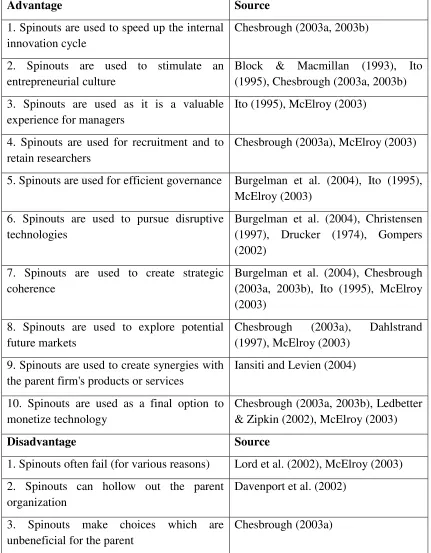
advantages for a parent firm to pursue a spinout (see table 1 for a short overview).
First, setting up spinouts can speed-up the internal deployment of R&D output
(Chesbrough 2003a). This is especially true when the option to use spinouts for
monetizing R&D output is agreed contractually with a semi-external party such as a
corporate VC unit. In that case, the new venture puts pressure on the internal business
units to speed up the internal innovation process. Second, spinouts stimulate an
entrepreneurial environment that many organizations strive for (Burgelman et al.,
2004). Researchers will feel motivated and empowered to know that their R&D
efforts are likely to be turned into a new process or product inside or outside the
organization. If a venture does not fit into the corporate strategy it still has the chance
to become a viable venture as a spinout. This increased probability of success will
empower researchers at the parent organization to make faster decisions, take more
individual risk and have a greater individual identification with the business
opportunities latent in the technical resources of the company (Chesbrough, 2003a). In
this sense spinouts are a vehicle for spurring growth and entrepreneurial initiative
within the organization (Block and Macmillan, 1993; Chesbrough, 2003b). As a
consequence, an external path to market can positively influence the speed of the
internal path to market as well. Third, managing spin-outs is a very valuable
experience for managers inside an organization. The experience of actually managing
a small entrepreneurial business and coping with high technology and/or market
uncertainty, are very interesting to increase the competences of top-management of
large established organizations (Ito, 1995; McElroy, 2003). In addition, having
actively makes use of their ideas instead of putting them on the shelf (Chesbrough,
2003a).
Besides speeding up the internal deployment of ideas, spinouts can be used as
a mechanism to commercialize technology more cost- and time-efficient than projects
that are commercialized within the parent organization. Spinouts are more efficient
because of their relatively simpler organization, allowing its staff to take ownership of
the decision-making process, and because of a reward system that is better adapted to
develop and commercialize the technology (McElroy, 2003). Spinouts are not only
more efficient, but they can also be used to commercialize disruptive technologies that
have the ability to cannibalize the current business structure (Burgelman et al., 2004;
Drucker, 1974). This advantage applies when R&D targets to fulfill the needs of
current customers of the parent organization in a different way, which does not fit the
existing organization's processes or values. Another potential advantage is that by
commercializing technology through spinouts, the parent company can maintain
strategic coherence (McElroy, 2003). The advantage of creating strategic coherence
applies to a situation in which an organization commercializes R&D for smaller,
emerging markets through a semi-external organization like a spinout, and hence the
current business structure of the organization is not affected. This is needed as large
organizations cannot be expected to allocate too much of their critical financial and
human resources into small, emerging markets (Burgelman et al., 2004). However,
spinouts can over time create a strong position in emerging markets, and the parent
company can decide to incorporate its spinout when matured, e.g. have a better fit
with the businesses of the parent organization. Another potential advantage for an
organization to set-up a spinout is that it can explore future technologies and markets
organization to engage in promising new areas outside the existing scope of the
company, but with a potential future interest (Dahlstrand, 1997). Next to that, spinouts
can generate synergies with the current products – and services portfolio of the parent
organization (Iansiti and Levien, 2004). Finally, spinouts are often the only possible
path to market to commercialize a technology. Especially R&D output that does not
match the existing technology strategy and/or lacks initially the requested commercial
viability will remain on the shelf inside a parent organization (Chesbrough, 2003a,
2003b). Having a spinout option available as a path for R&D output will correct the
false negative judgments of the parent organization. False negative judgments are
projects that initially are judged as commercially unattractive, but which later turn out
to be valuable (Chesbrough, 2003a). This is especially the case when the technology
of the venture is still in an embryonic phase laden with a lot of technical and market
uncertainty. Once these uncertainties have been reduced to an acceptable level, a
parent company can decide to spin in the venture or to acquire it based on its first
right to purchase the venture2.
Besides the advantages of undertaking spinouts, there are some important
challenges or disadvantages for the parent firm to consider. The first potential
disadvantage for an organization to set-up spinouts is the high risk of failure (Lord et
al., 2002). In general, the high failure rate of spinouts can be imputed to the high
technical and market uncertainty, which both need to be managed in a context outside
the boundaries of the parent organization. Second, selecting the wrong spinouts, or
even too many spinouts, can hollow-out the parent firm's business by loosing core
staff and core activities (Davenport et al., 2002). The last potential disadvantage is
2
that a spinout has the freedom to decide about its own strategic direction, which is not
always in line with the interests of the parent organization (Chesbrough, 2003a).
--- Insert table 1 about here ---
Next to the potential advantages and disadvantages for the parent organization,
we can also identify several pros and cons from the perspective of the spinout venture
(see table 2). It is important to note that these advantages and disadvantages are not
the main reasons to set-up a spinout; however, they still need to be considered by the
parent firm when the decision to spin-out an internal project is made.
The first potential advantage for the spinout venture is that they can avoid
large overhead costs and bureaucratic decision making because they are typically
organized as a relatively simple organization (Davenport et al., 2002; Ito, 1995;
McElroy, 2003). In this way, they can work in a more agile way compared to the
situation where a venture is part of a larger organization. Second, spinouts enjoy a
high extent of independence that allows them to make their own decisions. In
combination with the reduced level of bureaucracy this implies that the venture
becomes highly flexible in changing its business model as it gains experience during
its lifetime. Among other things, this enables the venture to directly and continuously
incorporate learning from the market place in its modus operandi, and improves the
speed of decision making (Jagersma and van Gorp, 2003).
Third, previous research shows that ventures with corporate backing in terms
of resources and assistance, perform relatively better than its standalone start-up
knowledge that the parent firm can provide to the spinout is valuable since this
information is usually not easy to get and relatively expensive. Besides the offered
resources and assistance the venture can benefit from the reputation of the parent
organization. When potential customers and business partners see that a well
established company is investing in a certain spinout, they might be more inclined to
establish a business relationship with the spinout.
As a final point, spinouts stimulate an entrepreneurial culture in which
employees are more willing to take risks and feel ownership for the prosperity of the
spinout venture (Chesbrough, 2003a). Often this entrepreneurial spirit is the single
factor that is required to transform an innovative idea that was not thriving inside the
parent organization into a successful spin-out business (Ledbetter and Zipkin, 2002).
Next to these four advantages for a spinout venture, two disadvantages can be
identified. The first potential disadvantage for the spinout venture is that it can lose its
access to several key infrastructures after it has been spun-out. Spinouts frequently
have to cope with the loss of key infrastructures and borrowing these assets back from
the parent organization is an efficient way of doing that (Govindarajan and Trimble,
2005; McElroy, 2003). The second potential disadvantage for the spinout venture is
that spinouts are often still kept too tight to the parent organization after they are
spun-out, not allowing the spinout to reap the benefits of deciding on its own business
model and creating its own core competencies and values (Lord et al., 2002). Hence,
spinouts have to try to negotiate sufficient autonomy from their parent organizations
to successfully create their own identity.
Besides the abovementioned advantages and disadvantages, previous research
also identified several factors that enable the formation of spinouts. First, there should
be an internal champion or sponsor that has sufficient political power inside the large
established organization to stimulate spinouts by re-directing qualifying R&D output
towards the set-up of a new external entity (Chesbrough, 2003a; Lord et al., 2002).
Second, a corporate VC unit that can actively scout for potential R&D output in the
internal organization that qualifies for a spinout venture is increasing the likelihood
that a company establishes spinouts (Chesbrough, 2003a, 2003b; Mason and Rohner,
2002). CVC units that formally have the first rights when R&D output is rejected by
the internal businesses can in this sense be complementary to, or even act as a
replacement of the more informal role of a champion to re-direct R&D output to
better paths to monetize the technology. Finally, inventors of the R&D output actively
act as entrepreneurs to enable the monetization of their R&D output outside the parent
organization (Chiesa and Piccaluga, 2000; Davenport et al., 2002).
In sum, spinout success is defined in context of the upfront expectations of the net
advantages a spinout will bring for the parent organization. The overview presented in
tables 1 and 2 evaluates the advantages and disadvantages of spinouts for the parent
organization and spinout management, creating a starting point for organizations
about what can be expected when they spin-out internal R&D projects. This overview
can guide organizations to make more informed decisions on whether or not to make
use of spinouts as a strategic vehicle to commercialize their technology. Hence, the
overview presented in tables 1 and 2 can be an important management asset for
How to successfully set-up a spinout
After the decision is made to set-up a spinout, managers have to decide on the set-up
characteristics and governance structure of the spinout venture. The exact set-up
structure has to be agreed upon during the negotiations about the formal separation of
the team working under the parent organization. However, organizations should be
aware of the fact that the agreed upon structure remains dynamic and requires
continuous negotiation and management over the lifetime of the spinout. In addition,
it is recommended that an independent counsel guides these negotiations to best
consider the interest of all parties (McElroy, 2003).
The set-up phase of spinouts can be structured along five dimensions, i.e.
product, market, people, finance and governance. Although the first four dimensions
have been introduced in the context of technology ventures (Mason & Rohner, 2002),
they have not yet been adopted in the context of spinouts. The governance dimension
has to be added as it plays a crucial role given the interdependency in the
parent-spinout relation. We believe that these five dimensions create a basis for analyzing the
set-up and management of spinouts in a more detailed way than the prevailing
models.
The first dimension entails different aspects related to the product or offering
of the venture, including the product specifications, the delivery channels and the
platform (next generations of the spinout’s product/service). The latter is important
since high-technology products are often systems that consist of a set of
interdependent complements building on specific platforms (Gawer and Cusumano,
2002; Teece, 2007). Second, the market to be targeted by the spinout, and an
appropriate sales and marketing strategy has to be identified. Paramount for making
about customers, competitors and suppliers (Teece, 2007). Third, the financial picture
has to be made insightful to all stakeholders, in order to secure funding. In this phase,
parent organizations have to make sure that any investment round is
performance-based (Gompers, 2002; Mason and Rohner, 2002), and that the spinout's focus is
incentivized to reduce the level of uncertainty of the initial cost and revenue estimates
of the targeted markets.
With respect to the people dimension, CEO, board and core venture teams
have to be selected in coordination with the parent firm. For the spinout CEO
position, there are valid arguments for selecting an internal or an external CEO (see
Chesbrough 2003a), although it appears that in general external CEO's lead to a better
spinout performance (Chesbrough, 2003b). Furthermore, the selection of the core
team plays an important role; during this process it is important for the success of the
venture to attract knowledge from outside the parent organization as a spinout works
along the guidelines of a business model that is fundamentally different than the one
of the parent organization (Mason and Rohner, 2002). In sum, external people play a
vital role in the success of a spinout and they create value to the spinout venture if
they complement the parent firm in terms of knowledge and experience.
Another important element of the people dimension is the compensation of the
venture's employees in terms of salary, equity or other financial benefits. First,
financial rewards determine, to a great extent, the ability of the venture to attract
high-quality employees. In addition, employees are more motivated and committed to the
venture's performance when they are offered part of the spin-out shares (Jagersma and
van Gorp, 2003). Second, employees in spinout ventures often have to deal with high
uncertainty and risk. This can be compensated by offering them the potential of
to remember that external issues also have an impact on the offered compensation.
For example the division of equity between the venture and its external investors will
affect how much equity eventually is available to the team members (Timmons and
Spinelli, 2004).
Finally, for each spinout the most appropriate governance structure needs to
be identified. In particular, the governance relationship between the spinout and the
parent organization requires special attention. In general, successful governance
consists of both formal and informal governance. As the formal side of governance
contains issues as financial agreements, planning & control, hierarchy and
conflict-management procedures, the informal side is composed of leadership style, reputation,
cultural differences, trust and values (De Man, 2006).
Some scholars argue that the involvement of an outside venture capitalist firm
(VC) is useful to improve the governance of the spinout venture, as these VC firms
bring the "critical managerial and entrepreneurial expertise that is absent in most
companies and public market institutional investors" (Ledbetter and Zipkin, 2002, p.
341). Others give successful examples of CVC outfits that are governing a portfolio of
spinouts in order to manage the strategic alignment with the parent organization. A
third option is to have the portfolio of spinouts under management by a venture
business office, which owns the equity stake instead of the business units, in order to
protect the ventures from "corporate anti-bodies" (Mason and Rohner, 2002). In any
case, it is wise for a parent organization to choose a governance model that protects
the strategic interest of the parent organization in the ventures, while at the same time
introduces professionalism and a latitude – but effective – form of control. Practice
unit that acts as a hybrid between a private VC and an internal business development
unit to govern their spinouts (Ernst et al., 2005).
How to successfully manage a spinout
When the venture is established, the parent firm and the spinout venture
should furthermore cope with the spinout management. Here it is important to note
that reconfiguration of the initial set-up dimensions is one of the most essential
spinout management functions. This is based on the idea that during the different
phases of the spinout's lifetime the technological and market uncertainty reduce and as
a consequence the venture needs to constantly manage and refine its strategic
direction (Davenport et al., 2002). To achieve the proper strategic direction and
enhance both the venture's internal and external fitness continuous management
efforts to build, maintain, and reconfigure the necessary resources are required
(Teece, 2007). An ongoing relationship with the parent organization can be one of the
main sources for the spinout to gain access to these needed resources at a relatively
low cost (Govindarajan and Trimble, 2005; McElroy, 2003; Rothaermel, 2001).
Especially customer relationships, distribution channels, supply networks, brands,
credibility, manufacturing capacity and expertise in technologies are resources that
can be borrowed from the parent organization (Govindarajan and Trimble, 2005). It
can thus be concluded that systematic management of spinouts has much to do with
making well-informed decisions to adjust the initial set-up dimensions of the spinout -
often enabled by resources the spinout sources from its parent - and less with daily
The parent organization has of course its own reasons to have an ongoing
relationship with its spinouts, which are also related to the changing nature of
technological and market uncertainty. Especially in a business environment
characterized by rapid, complex and radical technological changes, uncertainty is very
high. Under these circumstances, the parent firm needs to respond in a flexible way
and investing in spinouts is a possibility for the parent firm to explore newly emerging
technologies or business opportunities. Over time, by continuously monitoring the
spinout, the parent firm will get an improved understanding of the business
opportunities stemming from the new technology. Eventually, it has the option to
spin-in the venture when uncertainty drops to an acceptable level assuming that the
parent firm becomes sufficiently familiar with the technology and the venture proves
to be commercially viable (Van de Vrande, Lemmens en Vanhaverbeke, 2006).
METHODOLOGY
Setting
In the case-study section of this article we analyze the managerial practice by
looking at Avantium, an innovative company that was spun-out of Shell – a large oil
& gas multinational – in early 2000. The spinout currently (December 2009) employs
about 100 people and targets the R&D experimentation market. Avantium provides
customers with high-throughput experimentation services that allow customers to
speed-up their R&D, it sells complete research system tools and also manages its own
portfolio of drugs and biofuels intellectual property. During its first years Avantium
developed the core elements of its advanced high-throughput experimentation
processes by investing significant resources to upgrade the technology it inherited
investments in sub-technologies such as the 10-9 scale parallel catalyst-testing
platform, technology for heterogeneous catalysis research and parallel batch reactors
and catalyst preparation robotics technology. Furthermore, new systems and
associated software were developed to create a fully integrated process for
high-throughput experimentation. Since 2003 the spinout realized it needed a stronger
focus in its approach, and converged its attention on catalysis research for the
chemical- and oil industries and on crystallization research for the pharmaceutical
industry. In the spinouts first years collaborations and partnerships with industry
partners were a key value driver in the company’s approach to grow. In 2005
Avantium started with the sales of research system tools, and – to indicate the success
of the spinout’s partnership strategy – by the end of the year Avantium had formed
partnerships with some 40 of the world's major chemicals and pharmaceuticals
companies. In 2006 the company initiated its own program for developing new drugs
and biofuels. All these developments made Avantium a profitable company since
2007, and stable growth was achieved since then. In less than a decade the company
had established itself as a leading player in the technology services market.
Rationale for approach
Because of the absence of any previous systematic research about the setup
and the subsequent management of a spinout, we consider it essential to adopt a
qualitative approach to our inquiry (Lee, 1999). Furthermore, a qualitative research
design involving a case-study is appropriate since scholars have shown that it is well
suited for analyzing dynamic processes (Lee, 1999) and the object of study requires
observation in its context (Yin, 1994). In particular, we adopt the “theory elaboration"
or a preliminary model drives the study design" (Lee, Mitchell, & Sablynski, 1999:
164).
On the basis of these principles we started writing a case history based on
corporate documents, and observational and interview data (Eisenhardt, 1989; Yin,
1994). We triangulated data by using all data sources available, focusing on insights
that were supported by multiple data sources and confirmed by several interviewees
(Jick, 1979).We also followed-up with emails and/or calls to fill-in missing data or to
check insufficiently supported insights with interviewees when necessary. This led to
an initial version of the case study. After sharing the draft case study with some
interviewees for validation, we engaged in iterations between draft case study, the
interview output and spinout literature until a coherent story emerged.
Data Sources and Analysis
The details of the case-study have been achieved through the use of several
data sources: (1) corporate archives, including publications, announcements and
business plans at both the spinout and parent organization, (2) repeated
semi-structured interviews with managers of the parent organization that were involved in
the spin-out process, (3) repeated semi-structured interviews with executives at the
spinout, (4) follow-ups with emails, phone calls and transcripts of interviews to
validate initial findings with managers and executives at both the parent organization
and spinout.
A key data source for obtaining insights about the spinout were the
semi-structured interviews with managers and executives at both the parent organization
and spinout. For this particular case study we interviewed people both directly
insights in the technology strategy, spin-out rationale and policy. Over a period of 14
months – between November 2007 and December 2008 - multiple interviews were
conducted with five types of interviewees: 1) CEO and Management Team of the
spinout, 2) technology experts of the spinout, 3) senior business development
managers of the parent organization, 4) R&D managers at the parent organization
laboratory linked with the spinout 5) technology incubators at the parent organization.
These interviews ranged from 90 to 180 minutes. Although interviews were held with
a diverse set of people involved in Avantium as sources for the case-study, all
interviews roughly followed the order of phases in the lifetime of a spinout. First the
interviewees were asked to focus on the spinout decision, and then the interview
gradually moved towards the negotiation phase. After that the set-up and later
management phases of the spinout were discussed. As the interviews were only
semi-structured these phases of the interviews were guided by certain standardized
questions. However there was always space for the interviewees to go deeper into
certain topics they were most acquainted with, or bring-up new elements and
divergent views. Typically the set-up and management phases were discussed along
the elements of the classification of set-up and management dimensions, as
introduced by this article (product, market, people, finance, governance). This proved
to be a useful way to discuss topics with the interviewees, and also served as a
guideline to explore new topics. Depending if the interviewees were, or were not,
involved with Avantium in certain phases of its lifetime, certain elements of the
interview were trimmed down or even left out.
Furthermore it needs to be mentioned that since our case-based approach
resulted in situations in which interviewees were reflecting on periods that could be as
used. As said before, this case-study used a policy in which before concluding a
certain finding could be interpreted as accurate with reasonable certainty, it needed to
be underpinned with another source pointing in the same direction (Jick, 1979). This
came down to using data triangulation as described earlier, and in practice often
meant going through documents such as a Business Plan or other formalized
agreements, to underpin a statement. Nevertheless did the use of retrospective
data-gathering have consequences for the risk of biased views being included our case
study. More information about this issue and other consequences of the chosen
research methodology can be found in the Limitations section of this paper.
Procedure
We started by identifying factors relevant for achieving spinout success, as
scholars researching spinouts have not yet settled on an overview. Thereafter, our aim
was to examine if all identified factors relevant for the successful set-up of a spinout
could be captured in a practical applied assessment model including the five
dimensions we discussed in the previous section. The model provided a systematic
approach to decide about when to spin out a project and how to successfully set-up
and manage the spinout process. Now, theory will be elaborated by applying the
model to a case study regarding the spin-out of Avantium, which was spun-out of
Royal Dutch Shell. The setting of this case is in our opinion appropriate for several
reasons. Firstly, the relationship between the parent (a large multinational, with great
technical reputation) and the spinout (working on a niche product not deemed relevant
enough by the parent organization) is a common case for spinouts. Secondly, the
market targeted by the spinout (high-throughput experimentation) consists of
set-up decisions and management interventions can be viewed in the context of a
reasonably mature market with different types of competitors. Learning’s from the
spinout’s set-up and management over time are to be discussed and interpreted,
illustrating how to setup and manage a spinout in a systematic way.
MODELLING THE SPINOUT PROCESS
A model for the set-up and subsequent management of a spinout
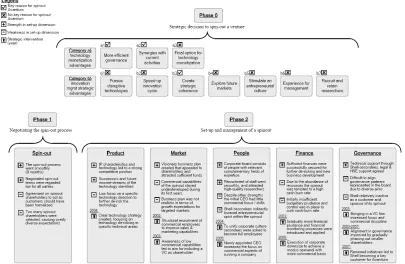
The model in Figure 1 captures the crucial dimensions in the assessment of the
establishment and subsequent management of a corporate spinout. The model depicts
how Shell de-facto uses a stepwise system for the decision making (phase 0) when
deciding about a potential spinout, which can be integrated with subsequent phases
that are able to analyze the spin-out process of the venture itself (phase 1) and the
set-up and management of a spinout (phase 2). This model, introduced by the authors,
reflects best-practices at Shell to decide on-, set-up and manage spinouts. It can be of
use for both academia and practitioners when looking at spinouts. In its core it reflects
two key points. Firstly, that successful spinouts need to be created with an end-goal in
mind (phase 0), and spun-out fast and fair (phase 1). Secondly, that in order to create
successful spinouts all of the spinout elements (the authors have defined a
categorization in five dimensions) need to be set-up and over time managed
successful (phase 2). In that sense the model treats a spinout as a ongoing process of
enacting set-ups, rather than static event. Below follows a quick description of the
different phases of the model, in the context of the spin-out of Avantium.
Phase 0 of the model focuses on the venture at the time it was still an internal
innovation project at Shell. During that phase it became progressively clear that the
within the company. Hence, in this phase the parent company decides whether the
venture can continue as an internal project, whether it has to be spun out, or whether
another external path to market has to be chosen. The different strategic advantages
for a parent organization to spin-out the venture are mentioned in Figure 1 and reflect
the advantages that have been listed in Table 1. These advantages for the parent
organization can be divided into two subgroups (technology monetization advantages
and strategic advantages related to innovation management), and are compared by
Shell during phase 0 with the parental disadvantages for a spinout, next to secondary
points about the pros and cons for the spinout venture itself.
Phase 1 covers the negotiation process of the spinout of Avantium. This is a
key phase for the successful set-up of a spinout; achieving fair and balanced outcomes
as well as speed of negotiation are critical in this phase.
In Phase 2 the spinout management has to determine how they will set-up and
manage the spinout. We identified 5 dimensions that are crucial to successfully set-up
a new spinout. They are applied to Avantium’s set-up phase and we will discuss them
in detail below. Finally the model shows how the set-up and management of a spinout
- including strategic interventions over time – determine how successful the spinout
becomes, and thus also determine the degree of success the parent organization has in
pursuing its strategic objectives identified in Phase 0.
--- Insert figure 1 about here ---
With this model of the spinout process in mind, we can now return to the start
of this innovative company; a research initiative that started within a R&D group
Phase 0 : Strategic decision to spin-out a venture
The first generation of the technology commercialized by Avantium was invented
and further improved by the catalyst R&D group at Shell between 1994 and 2000,
with the aim to faster de-risk and deploy new catalysts. From 1998 to 2000, a
visionary R&D leader who can be considered as the key inventor of the technology
led this catalyst R&D group. The first experiments with the new technology for
high-throughput experimentation showed great contribution to an improved speed for
deploying new catalysts. However, it became also clear that large investments were
needed to develop the technology further, including investments in robot technology
and experimentation software. The need for large R&D investments, especially in
areas in which Shell was not traditionally strong, were considered a key blocker for
the future of this project in Shell’s R&D portfolio. The project leader for the internal
project realized the need for large investments and technical and commercial expertise
in traditional non-Shell industries. This made the project suitable for a broadly
supported spinout, because of its ability to attract external investments, while at the
same time allowing shareholders with relevant technical and commercial backgrounds
to join in. After some discussion the project leader was given six months by Shell to
find interested parties that not only would invest as shareholders in the new spinout,
but also would serve as its first guaranteed customers. Soon after, the project leader
found a set of interested parties that met the demands of Shell, and in the following
months Shell decided that a spinout was the preferred way to take the project further.
In conclusion, Shell decided in 2000 to spin-out this internal venture based on 3 of
• To attain a more efficient governance model
• To create future synergies with Shell’s current products/ services
• To achieve strategic coherence within Shell’s portfolio of R&D investments
The first strategic reason for creating a spinout was that a spinout was
considered as a more efficient way to develop high throughput experimentation
technology for Shell. Deploying the technology through a spinout allowed attracting
external investment through other industry partners that would also bring in relevant
technical experience. A spinout would furthermore be able to work on a much lower
cost-basis - mainly due to reduced bureaucracy – which allowed Shell to
commercialize this technology more efficiently than it would if the technology would
be commercialized in-house.
The second strategic reason to choose for a spinout compared to other
alternatives was that the outcomes coming from this project could still be very
interesting for Shell, in the sense that catalyst-testing innovations by its nature had the
potential of creating synergies with Shell’s R&D developments in the catalyst
business. As a result, Shell had an incentive to ensure that this technology was further
developed by an entity with which it could maintain some sort of technology “Looking back at the rationale to spin-out Avantium, in summary Shell decided to
set-up a spinout because it was a more efficient governance structure, Avantium could
over time create synergies with Shell’s businesses and Shell could maintain its strategic
coherence by externalizing a research project that did not match our overall strategic
direction.”
Dr. Jan van der Eijk
Chief Technology Officer RDS (2006-2009)
development relationship and create synergies for its internal experimentation
capacity.
The third strategic reason in favor of a spinout was that a spinout allowed
Shell to adhere to a strong strategic coherence in its R&D portfolio. The product of
Avantium was something Shell was very interested in as a customer for its catalyst
business, but not as an owner of the business as it required expertise and competing in
typical non-Shell industries. Creating a spinout, where multiple shareholders would
own the technology, allowed Shell to refocus its R&D resources on projects more
directly linked to the Oil & Gas industry, and focus more on its role as a customer in
the high-throughput experimentation market. This also allowed the new venture
freedom to enter in markets where Shell was not active (e.g. testing new drugs for
pharmaceutical). As a consequence the spinout could use the technology for
monetization in non-Shell related applications and markets and hence achieve a
stronger commercial basis and over time become technologically more advanced than
an internal venture.
Phase 1: Negotiating the spin-out process
Because of the three reasons mentioned above Shell managers concluded to
give the current project leader of the internal R&D project six months to look for
interested parties for creating a spinout. The aim was to find interested parties that not
only would invest as shareholders in a spinout, but also could serve as its first
guaranteed customers. This was a hard condition for Shell, as this would assure the
continuity of any Shell investment in a spinout. In the following months, the project
preferred governance mode for the further development of this technology. The
interested parties that would turn into the new shareholders of the spinout were
multinationals like Pfizer, GlaxoSmithKline and Royal Dutch Shell. Also, institutes
like Delft University of Technology, Eindhoven University of Technology and the
University of Twente were founding parties of the new spinout. Once interested
parties were found, Shell started the negotiations with them for transferring the IP to a
spinout.
The negotiations with the consortium of companies and universities about the
conditions under which the IP would be transferred to the spinout company went
smoothly. Within six months all interested parties were aligned and the different
partners agreed upon the term sheets. All IP transfer documents were signed after
another quarter and the set-up of the new spinout could begin. This success in
establishing a spinout in such a short time – a critical factor in this phase – was
achieved because a professional external party (an investment bank) took the lead in
drafting all legal and commercial terms. Based on this experience it became best
practice for Shell to use investment banks to guide spin-out negotiations.
“Although Avantium’s spin-out was not done by Shell’s corporate venturing arm
Shell Technology Ventures (STV Fund 1 B.V.), a clear best practice applied by the
company was the guidance of the spin-out out of Shell and the negotiations of terms under
which this happened by an investment bank. In our experience this helps greatly in
achieving fair outcomes and a speedy process.”
Erik Vollebregt
Managing Director STV (2001-current)
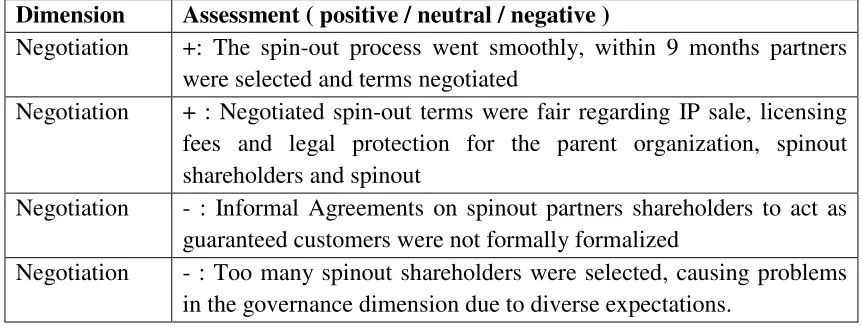
The negotiated terms during the spin-out process were regarded fair in terms
of the commercial, legal and IP arrangements for all parties involved – including the
parent organization Shell and the newly formed spinout company. The only problem
that originated from the spin-out negotiations was that during the six months no
formal agreements were signed regarding the volume of the mandatory orders the
companies' shareholders in the consortium would make; only informal targets were
agreed upon. This was a clear learning point for the parent organization, because as a
consequence Avantium faced considerable uncertainty about future income streams
during its first years. An assessment of the spin-out process of Avantium is
summarized in Table 3.
Insert Table 3 about here
---Phase 2: Set-up and management of a spinout
The set-up and management phase of Avantium can best be analyzed on the
basis of a model consisting of five key dimensions we identified earlier, i.e. product,
market, people, finance, and governance, which is created by elaborating on the
insights of different scholars. Most notably the dimensions product, market, people,
finance are derived from a Corporate Venture Capital context (see Mason & Rohner,
2002) and the governance dimension is added to this by the authors of this article as
this dimension is especially paramount given the nature of the special spinout/parent
relationship (Lord et al, 2002, Govindarajan and Trimble, 2005; McElroy, 2003).This
phase succeeds the successful spin-out negotiations with interested parties. It however
also relates to the strategic decision phase, as high-level decisions in the set-up and
management phase determine to what degree the strategic advantages the parent
higher-level set-up decisions and subsequent strategic management interventions.
Hence, day-to-day interventions and tactical management of the spinout are for that
reason excluded from the overview presented in this phase. This section will describe
the strengths, weaknesses and strategic interventions of the five key set-up and
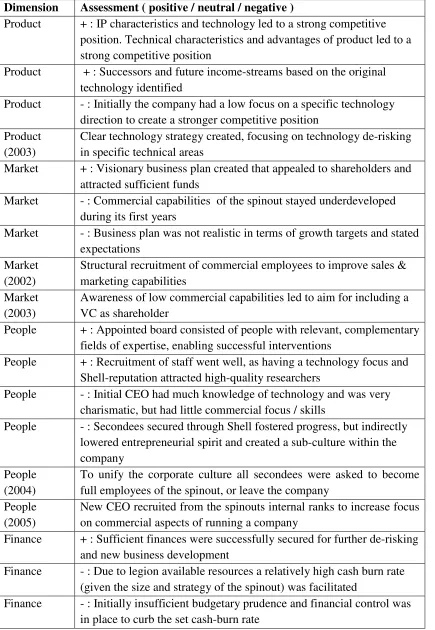
management dimensions by Avantium’s management, which are summarized in Table
4.
Insert Table 4 about here
---The product dimension was set-up relatively successful by Avantium, mainly
thriving on the strengths of the inherited IP. Firstly, the technical characteristics and
advantages of the products and services commercialized by the spinout led to a strong
competitive position. Secondly, future income-streams based on the initial IP were
already identified during the set-up phase. This enabled a successfully executed
diversification strategy during the period 2003-2007.
On the other hand, a weakness of the original set-up was the initial lack of a
focused technology strategy to create an even stronger competitive position by further “The quality of the IP that Avantium inherited from Shell was excellent, and
helped us to build-up a strong, competitive offering. Probably out of excitement about the
possibilities of our IP, many applications to commercialize Avantium’s technology were
intensively explored in our first years of existence.”
Dr. Chris John
Principal Scientist Avantium (2005-2008)
reducing technical risks. Spinouts usually burn cash on explorative R&D during the
first months and years after their establishment in order to generate the technical
knowledge needed to define a technology strategy. However, Avantium was already
developing its technology as an internal project within Shell for six years (1994-2000)
and the appointed CEO of Avantium was also the project leader when the project was
running inside Shell. The absence of a clear technology strategy in the first years of
the company led to a relative high cash burn rate as too many technical applications
were explored at the same time. Later on, the spinout management coped with this
lack of focus. Avantium’s current CEO, who took control over the company in 2005,
made a simple and focused technology strategy his primary focus in the first months
of his tenure. This, in turn, alleviated part of the company’s initial hunger for cash.
With regard to the market dimension a different story unfolded during the
setup of Avantium. Key marketing aspects such as clear sales and marketing strategy
-reflected in a business plan that sets achievable and motivating targets to guide stable
growth - was initially not of primary concern for the company. Only the marketing
towards current investors was well established and led to large investment from its
shareholders – something that was also needed to facilitate the relative high cash-burn
rate in the company’s first years. The business plans used for attracting finance rounds “When I became CEO in 2005 it was my key priority was to further rationalize
expenditure and bring focus in our approach to commercialize the IP. The business plans
used up to that point were visionary, but often lacked commercial grounding. It was time
for Avantium to become a more mature and commercially competitive company.”
Tom van Aken
CEO Avantium (2005-current)
can by hindsight called visionary at best, but were certainly not realistic in terms of
growth expectations at that time. It can thus be concluded that the commercial focus
of the spinout was initially very low. This is illustrated by the fact that only in 2002 –
two full years after the start of the spinout – Avantium hired its first commercial
employees. Re-adjustment of the initial set-up of the market dimension was
something that happened slowly but steadily between 2002 and 2004. The change
materialized first by attracting more people with a commercial background into the
company, and second by allowing a VC to enter as a key shareholder of the spinout in
2003. These interventions led to an increased commercial focus by means of a proper
sales and marketing strategy. This renewed focus on the market dimensions gradually
improved the financial results of the venture and in 2005 the spinout became
profitable for the first time.
In terms of setting-up of the people dimension, Avantium again did relatively
well. Firstly, the spinout’s new board was successfully recruited, and consisted of
people with relevant, complementary fields of expertise, which enabled the successful
interventions described in this study. Secondly, recruiting employees for the spinout
went well as the technology focus and Shell-reputation provided a strong employee
value proposition, and enabled the spinout to attract world-class researchers. Thirdly,
Avantium’s appointed CEO had much knowledge of technology and was extremely
charismatic, but he had limited commercial skills. Another, more commercially
oriented CEO was selected from Avantium's internal ranks in 2005. He effectively
addressed the issue of Avantium’s high cash burn rate and poor commercial focus.
Fourthly, ten secondees were attracted by the spinout from Shell under a general
agreement that fostered initial progress – especially in the product dimension – but
due to the fact that this relative large sub-group within Avantium did not face the
same entrepreneurial uncertainty that the rest of the spinout experienced. Hence, it
was decided in 2004 that all ten employees under the Shell-secondment agreement
should make a choice to either start working under the same conditions as Avantium
staff did, or leave the company. Only one employee working under the
secondment-agreement took the offer and remained employed by Avantium.
In setting-up the finance dimension of the spinout, Avantium achieved a
mixed set of results. Firstly, in terms of securing capital, sufficient financial means for
further de-risking of the technology and new business development was obtained
through financing rounds. This is a key hurdle to take for any new venture, and
Avantium passed this milestone with honors. However, this in turn also led to a
situation in which the spinout management was tempted to opt for a very aggressive –
and thus also more expensive – growth strategy. Although the aggressive growth
schedule was never realized, there also needs to be articulated that the decision was
taken in a time (2000, 2001) in which VC firm backed technology companies boomed
as never before. On the other hand there still can be concluded that budgetary
prudence and strict financial controls in order to monitor and control expenditure were
not in place, which are two elements that facilitated Avantium’s initial excessive cash
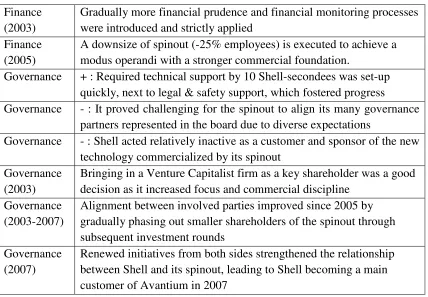
burn rate. A key strategic intervention in the finance dimension can be pinpointed to
2003, after which gradually more and more financial prudence was introduced, and
financial monitoring processes were introduced and strictly applied. Furthermore, a
downsize of the spinout in 2005 (roughly 25% of employees were made redundant)
was successfully executed to conclude efforts to achieve an operating mode with a
Finally, the governance dimension of Avantium was initially set-up quite
poorly, but got high priority in the strategic interventions in the years thereafter.
Directly after its set-up the governance relationship between Shell as parent
organization and the spinout led to some benefits for Avantium in the form of
borrowing technical expertise through Shell-seconded employees, next to legal and
safety related advice in the early years of the company (2000-2004). The governance
relationship between the consortium of shareholders and the spinout worked out less
successful in the first years of the spinout. After concluding the negotiation phase the
consortium of shareholders was represented in a large board that was governing
Avantium. Within this governance body it soon became clear that it was hard to align
the different views, partly because there were initially many shareholders invited in
the consortium owning the spinout. This led to a reduced feeling of ownership for
Avantium’s success by the (many) shareholders, and tensions between shareholders
due to diverging expectations. As a consequence a lack of focus in the technical and
commercial direction occurred, as every shareholder had slightly different objectives
with the spinout. Another issue was that the governance relationship with Shell did
not lead to business deals between the parent organization and spinout or the
establishment of any form of active sponsorship of the technology commercialized by
Avantium. After the first years of business Avantium focused on the adaptation of the “When spinouts mature, financial controls to monitor and control expenditures are
becoming more important. Since the 2003, step by step more financial prudence and
control was introduced at Avantium.”
Frank Roerink
CFO Avantium (2007-current)
initial set-up decisions in the governance dimension which led to much stronger
governance.
More specifically, several financing rounds took place during the period
2003-2007, in which many of the original stakeholders (including Shell) phased out their
stake in Avantium, while others used these opportunities to increase their stake. In
2003 also a VC firm used these financing rounds to obtain a significantly large stake
in Avantium; a step that strongly helped the spinout to become more commercially
oriented and financially disciplined. Over time these financing rounds led to a much
smaller group of shareholders, and hence increased uniformity of shareholder
expectations, which in its turn eased the governance of the spinout. Finally, strategic
interventions from Avantium’s management and renewed initiatives from both Shell
as parent organization and Avantium led to much stronger ties between the two
organizations. In 2007, Shell became a main customer of the technology services and
products commercialized by its spinout.
“The governance relationship between the consortium of shareholders and
Avantium did not work successful in the first years of our existence. This was a clear focus
area for me when I took over as CEO. Both the invitation of a Venture Capital firm and
Avantium as a consequence of the financing rounds having less shareholders helped us to
resolve the complicated governance structure that was inherited from our initial set-up.”
Tom van Aken
CFO Avantium (2005-current)
CONCLUSION AND DISCUSSION
Spinouts are becoming increasingly popular among large industrial companies
as an external path to market for technologies that do not fit into the corporate growth
strategy. The literature is relatively silent about how to spin out a venture
successfully, despite the apparent popularity of spinouts among large industrial
corporations. Evidence is scattered and based on a few case studies. In this study, we
provided a model to decide on, set up and manage a spin out. The spinout model
underlines the requirement to connect the strategic rationale for a spin-out by the
parent organization – as discussed in-depth in the theory section – with the more
practical negotiation-, set-up and management phases of the spinout.
This study contributes in different ways to our current understanding of the
spin out process. Firstly, it creates a coherent overview of advantages and
disadvantages of using spinouts in a strategic way as an alternative to internal
innovation projects to valorize and monetize the commercial potential of a
technology. Analyzing the condition under which monetizing technology through
spinouts is superior to internal paths to the market have thus far not received a lot of
attention in the literature (Klepper, 2009).
Secondly, the phased approach shows the critical steps that have to be taken
by actors in the decision, set-up and management phases of a spinout. The model we
use provides a structured approach to decide about when to spin out a project and
how to manage the negotiation, set-up and management phases. We have illustrated
how the model works applying it to one of Royal Dutch Shell’s spinouts. The model
has shown that a staged approach is important to structure the spin-out process: It
creates a platform to discuss key success factors of current and future spinouts in any
transfer, set-up, and management phase led to the creation of an assessment
methodology to analyze spinouts that can be generically applied and easily depicted
in a visual format. Such an assessment model has not been offered before in the
literature on spinouts.
Moreover, the 5 dimensions in the set-up phase are critical in setting up and
managing a spinout in its first years. We have illustrated this for Avantium, a spinout
of Royal Dutch Shell, but it is beyond doubt that each spinout can benefit from
carefully implementing the 5 dimensions in a systematic way after it is established.
Although spinouts might benefit from its corporate parent after it is established, it is
nevertheless critical that it focuses on its own managerial challenges. A closer look at
the 5 dimensions also reveals that the spinout DNA may still be too much a reflection
of its parent’s DNA. As most spinouts stem from an internal R&D project in large
corporations, they frequently have a strong technology push focus – this was also the
case in Avantium. A systematic analysis of the 5 dimensions would have revealed
that Avantium’s strategic direction was too much technical oriented and that the
range of applications was too broad. The subsequent strategic interventions corrected
these management problems, but they could have been avoided if the shareholders –
including Shell – carefully implemented the 5 dimensions in the set-up stage.
Managerial implications
This study offers managers a relatively simple model that can be systematically
applied in practice. In doing so we have provided managers with a phased approach
showing the critical steps that have to be taken in the decision, set-up and
management phases of a spinout. With respect to the decision phase, research shows
disadvantages and then making conscious decisions about valorizing and monetizing
the commercial potential of a technology by means of a spinout. As such, the
overview discussed in our paper can be an important source for managers who are
guiding business decisions on whether or not to spin out. Looking at the set-up and
management phases, it is argued by Siegel et al. (2007) that most attention has been
focused on spinout creation and not on their further development into a sustainable
venture. As spinouts become more popular we expect managers not only to set-up but
also manage spinouts in a highly structured way, thereby enhancing the development
of sustainable ventures.
Finally, given that an assessment model of the spinout process has not been
created before in scholarly literature, our study helps managers to develop insights
with respect to the necessary practices and mechanisms needed to carry out the
different phases effectively. Implementing the model (including the 5 dimensions) can
enhance management's capability to increase the likelihood of successful spinouts
thereby creating an important complement to their internal innovation model.
Limitations and future research
The contributions of this paper also come with limitations, which should be kept in
mind. Firstly, there should be noted that an individual spinout-case is useful for
establishing an overview of the issues faced by the spinout, and provide a good
starting point for a discussion, but should not be mistaken for a precise measurement
of performance, as only two categories (positive or negative) are used to qualify the
different management challenges. This quantification should not be considered as a
formal rating or assessment of the spinout. Future analyses can quantify the rating of