PARTICLE FILTERING WITH ALPHA-STABLE DISTRIBUTIONS
Lyudmila Mihaylova, Paul Brasnett, Alin Achim, David Bull and Nishan Canagarajah
Department of Electrical and Electronic Engineering, University of Bristol
[email protected], [email protected], [email protected]
ABSTRACT
In this paper we introduce a novel sequential Monte Carlo technique, which is based on the family of symmetricα -stable (SαS) distributions. Sequential Bayesian estimation generally involves recursive estimation of filtering and pre-dictive distributions of unobserved signals from their noisy measurements. In our proposed algorithm, the relevant den-sity functions are approximated by particles drawn from sta-ble distributions. We call this novel techniqueSαS par-ticle filtering (SαSPF). We assess the performance of the
SαSPF in comparison with the Gaussian Sum particle filter (GSPF) [1] and a standard (non-parametric) particle filter (PF). Results obtained using highly nonlinear models with simulated data show that theSαSPF outperforms the GSPF and compares very favorably with the PF.
1. INTRODUCTION
Recently, there has been considerable interest in solving the problem of sequentially estimating the state of a dynamic system based on sensor measurements [2]. Among the dif-ferent solutions, the Kalman filter [3] remains probably the most well known together with its variants - the extended Kalman filter (EKF) [2] and the unscented Kalman filter (UKF) [4]. However, Kalman filters are generally limited by the ubiquitous nonlinearity and non-Gaussianity of the physical world. Particle filtering methods (sometimes also refered to as Monte Carlo techniques) have been thus pro-posed as powerful tools, able to handle multivariate data and nonlinear / non-Gaussian processes [5, 6]. Particle filtering relies on a sample-based reconstruction of probability den-sity functions. Multiple particles (samples) of the variables of interest are generated, each one associated with a weight that characterises the quality of a specific particle. An esti-mate of the variable of interest is obtained by the weighted sum of particles. The different particle filters differ from each other in the way they propagate the probability density
This work has been conducted with support from the UK MOD Data and Information Fusion Defence Technology Centre under project DIF DTC 2.2.
functions. Most sequential Monte Carlo algorithms are non-parametric techniques, directly propagating a sample based representation of the probability density function. However, some recently developed algorithms, such as the Gaussian particle filter (GPF) [7] offer a parameterised solution, i.e. they use a Gaussian assumption and propagate the first two moments (mean and covariance). They approximate poste-rior densities by single Gaussians like the EKF and its vari-ants. The GPF has also been used as a building block for more complex filters, called the Gaussian sum particle fil-ter (GSPF) [1] that approximate the posfil-terior densities by mixtures of Gaussian components.
A more general distribution that includes the Gaussian density as a limiting case is theα-stable distribution. It has been used to model many phenomena where the Gaussian distribution is not a reasonable choice, for instance, noises with an impulsive nature. Signals and noises of such class contain sharp spikes or occasional bursts [8]. Impulsive noises, which can be modelled withα-stable distributions include atmospheric noise in radio links, ambient acoustic noise in underwater sonar and submarine communications, as well as lightening, switching transients and accidental hits in telephone lines. Different phenomena have also been modelled successfully with α-stable distributions in eco-nomics [9], physics, biology, and electrical engineering [8], including communications and image processing [10, 11].
So far alpha-stable distributions have not been used within the Monte Carlo framework, apart from in [12, 13, 14, 15]. In [14] they have been applied to solve parameter estimation problems in time-series. A Rao-Blackwellised implementation was reported without a direct evaluation of theα-stable probability density function, which in general is unavailable in closed form. In [12, 13] a batch-based Markov chain Monte Carlo (MCMC) method is proposed, whilst [14] develops a sequential Monte Carlo framework for on-line estimation with measurements corrupted withα -stable noise. Finally, in [15] Monte Carlo techniques were employed in order to derive a maximum likelihood estima-tor for the parameters of anSαSdistributed signal mixed with additive Gaussian noise.
through sequential evaluation of the parameters of the stable density. Sinceα-stable distributions incorporate the Gaus-sian distribution as a particular case, theSαSparticle filter can be regarded as a natural generalisation of the GPF [7] and of the GSPF [1].
The structure of the paper is as follows. Section 2 re-calls the main properties of theα-stable distribution. Sec-tion 3 develops anα-stable particle filter. Section 4 presents results with synthetic data examples and assesses the per-formance of theSαSparticle filter in comparison with the standard PF and the GSPF. Finally, conclusions and open issues for future research are highlighted in Section 5.
2. BASIC PROPERTIES OFSαSDISTRIBUTIONS
The appeal ofSαSdistributions as a statistical model for signals derives from some important theoretical and empiri-cal reasons. First, stable random variables satisfy the stabil-ity property which states that linear combinations of jointly stable variables are indeed stable. Second, stable processes arise as limiting processes of sums of independent identi-cally distributed (i.i.d.) random variables via the generalised central limit theorem. Actually, the only possible non-trivial limit of normalised sums of i.i.d. terms is stable. On the other hand, strong empirical evidence suggests that many data sets in several physical and economic systems exhibit heavy tail features that justify the use of stable models [8].
Generally, there is no closed-form expression for the probability density function ofSαSdistributions. Conse-quently, the most convenient way to define them is by means of their characteristic function
ϕ(ω) = exp(jδω−γ|ω|α) (1)
where
• αis the characteristic exponent , with values 0 <
α≤2. It is arguably the most important parameter as it determines the shape of the distribution. It controls the heaviness of the tails of the density function. A small positive value ofαindicates severe impulsive-ness, and thus tails are heavier, while a value ofα close to 2 indicates more Gaussian type behaviour. A value ofα= 1corresponds to Cauchy distribution.
• γis the dispersion parameter (γ > 0), which deter-mines the spread of the density around the location parameter. It behaves in a similar way to the variance of the Gaussian density, and it is, in fact, equal to half the variance whenα= 2, for the Gaussian case.
• δis the location parameter (−∞< δ <∞). It corre-sponds to the mean for1< α≤2, and to the median for0< α≤1.
ASαSdistribution characterised by the above three param-eters is denoted asS(α, γ, δ). The caseα= 2corresponds to the Gaussian distribution, whileα = 1corresponds to the Cauchy distribution. The density functions in these two cases are given by
fα=2(γ, δ;x) =√1
4πγexp
½
−(x−δ)
2
4γ
¾
, (2)
fα=1(γ, δ;x) = γ
π[γ2+ (x−δ)2]. (3)
Generalα-stable density members do not possess finite second or higher moments [16]. In particular, the variance of a stable distribution withα < 2does not exist, making the use of variance as a measure of dispersion meaningless. However, the dispersion of a stable random variable plays an analogous role to the variance. The larger the dispersion of anα-stable variable is, the more spread it is around its location parameter [8].
3. AN ALPHA-STABLE PARTICLE FILTER
Consider a dynamic system described by the following discrete-time state-space model
xk+1=f(xk,vk), (4)
yk+1=h(xk+1,wk+1), (5)
wherexk ∈ Rnx is the unobserved system state vector,
vk∈Rnv is the system noise assumed to belong to the class
ofα-stable symmetric processes;yk∈Rnzis the measure-ment vector,wk ∈Rnwis a white Gaussian noise, andkis
the discrete time. Functionsf(.)andh(.)are nonlinear in general.
In many statistical signal processing problems the pri-mary objective is the reconstruction of the filtering probabil-ity densprobabil-ity functionp(xk|y1:k), withy0:k ={y1, . . . ,yk}
being the set of all measurements available up to the mo-mentk. Denote withNthe number of particles.
The standard particle filtering technique is a non- para-metric inference technique, whilst theα-stable particle filter that we develop is a parametric technique, since it reduces the uncertainty to the calculation of the parameters of the
α-stable distribution. Theα-stable particle filter represents an extension to the GPF and of the GSPF. The GPF is based on the particle filtering concept, and it approximates the fil-tering and predictive state distributions by single Gaussians. The algorithm achieves this by the propagation of the first two moments of the Gaussian distribution, namely the mean and covariance through particles.
TheSαSPF algorithm is described in Table 1.
Table 1 The symmetricα-stable particle filter
Initialisation
Fork = 0draw samples from S(α0,γ0,δ0)and denote them
{x(0j)}Nj=1, for each state vector componenti = 1, . . . , nx. In
order to sample from a stable distribution we use the method pro-posed by Chambers et. al [17]. Set initial weightsW0(j)= 1/N.
Time update
Fork= 0,1,2, . . .,
1. For j = 1, . . . , N, samplex(kj+1) ∼p(xk+1|x(kj)), from
the motion model (4).
Measurement update
2. Forj= 1, . . . , N, compute the weights
Wk(j+1) =p(yk+1|x
(j)
k )S(αk,δk,γk)
q(x(kj)|y0:k+1) (6)
Under the assumption that the importance function
q(x(kj)|y0:k+1) =S(αk,δk,γk), then the weights are equal
to:
Wk(j+1) =p(yk+1|x (j)
k+1).
3. Normalise the weightsWk(+1j) =Wk(j+1)/PN j=1W
(j)
k+1.
4. Update the characteristic exponentαk+1, and the other parametersγk+1andδk+1from the shifted particles
Wk(j+1) x(kj+1) using thelog|SαS|method proposed in [18].
Output
5. Estimate the overall state
ˆ
xk+1=
N X
j=1
Wk(+1j)x(kj+1) , (7)
6. Setk=k+ 1and return to step 2.
An advantage of theSαSPF compared to the PF and the GSPF is that theSαSPF does not require a resampling procedure. Note that the resampling step in the PF is with respect to the particles, whilst in the GSPF it is applied to the mixing components. TheSαSPF relies on a parametric representation of the filtering and predictive state densities, whilst the PF representations of the state densities is non-parametric, and in this sense the PF is more general than the
SαSPF. On the other hand, theSαSPF represents a gener-alisation of the GPF and GSPF.
4. PERFORMANCE EVALUATION AND RESULTS
The developedSαSPF is compared to a standard PF and a GSPF.
Example 1. Consider the system model given in [7, 1]
xk+1= 0.5xk+ 25 xk
1 +x2 k
+ 8cos(1.2k) +vk, (8)
with a measurement equation
yk+1=xk+1+wk+1, (9)
wherevk ∼ N(0, Q),wk ∼ N(0, R), withQ = 1,R =
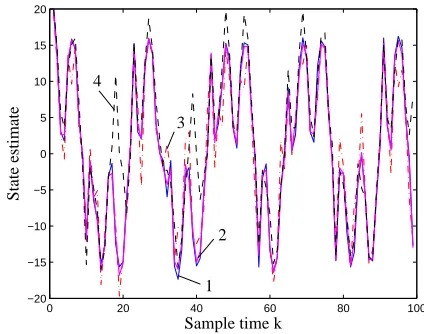
2.5. TheSαSPF and the PF are run withN = 1000 parti-cles, whilst the GSPF withN = 1000and 10 mixing com-ponents which means that the last has 10000 particles. The actual state and the state estimates for a single realisation for all filters are given in Figure 1, the mean errors are shown in Figure 2 over 100 Monte Carlo runs.
0 20 40 60 80 100
−20 −15 −10 −5 0 5 10 15 20
Sample time k
State estimate
2 4
[image:3.595.315.527.336.503.2]1 3
Fig. 1. State estimate from a single realisation: 1 - actual state, 2 - standard PF, 3 -SαSPF, 4 - GSPF
Example 2. This example considers a scalar system model with an additiveα-stable noise,
xk+1=−2xk+ 1.5x2k+vk, (10)
and measurement equation
yk+1=xk+1+wk+1, (11)
wherevk ∼ S(αnoise, δnoise, γnoise). The measurement
noise is Gaussianwk ∼ N(0, R), with the following
0 20 40 60 80 100 −14
−12 −10 −8 −6 −4 −2 0 2 4
Sample time k
ME of x
1
3
[image:4.595.315.526.82.247.2]2
Fig. 2. Mean error from 100 independent Monte Carlo runs: 1 - standard PF, 2 -SαSPF, 3 - GSPF
As in Example 1, theSαSPF and the PF are run with
N = 1000particles, whilst the GSPF withN = 1000and 10 mixing components which means that it has 10000 par-ticles. Since the model noise isα-stable, we draw samples from thevk ∼ S(αnoise, δnoise, γnoise)and samples from
xk ∼ S(αx, δx, γx).
The state estimate from a single realisation is presented in Figure 3, the corresponding mean error from 100 inde-pendent Monte Carlo runs is shown in Figure 4. As it can be seen from the figures, the standard PF and theSαSPF offer comparable results, while clearly outperforming the GSPF.
0 5 10 15 20 25 30
−3 −2 −1 0 1 2 3 4
Sample time k
State estimate
1 2
3
[image:4.595.59.270.83.247.2]4
Fig. 3. State estimate from a single realisation: 1 - actual state, 2 - standard PF, 3 -SαSPF, 4 - GSPF
The reason for this is that a Gaussian mixture
distribu-0 5 10 15 20 25 30
−0.5 −0.4 −0.3 −0.2 −0.1 0 0.1 0.2 0.3 0.4 0.5
Sample time k
ME of x
1 2
[image:4.595.60.269.473.640.2]3
Fig. 4. Mean error from 100 independent Monte Carlo runs: 1 - standard PF, 2 -SαSPF, 3 - GSPF
tion with a small number of components can not accurately model heavy-tail distributions whilstSαSdistributions can more accurately model these heavy tail signals. Regarding the computational complexity theSαSPF is more efficient because it estimates only the two parameters of theα-stable distribution, whilst the GSPF approximates two moments per mixing component.
5. CONCLUSIONS AND FUTURE WORK
In this paper we have proposed an alpha-stable particle filter framework and investigated its performance. It is more gen-eral than the Gaussian sum particle filter and propagates the filtering and predictive state distributions through an update of the parameters of theα-stable distribution. Results over synthetic data examples are presented.
So far the iterative calculation of the parameters of the
α-stable distribution were performed only for first-order sys-tems. Since the multivariateα-stable distribution has no co-variance, methods to estimate its spectral measure should be devised. This is an open issue for future research, as well as the validation of theSαSPF framework over applications with real data. The developedSαSPF can be applied to dif-ferent signal processing problems such as in queueing net-works and systems with impulsive noises.
6. REFERENCES
[2] A. Jaswinski. Stochastic Processes and Filtering Theory. New York: Academic Press, 1970.
[3] R. Kalman. A new approach to linear filtering and predic-tion problem. Trans. ASME, Ser. D, J. Basic Eng., 82:34–45, 1960.
[4] S. Julier and J. Uhlmann. Unscented filtering and nonlinear estimation. Proceedings of the IEEE, 92(3):401–422, 2004.
[5] A. Doucet, N. Freitas, and N. Gordon, Eds. Sequential Monte
Carlo Methods in Practice. New York: Springer-Verlag, 2001.
[6] B. Ristic, S. Arulampalam, and N. Gordon. Beyond the Kalman Filter: Particle Filters for Tracking Applications.
Artech House, Feb. 2004.
[7] J. H. Kotecha and P. M. Djuri´c. Gaussian particle filter-ing. IEEE Transactions on Signal Processing, 51(10):2592– 2601, Oct. 2003.
[8] M. Shao and C. Nikias. Signal processing with fractional lower order moments: Stable processes and their applica-tions. Proceedings of the IEEE, 81(7), July 1993.
[9] E. Tsionas. Monte Carlo inference in econometric models with symmetric stable distributions. Journal of
Economet-rics, 88:365–401, 1999.
[10] P. Tsakalides, P. Reveliotis, and C. L. Nikias. Scalar quan-tization of heavy-tailed signals. IEE Proceedings - Vision,
Image and Signal Processing, 147(5):475–484, Oct. 2000.
[11] A. Achim, P. Tsakalides, and A. Bezerianos. SAR image denoising via Bayesian wavelet shrinkage based on heavy-tailed modeling. IEEE Trans. Geosci. and Remote Sensing, 41:1773–1784, Aug. 2003.
[12] S. Godsill and E. E. Kuruoglu. Bayesian inference for time series with heavy-tailed symmetric α-stable noise process. Technical report, Techn. Report, 1999.
[13] S. Godsill. MCMC and EM-based methods for inference in heavy-tailed processes with α-stable distribution. In Proc.
of the IEEE Signal Processing Workshop on Higher-order Statistics, 1999.
[14] M. Lombardi and S. Godsill. On-line Bayesian estimation of AR signals in symmetric alpha-stable noise. Technical report, 2004.
[15] A. Achim and E. E. Kuruoglu. Image denoising using bi-variateα-stable distributions in the complex wavelet domain.
IEEE Signal Processing Letters, 12(1):17– 20, Jan. 2005.
[16] G. Samorodnitsky and M S Taqqu. Stable Non-Gaussian
Random Processes: Stochastic Models with Infinite Vari-ance. Chapman and Hall, New York, 1994.
[17] J. Chambers, C. Mallows, and B. Stuck. A method of sim-ulating stable random variables. Journal of the American
Statistical Association, 71:340–344, 1976.
[18] X. Ma and C. Nikias. Parameter estimation and blind channel identification in impulsive signal environment. IEEE Tran.