A study of bilingual children reading in a second language.
DAVIS, Beryl R.
Available from Sheffield Hallam University Research Archive (SHURA) at:
http://shura.shu.ac.uk/19540/
This document is the author deposited version. You are advised to consult the
publisher's version if you wish to cite from it.
Published version
DAVIS, Beryl R. (1987). A study of bilingual children reading in a second language.
Masters, Sheffield Hallam University (United Kingdom)..
Copyright and re-use policy
See
http://shura.shu.ac.uk/information.html
Sheffield Hallam University Research Archive
ProQuest Number: 10694421
All rights reserved
INFORMATION TO ALL USERS
The quality of this reproduction is dependent upon the quality of the copy submitted.
In the unlikely event that the author did not send a com plete manuscript and there are missing pages, these will be noted. Also, if material had to be removed,
a note will indicate the deletion.
uest
ProQuest 10694421
Published by ProQuest LLC(2017). Copyright of the Dissertation is held by the Author.
All rights reserved.
This work is protected against unauthorized copying under Title 17, United States C ode Microform Edition © ProQuest LLC.
ProQuest LLC.
789 East Eisenhower Parkway P.O. Box 1346
A STUDY OF BILINGUAL CHILDREN READING IN A SECOND LANGUAGE
Beryl Rae Davis BA Hons
A thesis submitted to the Council for
National Academic Awards for the qualification
of Master of Philosophy. The thesis is submitted
in partial fulfilment of the requirements
for this degree.
Sponsoring Establishment : Sheffield City Polytechnic Collaborating Establishment : Sheffield City Council
A STUDY OF BILINGUAL CHILDREN READING IN A SECOND LANGUAGE
BERYL DAVIS
The Abstract
This research tested the hypothesis that bilingual children, using their second language and matched with monolingual children on a word recognition test, may differ significantly from them- in the miscues made when reading and in attitudes to reading.
Some prior research has indicated ethnic minority pupils under achieving in British schools. However, much research in the teaching of reading has been based on standardised tests which may be culturally biased and which may be sometimes less than specific about the particular minority groups involved. It gives little indication about how teaching might be made more effective and the children's reading skills enhanced.
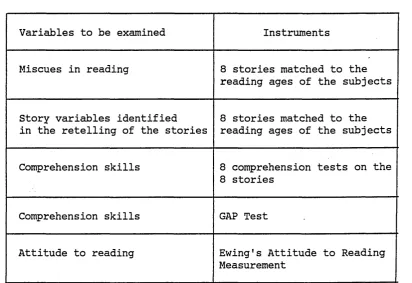
The research analysed the miscues made in the reading of a story, the retelling and the answers to questions about the story. It analysed the results of a cloze test and an attitudes to reading measurement. The subjects were 41 monolingual English children and 41 bilingual Pakistani children in four Sheffield primary schools. They were matched in pairs for sex, schools, chronological ages and reading ages from a word recognition test. Each child was taped reading and retelling a story that had been matched in a pilot study to the reading ages of the children. Using the Wilcoxon Matched Pairs Signed Ranks Test, the data was analysed for older and younger children, for less and more able readers and for a group of bilingual girls and boys.
ACKNOWLEDGEMENTS
The reading passages used in the study are reproduced by kind permission of the various copyright owners.
The Attitudes to Reading Measurement is reproduced by kind permission of Jim Ewing, Research Director, Dundee College of Education.
Personal thanks are due to the following for their advice and support:
William Latham, formerly Co-ordinator for Language Development Centre, Sheffield City Polytechnic.
Dr Ronald Parkin, Senior Lecturer, Sheffield City Polytechnic. Chris Searle, Adviser for Multicultural Education, Sheffield
LEA.
Jim Ewing, Research Director, Dundee College of Education. Jennie Ingham, Research Fellow, Middlesex Polytechnic.
Hilary Hester and Carolyn Steedman, Schools Council Project, University of London.
Sandra Saunby, Secretary, Sheffield City Polytechnic.
The Staff of the Language Development Centre, Sheffield City Polytechnic.
The Staff of Lowfield Multicultural Centre, Sheffield LEA. The headteachers, staff and pupils of the schools involved in
CONTENTS
The Abstract Acknowledgements Contents
List of Tables Appendices
Chapter 1 : The Background to the Education of Bilingual Children in Britain
1.1 Introduction 1
1.2 Linguistic diversity in Britain 4
1.3 Second language learning 6
1.4 Relevant research into the educational 8 performance of Asian children
1.5 Questions raised by the research 13
1.6 Oral language and reading 15
1.7 Research into reading in a second language 17
1.8 Summary 20
Chapter 2 : The Identification of the Variables
2.1 Introduction 22
2.2 The variables in the miscue analysis 25 2.2.1 The development of miscue analysis 25 2.2.2 Miscue analysis in Britain 27 2.2.3 The criteria for the identification of the 29
miscue variables
2.3 The variables in the retelling of the stories 37 2.3.1 Background to the variables concerned with 37
the telling of the stories
2.3.2 The criteria for the identification of the 38 variables in the story retelling
2.4 The variables in the comprehension tests 41 2.4.1 Some comments on comprehension in reading 41 2.4.2 The criteria for the identification of the 42
variables in the comprehension tests
2.5 The variables in the GAP test 44 2.6 The variables concerned with attitudes to reading 45
2.7 Summary 46
Chapter 3 : The Design of the Study - The Subjects
3.1 Introduction 48
Contents (cont) Page
3.3.1 The schools 54
3.3.2 Sex 55
3.3.3 Chronological age 57
3.3.4 Reading Age 60
3.4 Comments on the matching of the subjects 62
Chapter 4 : The Design of the Study - Data Collection
4.1 Introduction 64
4.2 Background to the instruments used to identify 65 the miscue variables
4.3 Criteria for the identification of the stories 68
4.4 The stories 74
4.5 The pilot study 75
4.6 Comments on the choice of stories 77 4.7 The recording of the readings 78 4.8 The retelling of the stories 79
4.9 The comprehension tests 81
4.10 Close procedure and the GAP test as a 82 measurement of comprehension
4.11 Attitude to reading measurement 85
4.12 Summary 88
Chapter 5 : Data Analysis
5.1 Introduction 89
5.2 Groupings for analysis 89
5.2.1 Grouping for chronological ages 91 5.2.2 Grouping for reading ages 92 5.2.3 Grouping of bilingual girls and boys 97
5.3 Statistical test used 100
5.4 Summary 100
Chapter 6 : The Results and Discussion of the Results
6.1 Introduction 101
6.2 Miscue variables - the results 103 6.3 Discussion of the results of the miscue variables 104 6.4 Substitution variables - the results 110 6.5 Discussion of the results of the substitution 111
variables
6.6 The recall of the story - the results 113 6.7 Discussion of the results for the recall of 113
the story
6.8 The misconceptions in the retelling of the story 115 6.9 The comprehension tests - the results 118 6.10 Discussion of the results of the comprehension 119
tests
6.11 The GAP test - the results 120
Contents (cont) Page
Chapter 7 : The Conclusions
7.1 Introduction 128
7.2 Community language teaching and fostering
linguistic awareness 132
7.3 Teaching English as a second language 135
7.4 Reading material 142
7.5 Helping children to read in a second language 143
7.6 Further research 147
7.7 Summary 148
LIST OF TABLES Page
1 The Miscue Variables 30
2 The Variables for the Retelling of the Stories 38 3 The Comprehension Test Variables 42
4 The GAP Test Variables 44
APPENDICES Page
A DAVIS B (1983) Reading in a Second Language SERCH 5
pp 15-16 A-l
B The Variables for the retelling of the Story A-5
C Comprehension Test Questions A-13
D The GAP Test A-29
E The Attitude to Reading Measurement A-30 F The Schonell Graded Word Reading Test A-31
G Racism in Books A-32
H The Fry Readability Graph A-34
I The Eight Stories A-35
J Grade Levels (Fry Graph) of each story and number A-36 of pairs matched to each story
K The Story Scripts A-37
CHAPTER 1
THE BACKGROUND TO THE EDUCATION OF BILINGUAL CHILDREN IN BRITAIN
1.1 Introduction
Since the 1950s, the arrival of people from different ethnic backgrounds into Britain has raised complex issues both in society and schools. In schools, the initial emphasis was on absorbing the children into the school population as soon as possible. Thirty years later, ideologies have progressed from this "assimilationist phase" (Swann, 1985) through the phase of multicultural education that helped to prepare children for life in a multi-racial society, to the implementation in the 1980s of an anti-racist policy in many education authorities.
the linguistic skills of bilingual children are coming to be valued (Twitchin and Demuth, 1985). The emphasis is also on supporting their bilingualism. The provision of community language teaching may help to give positive support to their language and culture (Fitzpatrick and Rees, 1980), may increase linguistic awareness for all children and may help children with the task of transferring concepts from one language to another. However the complex language issues raised by community language teaching have only recently started to be researched (Houlton, 1982) and it may be too early to draw firm conclusions.
Learning English as a second language, however, is also essential if children from ethnic minority groups are to succeed in this country. The Swann Report (1985) states that"the key to equality of opportunity, to academic success and more broadly to participation on equal terms and full membership of society is .good command of English." In the Report on the Brixton
school. Confidence increases as they encounter familiar objects and find that communication is no problem. Children from minority groups may enter school without the advantage of this prior experience, may be shocked to find the language through which they had previously communicated is no longer understood and may have to use books and materials that are culturally alien.
During the 1960s and 1970s, research tended to centre on the academic under-achievement of minority groups (Tomlinson, 1983). Little was done to relate to the experiences and linguistic skills these children were bringing into school and to make positive use of them in the classroom. During this period, much of the research was based on standardised tests, especially in the testing of reading ability. Many of these tests reflected the culture within which they were standardised and were unsuitable for students from another culture. There was little research to identify areas where they were underperforming and where specific help might be given.
cope, but may be willing to identify ways of enhancing linguistic diversity and to find out more about incorporating second language teaching into the mainstream curriculum. They may be interested in relevant information about how bilingual children may be helped. In some research, generalisations about "Asians" can also be misleading and does not take account of the different languages and cultures that might be included in such a word. It might be helpful, therefore, to identify ways in which a specific group of bilinguals might be given support in schools.
The present research, therefore, attempts to identify a particular group of bilingual children, to analyse the way in which they read, in order to indicate ways in which monolingual teachers may help them with reading in a second language. It tests the hypothesis that the miscues made by bilingual children reading in a second language and their attitudes to reading may differ significantly from the miscues and attitudes of mono lingual children.
1.2 Linguistic diversity in Britain
Oxford Dictionary, 1974. Beardsmore (1982) states that "bilingualism is the presence of two languages in one speaker though ability in these two languages may not always be equal." Lyons (1981) says that "perfect bilingualism is extremely rare, because it is rare for individuals to be in a position to use each language in a full range of situations and thus to acquire the requisite competence." Bilingual children may have concepts about family life and the home, their own culture and religion well established in their first language. In Britain, however, concepts across different areas of the curriculum are likely to be more fully developed in English.
in a French immersion programme for bilingualism in English and French, do not appear to have been placed at a disadvantage academically (Lambert and Tucker, 1972). However, the bilingual children in Britain, according to Edwards, are at a disadvantage as members of a minority culture and speakers of a minority language.
1.3 Second language learning
The "academic disadvantages", Edwards refers to, may have been further compounded by the provision made for ethnic minority children to learn English during the 1960s and 1970s. The Swann Report (1985) outlines the history of provision of ESL teaching in separate Language Centres and outlines the arguments against
y
separate education. There are strong linguistic arguments for mainstream provision. Language across the curriculum increases the opportunities for the cross-referencing of concepts. Conversing with white peers facilitates the use of English for different needs. In addition, mainstream teachers should see ESL teaching as a necessary skill and as part of their respons ibility, so that the mystique attached to ESL teaching in the 1970s can be dispelled. The Swann Report (1985), however, quotes the DES Survey (1983) that suggests that, nationwide, separate provision has been slow to disappear. Separate language centres apparently accounted for 7% of ESL provision and small specialist classes within the schools for 70% (this could mean full or part time withdrawal).
and the child's ability. Cummins (1982) identified a period of eighteen months to two years, after which it is assumed second language learners have become proficient in English. However, after this period, children may not be as proficient as they appear. "Teachers and psychologists tend to assume that minority language students have learned English when they have acquired peer-appropriate fluency in everyday face to face communication." Such communication would involve social exchanges with other children. However, this should not be interpreted as meaning that the child can cope with "context-reduced proficiency". Such a situation might include reading a difficult text or writing an essay with no supportive materials. Cummins also suggests that it may take "from five to seven years on the average for minority language students to approach grade norms in academic aspects of English proficiency."
learn to use the language up to a certain point of competence and never move beyond it." To help schools with ESL teaching, the Schools Council funded the Scope Project, "The Teaching of English to Immigrant Children" (1969) which provided graded material for teaching spoken English and for making a start with reading and writing. In the 1970s, therefore, concern was mainly on improving performance in English, especially oral language and reading. The emphasis tended to be on the problems that bilingual children presented rather than on the assets that bilingualism had to offer, and on a withdrawal situation where English was taught by specialist teachers in language centres.
It is not surprising, therefore, that in the 1980s mainstream teachers may feel themselves in need of help and advice as pupils with ESL needs become the responsibility of all teachers. The Swann Report (1985) was strongly in favour of "policies for meeting the needs of second-language learners through integrated provision within the mainstream school." The Report wished ESL teaching to be an extension of the range of language needs for which all teachers should be able to cater. A study such as this which attempts to identify areas where teaching for bilingual children may be enhanced should be of use to the teacher.
1.4 Relevant research into the educational performance of Asian children
were situated in a better social class area. The ILEA Literacy Survey, begun in 1967, identified 31,000 eight year olds to discover the factors influencing reading attainment. Pakistani children performed better than Indian children though less well than English children. When they were retested again at fifteen years, Pakistani children were only three points behind the English children (Mabey, 1981). Payne (1974) reported on 1,990 Birmingham primary school children examined in the SRA reading test as part of the Educational Priority Area Research (1968-72). She reported a poor performance, "three-fifths of the Asian children obtained a score indicating an inability to read in English." However, most of the children had only recently arrived in England. Phillips (1979) reported that Asian children tested on the Southgate Reading Test acquired educational skills to the level of indigenous children who are "matched for the social and familial features of ethnic minorities." This research, however, was not reported for ten years and Tomlinson (1983) questions "an inadequately explained D-Score."
would improve school performance. Essen and Ghodsian (1979), analysing the data of the National Child Development Study from testing the IQ scores of children born in 1958, found that Asian children had made significant gains at sixteen and that they scored higher than other minority groups. The Child Health and Education Study, assessing at ten years of age children born in 1970, indicated that West Indian children obtained lower scores on reading tests than Indian and Pakistani children (Swann, 1985). A study of 400 children in the West Midlands (1976-79) in their last year in infants' school reported that attainments in reading using the Southgate Group Reading Test were not significantly different for indigenous and Asian children (Phillips and Marvelly, 1984). However Robinson (1980), who worked in twelve primary schools and used the GAP Test, found that Asian children were 1 year 2 months behind the indigenous children, though Pakistani children scored higher than other ethnic groups and scores were higher for children whose parents spoke English.
tended to score lower for English language than the whites. The claims and methodology of Driver were, however, criticised in the Rampton Report (1981) for generalised statements. Craft and Craft (1983) found that in all secondary schools in an outer London borough, Asian A level results tended to be lower than those of whites. DES statistics (1981) in the Rampton Report indicated that although Asian pupils were reaching the norms of indigenous children, they tended to be in O/CSE exams rather than at A level.
Research comparing Asian girls with boys also presents con flicting findings. Dosanjh (1969) found all Asian girls scoring lower than boys and Muslim girls scoring lower than Sikh girls. Ashby, Morrison and Butcher (1975), Dickenson et al (1975), the ILEA Literacy Survey (1967-76), and Phillips (1979) reported similar trends. However Verma and Bagley (1981) showed Asian girls achieving a higher reading score than Asian boys. Allen and Smith (1975) reported that Pakistani girls in Bradford were less likely to reach CSE/O level than boys and that no Asian girls in Sheffield reached this level.
positive influences might be favourable teacher attitudes (Haynes, 1971), English being spoken by the parents (McEwan et al, 1975), home-school liaison (Dickenson et al, 1975), the level of education of the parents (Essen and Ghodsian, 1979) and parents being urban-born in the mother country (Robinson, 1980). The benefits of bilingualism in cognitive development were also acknowledged and the importance of mother tongue maintenance (Brown, 1979, Houlton, 1982, Tosi, 1984, Fitzpatrick and Rees, 1980).
1.5 Questions raised by the research
Studies of the educational achievements of Asian children have focussed on the academic levels of the pupils as shown by standardised tests. For schools that are searching for ways in which these children might be helped and for more acceptable methods of assessment than culturally biased standardised tests, such research may be of little help. Staff will be very aware of the levels at which individual children are performing, and will be more concerned with identifying areas where help is most needed. They will be more concerned with identifying more suitable methods of assessment. Some prior research, therefore, may have little direct relevance in the classroom.
Another anomaly in some of the research is the use of the blanket term "Asian" and an inadequate identification of different sub-groups. The Swann Report (1985) also mentions the problem, namely "the extent to which statistics on the performance of Asians as a group may mask considerable varia
Moslems, Punjabis and Bengalis, prosperous Kenyan middle class and Sikhs from rural areas. To talk about "Asians" therefore can be misleading and overlooks the existence of cultural sub groups reflecting country of origin, religion and language." Taylor and Hegarty (1985) point out that research has ignored the differentiation within broad Asian community groups, though such differences can be important. Children of middle class Pakistani parents, for example, are mentioned as doing best in school, but Pakistani children show the greatest range in performance. The majority in the north of England, according to Taylor and Hegarty (1985), come from rural backgrounds, form the largest areas of settlement in Britain and tend to do less well. The Swann Report (1985) also drew attention to the Child Health and Education Study directed by Professor N R Butler that identified children from Pakistan as achieving consistently low scores.
argument." Factors that bring about the statistics need careful consideration, for example the effect of attitudes, school experiences and teacher perceptions on the child's self-image, the pressures exerted by race and culture and the part played by racial prejudice.
Further studies therefore need to focus on finding ways of helping bilingual children in the classroom apart from using culturally biased standardised tests or trying to diagnose underachievement. The identification of specific groups of children and an in-depth review of their needs in a particular area of the curriculum might also provide some insight into methods and materials that can be used.
1.6 Oral language and reading
matter of what we happen to be reading." Hunter-Grundin (1979) stated that "reading is a language and communication process" and that "the more practised a child is in spoken language, the more easily he will understand written language." Southgate et al (1981) stated that "the process of reading is closely bound up with total language experience" and that "teachers need to give children a chance to exploit their expectations of a text
... through their experience of life and language."
The view that children should bring their previous knowledge and experience of language, and then associate it with what they find on the printed page has been termed "the psycholinguistic view of reading" (Hunter-Grundin, 1979). It presumes two things. Firstly, when most children read they will be searching for meaning and trying to solve any problems they might encounter in the text. Secondly, they will be familiar with the language they are reading, its phonology, syntax and semantics and will be able to use this linguistic knowledge in their search for meaning in the text. These strategies will also be used to check that any guesses made when reading are correct and also to confirm that what has just been read makes sense. In the early stages of learning to read, the most frequently used sight words, phonic sounds and the "language for reading" (Dean et al, 1978) such as the words "letter", "sound" and "sentence" will need teaching but children also need to develop problem solving strategies in order to tackle a text efficiently.
recognised, we look for them again and are able to incorporate apparently meaningless features into a coherent whole." In this way, when the same patterns recur they may either become mechanised for the child or by using prior knowledge, they can be guessed at. In the main these patterns will be either phonic or syntactic. Secondly the child begins to make associations with what he finds on the page and what already exists in his conceptual framework. This process may be less automatic and even for the monolingual pupil, changes in the way concepts are expressed or the introduction of new concepts, may be disconcerting.
The bilingual child may still be in the process of mechanising patterns of syntax, may be anxious not to make errors and therefore may have few problem solving strategies to support reading. Within the conceptual framework of the text, the concepts themselves may be unfamiliar to bilingual children, if they are centred on an alien culture. Even if familiar, the manner of expressing them may not have been communicated in past oral situations. The mechanisation of syntax and concepts, dependent as it is on constant practice, may not be sufficiently established to give confidence when reading. In such circumstances, it might be hypothesised that the miscues made by monolingual and bilingual children when reading and their attitudes may differ significantly.
1.7 Research into reading in a second language
though given the very substantial numbers of children who not only have to pursue literate activities in a second language but also have to acquire basic reading skills in it, there is clearly a need for further investigation.11 Edwards (1983) also states that "studies which focus specifically on the reading behaviour of children in a second language are rare." According to Edwards (1983), Goodman et al (1979) provide the fullest account of studies of children reading in a second language. Edwards points out that "although designed primarily for American teachers familiar with bilingual education programmes, a good deal of its discussion is relevant to British teachers working with children for whom English is a second language."
Goodman (1978) states that "there is a single reading process which underlies reading, no matter what the language back ground." He identified (1979) three main patterns of reading behaviour in second language learners. The first consisted of noticeable but superficial differences compared with the text, in which case the process can still be relatively efficient and effective. The second pattern consisted of limitations in the ability of - readers to express what they have understood in English. They may have understood far more than they are <able to explain. The third pattern consisted of disruptions to comprehension which could be severe.
from the text. Later pupils may be able to read but may encounter some uncertainty with comprehension. As children become confident in using a second language and as they acquire a vocabulary that encompasses a wide range of situations, reading competence will increase. Edwards (1983) states that "children's reading will faithfully reflect both the relative influence of the mother tongue and the gradual progression towards control over English phonology, orthography, grammar, vocabulary and idiom."
Finally in a pilot study (Appendix A) to test the hypothesis that scores on reading comprehension tests for ESL children are significantly depressed by problems involving concepts, the present researcher (1983) found some evidence to support Du Bois1 suggestion that "increased emphasis needs to be given to semantic relationships." Two groups of ESL children, matched in pairs on relevant variables, completed a comprehension test. One group was then taught the concepts involved in the test. Post testing using the same comprehension test revealed statistically significant better results for the group that had been taught. This suggested that the bilingual subjects were on the continuum towards learning a second language. Teaching particular concepts resulted in enhanced scores on the comprehension test.
The present study attempts to extend prior research into reading in a second language. It tests the hypothesis that bilingual children, using their second language and matched with monolingual children in a word recognition test, may differ significantly from them in the miscues made when reading and in attitudes to reading.
1.8 Summary
CHAPTER 2
THE IDENTIFICATION OF THE VARIABLES
2.1 Introduction
It is likely that the child's advancement in acquiring a second language can only be assessed by a long term, fact-finding programme of evaluation. Such a programme, if used in schools, could also indicate differences in usage and with the reoccurrence of particular words and phrases could reassure staff that they were part of the child's progression towards bilingualism. The Swann Report (1985) expressed concern about the negative attitudes of some mainstream teachers towards ESL learners, especially in their correlation of lack of English with lack of ability, and stated that "there clearly needs to be a major shift in opinion in order to accord these pupils opportunity within the mainstream school." Systematic attention to oral language or reading might, therefore, not only reassure the mainstream teacher that any departure from the apparent norm was in fact part of the child's becoming bilingual and to be expected, but might also help towards countering negative attitudes by staff.
Most Asian parents are anxious for their children to do well. Dosanjh (1969) noted that "there is a very strong desire among Punjabi parents for upward mobility in their children." The Schools Council Pamphlet 19 (1982) also states that "many immigrant parents attach a high value to success in the educa tion system" though "their particular expectations of it may derive from the education system in the homeland." This may involve rote learning, strict discipline and separate education for boys and girls. The Swann Report (1985) also expressed the growing concern of Asian parents for the education of their children, stating that "only in recent years have Asian parents, teachers and community representatives begun to make known their concern about their children's education." Some of the concerns mentioned were the need for Asian teachers, the effects of racism on their children's education, the need for the maintenance of the children's first language and some balance in the content of the curriculum which in some schools could be said to be monocultural. Among Asian children, some of these issues might affect their motivation and might be reflected in differentials of the variables concerned with children's attitude to reading.
"Asian" children. Such a reference takes no cognizance of their culture, language, religion and country, and the length of time they have lived in Britain.
In this chapter, some reference is made to relevant prior research in which the variables incorporated into the study had been used. The variables are also tabulated and the criteria for identifying each variable is examined.
2.2 The variables in the miscue analysis
2.2.1 The development of miscue analysis
The main part of the research is concerned with the analysis of miscue variables made when reading. Of relevance is some reference, in these two sections, to the work of Kenneth Goodman in the United States and to the development of miscue analysis in Britain.
"Miscue analysis" was first developed by Kenneth Goodman (Gollasch, 1982). His investigation into the reading miscues or errors that children make when reading was undertaken for the purpose of providing knowledge of the "reading process" (Goodman, 1973). This knowledge, he suggested, can form the basis for more effective reading instruction. In trying to establish a model of the reading process, he found he was mainly concerned with the miscues or errors that children made when reading and that these were of greater significance than the parts of the text that the children could read accurately. He also observed that when readers make reading errors they are not random errors and that therefore they are capable of analysis (Goodman, 1969).
Goodman (1973) defines miscues in reading as "an actual observed response in oral reading which does not match the expected response." For each error, a linguistic cause can be identified. The errors or miscues made when reading are not accidental and can be related not only to what is on the printed page but ,also to the linguistic knowledge the reader brings to the text. The miscues arise as a result of the child attempting to process the print in order to reach meaning and, for each miscue, there will be one or more identifiable linguistic causes. The child is using prior experiences and knowledge of language to decipher what is on the printed page.
information inherent in the error. Each error might be considered for its relationship to the visual input, for its proximity to the grammatical structure within which it is contained and for the degree of approximation to the meaning of the text (Gollasch, 1982). Any miscues made will be diagnostically useful for the class teacher, as they will indicate the extent to which the students are using grapho-phonic, syntactic and semantic know ledge. Teachers can then identify the strengths of the children and where they need help to become more effective readers.
Because of the complexity of Goodman's work in its original form, it had little practical classroom use, as making an analysis of each miscue was time consuming. Goodman and Burke (1973), for example, listed eighteen questions that could be asked of each substitution error. In Britain, adaptations have been made to Goodman's system of miscue analysis that make the coding simpler and are of more general use for the teacher. In the main, however, the principles behind Goodman's theory have been kept intact.
2.2.2 Miscue analysis in Britain
was a powerful diagnostic tool for the assessment of reading." Pumfrey (1977) also suggested that miscue analysis might be used as an indication of progress in reading. Each miscue needed to be examined for the extent to which preceding and succeeding context had been used. Dean et al (1978) outlined a simple form of miscue analysis by categorising the errors for substitutions, non-responses, insertions, omissions, pauses and correc tions, and then asking questions about the responses. Is the meaning still acceptable? How close is the miscue to the sound and shape of the printed word? Is the substi tution the same part of speech?
Southgate et al (1981) used miscue analysis to analyse the reading strategies of seven to nine year olds. Arnold (1982) suggested "a modified method of analysing miscues which should be feasible for general use." She provided a system of miscue analysis that could be used in the classroom and that had been discussed with several groups of teachers. Categories of miscues were analysed for non-response, refusal, omission, insertion, reversal, self-correction, hesitation and repetition. Substi tutions were grouped for their graphophonic, syntactic and semantic similarity to the words in the text. A Venn diagram also recorded whether each child might be using the cueing system negatively or positively.
text of these reading schemes. References to the ideas behind miscue analysis are to be found in some of the teaching manuals of reading schemes, for example Reading 360 published by Ginn. The manual states that "the limited use of graphic/sound cues produces successful reading when it supports the use of grammatical and meaning cues."
Bilingual children, however, may not have the facility with English to be able to take advantage of the approach. The content of the scheme may also be such that the children may not readily be able to relate to it. Some differentials in the miscue variables of monolingual and bilingual children might therefore be expected.
2.2.3 The criteria for the identification of the miscue variables
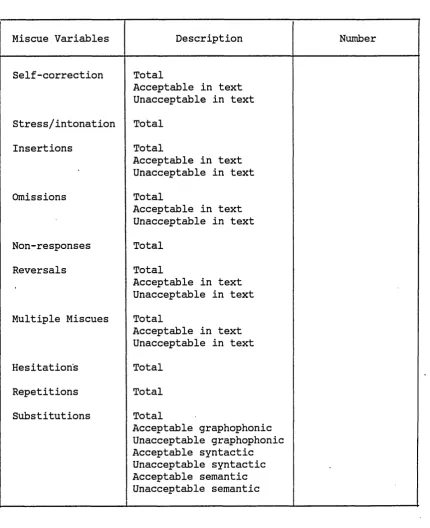
TABLE 1
THE MISCUE VARIABLES
Miscue Variables Description Number
Self-correction Total
Acceptable in text Unacceptable in text Stre s s/intonation Total
Insertions Total
Acceptable in text Unacceptable in text Omissions Total
Acceptable in text Unacceptable in text Non-responses Total
Reversals Total
Acceptable in text Unacceptable in text Multiple Miscues Total
Acceptable in text Unacceptable in text Hesitation's Total
Repetitions Total Substitutions Total
The criteria for the identification of the miscues made when reading owes much to the work of Kenneth Goodman (2.2.1). This section gives the criteria for the identification of each of the miscues and briefly states its significance in the analysis.
Self-corrections occur when a reader makes errors and then corrects them. An acceptable self-correction is when the previous error did not make sense. However, less acceptable is a reader who self-corrects an error that is acceptable in context. This could ’indicate a child anxious to please, who tends to sacrifice the flow of the reading for the accuracy of individual words, or who is not even aware that the original error made sense in the passage.
Stress and intonation miscues were only recorded if they resulted in changes in the meaning of the text. A stress miscue might give a word a different meaning as in "desert" and "des"ert". An intonation miscue might split a sentence so that part of it becomes part of the grammatical structure of another sentence and therefore changes the meaning, a statement might become a question or the dialogue of one character might be attributed to another.
reading strategy. On the other hand, it may show an immature reader who is unaware of the error, in which case the miscue will indicate less effective reading strategies.
Omissions occur when a word or words are left out of the passage. They should not be confused with non-responses which occur when a reader cannot process a word. Omissions indicate a mature reader who has processed the text and is adapting it to his/her own language and, on the whole, will be an indication of effective reading strategies. Such a reader may be processing the text so rapidly that small words, continually in use, for example the articles, may be omitted. However, unacceptable omissions were recorded if the meaning of the text were changed, for example if an adjective or a line of the text were omitted.
Non-responses are the least effective of reading strategies and occur when children cannot read the words. They may indicate an immature reader who does not know a word and who does not have the cueing skills to attempt to read it. They may also indicate a child lacking in confidence and possibly over-dependent on the teacher.
Multiple miscues involve a string of words that contains more than one miscue. It may indicate total breakdown in the reading, in which case it is listed as an unaccept able miscue. However, it may indicate a child who has made an error and is attempting to regain meaning. If this is successful, then effective reading strategies are shown. A child might also be reprocessing the text into a language structure that more closely approximates to his/her own and this is likely to indicate a mature reader.
Hesitations occur when a child pauses for several seconds before saying a word. Assessment of what constitutes a hesitation tends to be subjective and needs to be con sidered within the overall pattern of how a child is reading. A hesitation, for example, identified in a child who is reading rapidly, might not be given the same recognition in a child reading very slowly. Hesitations do not constitute errors. They may indicate a hesitant reader lacking in both confidence and cueing skills in which case less effective strategies are demonstrated, or they may indicate a reader who is reading ahead and try ing to gain time to process the text. In this case the strategies are more positive.
Substitutions occur when a word or words are substituted for part of the text. They are important as they can yield most information about the child's application of linguistic knowledge to reading. More effective readers begin to combine use of context with phonic knowledge and their substitutions will make sense in total context. Unacceptable substitutions mean that the sense of the passage is lost. Substitutions can be analysed for grapho-phonic, syntactic and semantic acceptability and unacceptability. Between, there is a range of possi bilities that show the reader is attempting to process the text so that a third level of partial acceptability was also identified.
For a substitution to be acceptable grapho-phonically, the phonemes at the beginning and end of a word, or at the beginning and middle, or the middle and end had to be the same as the expected response. For graphophonic partial acceptability, one phoneme of the observed response had to match the expected response or there was a reversal of letters, for example "was" for "saw". For unacceptability, the observed response had no similarity to the expected response.
expansion or contraction of the expected response was allowed with verb forms, for example the substitution of "shall not" for "shan't".
For partial acceptability, the substitution had to be acceptable grammatically with either the prior or succeeding part of the text, for example a verb might have a different tense that fitted the subject but might not make sense in the whole sentence. The observed response could also be a non-word to which the ending or intonation made it possible to assign a grammatical function, for example the substitution of "munning" for "running". For syntactic unacceptability, the substitu tion had to be a different part of speech from the expected response or a non-word to which neither the intonation nor the ending made it possible to assign a grammatical function. Finally, the substitution had to completely disrupt the grammatical structure of the sentence.
partially acceptable when the observed response only resulted in meaning being achieved with either the prior or succeeding parts of the text, and not both. They were also partially acceptable if there were either a change or loss of an unimportant detail in the story, for example in the comparative form of the adjective, or certain tense changes, for example "changed" and "have changed". For a semantically unacceptable substitution, the meaning of the sentence had to be disrupted and the substitution had to have no semantic relationship with either the prior or following parts of the text.
2.3 The variables in the retelling of the stories
2.3.1 Background to the variables concerned with the retelling of the stories
As part of the study, the criteria for the variables concerned with the content of the retelling of the story also had to be established. As a means of gaining additional information about how children read, Goodman (1978) requested a reader to retell the story immediately after the reading. He states that "the retelling provides information about the reader's ability to inter relate knowledge, to interpret, to draw conclusions and to develop concepts" and that "it adds to the picture of the subject's development of efficient and effective reading strategies." It can therefore be used as a test of the reader's comprehension of the text. His taxonomy for retelling the story (Goodman and Burke, 1973) included character analysis, description of the events or happenings in the story, and the order in which they were recalled, the plot or the central concern of the story and lastly the theme or viewpoint on which the story was built.
Research into the retelling of the story immediately after a reading appears to be scarce. The criteria for the selection of the variables was therefore based on the work of Goodman and on the researcher's evaluation of the retelling of stories based on several years of teaching bilingual children.
[image:49.612.157.508.312.436.2]2.3.2 The criteria for the identification of the variables in the story retelling
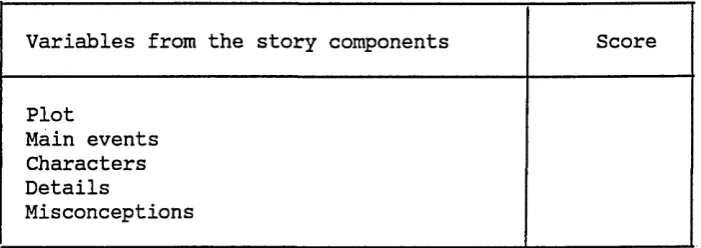
TABLE 2
THE VARIABLES FOR THE RETELLING OF THE STORIES
Variables from the story components Score
Plot
Main events Characters Details
Misconceptions
The plot of the story
It was hypothesised that, although some children might recall different parts of the story, the plot might not be fully understood and therefore the major problem, result or purpose in the story might be ignored. Between five and eight major facts were identified as being crucial to the understanding of each story and were listed as constituting the story plot. The major facts identified as the plot of the story are listed in Appendix B, Stories 1-8.
The main events
These were considered to be the action of the story, the happenings and activities. The omission of any of them would change the story. A list of these events are given for each story (Appendix B, Stories 1-8). In addition, anything that might reasonably be inferred from the story was also included in the marking as was any pertinent evaluation that the child might make of the story.
List of characters and character attributes
Details of the story
These were considered to be any facts inessential to the development of the story. They included the description of places, the manner in which something happened, or a minor piece of action or any remark that did not affect the main events in the story. A mark was given for each detail recalled.
Misconceptions
These were defined as any departures from the expected response that the child might make. It did not include anything that had been omitted by the child as this had been taken account of in marking for the plot of the story, the main events, character attributes and details of the stories. The misconceptions were any concepts or inferences the readers might make during the retelling which indicated that they were using the story material inappropriately. Such misconceptions would indicate some loss of comprehension or some misunderstanding on the part of the reader. No previous research analysing the misconceptions of bilingual children retelling a story in their second language was found. It was hypothesised that if any misconceptions were identified, a more detailed analysis might have provided useful information for teachers. The total number of misconceptions was recorded.
2.4 The variables in the comprehension tests
2.4.1 Some comments on comprehension in reading
The Bullock Report (1975) identified three categories of comprehension skills. In literal comprehension, the reader needs to be able to identify facts explicitly set down in the text, including details and main ideas. For inferential comprehension, the reader needs to interpret ideas or thoughts which have not been made explicit in the text and which includes the use of figurative language. With evaluative comprehension, the reader decides on the worth and acceptability of the material. Barrett's taxonomy, quoted by Clymer (1972), also includes "reorganisation" as a dimension of reading comprehension, requiring the student to "analyse, synthesise and/or organise ideas or information explicitly stated in the selection."
comprehension, that is drawing inferences from more than one part of the text, interpretation of metaphors, separating main themes from the rest of the text and forming judgements. Some of these aspects of comprehen sion were used to establish the variables for the comprehension tests in this study. This was because the pilot study into the reading of ESL children (Davis, 1982) and prior research into the educational performance of Asian children (1.4) had indicated that the variables on a comprehension test might show differentials between bilingual and monolingual children.
[image:53.612.106.517.4.568.2]2.4.2 The criteria for the identification of the variables in the comprehension tests
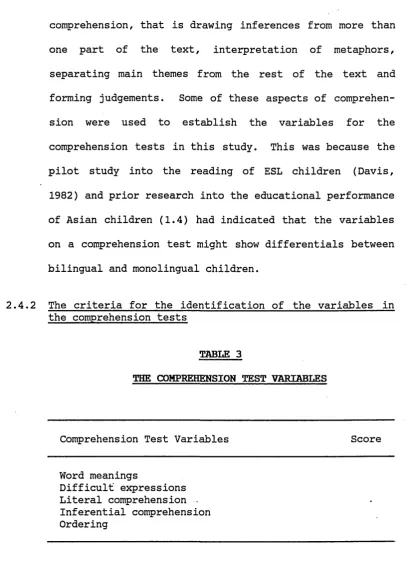
TABLE 3
THE COMPREHENSION TEST VARIABLES
Comprehension Test Variables Score
Word meanings
Difficult expressions
Literal comprehension *
Inferential comprehension Ordering
The criteria for each of the variables examined by the questions are outlined below. The questions are given in Appendix C.
Word meanings (Question 1)
Meanings of words in context (Question 2)
Words that had more than one meaning were chosen and the child had to identify their correct meaning in the context of the passage.
Meanings of more difficult expressions (Question 13)
This description was left purposefully vague. It included figures of speech such as metaphors and similes. It also included idiomatic expressions that it was considered might be difficult for the children to interpret. In the main, they were items consisting of several words, the meaning of which could not be deduced from individual words.
Literal comprehension (Questions 3-12)
In these questions, the answers could be found in a single phrase or sentence. The phrasing of the question was also part of the phrasing of the answer.
Inferential comprehension (Questions 14-19)
The questions entailed finding the answers from more than one area of the text. They might also involve making comparisons or identifying the main idea.
Sequencing (Question 20)
The child had to list the ideas, presented in the question as an .incorrect order of events, in the proper order.
2.5 The variables in the GAP test
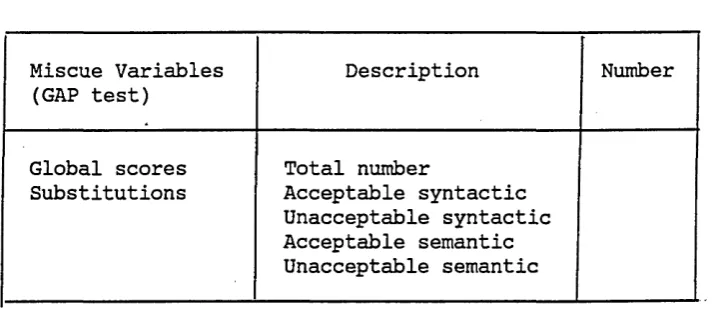
TABLE 4
THE GAP TEST VARIABLES
Miscue Variables
(GAP test) Description Number
Global scores
Substitutions Acceptable syntactic Total number Unacceptable syntactic Acceptable semantic Unacceptable semantic
The GAP test (Appendix D) is a comprehension test that leaves a blank for the child to construct his/her own response. It can be used to show how successful a child is in using the semantic and syntactic cues of a passage and the extent to which a child searches for clues both before and after the deletion. To do this, a similar system of syntactic and semantic variables can be estab lished for the substituted words as was done for the substitutions made during the reading of the story
(2.2.3).
assessed both syntactically and semantically for acceptability, partial acceptability and unacceptability in total context. This meant that the correct word was given a score but that equal credence was also given to any other word that made sense in total context. As with the variables in the miscue analysis of reading, the partially acceptable substitutions were identified but ultimately were not included in the final tabulation of the data. It was considered they were of less relevance to the study.
2.6 The variables concerned with attitudes to reading
Research into reading tends to centre on comprehension, word recognition and phonic skills; less attention has been given to research into attitudes to reading. Ewing (1981) defines attitudes to reading as "including the individual's feelings, beliefs and values as elicited in reaction to reading in general and to identifiable reading experience." He identifies research in this field, Estes Attitude towards Reading Scale (1974), Kennedy and Halinski's Attitude Test for Secondary Schools (1975) and the Dulin-Chester Scale (1974). However the variables listed in each of these scales were considered by Ewing as being either too complex or as giving "rather neutral results". Accordingly he developed a series of statements about reading that was rated on a five point scale. One of these measurements was used in the present research (Appendix E). Research has been identified that indicates Asian children may. be underperforming in schools compared with English children
(1.4). Authorities (Swann, 1985, Twitchin and Demuth, 1985)
indicate the demotivating factors of an Anglo-centric approach to the curriculum and Hicks (1981) and Klein (1981) indicate the drawbacks of materials that stereotype and caricature other cultures. These factors may affect attitudes to school and to reading.
The measurement used to test the hypothesis was taken from Ewing's "Attitude to Reading Measurement and Classification within a Curricular Structure" (1981). The ATR2 global attitude was chosen (Appendix E). It has eighteen statements that have to be assessed for "definitely disagree", "probably disagree", "not sure", "probably agree" and "definitely agree". The statements have a mixture of positive and negative attributes. Numbers 3, 5, 6, 7, 10, 12, 13, 17 and 18 are the positive statements and score from 1 to 5 for the five points of the scale. The negative statements are numbers 1, 2, 4, 8, 9-, 11, 14, 15 and 16, and score from 5 to 1 for the five points of the scale. The resulting scores may indicate a negative attitude (18-53), a neutral attitude (54-60) or a positive attitude (61-84). In this study, the total score from all the variables was recorded for each child.
2.7 Summary
CHAPTER 3
THE DESIGN OF THE STUDY - THE SUBJECTS
3.1 Introduction
In identifying the subjects, the following criteria were considered. There was need for relevance in the choice of subjects, so that as far as possible the research population would be able to provide the information needed. The sample needed to be representative of the population from which it was chosen. The sample also needed to be able to cope with the work involved in the research. Lastly, as far as the subjects were concerned, there was the need to consider the constraints of time, place and attitude for the institutions involved in the research. The schools involved had to be able to allow time for the children to take part in the research, space needed to be available and it was desirable for success that the research should be regarded favourably in the schools concerned.
This chapter identifies the subjects and describes their cultural and linguistic background. It lists the schools involved in the research. It gives the criteria for matching the monolingual and bilingual subjects and tabulates the resulting match.
3.2 The background of the bilingual children
here. Henley and Taylor (1981) state that "the people from Mirpur speak a dialect of Punjabi called Mirpuri." In Pakistan, Punjabi may, for many, be the oral medium but for Muslims, Urdu is the written language. It is also the administrative language of Pakistan so parents educated in Pakistan will be literate in Urdu. Within the Pakistani families in Sheffield, some of the fathers will be literate in Urdu and speak English, whereas most of the mothers speak Punjabi and may speak little or no English. Most of the children attend the mosque after school where they learn Qu'ranic Arabic and Urdu.
Three groups of bilingual children may be identified among the Pakistani children in Sheffield. Firstly there are a small minority from homes where both Urdu and English are spoken. Secondly there are those who speak mainly Punjabi/Urdu at home with some English to older brothers and sisters. Lastly there are those who speak no English at home. Of these groups, the bilinguals in this study belong to the last two, that is speaking mainly Punjabi/Urdu at home and English at school.
Coates et al (1978) in the Sheffield Asian School Leavers1 Project stated that "Urdu is the official language of Pakistan. Punjabi is the main dialect." In the School Languages Survey
minority groups tend to be more heavily concentrated in some areas than others. In this way, families are assured of the close support of the extended family which cannot operate so effectively in isolation. They are also able to observe their religion, and children can attend mosque schools in the evenings and at the weekend to learn about their faith and culture.
MacKillop (1980) has written about the background of the Pakistani families in Sheffield stating that "the social networks most Pakistani families left behind in their villages are very different from those in our urban industrial society. Within the self-contained confines of the village, life is strictly organised. The extended family gives support to both relatives and close friends; religions and social life is governed by Islamic Law." Though the majority of children in this study were born in England, family ties with Pakistan are strong and several of the children have returned to Pakistan for long holidays. Most of the parents were born in Pakistan and strong links with the home country are maintained.
All the bilingual children in the study had most of their early education in England, either in infant or first schools, and several had been to nursery schools. As the children were all over the age of eight years, they had been learning English for four years or more, and had passed the initial phase of learning English as a second language (1.3).
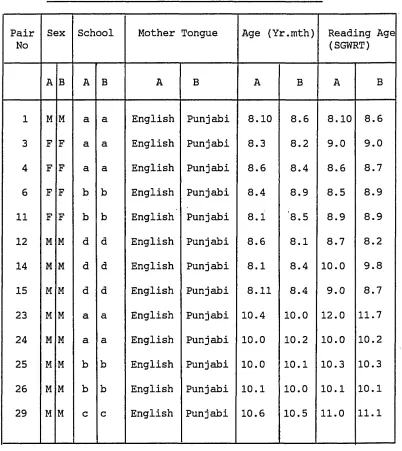
3.3 The matching of the subjects
bilingual and monolingual subjects to achieve a matching of pairs of children. It was considered that the Pakistani children in these schools were a representative sample of the Punjabi-Urdu speakers in the city. The schools were also generous about offering time and accommodation for the research. The criteria initially established therefore for the identification of the subjects (3.1) was observed.
TABLE 5
SUMMARY OF THE MATCHED PAIRS (8.0 - 8.11 YEARS)
Pair
No Sex School Mother Language Age (Yr.Mth) Age (SGWRT)Reading
A B A B A B A B A B
1 M M a a English Punjabi 8.10 8.6 8.10 8.6 2 M M a a English Punjabi 8.7 8.7 8.2 7.10 3 F F a a English Punjabi 8.3 8.2 9.0 9.0 4 F F a a English Punjabi 8.6 8.4 8.6 8.7 5 F F a a English Punjabi 8.8 8.0 7.10 8.1 6 F F b b English Punjabi 8.4 8.9 8.5 8.9 7 M M b b English Punjabi 8.6 8.8 7.1 7.4 8 F F b b English Punjabi 8.11 8.9 8.1 7.9 9 F F b b English Punjabi 8.1 8.0 7.2 7.5 10 F F b b English Punjabi 8.11 8.10 7.1 7.2 11 F F b b English Punjabi 8.1 8.5 8.9 8.9 12 M M d d English Punjabi 8.6 8.1 8.7 8.2 13 M M d d English Punjabi 8.11 8.1 7.6 7.8 14 M M d d English Punjabi 8.1 8.4 10.0 9.8 15 M M d d English Punjabi 8.11 8.4 9.0 8.7 16 F F d d English Punjabi 8.8 8.11 7.8 8.1 17 F F d d English Punjabi 8.7 8.8 6.10 6.11 18 F F d d English Punjabi 8.3 8.7 7.5 7.3 19 F F d d English Punjabi 8.7 8.11 7.10 8.2 20 F F d d English Punjabi 8.3 8.9 6.10 6.11
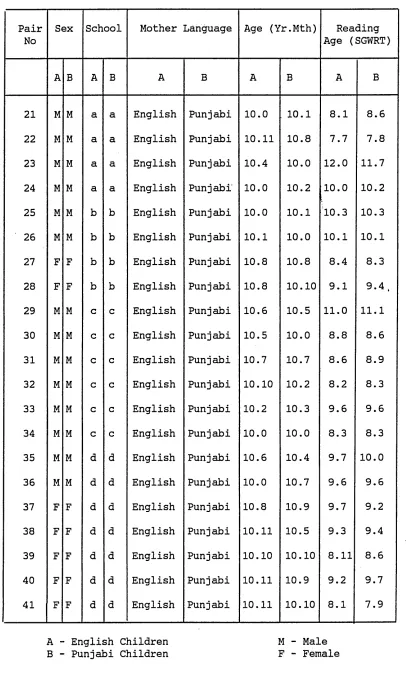
TABLE 6
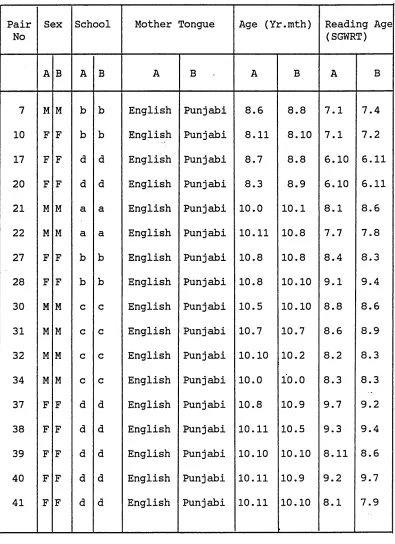
SUMMARY OF THE MATCHED PAIRS (10.0 - 10.11 YEARS)
Pair
No Sex School Mother Language Age (Yr.Mth) Age (SGWRT)Reading
A B A B A B A B A B
21 M M a a English Punjabi 10.0 10.1 8.1 8.6 22 M M a a English Punjabi 10.11 10.8 7.7 7.8 23 M M a a English Punjabi 10.4 10.0 12.0 11.7 24 M M a a English Punjabi' 10.0 10.2 10.0 10.2 25 M M b b English Punjabi 10.0 10.1 10.3 10.3 26 M M b b English Punjabi 10.1 10.0 10.1 10.1 27 F F b b English Punjabi 10.8 10.8 8.4 8.3 28 F F b b English Punjabi 10.8 10.10 9.1 9.4 , 29 M M c c English Punjabi 10.6 10.5 11.0 11.1 30 M M c c English Punjabi 10.5 10.0 8.8 8.6 31 M M c c English Punjabi 10.7 10.7 8.6 8.9 32 M M c c English Punjabi 10.10 10.2 8.2 8.3 33 M M c c English Punjabi 10.2 10.3 9.6 9.6 34 M M c c English Punjabi 10.0 10.0 8.3 8.3 35 M M d d English Punjabi 10.6 10.4 9.7 10.0 36 M M d d English Punjabi 10.0 10.7 9.6 9.6 37 F F d d English Punjabi 10.8 10.9 9.7 9.2 38 F F d d English Punjabi 10.11 10.5 9.3 9.4 39 F F d d English Punjabi 10.10 10.10 8.11 8.6 40 F F d d English Punjabi 10.11 10.9 9.2 9.7 41 F F d d English Punjabi 10.11 10.10 8.1 7.9
3.3.1 The Schools ,
Four schools within the Sheffield City Education Authority took part in the research. They were older schools within three miles of the city centre. Two of the schools were Middle Schools and two were Junior Schools. To effect a reasonable match of subjects, it was hypothesised that 25% or more of the children should be bilingual in each schoo^ and these four schools ful filled this criteria. At the time of the research, one of the Middle Schools had a Language Centre, though the children have since been integrated into mainstream classrooms. Each of the other schools had some additional support from a Sheffield Task Force teacher specialising in teaching English as a second language. The number of Pakistani children in each school varied from 25% to over 65%. In each school, there was a small percentage of other minority groups including West Indian, Bengali, Chinese, Indian, Arabic and Vietnamese children.
There did not appear to be any significant differences in the teaching of oral language or reading between the four schools. Oral language was being developed through visits outside school and the use of materials in school, so that language was being supported by practical experience. Language Centre teachers and ESL Task Force teachers were working with small groups of bilingual children who were in the early stages of learning English as a second language.
With 'regard to the teaching of reading, there was a variety of approaches within all four schools. Phonic skills were being taught, practice was being given in both silent reading and reading aloud and there was some use of cloze passages. Dictionary skills were being practised and comprehension exercises were being used. In all the schools, progression was mainly achieved through reading schemes, many of which used a language experience approach, by which the language used in the readers approximated to the children's own language. "Breakthrough to Literacy" (Mackay et al, 1970) was the first reading scheme to relate more closely to the language of young children. Other readers, such as "Link Up" and "Reading 360" which have followed a similar philosophy, were to be found on the schools' shelves. Some of the supplementary readers, used to move children sideways to consolidate their reading, did not always reflect this approach, for example the Ladybird books. Some readers, for example the Wide Range Readers, also had some content that was racist, especially in the stereotyping of other cultures and in the Euro-centric view of the world that was portrayed. In all the schools, the readers were colour-coded for easy identifi cation and were readily accessible to the children.
3.3.2 Sex
girls may be ahead of boys. At this age they develop physically more rapidly especially during the second half of their time in primary school.
little they can do to improve standards for girls who may be underperforming.
In conclusion, the match for sex was made because of differences in the maturational ages of boys and girls at primary schools. Attitudes and expectations towards Muslim girls might also have some effect on the findings, especially if staff considered the girls to be too quiet or unlikely to be as successful as boys because of home expectations.
3.3.3 Chronological Age
know what can be expected of the monolingual native speaker." A match within a year group might, therefore, give some indication of any differentials in the miscues made when reading and in attitudes. It would establish the areas where differences between monolingual and bilingual readers might be expected. If two groups with different chronological ages were also identified, then there might also be differences in the two sets of data. It might be hypothesised that an older group might show the bilingual children beginning to reach parity with the monolingual children, whereas with the younger group there might be greater differentials.
possibility that children younger than the subjects identified in the study might be nervous about being taped when reading, especially if reading strategies were only beginning to be established. This might be heightened for younger children if the research were being carried out by a stranger.
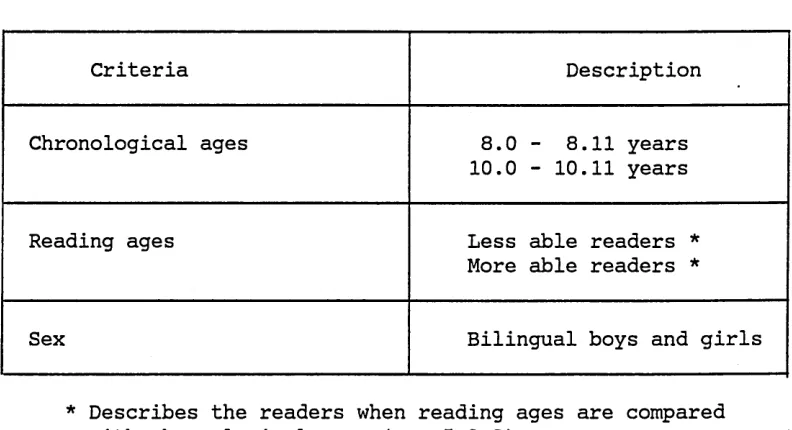
In the matching, two year groups were identified. Firstly, children in their Ml or J2 years, that is the first year at a Middle School or second year at a Junior School, and aged between 8.0 years and 8.11 years. Secondly, children in their M3 or J4 years, that is in the third year in a Middle School or last year in the Junior School, and aged between 10.0 years and 10.11 years.