Munich Personal RePEc Archive
Democratic Reforms, Foreign Aid and
Production Inefficiency
Christopoulos, Dimitris and Siourounis, Gregorios and
Vlachaki, Irene
Department of Economic and Regional Development, Panteion
University
June 2010
Democratic Reforms, Foreign Aid and
Production Inefficiency
Dimitris Christopoulos▲, Gregorios Siourounis■, and Irene Vlachaki●
June 2010
Abstract: We construct an endogenous growth model and we employ empirical
analysis to investigate the link between foreign aid and production inefficiency in the
presence of different political orientations in the recipient country. Using a panel of
124 countries from 1971 to 2007 and the production frontier toolbox, controlling for
unobserved heterogeneity, time horizons, the sources of aid, and the timing of aid
impact, we document that foreign aid is associated with higher production
inefficiency and that this inefficiency is reduced considerably if countries switch to
democratic governance. Our study contributes to the aid literature by pointing to the
institutional enhancement of the recipient countries through the adoption of
democratic ruling practices.
JEL Classification: C01, D24, F35, O43.
Keywords: Democratic reforms, foreign aid, production inefficiency.
▲ Department of Economic and Regional Development, Panteion University, Leof. Syngrou
136, Athens 176 71, Greece
■ Corresponding author: Department of Economics, University of Peloponnese, Terma
Karaiskaki Str., Tripoli 221 00, Greece, e-mail: [email protected]
● Department of International and European Economic Studies, Athens University of
1 1. Introduction
Much of the recent literature on foreign aid has focused on its effectiveness in
facilitating economic growth for recipient countries.1 Yet, this literature is far from
conclusive with recent studies arguing in favour of no effect at all.2 None, however,
has examined the indirect effects of aid that −although do not appear in per capita
economic growth− are important elements of its effectiveness. Instead of looking at
the direct impact of foreign aid on growth we look at the production inefficiency
reduction in the presence of foreign aid. Since foreign aid is managed by the ruling
class within a certain political environment, it is interesting to see if, in addition, there
are differential effects conditional on this environment.3
This paper uses a theoretical model and employs panel data techniques to answer a
simple question: what is the impact of foreign aid on the production inefficiency of
the recipient country conditional on its political governance. We define inefficiency as
the distance between the actual production and its potential level given the available
input resources and technology. If foreign aid is asymmetrically beneficial to any
production input and total factor productivity conditional on political governance, we
should observe a reduction in production inefficiency during democratic years.
Seeking to reveal the interactive effects of foreign aid and democracy on production
inefficiency, we test the following proposition which is derived from the aid-growth
and the democracy-growth literature: foreign aid will foster production efficiency in
democracies but not in autocracies; in other words, aid will be used inefficiently and
consequently reduce productivity in autocracies.
To empirically investigate whether foreign aid is associated with reductions in
production inefficiency we initially examine a sample of 124 bilateral and/or
multilateral aid recipients for the period 1971-2007. We then assess if this inefficiency
effect differs before and after incidents of permanent democratization during the Third
Wave of democratization and the 1990s. The panel results reveal some novel
evidence. First, controlling for time-invariant, country-specific characteristics and
global shocks, an increase of foreign aid by 1% increases production inefficiency by
0.7%. This effect, however, cancels out by an opposite positive efficiency effect of
1
For detailed reviews and evidence see Kanbur (2006), Doucouliagos and Paldam (2008), and the papers cited therein.
2
See, for example, Boone (1996) and Rajan and Subramanian (2008). 3
2
foreign aid during democratic years when aid shows to reduce inefficiency by
approximately the same magnitude. Second, although the direct effect of aid on
inefficiency is positive, there is evidence of an inverted U-shaped negative
inefficiency effect when aid interacts with democracy; early before countries switch to
democratic rule aid has a strong effect on inefficiency reduction which diminishes
significantly by the 4th, 5th and 6th year after democratization to pick up again
afterwards. Third, we find that moderate but stable political changes towards
democracy bolster production inefficiency reductions more than abrupt political
transitions.
We are not aware of any other paper that studies directly the link between foreign
aid and production inefficiency. The closest study to ours is that of Rajan and
Subramanian (2010) which show that aid inflows have systematic adverse effects on a
country’s competitiveness, as reflected in a decline in the share of labour intensive
and tradable industries in the manufacturing sector. They also show that these effects
stem from the real exchange rate overvaluation caused by aid inflows. By contrast,
private-to-private flows like remittances do not seem to create these adverse effects.
Our analysis departs from this study in three distinctive ways: (i) we associate directly
foreign aid with production inefficiency, (ii) we provide a theoretical framework to
explain how foreign aid affects total production inefficiency abstracting from factor
specific shares and prices, and (iii) we link foreign aid and production inefficiency to
the political orientation of recipients.
The rest of the paper is organized as follows. Section 2 provides an extended
review of the related literature and outlines the theoretical arguments of the key
relationships. Section 3 presents the theoretical framework of aid effectiveness and
section 4 provides the empirical methodology. Section 5 describes the dataset at hand
and reports the benchmark empirical results. Section 6 presents and discusses the
main empirical findings and finally section 7 concludes the paper.
2. Related Literature
Ample empirical literature on the cross-country aid-growth nexus using different time
horizons, channels and methodologies has reported very poor results so far, most of
them conditional on various but specific aspects of aid. Burnside and Dollar (2000),
for example, show that the growth impact of aid is conditional on the quality of
3
framework and Dalgaar et al. (2004) focus on the geography of aid allocations.
Clemens et al. (2004) argue that disaggregating aid is important and find evidence of a
positive, causal relationship between “short-impact” aid and economic growth
regardless of the recipient’s financial or institutional environment.4
Recent theoretical and empirical literature has emphasized the role of institutions
in the economic performance of countries.
Finally, Rajan and
Subramanian (2008) show that a comprehensive examination of the aid-growth nexus,
controlling for unobserved heterogeneity, endogeneity, different empirical model
specifications, time horizons, the sources of aid and the timing of aid impact, leaves
no room for a robust statistical relationship between aid and growth.
5
Several empirical studies have shown that
the most important institutional change of a country, that of democratization, asserts a
positive effect in long-run growth under certain conditions.6
As a theoretical argument of the aforementioned differential effect of aid one can
assert that political contestation and institutional constraints inherent in a democracy
not only prevent its leaders from predating on the society but also force them to
allocate resources –like aid– efficiently on an egalitarian basis. Angeles and Neanidis
(2009) show that the type of the local elite matters for the use of foreign aid but the
authors don’t associate this type with the political regime of the country. We do this in
the present study by matching the behavior of the local elites with the political
orientation of the state alongside foreign aid usage.
Yet, there is little, if any,
attention on the link between this major institutional change and the way foreign aid is
distributed, monitored and used in the recipient countries. Although there is evidence
that democratization leads to more foreign aid (see, for example, Alesina and Dollar,
2000), no one has so far investigated comprehensively the effect of aid on production
efficiency under different political regimes. A joint look at both fields is the
innovation of the present study.
More specifically, autocratic rulers tend to misuse state resources for political
reasons at the expense of investment and long-run growth and they are more inclined
to provide private benefits to political opponents rather than public goods to citizens,
4
In their analysis “short-impact” aid includes budget and balance of payments support, investments in infrastructure, and aid for productive sectors such as agriculture and industry. 5
For a review see Acemoglu et al. (2005). 6
4
as such an allocation better serves their desire to stay in office (Bueno de Mesquita et
al., 2001). This incentive of “rational self-interested dictators” is even stronger when
their time horizon is relatively short (Olson, 1993; Wright, 2008). On the other hand,
in democracies where the winning coalition becomes large relative to the electorate
and political contestation is more intense, political leaders have to provide sufficient
public goods as a means of securing popular support and political survival. In this
sense, democratic leaders are more pressured to distribute state resources, like foreign
aid, effectively and equally for the public rather than use it to favour a small minority
of the population. In turn, more equal distribution of foreign aid helps citizens accrue
precious capital and motivate them to invest for growth. Following this rationale, one
would expect increased aid effectiveness in more democratic recipients.
However, from the extant literature one can also derive the opposite hypothesis:
foreign aid may depress growth in democracies rather than in autocracies. The main
reason is that democracies of established participatory rights and civil liberties face
enormous public pressure for immediate state expenditure and equal resource
distribution, voiced easily by strong interest groups via formal channels (Huntington,
1968; Sirowy and Inkeles, 1990; Przeworski and Limongi, 1993; Przeworski et al.,
2000). Yet, economic theory teaches us that sustained growth requires increased
accumulation of capital for future investment along with decreased current
consumption. In essence, while democratic governments tend to satisfy voters’
demands for current consumption at the expense of long-term growth, autocratic
leaders of long time horizons and less political contestation have the nearly absolute
state autonomy to use aid resources in order to pursue rapid economic development
(Olson, 1982; Przeworski and Limongi, 1993). Taken these arguments together, it
becomes clear that whether foreign aid will stall or promote growth in the recipient
country depends crucially on the political environment of the recipient and the time
horizon of the ruling regime. In the following sections we develop a simple theoretical
model to describe the channels of aid effectiveness and we employ econometric
analysis to empirically test the model predictions.
3. A theoretical model of production efficiency and aid
Production efficiency and technological progress are the two components of total
factor productivity (Grosskopf, 1993). Production efficiency is of great importance for
5
While by technological progress we mean the expansion of the set of production
possibilities, an increase in production efficiency is synonymous to a more efficient
use of the existing production inputs and corresponds to a convergence towards the
production frontier. The production frontier thus refers to the maximum technically
feasible output attainable from a given set of production factors.
Following Drine and Nabi (2010) we construct an endogenous growth model of a
closed aid-recipient economy to describe how foreign aid affects domestic production
efficiency. A key feature of the model is the realistic hypothesis that a part of the
economy’s output is produced in the informal sector.7
Foreign aid is provided by donors directly to the local government of the recipient
country and is subject to misuse the extent of which depends on the government’s
policy; the government provides a part of it to co-finance the formal investment
projects of the economy and keeps the rest for own purposes. Foreign aid for
investment co-financing poses an incentive for investors to engage in the efficient
formal sector as it increases profits. The resulting shrinkage of the share of informal
sector is actually the mechanism through which foreign aid affects production
efficiency in the recipient economy. However, we assume that the profits of the
formal sector are subject to expropriation. By expropriation we mean any event that
abridges an investment, for instance acts of the government, such as actual
expropriation, capital levies, unexpected export or excise taxes, ownership risk due to
low protection of property rights, theft by private parties and actions by capricious or
ineffective courts. Investors of the informal sector do not suffer such losses, but have
to pay some cost of informality. Intuitively, investors’ decisions determine the relative This sector is widely accepted
to be less efficient than the formal one (Loayza, 1997; Johnson et al., 1997; Schneider
and Enste, 2000) due to non-exploitation of economies of scale (Ferreira-Tiryaki,
2008) and due to no access to financial markets (Lubell, 1991). The relative size of
the informal sector determines the production efficiency of the economy. Investors of
the economy have two choices: invest in the formal sector or the less efficient
informal one.
7
6
size of the informal sector and, eventually, the production efficiency of the economy.
Finally, to the extent that both aid misuse and investment expropriation risks −that
affect investors’ decisions− are associated with the political environment and the
institutional framework of the recipient country, we expect foreign aid to affect
production efficiency differently in each country, depending on the existing domestic
conditions.
We consider an economy of overlapping generations with an infinite, discrete time
horizon, t=0,1, 2... The economy produces a consumption good using capital and labour and an investment (or capital) good using the consumption good. At each date
a new generation of two-period living agents of mass 1 is born. The old of the first
generation are endowed with a stock k0 of capital good. Agents are endowed with one
unit of labour which they supply inelastically and at no disutility cost to the
consumption good sector during their first period of life and receive a wage which
they invest during their second period of life in order to maximize final consumption.8
Thus, labour supply is L=1 in each period. Old agents face a tradeoff when choosing
between a formal and an informal project: On the one hand, a formal project is
eligible for a complementary subsidy financed by aid, but generated profits are subject
to expropriation. The informal project, on the other hand, cannot be expropriated but
is self-financed and involves some informality cost.
3.1. Consumption good sector
The consumption good is produced out of capital K and labour L and is tradable. We
assume a Cobb–Douglas production function of constant returns of the form
1 a t t t t
Y =A K Lα − . (1)
If we set, for simplicity, the aggregate level of “knowledge” At equal to the aggregate
stock of capital = 1−a =
(
/)
1−at t t t
A Ak A K L , then the production of the consumption
good corresponds to the capital stock Yt = AKt and per capita output is given by
t t
y = Ak . (2)
8
7
Generated output is entirely distributed to workers and to investment good producers.
The factors’ prices are equal to their marginal productivity and capital depreciates
fully after production. Assuming further that A=1, we can write the price of capital
and labour respectively:
= t a
ρ
(3)
(
1)
= −
t t
w α k . (4)
3.2. Capital good sector
Old agents make their investment decision on a profit-maximization basis taking into
account the following: Any capital good, regardless of its type, is produced using a
linear technology of the form bqt, where b>1 and qt denotes the quantity of the
consumption good used in production. A formal project is eligible to a complementary
subsidy dtf in terms of the consumption good. This subsidy is financed by aid and
increases the amount of the consumption good invested in the formal project (qt) to
f t t
w +d and the quantity of the capital good produced to
(
)
1
f f
t t t
k+ =b w +d . (5)
Undertaking a formal project provides the agent an income f1 t
ak+ in terms of the
consumption good where a is the unit price of the capital produced. Assuming, for
simplicity, zero production cost, the generated income stands for the agent’s profits
and since the latter are subject to expropriation 0≤ ≤τt 1, then the agent’s net profit from the formal project is
(
)
(
)
1 1
f f
t t ab wt dt
π+ = −τ + . (6)
The alternative choice of the agent is to undertake an informal project. This
investment is self-financed but profits are not subject to expropriation. Thus, the
technology here is
1 j
t t
k+ =bw. (7)
Moreover, informal projects involve some cost of informality ctj+1 which reduces the
agent’s net profit to j1
(
j1 j1)
t a kt ct8
informality cost includes, for instance, bribes that enable the masking of the activity
or high transport costs due to distant firm localization and is assumed to vary across
agents and production level, j1
(
1)
j1t j t
c+ = −θ k+ , where the parameter θj is agent-specific
and is distributed uniformly on [0, 1]. Therefore, we can write the agent’s net profit
from the informal project as
(
)
1 1 1
j j j
t a kt ct a bwj t
π+ = + − + = θ . (8)
Each agent chooses the project that maximizes his net profit. Hence, at date t the
condition for choosing the informal project is j1 f1 t t
π+ ≥π+ and the set of informal
entrepreneurs is Θ={j such that θj∈[ ,1]θt },where θt is defined by
(
)
1 1 1
f f
t t
t t
t t
d
abw w
π
θ = + = −τ +
. (9)
The set Θ of formal entrepreneurs includes agents who support sufficiently high cost of informality and for whom it is more interesting to undertake formal projects
{j
Θ = such that [0, ]}θj θt . Notice that θt and 1−θt correspond to the share of the
formal and the informal sector respectively (0≤θj ≤1). As expected, the share of the
formal sector increases as the ratio of the investment subsidy to wage increases and as
the expropriation risk decreases. The intuition is simple; agents will be encouraged to
invest in the efficient formal sector as the projects co-financing increases and as the
profits of the sector become more secured.
3.3. Government
In each period t the country receives an amount dt of foreign aid per capita through the
local government. The government is responsible for the management of aid and
controls its allocation in the economy. Depending on the nature of the government,
foreign aid is subject to misuse. The government allocates a proportion 0≤ ≤λt 1 to self-interest purposes and a proportion 1−λt to co-finance the formal investment
projects. Thus, foreign aid per capita to the efficient formal sector equals
(
1)
f
t t t
9
The extent of aid misuse λt depends on the institutional framework of the recipient
country and the political environment.
3.4. The size of the formal sector and the role of aid
In this section we relate the relative size of the efficient formal sector with foreign aid.
This relationship is the mechanism through which aid affects production efficiency
because, as we will see below, production efficiency is a positive function of the share
of the formal sector. Using (9) and (10) the share of the formal sector can be written:
(
1)
1(
1−)
= − +
t t
t t
t d w
λ
θ τ . (11)
Differentiating (11) with respect to aid per capita we easily obtain
(
)(
)
11 t 1 t 0
t t
d w
θ τ λ
∂ = − − ≥
∂ . (12)
Interestingly, an increase in aid per capita increases the share of the efficient formal
sector in the economy. However, the magnitude of this effect depends negatively on
two closely related factors; the first one is the expropriation risk, implying that in a
hostile economic and institutional environment foreign aid will result in an enlarging
of the formal sector, the magnitude of which will be nevertheless small compared to
what would be the case in a more favorable environment. The second factor is the
extent of aid misuse; the greater the mismanagement of aid, the smaller the increase of
the formal sector as a result of aid receipts. The economic implications of these
relationships are recovered in the next section where we model production efficiency.
3.5. Production efficiency and foreign aid
Production efficiency is defined, at each period, as the ratio of the actual output per
capita to the potential output per capita. Thus, production efficiency of period t+1 can
be written
1 1
1 t t
t y y
φ + +
+
= . (13)
From (2) and (13) it follows that φt+1=kt+1/kt+1, i.e. the production efficiency of the
10
quantity of the capital good available at t+1 is the sum of the output of the formal
sector f1 tkt
θ + and that of the informal sector
(
)
11
t
j jkt d i
θ
θ + θ
∫
. By substitution from (5), (7)and (10) we obtain
(
)
(
)
1(
)
(
)
1 , ,
t
f
t t t t j t i t t t
k b w d bw d bw h
θ
θ θ θ θ λ
+ = + +
∫
= (14)where
(
)
(
)
2
1 1
, 1
2
t t t
t t t
t d h
w
λ θ
θ λ =θ + − + −
. (15)
As expected, production efficiency is a positive function of the share of the formal
sector and a negative function of the extent of aid misuse. Moreover, from (12), (14)
and (15) we can recover the marginal effect of aid on production efficiency
(
)(
)
(
)
1 1 1 1 1 1 0
t t t t
t t t t t t
t t t t
d k k
bw z z d
dd d d
φ θ τ τ
θ
+ =∂ + +∂ + ∂ = − + + ≥
∂ ∂ ∂ (16)
where
(
1 t)
t t z w λ − = .Evidently, the efficiency effect of aid is not uniform but rather depends negatively on
the expropriation risk and the extent of aid misuse. Notice, however that both factors
are indicators of political governance and institutional quality in the recipient
countries. This means that, to the extent that democratic ruling is linked to better
institutions and greater political accountability, we expect aid to encourage formal
investment activities and, consequently, production efficiency in democracies and not
in autocracies (λt=1). We can thus derive the following testable prediction:
The efficiency effect of aid depends on the political environment of the recipient
country with democratic countries enjoying production efficiency as a result of aid.
4. Empirical methodology
In this section we describe the empirical methodology we employ to test the
theoretical prediction. Let the production function be written as a Translog form as
11
2 2
2
1 1
ln( ) ln( ) ln( ) ln( ) ln( )
2 2
ln( ) ln( ) ln( ) ln( )
1 2
= + + + +
+ + +
+ + + −
it i K it L it KK it LL it
KL it it KT it LT it
T TT it it
Y K L K L
K L K T L T
T T V U
α β β γ γ
γ γ γ
δ δ
(17)
1, 2,... , 1, 2,... , i= N t= T
where Yitis the level of output for the ith country in the tth time period and Kitand Lit
indicate physical capital and labour respectively. T is a proxy for the exogenous
technological progress. αi shows country specific effects and are introduced in the
model to distinguish unobserved heterogeneity from the inefficiency component as in
Greene (2005). Finally, Vit is a two sided error term, i.e. ~ (0, ) 2
V it N
V σ while Uit is a
non-negative, unobservable variable associated with the technical inefficiency of
production, distributed as Uit =g w U( it) i where wit is a set of factors explaining
technical inefficiency while ~| ( , 2)|
U i
i N
U µ σ . Following Battese and Coelli (1995) the inefficiency effects are defined as:
it it
i
i w
U
E =µ = α* +η
)
( (18)
Where wit is a vector of explanatory variables we define latter on, α* is a (1×Μ) vector
of parameters to be estimated while ηit is a random variable. ηit is assumed to be
independently distributed with mean zero and variance σ2 that is η ~ID(0,σ2)
it such
that Uitis non-negative (i.e. ηit ≥−witα*). The vector wit includes aid flows (AIDit),
the time trend (T) and the interaction product of the existing democracy level (DEMit)
and aid flows (AIDitDEMit), i.e., wit = [AIDit, T, AIDitDEMit).
The production function (17) does not impose any restrictions on returns to scale and
bias of technical progress. Differentiating equation (17) with respect to primary inputs
of production, that is capital and labour, we get the output elasticity of the jth factor (j
= K, L).
) ln( ) ln( ) ln( ) ln( it KL it KK K it it
K K L
K Y
E =β +γ +γ
∂ ∂ = (19) ) ln( ) ln( ) ln( ) ln( it LK it LL L it it
L L K
L Y
E =β +γ +γ
∂ ∂
12 The rate of technical progress (TP) is obtained as:
) ln( ) ln( ) ln( it LT it KT TT T
it T K L
T Y
TP =δ +δ +γ +γ
∂ ∂
= (21)
A feature of the Battese and Coelli (1995) model is that it assumes independence over
time of the inefficiency terms. In other words, a country observed in two periods is
treated as two different countries. However, maximum likelihood estimates of model
(17) and (18) are still consistent as long as the distribution of each observation is
correctly specified; see Alvarez et al. (2006).
Battese and Coelli (1995) using the parameterization that replaces 2
V
σ and 2
U
σ
with 2 2 2 2 2
, U /
U V
ε ε
σ =σ +σ γ σ σ= , estimate equations (17) and (18) jointly by
maximum likelihood. Parameter γ must lie between 0 and 1 and it shows the extent of technical inefficiency relative to random effects (two sided error term).
Finally, Jondrow et al. (1982) have shown that measures of efficiency at country
level can be obtained from the error terms εit =Uit +Vit.
Φ + + = ) ~ ( ) ~ ( ~ 1 2 it it it it it w w w U E φ λ λ σ
ε ε (22)
where
2
2 2 2 2
2
, , , an d
ε
ε ε
σ ε λ
σ = σ + σ λ = = − = −
σ σ λ σ
i
i i
i
U it it
U V it it it
V
U
w w w while φ(w~it) and
) ~ (wit
Φ
are the density and cumulative density function of the standard normal distribution respectively. For space reasons we report estimation results for the
inefficiency equation and those for EK, EL, TP and TE.
5. Data description and preliminary results
Our estimations are based on annual observations of an unbalanced panel of 124
aid-recipient countries (listed in the Data Appendix) for the period 1971-2007.
Descriptive statistics of the variables at hand are given in Table B of the Data
Appendix. We use panel techniques, which address partially the problem of missing
unobserved time-invariant, country-specific characteristics.
Our dataset includes levels of aid, real output, stock of physical capital, and
13
Aten (2009) Penn World Table 6.3. The output series is GDP in constant 2005 I$
(chain series). The aggregate physical capital stock series was constructed using the
perpetual inventory method. To avoid the problem of initial conditions, initial capital
stocks were constructed for the year 1960 following Nehru and Dhareshwar (1993):
we used the investment share of Real GDP per capita and population data available in
PWT6.3 and we assumed a depreciation rate of 0.095 (see the Data Appendix for a
detailed description of the methodology). The labour force series was constructed
using real GDP (chain series) per worker, in 2005 I$.
Regarding aid data, we use the standard measure provided by the OECD. These
data correspond to Net Official Development Assistance from all donor countries
(listed in the Data Appendix), and denote the net disbursement amount, i.e.,
disbursements minus amortisation, of those flows classified as Official Development
Assistance. Official Development Assistance includes Grants or Loans to countries
and territories on developing countries provided by official agencies, including state
and local governments, or by their executive agencies, each transaction of which
meets the following three tests: (a) it is undertaken by the official sector; (b) it is
administered with the promotion of economic development and welfare of developing
countries as the main objective; and (c) it is given at concessional financial terms (if a
loan, having a grant element of at least 25 per cent).9
Estimates of the production function and the underlying inefficiency equation are
obtained by estimating jointly equations (17) and (18) via maximum likelihood. Table
1 reports estimation results for the benchmark models that involve foreign aid and
time and regional factors of inefficiency. For space reasons we report estimates for the
inefficiency equation (17) as well as for output elasticities EK and EL, technical
progress (TP) and technical efficiency (TE) evaluated at the sample mean.
We employ disbursements (i.e.
actual expenditures), instead of commitments and, following common practice, we
scale aid data with the recipient’s GDP (denoted by AIDGDP), both measured in
current US dollars. Data for GDP are drawn from the World Bank’s World
Development Indicators (WDI) 2009.
10
9
In addition to financial flows, technical co-operation is included in aid. Grants, loans and credits for military purposes are excluded. Transfer payments to private individuals (e.g. pensions, reparations or insurance payouts) are in general not counted.
The
10
14
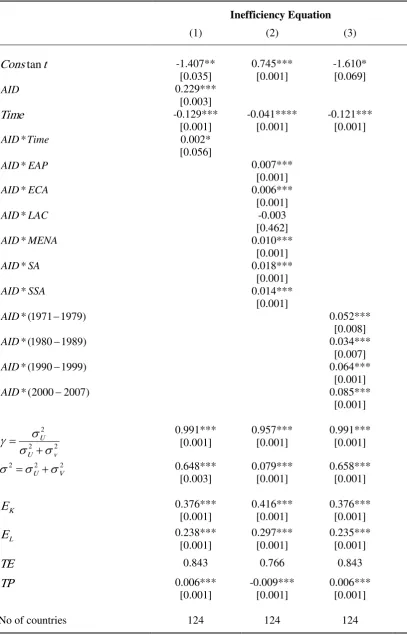
results suggest that the elasticities of capital and labour do not vary significantly
across model specifications and that the output elasticity of capital is higher than that
of labour. Kumbhakar and Wang (2005) also report similar estimates for a panel
sample of 65 countries over 1960-1999. The average worldwide technical progress is
found to be positive for models (1) and (3) and negative for model (2) and statistically
significant in all cases.11
γ
Our findings also show that the one sided error term (U)
dominates the symmetric error term (V); the relevant coefficient approaches unity
and is statistically significant. This means that the discrepancy between the observed
output and the frontier output is almost completely due to technical inefficiency. The
average level of technical efficiency ranges from almost 0.77 to 0.84. This means that
the world output could increase further if inputs were used efficiently. Henry et al.
(2009) report a value of technical efficiency close to 0.73.
Column 1 of Table 1 shows that foreign aid is associated with greater production
inefficiency. Following Temple (1999) we construct regional dummy variables to
capture differences in the initial level of technology, instead of controlling for
country-specific fixed effects. We thus segregate the sample and categorize countries
into six broad regions: East Asia and Pacific (EAP), Europe and Central Asia (ECA),
Latin America and Caribbean (LAC), Middle East and North Africa (MENA), South
Asia (SA), and Sub-Saharan Africa (SSA), following the World Bank geographic
classification.12
11
Kneller and Stevens (2003) and Kumbhakar and Wang (2005) report counter-intuitive negative rates of technical progress, whereas Christopoulos and León-Ledesma (2009) find evidence of positive technological progress. Henry et al. (2009) also find negative trend effects, but they consider the contribution of foreign R&D, making overall technical progress positive.
Column 2 shows that, with the exception of Latin America and
Caribbean, foreign aid increases production inefficiency in all regions, and this
inefficiency effect is considerably larger for South Asia, Sub-Saharan and North
Africa and oil-rich Middle-East countries. This finding is in line with Djankov et al.
(2008) who show that foreign aid results in the same curse as that of natural resources
where institution quality is severely undermined by rent seeking activities. Next, to
capture any time effects that might be associated with these changes we add decade
12
15
time effects as in Rajan and Subramanian (2008). Interestingly, estimation results
reported in column 3 of Table 1 show that the positive inefficiency effect of aid is
increasing over time with the highest effect observed in the last decade.
Using a Stochastic Frontier Analysis (SFA), Henry et al. (2009) show that
international trade, and particularly imports of machinery products, is an important
channel through which both technology transfers and production efficiency affect
developing countries’ output level. To investigate whether the efficiency impact of aid
depends on the targeting sectors of the recipient country we discriminate between aid
for social infrastructure and services (SIS), aid for economic infrastructure and
services (EI), and aid for production sectors (PS), following the disaggregation
argument of Clemens et al. (2004). A detailed listing of the sectors and subsectors of
each category is provided in the Data Appendix. Data are again drawn from the
Creditor Reporting System (CRS) database provided by the OECD.13
As a next step, we discriminate between multilateral aid (aid transferred by
alliances of multiple states) and bilateral aid (aid transferred from one single state to
another) on the basis that the economic effectiveness of aid may be constrained by the
strategic motivations of bilateral donors due to failed conditionality or aid
misallocation; that is, to the extent that donors are concerned with achieving
geopolitical rather than developmental objectives, their incentive to hold the recipient
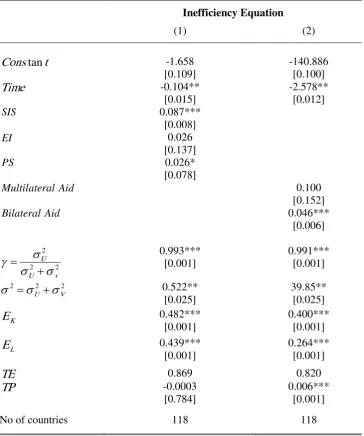
government accountable for the effective use of aid receipts is weakened. On the other Column 1 of
Table 2 reports the estimates and shows that aid for social infrastructure (i.e., aid for
education, health, water supply and civil society) and aid for production purposes
(targeting, among others, the agricultural, industrial, and construction sector)
increases production inefficiency, although the estimated coefficient for the latter
category is statistically significant at 10% level. Interestingly, aid related to economic
infrastructure sectors (like transport, communications, energy and banking) exerts a
statistically insignificant inefficiency effect.
13
16
hand, since bilateral aid is often used by the donors as a tool of securing their
political, military or economic interests, we expect this form of transfers to benefit
less, if not impair, growth in the recipient country, as compared with multilateral aid
that is presumed to have diluted donor control and neutralized ulterior motives. To
reconsider the bilateral-multilateral dichotomy in a production theory context we draw
aid data from the OECD database scaled with the recipient’s GDP (source: WDI
2009). Column 2 of Table 2 reports these estimates and shows that, as expected, only
strategically motivated bilateral aid increases production inefficiency.14 This finding
is in contrast with Ram (2003) who reports that bilateral aid has very strong growth
effects when outliers are removed, whereas multilateral aid has either a
non-statistically significant effect, or a massive negative effect, but both results can be
attributed to reverse causation as the author makes no allowances for the endogeneity
of aid. Controlling for this endogeneity, Rajan and Subramanian (2008) find that
multilateral aid is just as ineffective as bilateral aid. Overall, we reveal that foreign aid
is not only immaterial for local growth, as previous studies have show, but also that it
contributes positively in an inefficient use of the production inputs that are available
in the local economy. We next consider if this inefficiency contribution depends on
the political organization of the recipient government.
6. Main empirical results
In this section we report estimation results that link aid and production inefficiency
with political reforms (section 6.1), their timing (section 6.2) and their intensity
(section 6.3).
6.1. Political reforms, aid and production efficiency
To capture political reforms we rely on three different datasets and code them as a
binary variable: democratic transitions taken from Papaioannou and Siourounis
(2008a, PS hereafter), Polity IV democracy measure; and Freedom House ratings of
political rights and civil liberties.
PS dataset: The authors denote a democratic (or autocratic) transition by taking into
account sudden changes in the aforementioned measures of democracy, the timing of
14
17
free and fair elections, and whether a five-year stability condition is satisfied.15
Polity IV measure: The next dataset we employ is the composite Polity index
described in Marshall and Jaggers (2004). This index ranges from −10 to +10 , with
higher values indicating higher levels of political freedom, and it captures the degree
of competitiveness in political participation, the extent of openness in the selection of
the legislature, and the checks and balances on executive power. A fully democratic
government has three essential elements according to the Polity index: fully
competitive political participation, institutionalized constraints on executive power,
and guarantee of civil liberties to all citizens in their daily lives and in political
participation. A regime change is detected when the 21-range Polity measure jumps
from a negative to a positive value and remains there for five years.
This
coding alleviates some of the serious problems often met when measuring democracy,
like mismeasurement, exact timing, stability of the reform and acceptance of the new
regime. It also covers more countries and more years than any other available
democracy measurement. Based on PS dataset we construct a dummy variable that
equals zero before the transition year and one during the transition and in the
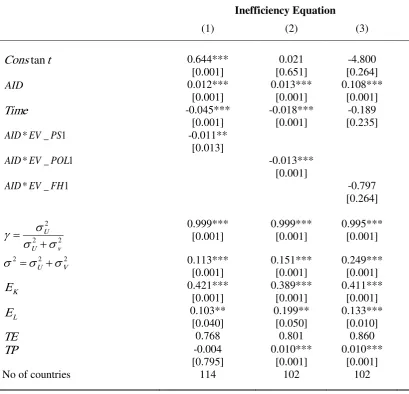
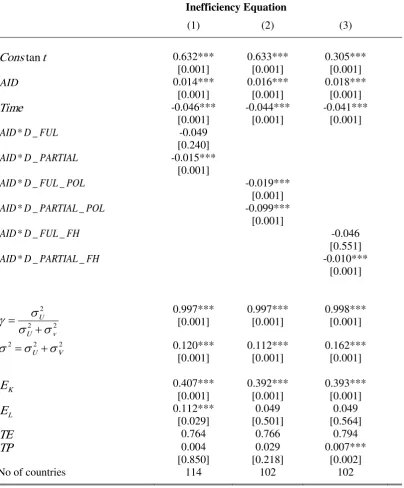
following years (denoted by PS1). Table 3, Column 1 reports the estimated
coefficients for both aid and the interaction of aid with this reform variable.
Surprisingly enough, not only democratization reduces production inefficiency by a
statistically significant amount but, more importantly, the size of this reduction offsets
almost entirely the inefficiency increase induced by aid. Thus, the model prediction
on the differential effect of aid in democracies is empirically validated.
16
. We construct a
dummy variable that equals zero before the transition year and one during the
transition and in the following years (denoted by Pol1). This dataset resembles
qualitatively that of PS but covers 12 countries less (see Table A in the Appendix).17
15
For more details on the index see Papaioannou and Siourounis (2008a).
Table 3, Column 2 reports the estimates where again the interaction of aid with
permanent democratization episodes is not only negative and statistically significant,
but also sizable enough to overturn the positive inefficiency effect of aid. Thus, the
16
See also Papaioannou and Siourounis (2008a). 17
18
empirical evidence on the differential effect of aid remains intact when we employ
alternative measures of democracy thereby validating the model prediction.
Freedom House Indices: Freedom House (FH) democracy measure consists of an
evaluation of civil liberties protection, such as freedom of speech, association,
assembly and demonstration, and political rights protection, such as the right for free
and fair elections that represent informed citizen preferences. Scores for political
rights and civil liberties range from 1 to 7 with lower values indicating more
democracy. Countries with an average score of political rights and civil liberties less
than 2.5 are assigned "free", while those with a greater than 5.5 score are designated
as "not free"; countries with an average score between 2.5 and 5.5 are designated
"partly free". Notice that, using this dataset to code transitions is not without problems
since these scores move very slowly failing to capture considerable changes in the
political organization of countries, whereas the stability criterion is difficult to be
implemented. In addition, Muck and Verkuilen (2002) have shown that Freedom
House evaluation methods are biased against left-wing governments, socialist regimes
and countries not open to international trade. We nevertheless code a regime change
when the FH status characterization jumps from Not Free to either Free or Partly Free
and from Partly Free to Free provided that the index remains at the new regime status
for five years. We then construct a dummy variable that equals zero before the
transition year and one during the transition and in the following years (denoted by
FH1). Table 3, Column 3 reports the results which show that, although with the
correct sign, reforms captured by this measure do not affect the positive inefficiency
impact of aid.
Table C of the Appendix ranks countries according to technical efficiency
estimated using PS1 dummy variable to capture political reforms. Given the amount
and combination of inputs used, the estimated efficiency values indicate how much
GDP a country “produces” as a portion of the GDP that would have been possible to
produce had the country in question been on the best practice frontier, i.e. had it been
efficient. The top five most efficient countries are Sao Tome and Principe, Namibia,
Libya, Vietnam and Tanzania, whereas at the bottom of the efficiency list we find
19
6.2. Timing of reforms, aid and production efficiency
It is important to know if the production inefficiency reduction induced by the
interaction of aid with the reform variable is monotonic. Some countries move to
democracy without considerable transaction costs, whereas others experience
considerable turmoil. In essence, aid distribution might improve immediately in the
former case whereas it can delay considerably in the latter. To time the effect of the
reform we construct dummy variables for four non-overlapping, three-year spaced
periods around the reform date that help capture short to medium-run effects and one
dummy variable to isolate the long run effect. In turn, the inefficiency equation (18)
for the preferred PS reform dataset becomes:
1 2 3 4 5
1 2 3 4 5 6 7
( i)
it it it it it it it it it it it it it E U
a β AID βT β AID D β AID D β AID D β AID D β AID D η
=
+ + + + + + + +
where 1
1 it
D = in the fifth, fourth and third pre-reform year; Dit2=1 in the second and first pre-reform year and at the transition year; 3 1
it
D = in the first, second and third
post-reform year; 4 1
it
D = the fourth, fifth and sixth post-reform years; and 5 1
it
D = in
the seventh and all subsequent post-reform years. So, the base period is the autocratic
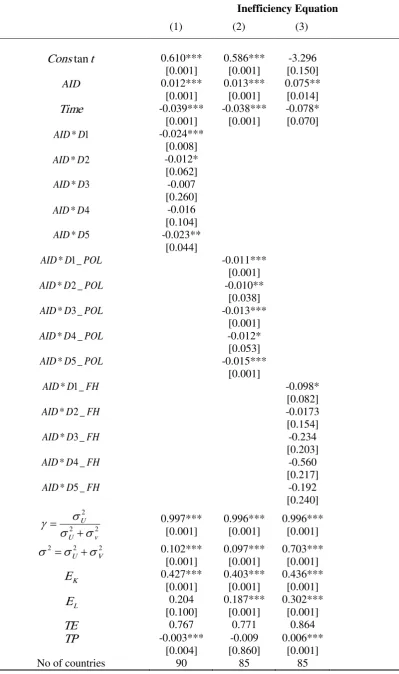
years before the 5th pre-reform year. Table 4, Columns 1-3, report the estimated
coefficients. From those, only the ones that are estimated with the PS and Polity
dataset are significant.
Anticipation and transition: The dummy variable D1 captures any anticipation effects.
It is possible that the ruling elite implements better and wider distribution policies in
an attempt to gain legitimacy and remain in power. Using the PS dataset, estimates
show that the interaction of D1 with aid is considerably large and even outweights the
positive inefficiency effect of aid, thereby strengthening our overall argument that
political governance is very significant in the way aid is distributed, monitored and
used. Evidently, due to anticipation effect foreign aid increases production efficiency
in the 5th, 4th and 3rd pre-reform year. Turning to the transition dummy, D2, we see
that although the interaction effect is negative, it is indistinguishable from zero. The
20
Short to medium-term effects: The estimated coefficients for the interaction terms with
D3 and D4 are also negative, but not statistically significant pointing to considerable
transition costs that do not allow any positive effects of aid on production efficiency.
This result implies that, in several cases it might be better to restrain foreign aid for
some time until the local government has established itself, as opposed to recent
studies which show that foreign aid exerts a 3-4 years impact in economic
performance. Conditional on political reforms, we find that the period when aid seems
to start playing a role is beyond 6 years. That period’s end seems to coincide with D5,
whose interaction with aid is significantly negative and sizable.
Long-term effects: The most important result is that of the coefficient of D5. Notice
that this coefficient is not only significant (using both the PS and the Polity datasets)
but its magnitude is large enough to render the overall efficiency effect of aid positive.
It shows that as democracy consolidates, representative governance is able to better
handle foreign aid, something that reduces considerably production inefficiency
present from the former type of governance.
To illustrate the conditional time-varying effectiveness of aid we recover the
corresponding inefficiency elasticities, calculated at different time intervals around
the PS1 reform, and we provide a graphical presentation. Notice that, these elasticities
correspond to inefficiency changes incurred as a result of a one-unit increase in
average aid. As shown in Graph 1, aid is mostly conductive to production efficiency
in the fifth, fourth and third year prior to the reform; for this time interval the
inefficiency reduction is the greater in absolute value (−0.08). Yet, this effect vanishes
gradually as the reform approaches. At the time of the reform and during the three
post-reform years aid produces production inefficiency for the reasons explained
above. Finally, after the fourth post-reform year aid fosters production efficiency
again; the inefficiency elasticity reached almost −0.06 . This graphical illustration
shows that foreign aid induces production efficiency early before the reform and after
the reform has established in the recipient country.
6.3. Intensity of reforms, aid and production efficiency
So far we have examined how the incidence and the timing of democratic reforms can
offset the positive inefficiency impact of aid. Another potential factor is the intensity
of the reforms. The intensity of reforms might have differential effects in the political
21
Sudden changes in the political leadership may foster aid effectiveness if, for instance,
the replacement of a corrupt or expropriate leadership by a democratic one is followed
by a distinctly different and more effective distribution policy of aid. On the other
hand, local autocratic leaders may allow some resources to be distributed in a more
egalitarian way if they are subject to internal or international pressure and the
marginal effect of the reform is large. To investigate if the effectiveness of aid
depends on the intensity of the political reforms we code countries into two
categories: fully democratized and partially democratized. For Papaioannou and
Siourounis (2008a) dataset we use the authors’ classification. For Polity IV, fully
democratized countries are those that scored at least +7 after democratization,
whereas partially democratized countries are those that scored 0 to +6 after
democratization. For Freedom House, we use the existing characterizations after
democratization episodes. Estimation results are reported in Table 5, Columns 1-3. As
can be readily seen, all coefficients for the interaction terms of aid with the reform
variables are negative, but only the interactions of aid with partial reforms are
statistically significant across estimations. This finding provides strong evidence that
the inefficiency effect of aid is moderated in recipients that have experienced partial
democratization episodes. Interestingly, estimation results of columns 1 and 2 show
that a partial move to democratic ruling has a significantly negative effect on
production inefficiency that is moreover sizeable enough to overturn the positive
effect of aid. Using the preferred PS reform dataset, we find evidence that recipient
countries that have moved to partial democratic ruling enjoy an inefficiency reduction
due to the reform that is not experienced by countries that have moved to full
democratic governance. This result is in accordance with Papaioannou and Siourounis
(2008a) who find that partial democratizations assert a higher impact in long run
growth and Barro (1996, 1997) who shows that growth accelerates when a country
moves from total autocracy to intermediate levels of political freedom.
7. Conclusions
This study contributes to the aid literature by investigating the impact of aid on the
production inefficiency of the recipient countries. This relationship has received
considerably little attention by theorists and empirical researchers who have mainly
focused on the growth implications of aid, giving rise to a huge literature of
22
corresponds to the efficient use of the existing production inputs and is of great
importance for aid-recipient countries as, in the majority of them, technological
progress –that could alternatively foster productivity– is very slow.
We document that foreign is associated with greater production inefficiency,
controlling for unobserved heterogeneity, the time horizon, and the sources of aid.
Moreover, our analysis goes further by exploring whether the political orientation of
the recipient country alters the positive relationship between the aid flows received
and the production inefficiency estimated. To this end, we present a theoretical
framework to describe the channels of aid effectiveness which lies in the realistic
assumption that a part of a recipient economy’s output is produced in the inefficient
informal sector. Foreign aid acts on the production efficiency of the economy by
increasing the relative size of the efficient formal sector. Yet, foreign aid is managed
by the ruling class within a certain political environment and, therefore, any
mismanagement of these resources has important implications for their economic
effectiveness. In line with the model prediction, we provide strong empirical evidence
that the quality of institutions, captured by the political orientation of the recipient
country, matter. Production inefficiency caused by the misuse of aid reduces
significantly if the political regime of the recipient switches to democratic ruling as
the latter is often associated with increased political accountability and moderate
corruption levels. In practice, democratic ruling enables the ruling elite to adopt
long-term policies that are less extractive and result in a better allocation of foreign aid
thereby increasing production efficiency.
Moreover, we find empirical evidence that the differential effect of aid is not
monotonic with respect to the time of the democratic reform; in the 5th, 4th and 3rd
pre-reform year aid has a strong effect in inefficiency reduction which diminishes
significantly by the 4th, 5th and 6th year after democratization to pick up again
afterwards. This result pinpoints the importance of anticipation and long-run effects in
determining the effectiveness of aid flows. Finally, we investigate the intensity of
democratic reforms and we recover that moderate but stable political changes towards
democracy bolster production inefficiency reductions in the presence of aid more than
abrupt political transitions.
We see this work as a contribution to the ongoing research on the prerequisites that
aid recipient countries need to have in order to benefit themselves from long-term
23 References
Acemoglu, D., Johnson, S., and J. Robinson (2005): “Institutions as the Fundamental
Cause of Long-Run Growth”, in Aghion, P. and Durlauf, S. (eds.) Handbook of
Economic Growth (Amsterdam: North-Holland).
Alesina, A. and D. Dollar (2000): “Who Gives Foreign Aid To Whom And Why”,
Journal of Economic Growth 5(1): 33–63.
Alvarez, A.M., Amsler, C., Orea, L., and Schmidt, P. (2006): “Interpreting and testing
the scaling property in models where inefficiency depends on firm characteristics”,
Journal of Productivity Analysis 25, 201–212.
Angeles, L. and K.C. Neanidis, (2009): “Aid effectiveness: the role of the local elite”,
Journal of Development Economics 90(1): 120–134.
Barro, R.J. (1996): “Democracy and growth”, Journal of Economic Growth 1(1): 1–
27.
Barro, R.J. (1997): “Determinants of Economic Growth: A Cross-Country Empirical
Study”, Cambridge, MA: MIT Press.
Battese, G.E., Coelli, T.J. (1995): “A model for technical efficiency effects in a
stochastic frontier production function for panel data”, Empirical Economics 20,
325–332.
Boone, P. (1996): “Politics and the Effectiveness of Foreign Aid”, European
Economic Review 40 (2): 289–329.
Bueno de Mesquita, B., J.D. Morrow, R. Siverson and A. Smith (2001): “Political
Competition and Economic Growth”, Journal of Democracy 12 (1): 58–72.
Burnside, C. and D. Dollar (2000): “Aid, policies and growth”, The American
Economic Review 90, 5,847–868.
Christopoulos, D. and León-Ledesma, M. (2009): “Efficiency and frontier technology
in the aftermath of recessions: international evidence”, Department of Economics,
University of Kent, School of Economics Discussion Paper 09/22.
Chickering, L.A., and M. Salahdine (1991): The Silent Revolution: The Informal
Sector in Five Asian and Near Eastern Countries, ICS Press, San Francisco.
Clemens, M.A., S. Radelet and R. Bhavnani (2004): “Counting Chickens when They
Hatch: The Short Term Effect of Aid on Growth”, Working Paper No. 44, Center
for Global Development.
Dalgaard, C., H. Hansen, F. Tarp (2004): “On the Empirics of Foreign Aid and
24
Djankov S., J. Montalvo and M. Reynal-Querol (2008): “The curse of aid”, Journal of
Economic Growth, 13(3), 169-194.
Doucouliagos, H., Paldam, M. (2008): “Aid Effectiveness on Growth: A meta study”,
European Journal of Political Economy 24, 1–24.
Drine, I. and M.S. Nabi (2010): “Public external debt, informality and production
efficiency in developing countries”, Economic Modelling 27(2): 487-495.
Ferreira-Tiryaki, G. (2008): “Informal economy and business economy cycles”,
Journal of Applied Economics 11, 91–117.
Friedman, E., Johnson, S., Kaufmann, D., and P. Zoido-Lobaton (2000): “Dodging the
grabbing hand: the determinants of unofficial activity in 69 countries”, Journal of Public Economics 76(3), 459–493.
Giavazzi, F. and G. Tabellini (2005): “Economic and political liberalizations”, Journal
of Monetary Economics 52(7): 1297–1330.
Greene, W.H. (2005): “Reconsidering heterogeneity in panel data estimators of the
stochastic frontier model”, Journal of Econometrics 126, 269–303.
Grosskopf, S. (1993): “Efficiency and productivity”, In: Fried, L.C., Schmidt, H.O.,
Schmidt, S.S. (Eds.), The Measurement of Productive Efficiency, Techniques and
Applications, Oxford University Press, New York.
Hansen, H. and F. Tarp (2001): “Aid and Growth Regressions”, Journal of
Development Economics 64: 547–70.
Henry, M., R. Kneller, and C. Milner (2009): “Trade, technology transfer and national
efficiency in developing countries”, European Economic Review 53, 237–254.
Heston, A., Summers, R., and B. Aten (2009): Penn World Table Version 6.3,
Pennsylvania, Center for International Comparisons of Production, Income and
Prices at the University of Pennsylvania.
Huntington, S. (1968): Political Order in Changing Societies. New Haven: Yale
University Press.
Johnson, S., Kaufmann, D., Shleifer, A., (1997): “The unofficial economy in
transition”, Brookings Papers on Economic Activity 2, 159–239.
Jondraw, J., Lovell, C.A.K., Materov, I., and P. Schmidt (1982): “On the estimation of
technical inefficiency in stochastic production function model”, Journal of
25
Kanbur, R. (2006): “The Economics of International Aid”, in S.C. Kolm and J.M.
Ythier (eds.), Handbook of the Economics of Giving, Altruism and Reciprocity,
Elsevier.
Kneller, R. and Stevens, A. (2003): “The specification of aggregate production
function in the presence of inefficiency”, Economics Letters 81, 223–226.
Kumbhakar, S. and H.J. Wang (2005): “Estimation of Growth Convergence Using a
Stochastic Production Frontier Approach”, Economics Letters 88, 300–305.
Loayza, N. (1997): The economics of the informal sector: a simple model and some
empirical evidence from Latin America, World Bank Policy Research Working
Paper 1727, World Bank, Washington, DC.
Lubell H. (1991): The Informal Sector in the 1980s and 1990s, Development Centre
Studies, OECD Publishing.
Marshall, M.G., and K. Jaggers (2004): Polity IV Project: Political Regime
Characteristics and Transitions, 1800-2004 Dataset Users’ Manual, Center for
Global Policy School of Public Policy, George Mason University, Arlington, VA.
Dataset available at: http://www.cidcm.umd.edu/polity.
Munck, G.L. and J. Verkuilen (2002): “Conceptualizing and measuring democracy:
evaluating alternative indices”, Comparative Political Studies, 35(1), 5–34.
Nehru, V., and A. Dhareshwar (1993): “A new data base on physical capital stock:
sources, methodology and results”, Revista de Análisis Económico 8, 37–59.
Olson, M. (1982): The Rise and Decline of Nations: Economic Growth, Stagflation
and Social Rigidities. New Haven: Yale University Press.
Olson, M. (1993): “Dictatorship, Democracy, and Development”, American Political
Science Review 87: 567–576.
Papaioannou, E. and G. Siourounis (2008a): “Democratization and Growth”,
Economic Journal 118(10): 1520–1551.
Papaioannou, E. and G. Siourounis (2008b): “Economic and Social Factors Driving
the Third Wave of Democratization”, Journal of Comparative Economics 36(3),
365–387.
Przeworski, A., M.E. Alvarez, J.A. Cheibub, J. Antonio, and F. Limongi (2000):
Democracy and Development: Political Institutions and Well-Being in the World,
1950-1990, Cambridge: Cambridge University Press.
Przeworski, A. and F. Limongi (1993): “Political Regimes and Economic Growth.”
26
Rajan, R.G. and A. Subramanian (2008): “Aid and Growth: What Does the
Cross-Country Evidence Really Show?”, The Review of economics and Statistics 90(4),
643–665.
Rajan, R.G. and A. Subramanian (2010): “Aid, Dutch Disease, and Manufacturing
Growth, forthcoming in the Journal of Development Economics.
Ram, R. (2003): “Roles of Bilateral and Multilateral Aid in Economic Growth of
Developing Countries”, Kyklos 56(1), 95–110.
Schneider, E., and D. Enste (2000): “Shadow economies: size, causes, and
consequences”, Journal of Economic Literature 38(1): 77–114.
Sirowy, L. and A. Inkeles (1990): “The Effects of Democracy on Economic Growth
and Inequality: A Review”, Studies in Comparative International Development 25
(1), 126–157.
Temple, J. (1999): “The new growth evidence”, Journal of Economic Literature 37,
112–156.
World Development Indicators (2009), The World Bank, data available at:
http://databank. worldbank.org/ddp/home.do.
Wright, J. (2008): “To Invest or Insure? How Authoritarian Time Horizons Impact
27
Table 1: Foreign Aid (% of GDP) and Production Efficiency
Inefficiency Equation
(1) (2) (3)
t
Constan -1.407**
[0.035] 0.745*** [0.001] -1.610* [0.069] AID 0.229*** [0.003] Time -0.129*** [0.001] -0.041**** [0.001] -0.121*** [0.001] *
AID Time 0.002*
[0.056] *
AID EAP 0.007***
[0.001] *
AID ECA 0.006***
[0.001] *
AID LAC -0.003
[0.462] *
AID MENA 0.010***
[0.001] *
AID SA 0.018***
[0.001] *
AID SSA 0.014***
[0.001] * (1971 1979)
AID − 0.052***
[0.008] * (1980 1989)
AID − 0.034***
[0.007] * (1990 1999)
AID − 0.064***
[0.001] * (2000 2007)
AID − 0.085***
[0.001] 2 2 2 v U U σ σ σ γ +
= 0.991*** [0.001] 0.957*** [0.001] 0.991*** [0.001]
2 2 2 V U σ σ
σ = + 0.648***
[0.003] 0.079*** [0.001] 0.658*** [0.001] K E 0.376*** [0.001] 0.416*** [0.001] 0.376*** [0.001] L E 0.238*** [0.001] 0.297*** [0.001] 0.235*** [0.001]
TE 0.843 0.766 0.843
TP 0.006*** [0.001] -0.009*** [0.001] 0.006*** [0.001]
No of countries 124 124 124
Notes: Estimation method is Maximum Likelihood. Production Function estimates are not reported foe space reasons but are available from the authors upon request. *, **, *** correspond to statistical significance at 10%, 5%, and 1%, respectively. For each independent variable the first row provides the estimates of regression coefficients whereas figures in brackets are p-values. EK and EL denote the
28
Table 2: Disaggregated Foreign Aid (% of GDP) and Production Efficiency
Inefficiency Equation
(1) (2)
t
Constan -1.658
[0.109]
-140.886 [0.100]
Time -0.104**
[0.015]
-2.578** [0.012]
SIS 0.087***
[0.008]
EI 0.026
[0.137]
PS 0.026*
[0.078]
Multilateral Aid 0.100
[0.152]
Bilateral Aid 0.046***
[0.006]
2 2
2
v U
U
σ σ
σ γ
+
= 0.993*** [0.001] 0.991*** [0.001]
2 2 2
V
U σ
σ
σ = + 0.522**
[0.025]
39.85** [0.025]
K
E 0.482***
[0.001]
0.400*** [0.001]
L
E 0.439***
[0.001]
0.264*** [0.001]
TE 0.869 0.820
TP -0.0003
[0.784]
0.006*** [0.001]
No of countries 118 118