Forecasting Realized Volatility Using Subsample
Averaging
*
Huiyu Huang1, Tae-Hwy Lee2
1GMO Emerging Markets Equity, Berkeley, USA
2Department of Economics, University of California, Riverside, USA
Email: [email protected]
Received March 1, 2013; revised April 1, 2013; accepted April 8,2013
Copyright © 2013 Huiyu Huang, Tae-Hwy Lee. This is an open access article distributed under the Creative Commons Attribution License, which permits unrestricted use, distribution, and reproduction in any medium, provided the original work is properly cited.
ABSTRACT
When the observed price process is the true underlying price process plus microstructure noise, it is known that realized volatility (RV) estimates will be overwhelmed by the noise when the sampling frequency approaches infinity. Therefore, it may be optimal to sample less frequently, and averaging the less frequently sampled subsamples can improve estima- tion for quadratic variation. In this paper, we extend this idea to forecasting daily realized volatility. While subsample averaging has been proposed and used in estimating RV, this paper is the first that uses subsample averaging for fore- casting RV. The subsample averaging method we examine incorporates the high frequency data in different levels of systematic sampling. It first pools the high frequency data into several subsamples, then generates forecasts from each subsample, and then combines these forecasts. We find that in daily S&P 500 return realized volatility forecasts, sub- sample averaging generates better forecasts than those using only one subsample.
Keywords: Subsample Averaging; Forecast Combination; High-Frequency Data; Realized Volatility; ARFIMA Model; HAR Model
1. Introduction
The rich dynamics in ultra-high-frequency financial data may be captured to improve estimation of quadratic va- riation (integrated variance) or forecasting volatility. There is a considerable amount of literature addressing the es- timation issue, whereas little work has been done on forecasting. This paper contributes to the forecasting is- sue in the high-frequency data literature by examining whe- ther it pays to incorporate the intraday data and, more importantly, how to incorporate the high-frequency infor- mation to achieve better performance for forecasting dai- ly return volatility. Further, we seek to link the estima- tion and forecasting aspects by adopting and tailoring me- thods proposed for estimation of quadratic variation to forecasting.
The existing literature on high-frequency data, espe- cially that devoted to the realized volatility issue, can be grouped roughly into two areas: estimating quadratic va- riation using realized volatility (RV) and forecasting volatility using RV. References [1,2] establish that RV,
defined as the sum of squared intraday returns of small intervals, is an asymptotically unbiased estimator of the unobserved quadratic variation as the interval length ap- proaches zero.
However, in the presence of market microstructure noise, this helpful property of RV is contaminated. More recent works investigating this issue include [3-8]. When the observed price process is the true underlying price process plus microstructure noise, it is shown that RV will be overwhelmed by the noise and explodes when the sampling frequency approaches infinity. Therefore, it may be optimal to sample less frequently than is the case in the absence of noise. References [6,8] establish through a subsampling scheme improved estimators for quadratic variation. The original subsampling idea can be traced back to [9], where for the first time an unbiased data- driven estimator of volatility and a subsample averaging volatility estimator are proposed. The bias-adjusted esti- mator of [6] based on the subsample averaging method is able to eventually push the estimation bias to zero. Refe- rence [8] shows that subsampling is highly advantageous for RV estimators based on discontinuous kernels. *The opinions expressed in this paper are those of the authors and do
not necessarily reflect those of Grantham,Mayo, Van Otterloo and
tility estimation, volatility forecasting using high-frequen- cy information has been addressed as well. Reference [10] represents an approach to forecasting volatility using RV. The model they propose is a fractional integrated AR model, ARFI(p,d), for logarithmic RV obtained from fo- reign exchange rates data of 30-minute frequency, and demonstrates the superior predictive power of their mo- del. Noticeably, the sampling frequency used in [1] is, however, 5 minutes when they analyze the distributional properties of RV.
Under the presence of microstructure noise, it may be optimal to sample less frequently than is the case in the absence of noise. As shown by [6,8,9], subsampling schemes improve estimators for quadratic variation. When it comes to forecasting RV, if the highest frequency re- turns are not necessarily the optimal frequency, the sub- sampling of the available highest frequency data will lead to several systematically sampled subsamples. In this pa-per we attempt to answer two questions: (1) can we use these subsamples to improve the out-of-sample forecast- ing? and (2) how do we incorporate the subsample in- formation when producing forecasts of daily realized vo- latility? We find that as long as the available highest- frequency data are not at the optimal frequency, we can improve prediction of RV out-of-sample through simple averaging of forecasts produced from subsamples.
The paper is organized as follows: Section 2 describes the data and subsamples. Section 3 discusses two models for forecasting daily realized volatility by subsample ave- raging. Section 4 presents their out-of-sample relative per- formances. Section 5 concludes.
2. Data and Subsampling
The data we use consists of S&P 500 index values at 5-minute intervals recorded between 9:30 a.m. and 4:00 p.m. (total 390 minutes a day) from June 9, 1997 to May 30, 2003, a total of 1501 days and 117,078 observations1. In cleaning the data, those periods of market closings are treated as no variation in index values, thus there exist 78 ticks each trading day. We can construct data-driven vo- latility, for instance, realized volatility, from this 5-mi- nute high-frequency data.
Let be the interval in minutes over which the re- turns are computed. The -minute return is the log-dif- ference of two consecutive index values over
-mi- nutes, multiplied by 100
1
1 , 1 1 t i 1 1 ,
t i t i t i
r p p (1)
where t denotes the logarithm of the S&P 500 index
value. Even if the interval can be as small as 5 min-
utes given the data available to us, we choose larger in- tervals such as , in order to con- struct subsamples. When
p
15,30,60 minutes
15
we can construct three sets (subsamples) of -minute return series. When
30
we can construct six sets (subsamples) of - minute return series. When we can construct 12 sets (subsamples) of 60-minute return series by sampling every 12th observation of 5-minute returns.
60
The RV is calculated by the sum of squared -min- ute returns within a day. Define realized volatility of day
as
t
2
1 , 1
1
m
t t i t i
i
RV r
1, (2) where390
m (3)
is the number of -minute returns per day.
To construct a subsample, we consider an interval 5.
The subsampled return data has the longer time interval than 5 minutes, within which
5
K (4)
number of subsamples of the -minute returns are ob- served. We consider
15,30,60,
,12
each producing a different number K 3,6 of subsamples.
For example, the intraday returns for produce daily realized volatility computed from (2) us- ing
15
15 ,
t
RV
26
m 15-minute returns. As there are three 5-
minute intervals within 15 minutes, we have K = 15/5 = 3 subsamples, producing three subsample RV forecasts for a day.
3. Volatility Forecast Models
Based on the subsample averaging methodology in [6] and [9], we demonstrate the benefit of subsample aver- aging in out-of-sample forecasting of daily volatility. We aim to check if the predictive ability of an RV forecast- ing model can be improved by averaging forecasts gen- erated using the same model but from different subsam- ples.
In comparing the predictive ability of the subsample averages with the benchmark forecast without subsample averaging, the key issues are: (1) the volatility proxy to compare forecasts with; (2) the loss function for forecast evaluation; and (3) the forecasting model. For the daily volatility proxy we use the daily RV computed from 5- minute returns. For the loss function for forecast evalua- tion we use the mean squared forecast errors (MSFE). Regarding the forecasting model, we consider two mod- els, ARFI model of [10] and HAR model of [11].
1We are grateful to George Jiang who generously shared this high-fre-quency intraday data with us. The data are extracted from the contem-poraneous index levels recorded with the quotes of SPX options from the CBOE.
3.1. ARFI Model
conditional realized volatility, we estimate the fractional- ly integrated autoregressive model, ARFI(p,d) for
ln
t t
X RV
(5)for each of Specifically, the model can be written as follows:
15,30,60.
1
d
p L L Xt
t
.
L
(6) where is the pth order AR lag polynomial. We fix p and
L
1
p p
L 1 For each we esti-mate
,
, ,
and the long-memory parameter by us- ing the method of [10,12]. ,
d
The presence of microstructure noise prevents us from sampling too frequently (with too small) when cal- culating RV. See [3]. If t (with ) series
are less noisy and more accurately estimated than where are indices of subsamples,
k
RV
K
5
5,
t
RV k1, ,
then using these likely leads to a better forecast 1
k T
RV
than RV T51. However, abandoning the finer information seems not very sensible. Thus, a possible way to balance this is the subsample averaging approach, which uses all subsamples, meaning no intra-day information is tossed out, and then taking the average over
K
1, ,
k K
to produce a final forecast. At the same time, the conta- minating effect of microstructure noise in the stage of computing RV is moderated through this subsampling procedure (using instead of ), and hence it is possible to achieve better performance in forecasting RV.
5
5
The subsample averaging method is as follows. First, for a given we estimate the ARFI(p,d) model for each of subsamples generated by systematically sam- pling the original 5-minute index data every steps:
,
K
K
1
1, ,
d k
k k k
p L L Xt
k K
k
,
k
t (7)
where Xt denotes kth daily logarithm of RV in day computed using the kth subsample. Following [10] we use ARFI(p,d) model on the natural logarithm transfor-
t
mation of RV, k ln
k , and then exponent-t t
X RV
k ttiated back to RV, k exp
. Running thet
RV X
model on each subsample we obtain K number of RV forecasts 1 , Next, we compute their
k T
RV k1, , . K
simple average
1 1
1 K k
T k RV RV K
T1 (8)to obtain the combined forecast (denoted Subsam- ple-Mean in Table 1). Similarly, “Subsample-Median” is to take the median of 1 ,
k T
RV k1, , . K
We compare Subsample-Mean forecast RV T 1
and
Subsample-Median forecast with the benchmark forecast (denoted Benchmark in Table 1). The benchmark is computed using only one subsample 1
k T
RV with
kK the last subsample and abandoning the other 1
K subsample information.
3.2. HAR Model
The heterogeneous autoregressive (HAR) model of the realized volatility in [11] is inspired by the heterogene- ous market hypothesis and is able to reproduce memory persistence (although not formally a long memory model) as well as many other major features of financial data. The square-root of daily RV
,
t t
Y RV (9) is assumed to have an AR-type process on past RVs over different intervals of aggregation (daily, weekly, and monthly):
1 D W W M M 1,
t t t t
Y c Y Y Y et (10)
where
1 2 5
1 5
W
t t t t
Y Y Y Y (11)
is the weekly aggregated RV, and
1 2 20
1 20
M
t t t t
Y Y Y Y (12)
is the monthly aggregation.
As illustrated in Section 3.1 above, we consider 15,30,60.
The subsample averaging method for the HAR model works in exactly the same way as the ARFI model. First, we estimate the HAR model for each of subsamples generated by systematically sampling the ori- ginal 5-minute index data every steps. We take subsamples of the
K
K K
-minute returns data when comput- ing 1
k t
Y
k1,,K
, apply the HAR model to eachsubsample to generate the subsample forecast YTk1
at
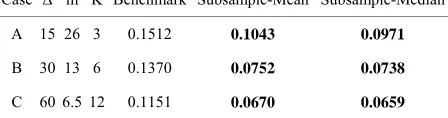
day for the next day , and then use the simple average or median to obtain the subsample averaging forecasts. The only difference here as compared to the ARFI case is the model used to produce forecasts. Note that here we use the square root of RV, as in [11], thus MSFE values of will appear in different scale than those of ARFI(p,d), when we show out-of-sample results in the next section.
T T1
Y
4. Results
Recent papers addressing this include [13,14]. Generally, the suggested volatility proxy is the realized volatility in some particular form, coupled with an MSFE evaluation criterion.
Our empirical work involves the comparison of fore- casting performances of subsample averaging (mean and median) of the forecasts using all -minute return subsamples with the benchmark model using only one -minute return subsample. We consider three cases (A, B, and C) of subsampling for
K
15,3
0,60
in Tables 1 and 2.
In Table 1 where the ARFI(p,d) model is used to fore- cast RV, we find that subsample averaging (mean and median) improves upon the benchmark in all three cases for Subsample-Mean and in two cases for Subsample- Median, quite substantially for Case A. In Table 2 where the HAR model is used, Subsample-Mean and Subsam- ple-Median are substantially better than the benchmark for all three subsampling cases.
5. Conclusion
[image:4.595.59.284.406.467.2]We propose a forecasting methodology that uses sub- sample averaging to forecast daily realized volatility.
Table 1. Using ARFI model for RV.
Case Δ m K Benchmark Subsample-Mean Subsample-Median
A 15 26 3 1.3119 1.0581 1.0561
B 30 13 6 1.1854 1.1610 1.1774
[image:4.595.60.284.585.644.2]C 60 6.5 12 1.2828 1.2392 1.2859 Notes: This table compares the performance of the ARFI model for the daily realized volatility (RV) forecast without and with subsampling average. We use the ARFI(p,d) model proposed by [10] where p = 1 and d is estimated by [12] method dynamically for each case. The out-of-sample size is P = 500 Days, and the in-sample size is R = 1000 Days. We report the out-of-sample MSFE with three different subsampling cases. ∆-minute returns have m ob- servations per day. Subsample-Mean or Subsample-Median is taken over the K subsample forecasts. The benchmark uses only the last subsample forecast. Bolded term indicates the better-than-benchmark case.
Table 2. Using HAR model for Sqrt(RV).
Case Δ m K Benchmark Subsample-Mean Subsample-Median
A 15 26 3 0.1512 0.1043 0.0971
B 30 13 6 0.1370 0.0752 0.0738
C 60 6.5 12 0.1151 0.0670 0.0659
Notes: This table compares the performance of the HAR model for the square root of the daily realized volatility (RV) forecast without and with subsampling average. We use the HAR model proposed by [11], which is applied to the square root of RV and estimated dynamically for each case. The out-of-sample size is P = 500 Days, and the in-sample size is R = 1000 Days. We report the out-of-sample MSFE with three different subsampling cases. ∆-minute returns have m observations per day. Subsample-Mean or Subsample-Median is taken over the K subsample forecasts. The benchmark uses only the last subsample forecast. Bolded term indicates the better-than- benchmark case.
While subsample averaging has been proposed and used in estimating RV, this paper is the first to use subsam- ple averaging for forecasting RV. In this paper, we show that subsample averaging, which was originally suggest- ed to overcome the bias in estimating quadratic variation under the presence of market microstructure noise, can also help forecast RV out-of-sample. In an application of S&P 500 index daily volatility forecasting, using two clas- sical forecasting models for RV, we find that the subsam- ple averaging forecast generally and substantially im- proves upon forecasts using only one subsample without averaging over all subsamples. We expect that subsample averaging method can enhance even more the forecast ability of RV when much higher-frequency data (15-se- conds, for instance) are available.
REFERENCES
[1] T. G. Andersen, T. Bollerslev, F. X. Diebold and P. La- bys, “The Distribution of Realized Exchange Rate Volati- lity,” Journal of the American Statistical Association, Vol.
96, No. 453, 2001, pp. 42-55.
http://dx.doi.org/10.1198/016214501750332965
[2] O. E. Barndorff-Nielsen and N. Shephard, “ Econometric Analysis of Realised Volatility and Its Use in Estimating Stochastic Volatility Models,” Journal of the Royal Sta- tistical Society Series B, Vol. 64, No. 2, 2002, pp. 253- 280.
[3] Y. Aït-Sahalia, P. A. Mykland and L. Zhang, “How Often to Sample a Continuous-time Process in the Presence of Market Microstructure Noise,” Review of Financial Stud- ies, Vol. 18, No. 2, 2005, pp. 351-416.
http://dx.doi.org/10.1093/rfs/hhi016
[4] F. M. Bandi and J. R. Russell, “Microstructure Noise, Re- alized Variance, and Optimal Sampling,” Review of Eco- nomic Studies, Vol. 75, No. 2, 2008, pp. 339-369. http://dx.doi.org/10.1111/j.1467-937X.2008.00474.x [5] P. R. Hansen and A. Lunde, “Realized Variance and Mar-
ket Microstructure Noise,” Journal of Business and Eco- nomic Statistics, Vol. 24, No. 2, 2006, pp. 127-218. http://dx.doi.org/10.1198/073500106000000071
[6] L. Zhang, P. A. Mykland and Y. Aït-Sahalia, “A Tale of Two Time Scales: Determining Integrated Volatility with Noisy High-Frequency Data,” Journal of the American
Statistical Association, Vol. 100, No. 472, 2005, pp.
1394-1411.
http://dx.doi.org/10.1198/016214505000000169
[7] O. E. Barndorff-Nielsen, P. R. Hansen, A. Lunde and N. Shephard, “Designing Realised Kernels to Measure the Expost Variation of Equity Prices in the Presence of Noise,” Econometrica, Vol. 76, No. 6, 2008, pp. 1481-
1536. http://dx.doi.org/10.3982/ECTA6495
[8] O. E. Barndorff-Nielsen, P. R. Hansen, A. Lunde and N. Shephard, “Subsampling Realised Kernels,” Journal of Econometrics, Vol. 160, No. 1, 2011, pp. 204-219. http://dx.doi.org/10.1016/j.jeconom.2010.03.031
eign-Exchange Rates,” Journal of Business and Economic Statistics, Vol. 14, No. 1, 1996, pp. 45-52.
[10] T. G. Andersen, T. Bollerslev, F. X. Diebold and P. La- bys, “Modeling and Forecasting Realized Volatility,” Eco- nometrica, Vol. 71, No. 2, 2003, pp. 579-625.
http://dx.doi.org/10.1111/1468-0262.00418
[11] F. Corsi, “A Simple Approximate Long Memory Model of Realized Volatility,” Journal of Financial Economet- rics, Vol. 7, No. 2, 2009, pp. 174-196.
http://dx.doi.org/10.1093/jjfinec/nbp001
[12] J. Geweke and S. Porter-Hudak, “The Estimation and Ap-
plication of Long Memory Time Series Models,” Journal of Time Series Analysis, Vol. 4, No. 4, 1983, pp. 221-238. http://dx.doi.org/10.1111/j.1467-9892.1983.tb00371.x [13] A. J. Patton, “Volatility Forecast Comparison Using Im-
perfect Volatility Proxies,” Journal of Econometrics, Vol.
160, No. 1, 2011, pp. 246-256.
http://dx.doi.org/10.1016/j.jeconom.2010.03.034
[14] P. R. Hansen and A. Lunde, “Consistent Ranking of Vo- latility Models,” Journal of Econometrics, Vol. 131, No.
1, 2006, pp. 97-121.