http://dx.doi.org/10.4236/alamt.2013.34008
Computing Approximation GCD of Several Polynomials
by Structured Total Least Norm
*
Xuefeng Duan1, Xinjun Zhang1, Qingwen Wang2 1
College of Mathematics and Computational Science, Guilin University of Electronic Technology, Guilin, China 2
Department of Mathematics, Shanghai University, Shanghai, China Email: [email protected]
Received September 28, 2013; revised October 30, 2013; accepted November 8,2013
Copyright © 2013 Xuefeng Duan et al. This is an open access article distributed under the Creative Commons Attribution License, which permits unrestricted use, distribution, and reproduction in any medium, provided the original work is properly cited.
ABSTRACT
The task of determining the greatest common divisors (GCD) for several polynomials which arises in image compres- sion, computer algebra and speech encoding can be formulated as a low rank approximation problem with Sylvester matrix. This paper demonstrates a method based on structured total least norm (STLN) algorithm for matrices with Sylvester structure. We demonstrate the algorithm to compute an approximate GCD. Both the theoretical analysis and the computational results show that the method is feasible.
Keywords: Sylvester Matrix; Approximate Greatest Common Divisor; Low Rank Approximation; Structured Total Least Norm; Numerical Method
1. Introduction
Let deg
In this paper, we consider the following problem. Let
1 ,
f x f2
x , , ft
x C x
\ 0
, namely
f x be the degree of f x
and C x
be the set of univariate polynomials. A2 stands for the spectral norm of the matrix A. Cn and Cm n
are the vector spaces of complex n vectors and m n
matrices, respectively. Transpose matrices and vectors are denoted by AT
and . denotes the
greatest common divisor for the polynomials
T
u GCD f
,g
f and
g. We use rank
A
to stand for the rank of matrixA.
1 n n1 ,
1 n n
1 0
f x a x a x a xa
1( 1) 1 0, 2, ,
p p
i ip i p i i .
f x b x b x b xb i t
Problem 1.1. Set k be a positive integer with
min ,
k n p . We wish to compute f1
x , f2
x , , ft
x C x
\ 0
, such that
1
deg f x n, deg fi x p, 2 i t,
1 1 2 2
deg GCD f x f x ,f x f x ,,ft x ft x k,
and
2
2
1 2 2 2 t
2
2
f x f x f x
is minimized.
The problem of computing approximate GCD of several polynomials is widely applied in speech encoding and filter design [1], computer algebra [2] and signal pro- cessing [3] and has been studied in [4-7] in recent years.
Several methods to the problem have been presented. The generally-used computational method is based on the truncated singular decomposition(TSVD) [8] which may not be appropriate when a matrix has a special structure since they do not preserve the special structure (for example, Sylvester matrix). Another common method ba- sed on QR decomposition [9,10] may suffer from loss of accuracy when it is applied to ill-conditioned problems and the algorithm derived in [11] can produce a more ac- curate result for ill-conditioned problems. Cadzow algo- rithm [12] is also a popular method to solve this problem which has been rediscovered in the literature [13]. *The author is supported by a grant from National Natural Science
Somehow it only finds a structured low rank matrix that is nearby a given target matrix but certainly is not the closet even in the local sense. Another method is based on alternating projection algorithm [14]. Although the algorithm can be applied to any low rank and any linear structure, the speed may be very slow. Some other me- thods have been proposed such as the ERES method [15], STLS method [16] and the matrix pencil method [17]. An approach to be described is called Structured Total Least Norm (STLN) which has been described for Han- kel structure low rank approximation [18,19] and Sylves- ter structure low rank approximation with two polyno- mials [20]. STLN is a problem formulation for obtaining an approximate solution
AE X
B H to an overdetermined linear systemAX B preserving the given structure in A or
A B
.In this paper, we apply the algorithm to compute the structured preserving rank reduction of Sylvester matrix. We introduce some notations and discuss the relationship
between the GCD problems and low rank approximation of Sylvester matrices in Section 2. Based on STLN me- thod, we describe the algorithm to solve Problem 1.1 in Section 3. In Section 4, we use some examples to illus- trate the method is feasible.
2. Main Results
First of all, we shall prove that Problem 1.1 always has a solution.
Theorem 2.1. Suppose that f1, f2, , ft ,
1deg f , deg
f2 , , deg
ft
and are defined as those in Problem 1.1. There existk
1
ˆ
f , fˆiC x
with deg
fˆ1 n, deg
fˆi p and
fˆ
1 2 t
ˆ ˆ, , ,
f f
deg GCD k su ch th at for all f1,
if C x w i t h deg
f1 n , deg
fi p a n d
1 2
deg GCD f,f ,,ft k, 2 i t. We have
2 2 2 2 2
1 1 2 2 1 1 2 2 2 2
2 2 2
ˆ ˆ ˆ .
t t t t
2
2
f f f f f f f f f f f f
Proof. Let hC x
be monic with deg
h k and set uiC
x with deg
ui deg
fi
kh
. For the real and imaginary parts of the coefficients of and of
. We are considered with the continuous ob- jective function
, i
u
1 i t
2 21 2 1 12 2 2 2
2 2 , , , ,
. t
t t
F h u u u u h f u h f
u h f
We will prove that the function has a value on a closed and bounded set of its real argument vector which is smaller than elsewhere. Consider 1
n n
f a x and
p i ip
f b x with a GCD of degree k for 2 i t. Clearly, any h and ui with
2 2 21 2 1 12 2 2 2 2
, , , , t > t t
F h u u u f f f f f f
can be discarded. So from above,we know that the
coefficients of 1 2 can be bounded
and so can the coefficients of 1 2 t by
any polynomials factor coefficient bound. Thus the ,
u h u h, ,
h
t
u h
, u, u , , u
function’s domain F h u u
, 1, 2,,ut
0
is restricted to a sufficiently large ball. It remains to exclude
1 2 t
u u u as the minimal solution. We have
2 2 21 2 2 2 2
2 2
1 1 2 2 2 2
, 0, 0, , 0 t
t t
F h f f f
2 2
f f f f f f
.
In conclusion, the theorem is true.
Now we begin to solve Problem 1.1, we first define a
p n p matrix associated with f1
x as follows1 2 1 0
1 1 0
1
1 1
0 0
0
, 0
0 0
n n n n n
n n
a a a a a
a a a a
S
a a a a
0
and an n
n p
matrix associated with f xi
,2, 3, ,
i t as
1 0
1 0
1 0
1 2 0
0 1 0
,
0
0 0 1
ip i i i i
ip i i i
i
ip i i i
b b p b p b b
b b p b b
S
b b p b b
0
0
T 1
1 2
.
p n t n p
t
S S
S C
S
Deleting the last k1 rows of S and the last k1 columns of coefficients of f1,f2,,ft separately is
, We get the -th Sylvester matrix
S k
n p k 1 t1n p tk t Sk C
2
1 2 1 1
2
0 1 10 2 1 0 1
0 20
0
.
n p tp
n p t p
n p
k
n p t t
t
a b b
a b b
a b
S
a a b b b b
a b
0
tp p
b
b
It is well-known that deg
GCD f
1ft
k if andonly if has rank deficiency at least 1. We
have
1k
S f ft
1
2 2
1 1 2 2 2 2
deg
2 2
1 1 2 2 2 2
dimNullspace 1
min
. min
t
k
t t GCD f f k
t t S
f f f f f f 2
2
2
2
f f f f f f
(2.1) where Sk is the k-th Sylvester matrix generated by
1,
f f2, , ft.
From above, we know that (2.1) can be transformed to the low rank approximation of a Sylvester matrix.
If we use STLN [16] to solve the following over- determined system
,
k k
A X b
for Sk
bk Ak
, where k is the first column of kand k
b S
A are the remainder columns of k, then we get a
minimal perturbation
S
hk Ek
of Sylvester structure sa-tisfying
.
k k k k
b h A E
So the solution with Sylvester structure is
k k k k k
S h b E A and dimNullspace
Sk > 1. We will give the following example and theorem to explain why we choose the first column to form the over- determined system.Example 2.1. Suppose three polynomials are given
21 1,
f x x
22 2,
f x x x
23 2 3
f x x x .
The matrix S is the Sylvester matrix generated by
1 ,
f x f2
x and f3
x1 0 1 0 1 0
0 1 1 1 2 1
1 0 2 1 3 2
0 1 0 2 0 3
S
The matrix S is partitioned as S b Aˆ1 ˆ1 or 1 1
S A b , where 1 is the first column of , whereas
ˆ
b S
1
b is the last column of S. The overdetermined system
1 ˆ1 ˆ
A X b
has a solution X
1 1 1 1 1
T, while the sys- tem1 1
A X b
has no solution.
Theorem 2.2. Suppose that f1, f2, , ft ,
1deg f , deg
f2 , , deg
ft
and are defined as those in Problem 1.1 and is the -th Sylvester matrix of 1k k
k
S
,
f f2, , ft . Then the following
statements are equivalent. 1) dimNullspace
Sk 1;2) A Xk bk has a solution, where bk is the first
column of Sk and Ak are the remainder columns of
.
k
S
Proof. Suppose A Xk bk has a nonzero
solution, then kRange
. bk
b A Since bk s the first co-
lumn of Sk, viously, the dimension of the rank de-
ficiency of
i o
k
S k k least 1.
Suppose the rank deficiency of
b A
is at
Sk
bk Ak
isat least 1 and D x
GCD f
1,f2,,ft
,
*
1 1 ,
f f D x f2* f2 D x
, ,
*t t
f f D x
1
, p k , ,1
x x
.
Multiplying the vector to
the matrix , then we obtain
n p
V x k n k
S
1
1, 1, , 1, 2, , 2, , , , .
p k p k n k n k
k t t
Next we will prove that A Xk bk has a solution. If
we multiply the vector V to two sides of the equation
k k
A X b , it turns out to be
1
1 1 2 2
1
, , , , , , , , ,
.
p k n k n k t t p k
x f f x f f x f f x f
X
(2.3)
The solution X of equation (2.3) is equal to the co- efficients of polynomials u1, u2, , ut such that
1 1 1 2 2 .
p k
t t
x f u f u f u f
We can get deg
D x
k and deg
f1* n k,
*deg fi p ,
dimNullspace S
k
2 i t
k 1from
. Dividing xp k by 2* t
*
f f
m
, we obtain a quotient q and a remainder satisfy
* *
2 .
p k
t
x q f f m
where deg
q deg
D x
k, deg
m p k 1 . Now we can get that* *
1 , 2 1, , t
u p u mf u mf1. are solutions of Equation (2.3), since
1
deg u deg D x k,
* 1
* 1
deg deg deg
deg deg ,
i
u q f
D x k f n k
and
* *
1 1 2 2 2 .
p k
t t t
u f u f u f fq f f fp fx
Next, we will illustrate for any given Sylvester matrix,
as long as all the elements are allowed to be perturbed, we can always find k -Sylvester structure matrices
hk Ek
satisfy k k , where kis the first column of and
Rangeb h A E
k
k k k
S
b A are the remainder column of k.
Theorem 2.3. Given the positive integer , there
exists a Sylvester matrix with rank
deficiency k.
S
, ,
n p t
n
n pp t1
SC
Proof. We can always find polynomials
1, 2, , t
f f f C x with deg
f1 n,
deg fi p, 2 i t and deg
GCD
f1,f2,,ft
k 1, 2, , t. Hence S is the Sylvester matrix of f f f and its rank deficiency is k.
Corollary 2.1. Given the positive integer , and -th Sylvester matrix
, ,
n p t k Sk
A bk k
, where
n p k 1pt1ntk t Ak C
k
k
b C
, , it is always
possible to find a -th Sylvester structure perturbation n p k 1 1
hk Ek
such that bk hk Range
AkEk
.3. STLN for Overdetermined System with
Sylvester Structure
In this section, we will use STLN method to solve the overdetermined system
,
k k
A X b
According to theorem 2.3 and corollary 2.1, we can always find Sylvester structure
hk Ek
with
Range
k k k k
h b A E . Next we will use STLN me-
thod to find the minimum solution.
First, we define the Sylvester structure preserving perturbation [hk Ek] of Sk
1 2 2
2 3 2 1
1 2 2
1 2 2 3 1 2
1 2 1
n n t p t
n n t p t
n n t p t
k k
n n p n n t p t n t p t
n n p n t p t
z z z
z z z
z z z
h E
z z z z z z
z z z
1
can be represented by a vector
T 1, 2, , n t 1p t
Z z z z .
We can define a matrix Pk such that hk P Zk .
1 1
1 0
,
0 0
n p k n t p t n
k
I
P C
where In1 is a
n 1
n 1
identity matrix.We will solve the equality-constrained least squares problem
2 2 ,
, subject to 0. min
Z X
Z r (3.1)
where the structured residual r is
,
k k
k k
.rr Z X b h A E X
By using the penalty method, the formulation (3.1) can be transformed into
2,
2
,
, 1
min Z X
wr Z X w
where is a large penalty value. Let
w
Z
and X stand for a small change in Z X , res
,
Z
and p be the correspondi
rder approximat ectively and
i
k
change in E . Then the first o
E
ng
e to
k
Z X X
s
r
k k
r Z Z X X b P Z Z
,
.
k k k
k k k k k k k k
A E E X X b P Z A E X P Z
A E X E X
Introducing a matrix of Sylvester structure and
(3.2) can be approximated by
k
Y
T 1, 2, , p t 1n tk t 1
X x x x
, 1
min
0
X Z n t p t
2 k k k k
w Y P w A E Z wr I
X Z
(3.3)
where satisfies that
(3.4)
e following, we presen btain the
matrix . Suppose
n p k 1n t1p t
k
Y C
.
Y Zk E Xk
In th t a method to o
k
Y f1, f2, , ft, E, Z and
X are d fined as abo
1
to th
e ve. Multiplying the vector
1
, n p k n p k
V x x x
e two sides of equation (3.4), it becomes
, ,, ,
. k k
VY ZVE X
Let Xˆ 0 X
, we obtain
ˆ 1 1ˆ ˆ ˆ2 2 ˆ ˆ , kX V hk k ˆu g u g uVE E X g t t (3.5)
where gˆ1
ed
is the polynomial with degree which is generat by the subvector of
n
Z:
z1 z2 zn1
,2 ˆ
g is the polynomial with degree which is rated by the subvector of
p
gene Z:
2 3 2 ,
n n n p
z z z
ˆt g by the
is the polynomial with degree wh h is generated subvector of
p ic
Z:
l w egree which is ge-
ed by the subvector of
2 2 1 1 ,
n t p t n t p t n t p t
z z z
ˆ
u1 is the polynomia ith d nerat
1
p k X:
de which is
generated by the subvector of
1
0 x xp k ,
2 ˆ
u is the polynomial with gree n k
X:
1 2 2
p k p k n p k
x x x 1 ,
ˆt u rate
is the polynomial with de wh h is gene-
d by the subvector of
gree n k ic
X:
2 1 1 2 1 1 1 ,
p t n t k t p t n t k t p t n tk t
x x x
Here we will present simp
a le example to illustrate how to find
Exampl 1. Suppose ,
k
Y .
e 3. k1 X
x x1, 2,,x7
and
3 21 3 2 1 0,
f x a x a x a xa
22 22
f x b x b21x b 20,
23 3 31 .
f x b x2 b x b
32 31 30 1 0 0 b b 30 22 3
3 21 22 32 2
2 20 21 22 31 32 1 1
1 20 2 30 31 0
0 2 30
0 0 0 0 0
0 0
, ,
0 0
0 0 0 0
b b a
a b b b a
A a b b b b b b a
a b b b b a
a b b
then 6 7 . 2 5
1 3 2 6 5
1 1 4 3 2 7 6 5
3 7
1 4
0 0 0 0 0 0 0
0 0 0 0 0
0 0 0
0 0 0 0 0
0 0 0 0 0 0
x x
x x x x x
Y x x x x x x
1 4
0
0
x
x x x x x
x x x
4. Approximate GCD Algorithm and
Experiments
Problem The following algorithm is designed to solve
1.1.
Algorithm 4.1.
Input-A Sylvester matrix S generated by f1, f2,
,
ft, respectively, an integer k and a tolerance
tol.
Output-Polynomials f1, f2, , ft and the -
ea distance
Eu clid n f1 f122 f2 f2 22 ftft 22 is
to
-th Sylvester matrix as the ab
rst column of and the
as a minimum.
1) Form the k ove
section, set the f re-
mainder column
k
S
as b
i s of
k
S k
k k
S A . Let Ek 0, hk 0. 2) Calculate X from min A Xk bk 2 and
k k
rb A X . Compute Pk and Yk as th above sec-
tion.
e
3) Repeat
(1)
, X Z
1
2 . min
0 k n t p t
w
I X Z
k k k
w Y P A E Z wr
, ,
X X X Z Z Z
(2) Let
(3) Form the matrix Ek and hk from Z, and from
k
Y X. Let Ak Ak Ek,
A
,
h r b
k k
b b k k kX until X 2 tol and
2
Z tol
4) tput t
Ou he polynomials f1, f2, , ft con-
structed from
k Ak
.nce
b
Given a tolera , we can use the Al m 4.1 to
co f
gorith mpute an approximate GCD o f1,f2, , t
p using Algorith
f
ith m 4.1
. The me-
thod begin w kmin
n,to compute the minimum perturbation 2
2 i i i
N
f fwith dimNullspace
S 1. If N <, then we can com- . Otherwise, pute the approximate GCD form matrixwe reduce k by one and repeat the Alg
k
S
orithm 4.1.
mple 4.1. We wish t d the m
Exa o fin inimal polynomial
perturbations f and g of 2
6 5,
f x x 2
6.3
gx x5.72,
satisfy that the polynomials f f and g g
ount.
have a common root. We take two
Case 1: The leading coefficients can e perturbed. Let
iteratio get the
cases into acc b
1
k and tol103
, after 3 ns, we poly-
nomials f and g
2
0.9850 6.0029 4.9994,
f x x
2
1.0 5
g 1 0x 6.2971x5.7206,
with a minimum distance
2 2
2
2 0.0004663.
N f f gg
nts can be perturbed. Let and after 3 iterations, we have the po-
ials
Case 2: The leading coefficie 1
k
lynom
3 10
tol ,
f and g: 2
6.0750 4.9853,
f x x
2
6.222 5.7353,
g x x
with a minimum distance
2 2
2
2 0.01213604583.
N f f gg
and
,
after 8 iterations, we have the polynomia
Example 4.2. Let k1, tol103
3 2
1 1.98 5 5 2.96,
f x x x
2
2 1.9 1,
f 9x 1.01 3.0
2
3 2 4.99 2.99
f x x
ls
3 2
1 1.9800 5.0000 5.0000 2.9600,
f x x x
2
2 1.9963 1.0100 3.009
f x x
2
3 2.0071 4.9900 2.9902,
f x x
with a minimum distance
2 2 2 5
1 12 2 2 2 3 3 2 9.0763 10 ,
N f f f f f f
and the CPU time
0.974920
t s
Example 4.3. Let k1., tol103 and
4 3 2
1 1.85 2 2.69 1.42 ,
f x x x x
3 2
2.9 x 1.18x
2 1.47 4 2.36,
f x
3 2
3 0.52 4.01 5.94 ,
f x x x
after 11 iterations, we have the polynomial
3 2
4 0.52 0.13 1.05 2.58.
f x x x
s
4 3 2
1 1.85 2 2.69 1.42 ,
f x x x x
9,
3 2
2 1.47 2.94 1.18 2.36
f x x x ,
3 2
3 0.5242 4.01 5.9405 ,
f x x x
3 2
4 0.52 0.134 1.05 2.58.
f x x x
with a minimum distance
2 2 2 2
1 1 2 2 2 2 3 3 2 4 4 2
5 3.4387 10 ,
N f f f f f f f f
and the CPU time
0.642582 .
t s
Example 4.4. Let k2, 3 10
tol and
4 3 2
1 0.144 0.761 1.316 0.74 ,
f x x x x
after 1 iteration, we have the polynomials 3
2 0.393 12 2.56
f x 2.2 x24.132x
3 2
3 0.182 0.358 0.752 1.48,
f x x x
3 2
4 0.173 0.544 0.01 0.592.
f x x x
4 3 2
1 0.144 0.761 1.316 0.74 ,
f x x x x
with a minimum distance
3 2
2 0.393 2.212 4.132
f x x x2.56,
3 2
3 0.182 0.3548 0.752 1.48,
f x x x
3 2
4 0.173 0.4701 0.01 0.6257
f x x x .
2 2 2 2
1 1 2 2 2 2 3 3 2 4 f4 2
N f f f f f f f
and the CPU time 0.0066,
Example 4.5. Let , and
after 1 iteration, we have the polynomials
4
0.001335 .
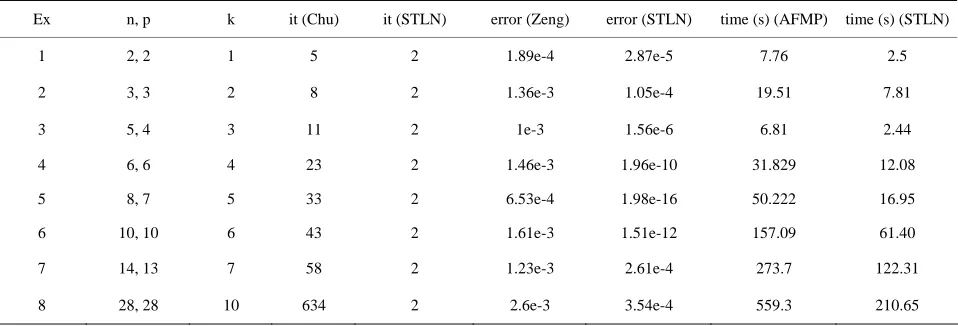
t s In Table 1, we present the performance of Algorithm 4.1 and compare the accuracy of the new fast algorithm with the algorithms in [9,21]. Denote be the total degree of polynomials
n
1
f and be the total degree of polynomials
p
, 2
i
f i t. It (Chu) stands for the number of iterations by the method in [14] whereas it (STLN) denotes the number of iterations by Algorithm 4.1. Denoted by error(Zeng) and error (STLN) are the
2
k tol103
6 5 4
3 2
4 2.56 2.56
0.62 1.03 3.32 5.8,
x x x
x x x
1 0.6
f
5 4
2 1.85 5.7 2.84,
f x x 1.31x33.96x2
5 4 3 2
3 0.44 3.23 7.64 4.7 4.72 4.72,
f x x x x x
perturbations 2
2 i i i f f
computed by the method in5 4 3 2
4 1.23 4.92 2.65 9.645 11.12 2.04,
f x x x x x
[21] and Algorithm 4.1, respectively. The last two co- lumns denote the CPU time in seconds costed by AFMP algorithm and our algorithm, respectively.
5 4 3 2
5 1.31 5.76 8.49 5.47 0.48 5.16.
f x x x x x
As shown in the above table, we show that our method based on STLN algorithm converges quickly to the mini- mal approximate solutions, needing no more than 2 itera- tions whereas the method in [14] requires more iteration steps. We also note that our algorithm still converges very quickly when the degrees of polynomials become large while the algorithm in [14] needs more iteration steps. Besides, our algorithm needs less CPU time than the AFMP algorithm. So the convergence speed of our method is faster. From the errors, we demonstrate that our method has smaller magnitudes compared with the method in [21]. So our algorithm can generate much more accurate solutions.
6 5
1
3 2
0.6401 2.56 2.5603
0.62 1.03 3.32 5.8,
f x x x
x x x
5 4 3
2 1.85099 5.7 1.3102 3.9
f x x x 6x22.84,
5 4
3
2
0.4389 3.23 7.64
4.7003 4.72 4.72, 3
f x x
x x
x
5 4 3 2
4 1.23 4.92 2.65 9.645 11.12 2.04,
f x x x x x
5 4
5
2
1.307 5.76 8.4902
5.47 0.48 5.16. 3
f x x
x x
x
with a minimum distance
5. Conclusion
2 2
1 12 2 2 2 3 3
2
2 2
5 5 2
1.1460 10 ,
N f f f f f f f f f f
and the CPU time
Examples 4.1, 4.2, 4.3, 4.4 and 4.5 show that Al- le to solve Problem 1.1.
In this paper, we present that approximation GCD of se- veral polynomials can be solved by a practical and re- liable way based on STLN method and transformed to the approximation of Sylvester structure problem. For the matrices related to the minimization problems are all structured matrix with low displacement rank, applying the algorithm to solve these minimization problems would be possible. The complexity of the algorithm is reduced with respect to the degrees of the given polyno- mials. Although the problem of structured low rank ap-
2
4 4 2
5
0.0923583 .
t s
[image:7.595.59.538.573.736.2]gorithm 4.1 is feasib
Table 1. Algorithm performance on benchmarks.
error (Zeng) error (STLN) time (s) (AFMP) time (s) (STLN)
Ex n, p k it (Chu) it (STLN)
1 2, 2 1 5 2 1.89e-4 2.87e-5 7.76 2.5
2 3, 3 2 19.51 7.81
3 1
1 1 1
1
2
8 2 1.36e-3 1.05e-4
3 5, 4 3 11 2 1e-3 1.56e-6 6.81 2.44
4 6, 6 4 23 2 1.46e-3 1.96e-10 1.829 2.08
5 8, 7 5 33 2 6.53e-4 1.98e-16 50.222 16.95
6 0, 10 6 43 2 .61e-3 1.51e-12 57.09 61.40
7 4, 13 7 58 2 1.23e-3 2.61e-4 273.7 122.31
8 8, 28 10 634 2 2.6e-3 3.54e-4 559.3 210.65
prox ation has been studied in m literatures and obtained many accomplishm ts, there is still much
to be ne, for le, low nk appr ation of nite
e ional m s not fully lved.
,”
Transactions on Signal Process, Vol. 42, No. 11, 1994
pp. 3104-3113 9/78.330370
im any
en ra
work fi
do examp oxim
dim ns atrix ha been reso
REFERENCES
[1] B. DeMoor, “Total Least Squares for Affinely Structured Matrices and the Noisy Realization Problem IEEE
, . http://dx.doi.org/10.110
[2] R. M. Corless ragerm and S.
0.
mputations, Genova, 2006.
, P. M. Gianni, B. M. T M. Watt, “The Singular Value Decomposition for Polyno- mial System,” Proceedings of International Symposium on Symbolic and Algebraic Computation, Montreal, 1995, pp. 195-207
[3] S. R. Khare, H. K. Pillai and M. N. Belur, “Numerical Al- gorithm for Structured Low Rank Approximation Prob- lem,” Proceeding of the 19th International Symposium on Mathematical Theory of Networks and Systems, Budapest, Hungary, 201
[4] E. Kaltofen, Z. F. Yang and L. H. Zhi, “Approximate Great- est Common Divisors of Several Polynomials with Line- arly Constrained Coecients and Simgular Polynomials,” Proceedings of International Symposium on Symbolic and Algebraic Co
[5] N. Karkanias, S. Fatouros, M. Mitrouli and G. H. Halikias, “Approximate Greatest Common Divisor of Many Poly- nomials, Generalised Resultants, and Strength of Appro- ximation,” Computers & Mathematics with Applications, Vol. 51, No. 12, 2006, pp. 1817-1830.
http://dx.doi.org/10.1016/j.camwa.2006.01.010
[6] I. Markovsky, “Structured Low-Rank Approximation and Its Applications,” Automatica, Vol. 44, No. 4, 2007, pp. 891-909.
http://dx.doi.org/10.1016/j.automatica.2007.09.011
rtied Ap- [7] D. Rupprecht, “An Algorithm for Computing Ce
proximate GCD of Univariate Polynomials,” Journal of Pure and Applied Algebra, Vol. 139, No. 1-3, 1999, pp. 255-284.
http://dx.doi.org/10.1016/S0022-4049(99)00014-6
[8] J. A. Cadzow, “Signal Enhancement: A Composite Prop- erty Mapping Algorithm,” IEEE Transactions on Acous- tic Speech Signal Process, Vol. 36, No. 1, 1988, pp. 49- 62. http://dx.doi.org/10.1109/29.1488
e with
1983-067944 [9] G. Cybenko, “A General Orthogonalization Techniqu
Applications to Time Series Analysis and Signal Proc- essing,” Mathematics of Computation, Vol. 40, 1983, pp. 323-336.
http://dx.doi.org/10.1090/S0025-5718- 9-6 [10] J. R. Winkler and J. D. Allan, “Structured Total Least
Norm and Approximate GCDs of Inexact Polynomials,”
Journal of tional an d Mathem .
215, No. 1, 2008, pp. 1-13.
://dx.do 1016/j.ca .03.018
Computa d Applie atics, Vol
http i.org/10. m.2007
[ Frieze, R a and S. V la, “Fast M arlo
9488.1039494 11] A.
Algorithm for Finding Low R
. Kanna empa
ank Approximations onte-C
,” Jour- nal of ACM, Vol. 51, No. 6, 2004, pp. 1025-1041. http://dx.doi.org/10.1145/103
ar Magnetic
ppro- rmale, 2011.
p. 157-172. [12] R. Beer, “Quantitative in Vivo NMR (Nucle
Resonance on Living Objects),” University of Technolo- gy Delft, 1995.
[13] B. Paola, “Structured Matrix-Based Methods for A ximate Polynomial GCD,” Edizioni della No
[14] M. T. Chu, R. E. Funderlic and R. J. Plemmons, “Struc- tured Low Rank Approximation,” Linear Algebra Appli- cations, Vol. 366, No. 1, 2003, p
http://dx.doi.org/10.1016/S0024-3795(02)00505-0
[15] B. Beckermann and G. Labahn, “A Fast and Numerically Stable Euclidean-Like Algorithm for Detecting Relative Prime Numerical Polynomials,” IEEE Journal of Symbo- lic Computation, Vol. 26, No. 6, 1998, pp. 691-714. http://dx.doi.org/10.1006/jsco.1998.0235
[16] B. Y. Li, Z. F. Yang and L. H. Zhi, “Fast Low Rank Ap- proximation of a Sylvester Matrix by Structured Total Least Norm,” Journal of JSSAC (Japan Society for Sym- bolic and Algebraic Computation), Vol. 11, No. 34, 20 pp. 165-174.
05,
. F. Yang and L. H. Zhi, “Structured Low
. Rosen, “Low Rank Approxi-
0.1023/A:1022347425533
[17] B. Botting, M. Giesbrecht and J. May, “Using Rieman- nian SVD for Problems in Approximate Algebra,” Pro- ceedings of the 2005 International Workshop on Symbo- lic-Numeric, 2005, Xi’an.
[18] E. Kaltofen, Z
Rank Approximation of a Sylvester Matrix,” Internatio- nal Workshop on Symbolic-Numeric Computation, Xi’an, 2005, pp. 19-21.
[19] H. Park, L. Zhang and J. B
mation of a Hankel Matrix by Structured Total Least Norm,” BIT Numerical Mathematics, Vol. 39, No. 4, 1999, pp. 757-779.
http://dx.doi.org/1
GCD of In- [20] L. H. Zhi and Z. F. Yang, “Computing Approximate GCD of Univariate Polynomials by Structure Total Least Norm,”
Mathematics-Mechanization Research Preprints, No. 24, 2004, pp. 375-387.
[21] Z. Zeng and B. H. Dayton, “The Approximate
exact Polynomials Part 2: A Multivariate Algorithm,”