Munich Personal RePEc Archive
Semiparametric Binary Random Effects
Models: Estimating Two Types of
Drinking Behavior
Dong, Yingying
California State University Fullerton
1 March 2010
Semiparametric Binary Random E¤ects Models:
Estimating Two Types of Drinking Behavior
Yingying Dong
Department of Economics California State University, Fullerton
September 2010
Abstract
This paper proposes a new estimator for cross section semiparametric regres-sions containing an unobserved binary random e¤ect and applies it to alcohol consumption. The unobserved random e¤ect (health-consciousness) explains a signi…cant proportion of the otherwise unexplained variation in alcohol consump-tion. Higher education positively correlates with health-consciousness.
JEL Codes: C14, I12
Keywords: Random E¤ects Model, Alcohol Consumption, Education
1
Introduction
This paper proposes a new estimator for cross-section semiparametric regressions
con-taining an unobserved binary random e¤ect, and applies it to alcohol consumption in
the US. Recent empirical evidence (e.g., Reboussin et. al. 2006, and Smith and Shevin,
2008) indicates that drinkers must be divided into two distinct populations: healthy,
light, safe drinkers versus unhealthy, risky, problem drinkers. In this paper’s model, an
unobserved binary random component captures this heterogeneity, and empirically
ex-plains a signi…cant proportion of the total variation in alcohol consumption. This holds
even after conditioning on characteristics such as race, education level, etc. (see, e.g.
Cook and Moore 1993 and Manning et al 1995).
The model is
Yi =h(Xi) +Vi+Ui (1)
whereYi is the log quantity of alcohol consumed by individuali,Xiis a vector of observed
covariates, Ui is the mean zero error, and Vi is an unobserved mean zero random e¤ect
where
Vi =v1Di+v0(1 Di) (2)
HereDi is the unobserved binary indicator of whether personiis non-health-conscious.
Therefore,Vi when added toh(Xi)represents the mean level of drinking for a person of
type Di, and vd for d= 0;1are shifts to the mean level of drinking for all drinkers, i.e.,
E(Y jX =x; D =d) = h(x) +vd.
The standard way to separately identify and estimate the distribution ofV in
equa-tion (1) is to use panel data assuming that V does not vary by time. Other methods
include latent class models that associate drinking with other observed characteristics,
deconvolution methods that assume the distribution of U is completely known, or by
mixture models have been used to estimate smoking behavior, where the number of
ciga-rettes smoked is parameterized by a conditional negative binomial distribution (Fletcher
et al. 2009).
In contrast, this paper proposes a new semiparametric estimator that can be used
to estimate the model without panel data, without assuming V is …xed over time, and
without parameterizing the U distribution.
2
Estimation
Assume we haven iid observations of (Yi; Xi). Let equations (1) and (2) hold. Letpd=
Pr (D=d)6= 1=2andh(X) = E(Y jX). Dong and Lewbel (2009) prove that ifU ?D,
D ? X, U j X is mean zero and symmetric, and E(Y9 jX) exists (to provide enough
identifying moment equations) then the entire model is nonparametrically identi…ed.
Given identi…cation, I now provide a new estimator for this model. Based on the
moment generating function of Y given X in equation (1), exploiting the de…nition of
V in equation (2) and symmetry of U, for any positive constant de…ne
m = E e
[Y h(X)]
E(e [Y h(X)]) =
E e U E e V
E(e U)E(e V) =
E e V
E(e V) =
p0e v0 +p1e v1
p0e v0 +p1e v1
. (3)
Probabilities sum to one, so p1 = 1 p0. Since V is mean zero, v0p0 +v1p1 = 0. Let
r =p0=p1, then p0 =r=(1 +r), p1 = 1=(1 +r), and v1 = v0r. Substituting these into
equation (3) gives
0 =r+e v0(1+r)
re2 v0
+e v0(1 r)
m (4)
the nonparametric Nadaraya-Watson kernel regression estimator for h(x), i.e.,
b
h(x) =
Pn i=1K
Xi x b Yi Pn
i=1K
Xi x b
,
where b is the bandwidth and K is a kernel function. Then estimate m by
b
m =
Pn i=1e [
Yi bh(Xi)] Pn
i=1e [
Yi bh(Xi)]
.
b
m is a function of averages of nonparametric regressions, which under standard
condi-tions are root n normal. Based on equation (4), let T be a set of positive values of .
Then de…ne br and bv0 by
(br;bv0) =
X
2T
arg min
r>0;v0<0
r+e v0(1+r)
(re2 v0
+e v0(1 r)
)mb 2.
Given br and bv0, the parameters of the distribution of V are pb0 = br=(1 +br), pb1 =
1=(1 +br), and bv1 = bv0br.
Rootn normality follows from the delta method, given asymptotic normality of mb .
Chen et al (2003) provide su¢cient conditions for asymptotic inference from
bootstrap-ping a two-step estimator with a nonparametric …rst-step like this.
One can directly calculate the fraction of the variation inY explained byV, i.e., the
ratio of vard(V) =bv2
0bp0+bv21pb1 to the sample variance of Y.
3
Application
This section identi…es and estimates the model using alcohol consumption data. Y, the
log average number of alcoholic drinks consumed per day, is modeled as a function ofX,
D, as well as a random error U. Rather than arbitrarily dividing the sample into light
versus heavy drinkers based on some pre-speci…ed cut-o¤, this model directly estimates
the impact of this unobserved binary heterogeneity on drinking. Also investigated is
how health-consciousness D changes with education level, which is of interest from a
policy perspective.
The data are from the 2004 US Behavioral Risk Factor Surveillance System (BRFSS).
This study draws a sample of 18 - 60 year old male drinkers who have completed
school-ing. Drinking behavior, and the de…nition of healthy drinking, can be a¤ected by health,
so this analysis focuses on individuals who self-report good, very good, or excellent health
to avoid this problem.
X consists of a marital status dummy, race/ethnicity in four categories, household
income in seven categories, number of children in the household, and mental health
condition (the number of days in the past 30 days an individual experienced stress or
depression).
Data from very occasional drinkers are subject to substantial rounding errors. For
example, someone who only drinks once every few weeks may report zero, one, or two
drinks in the last 30 days, and in the zero case would be mistaken for a teetotaler.
Therefore, I exclude those who reported less than one drink in two weeks, to essentially
focus on regular drinkers. The …nal sample has 33,444 observations, including 14,638
college graduates.
To investigate how health-consciousness changes with education, models for college
and non-college graduates are separately estimated. The conditional mean function of
alcohol consumption,h(X), is estimated using both OLS and nonparametric
Nadaraya-Watson kernel regression, where the bandwidth is chosen by cross-validation. For OLS,
second stage is set to be 100 equally-spaced values between 0.023 and 2.3.1 Table 1
reports estimation results. The results are comparable in both cases, implying that OLS
is reasonable here for h(X).
In Table 1, estimation using a kernel regression …rst-stage shows that 92.9% of
college-educated drinkers are the health-conscious type who drink moderately (0.46 drinks per
day on average), while the remaining 7.1% are the non-health-conscious type who drink
relatively heavily (almost 2 drinks per day). The non-college graduates are less likely
to be health-conscious (87% instead of 92.9%). Further, for non-health-conscious
indi-viduals, non-college graduates on average drink more than college graduates, with 2.32
versus 1.98 drinks per day. In contrast, the average drinking among health-conscious
individuals is almost the same regardless of education, i.e., 0.46 versus 0.50 drinks per
day. Estimates using an OLS …rst-stage are quite similar, though with slightly higher
mean levels of drinking and slightly higher probabilities of heavy drinking.
These results suggest that higher education is associated with both a higher
proba-bility of health-consciousness and a more moderate level of drinking among the heavy
drinkers. The distinction between the two types of drinkers are close to the typical
de…nition of heavy drinking. For example, the US Centers for Disease Control and
Pre-vention (CDC) de…nes heavy drinking for males as consuming an average of more than
2 drinks per day.
The last row in Table 1 presents the percentage of variation in Y explained by the
unobserved heterogeneity V. Estimation using a nonparametric …rst-stage shows that
15.4% of the variation in college graduates’ alcohol consumption and 22.4% in
non-college graduates’ can be explained by health-consciousness. Estimates using an OLS
…rst-stage are smaller but still signi…cant. Either way, the binary random e¤ect explains
1Experiments with di¤erent values for produced slightly di¤erent estimates, but all main
Table 1 Estimates of the Random E¤ects in Alcohol Consumption
College graduates Non-college graduates OLS Kernel Reg. OLS Kernel Reg. Health Consciousness
type (d)y 1 0 1 0 1 0 1 0
Probability 0.964 0.036 0.929 0.071 0.906 0.094 0.870 0.130 of type (p) (0.019) (0.019) (0.026) (0.026) (0.016) (0.016) (0.019) (0.019) Random e¤ect -0.059 1.556 -0.103 1.358 -0.143 1.377 -0.200 1.336 parameter (v0) (0.020) (0.188) (0.028) (0.137) (0.019) (0.080) (0.025) (0.072) Mean # of 0.485 2.437 0.460 1.982 0.536 2.450 0.500 2.324 drinks per day (0.010) (0.422) (0.268) (0.013) (0.012) (0.197) (0.014) (0.172)
% of variation 10.02% 15.4% 16.7% 22.4%
explained by type (0.012) (0.025) (0.016) (0.020)
Note: y Health consciousness typedequals 1 if an individual is health conscious, and 0
other-wise. Bootstrapped standard errors are in the parentheses below. All estimates are signi…cant at the 1% level.
a non-trivial proportion of total variation in alcohol consumption.
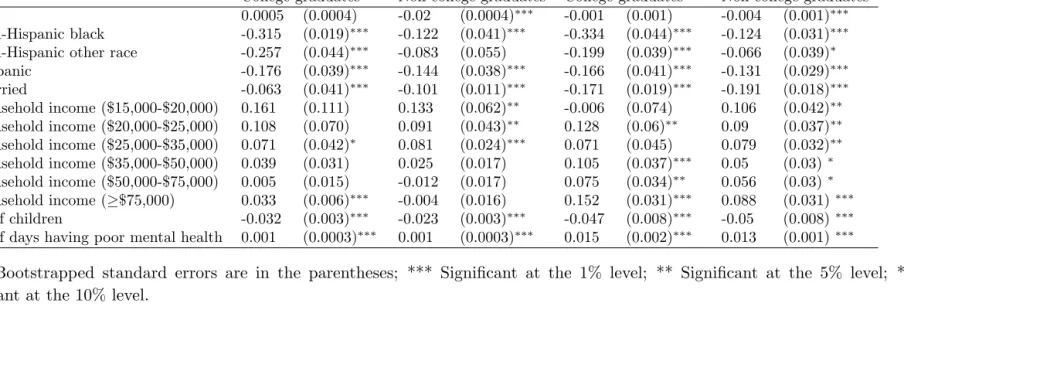
Table 2 reports the marginal e¤ects of covariates. In the nonparametric kernel
regres-sion, marginal e¤ects of continuous covariates are the partial derivatives of the regression
function with respect to these covariates, evaluated at the mean values of all covariates.
The marginal e¤ects for discrete covariates are calculated as the change in the regression
function when a categorical dummy changes from 0 to 1, holding the other categories
Table 2 Marginal E¤ects on Alcohol Consumption
Dependent variable: Log (drinks per day)
Kernel Regression based estimation OLS based estimation
College graduates Non-college graduates College graduates Non-college graduates
Age 0.0005 (0.0004) -0.02 (0.0004) -0.001 (0.001) -0.004 (0.001)
Non-Hispanic black -0.315 (0.019) -0.122 (0.041) -0.334 (0.044) -0.124 (0.031)
Non-Hispanic other race -0.257 (0.044) -0.083 (0.055) -0.199 (0.039) -0.066 (0.039)
Hispanic -0.176 (0.039) -0.144 (0.038) -0.166 (0.041) -0.131 (0.029)
Married -0.063 (0.041) -0.101 (0.011) -0.171 (0.019) -0.191 (0.018)
Household income ($15,000-$20,000) 0.161 (0.111) 0.133 (0.062) -0.006 (0.074) 0.106 (0.042)
Household income ($20,000-$25,000) 0.108 (0.070) 0.091 (0.043) 0.128 (0.06) 0.09 (0.037)
Household income ($25,000-$35,000) 0.071 (0.042) 0.081 (0.024) 0.071 (0.045) 0.079 (0.032)
Household income ($35,000-$50,000) 0.039 (0.031) 0.025 (0.017) 0.105 (0.037) 0.05 (0.03)
Household income ($50,000-$75,000) 0.005 (0.015) -0.012 (0.017) 0.075 (0.034) 0.056 (0.03)
Household income ( $75,000) 0.033 (0.006) -0.004 (0.016) 0.152 (0.031) 0.088 (0.031)
# of children -0.032 (0.003) -0.023 (0.003) -0.047 (0.008) -0.05 (0.008)
# of days having poor mental health 0.001 (0.0003) 0.001 (0.0003) 0.015 (0.002) 0.013 (0.001)
Using either the nonparametric kernel regression or OLS in the …rst-stage, the
es-timates are similar, and are consistent with the existing literature. For example, like
Cook and Moore (1993) and Manning et al. (1995), I …nd that, other things equal, white
males drink more than blacks and other minorities. Also, drinking is low in the lowest
income bracket (under $15,000 per year), but otherwise drinking tends to decrease as
income increases, particularly among non-college graduates.
4
Conclusions
I propose a method of semiparametrically estimating a binary random e¤ects model using
cross-section data. The functional form of the regression function and the distributions
of the random e¤ects and the remaining error are all nonparametric.
The model is applied to a sample of healthy male adults who are regular drinkers.
Alcohol consumption is speci…ed as a binary random e¤ects model, capturing
individ-ual heterogeneity in health-consciousness. I …nd that health-conscious drinkers consume
about half a drink per day on average, while those who are not consume near or over 2
drinks per day. These estimates are consistent with the typical de…nition of heavy
drink-ing for males. Further, college education is found to be associated with a higher
proba-bility of health-consciousness and a lower level of drinking among heavy drinkers. The
unobserved binary random component capturing individual types is shown to explain a
signi…cant proportion of the otherwise unexplained variation in alcohol consumption.
References
Chen, X., O. Linton and I. Van Keilegom, 2003. Estimation of Semiparametric
Cook, J.P. and M.J. Moore, 1993. Drinking and schooling. Journal of Health
Eco-nomics 12, 411-429.
Dong, Y. and A. Lewbel, Nonparametric Identi…cation of a Binary Random Factor
in Cross Section Data, Boston College Working Paper 707.
Fletcher, M.J., P. Deb and J.L. Sindelar, 2009. Tobacco Use, Taxation and Self
Control in Adolescence. NBER Working Paper 15130.
Manning, G.W., L. Blumberg and L.H. Moulton, 1995. The demand for alcohol:
The di¤erential response to price. Journal of Health Economics 14, 123-148
Reboussin, B.A., E. Songa, A. Shresthab, K. K. Lohmana, and M. Wolfson, (2006)
A latent class analysis of underage problem drinking, Drug and Alcohol Dependence,
83, 199-209
Smith, G.W. and M. Shevin, (2008) Patterns of Alcohol Consumption and Related
Behaviour in Great Britain: A Latent Class Analysis, Alcohol and Alcoholism, 43,