Implementation of evidence-based practice by
standardized care plans: A study protocol
Inger Jansson1*, Eva Törnvall2
1
School of Social and Health Sciences, Halmstad University, Halmstad, Sweden 2
Research and Development Unit, Local Health Care, County of Ostergotland, Linköping, Sweden Email: *[email protected]
Received 7 October 2013; revised 9 November 2013; accepted 28 November 2013
Copyright © 2013 Inger Jansson, Eva Törnvall. This is an open access article distributed under the Creative Commons Attribution License, which permits unrestricted use, distribution, and reproduction in any medium, provided the original work is properly cited.
ABSTRACT
Background: Patient records should both transfer and create knowledge about patients and their health care. A standardized care plan could be a way to im-plement evidence-based care directly in practice and improve the documentation in patient records. The aim of this study is to investigate and compare the development and implementation process of a stan-dardized care plan in hospital and primary health care. A further aim is to evaluate the effects on the quality of documentation and the care given in two contexts. Methods and Analysis: Realistic evaluation will be used as a framework to investigate the imple-mentation process. According to this framework, pos-sible contexts, mechanisms, and outcomes in the study will be considered. The study will be performed in two contexts: anorthopedic clinic and primary health care centers. In both contexts, the two key mecha-nisms will be the same: the implementation process will be driven by internal facilitators (practitioners at the units) and the process will be guided by the Rules and Regulations for interoperability in the Health and Social Care specification, “National information structure for standardized care plans”. Two outcomes of the study will be studied: to investigate the devel-opment and implementation process by an evaluation of fidelity and to evaluate how a standardized care plan affects the quality of documentation and the use of evidence-based care. Discussion: Implementation of the SCP will probably meet the same resistance as implementation of guidelines. Documentation of care is an important but resource-consuming requirement in health care, a more standardized method of docu-menting is requested by health professionals. This project can provide insight into the complex process of developing and implement an SCP in different
contexts, which will be useful in further implementa-tion processes.
Keywords:Standardized Care Plan; Orthopedic Clinic; Primary Health Care; Realistic Evaluation
1. INTRODUCTION
To implement evidence-based knowledge in health care is a responsibility and a challenge [1-3]. The goal of evi- dence-based care is to use the methods that do the most good. One way to implement evidence-based practice is by clinical guidelines [4], which provide evidence-based generic recommendations for best practice for a specific clinical domain [5,6]. The use of guidelines also means more opportunity for equal and comparable care [7]. Unfortunately, adherence to guidelines varies and some- times different guidelines for the same clinical domain are used at the same clinic [7]. Reasons for the defective use of guidelines can be poor knowledge, lack of infor- mation, lack of personal experience, lack of feedback, lack of leadership, and/or lack of a culture to improve care [7].
Health care is an information-intensive activity and the patient record is one of the most important sources and tools for information management. The patient record should both transfer and create knowledge about the pa- tient and their health care [8]. To meet these require- ments, the documentation in the patient record must be systematic and rigorous, and standardized structures, terminologies, and classification systems must be used [8]. Earlier studies of nurses’ documentation showed deficiencies concerning data about, for example, nursing diagnosis and outcomes [9].
A standardized care plan (SCP) could be a way to im- plement evidence-based care directly in practice and im- prove the documentation in the patient records. In Swe- den, the term SCP is used to describe a plan of health
care predefined on the basis of a defined knowledge base, describing recommended interventions for patients with one or more health problems [10]. In the literature, an SCP may be referred as a critical pathway, clinical path- way, care model, care map, evidence-based care guide- line, or protocol [11]. In a review, Kinsman, Rotter, James, Snow and Willis [12] suggested the term clinical pathway to identify a structured evidence-based multid- isciplinary plan of care. Three of the following four cri- teria must be fulfilled: the pathway must be used to translate guidelines or evidence into local structures; the pathway should comprise detailed steps for treatment or care; the pathway must have a time line; the pathway should aim to standardize care in one clinical domain [12]. Since SCP is a term used in Sweden this term will be used in this work.
In the Swedish Strategy for eHealth, work is taking place nationally to create and implement a Swedish in- formation structure that is a generic description of the health and social care process encompassing the required information and an interdisciplinary terminology in health care [13]. A general specification defining SCP and the development and implementation of SCP exists in Sweden: Rules and Regulations for Interoperability in Health and Social Care (RIV, acronym in Swedish) [10] and work is ongoing to develop and test SCP around the country [14,15].
Earlier studies have shown that nurses perceive that SCPs increase their ability to provide the same quality of care to all patients and reduce the time spent on docu- mentation as well as unnecessary documentation [14,16]. Pöder, Fogelberg-Dahm and Wadensten [17] found that perceived knowledge about evidence-based guidelines increased after implementation of SCP. According to Vanhaecht, De Witte, Panelle and Sermeus [18] clinical pathways support clinical processes and have a positive impact on coordination of care and organization of care processes.
The main factors that motivated nurses to implement SCPs [15] were that they were easy to understand and follow and corresponded to organizational norms. In the implementation process, internal facilitators acted as important educators, providing reminders to use the SCP and feedback to the SCP users. According to Hunter and Segrott [19], clinical pathways seem to achieve effects on clinical care and professional identities at the devel- opment stage. The aim of reducing documentation is often mentioned when clinical pathways are introduced.
Despite the regulation and positive effects of using SCP, the use of SCP in Swedish health care is not com- mon and therefore it is useful to investigate the devel- opment and implementation process as well as the effects of the process. Contextual factors have a crucial role in how successful an implementation became. Matland [20]
describe how conflicts and ambiguity can constitute both hindrance and possibilities for implementation of poli- cies and guidelines. When implementing guidelines one has to accept that there will be conflicts and find a way to solve them. The ambiguity in a guideline gives scope for compromises which can facilitate the acceptance of a guideline. Therefore, it is relevant to study two different contexts and then compare them.
The aim of this study is to investigate and compare the development and implementation process of SCPs in hospital and primary health care. A further aim is to evaluate the effects on the quality of documentation and care given in two different contexts.
2. METHODS
2.1. Theoretical Framework
There are several different theories about implementation. The theories have different perspectives such as the indi- vidual, the context and social interaction, and the or- ganization. For this study, we have chosen realistic evaluation as a framework to investigate the implemen- tation process. Realistic evaluation aims to find out how a program works, for whom and under what circum- stances, and can be based on methodological pluralism [21-23]. Realistic evaluation is guided by three themes: to understand the mechanisms through which the inter- vention produces change; to understand the contextual conditions necessary to trigger these mechanisms; and to develop outcome pattern predictions according to the context and mechanisms triggered [21]. The investigator initially considers possible contexts, mechanisms, and outcomes (CMO) to describe a program and then gathers data. The results are then used to revise the initial CMO propositions. This framework has been described previ- ously in study protocols and research [22,24].
Because the starting point of this study is in real ser- vices and involves real health personnel, the causal mechanisms are embedded in the particular contexts and their social processes; realistic evaluation offers a way to describe and understand the complex relationship be- tween mechanisms and the effect the context has on their practicability and outcomes.
2.2. Implementation Strategy
ences known so far are the types of health services that are offered and the experiences of using SCPs at an or- thopedic clinic and a PHCC. At an orthopedic clinic, the patient is admitted for a limited time and around the clock. In a PHCC, the care process extends over unlim- ited time but is mostly performed during office hours and often, the patient has a high degree of comorbidity. At an orthopedic clinic, the personnel may have experience using SCPs, whereas use of SCPs is infrequent in PHCCs.
At an orthopedic clinic, an SCP for patients with hip fracture will be developed and implemented. In PHCCs, an SCP for patients with leg ulcers and patients with hy- pertension will be developed and implemented. The in- tention is to develop a multi-disciplinary SCP.
In both contexts, the two key mechanisms (M) will be the same. The first mechanism is that the process will be driven from a bottom-up perspective, whereby the im- plementation will be driven by internal facilitators who are practitioners at the units. A facilitator often acts as a change agent for the implementation of the SCP and the facilitator is believed to be central to successful imple- mentation [22]. The second mechanism is that the proc- ess will be guided by the RIV specification “National information structure for standardized care plans” [10]. A RIV specification is an established method to describe IT support in a development project in Sweden. In the RIV specification, the development of an SCP is described as natural part of the work to develop care and make the care safer. It is also important that the base for an SCP is scientific, evidence-based, and experience-based knowl- edge and that the SCP is multi-professional. From the knowledge that the SCP is based on, the goal for health care should be identified as well as the interventions that are relevant.
[image:3.595.57.286.591.735.2]Project groups of internal facilitators will be estab- lished to develop an SCP and implement it within the electronic patient record. At the orthopedic clinic, a multi-professional group will be established and at the
Table 1. Initially CMOs considered in the study, according to the realistic evaluation framework [21].
Context Mechanism Outcome
A: Orthopedic clinic
1. Internal facilitators responsible for development and implementation of the SCP at the units
Implementation process: To describe the implementation process in different contexts and evaluate fidelity
B: Primary health care centers
2. The development and implementation process will be guided by the RIV
specification for SCP (Boxes 1 and 2)
Effect of SCP: How SCP affects the quality of
documentation and the use of evidence-based care
PHCC, the project group will be formed by nurses. In these groups, one person with competence in informatics will be included as an external facilitator. The work of the group will be to develop an SCP according to the steps in the RIV specification [10] (Box 1).
The group will meet continually and the time to com- plete the mission will depend on the resources. IJ and ET will be included in the groups as mentors and will simul- taneously act as researchers to study the process. The ma- nager of the organization and medically responsible phy- sicians will approve the SCP. To implement the SCP de- veloped, it has to be integrated into the electronic patient record. The person with competence in informatics will be needed for this part of the development of the SCP.
To implement the SCP in everyday work on the ward and at the PHCC, internal facilitators will be used. IJ and ET will support the facilitators during the introduction and education. The facilitators will introduce and educate the staff on how to use the SCP according to the steps in the RIV specification [10] (Box 2). Before the imple- mentation of SCP can begin, the introduction and ap- proach must be thoroughly anchored at the manager. It appeared that the motivation for nurses to use the SCP was that it was easy to understand, consistent with ap- plicable standards and regulations, and that the leader- ship had given their approval and that there was a clear division of roles in the implementation [15]. The facili- tators will continue to support the teams to use SCP in their daily work, and evaluate the applicability of the SCP.
Beyond those two known mechanisms, several others mechanisms will work as triggers for fidelity and
Development of an SCP:
Establish a project group
Make an inventory of available SCPs
Decide if a new SCP shall be developed or an available SCP
shall be used
Identify and state which knowledge base shall be used
Create an SCP
Assure the quality of the content
Approve the SCP
Register the SCP
Box 1. Development of an SCP according to the steps in the RIV specification [10].
Implementation of an SCP
Search for an SCP
Assess/motivate/decide on an SCP
Bring the SCP to the individual care plan
Perform care according to the applied SCP
Evaluate the applicability of the SCP
outcomes [25,26]. These mechanisms will be investi- gated and as far as possible explained by using action research, described later in this article. The result of the investigation will describe the relationship between CMO rather than explain the causality [23].
The outcome (O) of the study will be studied in two phases: phase 1 will investigate the development and implementation process by evaluating fidelity; and phase 2 will evaluate how the SCP affects the quality of docu- mentation and the use of evidence-based care.
2.3. Phase 1: Investigation of the Implementation Process
In realistic evaluation, mixed methods can be used [21,22]. To study the implementation process, action research will be used. Action research can be defined as: “The study of social situations carried out by those in- volved in that situation in order to improve their practice and the quality of their understanding” [27, p. 8]. In ac- tion research, the process starts by getting a group of people together who would like to do the work for their own purposes based on their experience. The focus will be twofold for the participants and the researcher: on the actions in the clinic and their own learning. These foci will be the source of different action-reflection cycles [28].
In the first cycle of the process, an SCP will be devel- oped and implemented in the electronic patient record, Box 1. This will give an action-reflection cycle in which new knowledge obtained while developing the SCP may lead to changes in the care performed. In the second cy- cle, the SCP will be implemented in the everyday work on the ward, in the two parts in the RIV specification described earlier, Box 2. Implementing the SCP in daily practice will provide knowledge about the attitudes and behavior of the personnel when changes take place.
To study the implementation process, focus groups in- terviews will take place with the participating staff mem- bers and managers. These interviews will be recorded and transcribed before analysis. The implementation process will also be observed by the researcher using field notes and log books for the personnel responsible.
All personnel employed in the two care setting will also be invited to participate in an inquiry dealing with the prerequisites for implementing a specific routine, using a questionnaire originally developed for measuring the factors and prerequisites for implementing clinical guidelines on the basis of the Promoting Action on Re- search Implementation in Health Service (PARIHS) framework [29,30]. This inquiry will be repeated at the end of the project. After the implementation, the applica- tion of the SCP will be examined by auditing patient re- cords.
The qualitative data from the focus groups interviews
will be analyzed using Grounded Theory [31], a method often used to study social processes when action research is used. The quantitative data from the questionnaire will be analyzed by descriptive statistics in SPSS. Compari- sons will be done between the two contexts.
2.4. Phase 2: Evaluation of the Effects of Using SCP
Examination of double documentation and adherence to evidence-based care in the electronic patient record will be done before and after the SCP is implemented. Elec-tronic patient record will be collected during a 3-month period before the start of the project and for a 3-month period 1 year after the SCP has been implemented in the electronic record. Approximately 90 records from the orthopedic clinic and about 10 - 30 records per PHCC will be included depending on the patient group (i.e. pa- tients with a leg ulcer or hypertension). A study-specific audit protocol appropriate for each patient group in which a SCP is created will be used. The audit protocol will be constructed by the authors based on the knowl- edge base for the SCP. The data collected from the elec- tronic patient record will be analyzed using summative content analysis [32].
Focus group interviews will also take place before im- plementation and 6 - 12 months after implementation to evaluate the personnel’s experience of the usefulness of the information in the patient records and the effects of the SCP in their work after implementation; the inter- views will be analyzed using conventional content analysis [32]. Comparisons will be done between the two contexts.
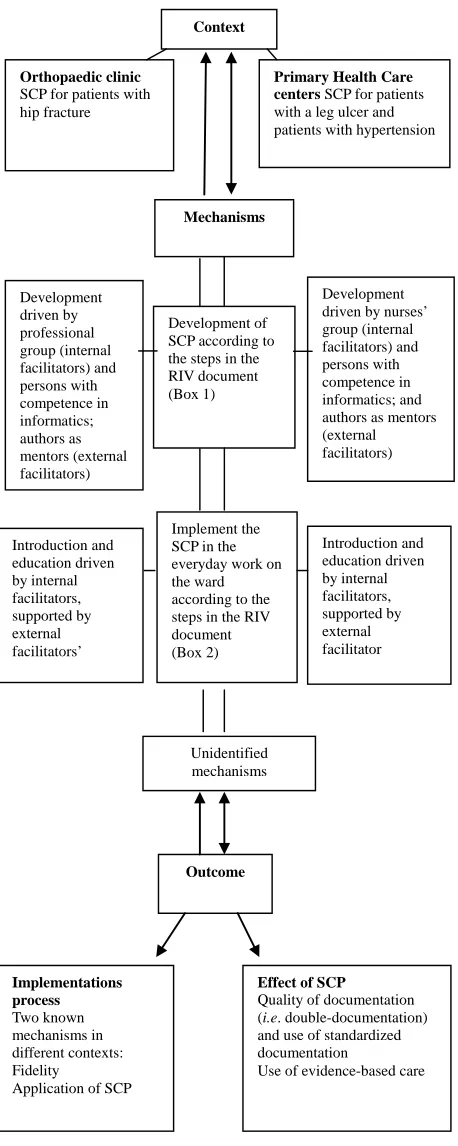
A summary description of the process, context, and planned studies for implementation of SCPs is given in Figure 1.
2.5. Ethical Considerations
To develop and implement SCPs should be part of the legal obligation of health care personnel to continuously update their knowledge and to transfer important infor- mation about the patient. Implementation of SCPs will not influence the possibility of the patient getting the right care at the right time, rather it will optimize the care given. No changes to or new methods of care and treat- ment will take place that are not verified by research or evidence-based knowledge.
The World Medical Association’s Declaration of Hel- sinki [33] and the Swedish Act on Ethical Review of Research Involving Humans [34] were taken into ac- count for the study. Permission to carry out the study has been granted by a Regional Ethics Committee (Ref: 2010/670 and Ö 9-2011).
Orthopaedic clinic SCP for patients with hip fracture
Primary Health Care centers SCP for patients with a leg ulcer and patients with hypertension Context
Development driven by professional group (internal facilitators) and persons with competence in informatics; authors as
mentors(external
facilitators)
Development driven by nurses’ group (internal facilitators) and persons with competence in informatics; and authors as mentors (external facilitators) Development of
SCP according to the steps in the RIV document (Box 1)
Mechanisms
Introduction and education driven by internal facilitators, supported by external facilitators’
Introduction and education driven by internal facilitators, supported by external facilitator
Outcome Implement the SCP in the everyday work on the ward according to the steps in the RIV document (Box 2)
Implementations process Two known mechanisms in different contexts: Fidelity
Application of SCP
Effect of SCP
Quality of documentation (i.e. double-documentation) and use of standardized documentation
Use of evidence-based care Unidentified
[image:5.595.59.288.82.655.2]mechanisms
Figure 1. Summary description of the process, context, and planned studies for implementation of SCPs.
formation, and their informed written consent will be obtained before participation. Participation will be vol- untary and the informants will be told that they can with- draw from the study at any time. Confidentiality will be
guaranteed.
3. DISCUSSION
This article presents the theoretical and methodological considerations for designing a research study to evaluate the implementation of an SCP. Efforts to develop an SCP are a challenge because development means combining the views of multiple health professionals and accom- plishing a joint health care agreement. Implementation of the SCP will probably meet the same resistance as im- plementation of guidelines [7,35]. Most health profes- sionals know what guidelines are valid and should be used but then do not use them; colleagues and experi- ences are used instead. Physicians should discuss with each other how to tackle the discrepancy between guide- lines and practice. Nurses use guidelines for an unknown problem but when they have learned how to solve the problem, they no longer use the guidelines [35]. A sys- tematic evaluation of the implementation process con- sidering the various and changing contexts of health care and the mechanisms embedded in social processes could provide one more piece in the puzzle of what makes an implementation successful.
Because documentation of care is an important but re- source-consuming requirement in health care, a more standardized method of documenting is requested by health professionals. This project can provide insight into the complex process of developing and implementing an SCP in different contexts, which will be useful in further implementation processes. It could also increase our un- derstanding of the barriers and possibilities in creating a generic model for interdisciplinary documentation of care, and evaluate the RIV specification [10] that will guide the process.
REFERENCES
[1] Estabrooks, C.A., Floyd, J.A., O’Leary, K.A. and Gushta, M. (2003) Individual determinants of research utilization: a systematic review. Journal of Advanced Nursing, 43, 506-520.
http://dx.doi.org/10.1046/j.1365-2648.2003.02748.x
[2] Carlson, C.L. and Plonczynski, J. (2008) Has the BAR-RIERS Scale changed nursing practice? Journal of Ad-vanced Nursing, 63, 322-333.
http://dx.doi.org/10.1111/j.1365-2648.2008.04705.x
[3] Squires, J.E., Hutcinson, A.M., Boström, A.-M., O’Rou- ke, H.M., Cobban, S.J. and Estabrooks, C.A. (2011) To what extent do nurses use research in clinical practice? A systematic review. Implementation Science, 6, 21.
http://dx.doi.org/10.1186/1748-5908-6-21
[4] Thomas, L.H., Cullum, N.A., McColl, E., Rousseau, N. and Steen, N. (2000) Guidelines in professions allied to medicine (review). The Cochrane Library.
[5] Natsch, S. and van der Meer, J.W.M. (2003) The role of clinical guidelines, policies and stewardship. Journal of Hospital Infection, 53, 172-176.
http://dx.doi.org/10.1053/jhin.2002.1372
[6] Gooch, P. and Roudsari, A. (2011) Computerization of workflows, guidelines, and care pathways: A review of implementation challenges for process-oriented health information systems. Journal of the American Medical Informatics Association, 18, 738-748.
http://dx.doi.org/10.1136/amiajnl-2010-000033
[7] Grol, R. and Grimshaw, J. (2003) From best evidence to best practice: Effective implementation of change in pa- tients’ care. Lancet, 362, 1225-1230.
http://dx.doi.org/10.1016/S0140-6736(03)14546-1
[8] Conrad, D. and Stocker Sneider, J. (2011) Enhancing the visibility of NP practice in electronic health records. The Journal for Nurse Practitioners, 7, 832-838.
http://dx.doi.org/10.1016/j.nurpra.2011.04.004
[9] Wang, N., Hailey, D. and Yu, P. (2011) Quality of nurs-ing documentation and approaches to its evaluation: A mixed-method systematic review. Journal of Advanced Nursing, 67, 1858-1875.
http://dx.doi.org/10.1111/j.1365-2648.2011.05634.x
[10] RIV (2011) RIV-Specifikation Nationell informations- struktur för standardiserade vårdplaner [RIV specification —National information infrastructure for standardized care plans].
http://www.cehis.se/images/uploads/dokumentarkiv/RIV _specifikation_nat_inform_struktur_fr_SVP_110610.pdf
[11] De Bleser, L., Depreitere, R., de Waele, K., Vanhaecht, K., Vlayen, J. and Sermeus, W. (2006) Defining Path- ways. Journal of Nursing Management, 14, 553-563.
http://dx.doi.org/10.1111/j.1365-2934.2006.00702.x
[12] Kinsman, L., Rotter, T., James, E., Snow, P. and Willis, J. (2010) What is clinical pathway? Development of a defi-nition to inform the debate. BMC Medicine, 8, 31.
http://dx.doi.org/10.1186/1741-7015-8-31
[13] Social Department (2010) Nationella eHälso-strategin [National strategy for eHealth].
http://www.regeringen.se/sb/d/14914/a/148429
[14] Dahm, M.F. and Wadensten, B. (2008) Nurses’ experi- ences of and opinions about using standardized care plans in electronic health records—A questionnaire study.
Journal of Clinical Nursing, 17, 2137-2145.
http://dx.doi.org/10.1111/j.1365-2702.2008.02377.x
[15] Jansson, I., Bahtsevani, C., Pilhammar, E. and Forsberg, A. (2010) Factors and conditions that influence the im- plementation of standardized nursing care plans. Open Journal of Nursing, 4, 25-34.
http://dx.doi.org/10.2174/1874434601004010025
[16] Lee, T.-T. and Chang, P.-C. (2004) Standardized care plans: Experiences of nurses in Taiwan. Journal of Clini- cal Nursing, 13, 33-40.
http://dx.doi.org/10.1111/j.1365-2702.2004.00818.x
[17] Pöder, U., Fogelberg-Dahm, M. and Wadensten, B. (2011) Implementation of a multi-professional standardized care- plan in electronic health records for the care of stroke pa- tients. Journal of Nursing Management, 19, 810-819.
http://dx.doi.org/10.1111/j.1365-2834.2011.01220.x
[18] Vanhaecht, K., De Witte, K., Panelle, M. and Sermeus, W. (2009) Do pathways lead to better organized care processes? Journal of Evaluation in Clinical Practice, 15, 782-788.
http://dx.doi.org/10.1111/j.1365-2753.2008.01068.x
[19] Hunter, B. and Segrott, J. (2008) Re-mapping client journeys and professional identities: A review of the lit-erature on clinical pathways. International Journal of Nursing Studies, 45, 608-635.
http://dx.doi.org/10.1016/j.ijnurstu.2007.04.001
[20] Matland, R.E. (1995) Synthesizing the implementation literature: The ambiguity-conflict model of policy im-plementation. J-PART, 5, 145-174.
[21] Pawson, R. and Tilly, N. (1997) Realistic Evaluation. Sage Publications, London.
[22] Pommier, J., Guével, M.-R. and Jourdan, D. (2010) Eva- luation of health promotion in schools: A realistic evalua- tion approach using mixed methods. BMC Public Health,
10, 43. http://dx.doi.org/10.1186/1471-2458-10-43
[23] Wilson, V. and McCormack, B. (2006) Critical realism as emancipatory action: The case for realistic evaluation in practice development. Nursing Philosophy, 7, 45-57.
http://dx.doi.org/10.1111/j.1466-769X.2006.00248.x
[24] Wand, T., White, K. and Patching, J. (2011) Realistic evaluation of an emergency department-based mental health nurse practitioner outpatient service in Australia.
Nursing & Health Sciences, 13, 199-206.
http://dx.doi.org/10.1111/j.1442-2018.2011.00601.x
[25] Carroll, C., Patterson, M., Wood, S., Booth, A., Rick, J. and Balain, S. (2007) A conceptual framework for im- plementation fidelity. Implementation Science, 2, 40.
[26] Williams, L., Burton, C. and Rycroft-Malone, J. (2012) What works: A realist evaluation case study of interme- diaries in infection control practice. Journal of Advanced Nursing, 69, 915-926.
http://dx.doi.org/10.1111/j.1365-2648.2012.06084.x
[27] Winter, R. and Munn-Giddings, C. (2001) A Handbook for Action Research in Health and Social Care. Routledge, London.
[28] McNiff, J. and Whitehead, J. (2011) All You Need to Know About Action Research. 2nd Edition, Sage Publi- cations, London.
[29] Rycroft-Malone, J., Kitson, A., Harvey, G., McCormack, B., Seers, K., Tichen, A. and Eastbrooks, C. (2002) In- gredients for changes: Revisting a conceptual model.
Quality and Safety in Health Care, 11, 174-180.
http://dx.doi.org/10.1136/qhc.11.2.174
[30] Bahtsevani, C., Khalaf, A., Willman, A. and Östman, M. (2008) Developing an instrument for evaluating imple- mentation of clinical practice guidelines: A test-retest study. Journal of Evaluation in Clinical Practice, 14, 839-846.
http://dx.doi.org/10.1111/j.1365-2753.2007.00916.x
[31] Charmaz, K. (2005) Grounded theory in the 21st century. In: Denzin, N.K. and Lincoln, Y.S., Eds., Handbook of Qualitative Research, The Sage, London, Chapter 20. [32] Hsieh, H.-F. and Shannon, S.E. (2005) Three approaches
Re-search, 15, 1277-1288.
http://dx.doi.org/10.1177/1049732305276687
[33] World Medical Association (2003) Declaration of Hel-sinki. In The Swedish Research Council’s Guidelines for the Ethical Evaluation of Medical Research on Humans. Medicinska forskningsrådet (MFR), Stockholm, 99-104.
[34] SFS (2003) Lag om etikprövning av forskning som avser människor [Act on the Ethical Review of Research
Involving Humans]. Socialdepartementet. Stockholm, 460.
[35] Gabbay, J. and le May, A. (2004) Evidence based guide-lines or collectively constructed “mindguide-lines”? Ethno-graphic study of knowledge management in primary care.
BMJ, 329, 1013.
![Table 1. Initially CMOs considered in the study, according to the realistic evaluation framework [21]](https://thumb-us.123doks.com/thumbv2/123dok_us/7966042.753970/3.595.57.286.591.735/table-initially-cmos-considered-according-realistic-evaluation-framework.webp)