Improvement of Bandwidth Efficient Video and
Live Streaming in Mobile using AWS Cloud
Vinod S H 1, Dr. K N Rama Mohan Babu 2
1
M.Tech Student, Dept.of Information Science & Engineering, Dayananda Sagar College of Engineering, Bangalore, Karnataka, India.
2
Professor, Dept.of Information Science & Engineering, Dayananda Sagar College of Engineering, Bangalore, Karnataka, India.
Abstract—The new method has been proposed a novel idea for mobile video streaming and live streaming in the clouds. The user request for videos over the mobiles through wireless links this wireless links capacity cannot be corporate with the traffic demand. As gap between traffic demand and link capacity, with link conditions, result poor quality service and sending data on this channel result in buffering time. Mobile traffic is serious concern for mobile network operator to provide the qos to mobile user, this video traffic exceeds the video bandwidth capacity of cellular network, to address the delay, packet lose video traffic. This paper propose a new framework, bandwidth efficient mobile video and live streaming using Amazon web services(AWS) elastic computing cloud (ec2) called as AWS Cloud, to demonstrate video performance and cloud server for live streaming and adaptive video streaming in cloud. which has two main parts: adaptive mobile live video streaming (LVS) and adaptive video streaming (AVS). LVS and AVS construct a private agent to provide video streaming services efficiently for every mobile user. For a given user, LVS-AVS lets an agent adaptively adjust user streaming flow with a scalable video coding technique based on the feedback of link quality. Sharing the video based on url path of video in cloud for social networking. The framework shows that the private agents in the clouds can effectively provide the adaptive streaming for both live visuals and video in cloud.
keywords: Live streaming, Adaptive video streaming, cloud computing, AWS, ec2.
I.
INTRODUCTIONIn recent times, most of mobile network operators are facing a serious challenge due to mobile data video traffic over the wireless network. While video streaming services become more crucial for mobile users, their traffic may often exceed the bandwidth capacity of cellular networks. Increasingly, more growing demand for video streaming services, that require high quality, quality of service (QoS) support over the wireless interfaces, such as guaranteed bandwidth, delay, error rate, delay and jitter, internet service providers (ISP) are required to extend their ranges of services to allow users to utilize streaming applications with optimum level of QoS in wireless environment.
To ensure an efficient provision of real time video streaming applications in wireless networks, mobile users should be able to dynamically negotiate their QoS requirements which are represented by the service level specifications (SLSs), with the access network. This conciliation should be executed per session. The network
operator must guarantee the negotiated SLS during the entire course of the session, which is not an easy task because of the mobility of users. additionally, transmission of premium quality video requires high bandwidth, that is difficult to guarantee because of the resource constraints in present wireless networks.
However, mobile users equipped with multiple wireless interfaces, in arrangement with internet service providers providing services through dissimilar wireless technologies, have to make simultaneous use of these interfaces to connect to the network and aggregate the available resources via these interfaces. Therefore, users can improve the supposed quality of their applications[5]-[6].
Increasingly more video traffic is accounted by video streaming and live streaming. During, video streaming services over mobile networks have become widespread over the past few years. Whereas the video streaming is not much difficult in wired networking, mobile networks have been distressing from video traffic transmissions over limited bandwidth of wireless network links. Despite network operators distracted efforts to improve the wireless link bandwidth e.g 3G, high video traffic demands from mobile users are quickly overwhelming the wireless link capacity.
While receiving video streaming traffic via 3G mobile networks, mobile users frequently undergo from long buffering time and irregular disruptions due to the limited bandwidth and link condition fluctuation caused by multi path fading and user mobility [2]-[4]. Therefore, it is crucial to improve the service quality of mobile video streaming while using the networking and computing resources efficiently both in streaming video as well as live streaming [8]-[9].
In recent times, there have been many research on how to improve the service quality of mobile video streaming on following aspects:
Scalable streaming for video: Mobile video streaming
audio video codec (AVC) video compression standard [10]-[12] defines a base layer (BL) with multiple enhance layers (EL). By the SVC, a video can be decoded or played at the lowest quality if only the BL is delivered. However, the more EL can be delivered, the improved quality of the video stream is accomplished.
Adaptive streaming for video: Traditional video
streaming techniques designed by considering relatively stable traffic links between servers and users, perform poorly in mobile environments. Hence the fluctuating wireless link status should be properly dealt with to afford bearable video streaming services. To address this concern, we have to alter the video bit rate adapting to the presently time varying available link bandwidth of every mobile user. Such adaptive streaming techniques can successfully decreases the packet losses and bandwidth waste [2] Scalable video coding and adaptive streaming techniques can be jointly combined to accomplish effectively the best possible quality of video streaming services. specifically, user can dynamically adjust the number of Scalable Video Coding (SVC) layers depending on the existing link status. The combination of adaptation technology and scalable media formats like Scalable Video Coding (SVC) is about to become applicable for a variety of use cases. Tools enabling the adaptation, e.g., MPEG-21 Digital Item Adaptation (DIA), are already standardized and the specification of SVC as an extension to H.264/AVC will be completed in mid–2007.
SVC compression and adaptation technology was developed for a variety of usage scenarios. These include video streaming cast, video conferencing and surveillance in the streaming, which are described in more detail in the following. Digital video broadcast (DVB), IPTV, and video on demand (VoD) are presently deployed solutions for the broadcast of video streaming content to one specific user (VoD) or many users (DVB, IPTV).
An advanced adaptation scenario for video streaming is given by a setup comprising multiple terminals (e.g. PCs, laptops, PDAs, mobile phones) with varying terminal capabilities that are connected via diverse networks in a joint video session [13]-[14].
In this module, we have designed a framework of adaptive live video streaming and prefetching framework for mobile users with the several objectives in considerations, abbrevated as LVS-AVS Cloud. LVS-AVS Cloud constructs a private agent for each mobile user in cloud computing environments, which is used by its two main parts: LVS (adaptive mobile video streaming), and
AVS (adaptive video streaming). The contributions of this framework can be explained as follows:
Live video streaming offers the best possible streaming experiences by adaptively controlling the streaming bit rate depending on the fluctuation of the link quality. Live streaming adjusts the bit rate for each user leveraging the scalable video coding. The private agent of mobile user keep track of the response information on the link status. Private agents of users are dynamically initiated and optimized in the cloud computing platform. Also the real-time SVC coding is done on the cloud computing side efficiently.
LVS-AVS using amazon web services (AWS) Cloud supports distributing video streams efficiently. The first level in cloud is a content delivery network, and the second level is a data center. With this demonstrated structure, video streaming can be optimized within the cloud.
II.
RELATED WORKAdaptive Streaming
In the adaptive streaming, the video traffic rate is adjusted on the fly so that a user can experience the maximum possible video quality based on user link’s time varying bandwidth capability [22]. There are mainly two types of adaptive streaming techniques were found, depending on whether the adaptivity is controlled by the client or the server.
The Microsoft’s Smooth Streaming is a live adaptive streaming service which can switch among different bit rate segments encoded with configurable bit rates and video resolutions at servers, whereas clients dynamically demand videos based on local monitoring of link quality. Adobe and Apple also developed customer side HTTP adaptive live streaming solutions working in the same manner.
HTTP Live Streaming (HLS)
This is one of the effective streaming technique, Hyper text transport protocol (HTTP) structured multimedia streaming communications protocol carried out by Apple company is known as Hyper text transport protocol (HTTP) Live Streaming (HLS), for Apple company products like IOS, Ipad and Iphone etc., HLS is an adaptive streaming multimedia distribution standard protocol. It is an exemplified and segmented in MPEG family transport channels and M3U8-MP3 Playlist File to offer live and on demand multimedia data by utilizing H.264 multimedia audio video codec. On behalf of most appropriate channel or stream similar to platform,bandwidth and CPU limits selected by device instantly, it downloads available bits for buffering to play multimedia file. HLS streaming provides the best user experience [15].
Bandwidth and Network for adaptive video streaming
In video streaming process, video encoding is used for the reason that uncompressed video needs huge information space to store data for cellular streaming systems, which can need information range rates as low as 30 kilobytes per second (kbps), this means that clip must be compressed thousands of times or more to achieve the essential information. With the growth of cellular multimedia streaming, user should exercise within the information limitations of the network and capability of the endpoint. Although 3G and next generation systems provide much higher bandwidths to cellular devices.
The network atmospheres used for distributing video services with different aspects. Eg: 3G wireless network uses the bandwidth range 256-768 Kbps with audio or video codecs H.263, H.264, MPEG-4 for different terminal devices like video handsets, smart phones [19]-[20].
Coding (SVC) technique has gained a momentum [09]. An adaptive video streaming system based on SVC is deployed, which studies the real time SVC decoding and encoding at personal computer servers.
Scalable Video Coding (SVC)
SVC is a highly attractive solution to the problems posed by the characteristics of modern video transmission systems. The term “scalability” refers to the removal of parts of the video bit stream in order to adapt it to the various needs or preferences of end users as well as to varying terminal capabilities or network conditions. The term SVC is used interchangeably for both the concept of SVC in general and for the particular new design that has been standardized as an extension of the H.264 standard. The objective of the SVC standardization has been to enable the encoding of a high-quality video bit stream that contains one or more subset bit streams that can themselves be decoded with a complexity and reconstruction quality similar to that achieved using the existing H.264 design with the same quantity of data as in the subset bit stream [16].
H.264 Audio/Video Codec
SVC was standardized as an expansion of H.264 Audio or Video codecs(AVC). The briefdescription of H.264/AVC is restricted to those key features that are relevant for understanding the concepts of extending H.264/AVC towards SVC. The blueprint of H.264/AVC covers a Video Coding Layer (VCL) and a Network Abstraction Layer (NAL).While the VCL creates a coded demonstration of the resourcesubstance, the NAL formats these information and provides header informationin a way that enables easy and successful customizationof the use of VCL data for a broad range of systems [16]-[18].
Adaptive Video Enhancement
Due to mobility, it always does not allow the best quality of video by only cellular networks. Thus, by exploiting different interfaces, e.g. 3G and WiFi, a mobile station(MS) receives video streams via a cellular link and also opportunistically accesses local WiFi with other mobile stations(MSs) to get video segments with a higher quality [5].
Mobile Cloud Computing
The cloud computing has been well positioned to provide video streaming services, particularly in the wired Internet networking because of its scalability and capability. Cloud computing based services to mobile environments requires more factors to consider: user mobility, wireless link dynamics, and restricted capability of mobile devices. Recently, new designs for users on top of mobile cloud computing environments are projected, which virtualize private agents that are in charge of satisfying the requirements (e.g QoS) of individual users such as Cloudlets[21] and Stratus[22].
Cloud is anything which involves delivering host dervices over the network,computing provides the technology to deploy the application. bandwidth assured quality link for mobile live streaming in cloud server and video streaming using realistic cloud is essential [7]. Thus, in order to construct the framework for adaptive live streaming and video streaming, we are motivated to
design the new LVS-AVS Cloud framework by using Amazon elastic computing cloud (ec2) to provide bandwidth efficint adaptive live streaming and video streaming services over the network for mobile.
III.
PROPOSED METHODLVS-AVS CLOUD Framework
In this Framework we explained the LVS-AVS Cloud framework includes the Adaptive Mobile Live Video streaming (LVS) and the adaptive Video Streaming (AVS) in cloud. As shown in Fig.1, the whole live video and adaptive video streaming system in the cloud is called the LVS-AVS Cloud framework. In that cloud, mobile user1 sends the request despence on different download stream to the cloud through HTTP Live Streaming(HLS) protocol. The mobile user2 requests for social video sharing based on url path to AVS on other end. LVS-AVS Cloud framework can keep serving most of live videos eternally, and the management work will be handled by the controller in the video controler.
Fig.1. LVS-AVS Cloud Framework
bandwidth and resources utilization graph for adaptive streaming. For live streaming streaming user requires the two mobile smart phone with tha android os version 4.0 and install tha apk file which is written in java and server name and stream, once start the camera of both phones the live streaming will happens in the proposed framework. AWS cloud also support the efficient video sharing for the social networking over the network through the particular video url in the cloud platform. The video encoder H.264 will encode the streaming video with the secure ssh-rsa encrypted key to get acces into the ec2 cloud to store the video into ec2 for adaptive streaming purpose.
Adaptive mobile live streaming:
Fig.2. Functional structure of user and LVS cloud
A. Adaptive streaming strategy in LVS and AVS
In this design the mobile client and the LVS-AVS cloud framework with the structure as shown in Fig.2. The link quality monitor at mobile client keeps tracking on metrics including signal strength, packet round-trip-time (RTT), jitter and packet loss with a assured task cycle, and the client will sometimes report to the LVS-AVS cloud framework. Here we define the cycle period for the reporting as the timing window which is denoted by Twin. Once the Video Cloud gets the information of the available bandwidth link quality, it will perform a precise calculation and predict the potential bandwidth in the next time window. It is important to note that we will use predicted bandwidth and predicted goodput inter changeably in following parts. Suppose sequence number of current time window is j, the predicted bandwidth can be estimated by using the following parameter SINR, RTT and packet lose rate p [7].
In this paper, we set up a measurement based bandwidth prediction, that is we directly use BWTH of very last time window as the BWTH of next time window, which is already proved with already high accuracy in simulation base [37].
B. Matching Between Available Bandwidth Prediction and scalable video coding:
Video Segments
When the predicted bandwidth is obtained, or considered as predicted goodput, of next time window, LVS-AVS cloud framework will match and decide how many video segments of base layer(BL) and enhanced layer(ELs) [6] can be transmitted approximately. Here we define the new
term “resolution” to indicate the different level of temporal segmentation of live video and the number of enhanced layers (ELs). If it is small and there are more ELs, hence we result that the Scalable Video Coding SVC-based video source is with a higher resolution. We illustrate two different cases of low resolution and high resolution for matching between the Scalable Video Coding (SVC) segments and the predicted goodput with comparision from the server to Mobile station (MS) as per time varying segments.
Algorithm : Matching LVS-AVS bandwidth and segments
Terms Proposed:
BWTH: Bandwidth
SINR: simple noice ratio
RBL: Bit rate length of base layer RTT: Round triple time
BL: Base Layer
EL: Enhanced Layer
---
Input:
1: sequence no timing window: j=0,
base bandwidth equals to bit stream length: BWTH0=RBL,
video layer rate : RL.
Output:
2: estimated bandwidth: BWTH delay T
system resource utilization : SYS Round triple time RTT, noise ratio SINR, packet lose rate p.
Initialization:
3: bandwidth enhanced layer BWTHEL=0, enhance layer l=0.
Procedure:
4: compute estimated bandwidth BWTH 5: compute practical bandwidth BWTH 6: compute packet lose rate p
7: bit rate of lth enhance layer RELl
repeat l++
if l>= total enhance layer k then break
bandwidth enhanced layer BWTHEL = BWTHEL+ RELl
until BWTHEL >=BWTH -RBL 8: if BWTH ≤ BWTH break
9: transmit SVC segment of BL with temporal sequence j
, , … . . ,
10: check BWTH in time interval Tim 11: increment sequence no timing window j++ 12: until last frame RL of stream transmitting.
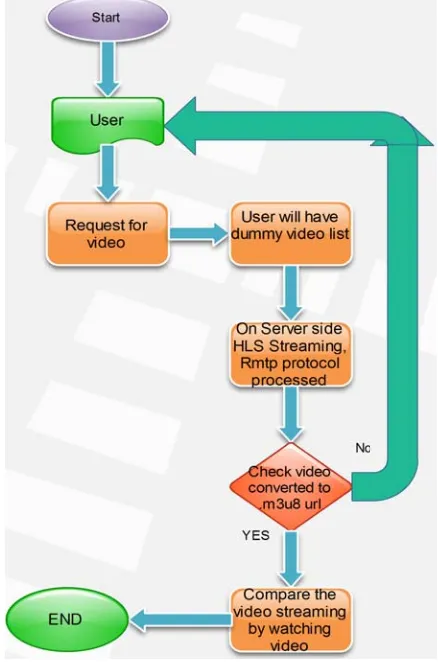
The flow diagram in fig.3 which clears the pictural reprasentation of user interactivity in LVS-AVS cloud platform.In the first case user has to register the details for authentication representation purpose, after entering user login details, the realistic cloud platform allow user to see the list of videos in the LVS-AVS cloud platform.The user can request for particular video on the server side HTTP live streaming (HLS) and RMTP protocol which processed the internal processing over the network.
The protocols check the particular requested url of the video path from the user if the requested url path is available it starts to compare the video streaming by watching the video,if the requested video not available, then it will revert to the user for another fresh request.
Fig. 3. Working flow of video streaming in LVS-AVS Cloud framework
IV.
PERFORMANCE AND EVALUATIONTestded Environment
The new proposed framework evaluate the performance of the LVS-AVS Cloud framework by a AWS cloud server for both live video streaming and adaptive videos streaming in cloud under different testing considerations.
Testded for AdaptiveVideo Streaming in Cloud
For adaptive video streaming test in realistic cloud, We choose the realistic amazon web server(AWS) elastic compute cloud (ec2), cloud server for adaptive videos streaming and utilize the virtual server with one virtual CPU cores (1.66 GHz) and 10 GB memory, which is fast enough for encoding 480P (480 by 720) video with H.264 SVC format in 10 fps at real time for the evaluation
purpose. In the cloud, we deploy our cloud server application based on Java programming, including one main server program that handles all tasks of the whole cloud while the program can dynamically initializes, maintains the all tasks of other components of cloud server and terminates instances of Java application as private agents for all active users in the cloud environment. we uses 3G network to indicate the general cellular network. We evaluate in the city center area, for the evaluation of practical bandwidth of mobile link for downloaded videos. The test which includes more videos in H.264 format with 480P resolution downloaded from YouTube and dailymotion for adaptive video streaming.
Testded for Live Video Streaming in Cloud
For realistic live streaming testing we choose private virtual cloud server with one sender/receiver and receiver for live streaming using java arc file to linux in amazon ec2. We implement the mobile client at a mobile phone, Samsung sduos, with android system version 4.0. The mobile data service is offered by 3G network, while in some uncovered area the 3G network is used. For evaluating live streaming, we still uses 3G network to indicate the general cellular network. We evaluate in the city center area, so the practical bandwidth of the mobile link is not as high as we estimated, but this won’t impact our live streaming results.
Results Observed in Live Video Streaming in cloud
For live streaming, first examine the prerequesities for both mobile users, once all set up is connected, the result observed in live streaming is, multiple user can view the same live data from different location using amazon web server and RTMP protocol using HLS streaming. user starts the camera in mobile fot live streaming as well as send frame the predicted bandwidth will moves from one frame to another frame in the continuous manner with the different framework level of bandwidth and resolution of the different segments in other mobile.
Once user start the camera in two mobiles with the installation of apk file in both the two mobiles then the user will set the stream for recording and server name with secure connection. After set up all the prerequisites then the user will start the live streaming in mobile.
Results Observed in Adaptive Video Streaming in cloud
For adaptive video streaming purpose, we use Amazon cloud platform ec2. we have written code for cloud server and stored in cloud linux part as third party user infrastructure on the basis of cloud infrastructure utilization pay as you consume or pay as you use. The Amazon cloud server provides the rental service for our desired application which are uploaded on linux jar files and evaluate the user uploaded video file bandwidth utilization and resource utilization like cpu,memory and other important parameter.
Fig.4 . Graphical representation of bandwidth utilized.
Fig.5 . Resource utilization while playing the video.
The above two figures Fig.4 shows that, the bandwidth variation with respect to the time factor, once the bandwidth is rich the graph is high when bandwidth is low, graph goes down but not pause or stop the streaming while video gets low bandwidth and bandwidth utilization will be vary depends on interbet as network infrastructure and adaptiveness. Fig.5 shows the clear indication of effective bandwidth utilization and resource utilization while playing the video in the Amazon elastic compute cloud (ec2) platform. Resources utilization means that the network infrastructure in the system components like cpu, memory and disk capacity while playing the streaming.
The effectivity of bandwidth while transmitting over the network and usage of CPU,heap memory and disk capacity utilization with respect to the percentage in each different frames of the transmitted videos.
V.
CONCLUSION AND FUTURE WORKIn this paper, we discussed an adaptive mobile live video streaming and adaptive video streaming framework, called LVS-AVS Cloud framework using Amazon web services elastic computing cloud (ec2), which efficiently stores videos in the realistic cloud plat form of Amzon ec2 for adaptivevideos and live streaming in the cloud platform, and utilizes cloud computing to provide the non terminating video streaming for each mobile user, adapting to the fluctuation of link quality based on the Scalable Video Coding technique. LVS-AVS cloud framework can further seek to provide non buffering experience of video streaming by background pushing functions among the different video base and local video base of mobile users. We have evaluated the LVS-AVS Cloud by realistic Amazon ec2 cloud server platform and shows that the cloud computing technique brings significant improvement on the adaptivity of the mobile streaming technique. The main concept of this paper is to verify how cloud computing technology can significantly improve the transmission adaptability and prefetching for mobile users. Regarding future enhancement, which will concentrate more on effective streaming in video quality with efficient bandwidth utilization, delay and minimize buffer expierence in wireless environment.
ACKNOWLEDGMENT
I would like to convey my thanks to my project guide Dr. K N Rama Mohan Babu, for his valuable guidance, constant support and suggestions for improvement. I also thank the college authorities Dr. M. Ravishankar, Head of Department of Information Science and Engineering, for providing the required infrastructure and encouragement which helped me a lot. Finally, I would like to extend a heartfelt gratitude to the researchers for making their resources available, publishers, friends, and family members.
REFERENCES
[1] “Cisco Visual Networking Index: Global Mobile Data Traffic Forecast Update, 2011–2016,” CISCO, 2012.
[2] Y. Li, Y. Zhang, and R. Yuan, “Measurement and analysis of a large scale commercial mobile Internet TV system,” in Proc. ACM Internet Meas. conf., 2011, pp. 209–224.
[3] T. Taleb and K. Hashimoto, “MS2: A novel multi-source mobile streaming architecture,” IEEE Trans. Broadcasting, vol. 57, no.3, pp. 662–673, Sep. 2011.
[4] X. Wang, S. Kim, T. Kwon, H. Kim, and Y. Choi, “Unveiling the bittorrent performance in mobile WiMAX networks,” in Proc. Passive Active Meas. Conf., 2011, pp. 184–193.
[5] Y. Li, Y. Zhang, and R. Yuan, “AMVS-NDN: Adaptive Mobile Video Streaming and Sharing in Wireless Named Data Networking ,” in Proc. ACM Internet Meas. conf., 2011, pp. 209–224.
[6] Juan Carlos Fernandez, Tarik Taleb, Mohsen Guizani, Nei Kato, " Bandwidth Aggregation-Aware Dynamic QoS Negotiation for Real-Time Video Streaming in Next-Generation Wireless Networks" IEEE Trans. multimedia, vol. 11, no.6, pp. 1082–1093, October. 2009.
[7] Xiaofei Wang, Xiaofei Wang, Ted Taekyoung Kwon, LaurenceT. Yang, Victor C. M. Leung, "AMES-Cloud: A Framework of Adaptive Mobile Video Streaming and Efficient Social Video Sharing in the Clouds" IEEE Trans. multimedia, vol. 15, no.4, pp. 811–820, june. 2004.
[8] A.Naffa,T. and L. Murphy, “Forward error correction adaptation strategies for media streaming over wireless networks,” IEEE Commun. Mag., vol. 46, no. 1, pp. 72–79, Jan. 2008.
[9] K. Zhang, J. Kong, M. Qiu, and G. L. Song, “Multimedia layout adaptation through grammaticalspecifications,”ACM/Springer Multimedia Syst., vol. 10, no. 3, pp. 245–260, 2005.
[10] M. Wien, R. Cazoulat, A. Graffunder, A. Hutter, and P. Amon, “Real-time system for adaptive video streaming based on SVC,” IEEE Trans. Circuits Syst. Video Technol., vol. 17, no. 9, pp. 1227–1237, Sep. 2007.
[11] H. S Schwarz, D. Marpe, and T. Wiegand, “Overview of the scalable video coding extension of the H.264/AVC standard,” IEEE Trans. Circuits Syst. Video Technol., vol. 17, no. 9, pp. 1103–1120, Sep. 2007.
[12] H. S chwarz and M. Wien, “The scalable video coding extension of the H. 264/AVC standard,” IEEE Signal Process. Mag., vol. 25, no. 2, pp. 135–141, Feb. 2008.
[13] Heiko Schwarz, Detlev Marpe, Mohsen Guizani, Nei Kato, "Overview of the Scalable Video Coding Extension of the H.264/AVC Standar" IEEE Trans. multimedia, vol. 17, no.9, pp. 1103–1120, October. 2007.
[14] Mathias Wien, Renaud Cazoulat, Andreas Graffunder, Andreas Hutter, and Peter Amon "Real-Time System for Adaptive Video Streaming Based on SVC ” IEEE Trans. multimedia, vol. 17, no.9, pp. 1227–1237, October. 2007.
[15] Saurabh Goel "Cloud-Based Mobile Video Streaming Techniques" International Journal of Wireless & Mobile Networks (IJWMN) Vol. 5, No. 1, February 2013.
[16] Heiko Schwarz, Detlev Marpe, Thomas Wiegand, "Overview of the Scalable Video Coding Extension of the H.264/AVC Standard" IEEE Trans. multimedia, vol. 17, no.9, pp. 1103–1120, September. 2007.
Handbook of Optimization in Complex Networks: Communication and Social Networks. Berlin, Germany: Springer, 2010.
[18] Z. Wang, L. Sun, C. Wu, and S. Yang, “Guiding Internet-scale video service deployment using microblog-based prediction,” in Proc. IEEE INFOCOM Mini-conf., 2012, pp. 2901–2905.
[19] Y. Fu, R. Hu, G. Tian, and Z. Wang, “TCP-friendly rate control for streaming service over 3G network,” in Proc. WiCOM, 2006, pp. 1–4.
[20] K. Tappayuthpijarn, G. Liebl, T. Stockhammer, and E. Steinbach, “Adaptive video streaming over a mobile network with TCP-friendly rate control,” in Proc. IWCMC, 2009, pp. 1325–1329.
[21] N. Davies, “The case for VM-Based Cloudlets in mobile computing,” IEEE Pervasive Computing, vol. 8, no. 4, pp. 14–23, 2009.
[22] B. Aggarwal, N. Spring, and A. Schulman, “Stratus: Energy-efficient mobile communication using cloud support,” in Proc. ACM SIGCOMM , 2010, pp. 477–478.