http://dx.doi.org/10.4236/jcc.2016.45012
Improve Data Quality by Processing Null
Values and Semantic Dependencies
Houda Zaidi
1,2, Faouzi Boufarès
3, Yann Pollet
11Laboratory CEDRIC, Conservatoire National des Arts et Métiers, Paris, France 2Laboratory RIADI, University Manouba, Tunis, Tunisia
3Laboratory LIPN, University Paris 13, Sorbonne Paris Cité, Villetaneuse, France
Received 12 May 2016; accepted 19 May 2016; published 26 May 2016
Abstract
Today, the quantity of data continues to increase, furthermore, the data are heterogeneous, from multiple sources (structured, semi-structured and unstructured) and with different levels of qual-ity. Therefore, it is very likely to manipulate data without knowledge about their structures and their semantics. In fact, the meta-data may be insufficient or totally absent. Data Anomalies may be due to the poverty of their semantic descriptions, or even the absence of their description. In this paper, we propose an approach to better understand the semantics and the structure of the data. Our approach helps to correct automatically the intra-column anomalies and the inter-col- umns ones. We aim to improve the quality of data by processing the null values and the semantic dependencies between columns.
Keywords
Data Quality, Big Data, Contextual Semantics, Semantic Dependencies, Functional Dependencies, Null Values, Data Cleaning
1. Introduction
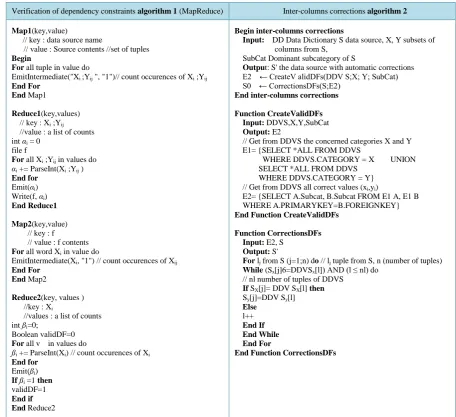
depen-dencies constraints between them. This is what constitutes the second part of the project which is the subject of this article. Constraint checking dependencies from large amounts of data will help to correct automatically the anomalies such as null values and some functional dependencies. In this paper, our proposal is to try to under-stand the semantics of the data before correcting it. An intra-column study allows the automatic correction of anomalies in the data related to its context. For example, the following two strings “Londres” and “London” are equivalent if they represent the context of city names but they are different if they are names of people. Algo-rithms of similarity distance calculation such as Levenshtein [8], Jaro-Winkler [9], Soundex [10] and Metaphone [11] do not take into account the context. Our approach is to illustrate the data structure (i.e. the semantic sche-ma) of the data source. First, the syntactic and semantic automatic corrections inside one column can be better focused. Second, eventual semantic links that may exist between columns can be discovered. Then, the process of anomalies caused by the violation of dependency constraints will start. In a context of Big Data, we use the MapReduce technology to verify the discoveries dependencies and correct anomalies caused by the violation of these dependencies. The rest of the article is organized as follows. The second section describes the step of se-mantic recognition of data. Section three discusses the intra-column and inter-columns data cleaning step. Fi-nally, we compare our approach with other work and we address our future goals.
2. Semantic Categorization of Data
The step of data categorization consists to determine the semantics of each column of a data source. Indeed, in order to qualify a syntactically incorrect data, it should be evaluated in its context. Several examples can illu-strate this: 1) The string “Pari” can be considered syntactically incorrect only if it is the French name of the city “Paris”. The words “Pékin” and “Beijing” mean the same thing in two different languages if we know that these are names of cities. “Beijing” could be considered semantically incorrect if the used language (dominant lan-guage) is French; 2) The three strings “16-10-1996”, “10-16-1996” and “1996-16-10” may represent the same type of information “date with different formats” defined by a regular expression; 3) The string “1996-10” is not a date.
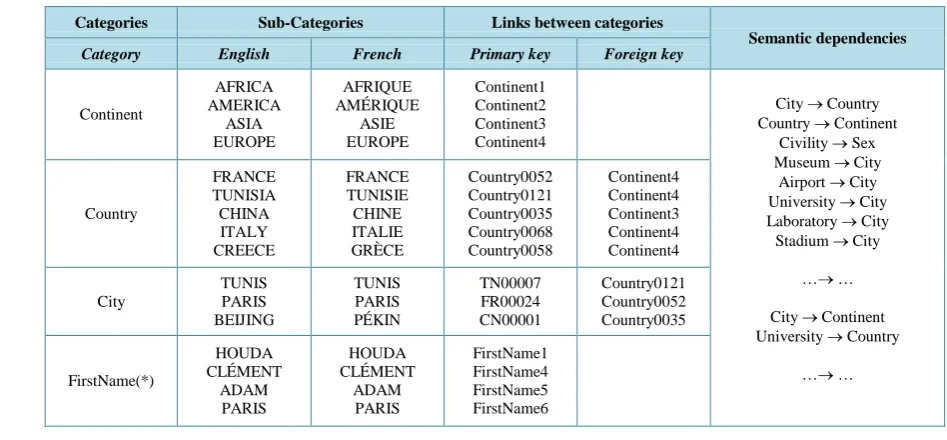
Then, we introduce the use of stored knowledge in a referential called Data Dictionary (DD) [5] [12] [13]. The DD contains knowledge identified by two modes: 1) Data defined by extension: a priori given list such as city names, country names and names of organizations. Valid Strings (DDVS) and Key Words (DDKW) are stored in the DD; 2) Data defined by intention: this knowledge must verify some properties such as regular ex-pressions or belonging to an interval of values (DDRE). For example Emails, Websites and Dates must be con-forming to a model which can be a regular expression. In other words, the DD can then be seen as a set of cate-gories. Each category corresponds to only one data type (String, Number, Date). Some categories can have subcategories such as languages. We propose a DD that contains not only information grouped by categories (Valid Strings, Rules such as Regular Expression) but also semantically valid knowledge such as constraints or functional dependencies pre-stored. Figure 1 below shows examples of pre-stored knowledge.
2.1. Recognition of the Data Structure
As metadata can be totally absent, we can consider that the Data Source (DS) will have to be corrected is in a CSV format and therefore without schema. The process of semantic categorization uses the DD to assign each column of the source to a context and thus a semantic (a category). It returns a new semantic structure of the DS enriched with constraints and comments. The objective is to propose for each column: 1) a semantic name (the category), 2) eventually a subcategory (the language), 3) a data type (the syntactic domain), 4) intra and inter- columns constraints and 5) comments. Details are given in [12].
Given the following example of DS (Figure 2), the semantic recognition consists to find similarities between the DS and the valid strings in the DD to infer the semantic name of each column. We interested by the contex-tual data quality. We use measurements of similarity distance. We propose a mixture of methods of similarity measure, on the one hand, “it is written as”, such as Jaro-Winkler or Levenshtein, and on the other hand, “is pronounced as”, such as Soundex or Metaphone. The application of our semantic recognition process on “Pa-tient.csv” file (Figure 2) gives the results in Figure 3. Let us note that the DS has no significant schema:
S (Column 1: String, Column 2: String, Column 3: String, Column 4: String, Column 5: String, Column 6: String, Column 7: String, Column 8: String, Column 9: String, Column 10: String).
Categories Sub-Categories Links between categories
Semantic dependencies
Category English French Primary key Foreign key
Continent AFRICA AMERICA ASIA EUROPE AFRIQUE AMÉRIQUE ASIE EUROPE Continent1 Continent2 Continent3 Continent4
City → Country Country → Continent
Civility → Sex Museum → City
Airport → City University → City Laboratory → City Stadium → City
…→ …
City → Continent University → Country
…→ … Country FRANCE TUNISIA CHINA ITALY CREECE FRANCE TUNISIE CHINE ITALIE GRÈCE Country0052 Country0121 Country0035 Country0068 Country0058 Continent4 Continent4 Continent3 Continent4 Continent4 City TUNIS PARIS BEIJING TUNIS PARIS PÉKIN TN00007 FR00024 CN00001 Country0121 Country0052 Country0035 FirstName(*) HOUDA CLÉMENT ADAM PARIS HOUDA CLÉMENT ADAM PARIS FirstName1 FirstName4 FirstName5 FirstName6
Figure 1. Extract of the data dictionnary for valid strings and semantic dependencies.
t01 t02 t03 t04 t05 t06 t07 t08 t09 t10 t11 t12 t13 t14 t15 t16 t17
100;Jean;M;M;A+;12/12/1984;0033645456932;Parix;France;Europe 101;Eve;Mme;Femme;B+;10-Sep-85;0033741256811;Paris;;Europe 102;Stephane;M;F;AB+;15-mars-65;0033644356922;Nice;Franc; 103;Adem;;M;AB-;03-avr-80;0033645336941;Tunis;Tunisia; 104;Anne;Mlle;0;1+;16-10-1996;0033645412944;Beijing;Chine;Asie 105;Karine;Mademoisel;0;O-;05/07/1983;0033638456945;Pikin;China; 106;Simon;M;Homme;AB-;04/02/1974;0033645144031;Par;Franca;Europe 107;Robert;M;;AB-;04/06/1975;0033675404932;Paris;Houda;EUROPE 108;Joseph;M;1;AB-;1996-16-10;0033775334900;Paris;Frence;Europe 109;Karine;Mme;Femme;B+;1996-16-10;0033752232901;Paris;France; 110;Martin;M;Femme;B+;1996-10;0033732132421;Paris;;
111;Anne;Mlle;Femme;A+;02/03/1928;0033732011427;;;
112;Karine;Mme;Femme;B+;1996-16-10;0033752232901;Paris;France; 113;;M;Femme;B+;1996-10;0033732132421;Paris;Fr;EUROPE
[image:3.595.65.539.82.302.2]114;Yang;Mlle;Femme;A+;02/03/1983;0033732011427;Paris;Cnam;EUROPE 115;Tang;Mlle;Femme;A+;02/10/1990;0033632047419;Pikin;Chine;Asie 116;Yang;M;Femme;A+;02/10/1995;0033632047419;Pékin;Chine;Asy
Figure 2. Patient.csv file extraction (from the DS).
New Semantic schema
IdColumn Category SubCategory Data Type Constraints Comments
Column1 Number * Number Interval of values
Column2 FirstName * String
Column3 Civility French String ϵ {M, Mme, Mlle} Civility → Sex a finite set of values
Column4 Sex French String ϵ {Homme, Femme} a finite set of values
Column5 BloodGroup * String ϵ {A+, B+, AB+, O+, …} a finite set of values
Column6 Date French Date DD-MM-AAAA
Column7 Phone French Number
Column8 City French String City → Country City→Continent
Column9 Country French String Country → Continent
Column10 Continent French String
[image:3.595.157.464.322.491.2]S (Number: Number, First Name: String, Civility: String, Sex: String, Blood Group: String, Date: Date, Phone: Number, City: String, Country: String, Continent: String); with constraints such as Civility ϵ {M;Mme;Mlle} and functional dependencies such as Civility → Sex and Country →Continent.
2.2. Recognition of Semantic Dependencies between Columns
Let us note that it is possible to exploit the syntactic domain of data to infer the implausible dependencies. Thus, the knowledge pre-stored can guide the user and reduce the search space in the process of discovering depen-dencies constraints. Suggestions of semantically valid dependepen-dencies can be given to the user. Contrary to some works such as [14] [15] which search to verify the functional dependencies between all columns. For example, trying to verify the following dependencies has no meaning: BloodGroup → City or Date → Country or Date → FirstName or FirstName → Date or FirstName → BloodGroup.
3. Data Cleaning
3.1. Correction of Intra-Column Anomalies
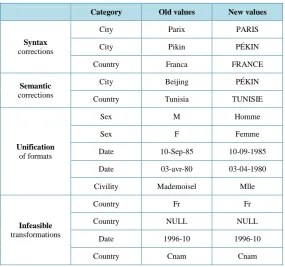
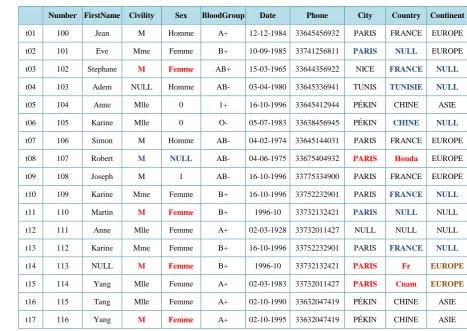
In this section, we present our approach which allows exploiting the semantic knowledge deduced from the step of semantic categorization to correct intra-column anomalies. We call this phase homogenization/standardiza- tion of data. The syntactical correction of data is done by approximating the values of the data source to those which are similar in the Data Dictionary. We use methods of similarity distance calculation. Our cleaning process can correct misspelled values. It allows standardizing formats. Some examples of syntax corrections are given in Figure 4. Note that certain transformations are not feasible at this level such as the string “Fr” or null values (NULL). The step of the semantic categorization of the data allows recognizing the dominant category and eventually the dominant subcategory (language) in each column. We propose to unify the data in the same subcategory. Then values that do not belong to the dominant subcategory are translated to their synonym in the dominant language. Various formats can be used in the same column. We propose unified coding values in a dominant Format (Figure 5).
The intra-column transformations do not correct the errors of violation of semantic dependencies. Null values are not treated at this level of the process.
Category Old values New values
Syntax corrections
City Parix PARIS
City Pikin PÉKIN
Country Franca FRANCE
Semantic corrections
City Beijing PÉKIN
Country Tunisia TUNISIE
Unification of formats
Sex M Homme
Sex F Femme
Date 10-Sep-85 10-09-1985
Date 03-avr-80 03-04-1980
Civility Mademoisel Mlle
Infeasible transformations
Country Fr Fr
Country NULL NULL
Date 1996-10 1996-10
[image:4.595.171.457.440.707.2]Country Cnam Cnam
Number FirstName Civility Sex BloodGroup Date Phone City Country Continent
t01 100 Jean M Homme A+ 12-12-1984 33645456932 PARIS FRANCE EUROPE
t02 101 Eve Mme Femme B+ 10-09-1985 33741256811 PARIS NULL EUROPE
t03 102 Stephane M Femme AB+ 15-03-1965 33644356922 NICE FRANCE NULL
t04 103 Adem NULL Homme AB- 03-04-1980 33645336941 TUNIS TUNISIE NULL
t05 104 Anne Mlle 0 1+ 16-10-1996 33645412944 PÉKIN CHINE ASIE
t06 105 Karine Mlle 0 O- 05-07-1983 33638456945 PÉKIN CHINE NULL
t07 106 Simon M Homme AB- 04-02-1974 33645144031 PARIS FRANCE EUROPE
t08 107 Robert M NULL AB- 04-06-1975 33675404932 PARIS Houda EUROPE
t09 108 Joseph M 1 AB- 16-10-1996 33775334900 PARIS FRANCE EUROPE
t10 109 Karine Mme Femme B+ 16-10-1996 33752232901 PARIS FRANCE NULL
t11 110 Martin M Femme B+ 1996-10 33732132421 PARIS NULL NULL
t12 111 Anne Mlle Femme A+ 02-03-1928 33732011427 NULL NULL NULL
t13 112 Karine Mme Femme B+ 16-10-1996 33752232901 PARIS FRANCE NULL
t14 113 NULL M Femme B+ 1996-10 33732132421 PARIS Fr EUROPE
t15 114 Yang Mlle Femme A+ 02-03-1983 33732011427 PARIS Cnam EUROPE
t16 115 Tang Mlle Femme A+ 02-10-1990 33632047419 PÉKIN CHINE ASIE
[image:5.595.69.537.79.410.2]t17 116 Yang M Femme A+ 02-10-1995 33632047419 PÉKIN CHINE ASIE
Figure 5. Intra-column automatic corrections done on the DS (Patient.CSV).
3.2. Correction of Inter-Columns Anomalies
The correction of intra-column anomalies facilitates the verification of semantic links between the columns which is our ultimate goal. Let S(C) the schema of the DS such as C is the set of columns, X and Y two subsets of columns such as X and Y are subsets of C. We call X functionally determines Y (noted X → Y) if and only if for all xi = xj then yi = yj. In other words for every value xi of X, there is only one corresponding value yj of Y. For instance, the functional dependency Country → Continent can not be verified using the instances given be-low: {(France, NULL); (Frence, Europe); (China, NULL); (Chine, Asy)}.
Hence, it is necessary to begin with the intra-column corrections. The search space is reduced. Figure 5 represents the results of data categorization and intra-column correction. Let us note that the source contains in-ter-columns anomalies. Using the DD some semantic dependencies are not plausible such as Date → City or BloodGroup → City. On the contrary, Civility → Sex, City → Country, City → Continent and Country → Con-tinent are proposed for the verification.
Number FirstName Civility Sex BloodGroup Date Phone City Country Continent
t01 100 Jean M Homme A+ 12-12-1984 33645456932 PARIS FRANCE EUROPE
t02 101 Eve Mme Femme B+ 10-09-1985 33741256811 PARIS FRANCE EUROPE
t03 102 Stephane M Homme AB+ 15-03-1965 33644356922 NICE FRANCE EUROPE
t04 103 Adem NULL Homme AB- 03-04-1980 33645336941 TUNIS TUNISIE AFRIQUE
t05 104 Anne Mlle Femme 1+ 16-10-1996 33645412944 PÉKIN CHINE ASIE
t06 105 Karine Mlle Femme O- 05-07-1983 33638456945 PÉKIN CHINE ASIE
t07 106 Simon M Homme AB- 04-02-1974 33645144031 PARIS FRANCE EUROPE
t08 107 Robert M Homme AB- 04-06-1975 33675404932 PARIS FRANCE EUROPE
t09 108 Joseph M Homme AB- 16-10-1996 33775334900 PARIS FRANCE EUROPE
t10 109 Karine Mme Femme B+ 16-10-1996 33752232901 PARIS FRANCE EUROPE
t11 110 Martin M Homme B+ 1996-10 33732132421 PARIS FRANCE EUROPE
t12 111 Anne Mlle Femme A+ 02-03-1928 33732011427 NULL NULL NULL
t13 112 Karine Mme Femme B+ 16-10-1996 33752232901 PARIS FRANCE EUROPE
t14 113 NULL M Femme B+ 1996-10 33732132421 PARIS FRANCE EUROPE
t15 114 Yang Mlle Femme A+ 02-03-1983 33732011427 PARIS FRANCE EUROPE
t16 115 Tang Mlle Femme A+ 02-10-1990 33632047419 PÉKIN CHINE ASIE
[image:6.595.78.539.80.411.2]t17 116 Yang M Homme A+ 02-10-1995 33632047419 PÉKIN CHINE ASIE
Figure 6. Inter-columns automatic corrections done on the DS (Patient.CSV): (Civitiy → Sex, City → Country, Country → Continent).
4. Related Work
We studied and compared the functionalities of some data quality tools such as Talend Data Quality [3] and Pentaho Data Integration [17]. These tools are used to verify only the functional dependencies given by the user. Then, the user must have knowledge about the data schema and the dependencies to be verified. These Tools do not correct anomalies caused by the violation of semantic dependencies between columns. They do not process null values. The different algorithms of discovery of functional dependencies [14] [15] [18] consist to find de-pendencies across all possible combinations for the different columns of a data source. This increases the size of the search space. These algorithms do not take into account the semantics of data, while, in our approach we fo-cus on contextual data quality. The application of the principle of MapReduce in Big Data will allow to validate algorithms on large volumes of data with good perfermance. Few studies include the principle of MapReduce (distribution of data and treatments).
5. Conclusion
References
[1] Chu, X., Morcos, J., Ilyas, I.F, Ouzzani, M., Papotti, P., Tang, N. and Ye, Y. (2015) KATARA: A Data Cleaning Sys-tem Powered by Knowledge Bases and Crowdsourcing, Proceedings of the 2015 ACM SIGMOD International Confe-rence on Management of Data, Melbourne, 31 May-4 June 2015, 1247-1261.
[2] Dallachiesay, M., Ebaidz, A., Eldawy, A., Elmagarmid, A., Ilyas, I.F., Ouzzani, M. and Tang, N. (2013) NADEEF: A Commodity Data Cleaning System. Proceedings of ACM SIGMOD International Conference on Management of Data, IEEE Press, New York, 22-27 June 2013, 541-552.
[3] Talend. https://www.talend.com/
[4] Ben Salem, A., Boufarès, F. and Correia, S. (2014) Semantic Recognition of a Data Structure in Big-Data. Proceedings of the 6th International Conference on Computational Intelligence and software Engineering, Vol. 2, Beijing, 11-13 July 2014, 93-103.
[5] Ben Salem, A., Qualité contextuelle des données (2015) Détection et nettoyage guidés par la sémantique des données. Ph.D. Thesis, Université Paris 13, Sorbonne Paris cité, Paris.
[6] Boufarès, F., Ben Salem, A. and Correia, S. (2012) Qualité de données dans les entrepôts de données: Elimination des similaires. Proceedings: 8èmes Journées francophones sur les Entrepôts de Données et l’Analyse en ligne, Bordeaux France, 12-13 Juin 2012, 32-41.
[7] Boufarès, F., Ben Salem, A., Rehab, M. and Correia, S. (2013) Similar Elimination Data: MFB Algorithm. Proceed- ings of IEEE-2013 International Conference on Control, Decision and Information Technologies, Hammamet Tunisie, 6-8 May 2013, 289-293.
[8] Levenshtein. http://fr.wikipedia.org/wiki/Distance_de_Levenshtein
[9] Jaro-Winkler. http://fr.wikipedia.org/wiki/Distance_de_Jaro-Winkler
[10] Soundex. https://fr.wikipedia.org/wiki/Soundex
[11] Metaphone. https://fr.wikipedia.org/wiki/Metaphone
[12] Zaidi, H., Boufarès, F., Pollet, Y. and Kraiem, N. (2015) Semantic of Data Dependencies to Improve the Data Quality. Proceedings of the 5th International Conference on Model & Data Engineering, LNCS, Vol. 9344, Springer, Rhodes Greece, 26-28 September 2015, 53-61.
[13] Zaidi, H., Boufarès, F. and Pollet, Y. (2016) Nettoyage de données guidé par la sémantique inter-colonne. Proceedings: 16th Conférence Internationale sur l’Extraction et la Gestion des Connaissances, Vol. RNTI-E-30, Reims France, 18-22 Janvier 2016, 549-550.
[14] Diallo, T. and Novelli, N. (2010) Découverte des dépendances fonctionnelles conditionnelles. Proceedings: 10th Con- férence Internationale sur l’Extraction et La gestion des Connaissances, Hammamet Tunisie, 26-29 Janvier 2010, 315- 326.
[15] Simonenko, E. and Novelli, N. (2012) Extraction de dépendances fonctionnelles approximatives: Une approche incré- mentale. Proceedings: 12th Conférence Internationale Francophone sur l’Extraction et la Gestion des Connaissances, Bordeaux France, 31 Janvier-1 Février 2012, 95-100.
[16] Dean, J. and Ghemawat, S. (2004) MapReduce: Simplified Data Processing on Large Clusters. Proceedings of the 6th Conference on Symposium on Operating System Design and Implementation, California, 137-150.
[17] Pentaho Data Integration. http://www.pentaho.fr/explore/pentaho-data-integration
Appendix
Verification of dependency constraints algorithm 1 (MapReduce) Inter-columns corrections algorithm 2
Map1(key,value)
// key : data source name
// value : Source contents //set of tuples Begin
For all tuple in value do
EmitIntermediate("Xi ;Yij ", "1")// count occurences of Xi ;Yij End For
End Map1
Reduce1(key,values) // key : Xi ;Yij //value : a list of counts int αi = 0
file f
For all Xi ;Yij in values do αi += ParseInt(Xi ;Yij ) End for
Emit(αi) Write(f, αi) End Reduce1
Map2(key,value) // key : f
// value : f contents For all word Xi in value do
EmitIntermediate(Xi, "1") // count occurences of Xij End For
End Map2
Reduce2(key, values ) //key : Xi
//values : a list of counts int ßi=0;
Boolean validDF=0 For all v in values do
ßi += ParseInt(Xi) // count occurences of Xi End for
Emit(ßi) Ifßi =1 then validDF=1 End if End Reduce2
Begin inter-columns corrections
Input: DD Data Dictionary S data source, X, Y subsets of columns from S,
SubCat Dominant subcategory of S
Output: S' the data source with automatic corrections E2 ← CreateV alidDFs(DDV S;X; Y; SubCat) S0 ← CorrectionsDFs(S;E2)
End inter-columns corrections
Function CreateValidDFs Input: DDVS,X,Y,SubCat Output: E2
// Get from DDVS the concerned categories X and Y E1= {SELECT *ALL FROM DDVS
WHERE DDVS.CATEGORY = X UNION SELECT *ALL FROM DDVS
WHERE DDVS.CATEGORY = Y} // Get from DDVS all correct values (xi,yi)
E2= {SELECT A.Subcat, B.Subcat FROM E1 A, E1 B WHERE A.PRIMARYKEY=B.FOREIGNKEY} End Function CreateValidDFs
Function CorrectionsDFs Input: E2, S
Output: S'
For lj from S (j=1;n) do // lj tuple from S, n (number of tuples) While (Sx[j]6=DDVSx[l]) AND (l ≤ nl) do
// nl number of tuples of DDVS If SX[j]= DDV SX[l] then Sy[j]=DDV Sy[l] Else
l++ End If End While End For
[image:8.595.82.539.101.518.2]End Function CorrectionsDFs