N A N O E X P R E S S
Open Access
Red Light-Emitting Diode Based on Blue
InGaN Chip with CdTe
x
S
(1
−
x
)
Quantum Dots
Rongfang Wang
1,2*, Xingming Wei
1,2, Liqin Qin
1,2, Zhihui Luo
1, Chunjie Liang
1,2and Guohang Tan
1Abstract
Thioglycolic acid-capped CdTexS(1−x)quantum dots (QDs) were synthesized through a one-step approach in an
aqueous medium. The CdTexS(1−x)QDs played the role of a color conversion center. The structural and luminescent
properties of the obtained CdTexS(1−x)QDs were investigated. The fabricated red light-emitting hybrid device with
the CdTexS(1−x)QDs as the phosphor and a blue InGaN chip as the excitation source showed a good luminance.
The Commission Internationale de L’Eclairage coordinates of the light-emitting diode (LED) at (0.66, 0.29) demonstrated a red LED. Results showed that CdTexS(1−x)QDs can be excited by blue or near-UV regions. This feature presents
CdTexS(1−x)QDs with an advantage over wavelength converters for LEDs. Keywords:Luminescence, Optical materials and properties, Semiconductors
Background
One of the main challenges in communication and illumination industries is the development of full color displays and solid-state light-emitting devices. White light-emitting diodes (LEDs), which are consid-ered as the next-generation solid-state illuminants, have recently gained considerable attention because of their high efficiency, long service life, and
environ-mental protection [1–3]. At present, white LEDs
(WLEDs) are fabricated by combining blue-emitting
InGaN chips with yellow-emitting Ce3+-doped Y3Al5O12
phosphors. However, Ce3+-doped Y3Al5O12
phosphor-based WLEDs have certain disadvantages, such as low luminous efficiency and a poor color rendering index owing to their red spectral deficiency [4–7]. A variety of red phosphors have been studied to increase red emissions [8–13]. Among the various new red phosphors, II–VI or
III–V semiconductor nanoparticles have been widely
investigated for wavelength converters [14, 15]. Compared with binary quantum dots (QDs) (CdSe, ZnSe, CdTe, etc.), ternary alloy QDs have received a great deal of attention
because they can be used in device fields because of their photoluminescence (PL) properties that can be tuned by controlling particle size and the composition of the alloy QDs [16, 17]. Cadmium sulfur (CdS) is one of the most important group II–VI nanoparticle (NC) semiconductors and displays a wide direct bandgap (2.42 eV). Compared with CdSe, CdTe QDs have greater exciton Bohr radius (7.3 nm) and stronger quantum size effect [18]. The band gap and lattice parameters of CdTexS(1−x) ternary alloy QDs can be varied by adjusting the concentration of S and Te in the CdTexS(1−x)compound. In addition, semicon-ductor nanoparticles can be excited by any optical source with an energy larger than their exciton energy [19].
In the present study, a facile method was developed to synthesize water-soluble red-emitting CdTexS(1−x) alloyed QDs by using thioglycolic acid (TGA) as a stabilizer. Compared with the traditional two step aque-ous synthesis, the approach proposed in the current study is simpler and more environment-friendly. The effects of reaction time and Te:S mole ratio on the maximum emission wavelength, full width at half maximum (FWHM), and PL quantum yield (QY) were also investigated. Furthermore, a red LED was fabricated by combining a 460-nm emitting InGaN chip with CdTexS(1−x)NCs. The performance of the fabricated red LED was then evaluated.
* Correspondence:[email protected]
1Guangxi Key Laboratory of Agricultural Products Processing (Cultivating Base), Colleges and Universities Key Laboratory for Efficient Use of
Agricultural Resources in the Southeast of Guangxi, College of Chemistry and Food Science, Yulin Normal University, Yulin, Guangxi 537000, People’s Republic of China
2Guangxi Experiment Center of Information Science, Guilin, People’s Republic of China
the original solution under stirring. The resulting mixture solution was heated to 100 °C and refluxed for different periods to control the size of the CdTexS(1−x) QDs. These CdTexS(1−x) NCs were pre-cipitated with the excess absolute ethyl alcohol added to the CdTexS(1−x) QD aqueous solution, centrifuged, and then dried at room temperature.
PL and UV-Vis absorption spectra were measured using a FluoroMax-4 fluorescence spectrometer and Cary 5000 spectrometer, respectively. The PL QY was determined using Rhodamine 6G as reference. High-resolution transmission electron microscopy (HRTEM) images were obtained with Tecnai G2 F20. X-ray dif-fraction (XRD) analysis was performed using Rigaku/
Dmax-2500 (Cu Kα= 1.5406 Å). LED parameters were
measured in an integrating sphere, which was connected to a CCD detector (HAAS-1200) under 20 mA for-ward bias.
Results and Discussion
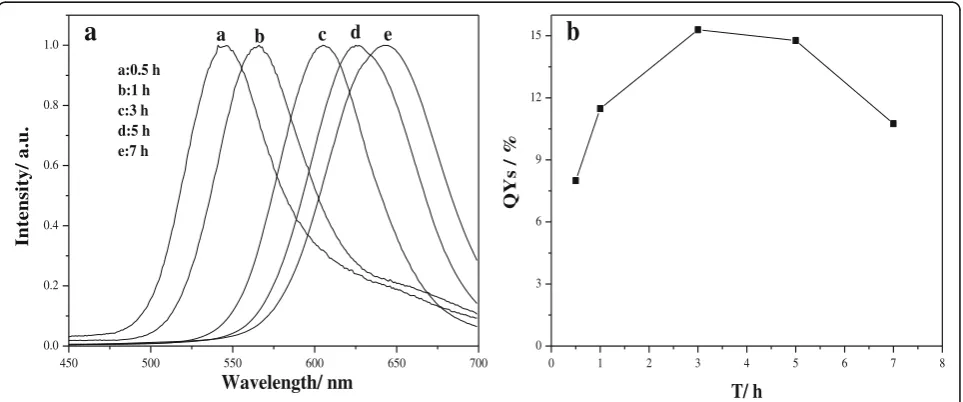
The effect of reflux time on the optical properties of the CdTexS(1−x) QDs was investigated. Figure 1 shows the
PL and corresponding QY of the CdTexS(1−x) QDs
further evidence that the particle size of CdTexS(1−x) QDs increases as the prolonged reaction times. The FWHM of the PL spectra was between 64 and
81 nm. As shown in Fig. 1b, the QYs of the CdTexS(1
−x) QDs initially increased and then decreased with
increasing reflux time. The highest QYs reached 15.29% when the reflux time was 3 h.
The transmission electron microscopy and
HRTEM images in Fig. 2 clearly show nearly mono-dispersed particles, which are approximately spher-ical with an average diameter of approximately 4 nm. The lattice fringes of an individual particle indicating the highly crystalline structure of the
CdTexS(1−x) NCs are shown in the HRTEM image.
The XRD pattern of the corresponding CdTexS(1−x)
NCs is shown in Fig. 3. The references of the bulk CdTe cubic structure (JCPDS No. 65-1046) and the bulk CdS cubic structure (JCPDS No. 65-2887) are also provided in this image for comparison. The
XRD diffraction peak of the CdTexS(1−x) NCs was
located between those of the CdS and CdTe NCs, thereby confirming the formation of the CdTexS(1−x)alloy QD NCs [20].
450 500 550 600 650 700
0.0 0.2 0.4 0.6 0.8 1.0
a:0.5 h b:1 h c:3 h d:5 h e:7 h
d c
b e
Intensity/ a.u.
Wavelength/ nm a
a
0 1 2 3 4 5 6 7 8
0 3 6 9 12 15
QYs / %
T/ h
b
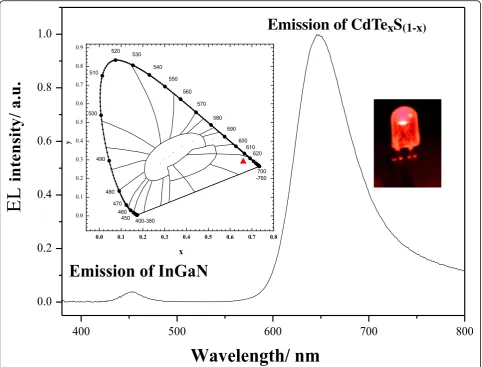
[image:2.595.58.540.512.713.2]An LED was fabricated by coating the CdTexS(1−x) NCs onto a 460-nm emitting InGaN chip. The elec-troluminescence (EL) spectra of the red LED with
CdTexS(1−x) NCs under 20 mA forward bias are
shown in Fig. 4. In Fig. 4, two emission bands can be observed at 460 and 647 nm. The peak at
647 nm was due to the emissions of the CdTexS(1−x)
NCs. The blue emission at 460 nm was attributed to
the emission of the InGaN chip because the
CdTexS(1−x) NCs were unable to absorb the whole
460-nm emission from the underlying blue LED chip. The residual 460-nm LED chip emission may be used as the excitation source of other phosphors
(green phosphors). Thus, a three-band WLED can be fabricated by combining a 460-nm emitting
InGaN chip with CdTexS(1−x) NCs (as a red
phos-phor) and the appropriate green phosphors. The insets in Fig. 4 show a photograph and the
corre-sponding Commission Internationale de L’Eclairage
(CIE) coordinates of the corresponding red LED under 20 mA forward bias. As shown in the figure, the CIE color coordinates of the device are (0.66, 0.29). The red light generated in the work showed a low color temperature of 1001 K. This result indicates
that CdTexS(1−x) QDs are good candidates for LED
applications.
Fig. 3XRD pattern of CdTexS(1−x)QDs
[image:3.595.58.540.88.223.2] [image:3.595.56.539.463.712.2]Conclusions
CdTexS(1−x) QDs (QYs = 15.29%) with tunable emission wavelengths were successfully synthesized in an aqueous solution by delicately controlling the reaction time. With an increase in reaction time, the PL emission peak ex-hibited an evident red shift. The HRTEM results showed that the size of the CdTexS(1−x)QDs was approximately 4 nm. The QDs were successfully used for phosphors for
LEDs. CdTexS(1−x)NCs and a 460-nm emitting InGaN
chip were fabricated to test the EL properties. The CIE coordinates of the red LED were located at (0.66, 0.29).
Abbreviations
CIE:Commission Internationale de L’Eclairage; EL: Electroluminescence; FWHM: Full width at half maximum; HRTEM: High-resolution transmission electron microscopy; LEDs: Light-emitting diodes; NCs: Nanoparticles; PL: Photoluminescence; QDs: Quantum dots; QY: Quantum yield;
TGA: Thioglycolic acid; WLEDs: White light-emitting diode; XRD: X-ray diffraction
Acknowledgements
This work was supported by grants from by the Nature Science Foundation of China (21565028); the Guangxi Natural Science Foundation
(2015GXNSFBA139043); and the scientific research project of Yulin Normal University (2015YJZD05).
Authors’contributions
All authors read and approved the final manuscript.
Competing Interests
The authors declare that they have no competing interests.
Received: 23 September 2016 Accepted: 23 December 2016
References
1. Huang CH, Wang DY, Chiu YC, Yeh YT, Chen TM (2012) Sr8MgGd(PO4)7: Eu2+: yellow-emitting phosphor for application in near-ultraviolet-emitting diode based white-light LEDs. RSC Adv 2:9130–9134
2. Park JK, Choi KJ, Kim KN, Kim CH (2005) Investigation of strontium silicate yellow phosphors for white light emitting diodes from a combinatorial chemistry. Appl Phys Lett 87:031108
3. Kimura N, Sakuma K, Hirafune S, Asano K, Hirosaki N, Xie RJ (2007) Extrahigh color rendering white light-emitting diode lamps using oxynitride and nitride phosphors excited by blue light-emitting diode. Appl Phys Lett 90:051109
4. Lee ZS, Seo SY (2002) Optimization of yttrium aluminum garnet: Ce3+
phosphors for white light-emitting diodes by combinatorial chemistry method. J Electrochem Soc 149:85–88
5. Wang ZL, Liang HB, Zhou LY, Wang J, Gong ML, Su Q (2008) NaEu0.96Sm0. 04(MoO4)2as a promising red-emitting phosphor for LED solid-state
[image:4.595.57.540.88.455.2]6. Nishiura S, Tanabe S, Fujioka K, Fujimoto Y (2011) Properties of transparent Ce:YAG ceramic phosphors for white LED. Opt Mater 33:688–691 7. Yum JH, Seo SY, Lee S, Sung YE (2003) Y3Al5O12:Ce 0.05 phosphor
coating on gallium nitride for white light emitting diodes. J Electrochem Soc 150:H47–H52
8. Jang H, Won Y, Jeon D (2009) Improvement of electroluminescent property of blue LED coated with highly luminescent yellow-emitting phosphors. Appl Phys B 95:715–720
9. Jang HS, Yang H, Kim SW, Han JY, Lee SG, Jeon DY (2008) White light-emitting diodes with excellent color rendering based on organically capped CdSe quantum dots and Sr3SiO5:Ce3+, Li+ phosphors. Adv Mater 20:2696–2702
10. Nazarov M, Noh DY, Sohn J, Yoon C (2008) Influence of additional Eu3+ coactivator on the luminescence properties of Tb3Al5O12:Ce3+, Eu3+. Opt Mater 30:1387–1392
11. Song H, Lee S (2007) Red light emitting solid state hybrid quantum dot– near-UV GaN LED devices. Nanotechnology 18:255202 (4 pp)
12. Yeo BE, Cho YS, Huh YD (2016) Synthesis and photoluminescence properties of a red-emitting phosphor, K2SiF6:Mn4+ for use in three-band white LED applications. Opt Mater 51:50–55
13. Kang D, Yoo HS, Jung SH, Kim H, Jeon DY (2011) Synthesis and photoluminescence properties of a novel red-emitting Na2Y2Ti3O10:Eu3+, Sm3+ phosphor for white-light-emitting diodes. J Phys Chem C 115:24334–24340
14. Chen YH, ZhangX ZJ, Cao J, Zhang JH, Yin LQ (2014) Effect of red, green CdSe@ZnS quantum dots ratios on standard three-band white led devices. Chinese Journal of Luminescence 35:992–997
15. Wang D, Wang F, Wang Y, Wang D, Wang F, Wang Y, Fan Y, Zhao B, Zhao D (2015) Interfacial emission adjustment in ZnO quantum dots/p-GaN heterojunction light-emitting diodes. J Phys Chem C 119:2798–2803 16. David JN, Alexander LE, Steven CE (2008) Doped nanocrystals. Science
319:1776–1779
17. Pu YC, Hsu YJ (2014) Multicolored Cd1-xZnxSe quantum dots with type-I
core/shell structure: single-step synthesis and their use as light emitting diodes. Nanoscale 6:3881
18. Gao XF, Li HB, Sun WT, Chen Q, Tang FQ, Peng LM (2009) CdTe quantum dots-sensitized TiO2nanotube array photoelectrodes. J Phys Chem C
113:7531–7535
19. Chung W, Yu HJ, Park SH, Chun BH, Kim SH (2011) YAG and CdSe/ZnSe nanoparticles hybrid phosphor for white LED with high color rendering index. Mater Chem Phys 126:162–166
20. Liao LF, Zhang H, Zhong XH (2011) Facile synthesis of red-to near-infrared-emitting CdTexSe1-x alloyed quantum dots via an on injection one-potroute. J Lumin 131:322–327
Submit your manuscript to a
journal and benefi t from:
7Convenient online submission
7Rigorous peer review
7Immediate publication on acceptance
7Open access: articles freely available online
7High visibility within the fi eld
7Retaining the copyright to your article