IJPSR (2019), Volume 10, Issue 4 (Research Article)
Received on 14 July 2018; received in revised form, 26 October 2018; accepted, 29 October 2018; published 01 April 2019
DEVELOPMENT AND VALIDATION OF STABILITY INDICATING HPLC METHOD FOR ESTIMATION OF SALMETEROL XINAFOATE
Mrinalini Damle * and Suresh Choudhari
Department of Quality Assurance, All India Shri Shivaji Memorial Society’s College of Pharmacy, Kennedy Road, Near R.T.O, Pune - 411001, Maharashtra, India.
ABSTRACT: Simple, rapid validated stability-indicating HPLC method for estimation of Salmeterol xinafoate was successfully developed. The separation was achieved by using a mobile phase of buffer: methanol in the ratio of 60:40 v/v using HiQ SiL C18 column (150 × 4.6 mm i.d. 5 μm) at 1.2 mL/min as flow rate. The detection was carried out at 252 nm using a PDA detector. The retention time observed was 11.89 ± 0.3 min. This drug was subjected to stress conditions as per ICH Q1A (R2). Linearity was found to be in the concentration range of 10-50 μg/mL with r2 = 0.9958. The suitability of this HPLC method for quantitative estimation of Salmeterol xinafoate was proved by validation by the requirements of ICH guidelines Q2A (R1).
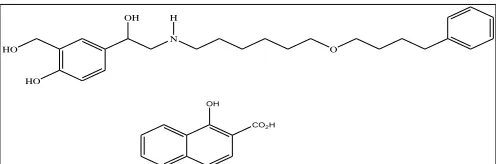
INTRODUCTION: Chemically Salmeterol xinafoate is (RS) -4 -hydroxy -α1-[[[6 -(4-phenyl-butoxy) hexyl] amino] methyl] -1, 3 -benzenedi methanol 1 -hydroxy -2 -naphthoate. Salmeterol xinafoate belongs to bronchodilator drugs category. The chemical formula is C25H37NO4, C11H8O3 and
molar mass is 603.756 g/mol. Salmeterol xinafoate is official in IP 2014. It is freely soluble in methanol. Salmeterol xinafoate is white to off-white powder 1. Literature survey reveals few analytical methods are reported for the determination of Salmeterol xinafoate viz. HPLC 2,
3, 4,
SIM RP-HPLC 5, UPLC 6, HPTLC 7, UV- spectrophotometric 8.
QUICK RESPONSE CODE
DOI:
10.13040/IJPSR.0975-8232.10(4).1865-69
The article can be accessed online on
www.ijpsr.com
DOI link: http://dx.doi.org/10.13040/IJPSR.0975-8232.10(4).1865-69
The ICH guideline for stability testing of new drug substances and products requires the stress testing to be carried out to elucidate the inherent stability characteristics of the active substance. Forced degradation is a process that involves degradation of drug products and drug substances at conditions more severe than accelerated conditions to determine the stability of the molecule 9. There is only one stability indicating Column Chromato-graphic method; therefore the aim of the present work is to develop an accurate, specific, and reproducible stability indicating HPLC-PDA method for determination of Salmeterol xinafoate and to develop a validated stability-indicating assay method.
MATERIALS AND METHODS:
Reagents and Chemicals: The working standard Salmeterol xinafoate was provided by NATCO Pharma (Hyderabad, India). The reagents used for the present study are as follows methanol HPLC grade (MeOH), distilled water, hydrochloric acid Keywords:
Salmeterol xinafoate, HPLC, Stress degradation, Validation, ICH guidelines
Correspondence to Author: Dr. Mrinalini Damle
Department of Quality Assurance, All India Shri Shivaji Memorial Society’s College of Pharmacy, Kennedy Road, Near R.T.O, Pune - 411001, Maharashtra, India.
(HCl), sodium hydroxide (NaOH), 6% w/v hydrogen peroxide (H2O2) were of analytical grade
from Loba Chemie Pvt. Ltd., Mumbai, India.
N
O HO
HO
OH H
[image:2.612.49.297.104.186.2]OH CO2H
FIG. 1: STRUCTURE OF SALMETEROL XINAFOATE Instrumentation: The method development and validation of RP-HPLC method were performed on JASCO HPLC system comprising of model PU 2080 Plus pump, Rheodyne sample injection port with 20 µl loop, using HiQ SiL C18 Column with MD 2010 PDA detector. The chromatogram was recorded with Borwin- PDA software (version 1.5). Shimadzu (Model AY-120) balance was used for weighing. Other instruments used were UV-Visible Double beam spectrophotometer make Jasco Model V-730, Elga Lab water purification system (PURELAB UHQ-II), hot air oven (Kumar Laboratory Oven), Photostability chamber (Make Newtronic. Model IC DAC version 1.2).
Preparation of Stock Solution: Standard stock solution of Salmeterol xinafoate was prepared by dissolving 10 mg of drug in 10 ml of methanol to get a concentration of 1000 μg/mL. It was suitably diluted with mobile phase to get concentration of solution 500 μg/mL working standard solution was prepared to contain Linearity range 10-50 μg/mL using the mobile phase as a solvent.
Selection of Detection Wavelength: From standard stock solution, appropriate dilution was made using Methanol and scanned over the range of 200-400 nm.
Optimized Chromatographic Conditions: The various mobile phases tried consisted of phosphate buffer pH 5: ACN: MeOH, water: ACN, ACN: MeOH, MeOH (0.05M HSASS): ACN, phosphate buffer (pH 7): ACN, ammonium acetate (pH 3): ACN, water: ACN: MeOH, potassium dihydrogen phosphate buffer pH 5 with 10M KOH: methanol. The optimized mobile phase consisted of buffer: methanol in the ratio of 60:40 v/v was chosen as the mobile phase, which gave good resolution and acceptable peak parameters. It was then filtered
through a 0.45 μm membrane filter using vacuum filtration assembly. They were then sonicated using an ultrasonic water bath for 10 min.
Stress Degradation Studies of Bulk Drug: The forced degradation studies were carried out on bulk drug substance to prove the stability-indicating property and selectivity of the developed method. The API was subjected to hydrolysis under different pH, oxidative, thermal and photolytic conditions. Optimization of conditions was done by changing the strength of reagent and the duration of exposure to achieve degradation in the 10-30% range.
Acid Treatment: 1 ml working standard solution of Salmeterol xinafoate (500 μg/mL) was mixed with 1 ml of 1N hydrochloric acid (HCl) and 8 ml of mobile phase to get a final concentration of 50 μg/mL and solution was kept at room temperature for overnight.
Alkali Treatment: 1 ml working standard solution of Salmeterol xinafoate (500 μg/mL) was mixed with 1 ml of 1 N sodium hydroxide (NaOH) and 8ml of mobile phase to get a final concentration of 50 μg/mL and the solution was kept at room temperature for overnight.
Oxidative Degradation: 1 ml working standard solution of Salmeterol xinafoate (500 μg/mL) was mixed with 1 ml of 6% w/v hydrogen peroxide (H2O2) and 8 ml of mobile phase to get a final
concentration of 50 μg/mL and the solution was kept at room temperature for overnight.
Thermal Degradation: Thermal degradation was performed by keeping the drug in an oven at 80 ºC for a period of 2 h. A sample was withdrawn, weighed and dissolved in the mobile phase to get the solution of 50 μg/mL.
Photolytic Degradation: Salmeterol xinafoate was exposed to UV light (200-watt-hours/square meter) and cool white fluorescent light (1.2 million lux hours). The sample was weighed, dissolved in mobile phase and diluted to a concentration of 50 μg/mL.
RESULTS AND DISCUSSION:
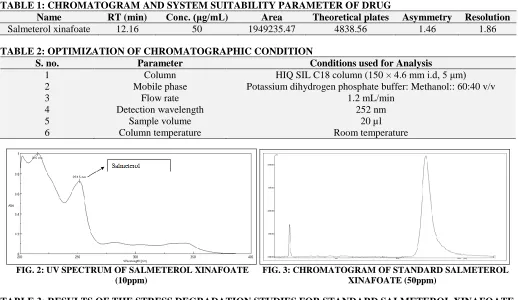
considerable absorbance at 252 nm; hence this wavelength was chosen for detection.
The result of Forced Degradation Studies: Degradation was seen in acidic, alkaline and oxidation condition. No degradation was seen in Thermal and photolytic conditions for pure Salmeterol xinafoate in HPLC.
[image:3.612.48.566.172.472.2]Also, there is no separate degradation peak in any condition. It was confirmed by multi-wavelength analysis peak purity comparison. These degradation studies indicated that Salmeterol xinafoate was susceptible to hydrolysis under acidic, basic pH and also to oxidative conditions. Relatively stable in other stress conditions.
TABLE 1: CHROMATOGRAM AND SYSTEM SUITABILITY PARAMETER OF DRUG
Name RT (min) Conc. (μg/mL) Area Theoretical plates Asymmetry Resolution
Salmeterol xinafoate 12.16 50 1949235.47 4838.56 1.46 1.86
TABLE 2: OPTIMIZATION OF CHROMATOGRAPHIC CONDITION
S. no. Parameter Conditions used for Analysis
1 Column HIQ SIL C18 column (150 × 4.6 mm i.d, 5 μm) 2 Mobile phase Potassium dihydrogen phosphate buffer: Methanol:: 60:40 v/v
3 Flow rate 1.2 mL/min
4 Detection wavelength 252 nm
5 Sample volume 20 µl
6 Column temperature Room temperature
FIG. 2: UV SPECTRUM OF SALMETEROL XINAFOATE FIG. 3: CHROMATOGRAM OF STANDARD SALMETEROL (10ppm) XINAFOATE (50ppm)
TABLE 3: RESULTS OF THE STRESS DEGRADATION STUDIES FOR STANDARD SALMETEROL XINAFOATE
S. no. Parameters Condition % Recovery
1 Initial No treatment kept overnight -
2 Acid hydrolysis 1 N HCl overnight at RT 80.56
3 Alkali hydrolysis 1N NaOH overnight at RT 66.77
4 Oxidative stress degradation 6% H2O2 overnight at RT 71.00
5 Neutral hydrolysis H2O 113.3
5 Photolytic degradation
The UV light (200 watt-hours/square meter) 97.06 cool white fluoro light (1.2 million lux hours) 107.47 6 Dry heat degradation Hot air oven at 60 ˚C at 8 h 95.45
Validation of the Method: 10 The method was validated for various parameters by ICH guideline.
Specificity: Peak purity profiling studies ascertained the specificity of the method. The peak purity values were found to be more than 990, indicating the non-interference of any other peak of degradation product or impurity
Linearity: Calibration curve was obtained in the range 10-50 μg/mL, peak area was recorded. Standard calibration graph was plotted of peak area
vs. concentration injected. The equation of calibration curve found to be Y = 37986x + 49376 having coefficient of correlation (r2) = 0.9958 shown in Fig. 5.
Range: The linearity range was found to be 10-50 μg/mL of Salmeterol xinafoate.
equivalent powder was weighed. And dissolve in 4 ml methanol sonicate for 10 min. Centrifuge the mixture and filter through membrane filter paper.
Then dilution was made to get a concentration of 20 μg/mL. The assay was found to be 99.75% for Salmeterol xinafoate.
FIG. 4: CHROMATOGRAM OF CALIBRATION CURVE FIG. 5: CALIBRATION CURVE FOR SALMETEROL OF SALMETEROL XINAFOATE (10-50 mg/µL) XINAFOATE AT 252 nm
Accuracy: To check the accuracy of the method, recovery studies were carried out by adding the standard drug to blank blend at three different levels 80, 100 and 120%. The results of the
[image:4.612.55.562.106.243.2]recovery studies indicated that the method is accurate for estimation of the drug in the blend. The results obtained are shown in Table 4.
TABLE 4: RECOVERY STUDIES FOR SALMETEROL XINAFOATE
Level (%) Amount spiked (μg/mL) Amount recovered (μg/mL) % Recovery
80 18 18.06 100.35
100 20 19.79 98.95
120 22 22.23 101.06
Precision: The intra-day and inter-day precision of the HPLC method are shown in Table 5. Results expressed in terms of % RSD, which describes
[image:4.612.53.565.448.534.2]intra-day and inter-day variation of Salmeterol xinafoate at a concentration of 10 μg/mL (n= 6).
TABLE 5: INTRA-DAY AND INTER-DAY PRECISION
S. no. Amount (μg/mL) Intra-day SD % RSD Inter-day SD % RSD
1 10 466780.938 5412.67 1.17 459626.427 5172.60 1.11
2 10 453479.303 468876.155
3 10 465406.473 467521.875
4 10 455712.297 459958.249
5 10 456714.108 458591.209
6 10 460218.821 469735.486
Limit of Detection (LOD) and Limit of Quantification (LOQ): The limit of detection and limit of quantification is the lowest concentration of an analyte in a sample which can be detected and quantified with acceptable accuracy and precision. The LOD and LOQ of the developed method were calculated using the formula as given below.
Limit of Detection = 3.3*σ / S Limit of Quantitation = 10*σ / S
Where, σ = standard deviation of the response at the lowest concentration, S = slope of the calibration curve.
LOD and LOQ were found to be 0.40 μg/mL and 1.24 μg/mL respectively, which show the sufficient sensitivity of the method.
Robustness: Peak area checked after flow rate variation, change in mobile phase composition and change in pH by varying the amount of potassium dihydrogen phosphate buffer were well within the limit, indicating that the proposed method is robust under given set of defined experimental conditions.
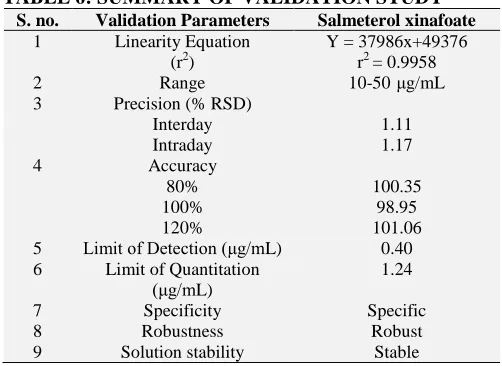
TABLE 6: SUMMARY OF VALIDATION STUDY
S. no. Validation Parameters Salmeterol xinafoate
1 Linearity Equation (r2)
Y = 37986x+49376 r2 = 0.9958
2 Range 10-50μg/mL
3 Precision (% RSD)
Interday Intraday
1.11 1.17
4 Accuracy
80% 100% 120%
100.35 98.95 101.06
5 Limit of Detection (μg/mL) 0.40
6 Limit of Quantitation (μg/mL)
1.24
7 Specificity Specific
8 Robustness Robust
9 Solution stability Stable
DISCUSSION: The HPLC method was developed using an isocratic system with a run time 17 min. The assay method in Indian Pharmacopoeia (2014) is based on a gradient system with a run time 60 min. As per the literature survey, degradation pattern reported in acid, base, and oxidation is completely different. In other condition, like neutral hydrolysis, photodegradation and thermal, no visible degradation was seen. P. S. Jain et al., have reported stability-indicating RP-HPLC method for estimation of Salmeterol xinafoate in bulk and a pharmaceutical formulation. In this work, they have used refluxing at 70 ºC as the condition for hydrolytic and oxidative degradation. Photo degradation has been carried out using ordinary sunlight. In the present work, hydrolytic degradation was carried out at room temperature; photostability chamber with UV as well as fluorescent light was used for photodegradation studies. There was a peculiar observation of an increase in absorptivity upon the heating the solution. Thus our observation does not match with the ones reported by P. S. Jain.
CONCLUSION: The developed method is simple, rapid and stability indicating. It may be used to monitor stability of Salmeterol xinafoate.
ACKNOWLEDGEMENT: Authors are thankful to the Principal and the management of AISSMS College of Pharmacy, Pune for providing the
necessary facilities for research work and to NATCO Pharma (Hyderabad, India) for providing API.
CONFLICT OF INTEREST: Authors have no conflicts of interest to declare.
REFERENCES:
1. Indian Pharmacopoeia: Government of India ministry of health & family welfare, published by the Indian Pharmacopoeia Commission, Ghaziabad, Vol. III, 2014: 2706.
2. Pączkowska E, Smukowska D, Tratkiwicz E and Białasiewicz P: HPLC method for simultaneous determination of Salmeterol xinafoate and Fluticasone propionate for the quality control of dry powder inhalation products. Acta Chromatographica 2015; 27(2): 309-320. 3. Ahmed S, Hesham S and Abdelkawy M: Simultaneous
Determination of Salmeterol xinafoate and Fluticasone propionate in bulk powder and seritide diskus using High Performance Liquid chromatographic and Spectro-photometric method. Pharma Anal Acta 2012; 3(8): 1-7. 4. Murnane D, Martin GP and Marriott C: Validation of a
Reverse-Phase High-Performance Liquid
Chromatographic method for the concurrent assay of a weak base (Salmeterol xinafoate) and a pharmacologically active steroid (Fluticasone propionate). Journal of Pharmaceutical and Biomedical Analysis 2006; 40: 1149-1154.
5. Jain PS, Gorle AP, Patil SS, Chavan RS, Bari PR and Surana SJ: Stability-indicating RP-HPLC method for estimation of Salmeterol xinafoate in bulk and in a pharmaceutical formulation. International Journal of Pharmaceutical Chemistry and Analysis 2015; 2(1): 28-33. 6. Luigi G, Giovanni F and Valentina G: Analysis of beta-agonist residues in bovine hair: Development of a UPLC-MS/MS method and stability study. Journal of Chromatography B 2016; 1036-1037: 76-83.
7. Kasaye L, Hymete A and Mohamed A: HPTLC-densitometric method for simultaneous determination of Salmeterol xinafoate and Fluticasone propionate in dry powder inhalers. Saudi Pharmaceutical Journal 2010; 18: 153-159.
8. Patel P and Patel U: Development and validation of spectrophotometric method for simultaneous determination of Roflumilast and Salmeterol in the synthetic mixture. International Journal of Pharmacy and Pharmaceutical Research 2016; 5(2): 68-77.
9. ICH guidelines, Q1A (R2): Stability Testing of New Drug Substances and Products, International Council for Harmonisation Geneva. 〈http://www.ich.org/products/ guidelines/quality/article/quality-guidelines/html), 2003. 10. ICH guidelines, Q2 (R1): Validation of Analytical
Procedures: Text and Methodology, International Conference on Harmonization Geneva. 〈http://www.ich. org/products/ guidelines/quality/article/quality guidelines/ html), 2005.
All © 2013 are reserved by International Journal of Pharmaceutical Sciences and Research. This Journal licensed under a Creative Commons Attribution-NonCommercial-ShareAlike 3.0 Unported License. This article can be downloaded to Android OS based mobile. Scan QR Code using Code/Bar Scanner from your mobile. (Scanners are available on Google Play store)
How to cite this article: