Number 6061
Konkoly Observatory Budapest
3 July 2013
HU ISSN 0374 – 0676
DISCOVERY OF IRREGULAR VARIABILITY OF FIVE STARS IN
THE VICINITY OF THE YOUNG STELLAR OBJECT V645 CYGNI
SOBOLEV, A. M.; GORDA, S. YU.; DAVYDOVA, O. A.
Astronomical Observatory, Ural Federal University, Russia E-mail: [email protected], [email protected]
We carried out a search for irregular variable stars in the vicinity of the young massive star V645 Cyg. The search was performed on the basis of a set of CCD frames obtained at the Astronomical Observatory of the Ural Federal University. The data was collected in the course of the 1.5-year photometric monitoring of the young variable star V645 Cyg in filters V and Rc. All frames were obtained with the AZT-3 reflector (D = 0.45 m,
FNewton = 2.0 m) equipped with Alta-U6 CCD camera (Kodak KAF-1001E, 1048×1048, 24-micron chip). The frames contain information on sources within about 40′×40′ fields centered approximately at V645 Cyg. These sources include several suspected young stellar objects (YSOs), e.g. IRAS 21377+4955 and IRAS 21389+5003, which are poorly studied at optical wavelengths.
Search for the YSOs in the V645 Cyg vicinity is necessary to find other young stars which could be born together with this massive star which recently emerged from its cocoon. At present there are no firmly established YSOs in the vicinity of V645 Cyg. This is enigmatic because the current paradigma implies that “massive stars are seldomly (if at all) formed in isolation” (Zinnecker and Yorke 2007).
In this study we considered objects in 15′ vicinity of V645 Cyg. YSOs are char-acterized by being brighter in infrared than expected for the main sequence stars. In order to identify YSO candidates in the obtained frames we carried out photometry of a number of selected stars which show infrared colour indices H−Ks > 0m.3 in 2MASS
catalog. The area is rich in the sources that are surely more distant than V645 Cyg. In order to avoid them we introduced the following criterion: Ks < 11m. One object
1 21395825+5014209 ∼13 ∼12 21401743+5013545 21395248+5015526 21393905+5012016
(V645 Cyg)
2 21392977+5009286 14.31 12.36 21393905+5012016 21394305+5010491 21393643+5008273 (IRAS 21377+4955)
3 21404646+5016489 12.61 10.72 21403765+5016258 21405102+5017094 21394758+5017008 (IRAS 21389+5003)
4 21385638+5012061 15.53 13.55 21391128+5011193 21385214+5011225 21384244+5012131 5 21390639+5004544 13.01 11.15 21384996+5007368 21391834+5003325 21390691+5003206 6 21393188+5006596 16.00 14.75 21394160+5009340 21393870+5006470 21391935+5008547 7 21402043+5020007 15.04 13.84 21403180+5019153 21403029+5017160 21401798+5022063 8 21403143+5021300 15.73 14.51 21401858+5022036 21403180+5019153 21405252+5022075 9 21403966+5010088 16.04 14.29 21404627+5010344 21404549+5007301 21403186+5009173 10 21404091+5013584 13.24 11.33 21410979+5012361 21403765+5016258 21404271+5010334 11 21410408+5010083 12.90 11.60 21410979+5012361 21410818+5008461 21404271+5010334 12 21410428+5014152 14.41 12.88 21411409+5016534 21405102+5017094 21410979+5012361 13 21410943+5018008 11.38 10.51 21411409+5016534 21410645+5017483 21412779+5018164 14 21411121+5010380 13.91 12.83 21410818+5008461 21410979+5012361 21412626+5009326
In total, 14 stars were selected for analysis. We included V645 Cyg in the analysis because it satisfies our selection criteria. Except for V645 Cyg the list includes 2 other members of the IRAS point source catalogue, the rest of the target stars have considerable red colour indices.
One of the IRAS sources (IRAS 21377+4955, 2MASS 21392977+5009286) was previ-ously identified as a carbon star (Alksnis and Alksne, 1988) and suspected to be variable (NSV 25721). The list of IRAS sources and other target stars is given in Table 1 in order of increasing right ascension. Designations of the stars are given according to the 2MASS catalog. For each target star we selected three stars of comparison in its near vicinity (r <5′), see Table 1.
The reduction of the CCD frames was carried out using M uniwin software
(http://c-munipack.sourceforge.net). After that we calculated values of the night-average differences of the brightness for each star with respect to the three comparison stars. Before averaging all the values were reduced to a particular comparison star (C1 stars in Table 1).
In order to determine the degree of brightness variability for the investigated stars we used a simple criterion similar to the Stetson index (Stetson, 1996). Namely, we considered ratio of the root mean square (rms) brightness differences for the target stars to rms brightness differences for the comparison stars calculated for the whole period of observations. In this case the dispersion of the brightness differences for the stars of comparison characterizes accuracy of the brightness measurements for the target stars.
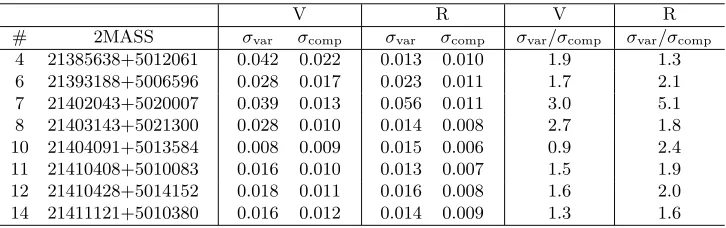
As a criterion for the existence of variability we adopted 3σ criterion. This means that the star was considered to be variable if the rms difference of the brightness of a target star in both filters exceeds the corresponding rms difference for the comparison stars more than three times. Tables 2 and 3 contain values of the rms brightness difference for the target stars (σvar) and the comparison stars (σcomp), correspondingly. It is seen thatσcomp in filter Rc is of the order of 0m.01 and less. The accuracy of measurements in filter V in
[image:2.595.76.524.99.312.2]0 200 400 600 800 JD-2454850 1.5 1.3 1.1 0.9 0.7 0.5 0.3 0.1 V
0 200 400 600 800
-0.8 -1.0 -1.2 -1.4 -1.6 -1.8 -2.0 -2.2 -2.4 R V R IRAS 21389+5003 ∆ ∆
0 200 400 600 800
JD-2454850 1.6 1.5 1.4 1.3 1.2 1.1 1.0 V
0 200 400 600 800
[image:3.595.120.483.127.351.2]-0.5 -0.6 -0.7 -0.8 -0.9 -1.0 -1.1 -1.2 -1.3 R V R IRAS 21377+4955 ∆ ∆
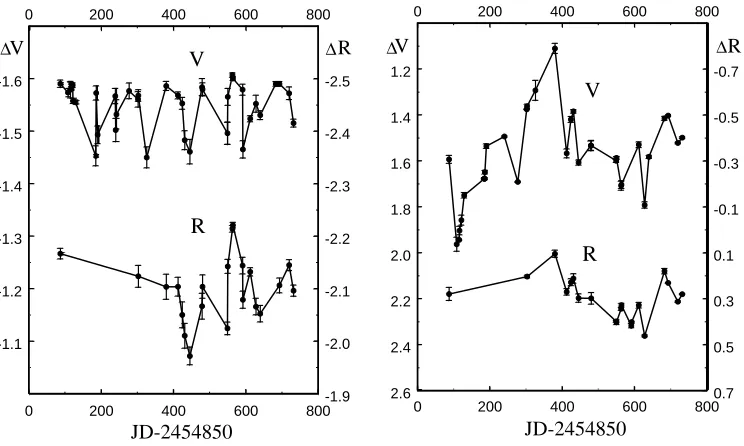
Figure 1. The light curves of the IRAS point sources. The bars correspond to the rms scatter of brightness during one night.
0 200 400 600 800
JD-2454850 -1.1 -1.2 -1.3 -1.4 -1.5 -1.6 V
0 200 400 600 800
-1.9 -2.0 -2.1 -2.2 -2.3 -2.4 -2.5 R V R ∆ ∆
0 200 400 600 800
JD-2454850 2.6 2.4 2.2 2.0 1.8 1.6 1.4 1.2 V
0 200 400 600 800
0.7 0.5 0.3 0.1 -0.1 -0.3 -0.5 -0.7 R V R ∆ ∆
[image:3.595.117.489.478.701.2]1 21395825+5014209 (V645 Cyg) 0.097 0.011 0.077 0.009 8.8 8.6 2 21392977+5009286 21377+4955 25721 0.104 0.009 0.093 0.006 11.2 16.0 3 21404646+5016489 21389+5003 0.265 0.015 0.190 0.008 17.5 23.8 5 21390639+5004544 0.217 0.013 0.237 0.010 16.5 23.7 9 21403966+5010088 0.187 0.007 0.090 0.006 25.9 15.6 13 21410943+5018008 0.047 0.008 0.063 0.004 5.8 15.2
Table 3.Target stars without detected variability
V R V R
# 2MASS σvar σcomp σvar σcomp σvar/σcomp σvar/σcomp
4 21385638+5012061 0.042 0.022 0.013 0.010 1.9 1.3 6 21393188+5006596 0.028 0.017 0.023 0.011 1.7 2.1 7 21402043+5020007 0.039 0.013 0.056 0.011 3.0 5.1 8 21403143+5021300 0.028 0.010 0.014 0.008 2.7 1.8 10 21404091+5013584 0.008 0.009 0.015 0.006 0.9 2.4 11 21410408+5010083 0.016 0.010 0.013 0.007 1.5 1.9 12 21410428+5014152 0.018 0.011 0.016 0.008 1.6 2.0 14 21411121+5010380 0.016 0.012 0.014 0.009 1.3 1.6
not show significant variability of brightness. This exception is 2MASS 21402043+5020007 (#7) for which the 3σ criterion is satisfied only in filterRc. We consider the detection of
variability of this star uncertain.
We analysed the changes of brightness of newly found variable stars and V645 Cyg during particular nights. In several cases observations during one night lasted for up to 6 hours. In most cases variability had a character of monotonic brightness changes. In a few cases one brightness extremum was registered during a single night.
We examined the brightness data of the six variable stars for possible periodicity. For this purpose we implemented the Lafler-Kinman method realized in the package winefk3 written by Goranskij V.P. (the program with comments in English can be downloaded from http://variablestars.ru/FILES/winefk.rar). Brightness changes for all newly found variable stars and V645 Cyg were found to be non-periodic.
We found that the bright infrared point sources IRAS 21377+4955 and IRAS 21389+5003 show brightness variability of irregular type with amplitudes up to 0m.8. For IRAS 21389+5003 the variability of brightness is registered for the first time. For another bright infrared source IRAS 21377+4955 only photographic estimates of the optical brightness were reported (Alksnis and Alksne, 1988). In this study we present results of much more accurate CCD measurements of the brightness in filters V and Rc
for a period of 1.5 years.
[image:4.595.118.481.229.343.2]100 300 500 700
JD-2454850
0.8 0.6 0.4 0.2 0.0 -0.2 -0.4 -0.6 -0.8 -1.0
V
0 200 400 600 800
0.6 0.4 0.2 0.0 -0.2 -0.4 -0.6 -0.8 -1.0 -1.2
R
V
R
∆ ∆
0 200 400 600 800
JD-2454850
1.3 1.2 1.1 1.0 0.9 0.8 0.7 0.6
V
0 200 400 600 800
0.8 0.7 0.6 0.5 0.4 0.3 0.2 0.1
R
V
R
[image:5.595.118.486.126.350.2]∆ ∆
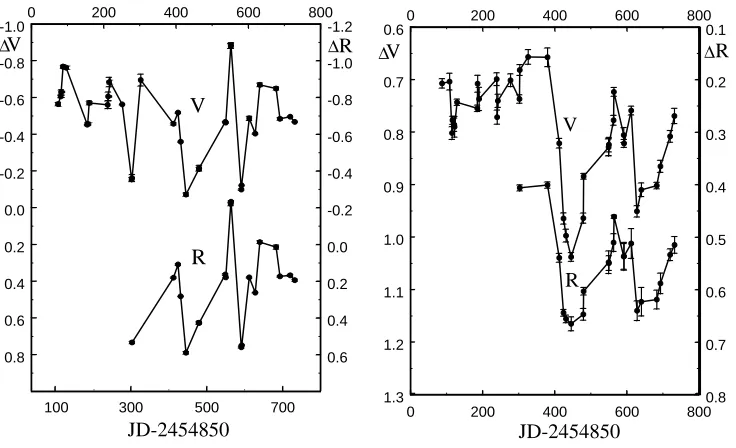
Figure 3. The light curves of 2MASS 21390639+5004544 (#5, left) and V645 Cyg (right). The bars correspond to the rms scatter of brightness during one night.
In this study we have registered the irregular type of optical variability of the mentioned IRAS sources by means of CCD photometery.
Brightness changes of similar character were detected for 3 other target stars and V645 Cyg. Variability of brightness had considerable amplitudes ∆m =|mmax−mmin|:
• ∆m∼1m.0 – 2MASS 21390639+5004544 (#5),
• ∆m∼0m.9 – 2MASS 21403966+5010088 (#9),
• ∆m∼0m.3 – 2MASS 21410943+5018008 (#13),
• ∆m∼0m.4 – 2MASS 21395825+5014209 (V645 Cyg).
The light curves of the 5 target stars and V645 Cyg with variability detected in filters V and Rc are shown in Figures 1-3. Measured values of the brightness changes for the 5 newly found variable stars and V645 Cyg are presented in Table 4 (online only).
Thus, in the course of the current study we have found 4 new variable stars in 15′ vicinity of the young massive variable star V645 Cyg and confirmed variability of one suspected variable. All of these stars show variability of irregular type and have consid-erable infrared colour indices characteristic of the young stellar objects. Amplitudes of variability of the newly detected variables are similar to those of some Orion variables of IN type. According to the General Catalogue of Variable Stars (GCVS) the amplitudes of the IN type variables have values in the range from 0.5 to 1-2 magnitudes on the time scale of several tens to hundreds of days. The nature of these sources and their association with V645 Cyg will be discussed in a forthcoming paper.
References:
Alksnis, A. and Alksne, Z., 1988, Carbon stars in a field in Cygnus, Riga: Zinatne, 12. Stetson, P. B., 1996, PASP, 108, 851.