Munich Personal RePEc Archive
Hidden panel cointegration
Abdulnasser, Hatemi-J
UAE University
June 2011
Hidden Panel Cointegration
Abdulnasser Hatemi-J
UAE University
E-mail: [email protected]
Abstract
This article extends the seminal work of Granger and Yoo (2002) on hidden cointegration
to panel data analysis. It shows how cumulative negative and positive changes can be
constructed for each panel variable. It also shows how tests similar to the augmented
Dickey-Fuller tests can be implemented to find out whether the cointegration is hidden in
the panel or not. An application is provided to investigate the impact of permanent
positive and negative shocks in the government expenditure on the national output in a
panel of three countries.
Running Title: Hidden Panel Cointegration
JEL Classification: C33, H21
Keywords: Asymmetry, Panel Data, Cointegration, Testing, Government Spending,
Output
1. Introduction
Since the pioneer work of Granger (1981) cointegration analysis has become an integral
part of applied econometrics when the underlying variables are measured across time.
Based on Granger’s definition, cointegration occurs in a situation in which a linear combination between integrated variables has one unit root less than the integration order
of the variables in the model. The variables cointegrate if and only if they have common
stochastic trends that cancel each other out. There is a massive literature on cointegration
indicating its due importance. Cointegration analysis is important in empirical research in
order to avoid spurious results based on a regression model. It is also important for
analyzing the long-run relationships between the underlying variables combined with the
Testing for cointegration was initiated by Engle and Granger (1987) via implementing
residual based tests for cointegration. More robust tests where suggested by Phillips
(1987) as well as Phillips and Ouliaris (1990). Multivariate tests for cointegration were
developed by Johansen (1988, 1991), Johansen and Juselius (1990) as well as Stock and
Watson (1988). The idea to conduct tests for unit roots within a panel system originates
from Quah (1994). Tests for panel cointegration were suggested by Pedroni (1999, 2004),
Kao (1999) and Westerlund (2007), among others.
In all previous literature on cointegration testing, there was no separation between the
impact of negative and positive shocks until Granger and Yoo (2002) introduced the
concept of hidden cointegration for time series data. It is hidden in the sense that there
might not be cointegration between the variables in the original format but when the
impact of positive shocks is separated from the impact of negative shocks then
cointegration might exist between the components of the variables. The aim of this article
is to extend the concept of hidden cointegration to panel data analysis. The suggested
tests in this paper are applied to investigate the impact of contractionary as well as
expansionary fiscal policy on the economic performance in a panel consisting of
Denmark, Norway and Sweden.
The article continues as the following. Section 2 introduces hidden panel cointegration
analysis. Section 3 provides an application. The last section concludes the article. Finally,
an appendix at the end of the article provides a simple mathematical example that shows
the necessary condition for cointegration in a panel system.
2. Hidden Panel Cointegration
Consider the following variables that are integrated of the first degree, with the
resultant solution for each that is found by the recursive approach:1
∑
1
∑
For i=1, …, m. Where m signifies the cross-sectional dimension (which is two in this
particular case) and e is the disturbance term that is assumed to be a white noise process.
The positive and negative shocks for each panel variable are defined as
( ), ( ), ( ) and ( ).
Using these results, the following can be obtained:
∑
∑
∑
∑
Assume that our dependent variable is y, and then the two potential panel cointegration
equations for the components can be defined as
(1)
(2)
The positive cumulative shocks are cointegrated in the panel if is stationary.
Likewise, the negative cumulative shocks are cointegrated in the panel if is
stationary.2
2
It should be mentioned that other combinations are also possible. Such as, cumulative positive changes of
There is potentially a battery of the tests available in the literature that can be used
for testing whether as well as is stationary or not. However, the well-known
augmented Dickey-Fuller (ADF) test is the simplest one that can be used for this purpose.
Assume that we wish to test for cointegration in the panel model (1). Then, the panel
ADF test equation is the following:
∑
The optimal lag order l can be determined by minimizing an information criterion. The
null hypothesis of no cointegration between the positive components is . It is also
possible to allow for deterministic components such as individual drifts and trends in
equation (3) if necessary. Based on the results provided by Kao (1999), the following test
statistics can be used to test the null hypothesis of no panel cointegration:
√
√
Where is the t-statistic for parameter in equation (3). The variance is estimated as
, and the long-run variance is estimated as
.
Let [
]
. The variance-covariance for is estimated as
[
] ∑ ∑
The long-run variance-covariance matrix is estimated via the kernel estimation approach
[
]
∑ [ ∑
∑
∑
]
Where is representing the kernel function and b is the bandwidth.
The ADF test as presented in equation (4) has a standard normal distribution
asymptotically. For a proof see Kao (1999). To test for stationarity in the linear
combination between negative components as presented in equation (2), a similar ADF
test can be conducted. Other combinations are also possible.3 A Gauss code for constructing cumulative sums of positive and negative changes of each variable for each
cross sectional unit in the panel is available on request from the author.4
3. An Application
The suggested test for hidden panel cointegration is applied to investigating the long-run
relationship between government spending and economic performance in Denmark,
Norway and Sweden. Quarterly data is used during the period 1993-2010. The source of
the data is the statistical bureau of each country. In order to capture real effects, the
variables are expressed at constant prices. The cumulative sums of positive and negative
shocks were constructed based on the procedure presented in the previous section. Prior
to testing for panel cointegration, panel unit root tests were implemented by using the Im,
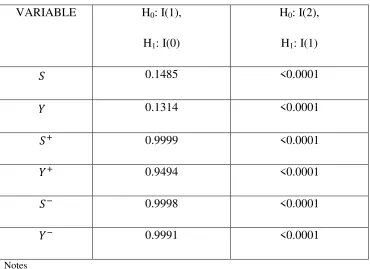
Pesaran and Shin (2003) test. The results are presented in Table 1, which show that each
panel variable has one unit root.
3
It should be mentioned that it is also possible to test for hidden panel cointegration using other tests such as seven residual based testes suggested by Pedroni (1999, 2004) as well as panel version of the multivariate Johansen (1991) test as developed by Maddala and Wu (1999) based on the Fisher (1932) principle of deriving a combined test using the individual test results.
4
Table 1: The Results of Panel Unit Root Tests.
VARIABLE H0: I(1),
H1: I(0)
H0: I(2),
H1: I(1)
0.1485 <0.0001
0.1314 <0.0001
0.9999 <0.0001
0.9494 <0.0001
0.9998 <0.0001
0.9991 <0.0001
Notes
The denotation S stands for the log of government spending and Y is representing the log of GNP.
The Im, Pesaran and Shin (2003) test is used to test for panel unit root. P-values are presented.
Given that each variable in the panel has one unit root, it is crucial to conduct tests for
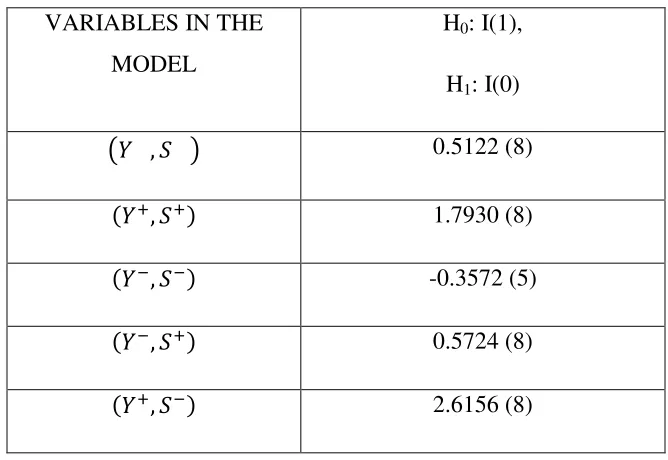
panel cointegration. The results of these tests based on equation (4) are presented in
Table 2, which indicate that there is no cointegration between government spending and
output in the panel sample for these three countries. Tests for cointegration between
[image:7.612.122.492.88.357.2]Table 2: The Results of Panel Cointegration Tests.
VARIABLES IN THE
MODEL
H0: I(1),
H1: I(0)
( ) 0.5122 (8)
1.7930 (8)
-0.3572 (5)
0.5724 (8)
2.6156 (8)
Notes
The values in the parenthesis indicate the bandwidth in the kernel estimation. The null hypothesis of no
panel cointegration is rejected at the 5% significance level if the estimated test value is lower than -1.64.
4. Conclusions
The aim of this article is to extend the hidden cointegration tests of time series data as
developed by Granger and Yoo (2002) to hidden cointegration tests of panel data. It is
shown how cumulative sums of positive and negative changes can be constructed. An
augmented Dickey-Fuller test for a panel system can be implemented to test the null
hypothesis of no panel cointegration between different components of the underlying
variables. A user friendly Gauss algorithm is produced to transform the panel variables
into their respective components.
The suggested test procedure is applied to investigating the impact of government
spending on economic output in a panel of three countries—namely Denmark, Norway
and Sweden. The results show that there is no panel cointegration between these variables
or their components. This surprising finding of no panel cointegration between GNP and
government spending in Denmark, Norway and Sweden might provide empirical support
for the existence of the Ricardo equivalence theorem in these countries. According to this
the government expenditure now means an equivalent increase in the taxes in the future.
Hence, they will adjust their behavior in such a way that there will be no real effects of
increases in the government expenditure on the economy.
In this particular case, the same cointegrational inference was obtained in the panel
regardless if the impact of positive shocks is separated from the impact of negative
shocks or not. This might be indicative of the strength of the empirical findings.
Nevertheless, future applications of the test might indicate cases in which the panel
cointegration is indeed hidden. In addition, separating the impact of positive shocks from
the negative ones might be informative per se, in order to capture the potential
asymmetry that might prevail.
References
Engle, R. F., and Granger, C. W. J. (1987) Co-integration and Error Correction:
Representation, Estimation and Testing, Econometrica, 55(2), 251-276.
Fisher, R.A. (1932) Statistical Methods for Research Workers, Oliver & Boyd,
Edinburgh, 12th Edition.
Granger, C. (1981) Some Properties of Time Series Data and Their Use in
Econometric Model Specification, Journal of Econometrics, 16, 121-130.
Granger, C.W., and Yoon, G. (2002) Hidden Cointegration. Department of Economics
Working Paper. University of California. San Diego.
Hatemi-J A. (2010) Asymmetric Causality Tests with an Application, Empirical
Economics, forthcoming.
Hatemi-J A. (2011a) Asymmetric Panel Causality Tests with an Application,
Unpublished Manuscript.
Hatemi-J A. (2011b) Asymmetric Generalized Impulse Response Functions and
Variance Decompositions, Unpublished Manuscript.
Im, K. S., Pesaran, M. H. and Shin, Y. (2003) Testing for Unit Roots in
Heterogeneous Panels, Journal of Econometrics, vol. 115(1), 53-74.
Johansen, S. (1988) Statistical Analysis of Cointegration Vectors, Journal of
Johansen, S. (1991) Cointegration and Hypothesis Testing of Cointegration Vectors in
Gaussian Vector Autoregressive Models, Econometrica, Vol.59, No.6, 1551–1580.
Johansen S. and Juselius, K., (1990) Maximum Likelihood Estimation and Inference
on Cointegration–with Applications to the Demand for Money, Oxford Bulletin of
Economics and Statistics, Vol. 52, No. 2, 169–210.
Maddala, G. S., and Wu, S. (1999) A Comparative Study of Unit Root Tests with
Panel Data and New Simple Test, Oxford Bulletin of Economics and Statistics, 61,
631-652.
Quah, D. (1994) Exploiting Cross Section Variation for Unit root Inference in
Dynamic Data. Economics Letters, 44, 9-19.
Pedroni, P. (1999) Critical Values for Cointegration Tests in Heterogeneous Panels
with Multiple Regressors, Oxford Bulletin of Economics and Statistics, 61, 653-670.
Pedroni, P. (2004) Panel Cointegration, Asymptotic and Finite Sample Properties of
Pooled Time Series tests with an Application to the PPP Hypothesis, Econometric
Theory, 20, 597-625.
Phillips, P.C.B. (1987) Time Series Regression with a Unit Root, Econometrica 55,
277-301.
Phillips, P.C.B, and Ouliaris S. (1990) Asymptotic Properties of Residual Based Tests
for Cointegration, Econometrica 58, 165-193
Stock, J. and Watson M. (1988) Testing for common trends, Journal of the American
Statistical Association, 83, 1097–1107.
Westerlund J. (2007) Testing for Error Correction in Panel Data. Oxford Bulletin of
Appendix
An Example regarding Panel Cointegration
Let us be more explicit about panel cointegration between two integrated variables by
a simple example. Consider the following two non-stationary panel variables:
(A1)
(A2)
Where and are two white noise error terms. Assuming that the initial values are
zero, continuous substitutions give the following solutions:
∑
∑
By taking the first difference of each variable, we obtain
∑ ∑
∑ (∑
)
(A6)
That is, each variable becomes stationary after taking the first difference. Hence, the
variables are integrated of the first order, denoted I(1). Now the question is if these two
panel variables are cointegrated. Denote Yt as the difference between the two variables,
∑ (∑
)
This difference is clearly a stationary process. That is, a linear combination of the
non-stationary variables is non-stationary in the panel, which in turn means that the variables
cointegrate with (1.0, -1.0) as cointegrating vector. It should be noted that the variables
cointegrate because their stochastic trend cancels each other out. In another word, the
variables have a common stochastic trend. This is the case in the hidden panel
cointegration analysis also. In order to have hidden panel cointegration, there must be at
least one common stochastic trend between the cumulative components of the positive or