Munich Personal RePEc Archive
The feasibility of implementing a
congestion charge on the Halifax
Peninsula: filling the ’Missing Link’ of
implementation
Althaus, Catherine and Tedds, Lindsay M and McAVoy,
Allen
University of Victoria
2011
Online at
https://mpra.ub.uni-muenchen.de/39790/
Electronic copy available at: http://ssrn.com/abstract=1629882 Electronic copy available at: http://ssrn.com/abstract=1629882 Electronic copy available at: http://ssrn.com/abstract=1629882
1
The Feasibility of Implementing a Congestion Charge on the Halifax Peninsula: Filling the “Missing Link” of Implementation
Electronic copy available at: http://ssrn.com/abstract=1629882 Electronic copy available at: http://ssrn.com/abstract=1629882 Electronic copy available at: http://ssrn.com/abstract=1629882
2 Catherine Althaus
University of Victoria
Lindsay M. Tedds°
University of Victoria
Allen McAvoy
Halifax, N.S.
Date: 3/17/2011
°
3
Abstract
Congestion charges pose a policy dilemma due to the balance that must be made between the management of a quasi public good along with the correction of negative externalities against the needs of economic, demographic, and urban growth along with citizen acceptance. The literature provides detailed rationales for congestion charges but minimal consideration on how to implement such charges once the decision to proceed has been made. The purpose of this article is to expose some of the technical and administrative issues that come with enacting and implementing congestion charges. The Halifax Peninsula is used as a case study to illuminate the topic. Drawing on this case, we spell out eleven ex ante implementation criteria that can be used to assess implementation considerations in any given congestion charge context. In so doing, we argue that context-specific factors must also be recognized and accommodated by policy and decision makers if congestion charge policy is to present a feasible, and palatable, choice.
4
Introduction
Congestion charging, a user fee charged to motorists for travelling on certain roadways in peak
periods, has been advocated by economists for nearly a century (Knight, 1924; Pigou, 1920) as an
economically efficient solution to the traffic congestion problem facing many cities. London,
Singapore, Stockholm, Milan are some jurisdictions to have implemented such charges and provide
helpful success stories that have attracted the attention of scholars and practitioners intent on
discovering a positive implementation path. New York, Edinburgh, Hong Kong, and Manchester, on
the other hand, provide examples of cities that have rejected implementing congestion charging after
public consultations including referendums. These failed cases demonstrate that far from being a
mundane policy arena, congestion charges represent a controversial issue relevant to the pressures of
modern urban planning: the demands of the modern city are forcing many governments to consider the
issue and decide whether or not to move ahead with congestion charges and, if so, how.
Congestion charges pose a policy dilemma due to the balance that must be made between the
management of a quasi public good (i.e. transport corridors) along with the correction of negative
externalities (i.e. travel delays and lost productivity; greenhouse gas emissions from idling; accidents;
and wear and tear on road infrastructure) against the needs of economic, demographic and urban
growth along with citizen acceptance. The literature (e.g. Banister, 2003; Blythe, 2005; Glaister &
Graham, 2006; Lindsey, 2007; Maddison et al., 1996; Newbery, 1988; Safirova, Houde, Lipman,
Harrington, & Bagliano, 2006; Sandholm, 2002; Stopher, 2004; Vickrey, 1963; Yin &
Lawphongpanich, 2006) provides a detailed rationale for congestion charges but consideration as to
how to implement such charge once the political decision to proceed has been made has only recently
begun to be discussed in the literature. The purpose of this article is to explore key technical and
5 policy, legal, and public administration considerations that have traditionally been separated in the
literature.
The Halifax Peninsula is used as a case study, detailing the context and specific elements of its
congestion problem, to illuminate the topic. We have focused on the depth of detail that is achievable
through a single case study analysis (Yin, 2008) to extract implementation lessons that can be
investigated further and more widely applied. Why Halifax? Halifax Regional Municipality (HRM)
faces serious traffic congestion1
Drawing on the HRM case, we expound eleven implementation criteria, with particular regard to
technical and administrative feasibility, that can be used to assess implementation considerations in
any given congestion charge context. In so doing, we argue that context-specific factors must also be
recognized and accommodated by policy and decision makers if congestion charge policy is to present
a feasible, and palatable, choice. Halifax provides a helpful example that offers ex ante implementation
lessons applicable not just to other jurisdictions contemplating congestion charge regimes but also to
jurisdictions that have already implemented congestion charges and may be willing to undergo
learning assessments of the successes and challenges associated with implementation of their regime.
The unique contribution of our analysis is that we have simultaneously developed and applied a ‘smart
practice’ (Bardach, 1998, 2005) guide on ex ante implementation issues associated with congestion on the roads leading onto, on, and away from the Peninsula, the
economic hub of HRM, during peak commuting times. As a result, HRM officials have been
examining policies and actions designed to ease traffic congestion in this area, including a congestion
charge. This case provides a classic congestion charge scenario that lends itself to scrutiny for two
reasons. First, HRM is constrained by addressing the problem through new road infrastructure. Second,
6 charging by melding public administration, public policy, law, and economic issues and literature. The
approach and process outlined in this paper parallels the emphasis in recent contributions addressing
the technical and administrative issues involved in implementing tax reforms (e.g. Bahl & Bird, 2008;
Bird, 2009; Rao & Bird, 2010), including the fact that fiscal policy is “path-dependent and
context-specific…[and] politics…deserves close attention by those interested in improving tax policy” (Bird,
2009, 12).
Literature Review
Some existing congestion charge implementation literature must be acknowledged. Albalate and Bel
(2009) use experience from cities2 that have implemented the congestion charge to explore lessons of
success and failure but they focus only on: (i) fee structure and operational technology; (ii) revenue
uses and investments; and (iii) political impacts. This work provides important factors that define
congestion charge policy implementation, but fails to detail other administrative components of the
implementation challenge.
Some of these issues are addressed in Gaunt, Rye, and Ison (2006) and Rye, Gaunt, and Ison (2008)
who outline reasons behind the 2005 Edinburgh “no” referendum vote against congestion charging.
They argue that negative press coverage directly influenced community perceptions, highlighting the
important distinction between consultation and promotion of the policy unaccounted for by
policymakers. Implementers focused on consulting with the community at the expense of
communicating policy rationale. As a result, policymakers failed to capitalize on the positive economic
rationales for the charge. In fact, community and political sentiment for congestion charging is said to
be “inversely proportional” to the consensus of support among economists regarding its desirability
7 proportionality on its head (Albalate & Bel, 2009). Albalate and Bel (2009, 964) suggest if the revenue
from congestion charging can be framed as being invested back into the majority’s welfare, it helps
make the project politically feasible and increases community acceptance. The lack of clear
communication regarding congestion charge functionality contributed to the public’s disillusion in
Edinburgh. If congestion charging implementation is explained clearly to the public, Rye et al. (2008)
suggest it can contribute to positive implementation.
Rye et al. (2008) also suggest agreement on objectives and the presence of a political champion were
lacking in the Edinburgh case and that this led directly to the choice of a referendum; a political tool
that more often than not spells doom for a policy option before it progresses to the vote. Leape (2006),
who examines the success of London congestion charging policy, explains that Mayor Ken
Livingstone’s champion status for congestion charging was a critical force behind London’s successful
uptake and implementation. The lack of a centralized administrative agency for implementation, on the
other hand, created disaster in the Edinburgh case, a point Gaunt et al. (2006) argue is generalizable
across other congestion charging contexts.
While much of the existing literature focuses on ex post implementation regimes, literature applying
these lessons to cities that are, or should, consider congestion charges is limited. Lindsey (2007, 2008)
has elaborated on various elements of the implementation dimension to congestion charging using
three cases (Toronto, Montreal, and Vancouver) that could implement a congestion charge but have not
yet. He addresses a few of the elements of implementation that we identify, but notes his work “does
not identify an optimal implementation path for any city, let alone for Canada; its focus is limited to
determining how road pricing might be introduced in the next few years using established
8 This survey suggests that while congestion charge implementation has begun to be explored, much is
still missing from the current analysis of implementation factors relevant to policy development. The
significance of implementation for any policy, let alone congestion charges, must not be underrated.
Authors across public policy disciplines continue to be united in their conclusion that implementation
remains “the missing link” since the tagline was coined by Hargrove in 1975 (Robichau & Lynn, 2009;
Hill & Hupe, 2009): Pressman and Wildavsky (1973) bemoaned the lack of an implementation focus;
Gunn’s (1978) seminal—if criticized—‘top-down’ approach to ‘perfect’ implementation endures as a
dominant model highlighting the challenges of achieving successful policy implementation; and, Pal
(2009), suggests “policy is initially nothing more than ideas or conceptualizations, while
implementation is the specific needs of execution and elaboration in practice” (241). The missing link
dilemma associated with implementation has also begun to be mirrored in the tax policy literature, with
Bird (2009) stating that good fiscal policy planning and formulation “pays close attention to detail and
implementation” (31).
Halifax Regional Municipality & the Halifax Peninsula
HRM is the urban centre of the maritime province of Nova Scotia. It has approximately 150 km of
shoreline comprised of numerous inlets and the Halifax Peninsula is formed by one such inlet. The
Peninsula is 3.3 km wide, 7.5 km in length, and has a population of approximately 72,000 (19 per cent
of HRM’s population) (Government of Nova Scotia, n.d.). The Peninsula, while small geographically
and demographically, is considered to be the region’s cultural, historical, educational, political, and
economic centre, thereby making efficient access to the area a necessity. However, the geography
combined with commuting patterns has resulted in the Peninsula becoming heavily congested during
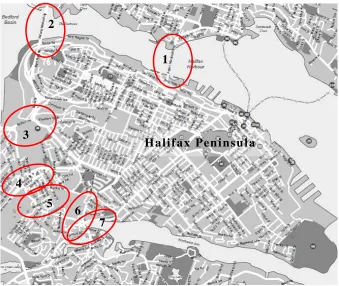
9 Vehicle access to the Peninsula is constrained due to limited road options. As shown in Figure 1, the
Macdonald Bridge (1), the MacKay Bridge (2), Bedford Highway / Kempt Road (3), Bayers Road (4),
Mumford Road (5), Chebucto Road (6), and Quinpool Road (7), are the only road access points. Most
of these seven roads are one or two lanes so when a traffic incident happens there are long queues,
slower speeds, and increased travel times. The building of new—or the expansion of existing—road
infrastructure is constrained by land costs, space, and public opposition yielding limited opportunity to
[image:10.612.137.476.330.616.2]address congestion through additional road infrastructure.
Figure 1: Seven Access Points to Halifax Peninsula
Source: Halifax Regional Municipality (2009)
Several factors shape HRM commuting patterns. First, nearly 40 per cent (80,000) of the jobs in HRM
are located on the Peninsula (McCormick Rankin Corporation, 2008, 4), yet less than 20 per cent of the
H a l i f a x Pe n i n s u l a 1
2
3
4
5 6
10 population lives there, resulting in many people commuting to the Peninsula daily for work.
Haligonians are highly reliant on their cars for commuting purposes with “65 per cent of the working
population in HRM commut[ing] to work using their car on a daily basis” (Statistics Canada, 2008,
27). Settlement patterns suggest the congestion problem will only worsen as most of the region’s
population growth is expected to occur off the Peninsula and into the suburbs, commuter shed and
rural areas (McCormick Rankin Corporation, 2008). Further, employment growth on the Peninsula, as
well as Central Dartmouth and Dartmouth North, is expected to increase more than in any other area in
HRM (McCormick Rankin Corporation, 2008, 12).
Second, the Port of Halifax and the reliance of the Peninsula as a strategic transportation centre
compound the Peninsula’s traffic congestion. The Port of Halifax, one of the largest deepwater ice-free
ports in the world and one of the top three ports in Canada in terms of traffic, has two container
terminals that generate “686 truck movements in and out of the south end container terminal each day”
(MariNova Consulting Ltd., 2006, ii). These vehicles, which travel along the congested routes, serve to
strain transportation infrastructure. The Atlantic Gateway initiative, which is expected to increase
cargo container shipment and attract business investment into the Port, will further exacerbate traffic.
Third, public transit faces the same traffic congestion as private vehicles. The traffic congestion on
access roads onto the Peninsula can “delay buses for up to 15 minutes in the peak hour” (HRM, 2008,
4), lowering the incentive to take public transit. In addition, while there are over 30 transit routes, most
of those routes serve the urban region, leaving the suburban or rural areas underserved and contributing
to high reliance on vehicle use. Halifax, therefore, faces a “chicken and egg” problem: public transit
cannot be improved unless people stop using their cars as their main source of transport but people will
11 The Peninsula’s strategic importance, forecasted population growth and settlement pattern, places
pressure on traffic planners to find viable policy solutions to address the traffic congestion problem.
HRM has made congestion reduction a priority, acknowledging that “the current system is not
sustainable . . . and the municipality must look at ways to improve public transit and encourage people
to leave their cars at home” (“Better Transit,” 2008, para. 8). HRM’s (2006) approved 25-year
Planning Strategy articulated a number of policies to encourage drivers to travel other than by vehicle
to improve traffic congestion, including congestion charges designed “to provide a pricing signal to
commuters that will trigger a market response….” (77-78).
The Eleven Implementation Criteria applied to Halifax Peninsula
We now turn to the implementation criteria that we propose should factor into the execution of
congestion charging. These interconnected criteria need to be addressed simultaneously by
governments should they wish to have a chance of success with the scheme. Because consideration of
these implementation criteria may force policymakers to review and potentially reevaluate policy
design, these criteria also possess characteristics worthy of design elements. We leave the specifics of
classification to policymakers themselves; suffice to say these issues demand attention prior to taking
any final decision to implement a congestion charging scheme.
Two outstanding issues must be mentioned upfront before the criteria are outlined. First, congestion
charging policy should take place within a broader framework of city and urban planning including
consideration of the type and style of city living that is desired for any particular jurisdiction where
congestion charging poses a policy possibility. The forces surrounding inner city renewal can vary
considerably from trying to service overpopulation demands, to trying to kick-start growth in the face
12 this article but instead suggest the implementation criteria we detail furnish generalizable factors
specific to congestion charging policy once the political decision has been made to press ahead with a
congestion charging regime. Second, for efficiency and equity reasons congestion charges need to be
embedded in a suite of accompanying policy measures, such as earmarking revenues for public transit
service, reforming parking charges, and so on. The significance of implementing congestion charges as
part of a suite of initiatives is stressed in Stockholm where it became clear that people are more
positively inclined to congestion charging if such an approach takes place (Winslott-Hiselius,
Brundell-Frej, Vagland, & Byström, 2009).
i) Jurisdictional Authority
Since traffic congestion is a local phenomenon, congestion charges are likely to be pursued by
municipal governments, like HRM, rather than at the provincial/state or national level.As “creatures of
the provinces,” municipalities cannot legally do anything that has not been authorized through their
enabling provincial legislation. For HRM, the relevant legislation is the Halifax Regional Municipality
Charter (S.N.S 2008, c. 39). Section 102 provides the authority to establish user charges: “the Council
may, by by-law, prescribe charges for the provision of services for persons who use or benefit from the
service, on a basis to be set out in the by-law.” Section 188(1)(e) also grants HRM the power to make
by-laws related to transport and transport systems and as a consequence most roads within the
boundaries of a municipality are owned by the municipality, with the exception of private roads,
provincial highways and federal highways.
Examination of the enabling legislation indicates HRM is likely to have the jurisdictional authority to
pursue a congestion charge without approval from or additional authorities granted by the province,
13 consider the status of a congestion charge as a user fee and under what conditions in section (iii).
Implicated roads are considered in the charging strategy discussed in section (vi). Regardless, it would
be prudent for policymakers to carry out a detailed legal analysis prior to proceeding. It would also be
wise for HRM consult with the province throughout implementation, particularly organizations such
as: Service Nova Scotia and Municipal Relations; Transportation and Infrastructure Renewal; and the
Strategic Joint Regional Transportation Planning Committee, which committee takes an integrated
approach to transportation issues between the province and the municipality. This point is detailed in
section (xi).
ii) Clear and agreed objectives
Decision makers need to be clear about why they have selected a congestion charge policy and to
reflect this clarity into agreed, transparent objectives behind the decision. These objectives should then
be used to structure policy design, as well as be communicated to the public to provide coherence to
the entire scheme. As a general rule, the objectives behind congestion charging are often unstated,
conflated, or misunderstood. In particular, opponents to congestion charges often levy accusations
against implementers that the charge constitutes nothing more than a “tax grab”.
In the case of HRM, the primary objective would not be to raise revenues but rather to reduce
congestion by incentivizing individuals to use public and other alternative transit rather than their
vehicles. Unlike road tolls, which are aimed at recouping road infrastructure costs (including
maintenance and future investment in the road network), congestion charges are aimed at reducing
vehicle use in heavily congested areas at heavily congested times. Traffic congestion is defined as a
condition of traffic delay where the volume of vehicles attempting to access a road network exceeds
14 to some positive amount in order to reduce demand for road space back to the efficient level. Though
some revenue will be generated, the main rationale for a congestion charge is to promote greater
efficiency through the correction of a market failure created by the overconsumption of an underpriced
good. The distinction between a road toll and a congestion charge needs to be made clear to decision
makers, policy teams, and the public.
Transparency in, and understanding of, the objectives is important for policy design and
implementation. Road pricing can be implemented for at least three purposes: congestion relief,
reduction of other traffic-related externalities (e.g. the environment), and revenue generation. While all
three purposes hold merit and may tempt governments to design a road pricing scheme that pursues all
three, there is a danger the public will become confused by multiple objectives and trust in the scheme
will be lost. For example, the added environmental goals in the case of the London congestion charge
(when a 25£ charge was proposed for high-emission vehicles and exemptions for low-emission
vehicles) became a problem. Similar problems emerged in Stockholm, when high-occupancy toll lanes
allowed hybrids to use toll lanes for free. The benefits from considering environmental pricing into a
congestion charge depend directly on the severity of the pollution. In HRM, an environmental goal is
questionable since air quality in the area is generally good, even with the traffic congestion. As such,
HRM should focus its policy on the main goal which is to reduce congestion. Whether reduced
congestion should be measured in terms of traffic volume or travel speeds, however, remains debated.
While reduced traffic volumes are easy to communicate and measure, travel speeds are a better
indication of the efficiency gains from a congestion charge (Eliasson, 2008, 397).
15 The objective of the congestion charge is also important for classifying the charge as a road toll, tax, or
a user fee. Since economists call a congestion charge a Pigouvian tax4, many assume it is a tax. This
assumption may be misguided, as congestion charges can be considered as a form of user fee,
depending on design. Determining whether or not a congestion charge is a tax or a user fee is
important from an implementation standpoint since municipalities have the authority to impose user
charges but cannot implement taxes beyond those granted to them within enabling legislation.
Interestingly, detailed consideration of this issue has been overlooked in the congestion charge
literature with the exception of Powell (2009).
HRM is limited to imposing property and deed taxes. This is unfortunate since the status quo has
transportation infrastructure funded through property taxes, the level of which has no link to the
consumption of the funded services. To expand its fiscal authorities to include the collection of a
congestion tax, HRM would need to lobby the provincial government to have its enabling legislation
modified which would not only set a potentially undesirable precedent in Nova Scotia and get
lukewarm reception since provincial governments have traditionally been unenthusiastic in granting
additional tax authorities to municipalities but may also result in decreased payments to Nova Scotia
under the existing equalization program. Hence, there may be little political appetite in the province to
allow HRM to implement a tax making the question of how to design the charge so that it is classified
a user fee of paramount importance. If congestion charges can be considered user fees then pursuing
the tax authority route may be an unnecessary complication.
As Bird and Tsiopoulos (1997) note “taxes are mandatory levies that are not related to any specific
benefit or government services …[whereas user fees are] payments levied to recover the cost of a
16 when one seeks to consume the associated good or service on which the fee is levied. Since congestion
charges are only imposed on individuals who seek to consume road space at peak times, they would
appear to satisfy this basic criteria of a user fee. Unfortunately, other than this descriptive distinction,
there are no hard and fast rules regarding what constitutes a valid user fee versus a tax but case law
does provide some additional determining guidance.
As outlined in Lawson v. Interior Tree Fruit and Vegetable Committee of Direction, [1931] S.C.R. 357
(Supreme Court of Canada) at paragraph 10, a tax is: enforceable by law; levied by a public body;
imposed under the authority of the legislature; and, intended for a public purpose. The final criterion is
the most important that arises in case law. Saying that something is “intended for a public purpose”
means the charge is a revenue-generating device. For example, in Eurig Estate (Re)., [1998] 2 S.C.R.
565 (Supreme Court of Canada) the court determined that a probate levy was a tax and not a user fee
because the levy was used for the public purpose of defraying court administration costs in general and
not simply to offset the costs of granting probate. This means for a charge to be considered a user fee,
the purpose of the charge must be to defray or recover the costs of providing a service from those who
benefit.
That is, the monies collected from a user fee cannot be deposited into general revenues to offset
general expenditures, but instead must be earmarked and spent purposefully. This is important not only
from an implementation perspective but also politically and economically. Politically, while
governments may seek flexibility in the allocation of revenues generated from user charges, the
palatability of such flexibility needs to be weighed against public perceptions and legal ramifications.
Economically, public finance theory suggests that tax revenue should not be locked into any particular
17 hampers effective budget control. That being said, earmarking user fees can be justified using the
benefit-received principle and arguments of accountability (Bird & Tsiopoulos, 1997; Bird, 2009).
Another criterion that the courts have used in the past to distinguish a user fee from a tax is the size of
the fee. As indicated by the court in Eurig Estate (Re), [1998] 2 S.C.R. 565 (Supreme Court of
Canada) at paragraph 3 “another factor that generally distinguishes a fee from a tax is that a nexus
must exist between the quantum charged and the cost of the service provided in order for the levy to be
constitutionally valid.” That is, the fee charged cannot exceed the cost to government of providing the
service. This criterion places a substantial burden on a government to establish a defensible charge.
Fortunately, the court in Eurig Estate (Re), [1998] 2 S.C.R. 565 at paragraph 3 provided a caveat:
“courts will not insist that fees correspond precisely to the cost of the relevant service. As long as a
reasonable connection is shown [between the cost of the service provided and the amount charged],
that will suffice.”
These legal criteria suggest that in order for a congestion charge to be considered a user fee as opposed
to a tax, the fee charged must be carefully developed and rationalized according to costs of congestion
and that the monies collected be earmarked and dedicated to expenditures related to reducing
congestion. Ironically, a well designed congestion charge tightly adheres to these principles leading to
the conclusion that congestion charges are user fees.5
iv) Revenue uses
While the primary objective of congestion charging is not to produce revenue, the literature
demonstrates that congestion charges can generate substantial revenues. There may be some desire in
18 taxes or, perhaps more appropriately, a reduction in public transit fares. The ability to achieve this
outcome is hampered by two features: (1) the constraints of designing a user fee noted in section (iii);
and (2) expected revenue declines from the charge over the medium and long term as behaviour is
modified. Pursuing a revenue neutrality objective in designing a user fee may be palatable politically
and may ease the distributional effects; however, implementers will have to weigh this against the need
for additional revenues in the short term to ensure the success of the congestion charge.
While a portion of the revenues generated from a charge will be required to administer and operate the
charging system (see section (vii)), remaining revenues must be directed to specific expenditures
related to the purpose of the congestion charge, as noted in section (iii). Congestion reduction
expenditures aimed at increasing the supply of transit options through the construction of additional
roads, bridges, and tunnels as well as improving road quality and infrastructure. These points are
particularly relevant to Halifax given a recent report that suggested that due to traffic congestion and
predicted population growth “there is still a need for a third crossing by 2026” (McCormick Rankin
Corporation, 2008, 22). However, road construction is expensive and contentious and land costs and
space constrain opportunities to address congestion on the Peninsula.6 If the real objective of
congestion charging is to get people out of their cars (i.e. reduce demand on existing infrastructure), it
is essential there be viable alternatives.
v) Availability of alternative transport
As noted by Lindsey (2008), the case for a congestion charge rests on two factors: severe traffic that
regularly imposes costs on motorists and the scope for commuters to modify their travel decisions. As
such, a jurisdiction should not invoke a congestion charge without first giving serious consideration
19 consideration given to buses, bikes, ferries, among other modes. The issues of access, scheduling and
pricing, quality, coordination, and a comprehensive transit plan are all important.
As discussed in section (iv), congestion charges can provide revenues to fund public transit
infrastructure. Such investments make it easier for commuters to see the value of the congestion
charge, which assists in the public accepting the charge, and are consistent with the charge being
considered a user fee. Indeed, as noted by Farrell and Saleh (2005), voters in Edinburgh were more
accepting of a possible congestion charge when it was indicated that the revenues were going to be
spent on bus service improvements. In Halifax, a deserving recipient of potential congestion charge
revenues could be Metro Transit, HRM’s public transportation agency. Unlike many municipal public
transit bodies, Metro Transit does not receive provincial funding. Rather Metro Transit “has operated
in a constrained fiscal environment” with needs “just barely been met with nothing going toward future
expansion” (Wells, 2008, para. 16). A 2008 survey by Bristol Omnifacts Research found that 40 per
cent of Halifax transit users believed the transit system was “inconvenient” and that HRM needed to
provide more than a few buses if the transit system was to be a viable way to commute to and from
work (Jones, 2008). These views are supported by evidence which shows that HRMs transit system is
operating at or above capacity, with the incidence of standing loads and passenger pass-ups increasing,
and that additional capacity must be provided to increase ridership (IBI Group, 2009, 19 and 37). Even
HRM acknowledged the problem: “to be an attractive alternative to the automobile, Metro Transit
must not only consider new higher order services such as fast ferries and bus rapid transit . . . but also
enhance its regular routes that feed these services and serve a wider population base” (HRM, 2006,
20 The low quantity of public transportation is compounded by the lack of transit alternatives on the
Peninsula itself. People commuting to the Peninsula often need to travel within the Peninsula or to
Dartmouth for employment activities. If there are no suitable transit alternatives to make these
journeys during the day, this limits the possibility of leaving vehicles at home. Peninsula specific
transit alternatives, such as the availability of taxis, passenger ferries, hop-on/hop-off buses, among
other options need to be considered.
A final element associated with transit alternatives concerns the timing of investments.7 Consideration
needs to be given to whether investments in transit options should be made before implementing a
congestion charge. It is noteworthy that the success of the London and Singapore congestion charges
was due to pre-existing excellent, area-wide public transport systems which provided a viable
alternative to commuters upon implementation of the congestion charge. In Stockholm, a seven-month
trial period of congestion charges took place during 2006 before referendum approval and
implementation in August 2007. The trial took place only after a coinciding public transit funding
injection and upgrades which saw a small increase in public transport use during the trial and a positive
reduction in crowding from the minor influx of commuter-switching. Both these factors helped ensure
citizens’ post-trial acceptance of congestion charging was higher than the pre-trial acceptability levels
(Eliasson, 2008; Schuitema, Steg, & Forward, 2010).
HRM has already committed to investing in public transit. In 2008, a $115 million five-year Transit
Plan was approved. The plan includes the addition of new buses being added to the existing fleet of
265 buses starting with 15 buses in 2008-2009 and 10 buses in each of the financial years 2010-2013
(HRM, 2008, 13). In addition, new routes and rapid transit alternatives are being created throughout
21 demands evaluation to determine whether or not HRM will need additional improvements in advance
of a congestion charge.
vi) Pricing technology and strategy
Collection of congestion charges is another piece of the implementation puzzle. The advent of a
number of electronic tolling devices and technologies have made it possible to collect the congestion
charge from drivers more efficiently and effectively than traditional methods and without imposing
delays on drivers. Pricing technology and pricing strategy selection should occur by weighing the
relative costs and benefits, along with the objectives of the congestion charge itself, to determine the
best scheme for each case.
With respect to technologies, several electronic systems are currently available and use one of the
following three technologies: (1) Global Positioning System (GPS); (2) Global System for Mobile
(GSM); and, (3) Automatic Vehicle Identification (AVI) systems. In the long-run, GPS and GSM
systems may come to dominate the congestion charge landscape when the technology is projected to
be ubiquitous; but basing a congestion charge on GPS or GSM would mean the installation of such
devices would need to be mandated in vehicles which would require either provincial or federal
legislation. Implementers would then have to wait until all vehicles can feasibly be equipped with such
technology which may take more than two decades. In addition, GPS and GSM systems raise
numerous privacy concerns. AVI systems, on the other hand, are simple, feasible and currently in place
in many locations, including HRM.
Three of the most successful congestion charge systems, London, Singapore, and Stockholm, are based
22 reasons why London chose the camera option is related to existing infrastructure and experience
through the closed-circuit television (CCTV) system upon which the congestion charge system was
built in that jurisdiction. Singapore, on the other hand, pursued the gantry system which provides for
the congestion charge being paid when a driver passes under a gantry, an overhead assembly on which
debiting technology is mounted. Singapore vehicles are outfitted with smart cards so as vehicles pass
under gantries the charge is automatically deducted from a cash card.
Much like the London case, an AVI system is already being used in HRM that could potentially be
extended for use in a congestion charge scheme, thereby minimizing the technological investment for
both commuters and the municipality. A toll already exists on the Macdonald and MacKay bridges,
which provides a useful precedent for charging in the area as well as experience with charge collection.
The MACPASS is an electronic device that works in conjunction with an electronic tolling system
used on these two bridges. MACPASS enables toll collection by using an AVI system based on
transponders attached to windshields containing information identifying a driver’s account, which
automatically deducts the charge from the account associated with the vehicle allowing vehicles to
pass without stopping. The fact that these two bridges comprise two of the seven entry points onto the
Peninsula begs the question why a new separate system should be developed for the congestion charge
when the existing system appears to work and be accepted.
Consideration has to be given as to whether it would be mandatory for vehicles entering the congested
area to be fitted with the MACPASS system or whether payment will be accepted in other ways.
Eliasson (2008, 398) notes Stockholm initially used a transponder system, much like the MACPASS,
but abandoned the transponder in favour of camera identification because it worked so well. However,
23 used to decide and register a charge for payment (similar to Highway 407 in the Greater Toronto
Area), thus facilitating a variable charge regime. Alternatively, accepting cash payments at the access
points is a possibility but doing so requires additional infrastructure and can disturb traffic flows.
Allowing payment by post, via a call centre or website, or at various retail sites is also possible but
there would need to be a way to record a license plate and link it to the payment, though Stockholm
and London provide examples for how this can be implemented. It needs to be acknowledged that such
flexible payment arrangements add to the collection costs of the charge as experienced in London.
Moreover, cameras will be essential to any congestion charge system in order to record those vehicles
not paying the charge. These cameras allow officials to ticket violators and impose penalties.
Enforcement for nonpayment will need to be strict and the penalty high to ensure compliance,
particularly in the early days of the charge.
Related to the pricing system is the pricing strategy, which relates to where the charge will be imposed
and collected. Currently, there are four types of pricing strategies: area, cordon, facility, and network.
Facility pricing is ideal on individual highways (e.g. Highway 407 in the Greater Toronto Area) and
network pricing on highway systems (e.g. the highway systems around Bergen, Oslo, and Trondheim
in Norway) whereas area and cordon pricing are suited for well-defined areas with multiple access
points. This implies the role of road geography is crucial to selecting a pricing strategy.
In the context of HRM and the Halifax Peninsula, the aim is to limit vehicle entry onto and exit from
the Peninsula during peak hours at the seven access points. The cordon or area-based systems appear
better suited to the Peninsula than the facility or network systems given the Peninsula’s geography and
road infrastructure. While existing literature discusses area and cordon-based systems in detail, the
24 a cordon and an area charge has not been systematically examined in the literature” (Lindsey, 2007,
13). However, Santos and Newbery (2001) and Safirova et al. (2006) argue cordon-based systems are
more cost-effective as they are relatively simple to implement, administer, and enforce. Lindsey (2007)
further notes that a cordon-based system is preferred if traffic within the designated area is of less of a
concern than traffic accessing the designated area. With respect to Halifax, a cordon-based system
would mean vehicles located on the Peninsula would not be charged if they do not leave the Peninsula
but nonetheless drive within the downtown core, which could decrease (though by no means eliminate)
public opposition to a congestion charge.
While a detailed assessment of the costs and benefits of a cordon versus an area charge, along with the
selection of the technology, would have to be completed before choosing between the two strategies, in
HRM’s case it would appear that combining AVI technology with a cordon-based strategy seems to be
ideal given the nature of the problem and existing technology in HRM. In addition, the gantry system
used in Singapore seems ideal to the HRM situation given the limited number of access points and how
easily it can be combined with the MACPASS system. Using pre-existing infrastructure and familiar
collection methods (for which the latter applied in Stockholm where “…the cordon had been termed
the ‘toll cordon’ for several hundred years since this was where the ancient trade tolls were located…”
(Eliasson, 2008, 397) may aid with public acceptance of the charge. Whatever the choice for Halifax,
the issue of technology and existing investments must be taken into account by implementation teams
when considering congestion charging.
There are two complexities that arise. First, two tolled bridges comprise two of seven access points
onto the Peninsula and due consideration must be given to how the bridge tolls and the congestion
25 are municipal roads. For example, the two toll bridges fall under provincial jurisdiction. HRM will
need to determine whether it is able to impose a congestion charge on these roads and/or whether it can
partner with the province to implement a congestion charge on these toll bridges. The Strategic Joint
Regional Transportation Planning Committee, noted in section (i) and further discussed in section (xi),
could help address these issues.
vii) Fee structure, size and tailoring
In establishing a congestion charge, three questions arise. When is the charge going to be levied? How
much is the charge going to be? Who pays (and does not pay) the charge? There exist multiple
charging schemes based on static, variable, or dynamic pricing models, each of which can have
varying complexities. A dynamic pricing model means prices can be updated in real time according to
the level of congestion, variable pricing means prices vary with time according to a predictable
schedule, and static means that the price is preset, usually according to usual traffic conditions.
Dynamic pricing approaches require extensive technology to monitor traffic flow and to communicate
this information to commuters so that appropriate incentives can be structured to change commuting
behaviour from the congested road to the uncongested roads and as congestion varies. While these
dynamic schemes are desirable in theory, as they adjust according to the effective marginal cost of
driving at that point in time, there are shortcomings. In particular, as drivers will not know the exact
cost of their decision to drive or the route they wish to select when they begin their trip, the charge will
not effectively dissuade marginal drivers from entering the road. Given that congestion in Halifax is
predictable in terms of times (i.e. 7.30 am to 9.30 am and 3.30 pm to 5.30 pm) and days it occurs (i.e.
Monday to Friday) it is not clear this added complexity derives any discernible benefit. Perhaps either
26 given the specific case study circumstances. The static or variable pricing model based on this
set-time-of-day approach, then, would be based on usual traffic patterns and would not demand the same
levels of technology, monitoring, or commuter communication. The decision taken in London was to
follow a static pricing model whereas Stockholm opted for a variable pricing model.
Once it is determined when the charge will be levied, the amount of the charge needs to be determined.
Again, this appears simple in theory but is quite difficult in practice.8 There are three elements to
consider when setting the fee size. First, the theoretically ideal charge would set the charge equal to the
marginal costs. These costs, however, are not only difficult to define properly, but also nearly
impossible to estimate quantitatively.9 Taking a cue from London, which instead relied on extensive
modeling of household behaviour and traffic patterns to determine the charge, the undertaking required
to determine a sustainable and economically efficient charge for the long term and not just for the short
term should not be underestimated.10 Second, once a charge is set, it may be politically and
administratively difficult to modify the charge, particularly to revise the charge upwards (Bird &
Tsiopoulos, 1997, 54) unless the charge is calculated according to well-defined and verifiable rules as
was done in Singapore and on Route 91 in Orange Country, California. Third, the charge should cover
the operating costs of the congestion charging system. Last, the charge has to be high enough to elicit
the desired behavioural change.
Obtaining the desired behaviour change is dependent on three things. First, the price elasticity of
demand (PED), which indicates the resulting percentage change in quantity demanded given a
percentage change in price. If a price change elicits no or limited change in quantity demanded then the
desired behavioural change will not be forthcoming. Second, the desired traffic reduction (measured
27 given to the cost of transit alternatives (which influences the PED), particularly public transit. An
individual’s choice between various modes of transportation is not simple and is based on more than
just monetary costs, including transit times, waiting times, reliability, comfort, privacy, security, and so
forth. While on the surface it may seem transit fares would need to be less than that of the imposed
congestion charge in order to incent commuters to substitute their car for public transit, there is no rule
that suggests transit fares have to be less than the congestion charge component of the monetary cost of
driving.
The final consideration in setting the congestion charge concerns distributional effects along with
discounts and/or exemptions. As noted by Ecola and Light (2009), who provide a comprehensive
discussion of equity effects of congestion charges, “many proposals for a congestion charge have been
rejected based on worries that congestion pricing is inequitable” (iii). Further, Bird (2009) stipulates
that not only do “distributional issues matter in tax policy…[but] they often dominate in the minds of
those who shape policy” (19). Congestion charges are often argued to be regressive (e.g. Flowerdew,
1993), where the payment forms a larger proportion of total income as income decreases, but in reality
the regressive impacts are dependent on the “socio-economic and geographical considerations of the
town where the scheme is under consideration” (Santos & Rojey, 2004, 23) as well as the current
system for funding of, fees for, and taxation to support transportation infrastructure (Ecola & Light,
ix). For these reasons, assessing equity implications is not a simple task and will depend on “how we
measure equity and define groups, the specifics of the location, and to what we compare congestion
pricing” (Ecola & Light, x).
As an illustration, if higher proportions of low-income households do not own a car or use their cars
28 charge area, have more flexible work arrangements, or have better access to public transit, the charge
will not disproportionately affect low income individuals. Instead, it may be more likely that the
burden of a congestion charge peaks among middle-income earners (Blow, Leicester, & Smith, 2003,
16). In reality, any regressive or disproportionate effects can be minimized or even reversed (made
progressive) with careful design, revenue uses, and compensation mechanisms, particularly discounts
and exemptions for readily identifiable groups (e.g. the disabled) or vehicles (e.g. bicycles,
motorcycles, taxis, public transport vehicles, emergency response vehicles, tow-trucks, armed forces
vehicles). Equally, consideration should also be given to compensation mechanisms that can be put in
place to ensure these select targeted groups are out of their cars without burdening them with
prohibitive cost. For example, offsetting the congestion cost by subsidizing the cost of using alternative
transport (e.g. subsidizing bus passes and tickets for low-income individuals). Governments need to
determine their own social policy on these matters. However, it should be noted that “accounting and
enforcement of tolls are easier if vehicles and individuals are treated equally; moreover, opinions can
differ regarding who should be favored on grounds of efficiency or fairness” (Lindsey, 2008, 250).
Other distributional aspects relates to the economic effects of a congestion charge on businesses
located in the congestion charge area. In the short term, the concern is that fewer people will enter the
congestion charge area for shopping, eating, and other entertainment related activities. These concerns
are partially addressed if the charge is limited to peak commuting times. In fact, some activities may
increase as people remain on the Peninsula after work and have dinner or do shopping in order to avoid
the charge on the way home. Equally, the implementation of a congestion charge may improve public
transport and reduce congestion, allowing for better access to the Peninsula thereby improving the
attraction to travel to the area for pleasure purposes. The literature examining congestion charging
29 (2007) found retail sales decreased by about 8.2 per cent after the implementation of the London
congestion charge; whereas Clark (2004) surveyed 500 firms and only 26 per cent reported that they
felt the effect on the London economy was negative. Eliasson, Hulkrantz, Nerhagen, and Rosqvist
(2009) and Daunfelt, Rudholm, and Ramne (2009) found no effects on retail markets following the
Stockholm trial.
In the long term, some businesses may relocate from the Peninsula to the suburbs so that their
employees can avoid paying the congestion charge. While some business flight from the Peninsula
might actually be optimal, particularly given projected settlement patterns, incentives to keep
businesses in the Peninsula may have to be considered. For example, Metro Transit could offer
discounted transit passes to Peninsula employees, similar to what is in place for university students and
naval forces personnel. Discounts and exemptions may also be desired for economic reasons. For
example, in the case of Halifax, port traffic might classify for special compensation. Certainly, the
ability for congestion charges to influence such economic traffic is complicated by business
constraints. With respect to port traffic, changes in the timing regarding the loading and unloading of
freight are necessary to redirect traffic. Evidence from the Ports of Los Angeles and Long Beach
suggest a peak hour congestion charge may incent cargo owners to change pickup and delivery times
from peak hours to nights and weekends (“Industry Stakeholders,” 2010).
That being said, if there are business and economic constraints that limit the ability to shift this traffic,
discounts or exemptions could be considered. Local delivery trucks must access the Peninsula and their
delivery schedules may be inflexible and they may have limited ability to pass along the congestion
charge through higher prices to their customers. Hicks (1977) suggested that in these cases the
30 Holguin-Veras (2008) suggested tax incentives to incent businesses to change their delivery schedules.
There may also be interest in providing an exemption or discount to some or all of HRM vehicles (e.g.
snowplows, refuse collection trucks, emergency vehicles).
Another group that may be considered for discounts or exemptions is through traffic commuters:
commuters that are using the roads subject to congestion charges not through choice but necessity. For
Halifax, through traffic commuters would comprise commuters using the bridges to drive to and from
Dartmouth. Their usage of the bridges occurs because there are no other access points to Dartmouth
without going all the way around the inlet. It could be argued that these commuters should not be
charged for congestion because they do not have any realistic alternatives. In London, drivers are not
charged on a few designated through-fare routes so as to reduce the impact of displaced traffic to other
parts of the congestion charge zone and on roads approaching the congestion charging zone. In
Stockholm, there is no charge levied on Essinge bypass, despite the bypass being heavily congested
(Eliasson, 2008, 396). In Halifax, the same might be accomplished by designating the route from
Joseph Howe Drive to Bedford Highway and onto the MacKay Bridge as a charge-free route.
Alternatively, HRM could consider building or modifying road connections that exempt such drivers
from these charges.
Computing an optimal congestion charge scheme is just one aspect. Conveying the scheme is an
intelligible way to commuters is another matter altogether. Whatever the selection of pricing structure,
size, and discounts, the implementing jurisdiction needs to ensure that commuters understand and
appreciate the rationale for any variability and are clear about its application so they can make
31
viii)Parking and Park and Ride lots
Parking access, location, and charges are also important components of a congestion charge scheme.
Commuters will be tempted to drive just to the congestion charge boundary, park their car, and walk or
take public transit into the zone. This can impose an extreme negative spillover on residents and
businesses in these boundary areas. On the other hand, it provides an opportunity for additional
economic activity as residents and businesses could rent out parking space on their privately owned
property to interested commuters. HRM will have to give consideration to parking rules, charges, and
enforcement in a set perimeter around the congestion charge boundary.
Park and ride lots can reduce illegal or unwanted parking in residential areas and make public transit a
more palatable option, particularly for commuters living in areas ill served by public transit. Park and
ride lots provide transit customers with parking. In some instances, parking is free whereas in other
jurisdictions there is a parking charge. Metro Transit currently runs 12 such lots, most of which are
free. The number of available parking spots at these sites varies from 15 to 315 spots (Metro Transit,
2009) and there may be need to expand not only their number of parking spots but also the number of
sites.
There might be pressure to consider parking charges on the Peninsula, perhaps even in lieu of a
congestion charge scheme. This includes raising the fee on publically provided parking spots as well as
a levy on parking spots provided by businesses to their employees. Albert and Mahalel (2006) caution
against using parking fees to address traffic congestion because commuters are much more sensitive to
a congestion charge; they are willing to change their travel behaviour to avoid the charges yet more
willing to pay parking fees. Thus congestion tolls are more effective in curbing congestion during the
32 no direct effect on through traffic, which in the case of Halifax contributes to the congestion problem.
In addition, parking charges can influence the parking space search process and can influence idling
time and the volume of circulating traffic. It is also the case that parking fees have no effect on
reducing delivery or freight traffic.
Parking fees, therefore, can be a poor substitute for well-designed congestion charges, depending on
the congestion charge design and the vehicles targeted. Increasing parking fees in tandem with a
congestion charge also seems odd since a properly designed congestion charge should effectively
address the congestion problem. An alternative strategy is to reduce or abolish parking charges at
public parking sites in the congestion charge zone as a way to reduce “peak period congestion while
preserving, perhaps enhancing, the role of the city centre as a location for retail activity and increasing
equity.” (Bonsall & Young, 2010, 333) Such a scheme would increase the acceptance of the congestion
charge and could be financially viable if there are far more people paying the congestion charge than
parking in the public spaces.
ix) Timing, communication, consultation
It is clear that decision makers cannot just decide in favour of a congestion charge, announce its
implementation, and think reduced congestion will automatically follow. On the contrary, a
jurisdiction needs to provide alternative transit options (noted in section (v)) and time will be needed to
install appropriate collection technology to facilitate collection of the charge on a streamlined basis.
Additionally, political decisions need to be made as to the timing of congestion charge announcements
to maximize political capital and minimize political risks (see section (x)). Overall, the development,
announcement, and implementation of congestion charging must be packaged into a comprehensive
33 Public awareness is also critical. As Bird and Tsiopoulos (1997) comment:
nowhere, it seems, is government doing a very good job of explaining either to citizens in
general or to the users (and managers) of particular services why [user] charges, and why
these particular charges, should be imposed … [t]he potential of good user-charge policy is all
too likely to be swamped by its perceived and actual bad implementation…A critical question
in user charge policy… is how to sell user charges both to the public at large and to those who
stand to be directly affected by them. (31)
Care and attention must be paid to incorporating the right communication and consultation strategy for
each jurisdiction, circumstance, political will, and community mood.11 This includes educating drivers
on the costs and causes of congestion before embarking on implementation and enforcement of the
congestion charge regime. Attention also needs to be paid to communicating the desirability for
commuters to consider alternative public transit options. Through this process, it is important to
consider the messaging of how to sell the idea particularly since “[t]here is a potential conflict between
making congestion charging [economically] ‘efficient’ in the theoretical sense and making it easily
understood” (Eliasson, 2008, 397). The communication process also needs to continue after
implementation. Stockholm demonstrates the value of visible proof of congestion relief and providing
extensive, professional, and independent scientific data showing hard data on actual reductions in
traffic volumes and congestion.
Whatever the marketing approach taken, it is worth noting the challenges in selling the concept of
34 Stockholm trial powerfully exemplifies the need for the public to gain positive experiences (as opposed
to just information) with congestion charging schemes if support is to be secured. The turnaround in
public opinion pre-trial to post-introduction in Stockholm was somewhere in the order of 15 to 40 per
cent (Eliasson, 2008, 402-403; Winslott-Hiselius et al., 2009, 280). Precise explanations and causality
links regarding the change are difficult to obtain, but Winslott-Hiselius et al. (2009) conclude that
citizens seem to “need personal experience before they know what they really think about such a
complex issues as road charges” (281). In undertaking a trial approach to congestion charging
governments need to ensure visible congestion reduction actually occurs and public expectations are
not disenchanted by poor implementation during the trial period. In Stockholm “…people knew what
to do…the information campaign… [and] the technical system…worked…. Anticipated problems with
people who did not know that they should pay or did not know how to pay, did not materialize”
(Eliasson, 2008, 403).
The status of Halifax as a regional municipality means that it should pay careful attention to the
realities of the policy from the region’s own perspective. HRM is a mix of urban, suburban, and rural
communities that all need to be engaged and the diverse transit needs of individuals in each of these
communities will need to be balanced to maximize the effectiveness of the congestion regime. HRM
should also exercise care in selecting which media mediums and outlets best fit each of these
community’s communication needs. Data should be developed to show the exact implications of the
policy for HRM and each of its diverse communities. In this way the personal dimension to municipal
governance can be stressed; users and the general population can feel comforted that they are being
treated seriously and with respect, that the policy is not some abstract, theoretical idea that has been
35 the policy and are not being coerced into implementing a decision made by another level of
government.
HRM officials may be drawn to the idea of holding a referendum, but experience suggests such a
strategy would not necessarily provide a positive message on which to request citizen preference
expression, unless a positively experienced trial has taken place. Lindsey (2007, 19) indicates that
while there is “scant evidence on which to propose a guideline… opposition to most road-pricing
schemes tends to wane after they come into operation, the traditional explanation being that attitudes
improve after people experience the benefits of the schemes.” Schade and Baum (2007) further suggest
that people become more favourable toward a congestion charge if the introduction of such a charge
appears to be inevitable.
x) Political impacts
Experience shows that implementation of congestion charging is highly political. Congestion charging
can draw sustained and, in some cases, misinformed opposition from businesses, citizens, and drivers
which can adversely affect public perception resulting in sustained pressure to abandon congestion
charging plans. This criterion is among the more vital as it requires political vision and stamina to
shepherd the process from concept to implementation in the face of vocal opposition.
Althaus (2008) suggests six political risk barometers should be addressed if the political risk success or
failure of any policy is to be managed. Three are situational: (1) confronting and reducing policy and
political uncertainty; (2) concern for constituent and community impacts; and, (3) awareness of policy
settings and control over policy levers. Three are personal: (4) presence of a champion politician; (5)
36 As an overarching rule, while various people contribute to the political risk decision making process
the calculation fundamentally rests with politicians (Althaus, 2008) who rely particularly on their own
personal experience to help guide them through their assessment of what to do in the face of
uncertainty. Politicians who are able to manage the paradox of reading the community well and who
take leadership action despite community sentiment are seen to be good at political risk management
(Althaus, 2008). The political risk portfolio across the jurisdiction agenda will also need to be carefully
considered and the place of congestion charging in this portfolio and within electoral and policy cycles
needs to be contextualized and controlled accordingly (Althaus, 2008, 231-5).
London showed the benefits associated with having a champion politician, Ken Livingstone, whose
personal commitment to the policy helped promote detailed analysis of the policy and positive
marketing to ensure successful implementation. This champion status cannot be viewed, however, in
isolation from other political forces. Livingstone, for example, benefited in many ways not just from
being counter to Margaret Thatcher but also from being an independent pitted against the Blair New
Labour candidate. Together, these factors arguably improved his status with the electorate as being
London-focused and not beholden to any party (Richards, 2006) enabling him to champion congestion
charging as a policy that would separate him as a genuine local candidate. Livingstone also benefited
from the work of the Road Charging Options for London Working Group established in 2000 in
advance of the mayoral elections to “inform Mayoral candidates on how they might use their road user
charging powers” (Richards, 2006, 3). The resources, advice, and expertise of this group enabled
Livingstone to explore options, be decisive and take speedy action upon taking office as well as within
the timing demands of the electoral cycle—all salient political features in the successful uptake of the
37 A political champion is not a necessity for successful congestion charging implementation. Singapore
and Stockholm provide cases where no such individual can be clearly identified. Instead, Singapore,
for example, chose the tactic of political consensus through education and consultation to help achieve
implementation success. Political consensus took the place of a champion. The size of the jurisdiction
and the style of the political system are relevant in this regard but Singapore’s dominance of the media
suggest that authorities could have unilaterally “…implemented congestion pricing with little or no
public involvement. Instead, authorities carried out a year-long intense assessment and education
program. They responded to public reaction by making adjustments to the pricing program before
implementation” (K.T. Analytics, 2008, 2.9). At this point in time, it would not appear that there is an
identifiable political champion in HRM; however, there may be scope for this to change as a few HRM
politicians have suggested that a congestion charge is a great idea worth pursuing. Attention to political
factors such as a champion politician or political consensus might provide a much-needed checklist to
ensure Halifax maximises its chances of putting in place appropriate political struts to support the
congestion charge case.
The position of HRM as a regional municipality must be recognized. The capacity to deliver policy ‘on
the ground’ is, according to the principle of subsidiarity, best met when decision making occurs at the
level of implementation responsibility. A regional municipality faces political forces that are different
from sub-national and national governments and must weigh its own political portfolio in its own way.
Being closer to the people being affected by the charge is an important dimension. Politicians at this
level of government are often known ‘in person’ to the voters on the street and their proximity to the
people suggest it is wise on the part of the government to walk alongside the populous throughout
implementation rather than impose a heavy-handed, top-down implementation regime that is