ISSN Online: 2160-0384 ISSN Print: 2160-0368
The Geometry of the Mappings by General
Dirichlet Series
Dorin Ghisa
York University, Glendon College, Toronto, Canada
Abstract
We dealt in a series of previous publications with some geometric aspects of the mappings by functions obtained as analytic continuations to the whole complex plane of general Dirichlet series. Pictures illustrating those aspects contain a lot of other information which has been waiting for a rigorous proof. Such a task is partially fulfilled in this paper, where we succeeded among other things, to prove a theorem about general Dirichlet series having as corollary the Speiser’s theorem. We have also proved that those functions do not possess multiple zeros of order higher than 2 and the double zeros have very particular locations. Moreover, their derivatives have only simple zeros. With these results at hand, we revisited GRH for a simplified proof.
Keywords
General Dirichlet Series, Sk Strips, Intertwining Curves,
Fundamental Domains, Riemann Hypothesis
1. Introduction
The study of general Dirichlet series has its origins in the works [1]-[18] of E. Cahen, J. Hadamard, E. Landau, H. Bohr, G. H. Hardi, M. Riesz, T. Kojima, M. Kuniyeda, G. Valiron, etc. A lot of contemporary mathematicians created a diversified theory of general Dirichlet series, some insisting on the connection with the Laplace-Stieltjes transforms [19]-[24] as J. Yu, Y. Kong, S. Daochun, X. Luo, Y. Yan, C. Singhal, G. S. Srivastava, etc., others as P.K. Kamthan, S. K. Shing Gautam, L.H. Khoi, [25] [26] endowing them with some topological structures, extending to them the Nevanlinna theory (too many to be cited) or dealing with vector valued Dirichlet series [27]-[32] as A. Defant, M. Maestre, D. Perez-Garcia, J. Bonet, B.L. Srivastava, A. Sharma, G. S. Srivastava, etc.
We will use normalized series defined as follows. To any sequence
How to cite this paper: Ghisa, D. (2017) The Geometry of the Mappings by General
Dirichlet Series. Advances in Pure
Mathe-matics, 7, 1-20.
http://dx.doi.org/10.4236/apm.2017.71001
Received: November 22, 2016 Accepted: January 19, 2017 Published: January 23, 2017
Copyright © 2017 by author and Scientific Research Publishing Inc. This work is licensed under the Creative Commons Attribution International License (CC BY 4.0).
(
1 1, 2,)
A= =a a of complex numbers and any increasing sequence
(
0 λ1 λ2)
Λ = = < < such that limn−>∞λn = ∞ we associate the series
( )
, 1 e
ns
A s n an
λ
ζ
∞ −Λ =
∑
= (1)Λ is called the type of the series (1) and the series defined by the same Λ will be called series of the same type. When λ =n lnn, we obtain the ordinary
(proprement dites, [18]) Dirichlet series.
Suppose that A and Λ are such that the abscissa of convergence (see [14]
[18]) of the series (1)
1
1
limsup log n
c n k k
n
a
σ
λ
−>∞ =
=
∑
is finite. (2)Then (see [1]) z=ζA,Λ
( )
s is an analytic function in the half plane ℜ( )
s >σu,where σu is the abscissa of uniform convergence of (1), and where σu is at
most σ +c D with
log lim supn
n
n D
λ
−>∞
= (3)
For the ordinary Dirichlet series D=1 and it is known that in the case of
Dirichlet L-series defined by imprimitive Dirichlet characters σ =c 0 and 1
u
σ = , while in the case of primitive characters σc =σu =0.
In general, when D=0 then σu =σc, and the series (1) is an analytic
function in the half plane ℜ
( )
s >σc.Suppose that this function can be continued analytically to the whole complex plane, except possible at s=1 which is a simple pole. We keep the notation
( )
,A s
ζ Λ for the function obtained by analytic continuation.
With the exception of a discrete set of points from the complex plane, this function is locally injective, i.e. it maps conformally and hence bijectively small neighbourhoods of every point onto some domains. Enlarging these neigh- bourhoods, the image domains get bigger. How big can they get? The answer is: they become the whole complex plane with some slits (see [33][34][35][36]). A region with this property is called fundamental domain of ζA,Λ
( )
s .Our aim is to show that the complex plane can be divided into a countable number of sets whose interiors are fundamental domains of this function. We have done this previously for the Riemann Zeta function [37][38] as well as for Dirichlet L-functions [35]. To do the same thing for functions obtained by analytic continuations of general Dirichlet series we made [36] the assumption that (1) satisfies a Riemann type of functional equation. We will show next that such a strong assumption is not necessary and we can obtain the same result by using just elementary properties of the conformal mapping.
It has been proved [36] that for normalized series (1) the limit
(
)
,
limσ→+∞ζAΛ σ+it =1 is uniform with respect to t. This means that for any 0
>
there is σ≥σc such that σ σ> implies
ζ
A,Λ( )
s − <1 , therefore the whole half plane ℜ( )
s >σ is mapped by ζA,Λ( )
s into a disc centred at1
An immediate consequence of this fact is that the abscissa of convergence of a normalized series is less than +∞. Moreover, for <1 there is no zero of
( )
,A s
ζ Λ in the half plane ℜ
( )
s >σ. Also, if ζA,Λ( )
s satisfies a Riemann type of functional equation, then there cannot be non trivial zeros of ζA,Λ( )
s in the half plane ℜ( )
s < −σ neither.2. Pre-Images of Lines and Circles
Suppose that, for a point s0 with ℜ
( )
s0 >σc the function ζA,Λ( )
s has a real value ζA,Λ( )
s0 >1. The continuation from s0 along the interval[
1,+∞)
, is a curve Γ′k such that when z=ζA,Λ( )
s tends to 1, we have thatσ
tends to +∞ on Γ′k, or there is a point uk j, such thatζ
A,Λ( )
uk j, =1 and the con- tinuation can be carried along the whole real axis giving rise to a curve Γk j, . Wewill show later that when z=ζA,Λ
( )
s tends to +∞ on the real axis thenσ
tends to −∞ on Γ′k, or on Γk j, , in other words these curves cannot remain in a right half plane.Let us notice first that ζA,Λ
( )
s are transcendental functions and s= ∞ is an essential singular point for them. The value z=0 cannot be a lacunaryvalue for ζA,Λ
( )
s since then( )
,1
A s
ζ Λ would be a non polynomial integer
function for which s= ∞ is an essential singular point and hence
s
=
0
would be also an essential singular point for ζA,Λ( )
s , which is not true. Then, by the Big Picard Theorem, ζA,Λ( )
s has infinitely many zeros in every neigh- bourhood of s= ∞.Given a bounded region of the plane, there is r>0 such that the pre-image
of the circle Cr centred at the origin and of radius r has only disjoint com-
ponents, which are closed curves containing each one a unique zero of ζA,Λ
( )
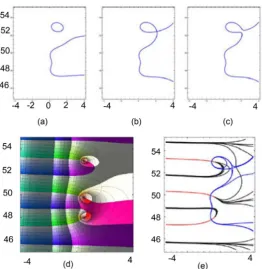
s belonging to that region. When r increases those curves expand and they cantouch one another at some points vk (see Figure 1(b)). These are branch
points of the function, since in every neighbourhood of vk the function takes at
least twice any value on the image circle. Therefore the derivative of ζA,Λ
( )
s cancels at vk. It is obvious that any zero of the derivative, which is not a zero ofthe function itself, can be obtained in this way. Indeed, if v is such a zero, we can take r=
ζ
A,Λ( )
v and necessarily at least two components of the pre-image of Cr will pass through v.What happens with those components of the pre-image of a circle Cr when 1
r= ? We have proved [36], Theorem 1 that there is at least one unbounded component of the pre-image of the unit circle. That proof did not use the as- sumption of ζA,Λ
( )
s satisfying a Riemann type of functional equation and therefore it is true for any function ζA,Λ( )
s .Let us notice that two curves Γ′k and Γl′ cannot intersect each other. Indeed,
Figure 1. Pre-images of circles and the birth of a strip.
a pole of ζA,Λ
( )
s which is not true. Therefore an intersection point s0 of the two curves cannot exist and consecutive curves Γk′ and Γ′k+1 bound infinite strips Sk. We suppose that S0 is the strip containing the point s=1 and for every integer k, the curve Γk′+1 is situated above Γ′k. Figure 1(e) illustrates the birth of a strip Sk when the pre-image of a ray making a small angleα
with the positive real half axis is taken and then we let α →0.
We have also proved [36], Theorem 2 that every unbounded component of the pre-image by ζA,Λ
( )
s of the unit circle is contained between two con- secutive curves Γk′ and Γ′k+1 and vice-versa, if k≠0 between two con- secutive curves Γk′ and Γ′k+1 there is a unique unbounded component of the pre-image of the unit circle. It has been shown that the respective component does not intersect any one of these curves. For k≠0 every strip Sk contains also a unique curve Γk,0 which is mapped bijectively by ζA,Λ( )
s onto the interval(
−∞,1)
of the real axis, as well as a certain number of curves Γk j, ,0
j
≠
which are mapped bijectively by ζA,Λ( )
s onto the whole real axis. There are infinitely many strips Sk covering the whole complex plane [36], Theorem4. Therefore, there are infinitely many unbounded components of the pre-image by ζA,Λ
( )
s of the unit circle. Some strips Sk can contain also boundedcomponents of the pre-image of the unit circle as well as bounded components of the pre-image of Cr with r>1. Figure 1(d) portrays the strip S5 of
( )
sζ containing two components of the pre-image of the unit circle: the unbounded one containing two zeros and the other bounded, containing one zero.
[39] on the Riemann Zeta function. After that the pre-image of the real axis does not appear any more in literature as a tool except for the paper of Arias-de-Reina
[40], who revisits Speiser’s theorem. In the same year John Derbyshire uses both: the pre-image of the real axis and that of the imaginary axis in his popular book
Prime Obsession and declares that they are at the heart of that book. The
classification of the components of the pre-image of the real axis by the Riemann Zeta function appears for the first time in [37], where the strips Sk are also
introduced and a method is devised of partitioning them into fundamental domains. Later, such a classification has been extended to Dirichlet L-functions and finally to functions defined by general Dirichlet series.
A different approach, namely that of phase diagram, has been used by Elias Wegert for visual exploration of complex functions [41] [42]. Applied to the Riemann Zeta function, his phase plots revealed interesting patterns pertaining to the universality property of that function. It is known that such a property extends to more general Dirichlet series and probably it can complement our fundamental domains approach.
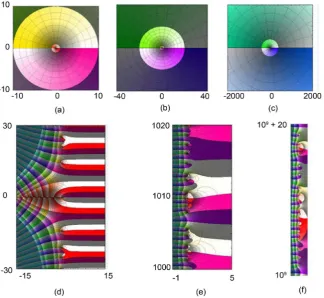
An even better way to visualize the complexity of conformal mappings by analytic functions of a complex variable is to use an orthogonal mesh in the z-plane formed with rays issuing from the origin and circles centred at the origin. Moreover, a spectre of colors can be superposed to the mesh as seen in Figures
2(a)-(c). By taking the pre-image of that mesh we obtain a coloured orthogonal
[image:5.595.211.536.409.707.2]mesh in the s-plane in which the color of every point coincides with that of its
image. In this way we can locate the corresponding points in the two planes and have also a global view of the mapping. The pre-image of the real axis and the
k
S -strips are still identifiable. Figures 2(d)-(f) above illustrates the mapping by the Riemann Zeta function in the rectangles
[
−20, 20] [
× −30, 30]
,[
−1, 5] [
× 1, 000;1, 020]
and[
0.4,1.4]
×10 ,109 9+20. By comparing them, onecan notice the increasing number of zeros in the strips with increasing t. The pattern we can see here is proper to any function ζA,Λ
( )
s .Theorem 1 No zero of ζA,Λ
( )
s or of ζA′,Λ( )
s can belong to a curve Γ′k.Proof. The affirmation of the theorem is obvious for the zeros of ζA,Λ
( )
s since 0 does not belong to the interval[
1,+∞)
of the real axis. A more intricateargument guarantees that the same is true for the zeros of the derivative of
( )
,
A s
ζ Λ . Indeed, even if r>1, no bounded component of the pre-image of Cr
can reach Γ′k , despite of the fact that Cr intersects the interval
[
1,+∞)
.Indeed, in the contrary case, the respective component should intersect Γ′k at
lest twice, or it should be tangent to it, fact which requires that Cr intersects
the interval
[
1,+∞)
the same number of times or to be tangent to it, which isnot possible. The fact that Cr intersects the interval
[
1,+∞)
has as effect thepre-image of Cr intersecting the curves Γk j, (and not Γk′ ). It results that no
two bounded components of the pre-image of Cr can meet on Γ′k, neither
can one of these components meet on Γk′ an unbounded component of the
pre-image of Cr into a zero of ζA′,Λ
( )
s .Remark: Theorem 1 does not imply that ζA′,Λ
( )
s cannot have zeros on some ,k j
Γ . Such zeros appeared as possible for the Dirichlet L-function L
(
5, 2,s)
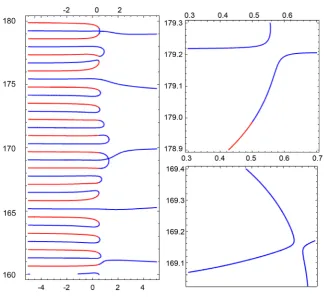
as seen in Figure 3 when t has approximately the values 169.2 and 179.2. However, we suspected that this was due to the poor resolution of the picture and indeed, when we zoomed on the respective points, we obtained configu- rations which show clearly that ζA′,Λ( )
s does not cancel there. However, as we will see later, the possibility of such zeros cannot be excluded.We have seen that the unbounded components of the pre-image of the unit circle do not intersect any Γk′ . On the other hand the bounded components of
the pre-image of the unit circle intersect curves Γk j, at points uk j, where
( )
, , 1
A uk j
ζ
+Λ = − . In the same way the bounded components of the pre-image of
r
C with r>1 will intersect Γk j, at points u where
ζ
A,( )
u r+
Λ =− . However
the story of the unbounded components of the pre-image of Cr is a little more
complicated.
When increasing r past 1 all the unbounded components of the pre-image
of C1 fuse together into a unique unbounded curve γr intersecting every
curve Γ′k, hence they do not generate by this fusion zeros of ζA′,Λ
( )
s . Indeed, since the mapping of Γ′k onto the interval(
1,+∞)
is bijective, there should bea unique point sk on every Γk′ such that ζA,Λ
( )
sk =r. The continuation over rFigure 3. Possible zeros of ζA′,Λ
( )
s on Γk j, which are not double zeros of ζA,Λ( )
s .Given any bounded domain in the plane
( )
s , we can take r>1 closeenough to 1 such that γr does not touch any bounded component of the
pre-image of Cr included in that domain. However, for bigger values of r the
curve γr comes into contact with bounded components which were turning
around one or several zeros sk j, of ζA,Λ
( )
s , fusing with them and getting to the left of those zeros, hence intersecting also the curves Γk j, which contain therespective zeros. The curve γr is orthogonal to every component of the pre-
image of the real axis if it intersects that component at a point where ζA′,Λ
( )
s does not cancel.Since a point turning around the origin in the same direction on an arbitrary circle Cr centred at the origin will meet consecutively the positive and the
negative real half axis, the components of the pre-image of Cr (including γr
when r>1) should meet consecutively the pre-image of the positive and the
negative half axis (coloured differently). This is [33] [35] the so-called color alternating rule.
An immediate consequence of this rule is that in every strip Sk the first and
the last curve Γk j, should be such that the pre-image of the negative real half
axis faces the corresponding Γk′. Then, consecutive Γk j, have the same orien-
tation, as long as they are on the same side of Γk,0. A zero s0 of ζA′,Λ
( )
s being on Γk j, and not being a zero of ζA,Λ( )
s (where the colors are changing) implies that different components of the pre-image of a circle Cr fuse (for avalue r0 of r) on Γk j, . The respective components must obey the color
can be such that the rule is still in force. Indeed, if Γk j, and Γk j,′ have the
same color at s0 then this curve can continue to meet the respective color without affecting the color alternation by simply switching the branches of Γk j,
and Γk j,′ which come to s0. However, as we will see next, the position of s0 with respect to the two zeros of ζA,Λ
( )
s on these curves cannot be arbitrary.Theorem 2 For k different of 0, there is no zero of the derivative of ζA′,Λ
( )
sat the left of the leftmost zero of ζA,Λ
( )
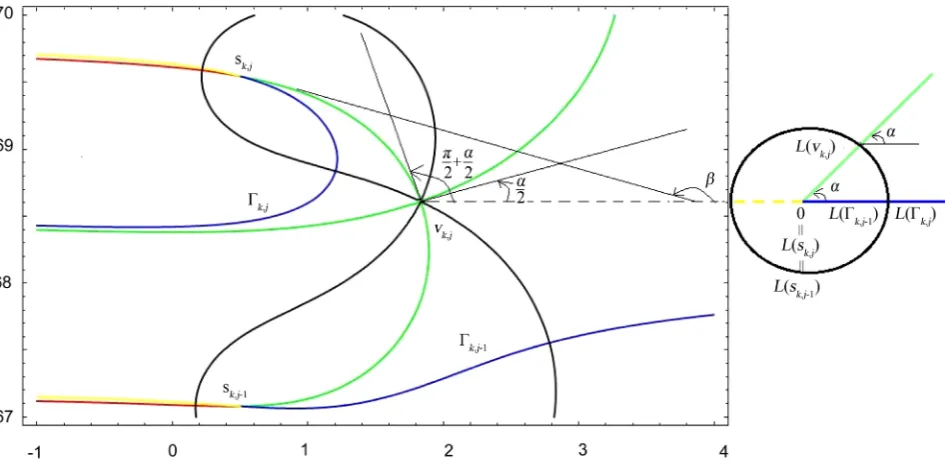
s in SkProof. We can reproduce the proof of Theorem 1 from [43] for arbitrary functions ζA,Λ
( )
s . Let sk j, be the leftmost zero of ζA,Λ( )
s from Sk andsuppose that the simple zero vk j, of ζA′,Λ
( )
s is a progenitor of sk j, , i.e. acomponent of the pre-image of the circle Cr with
r
=
ζ
A,Λ( )
v
k j, contains the point sk j, . It is obviously enough to deal with the case wherej
>
0
, i.e. where,
k j
Γ is above Γk,0. Then
ζ
A,Λ( )
vk j, (indicated in Figure 4 as L v( )
k j, , since it has been partially computer generated by a Dirichlet L-function) belongs to the upper half plane and 0≤ <α π, whereα
=argζ
A,Λ( )
vk j, .The pre-image of the ray determined by
ζ
A,Λ( )
vk j, contains two curves which are orthogonal at vk j, . The angles at vk j, are doubled by ζA,Λ( )
s , hence the four arcs of the pre-image of that ray make angles of α 2, π 2+α 2,π+α 2 and 3π 2+α 2 with a horizontal line whose image passes through
( )
, ,A vk j
ζ
Λ . The angle π 2+α 2 made by the second arc (which ends in sk j, ) with this line is less than the angleβ
made by the tangent to the pre-image of the respective ray at any point between sk j, and vk j, with the same horizontalline. If ℜ
( ) ( )
vk j, ≤ ℜ sk j, , then there must be a point on that arc for whichπ 2
β = , therefore α <0, which is absurd. ■
Corollary: If ζA,Λ
( )
s satisfies RH, then the zeros of ζA′,Λ( )
s from every [image:8.595.62.535.477.711.2]strip Sk are at the right side of the critical line. When ζA,Λ
( )
s is the RiemannZeta function this corollary represents the Speiser’s theorem [39].
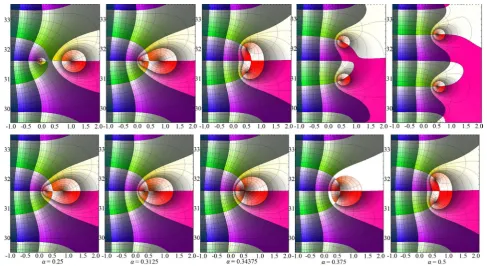
The existence of multiple zeros of functions obtained by analytic con- tinuations of Dirichlet series has been documented (probably for the first time) in [44], where double zeros of a linear combination of Dirichlet L-functions have been found (see Figure 5 below).
We have shown that all those double zeros are located on the critical line. In this example the function is L
(
7, 2,s)
+0.34375L(
7, 4,s)
and the double zero is obtained for the approximate value of s of 0.5 31.6i+ . The double zeros wehave found for all the functions of this type were located at the intersection of
,0
k
Γ and Γk,1 or of Γk,0 and Γk, 1− . We can make now a much more general affirmation about the multiple zeros of functions obtained by analytic con- tinuation of general Dirichlet series.
Theorem 3 In every strip Sk of a function ζA,Λ
( )
s this function has atmost one double zero. Such a zero is found at the intersection of Γk,0 and Γk,1
or of Γk,0 and Γk, 1− . There is no multiple zero of ζA′,Λ
( )
s in Sk and hence no zero of a higher order than two of ζA,Λ( )
s .We need to postpone the proof of this theorem for a while.
3. Intertwining Curves
[image:9.595.54.542.449.715.2]When studying functions z=ζA,Λ
( )
s it is useful to consider besides the planes( )
s and( )
z also a plane( )
w , where w=ζA′,Λ( )
s . Sometimes the planes( )
z and( )
w will be identified in order to make more obvious certain relations between the configurations defined by the two functions in the respective planes. The configurations we have in view are pre-images by both ζA,Λ( )
s and by( )
,A s
ζ′Λ , of some curves or domains.
Regarding the pre-image by ζA,Λ
( )
s and by ζA′,Λ( )
s of the real axis it has been found [34][36] that the components of these pre-images are paired in such a way that only the components of the same pair can intersect each other. The respective pairs form the so-called intertwining curves.Three kinds of intertwining curves have been distinguished [33][34][35][36], namely:
1) Γk′ and ϒ′k, k∈, which are mapped bijectively by ζA,Λ
( )
s and by( )
,
A s
ζ′Λ onto the interval
(
1,+∞)
, respectively(
−∞, 0)
,2) Γk,0 and ϒk,0, k∈, which are mapped bijectively by ζA,Λ
( )
s and by( )
,
A s
ζ′Λ onto the interval
(
−∞,1)
, respectively(
0,+∞)
3) Γk j, and ϒk j, ,
j
≠
0
, k∈, j∈Jk \ 0{ }
= (a finite set of integers),which are mapped bijectively by ζA,Λ
( )
s , respectively by ζA′,Λ( )
s onto the whole real axis.Theorem 4 The intertwining curves touch each other at the points where the tangent to Γk j, , respectively Γ′k is horizontal. Vice-versa, if at a point of such a curve the tangent is horizontal, then a component of the pre-image of the real axis by ζA′,Λ
( )
s passes also through that point.Proof. Indeed, suppose that s=s x
( )
is the equation of a curve Γ′k or of acurve Γk j, such that
ζ
A,Λ(
s x( )
)
=x. Then (see Figure 6 below)( )
(
)
( )
, 1
A s x s x
[image:10.595.63.543.382.725.2]ζ
′Λ ′ = . (4)The Equation (4) shows that the argument of
ζ
A′,Λ(
s x( )
)
is opposite to that of s x′( )
, therefore they cancel simultaneously, and when one is π, the other should be −π. Yet these values of the argument of a point mean that the respective point is on the real axis, therefore s x( )
belongs to both pre-images of the real axis, by ζA,Λ( )
s and ζA′,Λ( )
s which completely proves the theorem.■ Remark: The Theorem 4 is a corollary of a much more general property which says that if z= f s
( )
is an analytic function in a domain D of the complex plane and γ is the image by f s( )
of a smooth curve Γ:s=s z( )
, then denoting by ϒ the pre-image by f′( )
s of γ, at every point s0 where Γ and ϒ intersect each other we have argf′( )
s0 +args z′( )
0 =0 mod 2π(
)
, where s0=s z( )
0 .Indeed, suppose that the planes
( )
z and( )
w are identified, where( )
w= f′ s and write S=S w
( )
for the curve ϒ. Then at an intersection point s0 of Γ and ϒ we have s0=s z( )
0 =S f(
′( )
s0)
and f s z(
( )
)
=z implies f′(
s z( )
)
s z′( )
=1, hence f′( ) ( )
s0 s z′ 0 =1, etc.We can show now that:
Theorem 5 No strip Sk can be included in a right half plane.
Proof. The formula (4) written for Γ′k tells us that when s x′
( )
tends to∞ then
ζ
A′,Λ(
s x( )
)
must tend to 0. Yet, there is no zero ofζ
A′,Λ(
s x( )
)
on any Γ′k . On the other hand,ζ
A′,Λ(
s x( )
)
is an unlimited continuation of( )
,A s
ζ′Λ alongside Γ′k , hence when s x
( )
tends to ∞ we have that( )
(
)
,A s x
ζ
′Λ tends to ∞ not to 0 and this is a contradiction. The conclusion is that the geometry of the pre-image of the real axis is in the whole complex plane similar to that we can see in a bounded region of the plane in Figure 2, Figure 3,Figure 6, Figure 7. ■
Summarizing these facts and having in view [36] we can say:
Theorem 6 The variable
σ
takes any real value on every curve Γk′. Con-secutive curves Γ′k form infinite strips Sk which are mapped (not necessarily
bijectively) onto the whole complex plane with a slit alongside the interval
[
1,+∞)
of the real axis. If Sk contains mk zeros of the function ζA,Λ( )
s ,then it will contain mk −1 zeros of ζA′,Λ
( )
s . For any given k, the function( )
,
A s
ζ Λ either has a finite number of zeros sk j, in Sk, or limj→∞sk j, = ∞. If
( )
,A s
ζ Λ satisfies a Riemann type of functional equation, every strip Sk, k≠0
contains a finite number of zeros of this function. The strip S0 may contain
infinitely many zeros of ζA,Λ
( )
s .Proof. We only need to justify the numbers mk and mk−1 to which the
theorem makes reference. We have seen that every zero of ζA′,Λ
( )
s is obtained when two components of the pre-image of some circle Cr centred at the originand of radius r come into contact. If we consider the zeros of ζA,Λ
( )
s as the leafs of a binary tree whose internal nodes are obtained in this way, that tree is a complete binary tree and it is known that it must have exactly mk −1 internalFigure 7. The zeros of ζ
( )
s and of its first two derivatives for t∈[
0,100]
.are also clearly indicated. If there is a double zero of ζA,Λ
( )
s in Sk, then therespective leaf is counted twice as a leaf and once as an internal node, etc. When the number of zeros sk j, in Sk is infinite we must have limj→∞sk j, = ∞,
otherwise sk j, would have an accumulation point in Sk and hence ζA,Λ
( )
s would be identically zero. ■We can prove now also the Theorem 3.
Proof. Exactly 2 curves Γk j, and Γk j,′ should meet at a double zero s0 of
( )
,
A s
ζ Λ belonging to Sk . But s0 is also a simple zero of ζA′,Λ
( )
s and therefore a curve, say ϒk j, should pass through s0. Yet, Γk j,′ intertwineszero of ζA′,Λ
( )
s , the point s0 would be a double zero of for ζA′,Λ( )
s , and this is impossible.Hence , necessarily one of the curves Γk j, passing through s0 is Γk,0. This
shows that there can be only one double zero in Sk and the other curve passing
through s0 in that case is either Γk,1, or Γk, 1− .
We notice that the curve ϒk,0 does not contain any zero of ζA′,Λ
( )
s , hence it cannot pass through a multiple zero of order m of ζA′,Λ( )
s . Since every curve passing through that zero has an intertwining curve defined by the second derivative of ζA,Λ( )
s , the respective point should be a multiple zero of order m of this second derivative, which is absurd. Therefore ζA′,Λ( )
s has no multiple zero and then ζA,Λ( )
s cannot have any zero of the higher order than 2. ■4. Fundamental Domains
For
j
≠
0
, the curves Γk j, as well as ϒk j, are parabola like curves with branches extending to infinity asσ
→ −∞. Therefore we can distinguish between the interior and the exterior of such curves. They can be viewed as oriented curves, with the same orientation as the real axis whose components of the pre-image they are. By the same rule Γ′k and ϒk′, as well as ϒk,0 are alsooriented, the positive orientation of Γ′k and of ϒk,0 being from the right to
the left, while that of ϒk′, is from the left to the right. Some curves Γk j, ,
j
≠
0
can contain in interior some other curves of the same type (embraced curves) and by the color alternating rule the orientation of the embracing curve and that of the embraced curves must be different. We did not find any instance where an embraced curve is in turn embracing, yet there is no reason to believe that such a situation is impossible.
Theorem 7 If the strip Sk contains mk zeros counted with multiplicities,
then Sk can be partitioned into mk sub-strips which are fundamental do-
mains for ζA,Λ
( )
sProof. Suppose that curves Γk j, and Γk j,′ are containing the simple zeros
,
k j
s and sk j,′ and two components of the pre-image of a circle Cr which are going around each one of these zeros touch at a point vk j, . This is a zero of
( )
,A s
ζ′Λ . The pre-image of the segment of line connecting z=1 and
( )
, ,A vk j
ζ
Λ has as component an arc ηk j, connecting the points on the two curves where ζA,Λ( )
s =1 and passing through vk j, . If one of these curves is,0
k
Γ then the respective point is ∞ and ηk j, is an unbounded curve. The strip Ωk j, bounded by this curve and the branches of Γk j, and Γk j,′ corre-
sponding to the interval
[
1,+∞)
, turns out to be a fundamental domain of( )
,A s
ζ Λ . Indeed, Ωk j, is mapped conformally by ζA,Λ
( )
s onto the whole complex plane with a slit alongside the interval[
1,+∞)
followed by a slitalongside the segment from z=1 to
ζ
A,Λ( )
vk j, . If Γk j, embraces Γk j,′ then ,k j
Ω is bounded to the right.
the interval
[ ]
0,1 becomes part of the boundaries of adjacent fundamentaldomains. One of them will have as image the complex plane with a slit alongside the positive real half axis and for the other one a slit from z=1 to
( )
, ,A k j
z=
ζ
Λ v should be added, wherej
is 1 or −1.We know that sk j, cannot have a higher order of multiplicity and therefore
the cases analysed exhaust all the possibilities. Having in view Theorem 6, we conclude that the strip Sk can be always divided into mk fundamental
domains. ■
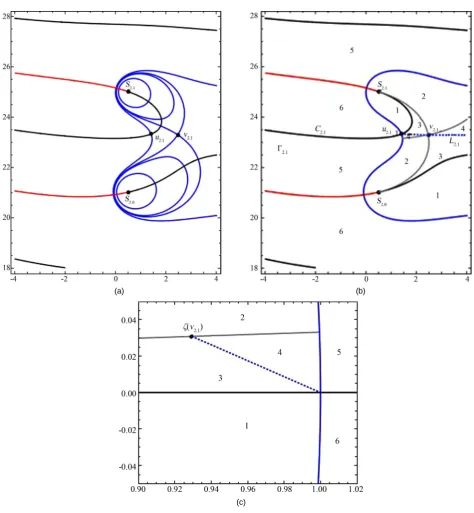
Figure 8 below illustrates this theorem for the case of the Riemann Zeta
(a) (b)
[image:14.595.56.531.209.723.2](c)
function and the strip S2.
As seen in the case of Dirichlet L-functions (including the Riemann Zeta function) the strip S0 has infinitely many zeros, yet following the same technique we can divide it into infinitely many fundamental domains.
If four different colors are used, say color 1 and 2 for the pre-images by
( )
,
A s
ζ Λ of the positive and of the negative real half axis and 3 and 4 for the pre-images by ζA′,Λ
( )
s of the same half axes, then two simple topological facts can be established [33]:a) The color alternating rule, which states that as a point turns indefinitely in the same direction on a circle centred at the origin, the pre-images of this point by each one of the functions ζA,Λ
( )
s and ζA′,Λ( )
s will meet alternatively the colors 1 and 2, respectively 3 and 4.b) The color matching rule, which states that when intertwining curves meet each other, then if these are not Γk,0 and ϒk,0 color 1 will always meet color 4
and color 2 will always meet color 3. Only the curves Γk,0 and ϒk,0 can
intersect each other at points where color 2 can meet color 4.
The series (1) which are Euler products display special important properties.
5. Euler Products
It is known that the Dirichlet L-functions are meromorphic continuations of ordinary Dirichlet series defined by Dirichlet characters and these series can be expressed as Euler products. This property is a corollary of the fact that the Dirichlet characters are totally multiplicative functions (see for example [33]. Yet the property of being total multiplicative can be extended to general Dirichlet series, as done in [35], and therefore some of the general Dirichlet series
( )
,A s
ζ Λ (see the details in [35]) can also be written as Euler products:
( )
(
)
1, 1 e 1 pe
p
ns s
A s n an p a
λ λ
ζ
∞ − − −Λ =
∑
= = Π ∈ − , (5)where is the set of prime numbers. This convention will be kept in the following for all the products and sums involving the subscript p. The product has the same abscissa of convergence as the series itself.
Looking for counterexamples to the Grand Riemann Hypothesis (GRH), some Dirichlet series satisfying a Riemann type of functional equation have been found, whose analytic continuation exhibit off critical line non trivial zeros, namely the Davenport and Heilbronn type of functions and linear combinations of L-functions satisfying the same functional equation. Although these are not counterexamples to GRH, their study allowed us to draw interesting conclusions. We have seen in [36] that if ζA,Λ
( )
s does not satisfy the GRH, then for every two distinct non trivial zeros s1= +σ it and s2= − +1 σ it there is τ0,0
0<τ <1 such that
ζ
A′,Λ(
s( )
τ
0)
=0, where s( ) (
τ = −1 τ)
s1+τs2, i.e. the derivative of ζA,Λ( )
s cancels at a point s0=s( )
τ0 of the interval I deter- mined by s1 and s2. Moreover, ℜ( )
s0 <1 2.Let us rephrase and give a simplified proof to [36], Theorem 3.
tional equation and the respective series has the abscissa of convergence
1 2
c
[image:16.595.205.535.457.719.2]σ < . Then for every non trivial zero σ +it of ζA,Λ
( )
s we have σ =1 2. Proof. Suppose that there is a zero σ +it of ζA,Λ( )
s for which σ >1 2. Then, due to the functional equation, 1− +σ it is also a zero of ζA,Λ( )
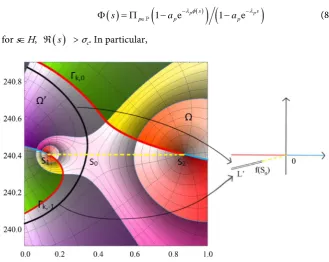
s (seeFigure 9 below). There is r>0 such that in the components D1 and D2 of the pre-image of the disc centred at the origin and of radius r containing the
respective zeros the function ζA,Λ
( )
s is injective. Then we can define the function φ:D1→D2 as follows:( )
( )
1( )
, ,
2
A D A
s s s
φ
ζ
−ζ
Λ Λ
= (6)
The function
φ
can be continued as an analytic involution of the union′
Ω ∪ Ω of the fundamental domains Ω and Ω′ of ζA,Λ
( )
s containing the respective zeros. The boundaries of the domains Ω and Ω′ have a common component L and the union Ω ∪ Ω ∪′ L is a simply connected domain H. The functionφ
can be continued to an analytic involution of H having s0 as a fixed point. We haveφ φ
(
( )
s)
=s in H, in particular(
it)
1 itφ σ+ = − +σ and φ
(
1− +σ it)
= +σ it. Moreover,( )
(
)
( )
, ,
A s A s
ζ
Λφ
=ζ
Λ in H. Let us define the function Φ by( )
sζ
A,Λ( )
sζ
A,Λ(
φ
( )
s)
Φ = (7)
Since the numerator and the denominator of Φ are analytic functions in H and the denominator cancels only at σ +it and 1− +σ it, the function Φ is analytic in H except at these two points. Since
ζ
A,Λ( )
s =ζ
A,Λ(
φ
( )
s)
, we have that Φ( )
s =1 for s not equal to one of these points. Yet they are removable singularities, and we can set Φ( )
s =1 in H. By the formula (5) we have( )
(
( ))
(
)
1 e p s 1 e ps
p p p
s ∈ a −λ φ a −λ
Φ = Π − − (8)
for s∈H, ℜ
( )
s > σc. In particular,(
)
( ) ( ) ( ) 1 1 11 e 1 e
e e
p p
p p p p
it it
p p p
ti ti
p p p
it
a a
e a e a
λ σ λ σ λ λ σ λ λ σ
σ
− − + − + ∈
− − −
∈
= Φ +
= Π − −
= Π − −
The arguments of these ratios represent the angles under which the segment between (1 )
e p
p
a −λ −σ and e p
p
a −λ σ is seen from the point eλpti on the unit circle. If a Ramanujan type condition is fulfilled, namely A and Λ are such that for every >0 we have lim e n 0
n an
λ ε −
→∞ = , then the respective angles
tend to zero as p→ ∞. This appears to be a necessary condition for the convergence of the series.
(1 )
arg e pti e p e pti e p
p p
p a a
λ −λ −σ λ −λ σ
∈ − −
∑
However, the condition is implicitly satisfied since we know that Φ
( )
s is well defined in the domain H. The series is a continuous function of σ , yet it can take only integer multiple values of 2π, which is possible only if it is a constant. Since lim e n 0,n an
λ δ −
→∞ = the series can remain constant only if there
is p0 such that for p > p0 we have arg e pti ape p(1 ) epti ape p 0.
λ −λ −σ λ −λ σ
− − =
This can happen in two situations: either the three points eλpti, e p p
a −λ σ and
(1 )
e p
p
a −λ −σ are collinear, or e p(1 ) e p
p p
a −λ −σ =a −λ σ and in this last case 1− =σ σ,
i.e. σ =1 2. In the first case, a shift in t will not affect the real part of the zeros,
yet it will destroy the collinearity of the three points and therefore this situation can be ignored. The final conclusion is that ςA,Λ
( )
s cannot have any non trivi-al zero σ +it with σ strictly greater than 1/2. The zero 1 2+it can be either a simple zero and then we have only one fundamental domain Ω, or a double zero and then it is the fixed point of the involution φ( )
s . In both cases it is located on the critical line, which completely proves the theorem.■ We need to point out the fact that Figure 9 above illustrates a situation in which the Equation (5) is not satisfied.
Remark: In all of our publications we understood by trivial zeros of an L- function those zeros which can be trivially computed. In this respect, the non trivial zeros of the alternating Zeta function
( )
(
1)
( )
1 2 s
a s s
ζ
= − −ζ
are thesame as those of ζ
( )
s and ζa( )
s satisfies the conditions of Theorem 8,therefore its non trivial zeros are located on the critical line. Thus, RH is also true for ζ
( )
s .Similarly, the non trivial zeros of a Dirichlet L-function
(
,1,)
(
1 1s)
( )
L q s = −q−
ζ
s defined by the principal character modulo q are the non trivial zeros of the Riemann Zeta function.Acknowledgements
The author is very much thankful to Florin Alan Muscutar for his contribution with computer generated graphics.
References
[1] Cahen, E. (1894) Sur la function ζ(s) de Riemann et sur des fonctions analogues, Ann. Ecole Norm., 3e serie, t. 11.
[2] Cahen, E. (1918) Sur les séries de Dirichlet, Compte rendue, t. 166.
[3] Hadamard, J. (1896) Sur la distribution des zéros de la function ζ(s) de Riemann et ses cons équences arithmé tiques, Bull. Soc. math., t. 24.
[4] Hadamard, J. (1908) Sur les s éries de Dirichlet, Rendiconti di Palermo, t. 25. [5] Landau, E. (1907) Über die Multiplication Dirichletscher Reihen, rendiconti di
Pa-lermo, t. 24.
[6] Landau, E. (1909) Über das Konvergenzproblem der Dirichletschen Reihen, Rendi-conti di Palermo, t. 28.
[7] Landau, E. (1917) Neuer Beweis eines Haptsatzes aus der Theorie der Dirichlet-schen Reihen, Leipziger Ber., t. 69.
[8] Landau, E. (1921) Über die gleichmassige Konvergenz Dirichletscher Reihen, Math. Zeitschrift, t. 11.
[9] Bohr, H. (1913) Über die gleichmassige Konvergenz Dirichletscher Reihen, J. fuer Math, t. 143.
[10] Bohr, H. (1913) Einige Bemerkungen über das konvergenzproblem Dirichletscher Reihen, Rendicnti di Palermo, t. 37.
[11] Bohr, H. (1913) Darstellung der gleichmassigen Konvergenzabszisse einer Dirich-letschen reihe ∑ an
ns
∞
n=1 als Funktionen der Koeffizienten der Reihe. Archiv der
Ma-thematik und Physik, 21, 326-330.
[12] Bohr, H. (1913) Zür Theorie der allgemeinen Dirichletschen Reihen. Mathema-tische Annalen, 79, 136-156.
[13] Hardi, G.-H. (1911) The Multiplication of Dirichlet’s Series. Vol. 10, London Ma-thematical Society, London.
[14] Hardy, G.H. and Riesz, M. (1915) The General Theory of Dirichlet’s Series. Cam-bridge University Press, CamCam-bridge.
[15] Kojima, T. (1914) On the Convergence Abscissa of General Dirichlet’s Series. To-hoku Mathematical Journal, 6, 140-142.
[16] Kojima, T. (1916) Note on the Convergence Abscissa of Dirichlet’s Series. Tohoku Mathematical Journal, 9, 28-37.
[17] Kuniyeda, M. (1916) Uniform Convergence Abscissa of General Dirichlet’s Series. Tohoku J., t. 9, 7-27.
[18] Valiron, G. (1926) Théorie générale des séries de Dirichlet. Mémorial des sciences mathématiques, fascicule, 17, 1-56.
[19] Yu, J. (1963) Borel’s Line of Entire Functions Represented by Laplace-Stieltjes Transformations. Acta Mathematica Sinica, 13, 471-484.
[20] Kong, Y.Y. and Daochun, S. (2008) On Type-Function and Growth of Lap-lace-Stieltjes Transformations Convergent in the Right Half Plane, 2008. Advances in Mathematics, 37, 197-205.
Trans-forms of Slow Growth. Acta Mathematica Sinica, 32A, 601-607.
[22] Kong, Y.Y. and Yang, Y. (2014) On the Growth Properties of the Laplace-Stieltjes Transform. Complex Variables and Elliptic Equations, 59, 553-563.
https://doi.org/10.1080/17476933.2013.766174
[23] Singhal, C. and Srivastava, G.S. (2015) On the Approximation of an Analytic Func-tion Represented by Laplace-Stieltjes TransformaFunc-tion. Analysis in Theory and Ap-plications, 31, 407-420.
[24] Srivastava, G.S. and Singhal, C. (2015) On the Generalized Order and the Genera-lized Type of Laplace-Stieltjes Transformation Convergent in the Right Half Plane. Global Journal of Pure and Applied Mathematics, 11, 469-477.
[25] Kamthan, P.K. and Shing Gautam, S.K. (1975) Bases in a Certain Space of Functions Analytic in the Half Plane. Indian Journal of Pure and Applied Mathematics, 6, 1066-1075.
[26] Khoi, L.H. (1998) Holomorphic Dirichlet Series in the Half Plane. Vietnam Journal of Mathematics, 26, 259-271.
[27] Defant, A., Garcia, D., Maestre, M. and Perez-Garcia, D. (2008) Bohr’s Strip for Vector Valued Dirichlet Series. Mathematische Annalen, 342, 533-555.
https://doi.org/10.1007/s00208-008-0246-z
[28] Bonet, J. (2015) Abscissas of Weak Convergence of Vector Valued Dirichlet Series. arXiv: 1502.00418v1.
[29] Srivastava, B.L. (1983) A Study of Spaces of Certain Classes of Vector Valued Di-richlet Series. Thesis, Indian Institute of Technology Kanpur, Kalyanpur.
[30] Srivastava, G.S. and Sharma, A. (2011) Bases in the Space of Vector Valued Analytic Dirichlet Series. International Journal of Pure and Applied Mathematics, 7, 993- 1000.
[31] Srivastava, G.S. and Sharma, A. (2012) Spaces of Entire Functions Represented by Vector Valued Dirichlet Series of Slow Growth. Acta Universitatis Sapientiae, Ma-thematica, 4, 154-167.
[32] Sharma, A. and Srivastava, G.S. (2016) Coefficient Multipliers on Spaces of Vector Valued Entire Dirichlet Series.
[33] Ghisa, D. (2013) Fundamental Domains and the Riemann Hypothesis. Lambert Academic Publishing, Saarbrücken.
[34] Ghisa, D. (2014) On the Generalized Riemann Hypothesis, Complex Analysis and Potential Theory with Applications. Cambridge Scientific Publishers, Cambridge, 77-94.
[35] Ghisa, D. (2016) On the Generalized Riemann Hypothesis II. International Journal of Scientific and Innovative Mathematical Research, 4, 46-55.
[36] Ghisa, D. (2016) Fundamental Domains and Analytic Continuation of General Di-richlet Series. British Journal of Mathematics & Computer Science, 9, 94-111. [37] Andreian-Cazacu, C. and Ghisa, D. (2009) Global Mapping Properties of Analytic
Functions. Proceedings of 7th ISAAC Congress, London, 13-18 July 2009, 3-12. [38] Andreian-Cazacu, C. and Ghisa, D. (2011) Fundamental Domains of Gamma and
Zeta Functions. International Journal of Mathematics and Mathematical Sciences, 2011, Article ID: 985323. https://doi.org/10.1155/2011/985323
[39] Speiser, A. (1934) Geometrisches zür Riemannschen Zetafunction. Mathematische Annalen, 110, 514-521. https://doi.org/10.1007/BF01448042
[41] Wegert, E. (2012) Visual Complex Functions. Springer, Basel. https://doi.org/10.1007/978-3-0348-0180-5
[42] Wegert, E. (2016) Visual Exploration of Complex Functions. In: Qian, T. and Ro-dino, L.G., Eds., Mathematical Analysis, Probability and Applications—Plenary Lectures, Vol. 177, Springer International Publishing, 253-279.
https://doi.org/10.1007/978-3-319-41945-9_10
[43] Barza, I., Ghisa, D. and Muscutar, F.A. (2014) On the Location of the Zeros of the Derivatives of Dirichlet L-Functions. Annals of the University of Bucharest ( Ma-thematics Series), 5, 21-31.
[44] Cao-Huu, T., Ghisa, D. and Muscutar, F.A. (2016) Multiple Solutions of Riermann Type of Functional Equations. British Journal of Mathematics and Computer Science, 17, 1-12. https://doi.org/10.9734/BJMCS/2016/26322
Submit or recommend next manuscript to SCIRP and we will provide best service for you:
Accepting pre-submission inquiries through Email, Facebook, LinkedIn, Twitter, etc. A wide selection of journals (inclusive of 9 subjects, more than 200 journals)
Providing 24-hour high-quality service User-friendly online submission system Fair and swift peer-review system
Efficient typesetting and proofreading procedure
Display of the result of downloads and visits, as well as the number of cited articles Maximum dissemination of your research work
Submit your manuscript at: http://papersubmission.scirp.org/
![Figure 6. Intertwining curves of ζ σ +(it) for t ∈[0,100].](https://thumb-us.123doks.com/thumbv2/123dok_us/7785704.723484/10.595.63.543.382.725/figure-intertwining-curves-z-s-t.webp)
![Figure 7. The zeros of ζ( )s and of its first two derivatives for t ∈[0,100].](https://thumb-us.123doks.com/thumbv2/123dok_us/7785704.723484/12.595.64.536.65.550/figure-zeros-z-s-derivatives-t.webp)