Shape Retrieval Using ECPDH with Dynamic
Programming
Xin Shu
1,2, Lei Pan
1, Yunsong Qi
11School of Computer Science and Engineering, Jiangsu University of Science and Technology, Zhenjiang, China 2School of Internet of Things, Jiangnan University, Wuxi, China
Abstract
The matching and retrieval of the 2D shapes are challenging issues in object recogni-tion and computer vision. In this paper, we propose a new object contour descriptor termed ECPDH (Elliptic Contour Points Distribution Histogram), which is based on the distribution of the points on an object contour under the polar coordinates. ECPDH has the essential merits of invariance to scale and translation. Dynamic Pro-gramming (DP) algorithm is used to measure the distance between the ECPDHs. The effectiveness of the proposed method is demonstrated using some standard tests on MPEG-7 shape database. The results show the precision and recall of our method over other recent methods in the literature.
Keywords
Shape Descriptor, Shape Retrieval, Elliptic Contour Points Distribution Histogram, Dynamic Programming
1. Introduction
Shape is one of the key characteristics for image understanding and computer vision applications. However, using shape information to recognize the objects has proven to be a challenging task for computer vision system as e.g. in image retrieval or object recognition. Finding good shape descriptors and good methods for comparing these descriptors are the crucial issues in such applications. During the past decades, a variety of shape descriptors and matching methods have been proposed in the literature. References [1][2][3][4] review various approaches and methods for shape analysis.
According to [4], the existing object description and representation approaches are usually sorted into two categories: Region based approaches and contour based ap-How to cite this paper: Shu, X., Pan, L.
and Qi, Y.S. (2016) Shape Retrieval Using ECPDH with Dynamic Programming. Journal of Computer and Communications, 4, 63-78.
http://dx.doi.org/10.4236/jcc.2016.416005
Received: November 14, 2016 Accepted: December 26, 2016 Published: December 30, 2016
Copyright © 2016 by authors and Scientific Research Publishing Inc. This work is licensed under the Creative Commons Attribution International License (CC BY 4.0).
proaches. The region based techniques extract features from the whole shape region, while the contour-based methods extract features only from the object’s boundary. The representative approaches in the literature of region based include Invariant Moments [5], Zernike Moments [6], Generic Fourier Descriptor [7] and Radon Transform [8] [9]. These region-based approaches are computationally intense and most of them need to normalize the image to achieve common geometrical invariance. The representative approaches in the literature for contour based include Contour Flexibility [10], Curva-ture Scale Space [11], Fourier Descriptors [12], Shape Contexts (SC) [13], Inner-Dis- tance Shape Contexts [14], Distance Sets [15], Aligning Curves [16], Height Functions [17], Shape Signature [18] and integral invariants [19]. These contour descriptors are based on the boundary of a shape; they do not capture the internal structure of the shape, and so they are unsuitable for disjoint shapes or shapes with holes because in-ternal boundary and topological information is used by these descriptors.
In recent years, more attention has been paid to contour based descriptors, which may be due to the fact that humans are considered to recognize shapes by their con-tours. Inspired by the shape contexts descriptor [13], typical of the sampled points based approaches, Ref. [20] uses a finite set of points taken from the object’s boundary to represent the shape. The descriptor is called contour points distribution histogram (CPHD). Then CPDH is combined with the Earth Mover’s Distance (EMD) to match and retrieval shapes. The main deficiency of [20] lies in the high matching cost in dis-tance measurement. In order to partly deal with the rotation invariance, EMD is com-bined with circular shift and mirror matching in [20] and this tactic lead to high time cost. So as to make up for the deficiency of CPDH, this paper suggests employing the minimal circumscribed ellipse instead of circle for the histogram construction. We named the new histogram as Elliptic Contour Points Distribution Histogram (ECPDH), which is prior to CPDH in terms of human visual perception because most of the ob-jects of nature are tend to have elongated shapes. ECPDH can obtains more details of the distribution of contour points and describes the object more precisely than that of [20]. Scale and translation invariance are still intrinsic to the ECPDH. For measuring the similarity between ECPDHs, Dynamic Programing (DP) is employed to find the best correspondence that minimizes the Euclidean distance between the histograms of two shapes. The advantage of using DP rather than EMD for measuring the distance between ECPHDs is no need to adopt circular shift matching. As a result, time cost is decreased obviously.
The remainder of the paper is arranged as follows. Section 2 presents the proposed ECPDH descriptor in detail and the DP algorithm is employed to measure the distance between ECPDHs. The experimental results are presented in Section 3. Finally, Section 4 concludes the paper.
2. Method
2.1. ECPDH Descriptor
repre-real world, most of the shape of the object is usually tend to slim or oval. Based on this, authors suggest to construct the contour points distribution histogram with multiple concentric elliptical grid, as being illustrated in Figure 1. This tactic is quite different from that of [20]. The extracted histogram, namely ECPDH, has stronger ability of shape identification than that of CPDH because of the main direction of the object is embedded in ECPDH. The following sections describe the process of building ECPDH.
The first step of our method is to represent the shapes by the sequences of points sampled from the object contour. In this paper the equidistant sampling is used for the task of shape retrieval. Thus, any input shape is represented by the sequence of points
set
{
(
) (
)
(
)
}
(
)
21, 1 , 2, 2 , , n, n , i, i
P= x y x y x y x y ∈R , where n denotes the amount of
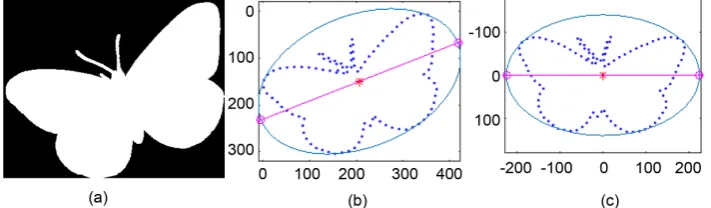
the sampled points from object contour. The resulted contour points are illustrated in the Figure 1: (a) is the original image; (b) shows the sampled points found using the equidistant sampling technique and its minimum circumscribed ellipse, which is used to building the ECPDH. In this paper, the minimum circumscribed ellipse is deter-mined by Khachiyan’s algorithm [21][22]. In Figure 1, the pink line is the long axis of the minimum circumscribed ellipse which represents the main direction of the shape. The red star is the ellipse center. The small pink circles are the long axis and ellipse in-tersection points.
With the extracted and sampled the points from the object contour, the ECPDH de-scriptor is being constructed. For partly making the ECPDH invariant to rotation, these contour points should be aligned to the main direction. After the main direction of the shape is obtained, then it will be converted in line with the horizontal. These sampled contour points are also rotated to a new location and Figure 1(c) illustrate the aligned results.
[image:3.595.197.553.583.687.2]Then authors consider the distribution over relative location as a compact and strong descriptor, which is also with high discrimination capability. The region inside the minimum circumscribed ellipse is divided into a few bins with concentric ellipses and uniform interval angles. An illustration of such division is shown in Figure 2. The sampled shape contour points in each bin will be counted and form a histogram which is called ECPDH. ECPDH is very easy to be calculated and has the properties of inva-riance to translation and scale in nature. Due to the alignment of the shape’s main di-rection, ECPDH also has rotation invariance. Figure 3 illustrates two instances of the
Figure 2. Distribution of contour points with polar coordinate.
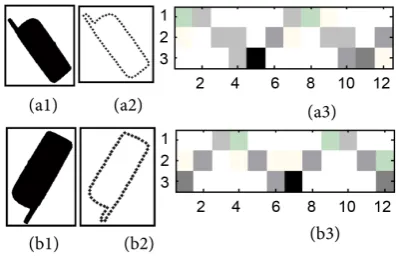
Figure 3. The instance of shapes and their ECPDHs.
ECPDHs. In Figure 3, (a1) and (b1) show two original phone shape images separately, (a2) and (b2) are the uniformly extracted contour points from (a1) and (b1) respective-ly, and (a3) and (b3) are the according ECPDHs, respectively. The different color levels of the bins in (a3) and (b3) represent the different numbers of the points located in those bins.
2.2. Distance between ECPDH via DP Algorithm
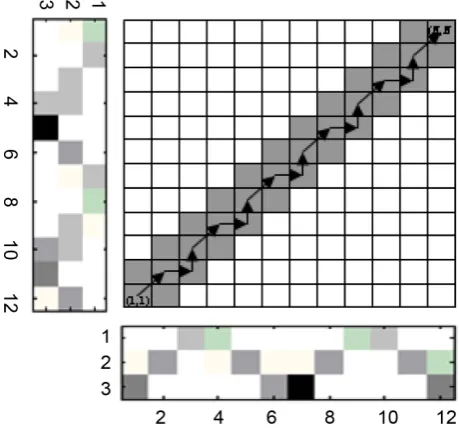
Many researchers have applied dynamic programming (DP) to the 2D shape matching problem [23][24][25][26][27]. In the following, we make our definition of shape dis-tance via the DP algorithm using Euclidean disdis-tance between the bins in ECPDHs. As [23][24] [25][26] [27], a DP table is also utilized to find the least cost matching be-tween bins of two ECPDHs and the update path is hold along with the diagonal in the DP table. We restrict the path to lie in the area close to the ideal straight diagonal line in order to speed up the matching process (see Figure 4).
In detail, every column in the ECPDH is considered as a vector ri corresponding to the feature of point’s distribution in a sector region in Figure 2. As illustrated in Figure 4, two ECPHDs are put along with the DP table in horizontal and vertical directions, respectively. A vector ri of one of the ECPDH is corresponding to one row or one column in the table.
[image:4.595.273.473.240.368.2]Figure 4. The DP table used for matching ECPDHs.
(
)
(
)
(
)
initial
0, max 1, 1 min , 1
DPT ,
, otherwise
n w m N n w
n m = − + ≤ ≤ + −
∞
(1)
where, n m, ∈ 1,N , N is the number of vectors in ECPDHs, w is the predefined
diagonal width illustrated in Figure 4. Only the elements of DPT that fall within w
are updated during the DP search.
Starting at a selected vector for both shape contours A and B, the DPT is searched, through the diagonal window of width w, left-to-right and bottom-to-up starting from
the bottom-left element, as shown in Figure 4. The first row and first column elements are initialized as the distances between the corresponding vectors using Equation (2)
(
,)
n mD n m = r −r (2)
where, * denotes the Euclidean distance between two vectors from the two different ECPDHs.
Then, the rest of the zero-valued elements of DPT are updated as
(
)
(
)
(
)
(
)
(
)
DPT 1,
DPT , , min DPT 1, 1
DPT , 1
n m
n m D n m n m
n m − = + − − − (3)
The least cost path through the DPT is the value of element DPT
(
N N,)
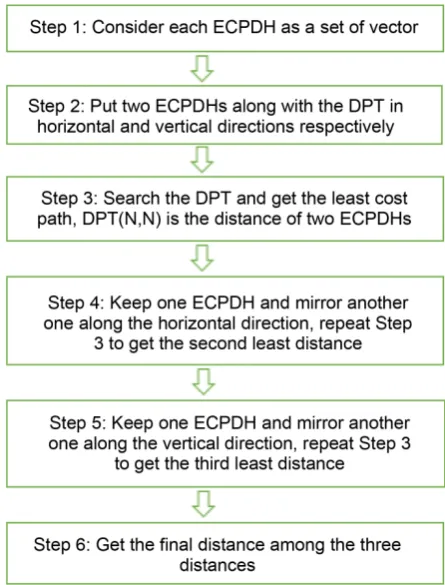
, which corresponds to the best matching between the two ECPDHs. Moreover, in order to ob-tain the invariance to the horizontal and vertical mirror transformation, one ECPDH is fixed and the other one is reconstructed according to the horizontal and vertical mirror transformation of the original shape. The final least cost correspondence is taken as the minimum value of DPT(
N N,)
among three runs of the DPT search, denoted bymin
Figure 5. The flow chart for the DP algorithm.
3. Results
This section presents the results obtained using the proposed approach and several sets of experiments are proceeded. The first experiment is proceeded on the sub dataset of MPEG-7 shape dataset (see Figure 6), which is make up of 216 images including 18 categories, and each category includes 12 shapes with variations in form and occlusion of parts. An experimental method referred by [28] suggests that each shape should be used as a query to be matched against all the others, and the results are sorted by the distance between each pair. The nearest matches according to category and the corres-ponding recognition rates are summarized in Table 1. The results of comparison be-tween the SC [13] and the proposed method is illustrated in Table 2. It is clear that ECPDH combining with DP performs better than that of SC [13]. To give a more com-prehensive comparison, the common performance measurement [11], i.e. precision and recall curves of the retrieval are used here. The precision-recall diagram is illustrated in Figure 7. The results show that ECPDH combining with DP outperforms all the other methods. The parameters used in the experiments are 200 sampled points with
7
ρ
×24θ
=168 bins and w is set to 1.Figure 6. Illustration of the MPEG-7 shape dataset.
Figure 7. Precision-recall curves of different methods on MPEG-7 sub dataset (216 shapes).
of the shape representations. The parameters used in the experiments are 200 sampled points with 5
ρ
×24θ
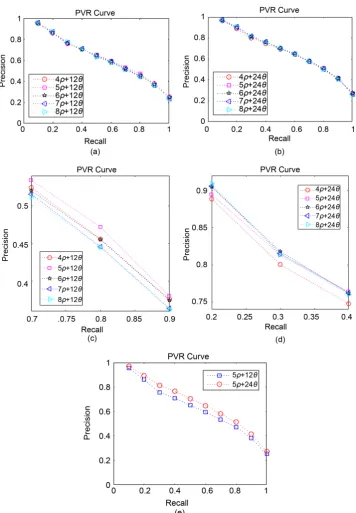
=120 bins and w is set to 1.For each retrieval, the precision of the retrieval at each level of the recall is recorded. The final precision of retrieval with a shape descriptor is the average precision of all the retrievals with that shape descriptor. The average precision and recall of the retrieval on each data set are illustrated in Figure 8. We compare the results of the proposed ap-proach with several other common contour based shape analysis methods on Mpeg-7 dataset. As we can see from Figure 8 that the performance of ECPDH + DP is very competitive.
Table 1. Resulted nearest matches according to category on the sub dataset of MPEG-7 (216 shapes). The values in the table denote the number of nearest matches, and that 12 matches are the most possible. Last row: recognition rate for each nth nearest matches for all in the database. Last column: recognition rates for each category.
Category 1 2 3 4 5 6 7 8 9 10 11 12 %
Birds 12 10 10 11 8 8 8 7 5 4 2 2 60.42
Bones 12 12 12 12 12 12 12 12 12 10 0 1 82.64 Bricks 12 12 12 12 12 12 12 12 12 12 11 10 97.92
Camels 12 12 12 11 11 11 9 8 9 5 9 4 78.47
Cars 12 12 12 12 12 12 12 12 12 12 12 12 100 Children 12 12 12 12 12 12 12 12 12 12 12 12 100 Classic 12 12 12 12 12 12 12 11 12 12 11 9 96.53 Elephants 12 11 11 12 12 12 12 10 6 6 5 4 78.47 Faces 12 12 12 12 12 12 12 12 12 12 12 12 100 Forks 12 12 12 11 12 12 12 11 10 10 10 6 90.28 Fountain 12 12 12 12 12 12 12 12 12 12 12 12 100
Glasses 12 12 12 12 12 12 12 12 12 12 12 10 98.61
Hammers 12 12 12 12 8 7 8 8 2 3 3 3 62.50
Hearts 12 12 11 12 11 11 11 12 11 10 9 0 84.72 Keys 12 12 12 12 12 11 12 12 10 10 8 8 90.97 Misk 12 12 12 11 12 11 11 11 12 11 5 3 85.42
Rays 12 12 10 10 10 6 4 5 5 5 4 3 59.72
Turtles 12 11 11 10 10 10 9 8 4 5 4 5 68.75
% 100 98.15 96.76 96.30 93.52 90.28 88.89 86.57 78.70 75.46 65.28 53.70
Table 2. Retrieval results compared with SC on MPEG-7 sub dataset (216 shapes).
approaches 1 2 3 4 5 6 7 8 9 10 11 total
SC [13] 214 209 205 197 191 178 161 144 131 101 78 1809 ECPDH + DP 212 209 208 202 195 192 187 170 163 141 116 1995
is achieved with larger
θ
. In general, when the parameterρ
is selected as 5 and the parameterθ
is selected as 24 the experiments can achieve favorable results. [image:8.595.193.553.501.552.2]Figure 8. Comparison of PVR Curves (MPEG-7 shape database).
Table 3 shows the compare of the average bull’s-eye score and the recognition rate between CPDH + EMD [20] and ECPDH + DP. It is clear that ECPDH + DP outper-forms CPDH + EMD with the same parameters. When the parameter
ρ
is selected as 5 and the parameterθ
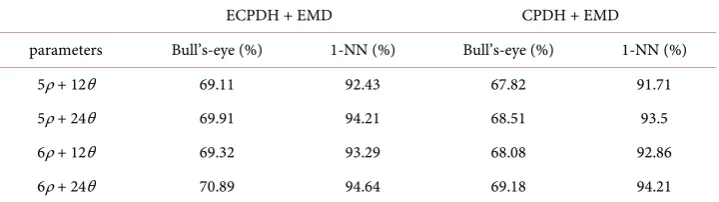
is selected as 24, ECPDH + DP get the average bull’s-eye test with 72.81% and recognition rate with 95.5.Table 4 shows the comparison of the average bull’s-eye score and the recognition rate between ECPDH + EMD and ECPDH + DP. It is clear from the Table 4, when the ECPDH is used for describing the shape, DP algorithm can obtain better retrieval per-formance than the EMD algorithm.
Table 5 shows the comparison of the average bull’s-eye score and the recognition rate between CPDH + DP and ECPDH + DP. As it is shown in the Table 4, the pro-posed ECPDH outperforms the CPDH for both retrieval and recognition rate perfor-mances.
Table 6 shows the comparison of the average bull’s-eye score and the recognition rate between ECPDH + EMD and CPDH + EMD. As it is shown in the Table 5, the proposed ECPDH outperforms the CPDH for both retrieval and recognition rate per-formances again. From Table 5 and Table 6, it is obviously that our proposed ECPDH is more effective than CPDH.
Figure 9. Comparison of PVR Curves for different parameters (MPEG-7 shape database).
CPDH + EMD ECPDH + DP
parameters Bull’s-eye (%) 1-NN (%) Bull’s-eye (%) 1-NN (%)
5ρ + 12θ 67.82 91.71 69.22 93.07
5ρ + 24θ 68.51 93.5 72.81 95.50
6ρ + 12θ 68.08 92.86 68.74 92.86
[image:11.595.191.555.102.205.2]6ρ + 24θ 69.18 94.21 72.53 94.86
Table 4. Comparison of average bull’s-eye score and recognition rate between ECPDH + EMD
and ECPDH + DP.
ECPDH + EMD ECPDH + DP
parameters Bull’s-eye (%) 1-NN (%) Bull’s-eye (%) 1-NN (%)
5ρ + 12θ 69.11 92.43 69.22 93.07
5ρ + 24θ 69.91 94.21 72.81 95.50
6ρ + 12θ 69.32 93.29 68.74 92.86
[image:11.595.191.554.251.352.2]6ρ + 24θ 70.89 94.64 72.53 94.86
Table 5. Comparison of average bull’s-eye score and recognition rate between CPDH + DP and
ECPDH + DP.
CPDH + DP ECPDH + DP
parameters Bull’s-eye (%) 1-NN (%) Bull’s-eye (%) 1-NN (%)
5ρ + 12θ 66.02 91.5 69.22 93.07
5ρ + 24θ 69.44 93.86 72.81 95.50
6ρ + 12θ 65.79 92.07 68.74 92.86
6ρ + 24θ 68.92 94.00 72.53 94.86
Table 6. Comparison of average bull’s-eye score and recognition rate between ECPDH + EMD
and CPDH + DP.
ECPDH + EMD CPDH + EMD
parameters Bull’s-eye (%) 1-NN (%) Bull’s-eye (%) 1-NN (%)
5ρ + 12θ 69.11 92.43 67.82 91.71
5ρ + 24θ 69.91 94.21 68.51 93.5
6ρ + 12θ 69.32 93.29 68.08 92.86
6ρ + 24θ 70.89 94.64 69.18 94.21
[image:11.595.193.554.397.501.2] [image:11.595.194.554.547.648.2]Table 7. Rotation and mirror invariant retrieval results using ECPDH + DP.
[image:12.595.44.553.235.711.2]Query shape 1 2 3 4 5 6 7 8 9 10
Table 8. Rotation and mirror invariant retrieval results using CPDH + DP.
Query shape 1 2 3 4 5 6 7 8 9 10
Table 7 shows the retrieval illustrations of ECPDH+DP. The left column of the Ta-ble 7 lists the 10 benchmark images which are used as query images. All of the front 10 retrieved images, ranked by the distance (similarity) between them and the query im-age, belong to the same category as the query image. That is to say ECPDH + DP has robust performance of invariance to rotation and mirror.
[image:13.595.36.552.88.396.2]Table 8 lists the retrieval results of CPDH + DP. The left Colum of the Table 8 lists the 10 benchmark images which are used as query images as well. Compared with the results in Table 7, there are 8 shapes, with blue background color in the table, which have the different category with the query kinds in all the front 10 retrieved images. From the retrieval results, it is easy to conclude that the ECPDH + DP has the stronger ability of invariant to rotation and mirror than that of CPDH + DP.
Table 9 lists the retrieval results of CPDH + EMD. The left column of the Table 9 lists the 10 benchmark images which are used as query images as well. Compared with the results in Table 7, there are also 8 images, with blue background color in the table, which have the different category with the query kinds in all the front 10 retrieved im-ages. We can easily draw conclusion that the ECPDH + DP is prior to CPDH + DP in term of invariance to rotation and mirror too.
4. Conclusion
retrieval, which use concentric minimum inscribing ellipse to describing 2D shape. The idea is intuitive and very simple. The proposed ECPDH not only satisfies the human’s visual perception and easy to be implemented, but also it naturally has the attributes of invariant to scaling, translation and rotation. Compared with CPDH, ECPDH can more precisely describe the distribution of object contour points. Embedding the information of the main direction of object is also one of its merits. The authors also suggest using the DP algorithm to measure the distance between ECPDHs. Compared with the EMD algorithm, the time cost is reduced obviously. Several kinds of experiments on MPEG7 shape dataset indicate that our proposed approach achieves favorable results when used for 2D shape image retrieval. The shortage of ECPDH is that it can only describing 2D objects with a single closed contour. This decreases its potential. Extending ECPDH being applied in 3D model description and matching is a promising research direction.
Acknowledgements
The authors would like to thank the anonymous reviewers for their beneficial and con-structive advices. This work is supported by National Natural Science Foundation of China (Grant No. 61471182), Natural Science Foundation of Jiangsu Province of China (Grant No. BK20130473), Postdoctoral Scientific Research Foundation of Jiangsu province (Grant No.1402068C).
References
[1] Dryden, I.L. and Mardia, K.V. (1998) Statistical Shape Analysis. Wiley, New York.
[2] Loncaric, S. (1998) A Survey of Shape Analysis Techniques. Pattern Recognition, 31, 983- 1001. https://doi.org/10.1016/S0031-2023(97)00122-2
[3] Veltkamp, R.C. and Hagedoorn, M. (1999) State of the Art in Shape Matching. Utrecht University, The Netherlands, Tech. Rep. UU-CS-1999-27.
[4] Zhang, D.S. and Lu, G.J. (2004) Review of Shape Representation and Description Tech-niques. Pattern Recognition, 37, 1-19. https://doi.org/10.1016/j.patcog.2003.07.008
[5] Hu, M.K. (1962) Visual Pattern Recognition by Moment Invariants. IEEE Transactions on Information Theory, 8, 179-187. https://doi.org/10.1109/TIT.1962.1057692
[6] Kan, C. and Srinath, M.D. (2002) Invariant Character Recognition with Zernike and Or-thogonal Fourier-Mellin Moments. Pattern Recognition, 35, 143-154.
https://doi.org/10.1016/S0031-3203(00)00179-5
[7] Zhang, D.S. and Lu, G.J. (2002) Shape-Based Image Retrieval Using Generic Fourier De-scriptor. Signal Processing: Image Communication, 17, 825-848.
https://doi.org/10.1016/S0923-5965(02)00084-X
[8] Tabbone, S., Wendling, L. and Salmon, J.P. (2006) A New Shape Descriptor Defined on the Radon Transform. Computer Vision and Image Understanding, 102, 42-51.
[9] Chen, Y.W. and Chen, Y.Q. (2008) Invariant Description and Retrieval of Planar Shapes Using Radon Composite Features. IEEE Transaction on Signal Processing, 56, 4762-4771.
https://doi.org/10.1109/TSP.2008.926692
[10] Xu, C.J., Liu, J.Z. and Tang, X. (2009) 2D Shape Matching by Contour Flexibility, IEEE Trans. Pattern Analysis and Machine Intelligence, 31, 180-186.
Representation, 14, 39-57. https://doi.org/10.1016/S1047-3203(03)00003-8
[12] Abbasi, S., Mokhtarian, F. and Kittler, J. (1999) Curvature Scale Space Image in Shape Si-milarity Retrieval. Multimedia Systems, 7, 467-476. https://doi.org/10.1007/s005300050147
[13] Belongie, S., Malik, J. and Puzicha, J. (2002) Shape Matching and Object Recognition Using Shape Contexts. IEEE Transactions on Pattern Analysis and Machine Intelligence, 24, 509- 522. https://doi.org/10.1109/34.993558
[14] Ling, H.B. and Jacobs, D.W. (2007) Shape Classification Using the Inner-Distance. IEEE Transactions on Pattern Analysis and Machine Intelligence, 29, 286-299.
https://doi.org/10.1109/TPAMI.2007.41
[15] Grigorescu, C. and Petkov, N. (2003) Distance Sets for Shape Filters and Shape Recogni-tion. IEEE Transactions on Image Processing, 12, 1274-1286.
https://doi.org/10.1109/TIP.2003.816010
[16] Sebastian, T.B., Klein, P.N. and Kimia, B.B. (2003) On Aligning Curves. IEEE Transactions on Pattern Analysis and Machine Intelligence, 25, 116-125.
https://doi.org/10.1109/TPAMI.2003.1159951
[17] Wang, J., Bai, X., You, X., Liu, W. and Latecki, L.J. (2012) Shape Matching and Classifica-tion Using Height FuncClassifica-tions. Pattern Recognition Letters, 33, 134-143.
https://doi.org/10.1016/j.patrec.2011.09.042
[18] De Oliveira, A.B., da Silva, P.R. and Barone, D.A.C. (2015) A Novel 2D Shape Signature Method Based on Complex Network Spectrum. Pattern Recognition Letters, 63, 43-49.
https://doi.org/10.1016/j.patrec.2015.05.018
[19] Janan, F. and Brady, M. (2015) Shape Description and Matching Using Integral Invariants on Eccentricity Transformed Images. International Journal of Computer Vision, 113, 92- 112. https://doi.org/10.1007/s11263-014-0773-x
[20] Shu, X. and Wu, X.J. (2011) A Novel Contour Descriptor for 2D Shape Matching and Its Application to Image Retrieval. Image and Vision Computing, 29, 286-294.
https://doi.org/10.1016/j.imavis.2010.11.001
[21] Khachiyan, L.G. (1996) Rounding of Polytopes in the Real Number Model of Computation. Mathematics of Operations Research, 21, 307-320. https://doi.org/10.1287/moor.21.2.307
[22] Todd, M.J. and Yildirim, E.A. (2007) On Khachiyan’s Algorithm for the Computation of Minimum-Volume Enclosing Ellipsoids. Discrete Applied Mathematics, 155, 1731-1744.
https://doi.org/10.1016/j.dam.2007.02.013
[23] Alajlan, N., Kamel, M.S. and Freeman, G. (2006) Multi-Object Image Retrieval Based on Shape and Topology. Signal Processing: Image Communication, 21, 904-918.
https://doi.org/10.1016/j.image.2006.09.002
[24] Alajlan, N., Elrube, I. and Kamel, M.S. (2007) Shape Retrieval Using Triangle-Area Repre-sentation and Dynamic Space Warping. Pattern Recognition, 40, 1911-1920.
https://doi.org/10.1016/j.patcog.2006.12.005
[25] Adamek, T. and O’Connor, N.E. (2004) A Multiscale Representation Method for Nonrigid Shapes with a Single Closed Contour. IEEE Transactions on Circuits and Systems for Video Technology, 14, 742-753. https://doi.org/10.1109/TCSVT.2004.826776
[26] Milios, E. and Petrakis, E.G.M. (2002) Shape Retrieval Based on Dynamic Programming. IEEE Transaction Image Processing, 9, 1057-7149.
July 2001, 755-762.
[28] Bernier, T. and Landry, J.A. (2003) A New Method for Representing and Matching Shapes of Natural Objects. Pattern Recognition, 36, 1711-1723.
https://doi.org/10.1016/S0031-3203(02)00352-7
[29] Latecki, L.J., Lakamper, R. and Eckhardt, U. (2000) Shape Descriptors for Non-Rigid Shapes with a Single Closed Contour. IEEE Conference on Computer Vision and Pattern Recognition (CVPR), Hilton Head Island, 15 June 2000, 424-429.
https://doi.org/10.1109/cvpr.2000.855850
Submit or recommend next manuscript to SCIRP and we will provide best service for you:
Accepting pre-submission inquiries through Email, Facebook, LinkedIn, Twitter, etc. A wide selection of journals (inclusive of 9 subjects, more than 200 journals)
Providing 24-hour high-quality service User-friendly online submission system Fair and swift peer-review system
Efficient typesetting and proofreading procedure
Display of the result of downloads and visits, as well as the number of cited articles Maximum dissemination of your research work