Isolation and Characterization of
R-Enantiomer in Ezetimibe
Kameswararao Chimalakonda*, Venugopal Kamani, Madhusudhan Gutta, Srinivasulu Polisetty, Sai Venkata Srinivas Koduri
Inogent laboratories Pvt Ltd., IDA-Nacharam, Jawaharlal Nehru Technological University Hyderabad, Hyderabad, India Email: *[email protected]
Received June 22, 2013; revised July 22, 2013; accepted August 28, 2013
Copyright © 2013 Kameswararao Chimalakonda et al. This is an open access article distributed under the Creative Commons Attri-bution License, which permits unrestricted use, distriAttri-bution, and reproduction in any medium, provided the original work is properly cited.
ABSTRACT
A simple and rapid Supercritical Fluid Chromatography (SFC) method has been developed to isolate and characterize R-Isomer of Ezetimi be by using normal phase Chiral Cel OD-H with 250 mm × 30 mm, 5 microns column using a mo-bile phase system containing super critical fluid carbondi oxide (Co2) and the percentage of 2-Propanol as a momo-bile phase (85:15) and detection at 230 nm. The isolated R-Isomer is characterized by using UV-vis, FT-IR, ESI-MS, HPLC1H and 13C NMR. The purity of isolated R-Isomer is about 98%.
Keywords: Isolation; Characterization; (R)-Isomer; Ezetimibe; Supercritical Fluid Hromatography (SFC)
1. Introduction
Introduction: Enantiomers of racemic drugs often show different behaviors in pharmacological action and meta-bolic process. It is not uncommon for one enantiomer to be active while other is toxic in biological systems. The pharmaceutical industry has raised its emphasis on the generation of enantiomerically pure compounds before undertaking phamarmacokinetic, metabolic, physiologi-cal, and toxicological evaluation in the search for drugs with greater therapeutic benefits and lower toxicity [1,2]. Nowadays, chiral separations are playing a more and more important role for the analysis of single enanti-omers in the field of pharmaceutical industry [3]. How-ever, the development of the methods for the quantitative analysis of Chiral compounds and for the assessment of enantiomeric purity is extremely challenging, because the same physical and chemical properties of the two enan-tiomers make discriminating and separating them very difficult [4].
Ezetimibe, a selective inhibitor of intestinal cholesterol and related phytosterol absorption, is designated as 1-(4-fluorophenyl)-3(R)-[3-(4-fluorophenyl)-3(S)-hydro- xypropyl]-4(S)-(4-hydroxyphenyl)-2-azetidinone. Ezetimi- be selectively prevents the absorption of cholesterol from dietary and capillary sources by blocking the transport of
cholesterol through the intestinal wall. This reduces the overall delivery of cholesterol to the liver, thereby pro-moting the synthesis of LDL receptors and the subse-quent reduction in serum LDL-C [5,6]. Few HPLC methods for the determination of Ezetimibe were re- ported in literatures [7,8]. The (R)-enantiomer is the un- desired enantiomer, which can be present as a chiral im-purity without any pharmacological and toxicological reports by now. So it is essential to find an effective way to analyze the enantiomers of Ezetimibe, the chemical structure of Ezetimibe is shown in Figure 1 , the
chemi-cal structures of (R)-enantiomer is shown in Figure 2
and (R)-enantiomer Ezetimibe may be at low level for little (R)-Ezetimibe exists in starting material or racemi-zation in synthesis.
Here, the direct enantioseparation of the undesired enantiomer from an active pharmaceutical ingredient, Ezetimibe, is isolated by Supercritical fluid chromatog-raphy (SFC) using modified cellulose as chiral stationery phases. The aim of this work was to isolate, and charac- terize and optimized the chromatographic conditions in terms of mobile phase composition in order to separate and identify the enantiomers of Ezetimibe. The deve- loped SFC method was used for isolation of (R)-enan- tiomer in Ezetimibe.
Supercritical Fluid Chromatography (SFC) is a form of normal phase chromatography that is used for the analy
489
Figure 1. (3R,4S)-1-(4-fluorophenyl)-3-[(3S)-3-(4-fluoroph-enyl)-3- hydroxypropyl]-4-(4-hydroxyphenyl) azetidin-2-one.
Figure 2. (3R,4S)-1-(4-fluorophenyl)-3-((3R)-3-(4-fluorophenyl)-3- hydroxypropyl)-4-(4-hydroxyphenyl)azetidin-2-one.
sis and purification of moderate molecular weight, ther-mally labile molecules. It can also be used for the separa-tion of chiral compounds. The principles are similar to those of high performance liquid chromatography (HPLC) [9]; however, SFC typically utilizes carbon di-oxide as the mobile phase; therefore, the entire chroma-tographic flow path must be pressurized.
Supercritical Fluid Chromatography (SFC) is found to be useful in industry primarily for the separation of chiral molecules, and the same columns are used as standard HPLC systems. SFC is now commonly used for achiral separations and purifications in the pharmaceutical in-dustry.
The mobile phase is composed of high pressure liquid or supercritical carbon dioxide, however, modifiers are added which can be used to change the chromatography, these are typically alcohols like methanol, ethanol or isopropyl alcohol. Other solvents such as Acetonitrile and chloroform can be used as modifiers. The solvent limitations are system- and column-based.
Here, the direct enantioseparation of the undesired enantiomer from an active pharmaceutical ingredient, Ezetimibe, is isolated by Supercritical fluid chromatog-raphy (SFC) using modified cellulose as chiral stationery phases. The aim of this work was to isolate and charac-terize. Optimized the chromatographic conditions in terms of mobile phase composition in order to separate and identify the enantiomers of Ezetimibe, the developed SFC method was used for isolation of (R)-enantiomer in Ezetimibe.
2. Experimental
Chemicals and reagents Ezetimibe racemic mixture (±) was obtained from the R&D department of Inogent La- boratory (Hyderabad, India). Chemical structure is pre- sented in Figure 1. HPLC grade 2-Propanal was pur-
chased from Merck (Mumbai, India) CO2, with a purity
of 99.9% was purchased from MRGenterprises (Hydera-bad, India). HPLC grade n-Hexane, 2-Propanal, Trifluor- oaceticacid and Ethanol was purchased from Merck (Mumbai, India).
2.1. Isolation by Supercritical Fluid Chromatography (SFC)
The isolation of R-enantiomer in Ezetimibe by using SFC 200 System in large Scale. The Chromatographic conditions are the total flow was 100 g/min; the % of solvent was 15% isopropanol and the Supercritical fluid is 85%. The Automatic back pressure Regulator main-tained at 180, the preparative column was Chiral Cel OD-H (250 × 30 mm), 5 microns. The output signal was monitored by using Gilson detector.
2.2. Sample Preparation
Ezetimibe racemic mixture (±) was prepared with 10 mg/ mL dissolving appropriate amount of the substance in di- luent and injected. Collected the R-Isomer fraction and di- stilled and characterize by using spectroscopy techniques.
2.3. Characterization of R-Isomer
2.3.1. UV-Vis Spectroscopy
UV-Visible spectrum was recorded by diluting sample in methanol in UV-2450 Perkin Elmer spectrophotometer.
2.3.2. FT-IR Spectroscopy
The FT-IR Spectroscopy was recorded in the solid state as KBr dispersion using Thermo Nicolet 380 FT-IR Spectrophotometer.
2.3.3. Mass Spectroscopy
Electrospray ionization mass spectroscopy was per-formed using a triple quadrupole mass spectrometer. The positive and negative Electrospray MS data was obtained by switching the capillary voltage between +5000 V and
−4500 V, respectively.
2.3.4. NMR Spectroscopy
The NMR experiments were performed on Varian 400 MHz. The 1H and 13C chemical shift values were re-
ported on the K scale in ppm.
2.4. High Performance Liquid Chromatography
[image:2.595.114.230.86.154.2] [image:2.595.108.235.197.264.2]Trifloroacetic acid (84:12:4:0.1 v/v). Detection was car-ried out at 230 nm and the flow rate 1.0 mL/min.
lectivity for the two enantiomers. There was an indica-tion of separaindica-tion on Chiralcel OD-H (250 × 4.6 mm, 5 tiomers. There was mobile phase consisting of upper critical carbon dioxide and 2-Propanol. The composition of the mobile phase was optimized to enhance the chro-matographic efficiency and resolution between the enan-tiomers. The results of resolution factor (Rs) and selec-tivity factor (N) are summarized in Table 1. Based on the
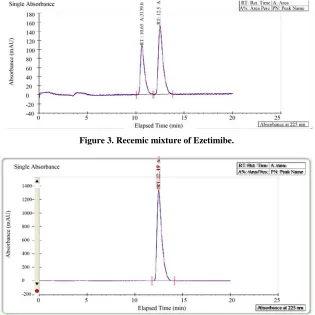
data obtained from the method development and optimi-zation activities, Chiralcel OD-H (250X4.6mm, 5µm) column. The phase of Supercritical carbon dioxide and 2-Propanol (85:15%) was selected for the method devel-opment. The phase of Supercritical carbon dioxide and 2-Propanol (85:15%) was selected for the method devel-opment. The flow rate of the final method was 2.0 mL/min with injection volume 20 devel column tem-perature was 25˚C, and the detection wavelength was 230 nm. Under these conditions, the two enantiomers were separated well and the peak of (R)-enantiomer eluted be- fore the peak of Ezetimibe. In the optimized method, the typical retention time of Ezetimibe and (R)-enantiomer were 5.31, 6.27 min, respectively. Base line separation of Ezetimibe and (R)-enantiomer was obtained with total run time of 20 min. The separation of an approximately 1:1 (wt/wt) mixture solution (in ethanol) of the two enan-
3. Results and Discussion
Isolation by Supercritical Fluid Chromatography (SFC) Racemic mixture solution of Ezetimibe and (R)-enanti- omer (10e solution of prepared in ethanol was used in the method development. To develop a rugged and suitable SFC method for the separation of the two enantiomers, different stationary phases and mobile phases were em-ployed. Initial screening of chiral column was carried out by several chiral column suppliers. Various chiral col-umns, namely Chiralpak AD-H (250 × 4.6 mm), chiralcel IA (250 × 4.6 mm), chiralcel AS-H (250 × 4.6 mm) of Daicel were employed. All these columns failed to pro-vide selectivity between Ezetimibe peak and the unde-sired enantiomer peak using different possible mobile phases. In the following method development activities, Chiralcel OD-H column (250 × 4.6 mm, 5 Mm) with mobile phase consisting of Supercritical Carbon dioxide and methanol was used, but all that was obtained was a defective separation of two enantiomers with a very low resolution.
[image:3.595.141.456.403.718.2]It was continued to select the best stationary and mo-bile phases that would give optimum resolution and se-
[image:3.595.150.455.404.531.2]Figure 3. Recemic mixture of Ezetimibe.
491
tiomers is shown in Figure 3. Ezetimibe peak confirmed
with by injecting individually is shown as Figure 4.
Cellulose based chiral stationary phase contained five chiral centers per unit, and Ezetimibe has only one chiral centre close to the carbonyl group in the structure. The stereo electronic interaction between the enantiomers and the chiral stationary phase generated enantio selectivity, thus causing significant difference in the migration of the enantiomers inside the column. Having the right amount of 2-Propanol in the mobile phase also played an impor- tant role in affecting the steric environment of the chiral cavities or channels of the stationary phase and contribu- tes to enantio selectivity. However, an excessive amount of 2-Propanol was likely to cut down the resolution by taking up chiral centers of the chiral stationary phase or forming hydrogen bonding with enantiomers instead of the hydrogen bonding between the enantiomers and the stationary phase. Other important interaction between the enantiomers and the stationary phase, such as π-π bond-ing Vander walls forces, dipole induced dipole attrac-tions, and steric effects can also achieve better resolution on chiralcel OD-H column and steric effects can also achieve better resolution on chiralcel OD-H column.
3.1. Characterization of R-Isomer by UV-Visible Spectroscopy
The UV-Visible spectrum was recorded by diluting
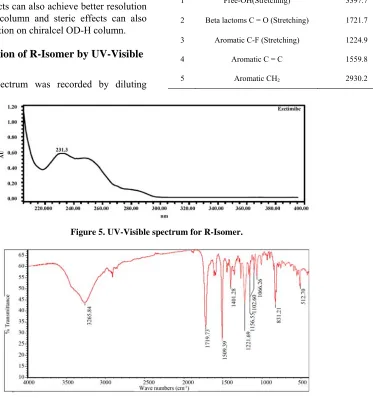
R-Isomer by using 10 ppm solution in methanol. Solution was scanned 200 - 400 nm against methanol as blank and recorded the UV-visible spectrum for R-Isomer spectrum is shown in Figure 5.
3.1.1. FT-IR Spectroscopy
Dispersed about 2 mg of R-Isomer in 300 - 400 mg of KBr, grind the mixre, spread uniformly on a die and compress in to a thick disk by applying pressure about 800 Mpa. Kept the pellet in KBr folder in FT-IR spec-trophotometer and scanned the spectrum from 4000 cm−1
to 450 cm−1.
Noted the wavelengths and it’s the spectrum from 4000 cm−1 to 450 cm−1 and shown at
Figure 6.
Func-tional groups are listed in Table 1.
Table 1. Functional groups from FT-IR spectrum.
S.No Assignment Wave number (cm−1)
1 Free-OH(Stretching) 3397.7
2 Beta lactoms C = O (Stretching) 1721.7
3 Aromatic C-F (Stretching) 1224.9
4 Aromatic C = C 1559.8
[image:4.595.141.514.327.727.2]5 Aromatic CH2 2930.2
Figure 5. UV-Visible spectrum for R-Isomer.
3.1.2. Mass Spectroscopy
Analyzed the R-Isomer by using Mass spectroscopy and observed the mass number (m/z) for R-Isomer and it’s
confirming the mass number of R-Isomer is 409 (m/z:
negative mode: 408), as shown in Figure 7.
3.1.3. NMR Spectroscopy
R-Isomer sample analyzed 1H NMR and 13C NMR using
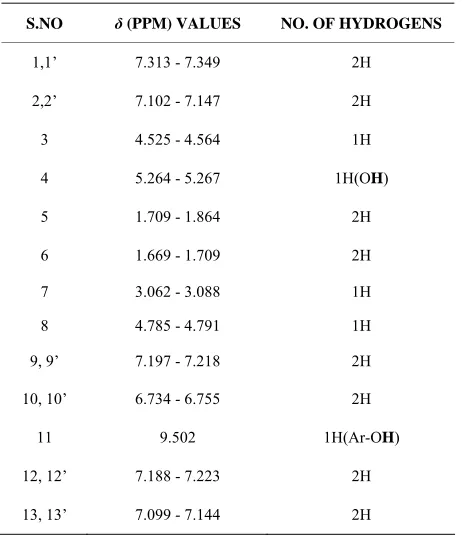
Varian 400 MHz. The no. of protons and no. of carbons confirms the structure of R-Isomer. The reported 1H
NMR spectrum was shown Figure 6. The reported 13C
NMR spectrum was shown Figure 8. 1H NMR and Fig-ure 9: 13C NMR. 1H NMR and 13C NMR K values are
listed Tables 2 and 3.
3.2. High Performance Liquid Chromatography
A validated LC method was used for Identification and
quantification of R-Isomer of Ezetimibe. Waters e2695 with 2998 PDA detector with Empower-2 software was used. The chromatographic conditions were Chiral Cel AS-H (250 × 4.6 mm, 5 microns was used. The chroma- tographic conditions were Chiral Cel AS-ethanol, 2- Propanol and Trifloroacetic acid (84:12:4:0.1 v/v). De- tection was carried out at 230 nm and the flow rate 1.0 mL/min.
Both Ezetimibe and Isolated R-Isomer ware prepared in diluent and injected individually and as co-injection. R-Isomer Retention time was confirmed by injected re-cemic mixture.Rere-cemic mixture shown as Figure 10,
Isolated R-Isomer shown as Figure 11 and Ezetimibe
shown as Figure 12.
4. Conclusion
[image:5.595.140.454.306.491.2]The research paper describes the isolation and charac-
Figure 7. Mass spectrum (m/z) for R-Isomer.
[image:5.595.143.460.519.720.2]493
[image:6.595.121.473.324.714.2]Figure 9. 13C NMR spectrum for R-Isomer.
Figure 10. R-Isomer and ezetimibe (1:1).
Figure 12. Ezetimibe.
Table 2. 1H NMR δvalues (ppm). Table 3. 13C NMR δ values (ppm).
S.NO δ (PPM) VALUES NO. OF HYDROGENS
1,1’ 7.313 - 7.349 2H
2,2’ 7.102 - 7.147 2H
3 4.525 - 4.564 1H
4 5.264 - 5.267 1H(OH)
5 1.709 - 1.864 2H
6 1.669 - 1.709 2H
7 3.062 - 3.088 1H
8 4.785 - 4.791 1H
9, 9’ 7.197 - 7.218 2H
10, 10’ 6.734 - 6.755 2H
11 9.502 1H(Ar-OH)
12, 12’ 7.188 - 7.223 2H
13, 13’ 7.099 - 7.144 2H
S.NO δ (PPM )VALUES
1,1’ 127.532 - 127.608
2,2’ 115.683 - 115.911
3 71.136
5 36.403
6 24.540
7 59.546
8 59.804
9,9’ 127.554
10,10’ 115.706
12,12’ 118.188 - 118.264
13,13’ 114.545 - 114.757
14 159.843 - 162.242
15 133.983 - 133.999
16 127.843
17 157.430
18 142.075 - 142.105
19 156.815 - 156.206
20 167.305
terization of R-Isomer of Ezetimibe by using Supercriti-cal Fluid Chromatography (SFC). The R-isomer was isolated by using Supercritical Fluid Chromatography (SFC) with Chiralcel OD-H (250 × 4.6 mm, 5D-H col- umn using a mobile phase consisting of Supercritical carbon dioxide and 2-Propanol (85:15). The isolated R-Isomer was characterized by using UV-Visible spec-troscopy, FT-IR, Mass number (m/z) m, 1 H NMR, 13 C
NMR and by Chiral HPLC analysis.
5. Acknowledgements
[image:7.595.305.538.348.667.2]495
REFERENCES
[1] H. Caner, E. Groner, L. Levy and I. Agranat, “Trends in the Development of Chiral Drugs,” Drug Discovery To-day, Vol. 9, No. 3, 2004, pp. 105-110.
doi:10.1016/S1359-6446(03)02904-0
[2] J. Caldwell, “Importance of Stereospecific Bionalytical Monitoring in Drug Development,” Journal of Chroma-tography A, Vol. 719, No. 1, 1996, pp. 3-13.
doi:10.1016/0021-9673(95)00465-3
[3] N. M. Maier, P. Franco and W. Lindner, “Separation of Enantiomers: Needs Challenges, Perspectives,” Journal of Chromatography A, Vol. 906, No. 3, 2001, pp. 3-33.
doi:10.1016/S0021-9673(00)00532-X
[4] T. E. Beesley and R. P. W. Scott, “Chiral Chromatogra-phy,” John Wiley & Sons, Ltd., New York, 1998, pp. 23-26.
[5] E. Leitersdorf, “Selective Cholesterol Absorption Inhibi-tion: A Novel Strategy in Lipid-Lowering Management,”
International Journal of Clinical Practice, Vol. 56, No. 2,
2002, pp. 116-119.
[6] M. Von Heek, C. Farley and D. S. Compton, “Ezetimibe
Selectively Inhibits Intestinal Cholesterol Absorption in Rodents in Presence and Absence of Exocrine Pancreatic Function,” British Journal of Pharmacology, Vol. 134,
No. 2, 2001, pp. 409-417.
[7] S. Singh, B. Singh, R. Bahuguna, L. Wadhwa and R. Saxena, “Stress Degradation Studies on Ezetimibe and Development of a Validated Stability-Indicating HPLC Assay,” Journal of Pharmaceutical and Biomedical Analysis, Vol. 41, No. 3, 2006, pp. 1037-1040.
doi:10.1016/j.jpba.2006.01.030
[8] R. Sistla, V. S. Tata, Y. V. Kashyap, D. Chandrasekar and P. V. Diwan, “Development and Validation of a Re-versed-Phase HPLC Method for the Determination of Ezetimibe in Pharmaceutical Dosage Forms,” Journal of Pharmaceutical and Biomedical Analysis, Vol. 39, No.
3-4, 2005, pp. 517-522.
doi:10.1016/j.jpba.2005.04.026
[9] T. L. Chester, “The Role of Supercritical Fluid Chroma-tography in Analytical Chemistry,” Journal of Chroma-tographic Science, Vol. 24, No. 6, 1986, pp. 226-229.
![Figure 1. (3R,4S)-1-(4-fluorophenyl)-3-[(3S)-3-(4-fluoroph-enyl)-3- hydroxypropyl]-4-(4-hydroxyphenyl) azetidin-2-one](https://thumb-us.123doks.com/thumbv2/123dok_us/7851703.735651/2.595.108.235.197.264/figure-fluorophenyl-fluoroph-enyl-hydroxypropyl-hydroxyphenyl-azetidin-one.webp)