ISSN Online: 2159-4481 ISSN Print: 2159-4465
Three-Dimensional Scenes Restore
Using Digital Image
Takialddin Al Smadi
1, Igried Al-Khawaldeh
1,2, Kalid Al Smadi
31Department of Communications and Electronics Engineering, College of Engineering, Jerash University, Jerash, Jordan
2College of Engineering Technology, Al-Balqa Applied University, Salt, Jordan
3Jordanian Sudanese Colleges for Science & Technology, Khartoum, Sudan
Abstract
Encryption and decryption method of three-dimensional objects uses holo-grams computer-generated and suggests encoding stage. Information ob-tained amplitude and phase of a three-dimensional object using mathemati-cally stage transforms overlap stored on a digital computer. Different three- dimensional images restore and develop the system for the expansion of the three-dimensional scenes and camera movement parameters. This article talks about these kinds of digital image processing algorithms as the reconstruction of three-dimensional model of the scene. In the present state, many such algo-rithms need to be improved in this paper proposing one of the options to im-prove the accuracy of such reconstruction.
Keywords
Three-Dimensional Scenes Restore Factorization Method, Triangulation, VRML Model, Hybrid Algorithm
1. Introduction
Digital photo is a configurable performance fitting with the soundtracks of computers in which the division of the image to the minute network of image consists of a set of integers, often referred to. Pixels picture elements, or pixels preparation. Digital photo consisting of many thousands or millions of these pixels apparently is having a picture and sound. Each pixel represents a value of 255) can be explained by studying how-0 (dark black) to 255 (bright white), over the Values (0) Handle computers with numbers as the computers [1].
Work directly in numerical binary system which is the most the effectiveness of the use of ranges is compatible with the capabilities of number 2. Numbers in
How to cite this paper: Al Smadi, T., Al- Khawaldeh, I. and Al Smadi, K. (2017) Three- Dimensional Scenes Restore Using Digital Image. Journal of Signal and Information Processing, 8, 1-8.
https://doi.org/10.4236/jsip.2017.81001
Received: March 30, 2016 Accepted: January 16, 2017 Published: January 19, 2017
Copyright © 2017 by authors and Scientific Research Publishing Inc. This work is licensed under the Creative Commons Attribution International License (CC BY 4.0).
the range (0 to 255) can be absorbed by 1 byte, which consists of eight binary di-gits, or bits. A value of 8-bit value can store 28 or 256 value [2].
It may be necessary because of the contrast in the landscape lighting engi-neering and supply, weather conditions, and the noise the sensor and response. Each of these varies depending on the sensor selected and the platform used for data and conditions during data acquisition. Also, it may be desirable to convert and calibration data to a known radiation units or units of reflectance (absolute) to facilitate the comparison of data [3].
Context and Aims
Visual and data security encryption and key issues in optical communication systems for data storage and transfer of data protection from unauthorized access compared to traditional security systems, optical and security essentially provides two types of benefits. First, the parallel data which are more suitable for image encryption and rapid transmission of information. Second, treatment provides optics has been exploring the many degrees of freedom that the light beam may be encrypted, such as amplitude, phase, wavelength and polarization types. Different from the visual information security, different applications of information security visual verification systems, based on the optical link have been reported. These systems are connected to the two functions: First, lock, and always within the correlator; and the other is the key, the system by the user in the verification stage. The materials used, such as light scattering medium to hide the image data for the first phase of data protection, the use of this tech-nique to hide to protect data from unauthorized access. Digital imaging is used to log efficiency. A triple security dimensions that combine encryption with random phase tri-dimensional digital technology system has been proposed three- dimensional images by computer. This system provides information encryption 3D visually [4] [5].
Three-dimensional scenes restore using digital images is in demand and in-tensively develops all over the world [1]. Let us detach three the most typical tasks from the whole their complex:
1) Earth relief reconstruction using aerospace images for the needs of map-ping and industrial facilities and emergency monitoring.
2) Premises plan reconstruction using images received from digital cameras and cine cameras for the needs of architecture and industrial premises rearrange-ment and equiprearrange-ment.
3) Mobile robots’ vision systems.
spa-tial resolution of 15 m). Let us note that in case of high resolution survey (d = 1 - 10 m) for typical orbital altitude h = 1000 km it is necessary to know cameras orientation with accuracy of ~d/h = 10−5 - 10−6 rad., and satellite coordinates
with an accuracy of order d. Such accuracies are achievable in principle, but they lead to complicated and expensive system with considerable mass and volume characteristics. That is why approaches that allow restoring such parameters di-rectly from video data are of big interest.
The majority of systems described in the literature are based upon any single physical principle. In the meantime different approaches mutually complement each other and have different “bad cases”. In summary it seems appropriate to construct combined system using the combination of different algorithms of three-dimensional scenes restore with choice of algorithm optimal for certain scene and its different parts.
2. Method
As a foundation for the system there was chosen a group of algorithms based upon matrix factorization [2]. The following reasons became the ground for such choice:
1) The possibility of restore of scene form and cameras motions, orientation and focal distances.
2) The possibility of work with dynamic scenes. 3) The method high accuracy due to big survey bases. 4) Low computational complexity.
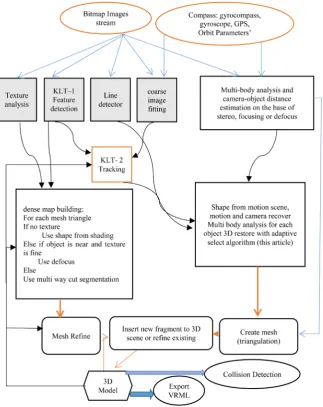
As a result of approaches application three-dimensional coordinates of some object points are obtained with high accuracy, and a surface in the form of net or mesh, cameras coordinates and orientation, and in the presence of near objects— camera focal distances may be constructed point wise [7] Algorithms structure opens possibilities for integration with other approaches and contiguous data in two ways.
For near objects initial distance estimation may be performed by methods of defocus or stereo [8], or antecedent data (GPS, gyroscopes, etc.) may be used, that gives information for approximation selection and accelerates repeatability
[9]. Coarse division of scene into areas of different remoteness may be per-formed, and for such areas the best approximation may be chosen. Usage of ste-reo or defocus with integrated camera allows detaching speedy objects and faci-litating their characteristic point tracking.
Figure 1. The flow chart of the system.
3. Points Detection and Tracking
The idea of tracking algorithm lies in the fact that at little differences of camera’s position and orientation the area in later image may be obtained by means of displacement of certain area of the previous image. Then the displacement may be found from functional minimizing.
Where is displacement vector, is a window function. By means of brightness function linearization the task solution reduce itself to iterative solution of linear system [1]: Algorithm [1] works with gray images. It is suggested to generalize approach [1] in the event of multichannel images, and in particular of color ones. It may be easily achieved by brightness’s in the functional to vectors whose components are corresponding to brightness’s in corresponding channels. Then the final equation is of the same form as equation but and, where and are calcu-lated independently from each channel as per formulas from [1].
Related Works
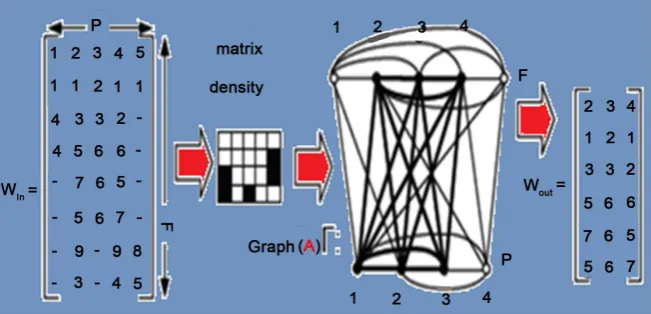
When points tracking along the series of images it is possible both to loss points and add new ones. However for three-dimensional scene restore algorithm the availability of all tracked points on all frames is necessary. Consequently there appears a task of separation of the largest completely filled matrix where rows are frames, and columns are tracked points.
We offer to solve this task by searching for cliques of graph. Graph g = {X, E} is constructed as follows. Its vertex set shall be all frames F and all tracked points P. Lines set E shall be set by two conditions. Subsets F and P are fully dependent sets. The line between vertexes and exists only in case if mark p presents in frame f (see Figure 2).
When singling out from the graph of overlapping cliques there is a possibility to restore separate scene parts with their subsequent clipping due to common points. This allows restoring the scene more completely because the algorithms require all tracked points to be seen on the frame that is by no means always practicable. To find the clique the [11] algorithm is used.
When singling out from the graph of overlapping cliques there is a possibility to restore separate scene parts with their subsequent clipping due to common points. This allows to restore the scene more completely because the algorithms
[2] [3] [4] require all tracked points to be seen on the frame that is by no means always practicable. To find the clique the [12] algorithm is used.
4. Three-Dimensional Scene Restore Algorithm
[image:5.595.211.537.547.704.2]Serial algorithms and iteration algorithm in geometrical projection are realized in the system. Let us point out that the algorithm on each iteration step uses scaled orthography approximation that theoretically allows breaking iteration loop and confining you to approximate solution. Since the iteration algorithm extracts additional data from perspective distortions, then in case of longer dis-tance to the object iterations do not lead to higher accuracy. The issue of itera-tion shutdown criterion comes under review in secitera-tion devoted to results.
5. Three-Dimensional Scene Construction in the Form
of Mesh, Export to VRML
The result of restore task solution is coordinates and cameras orientation, focal distances (in case of iteration algorithm usage) and three-dimensional coordi-nates of those object points that were detected and successfully tracked. Now we need to construct the object surface in the form of mesh due to these points. In reality the following approach is used. Since on every frame projection mutual arrangement of marks is always correct, and for the frame under number f two-dimensional coordinates of marks on this stage are available and are con-tained in matrix rows 2f + 1 and 2f + 2 (3), then the triangulation is performed in frame’s plane in two-dimensional space as per these points. Then obtained connections are formally applied to restore three-dimensional coordinates of corresponding points. Such approach allows to apply quick algorithm and ex-cludes the possibility of line joining of points from different surfaces (sides) of the object, e.g. during the object circular survey, because such points cannot be seen on the image simultaneously. The restored surface coordinates and camera directions may be exported into VRML format with strained textures 4-Related works.
Analysis
Provided algorithm tested on real and synthetic data. For synthetic data in the form of trihedral angle diagrams of comparative restoration accuracy in different approximations depending on ratio of object distance L to object size and are provided.
In Figure 3 and Figure 4, it can be seen that at short distances the method accuracy essentially exceeds the other ones. However with increase of distance different approximations accuracy becomes almost equal, and beginning with certain distance accuracy for method becomes comparable with or worse than for linear methods, It is connected with disappearance of perspective distortions in digital images. That is why the system must automatically switch to approxi-mation of scaled orthography or Para perspective method.
Criterion for switch in the system was chosen as per results of numerical modeling on synthetic data described above. Dimensionless parameter L/a has been taken for the basic analysis parameter. It is evident that the accuracy of restoration depends on other parameters as well:
− Camera angular resolution;
− Restorable object angular dimension;
− Maximum camera motion ratio to average object distance;
− Angle of camera’s rounding the object.
Numerical modeling results show that there is a small dependence of thre-shold value from these parameters, see In Figure 3 and Figure 4 real scenes re-store is presented.
Figure 3. Frame with highlighted characteristic points.
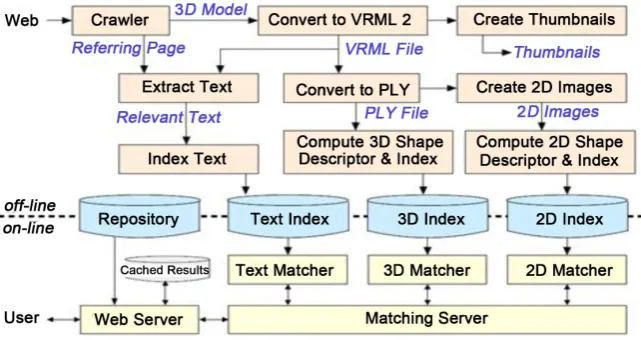
Figure 4. Flow of data through the search engine.
than once. Every downloaded 3D model goes through several preprocessing steps. We convert first to the VRML.
Our spherical harmonics method also can be indexed effectively. Figure 4
shows the average time (in seconds) required to find the 16 closest matches in databases of increasing size. Note that the search time grows sub linearly, and the total search time for a database of 17,500 models is less than 0.25 seconds.
6. Conclusions
Method is used to encrypt a 3D scene using random phase mask. Single and multiple phase masks are used as per sequence of digital images are developed. By means of numerical modeling, the criterion of computing (approximation) model adaptive selection was found. Restore accurate estimation was carried out. A new approach to dense measurements submatrix separation was suggested.
[image:7.595.214.535.270.440.2]between pairs of sequenced frames, and planned block of coarse integration is essential. In case of large distances, alternative way of forming disambiguation is necessary, that is based for example upon coarse knowledge of camera displace-ment between some pairs of frames.
Acknowledgements
This work was supported by the Deanship of Scientific Research, Jerash Univer-sity. The author Prof. Al-Khawaldeh Igriedis thankful to the AL-Balqa Applied University for their support and author Al smadi T. A to Jerash University by using their Laboratories and premises. We thank to reviewers for their valuable suggestions to enhance the quality of our article. This work has been carried out during sabbatical leave granted to the author Prof. Al-Khawaldeh Igriedfrom AL-Balqa Applied University (BAU) during the academic year 2015/2016.
References
[1] Al Smadi, T.A. and Maitah, M. (2013) An Efficiency and Algorithm Detection for Stenography in Digital Symbols. International Journal of Computer Network and Information Security, 6, 34.
[2] Nishchal, N.K. and Naughton, T.J. (2011) Flexible Optical Encryption with Multiple Users and Multiple Security Levels. Optics Communications, 284, 735-739. https://doi.org/10.1016/j.optcom.2010.09.065
[3] Cho, M. and Javidi, B. (2013) Three-Dimensional Photon Counting Double-Ran- dom-Phase Encryption. Optics Letters, 38, 3198-3201.
https://doi.org/10.1364/OL.38.003198
[4] Al Smadi, T., et al. (2015) Artificial Intelligence for Speech Recognition Based on Neural Networks. Journal of Signal and Information Processing, 6, 66.
[5] Rosenfeld, A. and Kak, A.C. (2014) Digital Picture Processing. Elsevier.
[6] Marks, R. (2007) System and Method for Providing a Real-Time Three-Dimen- sional Interactive en Reinhardt, Tilman, and Robert Seidl. Method and Apparatus for Image Assisted Modeling of Three-Dimensional Scenes. US Patent No. 7193633. [7] Cameron, C.D., Wilson, C.P. and De Braal, A. (Year) Three Dimensional Projection
Display. US Patent Application No. 11/947717.
[8] Fischler, M.A. and Firschein, O., Eds. (2014) Readings in Computer Vision: Issues, Problem, Principles, and Paradigms. Morgan Kaufmann.
[9] Medalia, M. (2007) Method of Generating a Three-Dimensional Interactive Tour of a Geographic Location. US Patent Application No. 11/782979.
[10] Spooner, D.A., Chan, S. and Simmons, C.L. (2014) Methodology for 3D Scene Re-construction from 2D Image Sequences. US Patent No. 8655052.
[11] Al Smadi, T. (2014) Real-Time Lane Detection for Driver Assistance System. Cir-cuits and Systems, 2014.
Submit or recommend next manuscript to SCIRP and we will provide best service for you:
Accepting pre-submission inquiries through Email, Facebook, LinkedIn, Twitter, etc. A wide selection of journals (inclusive of 9 subjects, more than 200 journals)
Providing 24-hour high-quality service User-friendly online submission system Fair and swift peer-review system
Efficient typesetting and proofreading procedure
Display of the result of downloads and visits, as well as the number of cited articles Maximum dissemination of your research work
Submit your manuscript at: http://papersubmission.scirp.org/