Adam Matthew Hart
A Constructivist Approach to Developing
Interactive Digital Technology for
Musical Learning
A thesis presented in partial fulfilment of the
requirements of the University of Salford for the degree
Doctor of Philosophy
School of Arts & Media
University of Salford, UK
i
Table of Contents
List of Figures vi
List of Tables xii
Acknowledgments xiii
Declaration xiv
Abstract xv
1. Introduction 1
1.1 About the Project 2
1.1.1 Overview 2
1.1.2 The Relevance of Constructivism 3
1.1.3 Validation and Dissemination 5
1.1.4 Limitations 6
1.1.5 Structure and Approach 8
1.1.6 Ethics 10
1.2 About the Researcher 10
1.2.1 Qualifications and Experience 10
1.2.2 Theoretical Orientations 11
2. Research Context 1: Constructivism & Creativity 13
2.1 What is Constructivism? 14
2.1.1 Overview 14
2.1.2 Emergence 14
2.1.3 Cognitive and Social Constructivism 16
2.1.4 Constructivism and Digital Technology 19
2.2 Constructivism and Music Education 22
2.2.1 Curriculum and Instruction 22
2.2.2 Musical Creativity in the Classroom 28
ii
2.3 Summary 39
3. Research Context 2: Environment & Interaction 42
3.1 Digital Technology in Creative Learning Environments 43
3.1.1 Visible Learning 43
3.1.2 Tangible (‘Hands-on’) Learning 45
3.1.3 Augmented Learning 48
3.2 Digital Technologies in the Music Classroom 49
3.2.1 Overview 49
3.2.2 Listening and Appraising 51
3.2.3 Performance 52
3.2.4 Composition 54
3.3 Learning from Games 56
3.3.1 Sandbox Games 56
3.3.2 Educational Applications 58
3.4 Summary 59
4. Methodology 63
4.1 Choosing a Methodology 64
4.1.1 Considerations 64
4.1.2 Software Development as Educational Research 65
4.1.3 Grounded Theory 67
4.1.4 Mixed Methodology 67
4.2 Research Tools 68
4.2.1 Programming Platform 68
4.2.2 Additional Software 69
4.2.3 Hardware 69
4.3 Research Model 70
4.3.1 Timeline 70
iii
5. Phase 1: Initial Design 78
5.1 Defining the Activity 79
5.1.1 Overview 79
5.1.2 Experiential Composition 79
5.1.3 Expected Outcomes 81
5.1.4 Domain Knowledge and Data Structures 82
5.2 Initial Development 84
5.2.1 Glossary 84
5.2.2 A Note on the Programming Process 85
5.2.3 Sequencing in GEM 86
5.2.4 ‘Painting’ Sound 87
5.2.5 Scale and Register 89
5.2.6 Dynamic Patching 89
5.2.7 Remote Communication 90
5.2.8 Designing Voices 91
5.2.9 Expanding the User Interface 92
5.2.10 Alternative Models 93
5.3 Summary 93
6. Phase 2: Development 96
6.1 Exhibition at University A, September 2015 97
6.1.1 Context 97
6.1.2 Method 98
6.1.3 Results 98
6.2 Exhibition at University B, November 2015 101
6.2.1 Context 101
6.2.2 Method 102
6.2.3 Results 104
6.3 Focus Group at School A, January 2016 105
6.3.1 Context 105
iv
6.3.3 Results 107
6.4 Scaffolding with Simple Structures 111
6.4.1 Tune-blocks 111
6.4.2 Editing Tune-blocks 113
6.4.3 Other Developments 114
6.5 Focus Group at School A, May 2016 115
6.5.1 Method 115
6.5.2 Results 116
6.6 Summary 119
7. Phase 3: Application, Refinement, Expansion 124
7.1 Refinement of the Interface 125
7.2 Storyboard Composition at School B, June 2016 127
7.2.1 Context 127
7.2.2 Method 127
7.2.3 Results 129
7.3 Melodic Composition at School C, July 2016 140
7.3.1 Context 140
7.3.2 Method 140
7.3.3 Results 141
7.4 Performance and Composition with iPads at School B, December 2016 146
7.4.1 Context 1 146
7.4.2 Method 1 148
7.4.3 Results 1 152
7.4.2 Context 2 155
7.4.3 Method 2 155
7.4.4 Results 2 158
7.5 Sound Objects and Keynote Sounds 164
7.6 Storyboard Composition at School D, March 2017 172
7.6.1 Context 172
v
7.6.3 Results 174
7.7 Performance and Composition with iPads at School C, June-July 2017 184
7.7.1 Context 1 184
7.7.2 Method 1 187
7.7.3 Results 1 187
7.7.4 Context 2 190
7.7.5 Method 2 190
7.7.6 Results 2 191
7.8 Theoretical Summary 197
8. Conclusion 199
8.1 Summary of Outcomes 200
8.1.1 Practical Outcomes 200
8.1.2 Theoretical Outcomes 200
8.1.3 Other Outcomes 202
8.2 Research Questions 202
8.2.1 Question 1: Interactive Digital Technologies and ‘Musical Behaviour’
202
8.2.2 Question 2: Sandbox Environments 205
8.2.3 Question 3: Constructivism and Design 207
8.2.4 Question 4: Creative Expression and the Musically Untrained 208
8.2.5 Recommendations 210
8.3 Critical Evaluation 211
8.3.1 Scope 211
8.3.2 Methodology 212
8.3.3 Design and Development 213
8.3.4 Application 215
8.3.5 Originality 216
vi
List of Figures
The following is a list of the figures contained in this document. At the head of each chapter is a figure which serves to represent, in some way, the portion of the narrative which it introduces. All other figures are illustrative of points within the text, and are referenced therein. Unless stated, figures (including screen recordings) are created by the author. Clip-art images are all public domain. Permission has been sought for any images which may be subject to copyright restrictions, and every effort has been made to credit the original sources of images. If you see any material which may be subject to copyright or uncredited, please contact the University of Salford Institutional Repository at www.usir.salford.ac.uk
1. Introduction
1.1 – Word cloud generated from the text of chapter 1 as an indication of the themes of the
project 1
2. Research Context 1: Constructivism & Creativity
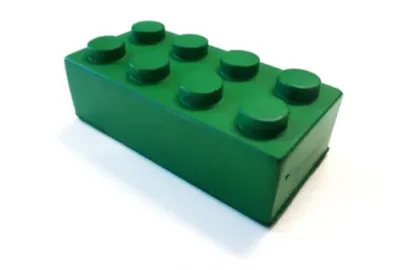
2.1 – Photograph of a child’s toy building brick, a symbol of constructivism and creativity
13
2.2 – Kolb’s cycle of experiential learning. Adapted from Kolb 1984 18
2.3 – Describing a square in LOGO. Retrieved 14 November 2015 from
www.teacherlearnstocode.com/2014/10/13/logo-something-to-get-excited-about/ 19
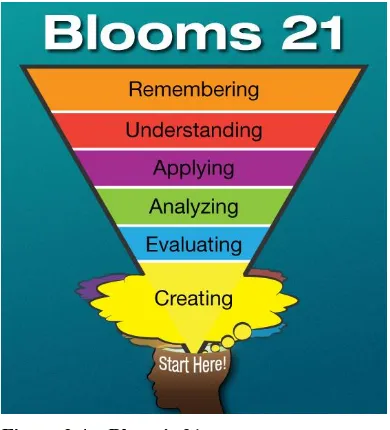
2.4 – Bloom’s 21. Retrieved 10 October 2016 from
www.plpnetwork.com/2012/05/15/flipping-blooms-taxonomy/ 24
2.5 – Exploding Art jam2jam. Retrieved 14 October 2015 from
www.explodingart.com/jam2jam/jam2jam/Home/Home.html 32
2.6 – Drumsteps. Retrieved 14 October 2015 from
www.bbc.co.uk/music/childrens/games/drumsteps/ 32
2.7 – Yelsi AG eJay 35
3. Research Context 2: Environment & Interaction
3.1 – Touchscreen tablets in a classroom music environment 42
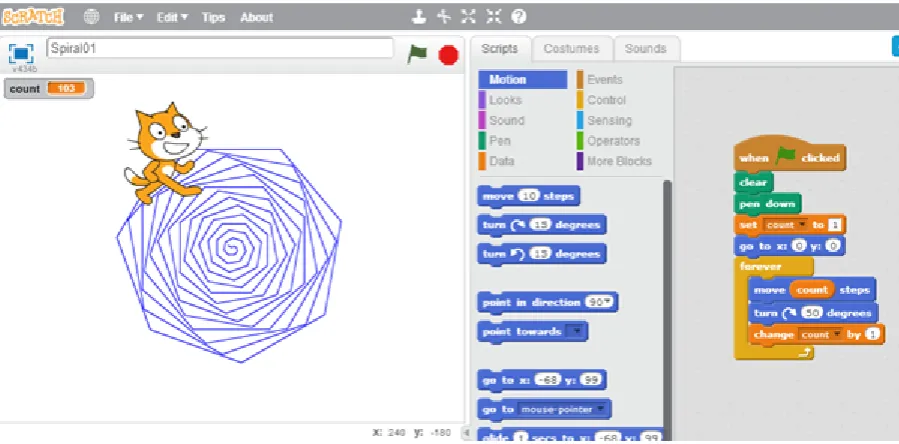
3.2 – Generating a spiral structure in Scratch. Retrieved 20 September 2017 from
vii
3.3 – Bloom 50
3.4 – Ars Nova Practica Musica 51
3.5 – Rising Software Auralia 51
3.6 – The sequence of progression in Charanga Music World, alongside the sequence of
musical development. Adapted from The Sequence of Musical Development: A Study of
Children’s Composition by K. Swanwick and J. Tillman, 1986. British Journal of Music
Education, 3(3), p.331. 52
3.7 – Assistive tools for composing and performing in Charanga 52
3.8 – Home Concert XTREME for iPad. Retrieved 19 December 2014 from
www.itunes.apple.com/us/app/home-concert-xtreme/id443017184?mt=8 53
3.9 – Yousicion. Retrieved 03 September 2017 from
www.youtube.com/watch?v=nlAXGJ8LuwM 53
3.10 – Synthesia. Retrieved 03 September 2017 from
www.voicesinc.org/yousician-vs-synthesia/ 53
3.11 – Avid Sibelius Ultimate 54
3.12 – Arranging clips in GarageBand 54
3.13 – Arranging drums in GarageBand 55
3.14 – Morton Subotnick’s Pitch Painter. Retrieved 19 December 2014 from
www.itunes.apple.com/us/app/mort-subotnicks-pitch-painter/id519738403?mt=8 55
3.15 – Impromptu 55
3.16 – Sim City. Retrieved 18 August 2018 from
www.gambitmag.com/2016/10/simcity-buildit-adds-lakes-rivers-forests-oh/ 56
3.17 – Minecraft 57
3.18 – Victorian House by Planet Minecraft forum member Paul_zero. Retrieved 07 August
2018 from www.planetminecraft.com/project/victorian-hospital-4091132/ 57
3.19 - A class of children, potentially across multiple schools, explore a teacher-generated
world in MinecraftEdu. Retrieved 19 December 2014 from
www.mrsboothsclass.weebly.com/building-bridges-minecraftedu/week-1-minecraftedu 58
4. Methodology
4.1 – Cutting cogs from coloured card 63
4.2 – Gantt chart of phases 1-3 70
4.3 - The research model for data collection, analysis and application. Studies across phases 2
viii 5. Phase 1: Initial Design
Note that most of these figures are screenshots of Pd patches from the earliest stages development.
5.1 – An early design sketch from my notebook, 22 April 2015 78
5.2 – An example of graphic notation, where symbols represent musical dimensions. I
frequently used this particular example as a music teacher 80
5.3 – A suggested initial framework for mapping musical dimensions to graphic notations 81
5.4 – Data structures in Pd 82
5.5 – Solitude by Hans Christoph-Steiner. Retrieved 20 November 2015 from
www.at.or.at/hans/solitude/ 83
5.6 – A basic 16 step sequencer 86
5.7 – The canvas window in my earliest patches 87
5.8 – A sine wave oscillator and amplitude envelope, used as a sound source in early patches
87
5.9 – 'Painting' in the canvas window 87
5.10 – Using the mouse to create geos 88
5.11 – Text file showing X axis position, MIDI pitch and amplitude 88
5.13 – Dynamic creation of abstractions 90
5.14 – UDP messaging between patches 91
5.15 – VST patches made for Graphick Score 91
5.16 – The user interface of Graphick Score in August/September 2015 92
5.17 – The mixer panel 93
5.18 – MetroNotes 93
6. Phase 2: Development
Note that most of these figures are screenshots of Graphick Score in development, or of pupil compositions using the programme. Any figures with pupil names also have an
accompanying video file of the piece, which can be found in the digital appendix.
6.1 – Processed photograph of the author presenting Graphick Score in November 2015 96
6.2 – Graphick Score in September 2015 97
6.3 – The canvas window in slendro tuning 101
6.4 – Exhibiting Graphick Score at University B, November 2015 102
6.5 – Keyboard commands printed onto a mouse-mat 103
ix
6.7 – SoundWorlds uses the Leap Motion to allow the user to ‘grab’ and ‘move’
3-dimensional geos, altering their musical parameters 105
6.8 – The Leap Motion uses infra-red to map hand motions to a XYZ axis 105
6.9 – Different geos; simple geometric shapes, complex shapes, 3-dimensional .mod files 106
6.10 – Alice 108
6.11 – Jessica 108
6.12 – Bill 109
6.13 – Hattie 110
6.14 – A tune-block for the song Oh When the Saints 111
6.15 – A sequence generated using the tune-block shown in Figure 6.14 112
6.16 – Block chords and broken chords 112
6.17 – Fruit rhythms making the rhythmic sequence for ‘pat-a-cake pat-a-cake baker’s man’;
coconut coconut apple pear 113
6.18 – Fruit rhythms 113
6.19 – Rotations of the tune-block shown in Figure 6.14 114
6.20 – The instrument menu 114
6.21 – A message directs the user to select a channel 114
6.22 – Graphick Score in May 2016 115
6.23 – Lara 116
6.24 – Lee 116
6.25 – Hattie 117
6.26 – Jessica 117
6.27 – Jessica 118
6.28 – Arranging a block of ‘sound painting’ 122
7. Phase 3: Application, Refinement, Expansion
Note that most of these figures are screenshots of pupil compositions made with Graphick
Score. Any figures with pupil names also have an accompanying video file of the piece, which
can be found in the digital appendix.
7.1 – Graphick Score as published in The London Review of Education (Hart 2017a) 124
7.2 – Graphick Score in June 2016 125
7.3 – The tune-block for Somewhere over the Rainbow is changed from a major to a minor
key. Arlen, H. & Harburg, Y. (1939) Over the Rainbow. London: Francis 125
x
7.5 – Animal tempos, moving from slow to fast; tortoise, man, hare, cheetah 126
7.6 – The instrument menu 126
7.7 – The example story, Incy Wincy Spider, told with ‘sound painting’ 128
7.8 – Carly 129
7.9 – Imogen 130
7.10 – Hayley 130
7.11 – Kody 131
7.12 – Rob 134
7.13 – Renee 135
7.14 – Barry 135
7.15 – Emma 136
7.16 – Aisha 137
7.17 – Millie 137
7.18 – Ronan 138
7.19 – Harvey 138
7.20 – The demonstration from the session 141
7.21 – Natasha 142
7.22 – Ethan 142
7.23 – Rickie 142
7.24 – Sammy 144
7.25 – Lewis 145
7.26 – The verse of Little Donkey. Boswell, E. (1959) Little Donkey. London: Chappell & Co.
Ltd. 149
7.27 – The verse and chorus of Little Donkey in iPad tune-blocks 150
7.28 – The chord interface 150
7.29 – Rhythmic variations 154
7.30 – Melodic variations with the same rhythmic structure 154
7.31 – Melodic variations with the same harmonic structure 155
7.32 – The Rainbow Keyboard 156
7.33 – Arranging tune-blocks into a complete structure 158
7.34 – Composing their own carols 160
7.35 – Original composition by group 161
7.36 – Original composition by group 161
xi
7.38 – Graphick Score in 2017. A version with a white canvas window was requested by the
London Review of Education due to printing considerations 164
7.39 – Kurtág’s Alapelemek from Játékok vol. 6. Retrieved 17 February 2018 from
www.junttu.net/_/_/jatekok_1_kirja.html. Kurtág, G. (1997) Játékok vol. 6. Budapest: Editio
Musica Budapest 165
7.40 – Group 1 177
7.41 – Group 2 178
7.42 – Group 5 179
7.43 – Group 7 180
7.44 – Group 6 181
7.45 – Group 8 183
7.46 – Smart keyboard in GarageBand 185
7.47 – Sample-It 186
8. Conclusion
8.1 – Sequence representing creative kinaesthetic actions; sketch, sculpt, splash, swipe? 199
8.2 - The theoretical codes emerging from the studies and analytical process, and their
xii
List of Tables
The following is a list of tables used in this document. Clip-art images are all public domain.
5. Phase 1: Initial Design
5.1 – Scale degrees 89
5.2 – Basic musical dimensions represented in Graphick Score 94
7. Phase 3: Application, Refinement, Expansion
7.1 – Table of sound objects 166
xiii
Acknowledgements
Research depends on community, and as such, I owe a tremendous debt of gratitude to the individuals and institutions that have supported me in so many ways throughout this project. This research is funded by the Arts and Humanities Research Council and the North West Consortium Doctoral Training Partnership. I will always be proud to have embarked upon my research career with the support of these networks.
I could not have commenced or completed this project without the guidance and friendship of Professor Alan Williams, and I greatly appreciate the time and thought he has given over the past several years. Also, I thank Professor Steve Davismoon for continuing to be a source of support and advice, even after moving on to another university. I am very much obliged to all of the staff and students at the University of Salford who have had such a lasting influence on my life, and who are too numerous to name here. I hope to continue to work with all of these people for many years to come.
I will always be grateful to my network of schools, teachers and other educational
professionals for training me, employing me, and letting me conduct my research in their classrooms. Teaching is the most important job in the world, and I count myself exceptionally lucky to have such a varied and valuable time in education among such inspirational people.
There are a number of online communities who have proved to be vital resources throughout this research. In particular, I would like to thank the endlessly insightful and helpful members of the Pure Data online community for always having an answer to technical queries,
however obscure or incomprehensible, and for the profound influence that their work has had upon my own.
xiv
Declaration
This thesis is submitted under the University of Salford regulation for the award doctor of philosophy. Unless otherwise stated in the text, I hereby declare that the contents of this thesis are the result of my own work, and that no part of it has been submitted in support of any application for other degree or qualification at this or other institutions of higher learning.
………
Adam Matthew Hart
xv
Abstract
This study explores the potential added value of interactive digital technology to early-years music education through the development of software artefacts and their application in the primary classroom. The aims of the study are to investigate and identify new designs and approaches for classroom music-making with technology, to integrate educational theory and software development in this field, and to promote musical creativities at the individual and social level. Following a constructivist-interpretivist approach, a range of qualitative methods are applied in the pursuit of these goals. The emerging educational methodology of Software Design as Research (SoDaR) is combined with an emergent model of Grounded Theory, adapting a new methodological approach for the unique purposes of this project, as well as examining how this model could be applied to similar projects.
Findings can be summarised as follows:
i. Rudimentary and familiar actions can be harnessed, through digital interfaces, as a means of affording creative expression in novice musicians
ii. Meaning-making structures are as vital as music-making structures in such activities, allowing creative ownership and communication to emerge through basic narrative elements
iii. Through this process of interactive and representational engagement, digitally-supported environments can allow learners to construct musical concepts for themselves, at the individual and social level.
This research has implications for music education: Appropriate digital technologies and approaches can support the process of musical learning in social settings. Furthermore, such technologies, and the framework for their use in the classroom, can be developed through a process grounded in empirical educational research. Closer working links between
1
1. Introduction
Figure 1.1
This chapter will frame the narrative of this project, which concerns two concurrent
2
1.1 About the Project
1.1.1 Overview
The aim of this research project is to investigate an approach for achieving musical learning
outcomes with digital technology. ‘Musical learning’ is defined, within this study, as learning
which enhances musical knowledge and skill arising from diverse modes of interaction and
engagement in creative environments. This is a practice-led project, one in which creative
practice is ‘in itself is a form of research and generates detectable research outputs’ and where this practice ‘can lead to specialised research insights which can then be generalised
and written up as research’ (Smith & Dean 2009, p.5). In this instance, the practice concerned
is the development and application of bespoke digital technology for musical learning, the
insights generated from which are used to answer a set of research questions:
To what extent have interactive digital technologies hitherto succeeded in encouraging musical behaviour in the classroom?
What conditions prompt musical learning in ‘sandbox’ environments?
How can constructivist educational theory be applied to software design as a means of facilitating creative musical learning?
How might interactive digital technology be harnessed to facilitate creative expression in the musically untrained?
As this is an exploratory project, where outcomes are directed, at least in part, by the changes
in this practice as it develops and responds to emergences, many of the more specific details
are arrived at during the narrative of this thesis. For example, the questions posed here, and
answered in the conclusion, are not the questions I was asking at the start of the research
project. At that time, I had a single question:
How can digital technology be used to facilitate musical learning?
Compared to those which emerged from it, this question may be smaller, but it is certainly
not simpler1. It demands answers to a series of qualifying questions: With what kind of digital
technology are we concerned? What constitutes musical learning? Why are these two ideas necessarily mutually relevant? How can I assume that we should we using digital technology for this purpose? These details, along with the research questions, are addressed in
1This distinction is present in the work of Bamberger (1996, p.42; see 6.6) and became a prominent influence in
3 subsequent chapters. I will begin, in this chapter, by clarifying my decision to adhere to a
specific theory of learning.
1.1.2 The Relevance of Constructivism
In simple terms, constructivism is the idea, originally theorised by Piaget, that individuals
develop their understanding (of anything) from interaction between their experiences and
their ideas. As such, it has significant implications for the nature of education and
instructional design, and is often used as an umbrella term encompassing a wide range of
related pedagogies. The various aims, assumptions, adherents and applications of
constructivism will be explored in detail in chapter 2. Here, I will just explain how this
particular theory came to feature so prominently in my research.
The original proposal for this project, entitled Educational Applications of Interactive
Music Technology, drew from my experiences of music education, as both a student and a teacher, and my continual interest in using digital technology to support learning. At this
time, the Office for Standards in Education (OFSTED) had recently published two reports
critiquing the lack of musical opportunities in the classroom, as well as insufficient
ICT-related advancements in musical learning (OFSTED 2012, p.54), and efforts to restructure
music education provision which were largely failing to address a fundamental lack of music
teachers and resources (OFSTED 2013). In my research proposal, I highlighted potential
solutions to these issues, and set out a plan for developing new resources for musical learning
and testing them in learning environments. Having spent the preceding five years working in
education in various capacities, including training and working as a secondary school music
teacher, I wanted to ensure a strong educational basis for my research, and so my first
semester as a PhD student was mostly devoted to reading education journals. Consequently, I
read much on constructivism. The dynamics of active experience and reflection to which it
referred resonated with my classroom experience, the outstanding teaching and learning
which I had observed, and what I understood to be indicative of best practice in education.
Although it has informed numerous pedagogies, constructivism is not by itself a pedagogy
but an ontology. If we subscribe to this ontology as a way of supporting teaching, by defining
learning structures, planning activities and promoting reflection, then could we not also apply
4 development and application? In my research, this specifically concerns digital resources for
musical learning.
A disparity between the modes of practice I proposed to combine in this project
became apparent. When planning a lesson, my training and experience led me to approach it
as a constructivist, allowing the students to apply their own skills and ideas and arrive at
outcomes in their own way, while also ensuring that this was evaluated against the learning
objectives. When programming a musical interface, I did not approach the task with the same
attention to reflexivity. My patches were typically based on a single and fixed initial idea, and
consequently had a single mode of use and fixed outcome, with little room for variability of
input and output. As an example, here is a description of a computer programme, or patch,
which I completed in 2013 as part of a collaborative project at the University of Salford with
Professor Alan Williams, who would become my supervisor for this research. The project
was an installation entitled Sing to Me and I’ll Tell You My Story:
A vocal melody is played through speakers, inviting listeners to ‘sing to me and I’ll tell you my story’. A listener then sings the melody back into a microphone, and the
patch analyses the frequency of the audio signal to check if it falls within a given
frequency range that can be perceived as an ‘accurate note’. A message on a screen
informs the listener how many notes they got right, and if they accurately sing all of
the notes, a pre-recorded audio file plays, ‘telling’ the listener a story.
Because the patch has an educative element – learning to accurately sing a melody in order to
receive the reward of a story – it came to mind when writing my proposal of how interactive
digital technology might support music education. However, though the process works well
as a game or installation, it is not a process that I would apply in a music lesson, for a number
of reasons: Firstly, the outcome, from the perspective of the listener, is not the ability to
accurately sing the melody, but the story it triggers, so they do not necessarily see the value
in any learning that may have taken place. Secondly, feedback is minimal, and is only given
when the melody is sung incorrectly, as when sung correctly, triggering the story, the melody
serves no further purpose for the listener. Thirdly, this involves no repetition or practice of
the correctly sung melody; once they have sung it accurately, they are silently listening to the
story. Fourthly, there is only one way in which the listener can approach the interface; they
sing the correct melody and are told a story, a single mode of input and a fixed output.
5 During the first semester of this project, I realised that the approach taken and
outcomes generated with this kind of patch contrasted with that of my lesson planning and
that I wanted to avoid this contradiction when exploring opportunities for musical learning in
digital technology. Therefore, the measure I set for myself in this project – to achieve an
ontological reconciliation between my teaching and programming practice, to develop this
combined practice, and to use it to produce research insights – was to approach it from a
constructivist perspective. Consequently, instead of producing several applications with
single modes of input and output, I focused my attention on a single versatile application with
multiple modes of use. This artefact, Graphick Score, is provided in the digital appendix
which accompanies this thesis.
1.1.3 Validation and Dissemination
My research proposal was awarded a three-year scholarship by the Northwest Consortium
Doctoral Training Partnership (NWCDTP) with funding from the Arts & Humanities
Research Council (AHRC) and I was accepted as a candidate for the award of PhD Music at
the University of Salford. I was supervised by Professor Alan Williams and Professor
Stephen Davismoon of the School of Arts and Media. I started work on this project in the
autumn of 2014, completing this thesis in 2018. This research has been widely disseminated
during this time, through its application in classrooms throughout the North West of England,
in a variety of national and international conferences and exhibitions, in two published
peer-reviewed papers and on social media. I have presented this research at each of the annual
NWCDTP postgraduate research conferences and Salford Postgraduate Annual Research
Conferences (SPARC) since commencing this project, winning the award for ‘Best
Interactive Presentation’ for two consecutive years at the latter. Other major conferences at
which I presented include the International Association for the Study of Popular Music
(IASPM) and the Nordic Educational Research Association (NERA).
Just prior to the third year of this research project, Professor Davismoon left his
position at the University of Salford to become Head of Performing Arts at Edge Hill
University, but remained in my supervisory team. As the university has a noted education
department, and given my previous links to the institution (my PGCE was awarded by Edge
Hill University) this presented an opportunity to expand my network with regard to education
research. I arranged consultations with professors of education Tim Cain at Edge Hill
6 cited as prominent contributors to the field of music education research in my literature
review, and was able to greatly expand my knowledge and practice with respect to this field
during this time. This is reflected in my outputs within international conferences and journals
within the field of education research in the latter half of the third year.
This research was presented at three major international conferences on education; the
45th and 46th international congresses of NERA in Copenhagen and Oslo respectively, as well
as the 19th annual conference on education at the Athens Institute of Education and Research
(ATINER). Some of the research conducted for this project has already been published in two
open-access peer-reviewed academic journals. Towards an Effective Freeware Resource for
Music Composition in the Primary Classroom (Hart 2017a), describing many of the central research outputs of this project, was published in the London Review of Education by the
Institute of Education at University College London. In what was a new approach for the
journal, the article was published with embedded hyperlinks to video examples of music
made by pupils using Graphick Score, which were uploaded to the journal’s YouTube
account. This novel approach, raising further possibilities for linking to interactive digital
media in open-access publishing, was taken by the editor to more effectively disseminate the
evidence I provided; the videos and software artefact which are submitted in the digital
appendix to this document. I also had The Tablet as a Classroom Musical Instrument (Hart
2017b), detailing additional research undertaken for this project, accepted for publication in
the Athens Journal of Education, as an outcome of my attendance at ATINER.
1.1.4 Limitations
In order to arrange a consistent series of case studies and produce sufficient results of a
reliable quality, this research is limited within certain boundaries. For example, research
focuses on music composition at key stage 2, as these were identified as areas on which to
focus during the initial stages of the project. It will be useful to extend this study to a wider
age group and range of activities in a follow-up project (see 4.3.2). Limitations were also
encountered as to where, when and for how long research could take place. Most of the
schools who were contacted were very accommodating, and glad to offer a novel musical
experience to the pupils, but an appropriate day had to be arranged sufficiently in advance,
and several schools had to cancel or postpone due to various circumstances. Due to busy
7 periods in mind, such as the weeks prior to the winter or summer breaks. Also, only schools
in the North West of England were contacted for this study, due to the logistics of travelling
wider distances for short studies, and because most of my school contacts are within this
region.
Sessions varied in length, from an entire day of studies, to afternoon sessions of
around 2 hours and, in the earlier stages, short ‘taster’ sessions of around 20 minutes.
Ultimately, the length of each study, and the number of pupils involved, was the decision of
the class teacher, who was in turn subject to various limitations, though many were happy to
accommodate requests. This meant that, in many cases, pupils only had a short window
within which to become acquainted with the digital resources used, and the outputs of such
sessions are limited in relation to those of longer sessions. It should also be noted that, due to
the investigative nature of the research project, and variable availability of equipment that I
was able to obtain from the school, university or other sources, the case studies often differ in
terms of lesson plan and resources. These differences are highlighted in the account of each
case study.
Lessons were primarily conducted by me acting as researcher and teacher, though the
class teacher was involved for some of the sessions. Most teachers were naturally more
receptive to the idea of a visiting music specialist taking the class than to the idea of
delivering a lesson using an unfamiliar resource themselves, though later sessions did see an
increased involvement (see 7.6). As such, I decided to focus mainly on the development of
these resources and student interaction with them rather than their use by the teacher, though
later research should certainly focus on this too. By acting as the teacher, I came to recognise
certain other limitations. My own training is largely in secondary school music, though I do
have previous experience working with younger children. Consequently, it must be
acknowledged that the pupils are working with someone who has a different set of skills from
their usual class teacher – a lack of personal knowledge of the pupils themselves, as well as
less pedagogical experience, but the additional knowledge of specialist musical training – and
the dynamic will not be that of a typical lesson. I must also acknowledge my own biases and
orientations with regard to teaching practice, educational theory, and musical ability. All of
these considerations are taken into account within this thesis.
Finally, it will be useful to extend this research to examine a greater number of factors
which might influence musical creativity. Some details, such as gender, ability, and musical
training, were known or became apparent, while other information was not available, either
8 requirements, or other logistical factors. As an initial study into a relatively new area of
research, I hope that this work generates useful findings which lead to a more substantial
body of research, in my future work and that of other academics working within similar
fields.
1.1.5 Structure and Approach
The conclusions derived from this project have been generated by two modes of research,
each supporting the other. A theoretical examination of educational research, focusing on
music and technology, but drawing from other possible areas of relevance, provides the initial
ideas, substantiates explorations, and gives validation to findings. This inquiry is primarily
covered by the second and third chapters of this document, which review the existing
literature and research in the field of educational music technology, as well as investigating
some technologies with hitherto untapped potential for music education. The second mode of
research is practical, involving the design, development and evaluation of software artefacts.
It is through this inquiry that the initial ideas are tested, honed and expanded upon. The
methodology is outlined in chapter 4, while my programming practice and field research in
the classroom is presented over chapters 5, 6 and 7. The conclusions emerging from this
research are summarised in the final chapter.
The digital appendix, which accompanies this thesis, contains two main folders. The
first, entitled ‘Graphick Score’2
is the principal software artefact, along with a text file of
instructions for installation and operation, as well as any auxiliary files required for it to
function. The second folder, entitled ‘Classroom Research’, contains the outputs of classroom
studies (see chapters 6 and 7) in a series of sub-folders. Each of these folders corresponds to
the study name given in the chapter (e.g. ‘Storyboard Composition at School B, June 2016’,
see 7.2) while the file names correspond to the (anonymised) pupil names used when
presenting these findings (e.g. ‘Carly’, Figure 7.7). These are audio-visual files of the pupil
compositions made during these studies; as such, the reader can use the appendix to view any
pupil work which is referenced within this document.
2
©Copyright 2017 Hart . All software artefacts presented within this thesis or the accompanying digital
9 This project can be characterised as qualitative, case-study led educational research
undertaken within an interpretivist paradigm (see O’Donoghue 2006). The interpretivist
position, common within social science research, is that individuals and society influence one
another in a meaningful way, and that the researcher should seek to understand this process of
mutual influence rather than any quantifiable absolute with which the positivist researcher, by
contrast, is concerned. Therefore, interpretivist research focuses on the behaviour of
individuals within specific contexts and environments. To a greater extent, this research
works towards the definition of theory from active practice and observation, as opposed to
research models which test existing theories:
Qualitative researchers build toward theory from observations and intuitive
understandings gained in the field.
(Merriam 1998, p.7)
This involves a prominent component of individual practice stemming from my experience of
interface design for composition, meaning that much of this research can be characterised as
practice-led research within the creative arts (see Nelson 2013). A mixed methodological
model for conducting and analysing this practice and its outcomes is taken from Brown’s
(2007a) software design as educational research model (SoDaR) supported by grounded
theory (see chapter 4). Furthermore, observations are derived from the application of this
practice, and its outcomes, in different case studies. These studies are often sequential
sessions returning to the same school, but where the emerging outcomes of one session,
analysed through a grounded theory-based approach, inform the structure and content of the
next. In this respect, the approach has links to the method of action research in education,
where issues are addressed dynamically within the learning environment (Mills 2000). To
some extent, this situates the findings within specific case studies, and means that the process
must be applied to different contexts in order to verify broader hypotheses. Bassey tells us
that these ‘fuzzy’ generalisations are of empirical value, as they can provide insights into the
effectiveness of educational practices within specific settings, as well as the understanding
10
1.1.6 Ethics
Ethical approval for this research project was obtained from the College Ethics Panel at the
University of Salford during the first year of study. This application detailed the methodology
for developing resources and using them to conduct research as a school visitor. At this time,
I also obtained new documentation from the Disclosure and Barring Service via the School of
Health and Social Care, certifying me to carry out research with children of less than 18 years
of age.
Schools were invited to take part in the study by email, and an electronic copy of a
leaflet detailing the aims of the project at a key stage 1 reading age was attached. When a
school agreed to take part and arranged a date, forms were sent to the school again giving this
information and requesting consent from the parents or guardians of the pupils to allow them
to take part in the study. These were given to the pupils by the teacher, who then collected
them prior to the date of the study. In early studies, surveys were used to gather information
on the musical ability of the pupils taking part. No other personal information was collected,
and the names of the pupils and their schools are anonymised in this thesis and the other
published works emerging from this research.
1.2 About the Researcher
1.2.1 Qualifications and Experience
Merriam (1998, p.205) tells us that one of the ways in which a qualitative researcher can
achieve validation is by stating their theoretical orientation and biases at the outset. To this
end, I feel that it would be helpful to give some insight into my ideas and experience prior to
commencing this research.
I have held some form of educational role for the entirety of my adult life. Several of
my immediate family are, or were, teachers in comprehensive schools similar to those in
which this research has been conducted, so the discussion of educational practice has been an
ever-present influencing factor. Naturally, I have always pursued occupations related in some
way to the educational environment, from work experience to later employment and study.
While attending university I worked as a peripatetic guitar and keyboard tutor. Upon
graduating, I was employed by an educational supply agency and worked in a variety of roles
11 pupils with special educational needs. I also held a long-term position as learning support and
intervention for the English department of Prestwich Arts College during this time, which
involved the assessment of individual learning needs and tailoring of approaches to meet
these requirements. After much experience and development in such roles, I eventually
completed a Postgraduate Certificate in Education through Edge Hill University alongside a
Schools Direct training programme with the Kingsbridge Educational Improvement
Partnership. During this period, I taught key stage 3 and 4 music at Hawkley Hall High
School in Wigan, with an additional placement at Manchester Communications Academy. I
now teach on the BA Music Production course at the British and Irish Modern Music Institute
and the MA Music course at the University of Salford, specialising in interactive and
emergent technologies.
Music and interactive technology have both been major components of my academic
and professional development. I hold a BA (Hons) in Popular Music and Recording and an
MA in Music Composition. Becoming interested in programming languages around the time
of my MA, I focused on the design and development of interactive music systems as modes
of composition. As previously mentioned, I have written and delivered modules relating to
this area of study for BA Music programmes. My main area of interest and expertise concerns
visual programming languages such as Pure Data and Max/MSP/Jitter, though I also have
experience working with Java, C, Visual Basic and Python. I occasionally made use of these
skills when teaching secondary school music, as a way of incorporating interactive games and
activities into my lessons. In some respects, this influenced my research proposal for this
project.
1.2.2 Theoretical Orientations
As an educational practitioner, I naturally hold certain preconceptions about how learning
takes place, rooted in experience, knowledge and instinct. In line with the ideas of
constructivism, I feel that people learn best when given opportunities for active experience
and reflection, and that, wherever possible, the learner should have opportunities to direct this
process for themselves. These ideas are not revolutionary, having been at the heart of
educational reform for the better part of a century. However, it is also my experience that
they have emerged in different areas of education, manifesting successfully in some ways but
12 prominent areas for constructivist teaching practices, though research tells us that this is not
the case (see 2.2). In my opinion, there are certain barriers imposed by resources and musical
forms commonly used in music curriculums, which emphasise knowledge and skills that
stand in the way of active experimentation. The learning of notation, for example, is
undoubtedly an important musical skill, but becomes a barrier if we take it as a prerequisite
of active music-making.
The above point raises another question of theoretical orientation. As a
classically-trained musician, I have an understanding and experience of traditional musical forms, such
as standard notation and orchestral instrumentation. However, as someone who has been
actively involved in many varied musical pursuits, I do not believe that being a musician
begins and ends with this kind of knowledge. The experiences which have most significantly
defined my musicality have all been active and social in nature. My route to these
experiences involved traditional musical training, but for others who shared these
experiences, this was not the case. Therefore, I tend toward a broader interpretation of what
kinds of activity can be considered music-making, and what constitutes a musician. Again,
this will inevitably have some influence on the kind of issues I will perceive as problems, and
the kind of solutions I will perceive as appropriate.
I also hold certain ethical assumptions surrounding educational research, that the
validity of educational research is shown when it is conducted in an educational setting and
learning takes place. In other words, educational research is valid when it assimilates into the
everyday learning process of a child at school, and results in some form of added value. This
is a responsibility not only to the relevance of the research, but also to the wellbeing of the
child and the practices of the school. Therefore, as educational researchers, we do not have
the freedom to try out a multitude of possibilities expecting different results, especially where
the educational benefit of such possibilities is questionable. The ethical considerations of
ensuring clear and accurate results through varied testing is inevitably compromised by the
more pressing ethical considerations of ensuring that each child has access to quality learning
experiences. This is supported in the ethical guidelines published by the British Educational
13
[image:29.595.198.396.150.285.2]2. Research Context 1: Constructivism & Creativity
Figure 2.1
As an interdisciplinary project, the associated research context covers a range of subjects, spanning musical creativity, educational theory and digital technology. Therefore, this part of the narrative is divided up into two chapters; chapter 2 covers broader
educational and creative considerations underpinning this research to define questions, while the chapter 3 focuses on a body of existing work, theory and practice necessary to develop practical and methodological considerations.
This chapter will establish the research context for this project. I will provide an overview of the constructivist paradigm, tracing the emergence and continual relevance of the associated theories of learning. This discussion will focus on interactive digital
14
2.1 What is Constructivism?
2.1.1 Overview
The concept of constructivism, emerging from among the competing paradigms of education
over the last century, has come to signify a variety of evolving perspectives on the nature of
learning and instruction as an active, student-led, dynamic process, and continues to drive
educational reform, as well as informing new strategies for teaching, resource-design and
research. Duffy and Cunningham (1996, p.2) summarise these perspectives as ‘the general
view that (1) learning is an active process of constructing rather than acquiring knowledge,
and (2) instruction is a process of supporting that construction rather than communicating
knowledge.’ If we conceive of knowledge as communicated artefact, something which can be
transmitted from a teacher or a book to the recipient learner, like data from one computer disk
to another, then learning is the acquisition of this information; the teacher possesses this
knowledge and the student does not, so they must follow the instruction of the teacher in
order to acquire it, typically involving the recitation of facts or copying of processes,
otherwise known as rote-learning. Constructivist educators attempt to accommodate or
facilitate the means by which learners build this knowledge for themselves. Despite varying
perspectives across the constructivist paradigm, the general consensus within education is
that teachers should strive for understanding, and that this is something which is achieved
only by the learner, within a context and environment that enables them to do so.
2.1.2 Emergence
Constructivism does not claim to have made earth-shattering inventions in the area of
education, it merely claims to provide a solid conceptual basis for some of the things
that, until now, inspired teachers had to do without theoretical foundation.
(Von Glaserfeld 1995, p.15)
Constructivism is not, in itself, an approach, methodology or pedagogy. It is an ontology
which recognises the experiential dynamic of learning and understanding, which may be used
to direct or understand specific approaches. For example, the seminal pedagogical
15 building upon the prior experience or understanding of the learner and abstracting from
concrete experiences to form new meaningful and functional processes3. The teacher, from
this perspective, is a skilled practitioner of education, not just the possessor of knowledge but
the facilitator of understanding. With the emerging acceptance of psychology as a science in
the late 19th century came the recognition of opportunities for a sound theoretical basis for
education (Thorndike 2013). However, such was the weight of behaviourist ideas in
psychology for the first half of the 20th century, the primary manifestation of influence in the
classroom during this time concerned discipline, or ‘learning as response acquisition’ (Mayer
1992, p.406-7).
With the latter half of the 20th century, the paradigm of educational psychology
shifted away from behaviourism and toward cognitivism, leading to a focus on ‘learning as knowledge acquisition’ and ultimately ‘knowledge construction’ (Mayer 1992, p.407-8). The
continual influence of Dewey emphasised a view of education as an evolving system, where
progress is sustained through preoccupation with the experience of the learner, and therefore
reliant upon challenge and change:
Education is a social process; education is growth; education is not preparation for life
but is life itself.
(Dewey 1916, p.239)
Such ideas ultimately drew the trajectory of educational philosophy toward a notion of a
system which must grow and develop like the learner, and must therefore be derived from the
experience of the learner, as opposed to the maintenance of externally imposed stasis implied
by the behaviourist model. Dewey is critical of such prescriptive curriculums of learning
where they do not reflect the life-experiences of students:
A single course of studies for all progressive schools is out of the question; it would
mean abandoning the fundamental principle of connection with life-experiences
(1938, p.78)
This questions the coherence of any paradigm which seeks to impose knowledge artefacts as
having universal relevance. The content of the progressive curriculum, then, would be open
3This taxonomy is comparable to Dewey’s ideas on formative life-experiences (English 2013, pp.105-13) and
16 to challenge and change, and delivered with a context of authenticity to the life experiences
of learners. Within this emerging paradigm, the focus of attention is not the content itself, but
the perspective of the learner.
2.1.3 Cognitive and Social Constructivism
Widely acknowledged as the most influential figure within the constructivist paradigm is
Piaget, whose theory of cognitive development proposes that children intuitively employ a
different mode of learning from those consciously employed by adults, in that they construct
their understanding through a process of experience, assimilation and accommodation, and
develop structures (or schemata) through their play and explorations (Piaget & Cook 1952).
This highlights the importance of the learner perspective, the need to bridge the cognitive gap
between the adult teacher and the child who have fundamentally different thought processes,
and the recognition of play as an exploratory and developmental component of learning:
The prevalence of play among children is therefore to be explained not by specific
causes peculiar to the realm of play, but by the fact that the characteristics of all
behaviours and all thought are less in equilibrium in the early stages of mental
development than in the adult stage.
(Piaget 1962, p.147)
It is through this dynamic process that the individual maintains a state of cognitive
equilibrium between new experiences and environments and those understandings previously acquired:
Equilibration is not a sequential process of assimilation, then conflict, then
accommodation; it is not linear. Nor is assimilation a process of ‘taking in
information’ as it has sometimes been described. Equilibration is instead, a non-linear, dynamic ‘dance’ of progressive equilibria, adaptation and organization, growth and change. It results from ‘coupling’ with our surround.
17 This contradicts the traditional curriculum model of information as sequentially transmitted
artefact, and of the learner as passive ‘blank slate’. The nature of how the learner receives
information is influenced by experience, both prior and during the immediate educational
process, a factor which shapes the information as well as the learner. Within constructivist
theory, knowledge is generally defined as a cognitive and social process yielding an
idiosyncratic representation of a new experience or environment; it is the active process of
gaining information rather than the abstract end-product (Cunningham & Duffy 1996, p.2;
Perkins 1999, pp.7-8; Rieber 1992, p.94; Scott 2006, p.17; Webster 2011, p.6). In educational
practice, this has led to a revision of the student-teacher classroom dynamic; the learner must
be both active and reflective, and it is the role of the educator to mediate this process through
maintenance of the environment and pertinent inquiry (Von Glaserfield 1995; 1996, p.7;
Holt-Reynolds 2000; Honebein 1996; Richardson 1997). These ideas are further substantiated
by Bruner’s theory of discovery learning (1961), which states that effective learning takes
place when knowledge is arrived at independently, leading to a realisation and individual
cognitive interpretation on the part of the learner.
While the earliest constructivist theories focused exclusively on the cognitive
processes of the learner, a new perspective emerged with theorists such as Vygotsky, who
believed that it is through interaction with society and culture that an individual forms a
context of understanding for their experiences, thus emphasising the importance of social
structures in learning. Vygotsky’s ‘zone of proximal development’ (1978, p.86) distinguishes
between what the learner can and cannot do unaided by assistive structures, or ‘scaffolding’
(Wood et al., 1976), making completion of a task significantly more accessible. The
distinction is often made between the camps of cognitive and social constructivism within
academic discussion (Cobb 1996; Palincsar 1998; Powell & Kalina 2009) including criticism
of the apparent mutual conflict of these ideas (Phillips 1995). It has been suggested that both
interpretations constitute manifestations of the same didactic process, whereby the individual
interacts with a changing environment (Scott 2011, p.192) and that the separation of these
ideas is pedantic and dualist (Liu & Matthews 2005, p.389). For the purposes of this
discussion, it will be useful to establish common ground between these two camps.
In both cognitive and social constructivism, the learning environment is defined as the
situation or setting in which the learner constructs knowledge, through interaction with peers
or some other external stimuli. To further consolidate these perspectives, Jonassen (1994,
p.35) suggests that there are characteristics shared by both cognitive and social constructivist
18
1. Providing multiple representations of reality, reflecting the complexity of real
life-experiences.
2. Emphasising the construction over the reproduction of knowledge.
3. Emphasising meaningful and authentic tasks over abstract knowledge.
4. Emphasising open-ended real-world environments over predetermined sequences of
instruction.
5. Encouraging reflection on concrete experience.
6. ‘[Enabling] context- and content- dependent knowledge construction.’
7. Supporting‘collaborative construction of knowledge through social negotiation, not
competition among learners for recognition.’
This example of a constructivist
framework situated in practice
reflects Kolb’s theory of experiential
learning (1984), conceived as a
four-stage cycle of active experience and
reflection (Figure 2.2). Concrete
experiences with real-world contexts
(in this case, multiple realisations of
such) and a process of meaningful
reflection are the means by which the
learner synthesises new knowledge from environment. The final point is of key importance,
highlighting the mechanism by which the learner also influences their environment as well as
adapting to it. It is for this reason that collaboration rather than competition is widely viewed
as preferable within constructivist models of learning environment; by influencing peers
rather than acting against them, the learner has the capacity to challenge and change their
zone of proximal development, so equilibrium is maintained not just by the learner but by the
environment itself. In modern perspectives on practice, the role of the teacher is to negotiate
and manage this environment to ensure that all students access opportunities for experience,
reflection and discovery (see Holt-Reynolds 2000; Powell & Kalina 2009, pp.247-8).
19
2.1.4 Constructivism and Digital Technology
A seminal convergence of constructivist learning
approaches and digital technology can be found in the
work of Papert, exploring the potential for meaningful
concrete experience adapted from abstract learning
materials (see 3.1). This involves virtual immersive
playground environments which the user navigates
through a process of experimentation, discovery and
assimilation (1980, pp.120-136; 1987). Papert’s
research incorporated the LOGO programming
language (Figure 2.3), the first programming
environment to follow a pedagogical design, with the
graphical avatar of a user-controlled turtle aimed at
situating the learner in the virtual environment, and
facilitating exploratory emergent behaviours:
My interest is in the process of invention of ‘objects-to-think-with’, objects in which
there is an intersection of cultural presence, embedded knowledge, and the possibility
for personal identification.
(1980, p.11)
Papert’s theory of learning, constructionism, emphasises the need for meaningful creative and
social learning outcomes:
Constructionism… shares constructivism's connotation of learning as "building
knowledge structures" irrespective of the circumstances of the learning. It then adds
the idea that this happens especially felicitously in a context where the learner is
consciously engaged in constructing a public entity, whether it's a sand castle on the
beach or a theory of the universe
(Papert & Harel 1991, p.1)
These opportunities arise from micro worlds (Papert 1980), software environments which
make objects-to-think-with – building blocks – out of challenging or abstract ideas.
Figure 2.3 – Describing a square in
20 Constructionism is arrived at by reconciling constructivist theory with emerging
technological possibilities, a consistent theme in 21st century interpretations of learning
theories, as demonstrated by the ‘digitisation’ of Bloom’s Taxonomy (Churches 2008; 2009)
and strategies for web-based learning (Churchill 2009; Duffy 2008; Greenhow et al. 2009).
Siemens (2006; 2014) and Downes (2008; 2012) present an interpretation of constructivism
‘for a digital age’ in the theory and principles of connectivism:
Learning and knowledge rests in diversity of opinions.
Learning is a process of connecting specialized nodes or information sources.
Learning may reside in non-human appliances.
Capacity to know more is more critical than what is currently known.
Nurturing and maintaining connections is needed to facilitate continual learning.
Ability to see connections between fields, ideas, and concepts is a core skill.
Currency (accurate, up-to-date knowledge) is the intent of all connectivist learning
activities.
Decision-making is itself a learning process. Choosing what to learn and the meaning
of incoming information is seen through the lens of a shifting reality.
While there is a right answer now, it may be wrong tomorrow due to alterations in the
information climate affecting the decision.
(Siemens 2014, p.5)
This theory recognises the learning environment as being in constant flux due to the changing
nature of culture ideas and information exchanges in a digital world. The ability to see
connections and make decisions is defined as learning, because the knowledge itself is
subject to change. Siemens (2014, p.3) argues that this pursuit of ‘fuzzy’ learning situates
constructivist principles in the modern world:
Constructivism assumes that learners are not empty vessels to be filled with
knowledge. Instead, learners are actively attempting to create meaning. Learners often
select and pursue their own learning. Constructivist principles acknowledge that
real-life learning is messy and complex. Classrooms which emulate the “fuzziness” of this
21 However, this interpretation is less likely to resonate with the critics who attribute evidence
for constructivist approaches as factual relativism (see Boghossian 2007). Phillips (1995, p.5)
argues that constructivism has ‘become something akin to a secular religion’among its
followers. Some educationalists have expressed the view that constructivist researchers can
be so blinkered by an ontological stance as to distort empirical evidence (Phillips 1995; Fox
2001). Arguing from a constructivist position, Jonassen (2006) warns against a dichotomy of
competing paradigms, where constructivists seek to replace perceived behaviourist methods
on principle alone.
In taking on the concerns of critics, it is important that constructivist ideas are situated
not just in emerging technological possibilities, but also in measurable outcomes of
classroom practice. Drawing from an extensive meta-analysis of classroom practice, Hattie
(2009; 2012) emphasises the importance of making learning visible so as to demonstrate clear
impact. This relates not just to the measurable visibility of what has been learned, but in the
capacity of educators to see this from the perspective of their students and thus help them to
become motivated evaluators of their own learning. Hattie defines learning as ‘the process of
developing sufficient surface knowledge to then move to deep or conceptual understanding’
(Hattie & Yates 2013b, p.26), where students become self-directed and self-aware knowledge
constructors. In measuring impact, then, we must question the extent to which students can
demonstrably appropriate new knowledge to different contexts and outcomes. This is often
referred to as deep learning, defined by Fullan and Langworthy as instances of learning
which ‘[develop] the learning, creating and ‘doing’ dispositions that young people need to thrive now and in their futures’ (2014, p.i). Constructivist ideas may help us to decide how
digital technology might be used to support specific learning outcomes, but it is then vital that
we provide sufficient supporting evidence of the impact of this approach (for example, the
ability of learners to apply their knowledge to new areas). For educational theorists
principally concerned with best practice, the researcher who attributes their findings as
evidence for their wider ontological stance may be guilty of factual relativism in the pursuit
of a theoretical agenda; certainly, this takes the discussion outside of the classroom, and
renders it unlikely to contribute to the forum between teaching practice and educational