International Journal of Emerging Technology and Advanced Engineering
Website: www.ijetae.com (ISSN 2250-2459, ISO 9001:2008 Certified Journal, Volume 7, Issue 11, November 2017)
137
Comparative Seismic Performance of a Conventional Slab and
Flat Slab over a Bubble Deck Slab
Mohammed Saifulla
1, M. A. Azeem
21PG Student, 2Assistant Professor, Department of Civil Engineering, Deccan College of Engineering and Technology,
Hyderabad, India
Abstract— Bubble deck slab has a unique feature of reducing the concrete in the tension zone of the slab eventually reducing the weight of the slab and in turn reducing the size of the various elements like columns, beams and footings. In this study, the seismic behavior of different sizes of conventional slab, flat slab and bubble deck slab is evaluated under different loadings with the help of SAP 2000 software, along with this quantities of steel and concrete are estimated for comparison. The main parameters evaluated in this study are displacement, bending moments, shell stresses, axial force and foundation reaction. It was found that the performance of bubble deck slab over conventional slab and flat slab is more effective. From results, it can be concluded that bubble deck slab has vast amount of concrete saving as it reduces the dead weight of the structure and hence the quantity of concrete is reduced considerably. High Density Poly Ethylene (HDPE) is used for the balls in bubble deck slab. Bubble deck slab is environmental friendly and carbon emission can be reduced.
Keywords—seismic design, linear dynamic analysis, quantities of material.
I. INTRODUCTION
In buildings, slab is a very important structural member and one of the largest members consuming concrete. So, in this consideration the weight of the building is mainly constituted due to the slab. The slabs were usually designed only to resist vertical load, however, due to the increased interest of people in the choice of residential environment, noise and vibration of slab are getting more importance. In addition, when the span of the building is increasing, deflection of slab is more, to compensate it the slab thickness has to be increased. Increasing slab thickness makes slabs heavier, and it leads to increased column and base size. Thus, it makes buildings consume more materials such as concrete and steel.
II. BUBBLE DECK SLAB SYSTEM
The Bubble Deck slab is a revolutionary biaxial concrete floor system developed in Europe in 1990s by Jorgen Breuning (Bubble Deck-UK 2008).
The traditional Bubble Deck technology uses spheres made of recycled industrial plastic to create air voids while providing strength through arch action. This results in a dramatic reduction of dead weight allowing much longer spans and less supporting structure than traditional solutions. Therefore, the Bubble Deck has many advantages when compared to traditional concrete slab, such as lower total cost, reduced material use, enhanced structural efficiency, decreased construction time, green technology. It gains much of attention from engineers and researchers from the world. Bubble deck slab system consists of hollow plastic spheres cast into the concrete to create a grid of void forms inside the slab and have a major contribution to the objective of sustainable buildings. This slab system could optimize the size of vertical members like walls and columns by lightening the weight of slabs.
Its flexible layout easily adapts to irregular and curved plan configurations. The system allows for the realization of longer spans, more rapid and less expensive erection, as well as the elimination of down-stand beams. Bubble deck slab can reduce total project costs. The principal characteristic is that hollow plastic spheres are incorporated in the floor, Clamped in a factory-made reinforcement structure.
III. LITERATURE REVIEW
International Journal of Emerging Technology and Advanced Engineering
Website: www.ijetae.com (ISSN 2250-2459, ISO 9001:2008 Certified Journal, Volume 7, Issue 11, November 2017)
138
Mahalakshmi S and Nanthini S (2017) studied bubble deck slab system for creating biaxial slabs. Jiji Jolly (2017) performed experiments on the bubble deck slab with spherical and elliptical balls of grade M25 and M30 and concluded that Bubble deck slab with elliptical balls have better load carrying capacity compared to that of bubble deck slab with spherical balls.
IV. METHODOLOGY
Bubble deck slab system consists of hollow plastic spheres cast into the concrete to create a grid of void forms inside the slab and have a major contribution to the objective of sustainable buildings. This slab system could optimize the size of vertical members like walls and columns by lightening the weight of slabs.
A. Analysis of various slab panels
Slab is one of the most critical structural members, which constitute the highest mass in each structure. Reducing the weight of the slab by removing the concrete in the tension zone of the slab will eventually reduce the weight of the slab resulting in reduction of weight of structure. The 3x3 bay slab panels of different slab systtems, viz. conventional 2-way slab, flat slab with and without drop, and bubble deck slab, of panel sizes 6x6m, 7x7m, 8x8m, 8x8.5m, 9x9m and 10x10m were analysed using SAP 2000. Various parameters like displacement, moment, shear force, stresses and reactions at the supports were computed to understand the behaviour of bubble deck slab and other conventional slab systems. M40 grade of concrete, Fe500 grade of steel and HDPE balls were chosen for analysis. The material properties of HDPE can be seen in Table I. The beam and column sizes were taken as 300x420mm and 500x500mm. The loading is given as per IS 875 (Part 1 and 2). The results obtained are compared with respect to bubble deck slab to understand the bubble deck slab system in a more elaborate way to show its potential benefits or faults if any and to identify the adaptability of it in conventional slab systems.
TABLEI MATERIAL PROPERTIES
Material E (kN/m2) µ α (/oC) Density(kN/m3)
HDPE 8.27E+05 0.42 3.59E-05 10.1
Depth Consideration:
Conventional slab: l/d=28
Flat plat without drop: l/d= (32x0.9) =29
Flat plat with drop: l/d = 32
Bubble deck slab system as per Euro Code 2 and BS 8110. Bubble deck is intended to be a flat, two way spanning slab supported directly by columns. The design of this system is generally regulated by the allowed maximum deflection during service loading.
The dimensions are controlled by the span (l) to effective depth (d) ratio (l/d) as stated by BS 8110 or Euro Code 2. The criterion can be applying a factor of 1.5 that takes in to account the significantly decreased dead weight of the bubble deck slab as compared to a solid concrete slab. (www.bubble deck-uk.com).
TABLEII
SHOWING VARIOUS TYPES OF BUBBLE SIZES AND SPANS
S.
No. Version
Slab
(Thickness) Bubbles Span
(Multiple) Cantilever Span (Single)
mm mm m M m
1 BD230 230 d180 5-8.1 ≤2.2 5-6.3
2 BD280 280 d225 7-10.1 ≤2.7 6-7.8
3 BD340 340 d270 9-12.5 ≤3.3 7-9.6
4 BD390 390 d315 10-14.4 ≤3.8 9-11.1
5 BD450 450 d360 11-16.7 ≤4.5 10-12.5
International Journal of Emerging Technology and Advanced Engineering
Website: www.ijetae.com (ISSN 2250-2459, ISO 9001:2008 Certified Journal, Volume 7, Issue 11, November 2017)
139
FIGURE 1:DEFINING OF BUBBLE SHELL
B. Comparison of the response parameters for the Slab of 8m x 8.5m
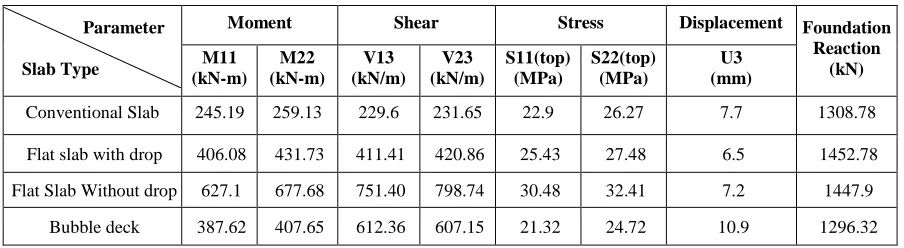
A comparison of the moment, shear force, stresses, displacement and foundation reactions is done for slab of dimensions 8x8.5m. Table III shows various response parameters for the considered slab systems. The figures 2 to 9 graphically represent the responses for a bubble deck slab system.
FIGURE 2:DISPLACEMENT:10.9MM
Figure 3: Moment (M11): 387.621 kN-m TABLEIII:
COMPARISON OF INTERNAL FORCES FOR THE SLAB PANEL 8M X 8.5M
Parameter
Slab Type
Moment Shear Stress Displacement Foundation Reaction
(kN) M11
(kN-m)
M22 (kN-m)
V13 (kN/m)
V23 (kN/m)
S11(top) (MPa)
S22(top) (MPa)
U3 (mm)
Conventional Slab 245.19 259.13 229.6 231.65 22.9 26.27 7.7 1308.78
Flat slab with drop 406.08 431.73 411.41 420.86 25.43 27.48 6.5 1452.78
Flat Slab Without drop 627.1 677.68 751.40 798.74 30.48 32.41 7.2 1447.9
[image:3.612.49.289.126.279.2] [image:3.612.81.533.482.606.2]International Journal of Emerging Technology and Advanced Engineering
Website: www.ijetae.com (ISSN 2250-2459, ISO 9001:2008 Certified Journal, Volume 7, Issue 11, November 2017)
140
FIGURE 4:MOMENT (M22): 407.65 KN-M
FIGURE 5:SHEAR FORCE (V13):612.367 KN/M
FIGURE 6:SHELL STRESS (S22TOP):24.72MPA
FIGURE 7:SHEAR FORCE (V23):607.154 KN/M
FIGURE 8:SHELL STRESS (S11TOP): 21.32MPA
International Journal of Emerging Technology and Advanced Engineering
Website: www.ijetae.com (ISSN 2250-2459, ISO 9001:2008 Certified Journal, Volume 7, Issue 11, November 2017)
141
It can be seen that the moments in the conventional slab are about 36% less, in flat slab with drop the moments are 4 to 5% more, in flat slab without drop the moments are 61 to 66 % more when compared to bubble deck slab. The shear forces in the conventional slab are about 60 % less, in flat slab with drop about 31% less and in flat slab without drop about 22 to 31% more when compared to bubble deck slab. The stresses are more all the conventional slab systems compared to bubble deck slab by a minimum of 7%. The stress patterns in bubble deck slab are much symmetric and indicating a symmetric flow which may be attributed to the arch action of individual ball element inside the slab. The displacement is comparatively high in bubble deck slab. The foundation reactions in the conventional slab is 1% more, flat slab with drop is 12% more and in flat slab without drop is 11.5% more when compared to the bubble deck slab because of the sole reason that the dead weight of the structure is reduced considerably.
From the results of the analysis in comparison with various slabs all the properties except deflection are proved to be much well within the limits. Table IV shows the comparison of internal forces between bubble deck systems with other conventional systems.
1) Shear Force
FIGURE 10:COMPARISON OF SHEAR FORCE
The shear force for the slab panels of different sizes can be seen in figure 10. In order to avoid punching shear, the bubble deck slab is usually laid with no balls near the columns. As the span of the slab increases the shear force increases. The magnitude of shear force in conventional slab and flat slab with drop is less because of the presence of the beams and drop panels.
When compared to flat slab with drop the shear force in bubble deck slab is high for shorter spans and decreases as the span increases.
TABLEIV:
COMPARISON OF INTERNAL FORCES FOR DIFFERENT SLAB PANELS
Types of Systems
Depth (mm)
Span (m)
Deflection (mm)
Moment (kN-m)
Shear Force (kN/m)
Reaction (kN)
Conventional
230 6X6 2.6 90 119 690.38
250 7X7 4.55 150 154 960.48
280 8X8 7.7 230 266 1239.43
320 9X9 8.8 440.03 566.32 1824.48
360 10X10 12.5 529.63 633 2238.6
Flat slab with Out Drop
200 6X6 3.5 193.45 196 604.5
240 7X7 6.3 292.16 270 926.65
280 8X8 9.1 380.62 490 1302.39
310 9X9 9.2 709.32 647.452 1757.38
350 10X10 14.2 819.72 748.71 2411.2
Flat slab with Drop
180 6X6 3.08 178.309 140 689.91
220 7X7 4.1 226.36 119.56 863.63
250 8X8 6.6 364.32 268.68 1420.7
280 9X9 9.2 572.39 588.27 1850.92
320 10X10 10.7 683.95 681.32 2583.81
Bubble Deck Slab
230 6X6 3.2 182.62 195.23 520.23
230 7X7 5.66 206.32 213.32 946.32
280 8X8 9.1 291.78 493.34 1108.75
340 9X9 12.1 509.34 623.42 1606.32
340 10X10 16.9 732.86 762.82 2021.65
2) Moment
International Journal of Emerging Technology and Advanced Engineering
Website: www.ijetae.com (ISSN 2250-2459, ISO 9001:2008 Certified Journal, Volume 7, Issue 11, November 2017)
142
FIGURE 11:COMPARISON OF MOMENT
3) Reactions
The moments for the slab panels of different sizes can be seen in figure 12. Reactions in Bubble deck slab have been reduced drastically the reason for this is reduced weight. It is observed that as the span of the slab panel increases the difference between the magnitudes compared to other slab systems also increases.
FIGURE 12:COMPARISON OF REACTIONS BETWEEN BUBBLE DECK
SLAB AND SOLID SLAB
4) Deflections
The bubble deck slab system has comparatively higher deflection values as seen in Figure 13, this might be due to the fact that the stiffness of bubble deck which is reduced due to the removal of concrete. But from the results it is well within the limits defined as per Indian code for standard deflection for 2-way slab.
FIGURE 13:COMPARISON OF DEFLECTION
C. Comparison of Concrete and Steel in Bubble Deck Slab with Respect to Various Contemporary Slabs
In order to get an idea on the amount of concrete and steel consumed in these different types of slab systems, quantities of steel and concrete estimated a slab panel of span 8 x 8.5 m. The conventional 2-way slab and flat slab is considered are designed as per IS 456 code and by calculating all the necessary checks. The bubble deck slab is designed based on the bubble deck patented work. The design guidelines are as per Bubble deck patent where reinforcement is placed both on top and bottom in the form of mesh and bubbles incorporated between them in between lattice girders. The quantities of materials is shown in Table V.
TABLE V:
SHOWING PERCENTAGE REDUCTION OF CONCRETE IN BUBBLE DECK
SLAB WITH RESPECT TO OTHER SLABS.
Types of slabs→
Cast in situ two way slab
Flat slab without drop and no column head
Bubble deck slab Parameters↓
Basic information
Depth=280mm (M30 and Fe415)
Depth=300mm (M30 and Fe415)
Depth=280mm (M30 and Fe415)
Quantity of steel (tones)
0.145 1.1225 0.723
Quantity of concrete(tones)
International Journal of Emerging Technology and Advanced Engineering
Website: www.ijetae.com (ISSN 2250-2459, ISO 9001:2008 Certified Journal, Volume 7, Issue 11, November 2017)
143
FIGURE 14:VARIATION OF STEEL IN BUBBLE DECK SLAB OVER
OTHER SLAB SYSTEMS
FIGURE 15:VARIATION OF CONCRETE IN BUBBLE DECK SLAB OVER
OTHER SLAB SYSTEM
The variation of the quantities of concrete and steel can be seen in Figures 14 and 15. The amount of steel required in a conventional slab is 80% less, in a flat slab is 55% more when compared to bubble deck slab. The amount of concrete required in a conventional slab is 94% more, in a flat slab is 103% more when compared to bubble deck slab. It can be noted that the bubble deck slab has a vast amount of concrete saving.
V. CONCLUSIONS
It is determined from the results obtained that in a bubble deck slab the material of concrete is reduced up to 50% i.e., (1 kg of plastic replaces 101 kgs of concrete) for the above case, which tells that bubble deck slab has a vast amount of concrete saving. The shear and moment in the bubble deck slab is more compared to the conventional slab because of the absence of beams and drop panels.
The reactions are also less in bubble deck slab when compared to other slab systems. The bubble deck slab has comparatively larger deflections but are within the limits defined as per IS codes. The quantity of concrete required in bubble deck slab is 50% less than the conventional and flat slabs. The quantity of steel required is half when compared to the flat slab. Hence, the bubble deck slab is more effective when compared with conventional slab and flat slab. Bubble deck slab reduces the dead weight of the structure and the quantity of concrete.
REFERENCES
[1] Ajay, H. and Dhananjay Patel. (2017). ―Analysis of Light Weight Formers in Concrete Slabs Using Voids.‖ International Journal of Advance Engineering and Research Development., 4(4), 360-369. [2] Bhagyashri, G, Barelikar, S.M. (June 2016). ―An Experimental
Study on Two Way Bubble Deck Slab with Spherical Hollow Balls.‖ International Journal of Recent Scientific Research., 7 (6), 11621-11626.
[3] ―Bubble Deck Slab‖ (2017).〈http://www.bubbledeck-uk.com〉 (Sep. 14, 2017).
[4] Corey midkiff, J. (2013). Plastic Voided Slab Systems: Applications and Design, B.S., Kansas State University, Manhattan.
[5] Gayatri Rajendra Vaishampayan. (2017). ―Eathquake Resistant Structures Using Voided Slab Systems.‖ International Journal of Innovations in engineering Research in Technology., 4(5), 30-38. [6] Immanuel Joseph Chacko., Sneha., Varghese. M. (2016). ―Study on
Structural Behaviour of Bubble Deck Slab using Indian Standards.‖ International Journal of Innovative Research in Technology., 3(4), 193-198.
[7] Jiji Jolly. (2017). ―A Study on Structural Behaviour of Bubble Deck Slab Using Spherical and Elliptical Balls.‖ International Research Journal of Engineering and Technology., 4(5), 2090-2095. [8] Lai, T. (2010). Structural Behaviour of Bubble Deck Slabs and Their
Application to Lightweight Bridge Decks, Massachusetts Institute of Technology, Massachusetts, USA.
[9] Mrinank Pandey., Manjesh Srivastava. (2016). ―Analysis of Bubble Deck Slab System by Finite Element Method.‖ International Journal of Research in Science technology and Engineering., 2(11), 599-606. [10] Mahalakshmi, S. Nanthini, S. (2017). ―Bubble Deck.‖ International
Journal of Research in Applied Science and Engineering technology., 5(3), 580-588.
[11] Neeraj, Tiwari. Sana, Zafar. (2016). ―Structural Behaviour of Bubble Deck Slab and Its Application.‖ International Journal for scientific Research and Development., 4(2), 433-437.
[12] Saifee Bhagat, Parikh, K.B. (2014). ―Parametric Study of R.C.C Voided and Solid Flat Plate Slab using SAP 2000‖ International Organization of Scientific Research – Journal of Mechanical and Civil Engineering., 11(2), 12-16.
[13] Surendar M. Ranjitham M. (2016). ―Numerical and Experimental Study on Bubble Deck Slab.‖ International Journal of Engineering Science and Computing., 6(5), 5959-5962.