Waste to Enzymes through Solid State
Fermentation
Agamuthu, P. and Nithiya, A. University of Malaya
Contact
Contact name : Nithiya, A.
Organization : Solid Waste and Hazardous Laboratory, University Malaya Postal Address : Institute of Biological Sciences,
Faculty of Science, University of Malaya, 50603 Kuala Lumpur, Malaysia
Telephone : 603- 7967 4631 Facsimile : 603- 7967 4631
Email : [email protected]
Executive Summary
Malaysia is facing tremendous challenges in minimizing the 8 million tonnes of municipal and agricultural waste thrown into landfill every year. Waste disposal is a major problem, as the costs associated with waste management are skyrocketing. Annually around 998 million tonnes of agricultural wastes are being produced globally. Only 15% is used as animal feed, particularly as cattle supplement, plant fertilizer or soil conditioner, while the rest are dumped in landfills; which leads to adverse environmental impacts including global warming. In order to minimize the waste, one option is to convert the waste to value-added products. Brewery spent grain (BSG), sugar cane baggase (SCB) and spent mushroom compost (SMC) are the agro-industrial waste disposed abundantly into landfills in Malaysia. These lignin and cellulose rich agro-industrial wastes have a big potential in enzyme production where it can supply and become economical source of raw material. It can act as an inducer in ligninolytic activities. High sugar content in the wastes made it economically feasible for enzyme production via solid state fermentation (SSF).
Introduction
Cultivating fungus using an inert substrate without any free-flowing water is known as solid state fermentation (SSF). SSF utilizes agro-industrial wastes as the substrates in the enzyme production. Substrates (agro-industrial wastes) act as either inert or non-inert material, supporting the fermentation process. Inert substrates only act as an attachment place for the fungal growth, while non-inert substrate also supply nutrients for the fungal growth (Couto and Sanroman 2005).
Solid state fermentation is a suitable process for enzyme production using filamentous fungi since, SSF is well adapted to the metabolism of the fungus and it gives the natural habitat for fungal growth (Singhania et al 2009).
Enzymes are protein biomolecules that serve as catalysts to speed up or slow down the chemical reactions. Laccases (EC 1.10.3.2) are copper-containing oxidase enzymes that are found in many plants, fungi, and microorganisms. Laccase has a variety of application in detoxification of environmental pollutants, wine stabilization, paper processing, and enzymatic conversion of chemical intermediates and production of useful chemicals from lignin (Minussi et al 2007). In Malaysia, enzymes have been used in many industries. Malaysian government is importing enzymes worth almost US$ 3.5 million annually from Netherland, Belgium and other countries to be used in the industries.
Globally approximately 998 million tonnes of agricultural wastes are being produced annually (USDA 2005). Agricultural wastes are either sold as cattle feed, composted, burned or disposed into landfill; which leads to adverse environmental impacts (Couto and Sanroman 2004). Using agro-industrial wastes for SSF is economically feasible and eventually solves the environmental problems caused by their disposal. Agricultural wastes such as brewery spent grain (BSG), sugarcane bagasse (SCB) and spent mushroom compost (SMC) are abundantly found in Malaysia, and these are considered for valorization.
Brewery spent grain is the solid residue left after the separation during the brewing process. It contains of grain husks and other residual compounds not converted to fermentable sugars by the mashing process. In a typical Malaysian brewery producing about 700,000hL of beer annually, 12,125 tonnes of spent grain are generated in one year.
Spent compost mushroom (SMC) material is a waste from the production process of edible mushroom, which is composed mainly of saw dust. The generation rate of SMC in UK alone reaches 200,000 tonnes/annum.
Sugarcane bagasse is the fibrous (lingo-cellulosic) waste that remains after crushing the sugarcane stalk and extraction of its juice. Every 100 tonnes of raw sugarcane generate 4 tonnes of SCB. In Malaysia, approximately 800,000 metric tons of sugarcane was produced, resulting in 32,000 metric tons of bagasse during 2006 (USDA, 2005).
Materials And Method
Fungal Selection
Substrate for SSF
Sugar cane bagasse (SCB), spent mushroom compost (SMC) and brewery spent grains (BSG) were used as the substrate for solid state fermentation process. BSG were collected from Carlsberg Brewery Malaysia, SMC from Ganofarm, Tanjung Sepat, Selangor and SCB from SS2, Petaling Jaya. The chemical properties and moisture content of the substrates were studied. 25gm of fresh samples were sterilized at 1210C for 20 minutes in 250mL flasks and left to cool.
Composition analysis
The moisture content and the chemical properties of the substrates were measured.
Solid state fermentation
Schizophyllum commune and Aspergillus niger were grown on Potato Dextrose Agar (PDA) at 300C for seven days. Four pieces of seven days old mycelial disk, measuring 1cm x 1cm, were inoculated into 250ml conical flask containing sterile substrate. Negative blanks were prepared without any inocula. All flaks were incubated at 300C for seven days.
Extraction
200ml of distilled water were added to each flask and mixed using an incubator shaker at 180rpm for 45 minutes (Series 25 Incubator Shaker).
Enzyme Activity assay
The extracts were tested for laccase activity according to Saito et al (2003) method. A volume of 0.1 ml of the crude extract was mixed with 2.9 ml of Syringaldazine (20µM in 0.1M phosphate buffer). The absorbance was read at 525nm. One unit of laccase activity was defined as one unit of enzyme producing absorbance chance / minute/ g of substrate.
Result And Discussion
[image:3.595.107.345.603.703.2]Moisture Content
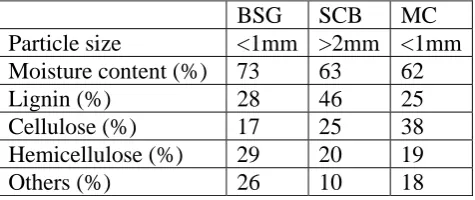
Table 1 shows the moisture content and chemical properties of the three substrates used. BSG has higher moisture level (73%) compared to SCB (62%) and SMC (63%). High moisture could be attributed to the BSG being sampled immediately after sugar extraction (mashing process), where the grains were soaked for six or seven hours before wort separating process. SCB were collected after the juice extraction. The moisture content of SCB was low since, 80% of the juice was extracted during the process. Mushroom compost showed lowest moisture content as each batch had been re-used for mushroom growth at least five or six times before it is finally discarded into landfills.
Table 1: Moisture content and chemical properties of organic wastes used in this research
BSG SCB MC
Particle size <1mm >2mm <1mm Moisture content (%) 73 63 62
Lignin (%) 28 46 25
Cellulose (%) 17 25 38
Hemicellulose (%) 29 20 19
Laccase production
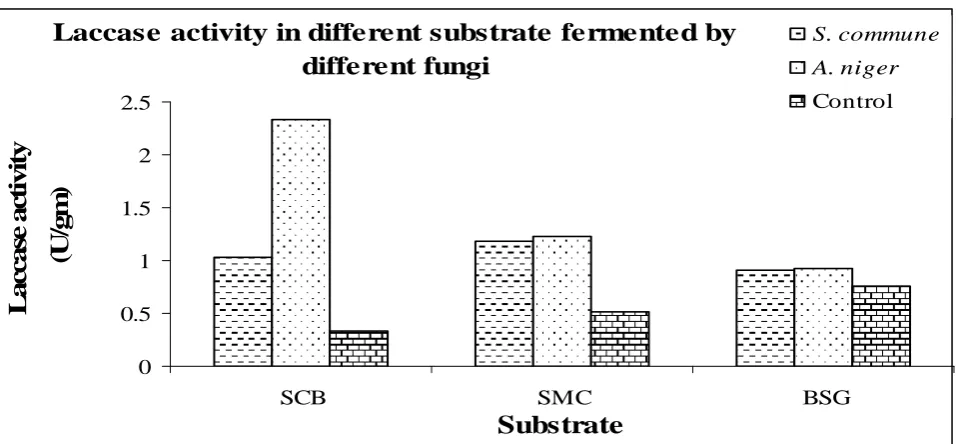
Figure 1: Laccase activity of enzyme extracts from different substrate fermented by S. commune and A. niger
Figure 1 shows the laccase activity of SSF extracts from different fermented substrates. SCB fermented by A. niger shows higher laccase activity at 608 % higher than the control. BSG gives the lowest laccase activity, 0.9 U/g, compared to MC and SCB. A. niger grew more efficiently in SCB then the other substrates, as is reflected by the higher enzyme activity of 2.33 U/g. Overall S. commune shows about the same activity in both BSG and SMC.
Smaller substrate particle would provide large surface area for microbial metabolism, which is a desirable factor in enzyme production. However, too small substrate particle will lead to substrate agglomeration, which may interfere with microbial respiration/aeration, and result in poor cellular growth (Pandey et al., 2000). During the beer brewing process, the grain kernels were mashed to extract the sugar and the mashed grains become very small particles and SMC contains grinded saw dust which is less than 1mm. The nature of BSG and SMC contributes to the lower laccase activity. The used compost losses half of its weight, decreases nitrogen level to below 1.5%, and has high level of porosity (Polat et al., 2009). This gives the low laccase production in SMC. Chemical properties of the substrates also play a major role in enzyme activity. Couto and Sanroman (2005) reported that, high cellulose content in the substrates will give higher laccase production. While Osma et al (2007) reported that particle size, porosity and chemical composition of the substrates play crucial role in higher enzyme production.
Conclusion
The study exhibited a possibility of developing an alternative option for agro-industrial waste utilization. Also, the study indicated the suitability of these materials as substrates for extra-cellular enzyme production via fungal SSF. Among the substrates SCB fermented by A. niger shows higher laccase activity. SSF is an effective method in reducing agricultural or organic waste and avoid agro-wastes from being dumped into landfills, which will otherwise cause environmental problems, such as global warming.
Laccase activity in different substrate fermented by
different fungi
0 0.5 1 1.5 2 2.5
SCB SMC BSG
Substrate
L
a
cca
se act
ivi
ty
(U
/g
m
)
S. commune
A. niger
Acknowledgement
The authors would like to gratefully thank Siaw Yon Miaw (Carlsberg Marketing, Malaysia Pvt. Ltd.) for graciously providing the spent grain utilized in this study.
This research was funded by the University of Malaya Graduate Research Fund PS183/2008B and Ministry of Science, Technology and Innovation Malaysia (MOSTI) 02-01-03-SF0363.
References
Couto, S. R., and Sanroman, M. A. (2005): Application of solid-state fermentation to ligninolytic enzyme production. Biochemical Engineering Journal 22 (3):211-219
Minussi, R. C., Pastore, G. M., and Dura´n, N. (2007): Laccase induction in fungi and laccase/N–OH mediator systems applied in paper mill effluent. Bioresource Technology 98:158–164
Osma, J. F., Jose´ L., Herrera, T., and Couto, S.R. (2007): Banana skin: A novel waste for laccase production by Trametes pubescens under solid-state conditions. Application to synthetic dye decolouration. Dyes and Pigments 75: 32-37
Pandey, A., Soccol, C. R., and Mitchell, D. (2000): New developments in solid state fermentation: I-bioprocesses and products. Process Biochemistry 35:1153–1169
Polat. E., Uzun. H. I., Topcuo_lu. B., Onal. K., Onus. A. N., and Karaca. M. (2009): Effects of spent mushroom compost on quality and productivity of cucumber (Cucumis sativus L.) grown in greenhouses. African Journal of Biotechnology Vol. 8 (2), pp. 176-180.
Saito, T., Hong, P., Kato, K., Okazaki, M., Inagaki, H., Maeda, S. and Yokogawa, Y. (2003): Purification and characterization of an extracellular laccase of a fungus (family Chaetomiaceae) isolated from soil. Enzyme and Microbial Technology 33:520–526